
加载中...
共找到 13,735 条相关资讯

Small cap stocks—those from companies with market values between about $300 million and $2 billion—are famous for their ability to deliver big gains, but they often come with a wild ride. When times are uncertain, these stocks tend to lag behind the giants.


Investors can benefit from artificial intelligence without taking the risk of buying the highflying technology names.

Phil Orlando, Chief Equity strategist at Federated Hermes, talks about the market's asymmetric risks. Stocks retreated as the US government veering toward a shutdown stoked anxieties about the possibly delayed release of key economic data the Federal Reserve needs to keep cutting interest rates.

SoFi's Kelly Keough breaks down the latest trends in ETFs, thematic investing, and AI-driven growth. Transcript: Caroline Woods: Great joining me now Kelli Keough, EVP, group business unit leader for spend, invest, protect and save at SoFi.

Investors are ramping up their bets on market turbulence, with positions tied to the CBOE Volatility Index (VIX) hitting levels not seen in years.

I see strong AI investments and data center buildouts across Big Tech, paired with OpenAI's strong H1'25 revenue and ARR growth. According to some media outlets, OpenAI posted $4.3B H1'25 revenue (16% vs.
Bitcoiners rarely pine for gold's old-school charm. Why would they?

OpenAI's massive $300 billion, 5-year Oracle (ORCL) deal raises questions about its ability to fund $60 billion in annual expenses while remaining unprofitable. Despite rapid revenue growth, OpenAI's escalating losses and reliance on equity financing highlight risks if market enthusiasm fades before profitability is reached.
Stock market forecast: S&P500 and Nasdaq retreat as shutdown clouds data flow. US stocks volatile with Fed outlook uncertain and sector moves divided.

The Securities and Exchange Commission approved the upstart's application Tuesday.

U.S. stocks traded lower midway through trading, with the Dow Jones falling more than 100 points on Tuesday.
CNBC's “Money Movers” team is joined by Binky Chadha, U.S. equity and global strategy chief at Deutsche Bank, to discuss his market outlook for the rest of 2025.

Despite September historically being the worst month of the year for investors, both the NASDAQ and S&P 500 have advanced more than 5% so far this month. The rally has continued despite a clearly faltering jobs markets, remaining worries about inflation, and uncertainty around the timing of future interest rate cuts.

For dealmakers across the world, the third quarter was one of the best and one of the worst in recent history.

Stock market valuations are at historic highs, with the CAPE ratio and Buffett Indicator signaling extreme overvaluation and heightened risk. Prominent investors like Warren Buffett, Roger McNamee, and Jamie Dimon are warning of potential market corrections and economic downturns.

The main U.S. stock indexes were on track to pare quarterly gains on Tuesday as a looming government shutdown risked delaying economic data, heightening investor anxiety around the Federal Reserve's next move.

US equities have found their groove again, and as so often before, this is coinciding with a clear and strengthening leadership of technology firms and their brethren. A rally to new highs has inevitably reignited discussions about a bubble - particularly regarding stocks driven by the ever-growing appetite for the promises of the AI revolution.
Reiterate buy recommendation on assets tracking main US indices, supported by robust GDP growth expectations and no recession forecast. Interest rate cuts historically boost S&P 500 returns in non-recession periods, and the consumer discretionary sector often outperforms post-cut.

SPDR S&P 500 ETF (SPY) remains a compelling long-term investment, even after recent strong performance and elevated valuations. SPY's valuation is above historical averages, but robust earnings growth and inflation-driven profit margins support continued upside potential.
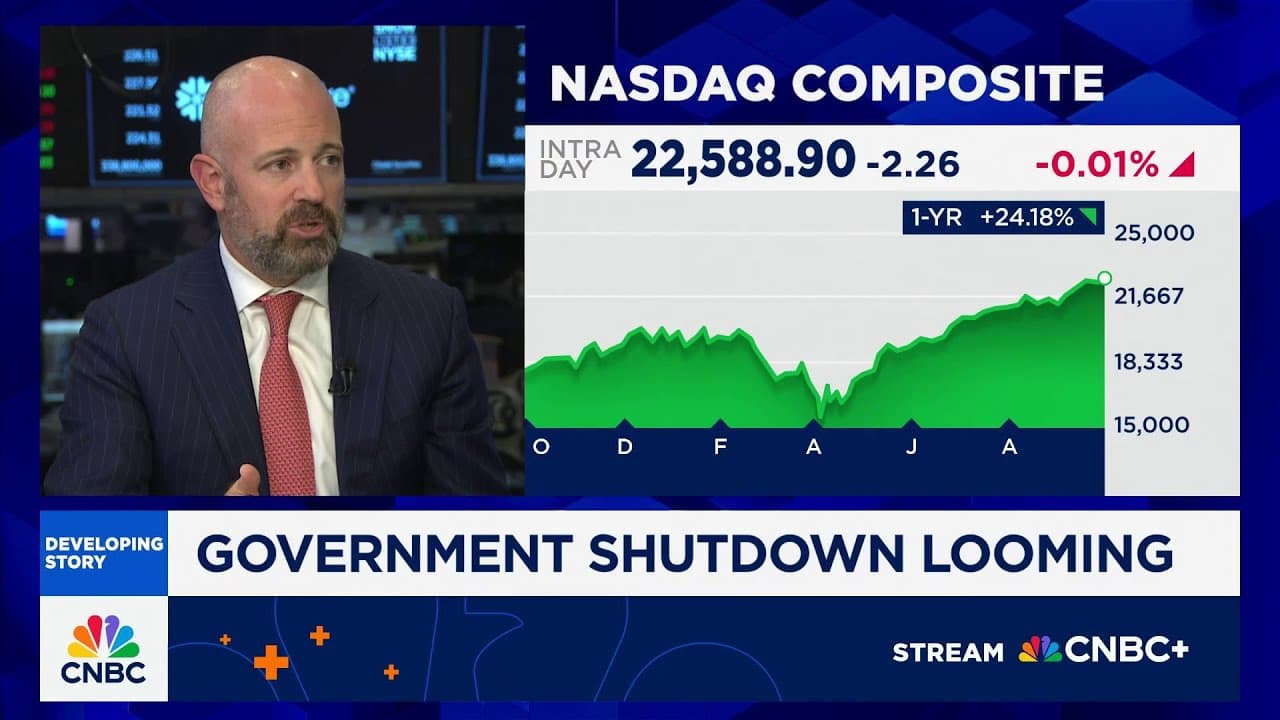
CNBC's “Money Movers” team discusses the potential impact of a U.S. government shutdown and what it may mean for markets and the economy with Michael Zezas, global head of fixed-income research and public policy research at Morgan Stanley.