
加载中...
共找到 13,886 条相关资讯
Micaela Capelli: Good morning, everyone, and thank you for accommodating the change in date and welcome to our first half report comment call. Here with us today, there is our CEO and Founder, Mr. Nazzareno Gorni; and our CFO and Founder, Mr. Matteo Monfredini. [Operator Instructions] I would leave the stage right now to Matteo in order to comment first half results, and then we can start with the discussion. Matteo Monfredini: Thanks. Good morning, everyone, and thanks for being here. So let's talk about numbers of the first half of 2025 starting from revenues. The total revenues for the first half of 2025 were around EUR 36.2 million, showing a 2% increase compares to the EUR 36.9 million in the same period of 2024. This decline was mainly due to changes in Agile Telecom revenues and the absence of certain extraordinary items that benefited the first half of 2024. The SaaS component grew by 20% represented growth 19% of 2024 of the total revenues, while the CPaaS line fell by 3.6% accounting for 80% of total revenues. The decrease in other revenues mainly reflect the nonrecurring extraordinary items recorded in the first half of 2024 related to grant funding and not obtained or not already approved as well as noncore billings related to the disposal of the ESP and Datatrics businesses. The Agile Telecom business unit posted the biggest revenues of approximately EUR 29 million decreasing by 3.8% over the same period of previous year. This is consistent with the strategy of prioritizing higher margin contract even at the expense of top line growth. The fastest business unit -- the fastest growing business unit is the -- with a 22% increase in revenues at EUR 7 million or USD 8.1 million revenues, driven by increasing volumes. The impact of unfavorable exchange rates in the first 6 months of the year has led to a slower growth in euros versus dollars of almost 6 percentage points. In fact, this growth in U.S. dollars was approximately 28%. Annual recurring revenue amounts to USD 16.9 million as of June 2025. Foreign revenues amounted to over EUR 25.9 million, representing 73% of total revenues decreasing by 11.2% versus the first half of 2024. This decrease is related to the reduction of Agile Telecom foreign traffic principal. Recurring revenues amount to EUR 6.9 million, growing approximately 20%. In the first half of 2025, gross profit reached EUR 9.5 million with a revenue incidence of about 26% up 18% compared to 2024. The cost of goods sold component decreased more than proportionally with the revenues, minus 7.6% decrease over 4 percentage points in terms of revenue incidents. This is related to the lower traffic cost for Agile Telecom. The operating cost items show the greatest increase, reflecting the investment made to develop the business unit, specifically the sales and marketing component that grew by 30% and the research and development that grew by 10%. So consolidated EBITDA is negative by approximately EUR 0.2 million in the first half of 2025 while decrease individual EBITDA is negative by approximately EUR 1.4 million, an improvement compared with the previous half year that was negative for EUR 1.7 million. Turning before taxes, negative by approximately EUR 2.2 million with EUR 2.1 million in depreciation and reflects a lower contribution of net financial income following the use of liquidity to pay dividends of EUR 20 million in the previous year and the resulting loss of related interest income as well as the loss related to the unfavorable exchange rate. IFRS 16 related amortization amounts to EUR 0.3 million and are substantially stable while research and development amortization grew by 14% to EUR 1.7 million in the first half of 2025. Net earnings in the first half of 2025 after current and deferred taxation estimates amounted to approximately minus EUR 2.4 million. The allocated figures are figurative, provided the consolidated taxation results from the aggregate amounts of individual taxation applied on each legal entity. The consolidated net financial position, I show -- as of 30 June 2025, exceed EUR 8 million cash, decreasing versus the previously recorded net cash amount of EUR 13 million as of December 2024 with the variation largely influenced by certain net working capital dynamics for Agile Telecom as well as the cash component of the scrip dividend that approximately was EUR 0.9 million paid in June 2025. Figurative debt from IFRS 16 adoption amounts to approximately EUR 1.2 million pressure equivalents exceed EUR 15 million. And that's all from my side. Micaela Capelli: Thank you very much, Matteo. And I would now leave it to Nazzareno to deep dive into the strategy and to comment what is next. Thanks so much. Nazzareno Gorni: Thank you. So I'm going to add some color to the numbers shared by Matteo. So starting from the Beefree business unit. As Matteo said, we are in line with the guidance that we released in February. So with the Beefree business unit and for the following periods in order to reach the targets, the plan calls for an acceleration in revenues and margins. So -- and in order to achieve this acceleration, the drivers are in terms of business activities that we put in place are related to an increasing investment in marketing sales and R&D related to the Beefree SDK, the Beefree SDK product. And on the Beefree SDK product also, we have a startup program in place that should slowly because the startup program foresee a discount -- 1-year discount for the start-ups that apply, but then the program start asking for payments. So that's a slow start, but should provide results in the midterm. Then we are going to -- we also released a few add-ons to the Beefree SDK product, which are the HTML importer and the Hosted Row, these add-ons should allow us to expand the revenue per client. And finally, we also released and we are still improving the Smart Checks to our tool to do Q&A, so quality and assurance to the assets that are designed with Beefree. And this is both side on Beefree SDK product and Beefree App product. We also have some challenges, of course, as always, AI is the main one. AI is changing the way clients and prospects search for our tools. So it's less and less through the usual Google search engine. So organic traffic is decreasing and people are starting using AI chatbots to find solutions. And so this is the discovery phase that is changing, and we are working to face this change. AI also changes the way people are developing software. So through AI-assisted coding or white coding, today, this is also an important change. And to face this change, we are also working to be more available and open to those new tools, coding tools in order to be a possible solution that wide coding apps such as [ Lovable ] or Cursor or Windsurf in order for them to find Beefree SDK and adopt Beefree SDK. So this is through our MCP protocol that we are developing, and we will soon release in beta version. And finally, I also changed in the way that the people design digital assets and also in this area, we are working, we are working to develop AI agent that will assist our clients in the designing part of the Beefree solution. Today, we already have some AI capabilities, such as translates text, generate an image or help me rephrase a text. But the agent will be something different, will be sort of chatbot that is aware of the context and you could ask this chatbot what to do. So please change this background, add one more paragraph. So more powerful AI agent will be available on the side of our design solution suite. So those are some important AI development. We are going to invest more and more on the AI side. Of course, as in many fields, is proven to be very successful, but the business case and the possible economic outcomes are still uncertain. And so this -- we live in this period where we need to invest, but we are not really sure of the results of this investment, but we need to follow this path in my view. On Agile Telecom, the other business unit, as Matteo shared, the margins are improving. So that's very, very good. And that was the strategy that we also shared last year. As always, Agile Telecom is a very volatile business. So there are many possible changes, both on the client side because we have a very concentrated client base on the regulatory side because the Italian AGCOM. The Telecom authority is -- are changing some of the rules. And so that could imply a possible changes to our business also as well. And finally, the OTP, onetime password business is also changing because there are many, many alternatives now like app notification, passkeys that are cheaper for the senders. And so that is also something that we are facing. So as we switch in a way that onetime password are delivered. And this is affecting the overall traffic. And as you can see, also the overall volumes that are decreasing, in fact. So this is a trend that we expect is going to continue. But we, of course, will work on Agile Telecom in order to increase or at least stabilize margins. And we are also using AI to do that. And we are also working -- still leveraging AI to develop new ways to increase direct clients and margins. Micaela Capelli: Thank you very much, Nazzareno. And I would now switch to a few questions that were submitted via e-mail by one of our investors and there are a couple of very detailed questions. First one is about Beefree stock option plan and about rents and expiry date. So let's just remind you that by law, the stock option plans cannot be undetermined. So cannot not have an expiry date. Can you please comment on that? Nazzareno Gorni: The expiry date we set is the end of the 2030 fiscal year. So it's quite a long time. Micaela Capelli: Thank you. Yes. So long-term goal. Matteo Monfredini: [ 6 years ] for the plan. Micaela Capelli: Thank you so much. So it's got an expiry at the end of fiscal year 2030 for 6 years. It was launched last year. And then we have a question about Beefree SDK, our embeddable software set about margins of this business line. Can you please comment, Nazzareno? Nazzareno Gorni: Yes. The margins of the SDK product are very similar to the margin of the Beefree App for designers products. So there is not much difference between the 2. So the gross margin you see and EBITDA margin are almost the same. Well, it depends on EBITDA and the gross margin. Micaela Capelli: Thank you so much. And we've been asked to comment the possibility that Kamba could embed a white label version of Beefree SDK. And Nazzareno, can you please comment on that? Nazzareno Gorni: Yes. Kamba is missing the e-mail content type. So technically, SDK could be embedded in Kamba. So if they want to enter this space, of course, that could be an option. They also have 2 other options. They could acquire a solution like SDK or others, and they could also develop them itself. We saw a few players that decided to invest themselves and develop themselves this kind of tool. So there are several options. And at the moment, we don't have any contact with Kamba. Micaela Capelli: Thank you very much. And around the cash that was set up as an escrow against system as it is very usual and regular in deals like the one we closed in 2023. What is the path to release them? And I don't know, Matteo, would you like to comment on that? Or shall I take the question? Matteo Monfredini: The escrow amount will be released over the time we see the effect in the next few years substantially. The maximum duration is 6 years and is related to the fiscal guarantee substantially. Micaela Capelli: Thank you so much. So we can just anticipate that the release of the escrow amounts will be visible in the coming financial statements and net financial position statements. And the most -- the farthest expiry date is 2029 as per tax-related guarantees. I would say that the majority of the funds will be available in the coming quarters and fiscal years. So we'll see the effects from that in the short -- in the near future. On my side, there is no further question unless the participants to this call want to type any further questions, as usual, we'll try and make available the conference call for replay on our website. Let me just remind you our next steps. We are going to participate into the NextGen conference in Milan, October 20, and we'll be releasing a quarterly report on November 11. So stay tuned for more news and always find us available by connecting to our investor relations at growens.io Investor Relations e-mail. Thank you, everyone, for following. Thank you, Nazzareno. Thank you, Matteo. Nazzareno Gorni: Thank you. Have a nice day. Matteo Monfredini: Thank you. Micaela Capelli: Thank you, everyone. Goodbye.

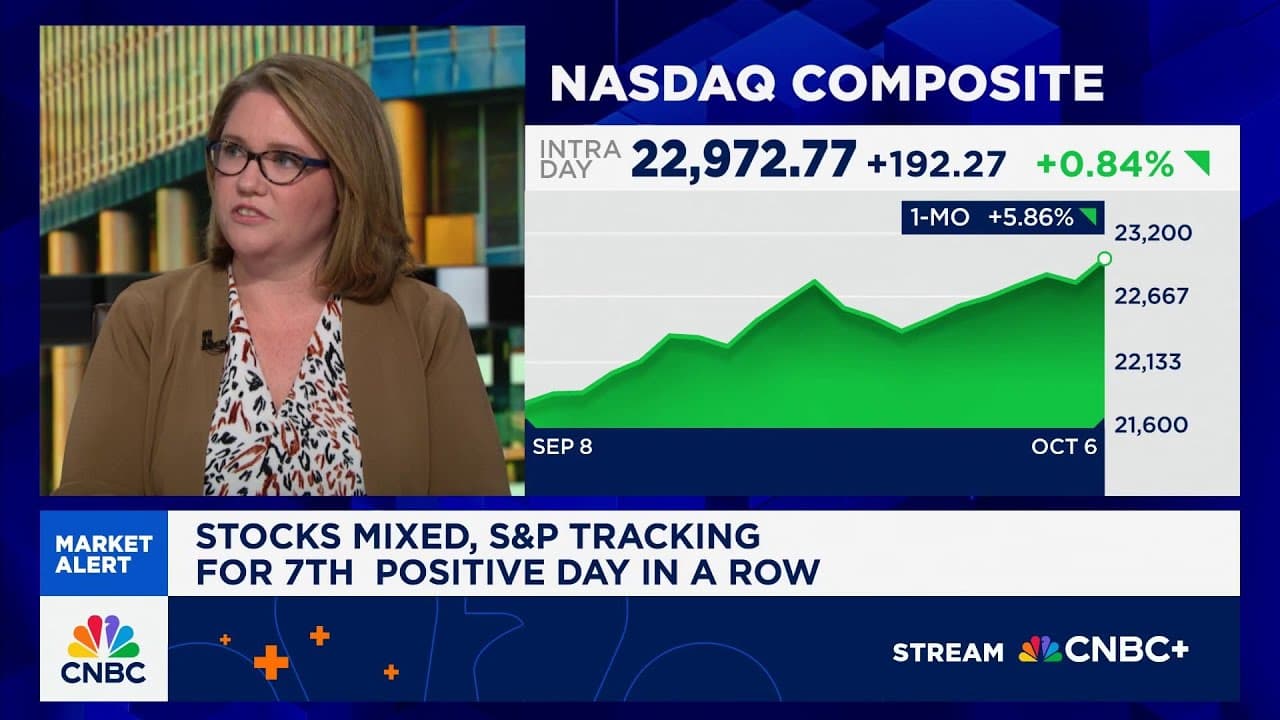
Lori Calvasina, RBC Capital Markets head of U.S. equity strategy, joins 'Power Lunch' to discuss Calvasina's thoughts on current valuations, the stocks hitting new highs and much more.

The S&P 500 now traded at the highest valuation since the dot-com bubble.

Given the record levels of uncertainty and the administration's tactical preferences for leading initiatives with shock and volatility, the uncertainty level is unlikely to decline to “normal” levels. Fortunately, markets have adapted.

September 2025 delivered another strong month across most asset classes, with world stocks gaining +3.62% and U.S. stocks posting a solid +3.56% return. Managed Futures posted their best month of 2025 with a +3.41% gain in September, building on August's positive momentum.

Evergy, Danaher, Quanta, and Kinetik are all set to deliver big, Citi analysts calculate.

US companies have repurchased $1 trillion of stock as of August 20, on track to hit a record of $1.1 trillion by the end of 2025. The top 20 S&P 500 companies continue to dominate buyback activity, making up 51.3% of total dollar-level buyback authorizations in Q2 2025.

President Donald Trump said on Monday that his administration will impose a 25% tariff on both medium- and heavy-duty trucks next month.
I reiterate my buy recommendation on assets tracking the main American indices, as market conditions remain favorable despite recent volatility. The S&P 500, Russell 2000, and other major indices show resilience, with optimism fueled by anticipated interest rate cuts and strong GDP growth projections.

All medium and heavy duty trucks imported into the United States will face a 25% tariff rate staring November 1, President Donald Trump said in a post on his social media platform on Monday.
Evercore Chairman Emeritus Ralph Schlosstein says the the risk of recession caused by this US government shutdown is "quite minor." But he thinks the shutdown might be longer than the last one.

By Michael Paciotti, CFA “Over time, it's been more profitable to invest in small companies than in large companies. The successful small companies of today will become the Wal- Marts, Home Depots, and Microsoft's of tomorrow.

Third-quarter profit growth should be solid. Tech and AI will lead the way, but earnings momentum could broaden too.
In the world of investing, two schools of thought have long competed for supremacy: technical analysts who follow price trends and fundamental analysts who scrutinize company financials.

While betting markets suggest this impasse could last a few weeks, we believe the economic impact should be limited. Several European markets made new highs, which may be partly driven by increased confidence in Germany's fiscal plans.
Jeff DeGraff, chairman of Renaissance Macro Research, joins CNBC's 'Money Movers' to discuss market outlooks, the long-term implications of AI investment, and much more.

There's no clear sign yet of a deal to the end the six-day-old U.S. government shutdown, leading to growing expectations that the closure could end up lasting around two or three weeks.
We suggest ignoring the bull and bear narratives alike, instead remaining calm during all market moves. We highlight our $770 target for SPY.

Wall Street is hanging near its records on Monday, as technology stocks keep rising.The S&P 500 rose 0.3%, coming off its latest all-time high. The Dow Jones Industrial Average added 17 points, or less than 0.1%, as of 9:35 a.m.

U.S. government bond yields followed their counterparts in Europe higher on Monday in reaction to the shocking resignation of French Prime Minister Sébastien Lecornu, who held the job for less than a month.