
加载中...
共找到 13,886 条相关资讯

Australian consumer confidence fell last week as the Reserve Bank of Australia left interest rates on hold and signaled that the inflation outlook might limit further cuts.

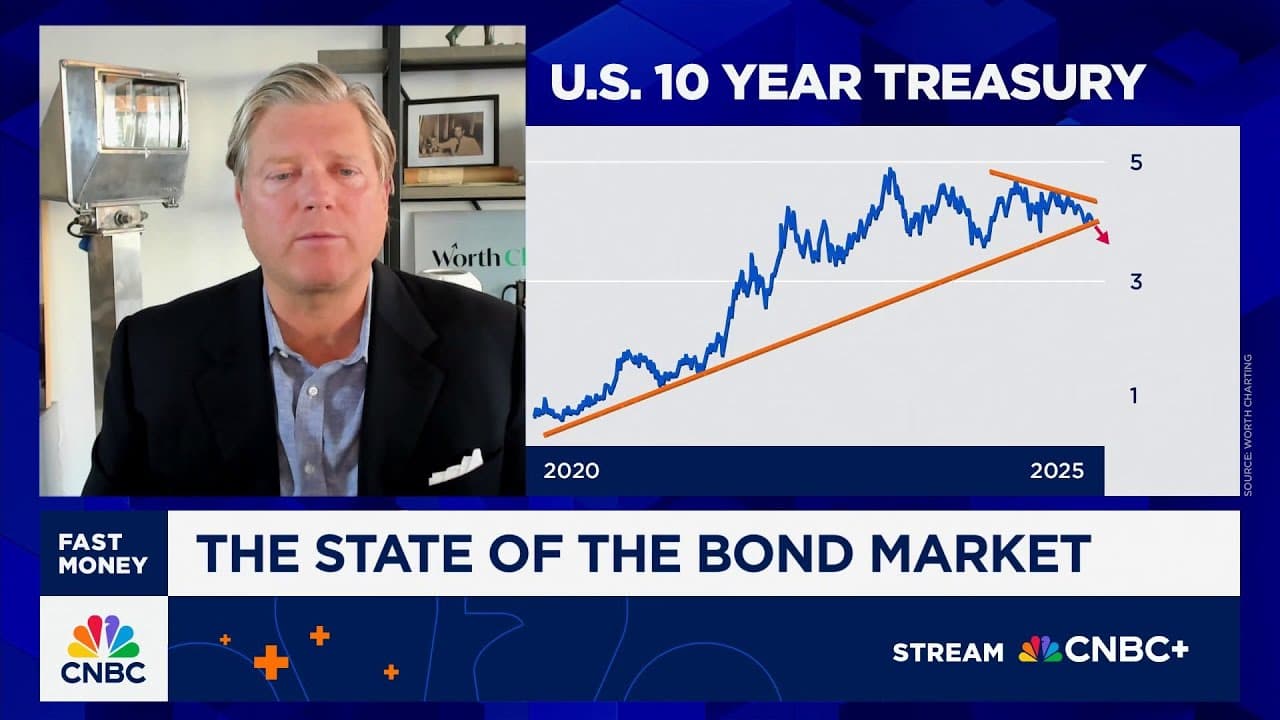
Carter Worth, Worth Charting, shares his technical take on the bond market.
The S&P 500 is increasingly driven by mega-cap tech stocks with heavy exposure to OpenAI-related deals, posing systemic risk. OpenAI's ambitious multi-billion dollar capex deals with AMD, Oracle, and others are based on aggressive, possibly unrealistic, revenue forecasts.

Ohsung Kwon, Wells Fargo Securities, joins 'Fast Money' to talk what is ahead for markets as tech leads markets higher.
While the government is shut down, the BLS is no longer reporting unemployment data. However, alternatives exist that we can watch in the meantime.

Moody's Analytics chief economist Mark Zandi warned that U.S. job creation is slowing as the government shutdown prevented the release of the BLS' September jobs report.

Citadel Founder and CEO Ken Griffin says the US economy is on a big of a "sugar high" right now and he says markets have moved away from the tariffs issue. He speaks to Bloomberg's Francine Lacqua at the Citadel Future of Global Markets Conference in New York.

The S&P 500 and Nasdaq hit records again, as did gold and silver. Plus, earnings season is almost here.

Drew Pettit, Citi research director of US equity strategy, and Keith Lerner, Truist Wealth Co-CIO, joins 'Closing Bell Overtime' to talk the day's market action and how to position in a ballooning AI trade.

Larry McDonald (@thebeartrapsreport6600) doesn't mince words: “What we're seeing in the last 3 weeks across private credit, business development companies, subprime student loans is the closest thing that I have seen to 2007-2008. I think there is a major, major move happening in the financials.

The fourth quarter has kicked off, with plenty of potential catalysts to push the markets in either direction. Amplify ETFs CEO Christian Magoon and Blackrock's U.S. head of equity ETFs Jay Jacobs sit down with CNBC's Seema Mody to discuss how investors are managing the government shutdown, uncertainty surrounding the Federal Reserve, geopolitical factors and other volatility.

Investors could be in for pleasant surprises this earnings season.
American companies continue to buy back their shares at a record pace in 2025. This has not only padded balance sheets but it's helped drive the stock market rally that's persisted since the April 8 trough.

Some strategists worry any seasonal weakness that usually happens in the third quarter may have been simply delayed into the fourth.

Ed Yardeni, Yardeni Research, joins 'Closing Bell' to discuss if the AI trade is overvalued, what investors should focus on with stocks and much more.
Operator: Greetings. Welcome to the Aehr Test Systems fiscal 2026 First Quarter Financial Results Conference Call. A question and answer session will follow the formal presentation. Anyone should require operator assistance during the conference. Please note, this conference is being recorded. I will now turn the conference over to your host, Jim Byers of Pondell Wilkinson Investor Relations. May begin. Jim Byers: Thank you, operator. Good afternoon. Welcome to Aehr Test Systems' first quarter fiscal 2026 financial results conference call. But with me on today's call are Aehr Test Systems' President and Chief Executive Officer, Gayn Erickson and Chief Financial Officer, Chris Siu. Before I turn the call over to Gayn and Chris, I'd like to cover a few quick items. This afternoon, right after market close, Aehr Test Systems issued a press release announcing its first quarter fiscal 2026 results. That release is available on the company's website at aehr.com. This call is being broadcast live over the Internet for all interested parties, and the webcast will be archived on the Investor Relations page of Aehr Test Systems' website. I'd like to remind everyone that on today's call, management will be making forward-looking statements that are based on current information and estimates and are subject to a number of risks and uncertainties that could cause actual results to differ materially from those in the forward-looking statement. These factors are discussed in the company's most recent periodic and current reports filed with the SEC and are only valid as of this date, and Aehr Test Systems undertakes no obligation to update the forward-looking statements. Now with that said, I'd like to turn the conference call over to Gayn Erickson, President and CEO. Gayn Erickson: Thanks, Jim. Afternoon, everyone, and welcome to our first quarter fiscal 2026 earnings conference call. I'll begin with an update on exciting markets Aehr Test Systems is targeting for semiconductor test and burn-in with an emphasis on how these markets seem to share a common thread of market growth related to the massive expansion of data center infrastructure and AI. After that, Chris will provide a detailed review of our financial performance, and finally, we'll open up the floor for your questions. Although we started with the typical low first quarter revenue, consistent with the last few years, and actually higher on both top and bottom lines in Wall Street analyst consensus, we're pleased with our start to this fiscal year. We had revenue from several market segments and strong momentum in sales and customer engagement in both wafer level and packaged part test and burn-in of artificial intelligence or AI processors. Again, although we did not provide guidance for the quarter, our first quarter results surpassed analyst consensus estimates for both the top and bottom lines. We saw continued momentum in the qualification and production burn-in of packaged parts for AI processors, which is fueling sales growth in our new Sonoma ultra-high power package part burn-in systems and consumables. During the quarter, our lead production customer, a leading hyperscaler, placed multiple follow-on volume production orders for Sonoma Systems, requesting shorter lead times to support higher than expected volumes as they accelerate the development of their own advanced AI processors. This customer is one of the premier large-scale data center providers and has already outlined plans to expand capacity for this device and introduce new AI processors over the coming year to be tested and burned in on our Sonoma platform at one of the world's leading test houses. We're also collaborating with them on future generations to ensure we can meet their long-term production needs for both package and even wafer level burn-in. Hyperscalers like Microsoft, Amazon, Google, and Meta are increasingly designing and deploying their own application-specific integrated circuits or ASICs for AI processing to meet the unique demands of their massive scale workloads and gain a competitive advantage. Aehr Test Systems allows customers to perform production burn-in screening qualification, and reliability testing for GPUs, AI processors, CPUs, and network processors directly in packaged form. Our Sonoma systems provide what we believe to be the industry's most cost-effective solution enabling customers to smoothly move from early reliability testing to full production burn-in and early life failure screening, which helps reduce costs, improve quality, and speed up time to market. In the last year, Aehr Test Systems has implemented several enhancements to the Sonoma system to meet qualification in broad production test and burn-in requirements across a wide range of AI processor suppliers, test labs, and outsourced assembly and test houses or OSATs. Major upgrades include increasing power per device to 2,000 watts, boosting parallelism, and adding full automation with a new fully integrated package device handler. Over the last quarter, including a very successful customer open house we held last week at our Fremont, California headquarters, 10 different companies visited Aehr Test Systems to see our next-generation Sonoma system and new features, including the fully automated device handler for completely hands-free operation, which we've installed here at our Fremont facility. Customer feedback regarding these enhancements has been very positive, and we expect these new features to open up new applications and generate additional orders this fiscal year. As I've mentioned before, one of the biggest benefits of our acquisition of InCal Technology one year ago is that it gives us a front-row seat to the future needs of many top AI processor customers, providing us with close insight into their burn-in requirements. As the only company worldwide that offers both proven wafer level and packaged part burn-in systems for qualification and production burn-in of AI processors, Aehr Test Systems is ideally positioned to assist them regardless of their burn-in method. Consequently, we are experiencing increased interest in our Sonoma high-volume production solution for package level burn-in, and some of these same customers, as well as other AI processor companies, are approaching us to learn about our production wafer level burn-in capabilities. This past year, we delivered the world's first production wafer level burn-in systems for AI processors. Importantly, these systems are installed at one of the largest OSATs worldwide, providing a highly visible showcase to other potential AI customers of our proven solution for high-volume testing and burn-in of AI processors in wafer form, thereby strengthening our market position. We anticipate follow-on orders from this innovative AI customer as volumes increase, and other AI processor suppliers have already approached us about the feasibility of wafer level burn-in of their devices. We're also developing a strategic partnership with this world-leading OSAT to provide advanced wafer level test and burn-in solutions for high-performance computing and AI processors. This joint solution, already in operation at their facility, marks a significant milestone for the industry. By combining Aehr Test Systems' technological leadership with this OSAT's global reach, we can provide unique capabilities to the market. This model offers a complete turnkey solution from design to high-volume production, and several customers have already begun discussions to learn more about our high-volume wafer level test and burn-in solutions for AI processors. This OSAT and Aehr Test Systems have a long history of innovation together, including the first FOX NP wafer level burn-in system installed in an OSAT for high power silicon photonics wafers. Now the world's first wafer level test and burn-in of HPC AI products, using Aehr Test Systems' FOX XP systems. And they're also one of the largest installed bases of Aehr Test Systems' Sonoma system for high power AI and high-performance computing processors. Additionally, this last quarter, we launched an evaluation program with a top-tier AI processor supplier for production wafer level and burn-in for one of their high-volume processors. This paid evaluation, which includes a custom high power wafer pack, and the development of a production wafer level burn-in test program, will feature a comprehensive characterization and correlation plan to validate Aehr Test Systems' FOX XP production systems wafer level burn-in and functional testing of one of this supplier's high-performance, high power, processors on 300 millimeter wafers. We believe this represents a significant step toward wafer level burn-in as an alternative to later stage burn-in and into future generations of their products. Our FOX XP multi-wafer test and burn-in system is the only production-proven solution for full wafer level test and burn-in of high-powered devices such as AI processors, silicon carbide, and gallium nitride power semiconductors, and silicon photonics integrated circuits. Beyond AI processors, we're seeing signs of increasing demand in other segments we serve, including silicon photonics, hard disk drives, gallium nitride, and silicon carbide semiconductors. We're experiencing ongoing growth in the silicon photonics market driven by the adoption of optical chip-to-chip communication and optical network switching. This quarter, we upgraded another one of our major silicon photonics customers, 3.5 kilowatt of power per wafer in a nine-wafer configuration. This latest system shipment includes our fully integrated and automated WaferPak aligner, configured for single touchdown test and burn-in of all devices on their 300 millimeter wafers. We anticipate additional orders and shipments this fiscal year to support their production capacity needs for their optical IO silicon photonics integrated circuits. In hard disk drives, AI-driven applications are generating unprecedented amounts of data, creating ever-increasing demand for data storage and driving new read-write technology for higher density drives, particularly for data center applications. We're ramping and have shipped multiple FOX CP wafer level test and burn-in systems integrated with the high power WaferProper and unique WaferPak high power contactors to a world-leading supplier of hard disk drives to meet the test, burn-in, stabilization needs of a new device used in their next-generation read-write heads. This customer is one of the top suppliers of hard disk drives worldwide and has indicated they're planning additional purchases in the near term as this product line grows. Gallium nitride devices are increasingly used for data center power efficiency, solar energy, automotive systems, and electrical infrastructure. Gallium nitride offers a much broader application range than silicon carbide and is set for significant growth in the next decade. Our lead production customer is a leading automotive semi supplier and a key player in the GaN power semiconductor market, and we have multiple new engagements with other potential GaN customers in progress. We're currently in design and development of a large number of wafer packs for new device designs targeted for high volume manufacturing on our FOX XP systems. Although silicon carbide growth is expected to be weighted toward the second half of the year, we continue to see opportunities for upgrades, wafer packs, and capacity expansion as that market recovers. Demand for silicon carbide remains heavily driven by battery electric vehicles, but silicon carbide devices are also gaining traction in other markets, including power infrastructure, solar, and various industrial applications. Late in last fiscal year, we shipped our first 18-wafer high voltage FOX XP system, extending beyond our previous nine-wafer capability to test and burn-in 100% of the EV inverter devices on six or eight-inch wafers in a single pass with up to plus or minus 2,000 volt test and stress conditions at high temperature. We believe we're well-positioned in this market with a large customer base and industry-leading solutions for wafer level burn-in. I also want to give a quick update on the flash memory level burn-in benchmark we've discussed earlier. This benchmark is ongoing, and we've now begun testing with our new fine pitch WaferPak that can meet the finer pitches and higher pin count more cost-effectively for flash memory, but also be applicable for DRAM and even AI processors if they require fine pitch wafer probing. This is the first WaferPak full wafer contactor demonstrating the capability. The benchmark has gone slower than expected with some challenges with the test system bring-up, but appears to show positive results of the new WaferPak, our ability to do an 18-wafer test cell, and using our full automated wafer handler and WaferPak aligner for the 300 millimeter NAND flash wafers. Interestingly, the market for NAND flash is in a state of flux, with earlier announced transition to hybrid bonding technologies for higher density NAND flash on 300 millimeter wafers, driving new requirements for higher parallelism and higher power. To now a push for high bandwidth flash, or HBF, which drives very different requirements in terms of test system capabilities. This is exciting news for Aehr Test Systems as both are driving power requirements up substantially, which is right in our wheelhouse. High bandwidth flash or HBF is an emerging technology developed by two of the flash market leaders and aims to provide a massive capacity memory tier for AI workloads by combining the DRAM high bandwidth memory or HBM-like packaging with 3D NAND flash. This innovation is said to offer eight to 16 times the capacity of HBM DRAM at a similar cost, delivering comparable bandwidth to dramatically accelerate AI inference and process larger models more efficiently while using less power than traditional DRAM. We're working with one of these lead customers on the now newer tester requirements to provide them with a proposal to meet even these newer higher performance and higher power requirements within our FOX XP wafer 18-wafer test and burn-in system infrastructure. We expect to have yet another update out at next quarter's earnings call. The rapid advancement of generative artificial intelligence and accelerating electrification of transportation and global infrastructure represent two of the most significant macro trends impacting the semiconductor industry today. These transformative forces are driving enormous growth in semiconductor demand while fundamentally increasing the performance, reliability, safety, and security requirements of these devices across computing and data infrastructure, telecommunications networks, hard disk drive and solid-state storage solutions, electric vehicles, charging systems, and renewable energy generation. As these applications operate at ever higher power levels, and in increasingly mission-critical environments, the need for comprehensive test and burn-in has become more essential than ever. Semiconductor manufacturers are turning to advanced wafer level and package level burn-in systems to screen for early life failures, validate long-term reliability, and ensure consistent performance under extreme electrical and thermal stress. This growing emphasis on reliability testing reflects a fundamental shift in the industry, from simply achieving functionality to guaranteeing the dependable operation throughout a product's lifetime, a requirement that continues to expand alongside the scale and complexity of next-generation semiconductor devices. To conclude, we're excited about the year ahead and believe nearly all of our served markets will see order growth in the fiscal year, with silicon carbide growth expected to strengthen further into fiscal 2027. Although we remain cautious due to ongoing tariff-related uncertainty and are not yet reinstating formal guidance, we're confident in the broad-based growth opportunities ahead across AI and our other markets. With that, let me turn it over to Chris, and then we'll open up the lines for questions. Chris Siu: Thank you, Gayn, and good afternoon, everyone. Looking at our Q1 performance, results exceeded analyst expectations for both revenue and profit. First quarter revenue was $11 million, a $16 million from $13.1 million in the same period last year. It is important to note that last year's Q1 benefited from a very strong consumables revenue quarter, which makes direct comparisons challenging. This quarter's revenue was primarily driven by demand for our FOX CP and XP products. In Q1, we shipped multiple FOX CP single wafer test and burn-in systems, featuring an integrated high power wafer prover for new high volume application involving burn-in and stabilization of new devices for our lead customer in the hard disk drive industry. Contact revenues, including WaferPaks for wafer level burn-in business, and beams and bips for our packaged part burn-in business, totaled $2.6 million and made up 24% of our total revenue in the first quarter, significantly lower than $12.1 million or 92% of the previous year's first quarter revenue. As we have discussed in the past, this consumable business is ongoing even when customers are not purchasing capital equipment for expansion. We feel that this revenue will continue to grow both in terms of absolute value but also as a percentage of our overall revenue over time. Non-GAAP gross margin for the first quarter was 37.5%, down from the 54.7% year over year. The decline in non-GAAP gross margin was mainly due to lower sales volume and a less favorable product mix compared to the previous year, which included a higher volume of higher margin WaferPaks. Also, our products shipped this quarter included lower margin probers and an automated aligner, both manufactured by third parties and sold as part of our overall product offerings. Non-GAAP operating expenses in the first quarter were $5.9 million, an 8% increase from $5.5 million last year. Operating expenses increased due to higher research and development expenses for our ongoing project that we can lead into resources and have support AI engine initiative and the memory project. As we previously announced, we successfully closed the InCal facility on May 30, 2025, and completed the consolidation of personnel and manufacturing into the Fremont facility at the end of fiscal 2025. In connection with the fleet consolidation, we eliminated a small number of headcount due to redundancy in our global supply chain and incurred a one-time restructuring charge of $219,000 in our fiscal first quarter. In 2026, we received $1.3 million of employee pension credit from the press for eligible businesses affected by the COVID-19 pandemic. We report this cash credit minus the professional fee to process the refund and other income on our income statement. In Q1, we recorded an income tax benefit of $800,000, and the effective tax rate was 26.5% for the first quarter, which includes the impact of soft base compensation. Action related compared to $2.2 million or 7¢ per diluted share in 2025. To consensus net income for the first even. Our backlog at the end of Q1 was $15.5 million, with $2 million bookings received in the first five weeks of 2026. Our effective backlog now totaled 17.5 cash flows and balance sheet. During the first quarter, we used $300,000 in operating cash flows. We ended the quarter with $24.7 million in cash, cash equivalents, and restricted cash compared to $26.5 million at the end of Q4, mainly due to the final $1.4 million payment for facility renovation. In total, we have spent $6.3 million on remodeling our manufacturing facility. With the renovation now complete, we have significantly upgraded our manufacturing floor, customer and application test labs, and clean room space for wafer pack, full wafer contactors. Improvements also increase our power and water cooling capacity, enabling us to manufacture all of our phosphate level burning products and package burning products, including Sonoma, Tahoe, and Macrol products, on a single floor. We are very excited about this renovation, and it was specifically designed to enable us to manufacture more high power systems for AI configuration. We believe investment in this facility renovation has increased our overall manufacturing capacity by at least five times, depending on the current configuration, and we are more ready than ever to support the growth of our customers. We celebrated these upgrades for the customer open house that was well attended and received very positively. Over the past quarter, we hosted many packaged parts with the level earning customers who had the opportunity to see our expanded capabilities firsthand. Importantly, we do not expect and anticipate additional capital expenditures for facility expansion in the near future. We have no debt and continue to invest our excess cash in market funds. As Gayn mentioned, we started the year by withholding formal guidance due to ongoing tariff-related uncertainty. Since we remain cautious, we will continue with that approach for now. However, looking ahead, we're confident in a broad-based growth opportunity across AI and our other markets. Lastly, look at the investor relations calendar. NetHunt will meet with investors at the seventeenth Annual CEO Summit in Phoenix tomorrow, Tuesday, October 7. The following month, we participate by Calum sixteenth Annual Alpha in New York on Tuesday, November 18. And on Tuesday, December 16, we will return to New York City to attend the NYC CEO Summit. We hope to see you soon at these conferences. This concludes our prepared remarks. We're now ready to take your questions. Operator, please go ahead. Thank you. Operator: At this time, we will be conducting a question and answer session. If you would like to ask a question, please press 1 on behalf of the team. Confirmation tone will be in line with the question. Igor Domachev: You may press 2 if you would like to remove your question from the queue. Operator: For participants using speaker equipment, it may be necessary to pick up your handset before pressing the star key. One moment, please, while we pull for questions. Once again, please press 1 if you have a question or a comment. Please continue to hold while we adjust some sound tech issues. One moment. Christian Schwab: Thank you for standing by. This is the operator once again. And we'll Operator: Christian Schwab, your line is live. Please go ahead. Christian Schwab: Great. That sounds like a much better connection. So, Gayn, you know, as we kinda get into the second half of the year, and kind of these more open-ended growth opportunities in AI that you've talked about in particular. You know, when do you think we'll see a material improvement in bookings to drive revenue down the road? Well, that sounds an awful lot like guidance again here. But so what we believe and what we've tried to communicate in our previous calls as well is that you know, our lead our first AI Waveflow earning production customer we anticipate that they will need additional capacity that would be both bookings and revenue for this year. And that could be more than last year, and and we won't put a a a top on that. So know, the question is timing of that. We're we're not sitting on an order. We didn't get it yet and just put it in our pocket. But as that order comes in, we typically will announce those within, you know, a couple of business days or so. What we are seeing is additional wafer level customer engagements. It's pretty interesting that kinda span from processors and ASIC Okay. So and I'm sorry? Okay. Hold on. That was a oh, oh, can you hear me okay? Oh, wow. Alright. I can hear you again. Okay. Alright. So I'll I'll assume that Christian is is on mute or something that he can hear me as well. So we're we're seeing it across several different groups from hyperscalers, AI processors, kind of across the board. And it's interesting. We had direct people that have come in saying, that's what they're interested in. We have people that are talking to us about Sonoma for their because their current customer is already doing, qualifications and are looking to do burn in for the first time and are looking to be their package and also now exploring the wafer level side of things. So these generally do take some time. And, you know, so I would probably guess these tend to be more second half, this being the '26 for us. But, you know, I at this point, we're just scrambling as fast as we can to address all the requests and requirements. And keeping our head down to to focus on them. On the package parts, same thing. Both additional calls and additional processes that are being put on our system and its enhancements to the Sonoma. As well as we've got customer interest to do additional production customers know, with and without the fully automated integration of the of the pick and place handler that bolts right onto the front of Sonoma. So I think it's ongoing and very interesting, and we're just really happy to have this number of engaged and active customers. Operator, can you hear us? Operator: Yes. I can hear you. Are you ready for next question? Christian Schwab: Yeah. Christian, do have any other questions, or was there Seems a little abrupt this time. Yeah. Have a question coming from Christian Schwab. Christian, your line is live. Go ahead, please. Christian Schwab: Yeah. That's best. Sorry about that, Gayn. I was telling you I could hear you, but it wasn't working. So we we have, you know, a few customers here currently. You talked about, you know, a bunch of more customers coming in there. As we look to the end of your fiscal year, do you have a target number of customers that you think you'll be in the process of shipping to by then or shipping to barely shortly afterwards. That's a good question in terms of targets. Actually, we do have some discrete quantity targets. In fact, some of the KBOs, are the bonus structures for our officers, are based upon not only numbers, but specific targeted AI customers. I'm really giving a lot of insight, but I would say in plural. For additional package part and also for wafer level. So you know, at this point, we're not really limiting ourselves, but we're just trying to be cautious about oversetting expectations either in terms of the timeline of it. But it's actually one of the things that was interesting that really came to fruition, and I've apologize if I said this before on the last call, is I'm starting to also understand a of things going on. One of them that was kinda new is there are many of the ASIC suppliers in particular, and there's some evidence with within the you know, the GPU or just a processor supplies themselves. They don't do a production burn in like you think about it, like using one of our tools. They're doing it at system level, like, as in the rack. So these processors are getting all the way to the end and then they're simply running them in rack form, sometimes at elevated temperatures and sometimes not. To try and get, you know, the first seven days of failures out of them. Which is so inefficient and extra uses a ton of power And, you know, there's only so many processors per rack, if you will. And so I was sort of surprised at some of this, you know, some of the test vectors that were getting from customers are not this is on a production tool today. This is just an HTOL, which is like qualification vector instead of a production vector, and that's because they weren't doing production yet. So, you know, you know, you're really at the leading edge of this. But one thing is really clear from the data we've seen so far, the devices are failing. We do see the failures in the burn in, so they're absolutely able to screen them using our tools at Wafer and production. And so, you know, that creates the leading edge of this market and why we're so excited about it. Mean, it's really easy. I mean, obviously, every single call you get on, your CEOs are talking about how they're using AI one way or the other. But this is really happening to us. I mean, it was 40% of our business last year from zero. It's we think it's gonna grow both package and wafer level this year. And, you know, we're still seeing the other businesses grow as well. We're really glad to have gotten the you know, the, facility upgrade you know, behind us. There's a lot of work to get that there. Now we have the capacity to be able to ship so many more systems, particularly the high power ones, And if you come on our floor right now, you'll see AI wafer level burn in systems right next to Sonoma systems. Being built today. So you know, I think that we believe that we have the opportunity to capture you know, multiple customers in both package and wafer level. And then my last question, Gayn, is, you know, last last call, you you you were quite enthusiastic about the the the TAM for you know, AI driven products for you to be three to five times bigger than than than silicon carbide And is there a time frame that that we should be thinking about that that you know, becomes evident? Again, I kinda asked it on the backlog question. But I'll ask it again more directly. You know, is is you know, are we gonna see material orders from you know, one or two customers you know, this fiscal year. Or is that something that it's just too early to know but, yeah, you feel confident it's gonna come. How should we be thinking about that? Gayn Erickson: So I I feel the latter is the easy out. To say that I comp they're I'm confident they'll come. I think timing it is can both be, you know, a lot more guidance than than we're we're providing right now. But there's also just some of these evaluations as we prove it the customers can actually start contemplating how how many and when they would want to install them. You know, the the the new evaluation, I think we already alluded to it. It's for a processor that is expected to go into volume production. At the end of next year or in the '26 is through May '26. If you talk about calendar twenty six, there's a lot of opportunities in play that need to play out that would be production for both wafer level as well as package. So it's not that far away. I mean, even something that seems like is one year away in our space, there's a lot of work that needs to be done to actually ramp a customer to be one year out. And so, we'll keep you know, we'll keep focused on this thing as we get little closer. We'd hope to give you answers. To to be candid, this will probably feel like you know, you'll hear enthusiasm and we think we're winning, and, you know, the customer has gotten good results. Those will be early indicators. And then, you know, we're gonna surprise everyone with a large production order. Not unlike what happened with the first wafer level system. Except for some of these customers are just significantly bigger. Christian Schwab: Great. Thank you. No other questions. Thank you. Gayn Erickson: Thanks, Christian. Operator: Thank you. Your next question is coming from Jed Dorsheimer. Jed, your line is live. Please go ahead. Jed Dorsheimer: Hey, Gayn. You have Mark Schuter on for Jed Dorsheimer. Congrats on the success in this quarter and the announcements and for the AI customers. Mean, that's great. Can you give us a little color? And how should we think about the engagement in the qualification cycle for these customers? Do you need, like, a new product cycle to occur? Like, do need to slide in between Blackwell and Rubin? And if you can give us a little bit of what's it what's it like in the room with the customers, the tenor of these guys risk aversion? Or is the overwhelming demand spur some willingness to to try a new equipment like Aehr Test Systems? Gayn Erickson: Oh, that's actually there's a there's a lot in there. That those are good ones. Alright. So let me talk about sort of the qualification process. So far in the engagements that we've had so far, we don't need a new product. K? So we are doing some things depending on the pitch of their probe cards. Which we call our WaferPaks, they we may need to do some things specifically for that. We have some design for testability features that we have been touting to our customer base. That allow them, you know, very short lead time high volume, low cost wafer packs. We can also supply them at higher cost and a little bit longer lead time if they don't hit those DFT targets. We've got some of both. And so, like, one of the engagements, they they we made a conversation related to them about their pitch of their devices. And we're like, wow. You know, you happen to choose a pitch on these so many pins. That's driving the cost of your wafer pack up. They're like, well, why didn't you tell me before? And they kinda joke because they hadn't talked to us. Before. And they're like, well, this will be no problem to cut in for our next generation. We're just gonna have to live with it on the current one. So, you know, they're they're engaged with us in kind of a roll up the sleeves working. The qualification, in some cases, is just validating that we can do the same type of and power delivery as we've done with the other processors. On their devices. I think customers I get it. They're they're kind of like, I it's hard to imagine that we can really pull this off, you know, if they haven't seen it with their own eyes. And so we're just showing it and demonstrating it to them somewhat like what we ended up doing with the first silicon carbide customers. And then at some point, people get it. Now one thing that also seems to be going on is, you know, these are pretty visible. I I already said that they're these systems are sitting on an OSAT. And there aren't that many of them. K? So especially not that many of the biggest. Right? There's a lot of people out there that are aware of the success of this. And even though the analysts are still trying to figure out everything, there's a lot of people that have pretty intimate knowledge and seem to know what's happening. And so they're they're like, can you do can I do it that way too? So they're leaning in, so it's a little less of you know, complete disbelief. Can you do it? But more of, can you prove it for me? Now from a timing perspective, it's it you know, just typical to industry. Normally, you you when people are buying test equipment, like semiconductor, that's equipment like ours, you do it at some disconnect. Either you're putting a new fab in if you're an IBM, or it's with some new product. Or if just simply the volume is growing so fast, that you wanna buy a tool that has more you know, output per dollar or so. So in this case, you know, outside of one supplier, everybody's using TSMC today, and eventually Tesla will be using Samsung stuff. But there it's not like there's a new fab. Although there are new fabs coming online. People are just getting access to those TSMC wafers and then want to be able to test them. And they either do it in a package for burn-in on something Sonoma or a system level test or or awfully all the way back at the rack. So customers are in engaging because they need to buy a capacity for these new products. And for new things coming out. So it is a fairer way of looking at it. To look at the intercept between product a to product b. That's at least what's been communicated to us with this latest one we just announced. K? And, similarly, our first customer intercepted us with their new their transition to a newer device. We announced that a year ago. So that's pretty typical, and sometimes that's the gating item of their timing. And sometimes that's fast or slow, but it's sort of you need to time it with that. Just the tenor or the tone, So you know, if you guys people that have followed us understand that you know, our value proposition and our pitch, if you will, is that semiconductors are growing you know, extremely high. So, you know, within it took forty years to get to 500,000,000,000. It's gonna take less than 10 to double that. K? Much of that is driven by either directly AI or all of the pieces surrounding all of the explosive data center growth. K? What's happening is people these devices are not more reliable. For multiple reasons. The smaller and smaller geometries the fact that they're putting multiple devices into one package because they can't make these devices any bigger, are driving the requirements for reliability and burn-in test. And if you look at the road maps from all of the players, every single one of them from, you know, from all of the NVIDIA products all, you know, to everyone else, from the ASIC suppliers, All of their all their products going forward are pulling multiple compute processors to make it generic in a single package along with many, many stacks of HBM and ultimately optical IO chipsets. Put these on these complex advanced packaging substrates, and they're extremely expensive. And I always remind people, the reason you burn them in is because they fail. And when they fail, you take out all the other devices. So the value proposition, if someone could ever do wafer level burn-in, is overwhelming because the cost of the wafer level burn-in is cheaper than the yield loss. I actually alluded to it in my prepared remarks. That our lead customer for packaged part burn-in is gonna do a couple few generations in packaged part and then wants to switch to wafer level. So it you know, what what are they gonna do with all those sonomas? It doesn't matter. The yield like, yield advantage of moving it to wafer level pays for it all. So, you know, that's that's a thing that's a a macro trend heading our way. And it's not just AI. It it happened to us in the silicon carbide side of things. We see it in stacked memories in both DRAM and flash. We see it in other complex devices in GaN. Are going to automotive that are mixing different devices together and why it's driving for wafer level. And these large trends are good for both reliability as tide that's rising for all and really good for us. But also for our unique products with the like, particularly the Sonoma and the high power wafer level burning systems we have with our FOX products. Mark Schuter: Gayn, all that color is very helpful. Thank you. To dig in a bit around that last part of the Sonoma versus Fox products, what are the what's the gating factor of why customers are going first with the Sonoma and not right to wafer level burn-in? What needs to be proven out for wafer level burn-in? Yeah. For for those customers? And and how you know, I'm assuming there's there's a sales cycle there of you'd like to start with SNOMA and then push people to wafer level burn-in. So how does that transition go? Gayn Erickson: Yeah. You know, the way we look at it is we say we're we're just neutral. If you wanna do package part, or you wanna do wafer level, we love you both. K? It's it's not easy to just go you know, talk someone out or whatever is they're used to. So in this case, we don't have to. We just say, listen. We think we make the best machine for qualification reliability of your complex packages with Sonoma. Can test all the processors, HBM, and all the chipsets inside of it in a single pass during your calls. If you want, we'll do it in in production as well. And we're now adding automation to it. But if you'd like to kinda go to the next step, you could do take the high failing devices out of there, and do a wafer level burning of them before you put them in those packages. And our data would suggest you don't need to burn them in again. But, you know, if you still need a little bit of urine, that may be fine. But it you don't wanna have the mass yield loss Some of these processors have four and eight CPU chips in them. Right? Process yeah. Compute chips. And have another, you know, six or eight HBM stacks on it. Just the COWAS substrate is extremely expensive and rare. And so, you know, it makes sense to go to wafer level, but you know, to be candid, one year ago, twelve months ago, we had didn't even have the first order. There was not one machine in the world that could do a wafer level burn-in of an AI processor. K? None. We're the only ones, and we now have just, you know, shipped our first systems And, you know, we're at the front end of this thing. I understand people are sort of in a doubting mode. Let us prove it to them. And I for those that are on the call, if you have a processor, we can you can sit down with us under nondisclosure. We can get tell you which exact specific files we need and we can do a paper benchmark and give you an answer within a couple of days. As to the feasibility of your devices. And so far, we have not found one that we haven't been able to test that we've been given that detailed data of. So I'm sure there are some out there. But for now, we're on a roll. Okay. Mark Schuter: Much appreciated. Operator: Thank you. Your next question is coming from Bradford Ferguson. Bradford, your line is live. Please go ahead. Bradford Ferguson: Hello, Gayn. I'm curious about the cost to wait till you get to the motherboard or the package part. Or the final part. We were talking about silicon carbide, you could have twenty four or forty eight sick devices on on launch in one inverter, And, you know, then the whole inverter's bad, and maybe that's maybe that's a a a thousand or $2,000, but you know, the retail price on these Nvidia is what? For $40,000? Gayn Erickson: Well, rumor is they have really high margins. And I'd love it if the customers would give me credit for their sales price. They really only give me credit for their cost, but fair enough. But their cost is significantly higher than any silicon carbide module ever would be. Fair enough. Yeah. I mean, it's you know? And and by the way, the the to me, the craziest thing is how many people are doing it at the rack level. Like, you're you're talking about all the way at the computer level side of things. And burning it in. And, you know, obviously, a a failure there is you know, some a lot more expensive than it would be all the way back at wafer level. So you wanna move with in our industry, we prefer to shift left. You want it to go as far left in the process as possible because it's way more cost effective In this case, we had the first two steps in the left side, wafer level. And when it's just the module level before that module is then put actually into the system level, where you'd start to see all of the power supplies and everything else on it. You know, like the black the like a g v 200 module itself. And then you'd and then you'd certainly, before it goes over to super micro or to gal or something in some main frame wrap. So, you know, one thing to put in perspective, and I don't think this is the value proposition yet, but it's it is interesting. We know that people are doing this burn in half the rack level. Or the computer level? K? When you're in the computer level, basically, what burn in does is you're basically applying stress condition of power via voltages or current and temperature. And what it does is it accelerates the life of the part without killing it. So I can take a device and then twenty four hours make it look like it's one year old, And if it hasn't died by then, it's gonna last twenty years. There's all kinds of books on it. You can read it, Google it, or something, and you can find out about the basic process of burn in and why you do it. K? The key here is you wanna do it in, you know, twenty four hours or four hours or two hours or something along those lines to get the infant mortality rate out so it doesn't ship to the customer or take down your large language model compilation. K? Now when you're at system level, you can't run that rack at a 125 degrees c. Everything will burn up. In fact, those racks are running cold water through them. Probably running 30 degrees C temperature. Maximum. I know of a company that was trying to do some things to try and get an isolate isolation of the GPU or the processors. To 60 degrees C and their burn in time was measured in days at the system level. That's what they were doing. Now by moving it to wafer level, we can actually run the devices at a junction temperature at a 125 degrees C, which is an accelerant that's more than 10 x. We can also run the voltages extremely close to their edge. We can get the burn in times to come down. So when we do that, we're actually applying only power to the processor, not the HPM, not all the inefficiencies everywhere else, not the rack and etcetera. Just to the processor, and we can do it for a significantly less amount of time. The long and short of it is I can burn it in to the same level of quality at a fraction of the power. Now I don't think anyone's gonna buy our system because of that. Per se, although there's some argument for But you know what's hard? Getting a permit for a megawatt burn in floor for your racks. So people may buy our systems because they can get the power infrastructure to burn in hundreds of wafers at a time in parallel in a regular four eighty, you know, volt maybe four you know, 1,000 or multi thousand amp circuit like we have in our building. You wouldn't be able to do that if you had to burn in a bunch of racks in our building, you wouldn't be able to do it. But I could have you know, 10 systems running with nine wafers apiece and test a 100 wafers at a time with the power that I have in my facility. Which is not that atypical of a facility in the Bay Area in Silicon in Silicon Valley. So there is a value proposition there. In addition to the real cost savings, it might just be feasibility of power. Bradford Ferguson: And and so you mentioned a the high high bandwidth flash. I'm hearing from some systems makers that they're they're focused on burning more just because of how expensive the it is to you know, scrap the whole motherboard or whatever. Do do you have any kind of end to high bandwidth memory, or is it mainly the high bandwidth flash? Gayn Erickson: Yeah. I mean, we talked at kind of our first our belief was that the engagements and the interest was first on the HP yeah. On the flash side of things. There is some things There's discussions on the DRAM side of things. I mean, people are really scrambling to try and solve that. Through all kinds of mechanisms. And I I I won't get in all the technological things that we understand, You know, there's very different implications when you talk about Micron Samsung, and Hynix and what they do and how they stack their memories and how they test them. And burn them in. That have know, kind of key differentiating features amongst themselves that make test interesting. We have a pretty good insight to that. I'm not gonna talk about it publicly. But that makes that interesting. Bottom line is you know, high bandwidth memory and then eventually high bandwidth flash, needs to be burnt in. And needs to have a cycle and stress to remove that somehow, or it's gonna show up as it has been in the processors, in the AI stacks. You know? And that, you know, that's widely known and understood and you know, NVIDIA came out last what, six months ago, yelled at everybody and said, you need to figure out how to burn these things in before you ship them to me. We're sick and tired of it. So, you know, I'm not I'm not creating rumors. Those are those are widely understood reports. And so right now, what we're seeing in the test community is sort of, you know, people overuse, you know, the Wild West, but there's just people scrambling for good ideas on how to address this and running as fast as they can. And, you know, it makes it exciting every day when you show up to work and you've got people that are like, how can you know, how can you help us? So I love our hand. I love the cards we're dealt right now. I love our position. I love our visibility that we have within. Pretty much all We've pretty I think we can now say we have communicated with every single one of the AI players. And, you know, we have a line into them and some thread either package or wafer level related. That gives us some great insights that I think we may be completely unique in that realm. So I think I think the HBF is it looks pretty interesting. Again, you know, that's stuff takes time. But more and more things are breaking the infrastructure of tests because of power at wafer level, and that's a good thing for us. We're really good at that. Our system you know, I just throw out 3.5 kilowatts per wafer and, you know, most people would not know what that means. That's crazy. That's I mean, you know, the world has wafer probers you know, thousands of those installed. That have 300 watts of power capability. If you try to go get a prober that has 1,500 to 2,000 watts, it's a specialized half a million dollar prober. It's what we ship with the CP to the hard disk drive guys. That's one wafer's capacity. Our systems can do three and a half thousand watts on each of nine wafers. In one machine. Nobody can do three and a half watts on one machine. K, or on or I'm sorry, on one wafer on one machine. And so people are, you know, coming to us because of the thermal capabilities that are unique, Many, if not most of them, are patented around the whole WaferPak concept. And what we in the blade where we deliver thermal power without a wafer prober, to create uniformity across a 3,000 plus watt wafer. Is is really awesome, and it's fun to talk about with the technical people. And they're you know, I'd say that people are quite impressed with with what they hear. And so it's great to rotate people through here and and let and by the way, they see it. We can show them it in operation when they come. This is not a story. So I think, you know, the more and more of these things, the rising tide, the, you know, the the better shape we're in. And we're not abandoning our silicon carbide customers that are listening. I know they have ramps. They have opportunities. There's new fabs. There's new capacity coming on. They have new technologies. We're not abandoning the OEMs that that the electric vehicle suppliers that we have met with personally and help them to develop the burden structures and burden plans that they drive their vendors towards We're fully committed to those guys. And we'll be there as they rep. And we have more capacity than we ever had to be able to address their their needs at a lower price point. And so I think we got that covered. We're not pivoting the company. We're just adding to it with this AI stuff. Bradford Ferguson: On silicon carbide, the sub be my last one. Thank you for your generosity. On Semi, I think one reason for their success is how aggressively they adopted Aehr Test Systems, Fox XP Systems. And, you know, we have a a pretty large bankruptcy that happened with you know, one of their competitors. Is there some kind of risk for the other chip makers if they don't take if they don't take burn in more seriously that it could spell issues for them. Gayn Erickson: So let me answer it this way. I have been invited to be a keynote speaker I've spoken at multiple technical conferences around the world until carbide and galvanitride conferences. I've sat on several panels, and I have been very almost emotional in some of those discussions. Because we have seen the test and burn in data of more almost all of the wafers in the world. K? That's pretty bold. K? Certainly more than anyone by far K? Everybody would like to think that they are special. And their devices are just so much better than everybody else The reality is that these devices fail during burn in, that represent the actual duty cycle or what called the mission profile of electric vehicles. What that means is if you do not burn them in, it is our belief the data that we have, they will fail during the life of the car. Period. We've talked about that. I've I think I've quoted several times. Whatever you do, it is my opinion. Never buy an electric vehicle that didn't have burn in. For something in the, you know, six to eighteen hours depending on the size of the engine and things like that. And there are OEM suppliers that have the data. Have failed customers who tried to qualify without doing an extensive burn in and kicked them out. And there have been very large suppliers that have lost in the industry because of quality and reliability. So my my call to arms for everybody is there's no reason not to do wafer level burn in or package part if you know, if you don't wanna go with us. Whatever you do, don't skip it. And we now with our 18 wafer system, even at high voltage, K. So we've extended the capability with more cape capabilities The cost of test at high voltage on our system with a capital depreciation of five years, etcetera, is about 0.5¢ per die on an eight inch silicon carbide inverter wafer. Per hour. You can do twenty four hours of burn in for 12¢ a day. And we have been very clear with that. To all the OEMs, and they understand it. And so they drive for a level of quality that they can measure directly on our tools from their suppliers. And I think there is a difference between the people that have adopted a high level of quality and reliability in their market share. And all I'll say is, you know, I think ON Semiconductor has done an incredible job you know, In 02/2019, I think the year before, they had done $10,000,000 in silicon carbide, and they're now, you know, kinda neck and neck for market leadership. And they have won well more than their fair share of the industry across the and I'm just repeating what they have said, across Europe, The US, Japan, and even China. They have done really, really well, and I commend them for that. Operator: Thank you. Your next question is coming from Larry Chlebina. Larry, your line is live. Please go ahead. Larry Chlebina: Hi, Gayn. The news today on the AMD, hookup with OpenAI Mhmm. Does that does that accelerate your evaluation process that you have with that second process, or will that put more pressure on getting that done? Gayn Erickson: I we have not talked to the level of detail to determine who it is. We've given up hints. That it's amongst the top suppliers of AI. They it's not one of the ASIC guys. So I I'm gonna try and avoid being more specific. I will restate we are in conversation with every one of the suppliers, and I will then say including those guys. K? So my interpretation of that is you know, it it honestly just sort of warms my heart to see the different people's commitment to the different types of processors. I mean, I without going into whether they are or could or might already be a customer or not, One thing about AMD is and and we've used that again, not as an endorsement to them. We've used them as one of the examples because their, MI three twenty five has eight processor chips in addition to, like, think, at least that many HBM stacks. Plus a chipset. In one substrate. If there's anyone that I would be doing wafer level burn in, they would be amongst them. Okay? But, you know, for exam you know, right now, we provide opportunities for our customers including the likes of those guys, to buy our tools for their their burden requirements for qualifications, either themselves or to use it at one of the many test houses that have our systems. To use our systems for package part burn in for the lowest cost alternative to things like system level test systems that are being used out there. And if the most advanced process would be to do wafer level burn in over time. So you know, I won't comment on anything more than that. Sorry, Larry. But No, sir. You know, I think I in general, you know, I think good news for the processor market is generally good for us right now. Larry Chlebina: The optical IO opportunity, is that going to involve actually new machines instead of upgrading existing machines? Is that that transition gonna happen here shortly, or is they have more machines that they're they're gonna Gayn Erickson: The forecast includes both. So Okay. More upgrades and more new machines. Larry Chlebina: They're be running out of machines upgrade, don't they? Sooner or later. Right? Gayn Erickson: Yeah. But there's also a scenario where they also have a bunch of products on the current machines. That haven't that haven't gone away. And so know, it's sort of, you know, while you're upgrading these systems, they're backwards compatible. So you can still use the old WaferPaks and everything on them. But, nevertheless, there it's both. And then the other thing, and it's subtle, and those don't know so we we introduced a couple years ago a a front end to the Fox systems that allow you for fully hands free operation with a WaferPak aligner. So you can come up to that with FUPS, in this case, with 300 millimeter, both overhead or AGV, automatic ground vehicles with an e 86 compliant port, that allows you to not even come and touch the machine. And the wafers can run around on the fab, and they can run a burden cycle then move on and go to the next step of test. And So you can you can you can upgrade them with the automation as well then? Exactly. So we took what so we actually took their tools that they had bought in the past with our older 300 millimeter fabs of, like, memory big AI processors, you know, even these silicon photonics you kinda wanna do it But, you know, that's the best way of doing it. Full automation. If they don't if they want offline, they can do that too with us. Larry Chlebina: On this HBF opportunity, is this a different company other than who you've been working with for Nope. A year and a half What's that? Same same company. Gayn Erickson: Just Same company. Requirements. Larry Chlebina: Okay. Yep. I mean, is there do you expect anything to break loose on the original enterprise flash application, or is this gonna continue on Gayn Erickson: It's yeah. It kinda feels like this is I was gonna say trumping it, but that that word means something different these days. This it feels like they're they're this is such an enormous opportunity to the flash guys. That it's sort of like, you know, the shiny bright light. That may actually be better for us. I'm not sure it's better in terms of near term, like, like, you know, the opportunity is as fast. We'll see. But they could know, they could configure a system. The the new system configuration is superset of the old requirements. And so we had already worked on previous one. And we're working on an updated proposal to show them how they could build blades in our system that could do both their old devices and the new ones. So maybe that'll help it be better I think it is, but you know, it's always interesting when things change. But the one thing none of their old tools will work with this HP Flash. Larry Chlebina: No. I think so. Gayn Erickson: Yep. So that's you know, maybe that's a good thing for us. Right? Larry Chlebina: Alright. That's all I had. I'll see you, tomorrow, I guess. Gayn Erickson: Thanks, Larry. And Larry's just alluding to we're gonna be over we're here in at semicon. In Arizona, Semicon West, and there's the CEO Summit. That Chris alluded to. Although, Chris, I don't know if you knew this. You were breaking up And it sounds like we had operator problems with the operator connection. The new one is been a lot better. So sorry about that too. To folks that are on the line. Operator, any other call any other questions? Operator: Yeah. I'm showing there are no further questions in queue at this time, and I'd now like to hand the floor back to management. For closing remarks. Thank you. Gayn Erickson: You know, I I was I I meant to try and work this in. I'm gonna do one little other thing. So the other one we haven't talked about, and maybe next call, we'll spend a little bit more time on. We we did a deep dive last time on the AI side of things. This time was more of an update on on things. There's other products that we have, and one of the things I wanna highlight is the activities that we have within PackagePart outside of AI. Turns out that with the Intel acquisition, they have a low power and a medium power system called Echo and Tahoe that we've been shipping a lot of systems kinda quietly in the background. And recently, we've had some customers I think, edged on egged on by some competitors that were saying, oh, there isn't even doing that stuff anymore, and that's just not true. These products are beloved by the customers for their software, their flexibility, and they did a really good job. In fact, those products were the products that honestly took care out of the packaged fire burn in market because the products were just better than ours. And, you know, we still love those. And if you come on our floor, you'll see them being built right alongside of your Sonoma systems and our Fox systems as well. So I just a message out to our customers We still love you. There's we're we're still committed to supporting those products. And we have way more manufacturing capacity than Intel ever did. So don't be timid. We're happy to continue to ship as we have. And we'll we'll we'll give the investors a little bit more insight. On some of the systems we're building right now, some of the applications that they're going into, that are also another part of this overall shift of all semiconductors needing more and more reliability tests from qualifications to burn in. So with that, I thank everybody, and we appreciate your your time and putting up with a little bit of the stuff going on with the call. We'll work on that and make sure we do better next time. And we appreciate you. Thank you now. Goodbye. Operator: Thank you. This does conclude today's conference call. You may disconnect your phone lines at this time, and have a wonderful day. Thank you once again for your participation.

Operator: Ladies and gentlemen, thank you for standing by. At this time, I would like to welcome everyone to Skye Biosciences conference call to discuss Phase IIa top line clinical trial results. I would now like to turn the conference over to Bernie Hertel, Head of Investor Relations. Please go ahead. Bernie Hertel: Good morning. Before we begin, I'd like to caution that comments made during this conference call will contain forward-looking statements under the safe harbor provisions of the U.S. Private Securities Litigation Reform Act of 1995, including statements about Skye's expectations regarding its development activities, time lines and milestones. Forward-looking statements are subject to risks and uncertainties that could cause actual results to differ materially and adversely, and reported results should not be considered as an indication of future performance. These forward-looking statements speak only as of today's date, and the company undertakes no obligation to revise or update any statements made today. I encourage you to review all the company's filings with the Securities and Exchange Commission concerning these and other matters. I will now pass the call to Skye's CEO, Punit Dhillon. Punit Dhillon: Good morning, everyone, and thank you for joining us today. We appreciate you taking the time this morning as we review the top line results from our Phase IIa CBeyond clinical trial in nimacimab -- of nimacimab in obesity. Before we begin, I want to acknowledge everyone on the panel today. I'm joined by several members of the Skye leadership team. Dr. Puneet Arora, our Chief Medical Officer; Tu Diep, our Chief Operating Officer; and Dr. Christ Twitty, our Chief Scientific Officer. I'm also very pleased to welcome 2 of our key external experts who are with us on the call Dr. Lou Aronne, former President of the Obesity Society and former Chairman of the American Board of Obesity Medicine, who also served as a principal investigator for the CBeyond study; and Dr. Sean Wharton from the Wharton Medical Clinic and University of Toronto, and he's a leading clinician and thought leader in obesity medicine. We're grateful to both of them for joining us this morning to provide their clinical perspectives on the data and its broader context in obesity treatment. Okay. So here's what we're going to cover today in the call. I'm going to begin with an overview of the top line results and what we've learned from this Phase IIa study. Dr. Arora, Dr. Twitty and Mr. Diep will then walk through the efficacy results as well as information on the exposure response findings that were talked about in our press release today, and they're going to also talk about that in more detail as well as the safety profile. And we'll continue to emphasize that the safety profile remains a really important cornerstone of this program. I'm going to return at the end to summarize the key takeaways and outline our next steps. And finally, we're going to open the line for question and answers, where both our management team and obesity KOLs will be available. Okay. So let's begin with the key results. As stated in our press release this morning, the 200-milligram monotherapy arm did not meet the primary end point compared to placebo in the modified intent-to-treat population. The least square mean change from baseline was negative 1.5% for nimacimab versus negative 0.3% for placebo. And we acknowledge that outcome directly and transparently. However, we believe we understand the reason for this result. Our PK and exposure response analysis showed lower-than-expected drug exposure of the 200-milligram dose. In other words, the amount of drug achieved in circulation was lower than predicted from our Phase I model, and most participants did not reach the steady state levels. Moreover, both our PK and PD and preclinical data inform us that nimacimab efficacy may be impacted by not only a less-than-ideal exposure, but also by a selection of a minimally effective dose at the 200 mg weekly dose. It's important to emphasize that some of these insights are still preliminary and partly qualitative, so the full PK modeling and exposure response analysis, which we're working on, and we're also reviewing compliance and dosing. This is going to take additional time, and we'll continue to go over that over the next several weeks. What we can say now, based on the data that's available, is that the directional -- from a directionality, it's consistent with lower-than-predicted drug exposures, which is driving the modest monotherapy effect. And the higher dosing is a logical next step really to test this hypothesis further. There's going to be a few things that I want to cover to really set up the call and before I turn it over to my colleagues. So I'm just going to walk through a couple of those things right now. Number one is what we've learned about exposure response and dosing from the CBeyond study. So we've observed a directional exposure response pattern for weight change values clustered more favorably in participants with higher drug exposure. And although these are preliminary results and are descriptive, the consistency of the trend gives us a clear hypothesis to test higher doses. When we overlay these human exposures observed at 200 mg dose on to our preclinical DIO model, they align closely with the lower exposure ranges in mice, which produced relatively minimal weight loss. This translation gives us confidence that higher dosing, and therefore, higher exposure, could yield increasing efficacy while remaining within the safety and tolerability limits. The analysis we've conducted so far supports this hypothesis and the additional work is underway to quantify the magnitude of underexposure, understand the variability across participants as well as assess any potential relationship between the observed exposure and the compliance behavior on a patient basis. Importantly, these are analysis that are now being performed using final PK -- the final PK data set from the study, and they're going to help refine our dose selection model ahead of any potential future trial. So in simple terms, we believe we were on the ascending portion of the exposure response curve and any potential future trials will be designed to reach that active part of the curve. Okay. Number two is the -- moving to the kind of the encouraging combination results. In the combination arm, we observed a clinically meaningful additional weight loss, approximately negative 14.3% at 26 weeks compared to negative 10.8% for semaglutide alone in the per protocol patient population. Importantly, no weight loss plateau was observed at week 26, indicating potential for additional weight loss, which we're evaluating further in the 26-week extension study. The responder profile was also encouraging. The per protocol analysis -- based on per protocol analysis, 100% of participants achieved at least 5% weight loss and 2/3 achieved at least 10%. And we believe that is clinically -- a clinically interpretable signal that supports further combination development. The question this data raises and something we've discussed internally is how can the same 200 mg dose show a modest activity alone, but stronger results in combination. And we believe the simplest answer at the moment based on the data that we have is rooted in the biology of these 2 distinct pathways. So mechanistically, the 2 pathways are complementary. Semaglutide acts through central and gastric mechanisms, while nimacimab modulates peripheral metabolic and lipid processes, even at the suboptimal exposure of the peripheral CB1 inhibition appeared to be sufficient to add to the semaglutide effect. And this combination result is both biologically and directionally consistent with what we've observed preclinically, where nimacimab has produced a dose-dependent and additive effect with incretins in our DIO models. To be clear, the combination effect was nominally statistically significant on a descriptive basis, but given the small size of the exploratory cohort, we're treating it appropriately as hypotheses generating. And nonetheless, when we look at the data, the 3.5% incremental delta at 26 weeks is both clinically meaningful and consistent with what we would expect mechanistically. The third point is safety. This is the foundation for dosing higher. So at the tested exposures, nimacimab showed a favorable safety and tolerability profile. As a monotherapy, its adverse event profile was similar to placebo. And in combination, it did not increase the GI side effects relative to semaglutide alone. There was no nimacimab-associated neuropsychiatric adverse events reported, and we've looked into a few cases of the vomiting reported in the combination arm. This doesn't appear to be a signal. To put that into context, those data reflect a very small number of events. And when examining the overall GI adverse event profile, there is no meaningful difference between the combination and the semaglutide alone arms. So the broader takeaway is that nimacimab did not increase GI burden at the 200 mg dose, and that remains one of its most important potential differentiating features. We believe this clean profile is meaningful because it's potentially differentiating us -- differentiating nimacimab from prior CB1 approaches, which were limited by the central nervous system effects. And we spent time discussing this ahead of today's call, and it will be fair by some to note that the 200 mg dose was likely underexposed. And that's precisely why any potential future trial will test higher doses to fully characterize that exposure safety relationship. However, what we'll cover today is that even in participants who achieved the higher end of the observed exposures in the study, we did not see any neuropsychiatric adverse events. And there's been a completely clean 200 mg starting point, which is, we believe, a strong foundation to build from. And it really enables us to escalate the dosing safely and systematically in any potential future trial. So overall, we want to reiterate that this is a big step for the class, and we believe that nimacimab has moved the field toward -- move the field forward on safety. Finally, I just want to touch on the bigger picture for a second. When you take a step back and what we take away from this data set, it provides some valuable insights. It demonstrated clinical activity and a complementarity in combination. It confirmed a favorable safety and tolerability at the 200 mg dose, and it provided an understanding of our PK model and exposure response direction that's actionable to dose higher and confirm that the dose exposure response for any future clinical study, we can model that. In the future, in terms of a broader comment or about the obesity landscape, where we've recognized that GLP-1s dominate, but have potential challenges with GI burden, lean mass loss and rebound, we believe nimacimab's profile peripherally acting and showing that this orthogonal biology as well as the clean safety profile based on the data to date, really positions nimacimab with a potentially competitive and complementary product profile. So with that, I'm going to turn it over to Dr. Arora, our Chief Medical Officer, to begin the presentation of the clinical data in more detail. Puneet Arora: Thank you, Punit. I'm going to start today with a quick overview of CBeyond, Skye's Phase IIa study to assess the safety, PK and efficacy of nimacimab, both alone and in combination with semaglutide. The primary endpoint of the study is weight loss. CBeyond is a placebo-controlled randomized blinded study that is being conducted across 16 sites in the United States. The study has 2 parts. In the first, we compared nimacimab with a matched placebo. The second part compares nimacimab in combination with semaglutide with a placebo in combination with semaglutide. Participants were randomized 2:2:1:1 to these 4 study cohorts and treated for 26 weeks to the primary end point. This was followed by a 13-week follow-up period of therapy after the last dose of study drug. We subsequently added a treatment extension to the study. Participants were offered the opportunity to continue the study graft for an additional 26 weeks. In the monotherapy arm of the extension, all participants receive a 300-milligram open-label nimacimab every week with the purpose of further refining our PK and safety models. The combination participants remain on blinded therapy as assigned during the initial treatment period. I will now hand it over to Tu to briefly discuss the rationale for dosing in CBeyond. Tu Diep: Thanks, Puneet. I wanted to take this opportunity to provide a historical perspective on how and why we chose the 200-milligram once-weekly dose for the CBeyond study. As a reminder, when we acquired nimacimab from Bird Rock Bio, we were fortunate enough to have data from a completed Phase I SAD/MAD study in healthy volunteers and NAFLD participants as well as a Phase I biodistribution study that compared IV versus subcutaneous dosing. From that, we developed a pharmacokinetic model from these studies that established our basis for 2 key things. First, that nimacimab, as a peripherally restricted monoclonal antibody should not enter the brain in significant amounts and as such, should be safe and not result of the serious neuropsychiatric adverse events that have played this class of drugs for decades. Second, a 200-milligram once weekly dose should significantly accumulate enough drug in the periphery over time and reach a steady state between 14 to 16 weeks such that we would expect weight loss at this dose. Importantly, I want to point out the amount of drug that we would have expected at 16 weeks of dosing that you see here in the slide, that is 83 micrograms per ml at the C trough, which is highlighted here. The significance of this value is important as we walk through the CBeyond data, especially when Dr. Chris Twitty highlights what we learned from the PK -- the actual PK exposures from the participants in CBeyond. However, with these critical learnings, combined with the additional data from the CBeyond study to further refine our PK model, we certainly are more confident in the dose ranging strategy for future potential studies with nimacimab. I'll hand it back over to Puneet to go over the remaining top line data review. Puneet Arora: Thanks, Tu. Moving on to top line data from the primary analysis of the study. This is a look at the key data sets. The mITT, or modify our intention to treat subset has all participants who were randomized and received any study drug. Study participants are classified by the treatment they actually received. This is significant because 7 participants early in the study were randomized to monotherapy based on illness instruction, which led them to be treated with semaglutide as well, similar to combination participants. These 7 participants were then allowed to continue semaglutide throughout the study and are therefore classified as combination arm participants. The per protocol subset includes all participants that adhere to the protocol. They completed 26 weeks of treatment, with adequate compliance and did not have a major deviation that affected study results. A treatment policy strategy was used to handle data. All observations were used in the analysis without adjustment. This is an overview of the data we will be reviewing today. So here, yes, we can go back to the last slide for a moment. Yes. So no explicit imputation for missing observations was performed, right? Let's move on. Okay. So this is an overview of the data we will be reviewing today. The 26-week primary efficacy data for both monotherapy and combination therapy, safety and tolerability data, top line data from the body composition DEXA scans will be presented. The biomarker data is not yet available for review. 136 participants were randomized to the 4 study cohorts. 37 participants withdrew from the primary study treatment prior to 26 weeks. This was largely balanced across cohorts. The mean age was 45.6 years. The mean BMI was 36.8. 85% of the participants were female. The nimacimab cohort had a higher mean weight at baseline, 107.3 kilograms compared to 101.7 kilograms for placebo. The nimacimab with semaglutide cohort also had a higher mean weight of 101.3 kilogram compared to semaglutide with placebo control arm at 92.3 kilograms. Of the 37 withdrawals -- the next slide... Punit Dhillon: Yes, having a problem here with the technicals here. Does that work? Yes. Puneet Arora: Yes. Of the 37 withdrawals, only 5 were because of an adverse event. 20 withdrawal by participants included those that started another weight loss medication, withdrew because of life events like moves and jobs or withdrew because of lack of weight loss. The primary endpoint of weight loss with nimacimab versus placebo was not met. The placebo-adjusted weight loss at 26 weeks was 1.26% -- the combination treatment had a placebo subtracted weight loss of 12.94% in the mITT analysis, which was meaningfully greater than the semaglutide and placebo mean of 9.99%. The p-value for this comparison was 0.03. In the per protocol subset, the combination cohort had a 3.51% additional weight loss over the semaglutide only treatment cohort with a p-value of 0.01. The placebo-subtracted weight loss at 26 weeks for the combination treatment was 14.29% at 26 weeks. As a reference, in the STEP 1 trial for semaglutide treatment, the placebo-adjusted weight loss at 68 weeks was 12.4%. On the next slide here, we see the weight loss data plotted by time in the study for monotherapy treatment, showing the trajectory of change in weight. On the next slide, the same data is plotted with adjustment for placebo, which is now represented by the flat black line at 0 change, allowing us to see the trajectory of weight change that is attributable to nimacimab clearly. Here, we see a waterfall plot with individual participants represented in the nimacimab and placebo arms. In the mITT analysis, 13% of participants on nimacimab treatment alone achieved at least 5% weight loss and 5% achieved 10% or greater weight loss compared to 7% and 2% for placebo. Now moving on to the combination treatment. This plot shows the trajectory of weight loss for nimacimab and semaglutide combination therapy in red, compared with semaglutide and placebo in blue and the placebo treatment only in black. The following plot is showing the placebo-adjusted weight loss for the combination therapy and the semaglutide treatment with placebo. Placebo is represented by the black line above with no change now shown. In the next plot, we see the combination cohorts now represented the weight loss adjusted for the control arm, which is semaglutide treatment with placebo. This now helps us to see the time-based trajectory of change in weight that is attributable to the addition of nimacimab These plots show a trajectory of continuing weight loss with the combination treatment without any plateau in weight during this 26-week treatment period. Now as before, we are seeing a waterfall plot representing individual participants receiving combination therapy and the semaglutide control. In the per protocol population, 100% of combination participants lost at least 5% of weight compared with 85% for semaglutide alone and 67% lost at least 10% compared to 50% for semaglutide alone. Now we'll move on to the body composition DEXA scans. The top line data shows that the combination arm lost 76% of the total weight loss as fat loss compared to 72% with semaglutide. For lean mass, the loss was 24% compared to 28% for the semaglutide alone treatment. This represents a healthier weight loss or predominantly fat mass, and this is reflected in the change that we see in the lean to fat mass ratio at 26 weeks. The ratio increased by 0.13 per semaglutide alone and 0.26 for the combination treatment, with a p-value for this difference being 0.01. In summary, following 26 weeks of treatment, the primary endpoint for CBeyond weight loss with nimacimab compared to placebo was not met. However, the combination of nimacimab with semaglutide showed a meaningful difference in weight loss as compared to the treatment with semaglutide alone. The placebo-adjusted weight loss for the combination treatment was higher at 26 weeks than that seen with semaglutide alone at 68 weeks in the STEP 1 trial. An improvement in the lean mass to fat ratio was also seen with the combination treatment compared to semaglutide alone. Chris is now going to talk about the exposure levels seen for nimacimab in this study. Christopher Twitty: Thanks, Puneet. We are clearly focused on understanding the relationship between nimacimab exposure and efficacy. I'd briefly note that the PK data we are able to share with you today is preliminary data and not the final PK data set, which will be delivered subsequently and analyzed over the next few weeks. Since the week 26 PK measurements were not readily available, we initially focused on evaluating the relationship between weight loss and exposure by using week 16 C trough measurements shown here. While this analysis has less than half of the data points that will be available with our final analysis, we are still seeing an interesting association between weight loss and serum concentrations of nimacimab. With an R-squared value of 0.038, we are cautious to not over-interpret this data, but we're encouraged by the trend towards increased efficacy with increased exposure. This data, coupled with multiple dose titration preclinical studies, suggest that higher dosing will likely drive more meaningful efficacy. Both Puneet and Tu will provide their perspective on higher clinical dosing strategies. A separate observation with this data set relates to the relatively wide range of C trough values observed at this week 16 time point. Specifically, when we overlay the percentiles of predicted C trough levels based on our previously modeled PK curves derived from our Phase I clinical data that Tu previously discussed, we see a few participants with serum nimacimab concentrations in the highest percentile as well as a few at the median level. Unfortunately, many of the participants had nimacimab concentrations at or even below the lowest predicted levels. While a less than ideal exposure for many participants can be observed in this figure, stepping back to examine exposure from the beginning of the trial reveals this issue more clearly. In this next figure, we highlight PK curves with observed C trough values from baseline through week 16 for a few representative participants. The PK curve seen on the left is an example of a participant with an optimal exposure of nimacimab. In contrast, the PK curves in the middle and the right are representative of suboptimal exposures. I would note that monotherapy and combination participants both had these types of curves, although our preliminary analysis suggests that the combination group had slightly better overall exposure than the monotherapy group. Our final PK analysis will provide a more detailed examination of this observation. I would note that any potential difference in the nimacimab exposure between monotherapy and combination groups is distinct from the suboptimal nimacimab exposure that is evident in the majority of our participants. Additionally, our initial anti-drug antibody analysis suggests that ADAs are not driving nimacimab clearance. Our final PK analysis, which will include evaluation of participants clinical diaries will help us better understand potential compliance issues that are likely to be key drivers in these suboptimal exposures. Moving beyond the observed suboptimal exposure in our CBeyond trial, I'd like to take a moment to further address nimacimab's potential for increased efficacy. While we cannot share the e-match for nimacimab today, we plan to develop this using the full PK data set in the near future. Separately, it is relevant to consider how learnings from our preclinical data may translate to our current clinical observations, particularly as they relate to dose response. Skye has a robust preclinical diet-induced obesity model, which has been used to run multiple independent dose response studies. While there are potentially small differences in biology and behavior of a DIO model, CB1 biology is highly conserved in a reasonable translation for the clinic. The tables we're looking at -- the table we're looking at this slide summarize various independent dose titration studies in our DIO model, which cover multiple logs of nimacimab dosing. Additionally, PK analysis in this model enables us to understand the relative exposure as measured by AUC analysis for each dose as noted in the second column from the left. The table also describes an extensive range of weight loss associated with this wide range of dosing. Using preliminary AUC modeling to calculate the average week 26 clinical exposure allows us to translate the CBeyond dosing to a corresponding preclinical dose at the end of the dose titration curve. This is at the low end of the dose titration curve. This is indicated to the right of the table with the arrow. Collectively, CBeyond's position in this relatively ineffective preclinical dose range suggests that with higher clinical dosing strategies, there is an opportunity to significantly increase the efficacy of nimacimab. I will now hand the presentation over to Tu, who will discuss how nimacimab can be safely dosed higher. Tu Diep: Thanks, Chris. This is a great overview of what we've learned from our DIO mouse models and ultimately, how we can translate it to our human studies. While we didn't have the luxury of these data prior to starting CBeyond, we can certainly use them to inform our next steps for dose ranging in future clinical trials. As Chris noted, the 200-milligram once weekly dose in humans is predicted to be between the 7.5 milligram per kilogram and 24-milligram per kilogram dose in mice. We're using the same approach as to translating these doses. We could assume that the 75-milligram per kilogram and 240-milligram per kilogram doses would approximately be 600-milligram once weekly and 1,000 milligram once weekly of nimacimab in humans. We believe these doses could potentially provide a similar stepwise increase in weight loss observed in the DIO model studies, while still maintaining a substantial safety margin well below the NOAEL dose we observed in our nonhuman primate toxicology studies. As I noted earlier, we expected the 200-milligram dose to have extremely low concentrations in the brain. As you will hear from Dr. Arora shortly, this proved to be true as we saw little signs of neuropsychiatric issues in participants treated with nimacimab. Even more, when we looked at participants who had high exposures to nimacimab, we did not see any correlation with increases in safety concerns, including gastrointestinal and psychiatric adverse events. I'll turn it back to Puneet to discuss the safety and tolerability data. Puneet Arora: Thank you, Tu. Safety and tolerability of nimacimab is a key endpoint in CBeyond. Overall in the study, 81% of participants reported a treatment-emergent adverse event. These were largely balanced across the study arms: 82.5% of participants from nimacimab; 75% of placebo; 78.6% on the combination; and 91.7% on semaglutide reported adverse events. 95% of these participants who reported at TEAE reported them as mild or moderate. Here, we now see the reported TEAEs by system, organ and class. The most frequent TEAEs are general disorders, including injection site reactions, followed by GI disorders, infections and infestations. No study arm shows a greater incidence of GI or nervous system disorders as compared to others. When we look at TEAEs by preferred terms, nausea followed by dizziness and injection site erythema are the most frequently reported events. Dizziness was reported by placebo arm participants more than by those treated with nimacimab and by semaglutide only participants as compared to those on combination treatment. Rates of participants reporting nausea and injection site erythema were not different across arms. Taking a closer look at GI-related events, the overall incidence of participants reporting TEAEs was not meaningfully different between placebo and nimacimab and between the combination treatment and semaglutide alone treatment. Given the small size of these cohorts, some differences in reporting individual events were noted. Placebo participants reported diarrhea more frequently than nimacimab. In turn, nimacimab participants reported more constipation. Combination treatment participants reported more vomiting but less constipation than semaglutide only. Notably, of the 40 participants in the nimacimab arm only one incidence of vomiting was reported. We looked at whether GI-related events were seen more frequently in participants that had higher exposure levels of nimacimab, which you can see in this slide. No such association was seen in either the monotherapy or the combination therapy arm. Finally, let's take a look at psychiatric disorders. Only 4 patients on the study reported 5 events that were classified as psychiatric-related disorders. There were 3 reports of insomnia, 1 of anxiety, 1 of depression that were recorded. The patient with depression was reported from a low PHQ-9 score on a single visit and did not report any symptoms. Only one of these cases, one particularly of one incidence of insomnia was in a nimacimab-treated study arm. In summary, nimacimab at the tested dose of 200 milligrams every week appear to be tolerable and safe, both as a monotherapy and in combination with semaglutide. GI-related events were not significantly different with combination treatment compared to semaglutide and as monotherapy compared to placebo. Neuropsychiatric events of significance were not reported with nimacimab treatment. Thank you. Over to you, Punit. Punit Dhillon: Thank you, Dr. Arora. Okay. So let me close by summarizing what this data tells us and how it positions Skye moving forward. First of all, the key learning from this data is that at the 200 mg weekly dose, we confirmed that drug exposure was lower than expected based on our preliminary pharmacokinetic data, and we believe that was why the efficacy was limited. Importantly, this data tells us how to potentially improve, dose higher, reach therapeutic exposures and confirmed the exposure response relationship in a future study. We also recognize that while the 200 mg dose resulted -- result -- produced a clean safety profile, this is at an underexposed dose. So that's kind of, for us, is the right problem to have. It gives us room to move forward safely, as Tu has articulated. And in the context of dose optimization, we see the current safety findings as a strong starting point and supporting our regulatory strategy rather than any limitation. The combination, are, meanwhile, delivered what we hope to see, a clinically meaningful magnitude of added weight loss versus semaglutide alone and an improvement in body composition with no additional safety burden. So when you put this data in context of the broader obesity landscape, there are 3 points that I'd like to highlight that matter strategically in today's overall obesity management medicine environment. First, this is clearly an orthogonal add-on without the extra GI burden. In the market that's dominated by GLP-1s, where we believe GI tolerability and discontinuation are real constraints for weight loss and management, the combination of nimacimab and semaglutide delivered a clinically meaningful incremental benefit without adding any GI side effects and with no neuropsychiatric events at the tested exposures. That supports nimacimab as a potentially clean, orthogonal enhancer, not a competing incretin. And this is differentiated from tirzepatide as a combination of GLP-1 GIP, and clearly differentiated from semaglutide alone as Dr. Arora pointed to the STEP 1 data. Second, body composition matters. Our DEXA data show a favorable lean to fat mass ratio improvement in the combination arm versus semaglutide alone at 26 weeks, and this is consistent with a healthier pattern of weight reduction. As the field increasingly focuses on lean mass preservation, we believe this could be a differentiating signal. And third, this is an actionable dose insight with -- and it's giving us a clear path forward. The monotherapy data, though unexpected, yields powerful insight into our clinical development plan for nimacimab, which we already considered the need for a dose-ranging study. So while we did not meet the primary end point, what this data lays out is clear minimally -- a clear minimally effective dose for nimacimab, and it also provides guidance on how we can and how we should go with our dose to achieve a more effective dose. So our path forward and what comes next, I just want to kind of over -- give you a kind of overview of how we move forward from here. The ongoing extension study is already evaluating a 300 mg dose, which we -- which should give us additional PK dose exposure data point as well as an efficacy data point in the first quarter of 2026. We are currently completing additional PK analysis to determine the appropriate next doses for evaluation, and we're evaluating the most efficient path to understand the dose and exposure response with more data. One additional consideration, which we've been already alluding to in our development path and our development plan, is exploring a dose-ranging combination focused trial, pending additional capital. And our toxicology margins and clean safety profile observed at 200 mg give us the flexibility to move up safely and systematically. The upper end of dosing, as is talked about today, will ultimately guide -- will ultimately be guided by our PK modeling, the CMC feasibility and the commercial kind of design parameters. But those analysis are ongoing, and we feel confident about that. We believe our safety margins give us the flexibility to explore higher doses, including the monthly dosing option, which is going to be enabled by our current drug supply. And just as a reminder, we're continuing to do a parallel R&D activity to evaluate a higher concentration formulation. A few additional points I want to touch on regarding milestones. So the 52-week data point from the combination arm will be available in Q1 2026. This is going to help us characterize the overall durability of the effect as well as inform any potential Phase II design. And we plan to have a deeper data cut based on the 26-week primary endpoint. Those results are going to be presented as a late-breaking oral presentation at Obesity Week. Our cash runway remains unchanged into Q1 2027. So with this projection, it excludes the cost of any additional Phase II clinical study. But what that means is we have the resources to better understand our dose and exposure response as well as plan for the next clinical study. And with that, I'd like to thank the team for their tremendous effort to crunch the data and the time that we had and all of you for your engagement and thoughtful feedback as well as continuing to build on these results. At this point, operator, we'll open the line up for any questions. Operator: [Operator Instructions] Your first question comes from the line of Jay Olson with Oppenheimer. Jay Olson: We have a few questions. In the context of the favorable safety data with no neuropsychiatric signals, can you talk about the optimal dose range of nimacimab that you're planning to test in the monotherapy setting and the corresponding therapeutic profile, especially with regards to maintaining clean neuropsychiatric safety and also the degree of weight loss that you're planning to achieve in the monotherapy setting. And then we have some follow-up questions, if we could. Punit Dhillon: Yes, Jay, thanks for that question. Clearly, this is a very important data point that you're pointing to. We believe this is the -- from the clinical trial perspective, this is the first study to really help derisk the CB1 safety in the clinic. And that's been a major historical overhang. So we've, I think, had a big kind of contribution there from moving that whole field forward on that -- from that perspective. In terms of doses that we're considering, Tu's talked about that in his remarks. So Tu, do you want to elaborate on that again? Tu Diep: Sure. Jay, thanks for the question. As I highlighted earlier, we're really taking all the learnings that we have, both from this clinical trial as well as the DIO studies. And as I pointed out from the previous slides, we think that in terms of exposure perspective, we're probably looking at least half a log higher dose than the 200-milligram dose. So that's probably a 600-milligram once-weekly dose. And we could go as high as 1,000 milligrams as well. From a safety margin perspective, we've looked at that. We've looked at our nonhuman primate studies where the NOELE dose was about 75 milligrams per kilogram. So from allometric scaling perspective and exposure perspective, the one we've modeled this, we are actually still well below that exposure. So we're still quite comfortable with dosing higher. It's still quite comfortable that even at those, I guess, relatively significantly higher doses, we're still going to stay within the safety margins where we wouldn't expect any neuropsychiatric adverse events. Jay Olson: Okay. Understood. And then can you comment on the clinical meaningfulness of the semaglutide plus nimacimab weight loss you observed? And would you expect those synergistic effects to be even greater with higher doses of nimacimab? And then we have one more question, if we could, please. Punit Dhillon: Yes. So Dr. Arora, do you want to talk about a little bit of the orthogonal synergy that we're seeing in the combo results? Puneet Arora: So thank you for that question. I do want to say that I'm personally really pleased to see the additional effect that we have seen, which I think is very significant, especially in light of the trajectory of weight loss that we are seeing along with it. I think the key theme here is that these mechanisms are complementary. The GLP-1 incretin mechanism for weight loss seems to predominantly work through its central action. And a lot of what you've seen with the incretins is a reduction in appetite, whereas what you're seeing with the CB1 pathway and with nimacimab is a lot of peripheral action, which works on counter-regulatory mechanisms and changing metabolism in key organs that are related to metabolism in the periphery. And these 2 are essentially coming together here in a way where we are seeing a dose that may be suboptimal as a monotherapy for nimacimab, still potentiating the effect of semaglutide in what appears to be a fairly significant manner in adding weight loss. And so that's really what we are seeing here. So I think the complementary nature of the mechanisms is really important. And I'm sure that Dr. Wharton and Aronne will have something to say about that too as we go along. Punit Dhillon: Yes. I mean that's a good segue. I think Dr. Aronne had a chance to talk about that with us. Maybe you can share your perspective, Dr. Aronne? Louis Aronne: Sure. I wanted to -- one of the key things I want to point out is that if you look at these results, results with tirzepatide where -- when you look at the effect of GIP infusion in humans, it causes weight gain. But when you add it to GLP-1, you get much greater weight loss. You get 50% -- at least 50% more weight loss. So there are unusual things that are going on in the background that we do not yet understand. So the result that we see today is entirely plausible to me, and it's very exciting. The other thing that's exciting is when we look at the trajectory of the weight loss. It seems to be accelerating towards the end. Does that mean that this is just a more gradual effect and it's just beginning to pick up steam. When you look at the magnitude, adding these together, I could imagine a result that is in the ballpark of tirzepatide over 68, 72 weeks. I think that is entirely plausible based on what we're seeing right now. Great. And also very quickly, what we're also may be seeing is that if you look at some of those waterfall plots, there's always people who do not respond to these medications. Here, we're seeing that we may be able to grab those people who didn't respond and push them into a response rate. You see there's always some that are gaining a little bit of weight on the monotherapy. But then when you add in, you may start to see them losing weight. We may even start to see difference in the mechanism in terms of maintenance. The ability to maintain these medications somewhat stocks medication for a week or 2 weeks, goes on vacation or -- whatever the case is there, there seems to be some ability to maintain the weight loss during that time frame before they restart the actual medication. So this combination therapy, which we don't exactly know how they all work. We don't know how GLP-1 and glucagon GLP-1 and GIP work and why they're making this synergistic action. But it's happening, and it certainly is a positive thing. You can see people wanting to actually potentially have this combination effect to get greater benefit. Operator: Your next question comes from the line of Michael DiFiore with Evercore ISI. Michael DiFiore: Just 2 for me. I was wondering, could the nimacimab [ construct ] just be too big, such that -- could it be a situation where perivascular things track the antibody and limit distribution to key tissues? And if that were true, would increasing the dose yield any more significant results? And I have a follow-up. Punit Dhillon: Yes. So it's a great question. I think, Chris, you should take that one. And I think, Chris, if you don't mind also maybe also elaborating here that this is truly a peripheral driven response that we've seen now in terms of the efficacy. So I think it's worth mentioning there in terms of this debate that's constantly been had about the central engagement being a factor for weight loss. Here, we're seeing that activity. But I think the compartmental question that Michael is asking is the first point. Christopher Twitty: Right. Yes. Mike, thanks for that question. Yes, it's certainly an interesting question, one that we've been thinking about for some time now. When we reflect back to the DIO model that we have, obviously, more granularity and insight into, we do believe that the antibody is able to get into tissues and we can actually do biodistribution and see readily interacting with some of those key tissues and compartment that we think help drive this peripheral response, notably adipose tissue, GI track, muscle, et cetera. Also noting that it does get out of the brain. Now translating that to the human can represent some challenges and they have potentially different biology. And so there may be potential relative difference between the ability to access those compartments in a human and the mouse, but we believe with the correct dosing, we believe that we can get there, but I would acknowledge that it may be a bit different in terms of the applicability, the relative translation of the mouse to human dose. There may be a coefficient that requires potentially doubling or more than the preclinical dose. So a fair question. But ultimately, we believe that we can get there and demonstrate more efficacy with a higher dose, and we believe that the CBeyond clinical dose is really at the earliest point of that efficacy curve with the current 200-milligram flat dosing. But a fair question and one that we'll answer succinctly in upcoming trials. Michael DiFiore: Just a follow-up question to that. I remember seeing in one of your preclinical posters that the DIO mouse, first received kind of an induction dose of nimacimab of 240 mg per kg for 3 days, but then switched to 75 milligram, like the whole idea of induction followed by maintenance dosing, would that be kind of a possible route to go in humans? Christopher Twitty: Yes. It's a great catch and something we're certainly looking at preclinically and considering clinically. And one of the keys, if you recall, the slide before this, when we're looking at some of the individual PK profiles, one of the keys that we think may be relevant actually ties somewhat into Dr. Aronne's comment is this antibody is different than a small molecule in many ways, but notably, the time it takes to get to an equilibrium dose may be really important. And so we're investigating strategies to try to compress that time frame and allow for a more meaningful exposure in a shorter time period that can ultimately start making those productive metabolic changes and yield weight loss as opposed to a bit more of a delayed connects we witnessed in this trial. So that idea of a load phase initially is certainly one approach and one that we're considering. Michael DiFiore: Got it. And if I could just squeeze one last one in. Obviously, you guys are going to have the extension trial data in 1Q next year. But in terms of additional news flow that will help get the stock moving again, will these additional PK analyses and possibly Phase II trials? Will that data be available next year? Or is that something more of a 2027 type of event? Punit Dhillon: Yes. So I'll take that one, Mike. We're obviously looking at things that we can do efficiently to understand this dose exposure response with more data. There's a deeper dive that we still need to do ahead of the Obesity Week presentation that we have. So we'll have more data to share there. We have the ongoing clinical trial, as you've alluded to. So you have -- we're evaluating opportunities that we have with the existing CBeyond study. But the additional data points that we have already planned for are intact, 52-week data on the combination. In Q1, the 300 mg dose continues to inform our PK modeling. So those will be available shortly. The other thing that we're looking at further is the durability of the response in the follow-up period. So there's that piece that we're going to have, hopefully, later this year as well. Operator: Your next question comes from the line of Kristen Kluska with Cantor Fitzgerald. Kristen Kluska: On the exposure for the monotherapy arm, do you have any initial thoughts as to why the exposure levels were scattered? And then do you think that potentially on the combination arm, these patients may have had better compliance taking all their injections, since we're seeing weight loss given the arm also had sema as well? Punit Dhillon: Yes. Thanks, Kristen. That's a really important question, and I'll let Chris talk about it in the context of the initial modeling that you've built out based on 16 weeks of data. Christopher Twitty: Yes, thanks for that question, Kristen. It does appear that we have a certain SKU that's evident in this C trough weight loss association curves here that we can readily see many of the patients in that really low quartile, even beyond the fifth percentage. There's certainly patients that are just very low in terms of those concentrations. In the slide after that we were just looking at also clearly demonstrates this sort of PK curve that is it, frankly, a bit concerning, whereby a majority of the patients unfortunately have that suboptimal type of PK profile. And so when thinking about this, our initial thought was, could there be some type of clearance issue that might be driven through something like ADA, for example. And the antidrug antibody analysis we've looked at, which is still preliminary and won't be final until we release our final PK data sets, but the initial data sets suggest this is likely not to be a player, very minimal, very much in line with the Phase I data. So outside of that, we're really focusing now and trying to understand better the simple compliance, which can be anything from patients missing some of those doses at home or potentially even misdosing one of the injections. And if that happens over a few weeks, you can start to see PK profiles similar to those on the right. So it is something that we certainly are appreciating, and we're considering different strategies to mitigate that type of compliance issue. Dr. Aronne and Dr. Wharton have suggested some ideas and our own internal team has thought about those as well, so we can address those in future trials. But it's a fair question, for sure. Kristen Kluska: Okay. Are there like patient diaries or anything that you can reference to kind of line up with some of these week-by-week data to see if there's something you can further gather from that? Christopher Twitty: Yes, absolutely. That will be part of the analysis. So the diaries are being interrogated and we're looking closely at matching diaries with some of the PK data. There's other approaches, too, that we can take from purely with the concept that blood doesn't lie. We can do things where we can mitigate and extrapolate from the diary and look at the blood and sort of put that together to have a better understanding of compliance. But yes, diaries are part of the equation for sure. Sean Wharton: Sean Wharton here. Maybe I can comment on that, too. We're seeing this type of problem in many studies that we're having now, for some reason, the GLP-1, the weight management studies exposures are not in line with what the doses that are actually given, are people shooting the drug up into the air or do we need to monitor them more closely in the clinic as something else happening. So it is a phenomenon that's not just a CB1, the CBeyond trial, but we're seeing it more so. And the more patients you have in the trial, the better you can actually mitigate that. But I do see it as a bit of a challenge. We don't have the answer, to be clear. Kristen Kluska: Okay. And then just other than exposure levels, was there any other correlation you can make between the patients that have responded the best to the therapy at the 26 levels? Punit Dhillon: I think that's what you're pointing to in terms of we're going to have to investigate this further in terms of compliance and adherence. That is a factor that we're looking into as well. Tu Diep: Kristen, we do have a planned biomarker analysis that's still ongoing. That's going to still be some time. So hopefully, something comes out of that, but I think that's also potentially what you're referring to as well. But at this point, no additional kind of biomarkers that seem to be pointing to any responders. Operator: Your next question comes from the line of Andy Hsieh with William Blair. Tsan-Yu Hsieh: So going back to some of the comments made by Chris, I'm curious for the design of nimacimab, can you remind us the Fc receptor binding activity as a potential explanation for some of the exposure that you're seeing? Second part of the question is on slide, I believe this is 23, basically association weight loss and exposure. There's the IC90 value, which is basically slightly below 20 micrograms per ml. Just trying to get your thinking in terms of how much higher than IC90 you need to derive additional weight loss there? So any sort of clarification on that will be much appreciated. And then lastly, I'm curious, just to -- just when you juxtapose the STEP-1 study, it seems like in this trial, the CBeyond, Wegovy outperform versus STEP 1 a little bit, maybe 1 or 2 percentage at week 24, but I'm curious if there's any sort of explanation for that. Punit Dhillon: So Chris, you want to take the first 2 questions? And if you want me to move to the PK modeling slide on Slide 7, I can do that as well. And then Dr. Aronne, maybe we can take the third question on the STEP 1 comparison. Christopher Twitty: Sure. Thanks for the question, Andy. In terms of the antibody structure, the IgG4 comment, the Fc region of the antibody being IgG4. One of the things that we've looked at is the potential -- we do have a 22-day -- 21, 22-day half-life. We've seen that very consistently now in multiple trials. When we looked at this -- the performance of this antibody in the murine system, it certainly has a more truncated half-life, roughly 2, 3 days, and we believe that the driver there is neonatal receptor recycling. So we're doing things to understand, such as crossing our human CB1 mice with the human neonatal receptor to get something closer towards -- to the clinic in terms of the behavior of the antibody. But ultimately, we do think that our nimacimab antibody is quite stable and likely through FcRn recycling dynamics that gives a strong half-life. We don't believe class switching has any limitations that might be occurring without that. So we do have some small additions to prevent fab switching with the antibody. Overall, I don't believe the dynamics relates to ADA or any FC concern, more than likely compliance issues, as Dr. Wharton was pointing to, we think, might be the driver. In terms of your follow-up question, when looking at the relationship to IC90 here in this figure, we can see that there's a few of the participants have some observations that are very close to that IC90 threshold and of course, some that are further away. The actual level in terms of achieving relative to the IC90 is still up for debate. When thinking about the previous question shared by Mike, you really started thinking about maybe serum nimacimab as being one important metric, but more than that, thinking about the compartmental concepts, getting nimacimab into adipose tissue or muscle even into other organ tissue systems that can really help drive some of these peripheral modulators. And so maybe we need to be thinking more about not so much as it relates to the IC90, but how much what concentration is required to get into those compartments. And that may be more than a 2 or 4 or even 6, eightfold. It may be something that's beyond that. And that's sort of one of the rationales we're thinking about as we look to a potential 600 milligram weekly dose, that would be high enough to really clear that IC90 in a meaningful way in the blood, but maybe give us something more in line with the concentration in the various compartments. So it's something we're actively looking at, Andy, and a great question. Punit Dhillon: I forgot that we have both important authors on both the tirzepatide paper and the STEP 1 paper on the panel today. So maybe, Sean, you should take the question on the STEP 1 question that Andy had asked. Sean Wharton: Yes. So a very quick answer to Andy. That was a good question. Every time we see another semaglutide trial at the week 16 or at whatever stage, it's at different times, different time frame. We have -- if the weight loss was a little bit less than what we had with STEP 1 a little bit, more than what we have at STEP 1, it's all within the realm and within the zone. So we're not -- we're never looking for the exact type of timing as that type of the result because timing is all different and the patient profile is different, smaller number of patients, different space and time. So never a concern. Head-to-head is going to be the most important. Tsan-Yu Hsieh: Do you mind if I squeeze one more question in? Punit Dhillon: Go for it. Thanks, Andy. Tsan-Yu Hsieh: Sure. So for Slide 17, basically, this is the waterfall plot. You do see some, I would call, maybe super responders on nimacimab arm, maybe 2 or 3. I am curious for those really deep responders. Where would you find them in the exposure, weight loss plot in Slide 23? Punit Dhillon: Yes. I don't think we have that detail at the moment based on the preliminary data, but that is obviously a good observation. I don't know if you want to touch on the demographics relative to this, Dr. Arora? But to answer your question directly, we don't have it broken down based on Slide 23 at the moment. To my knowledge, Chris, is that correct? Christopher Twitty: Yes. The preliminary data that we had to build out the PK analysis we're showing today had many, many patients that were not -- the data was not there for week 26 yet. So we're getting that shortly, and we'll be updating the PK analysis to answer Andy's question directly. We do see a trend in the week 16 that potentially would answer that, but I don't want to speak out of school. Operator: Your next question comes from the line of Albert Lowe with Craig-Hallum. Gum-Ming Lowe: I was wondering -- so you mentioned these potential for 600 to 1,000 once weekly, and maybe connected to this potential compliance issues around administration. Can you mention, are these prefilled syringes that are being used here? And maybe similarly for these higher doses, whether there will be perhaps an injection burden here and maybe the status of this new formulation work? Punit Dhillon: Yes. That's a great question. Tu, do you want to walk through that, and like what our CMC plan is for the next trial? Tu Diep: Yes. Sure. Thanks for the question. Yes. So to quickly answer your question, correct, these were what the CBeyond study was -- the drug was formulated in prefilled syringes concentrated in 100-milligram per ml and filled to 1 ml. So in order for us to get to the 200-milligram dose, patients were asked to inject 2 prefilled syringes. In the future, to get to the higher doses, yes, we're certainly very aware of any potential injection burden, tolerability issues as it relates to injection. So however, we're quite confident there's actually a lot of solutions out there for higher volume injections and higher volumes from subcutaneous infusions, whether it's from a formulation perspective or from a device delivery perspective. And there's lots of options out there that we have considered. We've already been working on even prior to this data readout. So we're confident that there's going to be solutions for us to easily and tolerably deliver higher volume doses to these patients. Punit Dhillon: Yes. And it's going to be in line with existing formats that we're already seeing in the AOM landscape. Gum-Ming Lowe: Okay. Do you still plan to, I guess, start -- yes, I guess does this new dose ranging study potentially started next year? Punit Dhillon: Yes, that's a plan. So I think like that's a very important point that you're bringing up. We've obviously generated an actionable kind of understanding here from a dose exposure understanding from this study, the proof-of-concept study. So when I look at the big picture, the time line for us has remained intact. This is the data point that we needed to understand what we're going to be doing for the next trial. I think there is a little bit of additional learning that we're going to take a moment to understand in terms of how the combo path could look like. That's certainly encouraging. So we're evaluating from a development standpoint, a strategy that can support the further review of what a combo path could look like. But we're also going to continue to evaluate what the dose ranging needs to be to better understand our monotherapy dose response. Gum-Ming Lowe: Great. One last question. Can you give us any more color on what trends you saw in the nimacimab PK profile and the combo treated patients? Punit Dhillon: What trends we saw in the -- sorry, was that safety you were asking about? Gum-Ming Lowe: No, in the PK profile. Punit Dhillon: In the PK profile. Gum-Ming Lowe: In the combo. Christopher Twitty: Yes, I can speak to that. So the -- by and large, it was a relatively similar PK profiles. The exposure overall did seem to have -- to be a bit more favorable in the combination. So our early analysis is looking like there may be a bit more. We're hesitating a little bit in being too firm. So sort of waiting for the final PK data set where we can really make that claim. But that's something that's a bit soft and we're seeing. We don't know if that's because maybe you can imagine in a combination setting, there may be better compliance and maybe that patients are losing more weight and that could impact how we look at exposure. So we want to be a bit hesitant to really provide too much color. But it's not, I would say, night and day. We don't see striking difference that would maybe argue why the combination effect is dramatic as it is relative to the monotherapy. We believe, overall, they're mostly in line, but we'll have that final data set in the next few weeks to month, and we'll share with you as soon as we can do that. Punit Dhillon: Yes. We had a bit of a short time here. I think we're running over. So we want to get to the rest of the questions. Can we take the next question from... Operator: Your next question comes from Jon Wolleben with Citizens. Jonathan Wolleben: Just one for me for Dr. Wharton and Dr. Aronne. Wondering if we think about offering 2 injections to your patients, are you seeing enough of this week 26 endpoint to say, hey, doing 2 injections is better than doing one? And if not, what do you want to see at week 52 in terms of separation or attributes to make that offering attractive to someone looking to lose weight? Unknown Executive: I think you're on mute, Lou. You're going to go ahead? Louis Aronne: So I think that when this would be commercialized, it would be one injection. And if you look at what we're seeing in the trials that we're doing right now, in my opinion, the big winner is going to be a lower dose of a GLP-1 plus another drug that enhances the weight loss but doesn't have a GI and other side effect profile. And we're seeing that. So a lower dose of GLP-1 plus something else that's given greater weight loss, I think that, that will be a very popular strategy, and it will be given as a single injection, not asking people to take 2 injections. The second thing, I mean, as far as the trial, a simple way to overcome this -- the possibility that people aren't injecting themselves, is to have them come in, and in a small study, give them the injection to see what happens. So doing a PK study where you're actually injecting. So there are ways to solve these riddles right now. We should be able to figure this out by next year. Sean Wharton: Yes. I think as well here, what people are looking to do is to find out about the body mass composition changes. Can we get better? Can we get better if we stop the medication for a period of time? If you're off for a week or 2 weeks or a month, can you still stay on track, not lose lean body mass, not regain weight. Can you not get those that side effect profile. So the CB1 antagonist from back in the early 2000 showed remarkable efficacy and real grade positivity, visceral adiposity loss. So this idea that we want to get back to all those positive aspects is still there. We just want it without the side effect profile. And right now, we didn't see any side effect profile. So it's truly staying in the peripheral area, not going up to the brain. And so I think that we're seeing a really -- that's a positive aspect. And we can get that and we can get the weight loss, that will be great, and that would may be the combination. Operator: Next question comes from the line of Ananda Ghosh with H.C. Wainwright. Ananda Ghosh: I have 2 questions. One is, given the suboptimal exposure of nimacimab, one still sees an additive effect if not synergistic. How does it fit with the overall MOA of the drug? And a close follow-up would be for Dr. Aronne, how significant is the lean mass data when you are thinking about with respect to the current landscape? Punit Dhillon: Thanks, Ananda. Dr. Arora, you want to just talk about the synergistic? Or Dr. Aronne, I think, yes, you can touch on both aspects, if you feel comfortable with that. Louis Aronne: Sure. I think that as far as synergy, we've seen this now going back 20 years, that there is some type of synergy between certain compounds. The amylin analogs are another example where we have seen some synergy. But when it comes to the cannabinoid antagonist, we have cases of patients who had rimonabant back 20 years ago. And when we lost rimonabant and switched them to GLP-1s, these are people with type 2 diabetes who are on insulin. One of the things that was so interesting is that the GLP-1s didn't substitute for the cannabinoid antagonist. And I'm talking about a small number of patients, a handful, less than 5, but it was really remarkable to me seeing the difference in efficacy profile. The second thing is there is a difference. I mean, we're seeing older patients, in particular, taking GLP-1s have significant reduction in lean mass and also a feeling of less strength. That's something that every clinician is going to tell you, maybe not in a 45-year-old man, but in a 60-plus-year-old person, there is a significant difference. So the question is if we're using a higher dose of this, will we get a better improvement in body composition, which by the way, we saw with the GLP -- with the earlier cannabinoid antagonists. So I'm confident that we get a better result. Sean Wharton: Yes. And adding color to that as well, you guys want to know will our patients want to take it? Like do people want to take 2 injections? As Lou said, it will likely be a combination. And even so, people will take, people are interested. They're really interested in these answers, and will push the envelope, taking 2 injections. I mean, we found -- we didn't think they take any injections. They will take one, they'll take 2, they'll take -- they're ready to go. So I think that this is something that we have learned about our patients is that we underestimate how much they're actually willing to do to get the impact that they are looking for that they want. Operator: We have no further questions in our queue at this time. I will now turn it back over for closing comments. Punit Dhillon: All right. Thanks, everybody. Well, obviously, from a proof-of-concept perspective, we came away with some real wins from the perspective of really proving that the orthogonal biology works, and thank you for highlighting that, Dr. Aronne and Dr. Wharton. We've also derisked CB1 safely in the clinic from the initial dose that we've tested. And then we have an actionable kind of plan here from a dose exposure perspective to evaluate in a subsequent trial. I want to take a moment to thank the team for their tremendous effort. I want to thank the patients and the physicians that have participated in the CB1 trial. And thank you all for your engagement today and your thoughtful feedback, and we look forward to providing additional updates later this year. Thanks. Bye-bye. Operator: Ladies and gentlemen, this does conclude today's conference call. Thank you for your participation, and you may now disconnect.
Operator: Good day, everyone, and welcome to the SANUWAVE Q3 Revenue Update. [Operator Instructions] Please note today's call will be recorded. [Operator Instructions] It is now my pleasure to turn today's conference over to Morgan Frank, CEO. Morgan Frank: Thank you very much. Welcome to SANUWAVE's Third Quarter 2025 Revenue Pre-announcement Call. Our press release on this went out earlier this afternoon. Joining me on the call is Peter Sorensen, our CFO. And after the presentation, we will open the call up to Q&A. So we'll begin with the always riveting forward-looking statements and other disclosures. This call may contain forward-looking statements such as statements relating to future financial results, production expectations and plans for future business development activities. Investors are cautioned that any such forward-looking statements are not guarantees of future performance and involve risks and uncertainties, many of which are beyond the company's ability to control. A description of these risks, uncertainties and other factors that could affect our financial results is included in our SEC filings. Actual results may differ materially from those projected in the forward-looking statements. The company undertakes no obligation to update any forward-looking statement. Certain percentages in this call are calculated from the underlying whole dollar amounts and therefore, may not recalculate some rounded numbers used for disclosure purposes. As best preface, let's get to it. As you've likely seen, the company preannounced Q3 2025 revenues today after market close. We came in at $11.4 million to $11.6 million, an all-time quarterly record for the company, representing 12% to 14% sequential growth from Q2 and 22% to 24% growth versus the pig through Python quarter last year. We also sold a record number of systems in the quarter. This was not, however, enough to reach our previously announced guidance of $12 million to $12.7 million from the Q2 earnings call. Back on that call, we spoke of Q1 and Q2 being max disruption and Q3 really being max construction. We spoke of sort of taking airplane apart, putting it back together while flying it. In the end, I think we were just a bit too optimistic in forecasting the end of peak disruption. And Q3 turned out to be a more challenging period than we had expected. The uncertainty created by the large proposed changes in reimbursement for skin substitute and allograft products seems like it froze the market and it just sort of caused everyone to take their foot off the gas while they waited to get some certainty on how this is going to play out. This seems to have begun to ameliorate later in the quarter, especially after the SAWC convention in Las Vegas early September. And after that, the pace of business picked up pretty markedly. September turned out to be the best single month in company history for revenue, for system sales and for applicators. It just wasn't enough to overcome the slow start to the quarter, and this resulted in revenues coming in below our expectations. As a result of this, we are adjusting our annual revenue guidance to $44 million to $46 million, approximately 40% year-on-year growth at midpoint versus our prior guidance of $48 million to $50 million. Many, including and especially a number of our customers and users have asked if these reimbursement changes for skin subs will affect reimbursement for UltraMIST. The simple answer is we do not believe that they will. The current proposed changes, which obviously are not yet final and may be subject to further change for CPT code 97 610 for 2026 look to be very small. It's an increase in reimbursement of between $2 and $4, roughly kind of 50 to 100 basis points. So nothing material, but in the context of what's going on in wound care, up a few bucks, seems like a win, and we're happy with that result. The bottom line here is that it seems like uncertainty has been holding up the wound care market a bit, and this has affected growth plans, capital budgets and even patient counts. We have no special insight into what the ultimate skin sub pricing will be, but industry consensus seems to be coalescing around kind of a decrease of 80% to 90% on price. And that's a lot for a market to plan for and around, especially when that outcome is uncertain. It's sometimes not knowing seems to freeze activity more than even knowing that something you're not going to like is going to happen. So our sense is that this seems to be beginning to resolve. And we saw revenue and business flow pick up in September. We also think that ultimately, this provides a substantial opportunity for us to expand our footprint and our partnerships. I mean all in all, it really was a good quarter for us, and we got a great deal done on both the capital market side as well as with our customers and our market. It just wasn't quite enough to reach our guidance. And I take the blame on that one. The disruption was just more than we expected, and we just couldn't make up the ground after the slow start. That said, I want to thank the team and our partners because given the headwinds here, this was a strong outcome, and we remain on our path to pursue profitable growth. We are still in ramp-up phase. 10 of our 13 salespeople have joined the company since last November. And they've been hitting the ground running well and building up both the quantity and quality of our pipeline, which remains robust and honestly is currently the best I've ever seen it. There's just been more delay and uncertainty than we anticipated. Our overall sense is there's a lot of traction building here. We're just still learning a bit on how to forecast the closing of such deals and getting them implemented. And it's just somewhat new territory. So just bear with us. We remain incredibly excited and optimistic about how this is playing out. So we'll now open the call up to questions. But before we do, I'd just like to remind everyone that this is a preliminary guidance call on top line numbers and overall market conditions and that as we do not yet have our final quarterly numbers, we will not be providing answers on topics like margins, costs, EBITDA or other financial metrics from below the revenue line, and we will not be getting into greater specifics on the Q4 guidance than that already provided in the release. We will, of course, provide all that in early November when we report our quarter. All right. So thanks, and now let's take questions. Operator: [Operator Instructions] We'll take our first question from Kyle Bauser with ROTH Capital Partners. Kyle Bauser: I guess a lot of my questions were on kind of a little bit more detail on the revenue number, but realizing you can't dig in too much. Maybe you could just speak at a high level just around like the mix potentially or maybe even like how -- like number of kind of capital equipment sales in the quarter. I think you said it was a record amount, so maybe above a certain number. I guess any color that you can provide would be appreciated. Morgan Frank: Yes. I guess -- I mean, on that one, we do -- I guess we do, in fact, have a final number. So we placed 155 systems in the quarter. Kyle Bauser: Got it. Yes. Great. I appreciate the color there. And in September, it sounds like things kind of rebounded, particularly after SAWC. Was -- do you think that was largely attributed to kind of the momentum at that conference? Was there more clarity around kind of where things will shake out with the final ruling early next month? And we're only a few days into Q4, but do you feel like that momentum is kind of continuing? Morgan Frank: I mean, it's always difficult to guess why a whole industry does things. But I think, yes, a fair bit of what happened, it seems like a lot of people kind of came and were waiting for SAWC to kind of go down and like talk to everyone and get a sense of what people thought was going on in the industry. It seemed like there was like sort of a wide variety of opinion, and it seems like it's sort of coalesced at SAWC. And so I think a lot of it was just sort of a reduction in this perception of uncertainty. But I mean, we're -- we've noticed a very significant uptick in sort of business and traction since that time. We don't see any signs of it slowing down yet. I mean, obviously, it's very early in Q4. So it's hard to say too much. But it does feel like things have gotten better. Kyle Bauser: Yes. Great. And in terms of kind of sites of care that have been the most active, obviously, you've got wound care centers and physician offices and skilled nursing facilities, even the mobile clinics. Like is there any to call out that have been particularly strong or areas that you think could be kind of key growth drivers here? Morgan Frank: I think we're seeing a lot of growth. I mean mobile has been such a big driver in the space. We're seeing a lot of growth there. We're starting to get some more traction in some of the wound centers as well. One of the spaces we're really starting to focus on a great deal, it's also the hospital space, like the HAPI market for hospital-acquired pressure injuries is -- I mean, it's estimated to be sort of a $22 billion market in the U.S. now. It's just such a growing problem for the hospitals themselves. We've had some providers tell us that like the average cost for them on a HAPI injury is between $20,000 and $150,000 kind of depending on where you get sued. And so they have like -- the hospitals have a lot of interest in preventing these injuries. I think it's a big marker for patient quality of life. It's a great way to get patients out of your hospital and back to their lives sooner. Like it really is kind of an everyone wins. And so that's a market that we plan to focus a lot on in coming months and quarters. Kyle Bauser: Got it. Makes sense. And then I think in the previous quarters, you kind of said in terms of kind of diabetic foot ulcers and venous blood ulcers, it's kind of evenly split. Is that still roughly kind of the same? Morgan Frank: It's hard to say. I mean we don't actually have visibility into exactly what wounds are being treated like a provider -- a mobile wound care provider buys applicators from us and they go and they treat their patients. And whether they've treated a DFU or VLU or a HAPI, like we ultimately -- we only get sort of like all prescriptions from them, like we don't actually have a treatment count. Kyle Bauser: Great. And then just lastly, you kind of called out you're feeling good about the pipeline. Anything you could speak about regarding the pipeline and kind of other things to think about? Morgan Frank: I mean we continue to be really focused on engaging with bigger, higher use customers. We've been trying to get more deeply involved with some of our bigger and more sophisticated customers. I think you'll start to see some posters, white papers, research papers coming out of these groups in the coming months and quarters. And ultimately, we're engaging with a bigger kind of customer, and it's a bigger kind of sale. And I think it's just some of these are -- I think it will just slow down a little bit in Q3. Some of these take a little longer to close than we thought. But we're not -- none of it feels like no. It just feels like this is going to take a little longer. So we're -- we feel really good about the pipeline, but I just -- I don't want to get into specifics on specific customers. But... Kyle Bauser: Yes. Great. Well, I appreciate the update. I mean the new guidance is still representing 39% at the midpoint, which is still very healthy. Operator: We'll take our next question from Carl Byrnes with Northland Capital Markets. Carl Byrnes: Great. Going back to the CMS disruption, I mean do you see -- or you perceive the CMS disruption was more of an issue with smaller customers or larger customers? Or was there no kind of distinction between the 2 with respect to that dynamic? Morgan Frank: I'm not sure that there was a great deal of distinction. It's a -- a number of our providers -- UltraMIST is actually a synergistic treatment with allografting. And so a number of our customers tend to use both. And so I think this is true in a lot of mobile care. It's true in a lot of wound centers. And when they just sort of pause, everything just slows down a little bit. So wasn't -- I didn't see it particularly focused any place. It seemed pretty general with anybody who is using skin subs. Carl Byrnes: Got it. Got it. And so -- and if we look at what's happening with skin substitute, let's assume that the PFS and the OPPS, they're adopted, which I think it will be, and there's a reasonable rate somewhere north of the initial proposal, let's call it, somewhere like 135, 155. Doesn't it create a need for an additional line of revenue for health care providers in addition to the clinical opportunity for better and improved outcomes. I would think you would actually potentially benefit. Morgan Frank: That's certainly the story we're telling our sales force. I think it does. And I think there's also an opportunity here to start to really drive some standards and some best practices around like how does the -- what's the best way to use a skin substitute? What is the right way to prepare a site for it? Like what should you be measuring? How do you get -- how do you build sort of the evidence-based protocols that show like this is the right way to treat a wound. This is the best way to heal your patient. This is a cost-effective way to do it. And so yes, there's a little bit of chaos here, but it's -- that's an opportunity. I think that there's a really -- there's a profound chance here to set up the protocols that are going to prevail in wound care over the next several years. Carl Byrnes: Cool, cool. And then just -- and I'll hop back in the queue here. If we look at the guidance of the third quarter, we just take the midpoint at $11.5 million, that kind of implies that the fourth quarter ramp is going to be $13 million to $15 million to get to the new guidance of $44 million to $46 million. That's a pretty big range. I mean, in terms of sequential, it's like 13% sequential over the midpoint and then the high end is 30% sequential. What sort of visibility do you have at this point? I mean, again, considering the guidance in those ranges? Morgan Frank: We have a great deal of visibility that we'd like to be cautious at this point with our guidance. Carl Byrnes: Cool. Cool. Understandable. All right. Congratulations. I mean the numbers that you're putting up despite the guidance, I mean, the growth is just for medtech company is stratospheric. So congrats on that. Operator: [Operator Instructions] There are no further questions on the line at this time. I'll turn the program back to our CEO for any additional or closing remarks. Morgan Frank: Well, thanks, everyone, for joining us, and we look forward to giving you the rest of the info when we report the quarter in November. Thanks again. Operator: This does conclude today's program. Thank you for your participation, and you may now disconnect.
Operator: Good morning, everyone, and welcome to VCI Global's First Half Earnings Conference Call. Joining me today to discuss our results are Victor Hoo, our Group Executive Chairman and CEO; and Zhi Feng Ang, our CFO. Before we begin, I would like to take this opportunity to remind you that our remarks today may contain forward-looking statements, which are subject to future events and uncertainties. Statements that are not historical facts, including, but not limited to, statements about the company's beliefs and expectations are forward-looking statements. Forward-looking statements involve inherent risks and uncertainties, and our actual results might differ materially from these forward-looking statements. All forward-looking statements should be considered in conjunction with the cautionary statements in our earnings release and the risk factors included in our filings with SEC. This presentation also includes certain non-GAAP financial measures, which we believe can be helpful in evaluating our performance. However, those measures should not be considered substitutes for the comparable GAAP measures. The accompanying reconciliation information related to those non-GAAP and GAAP measures can be found in our earnings press release issued earlier today. Without further ado, I will now turn the call over to our Group Executive Chairman and CEO, Mr. Victor Hoo. Voo Hoo: Thank you, and good morning, everyone. The first half of 2025 has been a pivotal period for VCI Global. We are not building just one platform, but a portfolio of high-growth verticals across cybersecurity, AI, fintech technology development and AI infrastructure. Each of this is designed to stand on its own as a strong business while working together to serve a growing base of enterprise and institutional clients. Our technology segment has taken the lead this year, delivering USD 9.3 million in the first half, up from USD 1.7 million a year ago. This marked a clear structural shift in the business with technology now driving most of our growth. At the same time, our Consultancy arm remains a solid foundation, contributing USD 8.1 million even as activity levels normalized after an exceptional 2024. Together, this gives us a balanced model, a fast-growing technology engine supported by stable consultancy cash flow. We are also opening up new revenue streams. One key milestone ahead is the launch of our GPU Lounge and GPU cloud platform, expanding into GPU as a service. Our RWA consultancy is gaining traction, and we are increasing investment in cybersecurity, AI, data analytics and fintech. These are areas with long-term potential and strong alignment with our strategy. In parallel, we are in advanced discussion on our digital asset treasury strategy, which we believe will complement our ecosystem and create additional growth opportunities. Another milestone on the horizon is the planned IPO of VCIG, our capital market advisory arm targeted for the first quarter of 2026. This reflects how each vertical from advisory to technology can evolve into a self-sustaining growth engine within the VCIG ecosystem, giving us strategic flexibility and opportunities to unlock value. Overall, revenue grew 37% year-on-year to USD 18.7 million with strong momentum in technology. EBITDA was USD 5.2 million, supported by top line growth and disciplined execution. Looking ahead, our focus is clear, execution and scaling. We are bringing our GPU and AI infrastructure services to market, growing our Cybersecurity offerings and maintaining healthy deal flow in our capital markets advisory business. We are building VCI Global as an ecosystem of platforms with clear commercial value and long-term potential. I'm encouraged by the progress so far and focus on what's ahead. With that, I'll hand it over to Ang to walk through the financial performance in more detail. Zhi Ang: Thank you, Victor. Hello. I'm Ang, CFO of VCIG, and let me walk you through our financial performance for the first half of 2025, covering the 6 months ended June 30. We reported total revenue of USD 18.7 million, representing a 37% increase from the prior year period. Gross profit increased by 17% to USD 15.1 million with gross margin maintained at 80%, supported by a disciplined cost structure and the operating leverage inherent in our model. EBITDA was USD 5.2 million, reflecting both top line growth and continued investment across our strategic initiatives. Net profit after tax was USD 4.66 million with a net margin of 35%, demonstrating the resilience of our earnings profile as we scale new verticals. Outside of the core business, interest income increased to USD 1.3 million compared to USD 0.7 million a year ago, driven by a larger loan receivable base and client financing activities. This remains a high-quality earnings stream that complements our core operations. Other services contributed USD 43,000 compared to USD 140,000 last year, while other income increased to USD 0.6 million from USD 0.1 million primarily from financial assets and ancillary gains. Taken together, the first half results reflect a scalable margin accretive model underpinned by diversified revenue stream and disciplined capital deployment. As we move into the second half, our focus is on execution, converting strategic initiatives into sustained earnings growth and maintaining the financial rigor that supports it. With that, I'll hand it back to the moderator. Operator: [Operator Instructions] Our first question comes from the floor addressed to Mr. Victor. You have been reinvesting in AI, cybersecurity, fintech and data analytics. How are you prioritizing capital allocation across these verticals? And what kind of returns or milestones are you targeting? Voo Hoo: We are taking quite a disciplined and phased approach when it comes to capital allocation. Right now, our top priority is AI infrastructure and related services. This is where we see the clearest commercial demand. So investments around the AI integrated server, cloud platform and upcoming GPU Lounge and GPU cloud are at the forefront. The next area is cybersecurity, which complements our AI initiatives and position us well with enterprise and institutional clients. For fintech and data analytics, we are being more selective. It's about finding the right partnership and making targeted investment rather than large upfront commitments. In terms of milestones, we are focused on commercial traction and revenue visibility within 12 to 24 months. We are not aiming for quick wins, but rather sustainable growth in areas that fit our platform. Operator: Next question asks, consultancy revenue moderate year-over-year while technology surged. Should we view this as a structural shift towards technology as the main revenue driver going forward or more of a cyclical effect? Voo Hoo: It's a bit of both. Consultancy had a very strong 2024. So part of the moderation is simply a return to more typical activity levels. The underlying business remains solid. At the same time, there's a structural shift underway with technology becoming a larger part of the business. The growth we are seeing in AI infrastructure and solution is real, and we expect this segment to continue driving growth. So we see this as an evolution of the revenue mix where technology plays a bigger role, while consultancy remains a stable and important foundation for the company. Operator: Here's another question from the floor. How is your current pipeline shaping out for the second half of the year, particularly in the technology segment? Voo Hoo: The pipeline for the second half looks steady and balanced across both segments. On the technology side, we are seeing consistent interest from enterprise clients in our AI integrated server and cloud platform. A number of these discussions have moved into later stages, including some proof-of-concept work and early commercial talks. While it's still early, these engagements are progressing in line with our expectations. For GPU as a service interest has been encouraging, particularly from local enterprises that are exploring more efficient ways to access or compute resources. As we roll out the GPU Lounge and GPU cloud platform in the coming months, we expect to onboard a small group of initial clients. This will help us validate the offering and fine-tune the operational model before we scale it more widely. On the consultancy side, the pipeline remains healthy with a mix of mandates at various stages. We are working closely with clients preparing for U.S. listings and several are expected to hit filing or other key milestones in the second half, subject to market conditions. Overall, the visibility is reasonable, and we are taking a measured approach to execution. The pipeline supports our outlook for steady progress in both technology and consultancy for the rest of the year. Operator: And our next question, as you scale both the technology and capital markets businesses, what are the key execution risk you are watching most closely for the remaining of 2025? Voo Hoo: There are a few areas we're keeping a close eye on. First is delivery capacity. As demand grows, especially on the technology side, it's important that we scale our infrastructure and teams in a controlled and sustainable way. Second is timing around consultancy deal closures, particularly IPOs, which can be influenced by external market conditions. We are managing this by keeping a diversified pipeline and working closely with clients. Third, capital deployment discipline remains key. We are sequencing investment carefully to match commercial milestones. Lastly, we continue to monitor regulatory developments, especially in AI and digital assets to stay ahead of compliance requirements. Overall, these are manageable risks, and we feel we have the right structures in place to navigate them to the rest of the year. Operator: Thank you. That wraps up all the questions we received from the floor. We have addressed all queries for today's session. I will now hand it back to our Group Executive Chairman and CEO, Mr. Victor Hoo, for his closing remarks. Voo Hoo: Before we end, I want to take a moment to reflect on the first half of 2025. It was a solid period for us, marked by healthy revenue growth, strong contributions from our technology segment and continued stability in consultancy. We also made meaningful progress in laying the groundwork for our next phase of expansion. Looking ahead to the second half, our focus is on execution. It is about taking the plans we have set in motion and delivering them. We know where our priorities are and the team is aligned and moving forward steadily. We appreciate everyone taking the time to join us today, and we are grateful for your continued support. We look forward to sharing our progress with you in the next quarter.
Micaela Capelli: Good morning, everyone, and thank you for accommodating the change in date and welcome to our first half report comment call. Here with us today, there is our CEO and Founder, Mr. Nazzareno Gorni; and our CFO and Founder, Mr. Matteo Monfredini. [Operator Instructions] I would leave the stage right now to Matteo in order to comment first half results, and then we can start with the discussion. Matteo Monfredini: Thanks. Good morning, everyone, and thanks for being here. So let's talk about numbers of the first half of 2025 starting from revenues. The total revenues for the first half of 2025 were around EUR 36.2 million, showing a 2% increase compares to the EUR 36.9 million in the same period of 2024. This decline was mainly due to changes in Agile Telecom revenues and the absence of certain extraordinary items that benefited the first half of 2024. The SaaS component grew by 20% represented growth 19% of 2024 of the total revenues, while the CPaaS line fell by 3.6% accounting for 80% of total revenues. The decrease in other revenues mainly reflect the nonrecurring extraordinary items recorded in the first half of 2024 related to grant funding and not obtained or not already approved as well as noncore billings related to the disposal of the ESP and Datatrics businesses. The Agile Telecom business unit posted the biggest revenues of approximately EUR 29 million decreasing by 3.8% over the same period of previous year. This is consistent with the strategy of prioritizing higher margin contract even at the expense of top line growth. The fastest business unit -- the fastest growing business unit is the -- with a 22% increase in revenues at EUR 7 million or USD 8.1 million revenues, driven by increasing volumes. The impact of unfavorable exchange rates in the first 6 months of the year has led to a slower growth in euros versus dollars of almost 6 percentage points. In fact, this growth in U.S. dollars was approximately 28%. Annual recurring revenue amounts to USD 16.9 million as of June 2025. Foreign revenues amounted to over EUR 25.9 million, representing 73% of total revenues decreasing by 11.2% versus the first half of 2024. This decrease is related to the reduction of Agile Telecom foreign traffic principal. Recurring revenues amount to EUR 6.9 million, growing approximately 20%. In the first half of 2025, gross profit reached EUR 9.5 million with a revenue incidence of about 26% up 18% compared to 2024. The cost of goods sold component decreased more than proportionally with the revenues, minus 7.6% decrease over 4 percentage points in terms of revenue incidents. This is related to the lower traffic cost for Agile Telecom. The operating cost items show the greatest increase, reflecting the investment made to develop the business unit, specifically the sales and marketing component that grew by 30% and the research and development that grew by 10%. So consolidated EBITDA is negative by approximately EUR 0.2 million in the first half of 2025 while decrease individual EBITDA is negative by approximately EUR 1.4 million, an improvement compared with the previous half year that was negative for EUR 1.7 million. Turning before taxes, negative by approximately EUR 2.2 million with EUR 2.1 million in depreciation and reflects a lower contribution of net financial income following the use of liquidity to pay dividends of EUR 20 million in the previous year and the resulting loss of related interest income as well as the loss related to the unfavorable exchange rate. IFRS 16 related amortization amounts to EUR 0.3 million and are substantially stable while research and development amortization grew by 14% to EUR 1.7 million in the first half of 2025. Net earnings in the first half of 2025 after current and deferred taxation estimates amounted to approximately minus EUR 2.4 million. The allocated figures are figurative, provided the consolidated taxation results from the aggregate amounts of individual taxation applied on each legal entity. The consolidated net financial position, I show -- as of 30 June 2025, exceed EUR 8 million cash, decreasing versus the previously recorded net cash amount of EUR 13 million as of December 2024 with the variation largely influenced by certain net working capital dynamics for Agile Telecom as well as the cash component of the scrip dividend that approximately was EUR 0.9 million paid in June 2025. Figurative debt from IFRS 16 adoption amounts to approximately EUR 1.2 million pressure equivalents exceed EUR 15 million. And that's all from my side. Micaela Capelli: Thank you very much, Matteo. And I would now leave it to Nazzareno to deep dive into the strategy and to comment what is next. Thanks so much. Nazzareno Gorni: Thank you. So I'm going to add some color to the numbers shared by Matteo. So starting from the Beefree business unit. As Matteo said, we are in line with the guidance that we released in February. So with the Beefree business unit and for the following periods in order to reach the targets, the plan calls for an acceleration in revenues and margins. So -- and in order to achieve this acceleration, the drivers are in terms of business activities that we put in place are related to an increasing investment in marketing sales and R&D related to the Beefree SDK, the Beefree SDK product. And on the Beefree SDK product also, we have a startup program in place that should slowly because the startup program foresee a discount -- 1-year discount for the start-ups that apply, but then the program start asking for payments. So that's a slow start, but should provide results in the midterm. Then we are going to -- we also released a few add-ons to the Beefree SDK product, which are the HTML importer and the Hosted Row, these add-ons should allow us to expand the revenue per client. And finally, we also released and we are still improving the Smart Checks to our tool to do Q&A, so quality and assurance to the assets that are designed with Beefree. And this is both side on Beefree SDK product and Beefree App product. We also have some challenges, of course, as always, AI is the main one. AI is changing the way clients and prospects search for our tools. So it's less and less through the usual Google search engine. So organic traffic is decreasing and people are starting using AI chatbots to find solutions. And so this is the discovery phase that is changing, and we are working to face this change. AI also changes the way people are developing software. So through AI-assisted coding or white coding, today, this is also an important change. And to face this change, we are also working to be more available and open to those new tools, coding tools in order to be a possible solution that wide coding apps such as [ Lovable ] or Cursor or Windsurf in order for them to find Beefree SDK and adopt Beefree SDK. So this is through our MCP protocol that we are developing, and we will soon release in beta version. And finally, I also changed in the way that the people design digital assets and also in this area, we are working, we are working to develop AI agent that will assist our clients in the designing part of the Beefree solution. Today, we already have some AI capabilities, such as translates text, generate an image or help me rephrase a text. But the agent will be something different, will be sort of chatbot that is aware of the context and you could ask this chatbot what to do. So please change this background, add one more paragraph. So more powerful AI agent will be available on the side of our design solution suite. So those are some important AI development. We are going to invest more and more on the AI side. Of course, as in many fields, is proven to be very successful, but the business case and the possible economic outcomes are still uncertain. And so this -- we live in this period where we need to invest, but we are not really sure of the results of this investment, but we need to follow this path in my view. On Agile Telecom, the other business unit, as Matteo shared, the margins are improving. So that's very, very good. And that was the strategy that we also shared last year. As always, Agile Telecom is a very volatile business. So there are many possible changes, both on the client side because we have a very concentrated client base on the regulatory side because the Italian AGCOM. The Telecom authority is -- are changing some of the rules. And so that could imply a possible changes to our business also as well. And finally, the OTP, onetime password business is also changing because there are many, many alternatives now like app notification, passkeys that are cheaper for the senders. And so that is also something that we are facing. So as we switch in a way that onetime password are delivered. And this is affecting the overall traffic. And as you can see, also the overall volumes that are decreasing, in fact. So this is a trend that we expect is going to continue. But we, of course, will work on Agile Telecom in order to increase or at least stabilize margins. And we are also using AI to do that. And we are also working -- still leveraging AI to develop new ways to increase direct clients and margins. Micaela Capelli: Thank you very much, Nazzareno. And I would now switch to a few questions that were submitted via e-mail by one of our investors and there are a couple of very detailed questions. First one is about Beefree stock option plan and about rents and expiry date. So let's just remind you that by law, the stock option plans cannot be undetermined. So cannot not have an expiry date. Can you please comment on that? Nazzareno Gorni: The expiry date we set is the end of the 2030 fiscal year. So it's quite a long time. Micaela Capelli: Thank you. Yes. So long-term goal. Matteo Monfredini: [ 6 years ] for the plan. Micaela Capelli: Thank you so much. So it's got an expiry at the end of fiscal year 2030 for 6 years. It was launched last year. And then we have a question about Beefree SDK, our embeddable software set about margins of this business line. Can you please comment, Nazzareno? Nazzareno Gorni: Yes. The margins of the SDK product are very similar to the margin of the Beefree App for designers products. So there is not much difference between the 2. So the gross margin you see and EBITDA margin are almost the same. Well, it depends on EBITDA and the gross margin. Micaela Capelli: Thank you so much. And we've been asked to comment the possibility that Kamba could embed a white label version of Beefree SDK. And Nazzareno, can you please comment on that? Nazzareno Gorni: Yes. Kamba is missing the e-mail content type. So technically, SDK could be embedded in Kamba. So if they want to enter this space, of course, that could be an option. They also have 2 other options. They could acquire a solution like SDK or others, and they could also develop them itself. We saw a few players that decided to invest themselves and develop themselves this kind of tool. So there are several options. And at the moment, we don't have any contact with Kamba. Micaela Capelli: Thank you very much. And around the cash that was set up as an escrow against system as it is very usual and regular in deals like the one we closed in 2023. What is the path to release them? And I don't know, Matteo, would you like to comment on that? Or shall I take the question? Matteo Monfredini: The escrow amount will be released over the time we see the effect in the next few years substantially. The maximum duration is 6 years and is related to the fiscal guarantee substantially. Micaela Capelli: Thank you so much. So we can just anticipate that the release of the escrow amounts will be visible in the coming financial statements and net financial position statements. And the most -- the farthest expiry date is 2029 as per tax-related guarantees. I would say that the majority of the funds will be available in the coming quarters and fiscal years. So we'll see the effects from that in the short -- in the near future. On my side, there is no further question unless the participants to this call want to type any further questions, as usual, we'll try and make available the conference call for replay on our website. Let me just remind you our next steps. We are going to participate into the NextGen conference in Milan, October 20, and we'll be releasing a quarterly report on November 11. So stay tuned for more news and always find us available by connecting to our investor relations at growens.io Investor Relations e-mail. Thank you, everyone, for following. Thank you, Nazzareno. Thank you, Matteo. Nazzareno Gorni: Thank you. Have a nice day. Matteo Monfredini: Thank you. Micaela Capelli: Thank you, everyone. Goodbye.