
加载中...
共找到 13,955 条相关资讯

The Cboe Group's VIX index is at its highest since early May.


Kevin Green analyzes the moves investors saw at the start of Tuesday's trading session, noting a broadening market that's weighed down by Big Tech selling. He talks about navigating the current market environment as the VIX lingers over the 20 level.
I strongly believe the selloff could be short-lived, and I expect the broader indices to be back at all-time highs in the next few weeks. I believe the recent Chinese export controls on rare earth elements are likely a negotiation tactic and have limited impact on semiconductor-driven U.S. tech stocks.
The stock market is showing signs of excessive risk-taking, frothy valuations, and investor complacency, suggesting a dangerous environment for heavily invested participants. Key risks include extreme market concentration in mega-cap tech stocks like NVDA, record-high margin debt, and growing instability in private credit and crypto markets.

Global markets are getting too comfortable with risks like trade wars, geopolitical tensions and yawning government deficits, which, combined with already overpriced assets, increase the chance of a "disorderly" market correction, the International Monetary Fund said on Tuesday.
Volatility spikes as Nasdaq and S&P500 retreat on China trade tensions. Tech stocks drop sharply, raising concern over the short-term stock market outlook.
Why the current AI boom shouldn't be compared with the environments seen in the late 1990s and late 2000s.
Government bond markets also under increasing pressure, says Global Financial Stability Report
Morning Brief anchor Julie Hyman breaks down the latest market moves for October 14, 2025. It was a big quarter for banks and financial stocks so far, with JPMorgan Chase, Goldman Sachs, Citigroup, BlackRock, and Wells Fargo reporting earnings.

On Monday, October 13, stocks moved decisively higher, as seen in the S&P 500 rising 1.56%, the Dow 30 rising 1.29%, and the Nasdaq 100 rising 2.18%. Most stocks saw buying, though some stocks missed out.
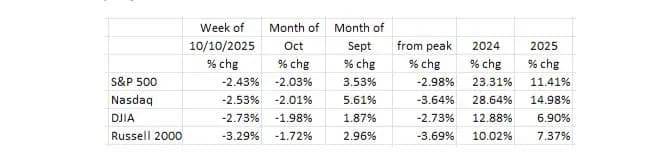
As the week ended, the equity markets sold off over trade issues with China. That country imposed a new “rare earths” export control policy where foreign entities must now obtain a license to export products that contain even a modicum of such rare earths.

Of the many newsworthy events and policy changes over the past quarter, few, if any, have rattled the markets. In high yield, the increased proportion of BB-rated bonds, now representing ~55% of the index, has helped to improve the overall credit quality of the index but has also made it more interest rate sensitive than in the past.

US stocks retreated on Tuesday, giving up the gains from the previous session, as renewed trade tensions between Washington and Beijing weighed on sentiment. The Dow Jones Industrial Average fell 416 points, or 0.9%, while the S&P 500 slipped 1.1% and the Nasdaq Composite dropped 1.6%.

Traders are focusing on the unofficial start of the earnings season. JPMorgan Chase & Co. fluctuated in the premarket after beating estimates for trading and investment-banking fees.
The S&P 500 and Nasdaq 100 surged 1.6% and 2.2%, respectively, on Monday (October 13), marking their best intraday rally since May. This is a swift reversal from Friday's (October 10) "flash crash" after President Trump threatened 100% import tariffs against China in response to Beijing's tightened rare earth export curbs.
More pressure pinned markets ahead of Tuesday's session as trade tensions reared their head again. Kevin Hincks reports from the @CboeGlobalMarkets to explain how this "back and forth" may be part of a larger negotiation.
Stock futures fell Tuesday as trade tensions between the U.S. and China intensified.

The U.S. economy hasn't suffered much so far from big increases in tariffs or a decline in the labor supply due to tighter immigration rules. But that might change.
The IMF's economic outlook forecasts global growth of 3.1% in 2026, down from prepandemic growth of 3.7%.

The lender expects world growth to slow to 2.6% this year from 3.6% last year, while it upgraded its U.S. outlook.