
加载中...
共找到 14,295 条相关资讯
Operator: Good day, and welcome to the Cadence Bank Third Quarter 2025 Earnings Webcast and Conference Call. All participants will be in a listen-only mode. After today's presentation, there will be an opportunity to ask questions. To ask a question, you may press star then 1 on a touch-tone phone. To withdraw your question, please press star, then 2. Please note that this event is being recorded. I would now like to turn the conference over to Will Fisackerly, Executive Vice President and Director of Finance. Please go ahead. Will Fisackerly: Good morning, and thank you for joining the Cadence Bank Third Quarter 2025 Earnings Conference Call. We have members from our executive management team here with us this morning: Dan Rollins, Chris Bagley, Valerie Toalson, and Billy Braddock. Our speakers will be referring to prepared slides during the discussion. You can find the slides by going to our Investor Relations page at ir.cadencebank.com, where you'll find them on the link to our webcast, or you can view them at the exhibit to the 8-Ks that we filed yesterday afternoon. These slides are also available in the presentation section of our Investor Relations website. I would remind you that the presentation, along with our earnings release, contains our customary disclosures around forward-looking statements as well as any non-GAAP metrics that may be discussed. Disclosures regarding forward-looking statements contained in those documents apply to our presentation today. Now I'll turn to Dan for his opening comments. Dan Rollins: Good morning. Thank you for joining us this morning to discuss our third-quarter results. It's been another outstanding quarter for our company. I will cover a few highlights, and Valerie will provide some additional detail on our financials. After our prepared comments, our executive management team will be available for questions. We are very pleased to have completed the acquisition of Industry Bank Shares on July 1, as well as the operational integration that just completed last week. Industry and First Chatham are now both fully integrated into our systems and processes, and we are operating as one bank under the Cadence brand. We look forward to the opportunity to grow in Central Texas and Georgia markets that were added through these transactions. Industry was certainly a unique transaction given the size and complexity of their securities portfolio, and it was just a home run on all fronts. Our team did a fantastic job in executing the disposition of 100% of their securities portfolios during the third quarter at a total mark that was less than our estimated mark when we announced the transaction. In fact, virtually all of the purchase accounting marks for Industry came in better than originally estimated. Valerie will cover the purchase accounting items in more detail in a moment. But these improvements are reflected in our quarter-end tangible book value per share declining only $0.12 to $22.82 as the impact of Industry was largely offset by strong operating earnings and improvement in our AOCI. As we look more specifically at our results for the quarter, we had another great quarter from an earnings standpoint. Adjusted net income from continuing operations increased to $152.8 million or $0.81 per share, and adjusted return on assets was 1.13% for the quarter. Our balance sheet growth combined with net interest margin improvement drove a meaningful increase in revenue, and our adjusted efficiency ratio improved to 56.5%. Deposits were up $3.4 billion, with core customer deposits up $3.1 billion due to the influx from Industry. Our teams have done a tremendous job retaining core deposit relationships at all of the acquired banks throughout their transition to our systems. And we look forward to being able to leverage our deposit products and services more fully now that we're past the integration. Loans were up $1.3 billion, with $1 billion coming from the Industry acquisition and over $300 million in organic growth across mortgage and multiple verticals. We did see an uptick in CRE paydowns during the quarter, but our new origination activity continues to be very strong across our footprint. Finally, credit results continue to be in line with expectations, with net charge-offs for the third quarter of 26 basis points annualized and non-performing asset levels and criticized and classified asset levels continuing to reflect stability. And for clarity, loans to NBFIs represent only 2% of our loan portfolio and even less than that if you exclude REITs. We continue to feel confident in that portfolio as well as our overall credit performance. I'll now turn to Valerie. She can provide some highlights. Valerie Toalson: Thank you, Dan. To add to Dan's comments, our adjusted pretax pre-provision net revenue for the third quarter reached a record $224 million, up nearly 9% from the prior quarter, driven by strong organic performance and the closing of our second acquisition this year. As Dan referenced, the Industry transaction added about $2.5 billion of securities on day one, all of which we sold during the quarter. We used those proceeds to invest back into securities, reduce wholesale borrowings, broker deposits, and certain higher-cost public funds, as well as fund loan growth. As part of the sale of those securities, we also unwound related hedges. The financials, the net result is zero impact, with a $4.3 million securities gain offset by a $4.3 million hedge loss included in other miscellaneous non-interest revenue. There were additional gains associated with these sold securities that we offset through a repositioning of $515 million of our existing portfolio securities at improved yields. Net of all this activity, our securities portfolio grew $780 million in the quarter and reflected an improved mix and interest rate profile compared to the prior quarter and day one acquired assets. Total adjusted revenue of $517 million increased $41 million or 9% in the quarter. Net interest revenue was up $46 million or 12% as a result of the larger balance sheet and improved net interest margin. Our net interest margin improved six basis points to 3.46%, driven by improved securities yields and a decline in overall funding costs. Looking forward, assuming the forward curve impact on our balance sheet, repricing, and growth expectations, we anticipate continued modest improvement in net interest margin through the end of the year and into next year. Loan yields were 6.37% in the quarter, up three basis points due to added accretion, while yields excluding accretion remained steady quarter over quarter. Securities yields improved by 32 basis points to 3.65%, again as a result of the restructuring and purchase activity discussed earlier. Our total funding cost improved seven basis points to 2.35% as we brought down wholesale borrowings, broker deposits, and time deposits repriced. Time deposit costs improved six basis points as new and renewed time deposits in the quarter came in over 26 basis points lower than the total portfolio rate. Adjusted non-interest revenue of $93.5 million was down $4.7 million due largely to mortgage banking revenue from seasonal declines in originations, combined with the impact of MSR fair value adjustments. Mortgage banking revenue before MSR was up 13% however, compared to the same quarter last year, reflecting our expanded production capabilities across our footprint. Our other fee businesses showed continued growth and solid performance in the quarter, with trust revenue declines due to the second quarter trust tax revenue. Adjusted non-interest expense increased $22.8 million linked quarter. Slide 15 breaks out the merger-related expenses by category to reduce some of that noise. Of the quarterly increase in adjusted expense, over two-thirds of it is comp-related, basically reflecting the addition of the new banks, our merit impact beginning July 1, and higher incentive accruals related to performance. Increases in occupancy and equipment expense, deposit insurance, assessment expense, and amortization of intangibles are all directly related to the acquired banks. This slide does a good job of highlighting the success we've had managing expenses, excluding the M&A-related growth and improving operating efficiency. The loan provision was $32 million, including the day one provision of just over $5 million associated with the acquired Industry loans. Our ACL coverage also remained stable linked quarter at 1.35%. I'd like to discuss just a few minutes looking at the updated purchase accounting for Industry. As you may recall, Industry had a unique balance sheet and organizational structure. As we refined our purchase accounting and tax evaluation work during the quarter, we were able to reflect improvement in several of the valuation marks relative to our initial estimates. As shown on slide 17, these improved results resulted in an additional $143 million intangible common equity relative to initial estimates. The largest benefit was an additional $80 million in deferred tax assets that was quantified post-close and that was realized during the quarter in conjunction with security sales. In addition, refined marks on loans, securities, and other assets also contributed to the improvement. All in, these adjustments result in the earn-back on this transaction, coming in closer to just two and a half years. Finally, our guidance for the rest of the year is on Slide 18. We continue to be confident in our performance and in the outlook for our markets, with projected growth and financial results through the end of the year all expected to continue to fall within the guidance ranges we shared last quarter. Operator, we would now like to open the call to questions placed. Operator: We will now begin the question and answer session. If you are using a speakerphone, please pick up your handset before pressing the keys. If at any time your question has been addressed and you would like to withdraw your question, please press star then 2. We ask that you please limit yourself to one question and one follow-up. We will now pause momentarily to assemble our roster. And your first question today will come from Manan Gosalia with Morgan Stanley. Manan Gosalia: Hi. Good morning, all. Dan Rollins: Good morning, Manan. Good to hear from you. My first question is on the guidance slide on Slide 18. Can you talk about the drivers of the slightly lower revenue and loan growth guide? I guess you're pointing to the lower end of the prior range. You know, I know you noted that there's an uptick on CRE paydowns. It feels like organic loan growth might have also been a little bit weaker this quarter relative to last quarter. So I was wondering if that's the reason or if there's anything else that's impacting these numbers. Dan Rollins: Okay. We can take that one. Yeah. I think that the answer is there's only three months left in the year, and so the timeline is much shorter and so we have a better clarity into where we are. I think if you look at the top end of that range, that would show some pretty good growth in the fourth quarter. And we continue to believe that we've got a good growth machine going. Our plans look good. We'll talk about all of that. I think the issue is, it's just a shorter time period. Valerie, you've got some specifics, I think. Valerie Toalson: I think you answered it spot on, Dan. The only other thing that I would add is what we've always talked about is that the expense expectations would fall in line with the revenue expectations. And so as we tighten the revenue, you'll notice we tighten the expense as well. And so again, to drive operating leverage as we go into the end of the year. Manan Gosalia: That's very clear. And maybe on slide 11 with the funding repricing and maturity schedule, I guess the question there is what sort of beta do you expect in the broker and time deposit as rates go down? And also, is there a mix shift you'd expect there as we go through next year? You know, maybe you'd pay down some of the higher-cost deposit with core deposit growth or do you expect that, that funding mix would remain unchanged? Dan Rollins: Yes. I think the Industry Bank Shares plays a big piece of that. Remember, they were very heavily funded on the CD desk. I think our expectation is, over time, we will be able to improve their deposit mix. I think your question was direct on beta on the brokerage side. The brokerage side is going to be market right there. It will move with the market pretty easily. We continue to want to move the broker deposits out. Our loan-to-deposit ratio went down quarter over quarter because of the deposits that came in with Industry. I think we feel pretty good about our funding source, Valerie. Valerie Toalson: Yeah. Thanks, Dan. On the betas, we are expecting, you know, our interest-bearing betas get us to about the 50% level. And the total deposits probably between 30s and 40s. The mix shift that Dan talked to, we do have the expectation that over time those Industry will begin to look a little bit more. So when you look at the balance sheet mix of deposits, looking back kind of prior to the acquisitions this year is something that I would consider a little bit over the normal. Time period for our deposits to migrate back to. Manan Gosalia: Got it. So just to be clear, the 15% sorry. The 50 beta was is is on an organic basis, and in addition to that, there should be some mix shift coming in these higher-cost deposits? Yeah. That's that's fair. Alright. Thank you. Operator: Thank you. And your next question today will come from Jared Shaw with Barclays. Jared Shaw: Good morning. Thanks. Hey, just following up on the deposit discussion, is there anything as we look at the mix shift this quarter with the decline in DDA, what's the expectations for DDA specifically? As we go through the rest of the year apart from maybe the opportunity to pick up mix shift within Industry? Dan Rollins: Yes. I think that you have to look back at a little bit longer time period than just one quarter over one quarter. We had some anomalies in the last couple of quarters that are moving some numbers around. If you look back, we finished year-end 2024 at 21.2% non-interest-bearing deposits. We were at 21.2% non-interest-bearing deposits Q1. Those deposits bounced up in Q2, some of that from First Chatham Bank that had a 30% non-interest-bearing deposit. Some of that from a customer of ours that seems to keep big balances with us at some points in the time period. And so we finished Q2 pretty high. We finished Q3 at 20.6. So from Q1 or year-end last year, 21.2% non-interest-bearing to point 6% is the run rate we've been talking about all along. 21% is kind of where we've been running on. And we've got that one big customer. What impacted this quarter was, remember, Industry's deposits non-interest-bearing deposits were 15% of deposits. So we would have expected to see a rundown from that 21% range a little bit because of their 15% free money on their balance sheets. And then that one customer, Valerie has got some details she can talk about that one customer a little bit. Yeah. Valerie Toalson: Let me just walk you through some details going back a quarter. You go back to the second quarter, of '25, excluding the $150 million NIB that we added from the First Chatham acquisition. Our non-interest-bearing deposits increased about $450 million period to period. And about $550 million of that was a customer that Dan referred to that periodically has influxes and had some dollars that came into our balance sheet in non-interest-bearing the last week of the quarter and stayed over period end. Otherwise, the non-interest-bearing balances excluding the acquisition deposit for that second quarter, would have been flattish. So then you move forward to the third quarter. We added about $50 million in non-interest-bearing deposits from Industry. And backing that out, you see our period-end deposits declined about $750 million. What that represents is the outflow of that $550 million that was in at the June as well as maybe a 2% to 3% reduction in non-interest-bearing as we saw those dollars migrate into interest-bearing products. As an offset in our total core deposits. I think the big difference is the average balances, obviously. And in the third quarter, that difference was driven by those temporary deposits that came into the balance sheet in the quarter and they were gone at the end of the quarter. Specifically, there was about $2 billion that came in at the July. About half of that left mid-August, and the rest the August. So those added those alone added about $850 million in average balances for the quarter. With the rest of that average balance increased due to the Industry acquisition. Jared Shaw: So all in all, when you normalize out that temporary influx and the acquisitions, our non-interest-bearing is very consistent, as Dan said, with our quarterly trends consistent as a percent of total deposits. Going forward, these period-end non-interest-bearing and the ratio of total balances, I'd say, are good levels to consider as a base. Periodically, we may have this customer bring some dollars in and out, but right now those dollars are out. And so it's a foundational base. I would expect that on a go-forward basis. Hopefully, that's helpful to you. Valerie Toalson: Yep. Other thing that I would add is Manan's question. I don't think I answered it on the brokered. We expect that brokered to run off as, you know, we can pay that down with investment cash flow. The bulk of those balances actually in the fourth quarter. Dan Rollins: Yes, we're fortunate to have good customers that trust us with their balances. And this customer has been our customer for decades. And it seems like on an irregular basis, they have a lot of cash that flows in and it sits in our bank for a while while they decide what they want to do with it. So we like good customers like that. Jared Shaw: Okay. Thanks. That's really helpful. I guess as my follow-up with these deals now closed and integrated, and the benefit from the lower purchase accounting marks, the capital is really, really strong here. What should we think of sort of a good capital level or a base capital level that you're trying to manage to? And what are some of the thoughts, I guess, on buyback versus additional deals from here? Dan Rollins: Yeah. I think we want to continue to be good stewards of the capital that we have. So I think we'll continue to execute on our plans. We said last quarter that we needed to build capital after the transaction. We did that already. We made some great changes this quarter that helped us on that front. So I think that puts us back in the buyback game much faster than we thought before. And I think we continue to look for opportunities to use capital and to grow. Number one is core organic growth and number two, be doing something inorganic. Operator: And your next question today will come from Casey Haire with Autonomous. Please go ahead. Casey Haire: Thanks. Good morning, everyone. Wanted to touch on deposits in the quarter. You guys so the deposits were up 3 and a half billion. Industry was a 4 and a half billion dollar franchise. It sounded like the core the legacy deposit franchise was pretty stable. Just wondering what was driving you know, what what happened to a billion of of the Industry deposits? And then any color on Dan, as you mentioned, it's heavily CDs. Any color on your ability to price them down and retention rate? Dan Rollins: Remember, their cost of CDs was actually equal to or lower than ours. So I don't think their pricing structure was wrong. And I think your numbers are off a little bit. Valerie, you want to walk through that? Valerie Toalson: Yeah. I think it might be helpful if you go on to page 20 of the slide deck, if you have that in front of you, Casey. We lay out the alone, addition of the bank shares and the organic change. And you can see in the organic change column, we actually paid down broker deposits $500 million in the quarter. Those public fund dollars that left, those were dollars that we actually that were higher-cost public funds associated with the Industry transaction that we intended on leaving. We talked about that in the second quarter. And they did leave in the third quarter. And then you can see that the core organic was actually flat. When you looked at what Industry brought on versus where we ended the quarter, it was very, very stable. So both Industry and First Chatham did a fantastic job of keeping all those deposits stable throughout the transition. And so there wasn't movement of that magnitude out of Industry. Does that help clarify? The other thing to keep in mind is also that on interest. Casey Haire: I missed that, Scott. I'm sorry. But you said you missed that. Yeah. I did. Sorry. I missed that slide. I see it. It's all laid out there. My bad. And just just following up on the on the NIM, think, Valerie, you said that you expected to be up going forward. Just wondering what does that presume in terms of purchase accounting adjustments going forward? Valerie Toalson: Yes. So the accretion this quarter was $5.5 million. It's projected to steadily decline as we go forward. So for example, next quarter, it's projected at about $4 million. And then for all of '26, about $12 million. And so you can see that's going to steadily decline. So that's not what's driving the NIM improvement. What's driving the NIM improvement is what it has been. It's the fact that we're bringing on new loans at greater than the portfolio rate. It's the repricing of the variable and fixed-rate loans, and it's the bringing down of the deposit cost. All of that is supporting that NIM improvement. Casey Haire: Gotcha. Thank you. Dan Rollins: Thanks, Ben. Thanks, Casey. Operator: Your next question today will come from Ben Gerlinger with Citi. Please go ahead. Ben Gerlinger: Hi. Good morning. It seems like it's a bit of a seller's market right now, the bank M&A. We're seeing some smaller transactions. In or around your footprint that you're the S4, you're seeing multiple bidders. So it kind of know that organic growth is a top priority for capital, and since you've kind of rebuilt with the accounting, to your benefit here, any conversations you might be having or is the bid ask too wide? Get me wrong. Like, doing two deals already this year is quite a bit. So I don't mean to my saying you're not doing a lot, but it seems like M&A is always on the front burner. You guys. Just any conversation you might be having or how sellers are viewing a bid ask spread. Dan Rollins: Yeah. I appreciate that. I think we continue to have opportunities in front of us. So when you look at our footprint today, look at what we've been able to do this year, announcing closing, integrating the two transactions that we've been able to do this year, the team has been very busy as you can imagine. But there will continue to be opportunities. We're in a consolidating industry. We like the position we sit in today. And I think we'll be able to take advantage of the market. Ben Gerlinger: Gotcha. But helpful. Kind of expanding on that a little further, you have a pretty substantial geography in terms of opportunities within MSAs. More you could kinda theoretically go back to the legacy BancorpSouth. We're really, really sticky deposit franchises. Is there one way you'd typically kinda lean if you have the opportunity? Is it more growth? Or is it more deposit focused? Dan Rollins: Yeah. No. I don't I think that we've always looked for opportunities. So when you look at the two transactions we closed this year, Industry transaction is smaller markets, as you call them, stickier deposits, a good core customer base that's been with the bank for a long, long time, I think the team that's been on the ground there, we had 300 and some odd people out for the last two weeks out of their home branches into the markets where Industry's 30 some odd branches are. Really good reception from customers there. Team has done a fantastic job of talking to customers and making that everybody is taken care of. There's really no difference in that to us. Versus the higher growth markets like Savannah from the First Chatham tremendous opportunities to grow further into that market because of the growth opportunities there. They bring different things to us. And so it's really the opportunity that brings themselves the opportunities that bring themselves to us. Ben Gerlinger: Gotcha. That's helpful. Thank you. Operator: And your next question today will come from Catherine Mealor with KBW. Please go ahead. Catherine Mealor: Hey. One on hey. Good morning. One follow-up on the margin. I know you did a lot in the bond book this quarter and we saw a big jump into yield. But curious if there's any insight you can give us into maybe the kind of where that yield was at towards the end of the quarter just so we could kinda fully appreciate maybe what a full quarter's impact would be from all the restructuring you did this quarter. Dan Rollins: That's a good question. Yes. Well, I think. Operator: Can you do you lose Valerie? Am I still on? Pardon me, ladies and gentlemen. It appears we have lost connection to our speaker line. Please standby while we reconnect. Thank you for your patience. Pardon me, ladies and gentlemen, I reconnected to the main speaker line. Please continue. Dan Rollins: Okay, Larry. Answer that question again. Valerie Toalson: You can hear us now. We'll go in again. Yes, Kathryn, that's a great question. We had about $1 billion that we reinvested after selling the securities from the Industry acquisition. And then we had the addition of $550 million that we repositioned of our existing securities book. So all in, about $1 billion of say, new securities, if you will, this quarter. Those came in at about a 5.2% yield. So that'll be helping out that overall securities yield, which actually increased during this quarter as well. The securities that we bought after Industry, those were bought probably by mid-July. The restructuring didn't occur until later in September. So there'll be a little bit additional bump as we go into the next quarter. Catherine Mealor: Okay, great. And then would you expect to continue to grow the bond book as we move through next year? How do we think about I know we can look at what loan growth will do, but how do you think about the bond book with an average earning asset growth? Valerie Toalson: Yeah. So we kind of like where it is as a percent of total assets. That being said, we've also got flexibility there. Where we could add a little bit depending on what the rest of the balance sheet does, but it could also as we show in some of our slides, the cash flow that comes off that portfolio was pretty significant as well. And so it can also serve to be a funding mechanism should we need it. So it's we'll probably stay somewhere between 15-20% of total assets. And really, that's going to depend on the loan growth outlook, etcetera. Dan Rollins: We challenged the team to fund loan growth with core deposit growth. Valerie Toalson: Yeah, exactly. That's the preferred method. And if that was the case, then we would certainly be reinvesting and adding a little bit more into security specs. Catherine Mealor: Okay. Very helpful. Thank you. Dan Rollins: Thank you, Catherine. Operator: And your next question today will come from Michael Rose with Raymond James. Please go ahead. Michael Rose: Hey, good morning. Thanks for taking my questions. Maybe we can just start on expenses. So I think the guide would imply a little bit of build next year, but you still have as we think about 2026, you still have about 75% of the cost saves. From Industry still to kind of be realized. Can you just I'm not asking for explicit guidance, but can you just give us kind of a starting point for expectations as we start to think about 2026 expenses? I mean, obviously, there's gonna be merit increases. There's seasonal impacts, things like that. I know health care costs are going up for a lot of banks, but you do have these cost saves. At the same time, I assume you're still reinvesting in the franchise. So we just love to frame out the puts and takes. Dan Rollins: I appreciate the questions, Michael. I think from a where we stand cost save wise, I don't think you have any cost saves in the numbers that you see yet. I mean, we firstly we ran the quarter. There's a little bit, but also had some old First Chatham expenses still in there. So you've got some pretty good cost saves that we will continue to execute on in 4Q. I think 1Q becomes a run rate quarter that you would want to see on a go-forward basis with the cost saves in. Off of that 1Q, base quarter, then what's the build, I think, is what you're asking? Valerie Toalson: Yeah. And I think what you walked them through, Dan, is exactly right. We really don't have those cost saves for Industry in the fourth quarter at all. We just completed the conversions. And so those will be flowing through most significantly through 2026. As typical, but that's you know, we will preside or present our twenty-sixth guidance when we do our end-of-year earnings. So that's when we'll kind of lay it all out. But I think if you just think about it from a broader spectrum, we do anticipate continuing to build operating leverage as we go into next year. And that's really driven by the strong revenue growth and the good loan opportunities that we see across our footprint as we continue into next year. Michael Rose: Okay. That's helpful. And then maybe if I can just go back to the slide deck from when the deal was announced. On Slide 12, you had pro forma EPS reconciliation for 'twenty-six and 'twenty-seven. I know things have changed, obviously, that was based on consensus. At the time. But maybe, Valerie, if you can just walk us through maybe some of the major changes just to summarize those and maybe how we should think about the build. From the deal? Thanks. Dan Rollins: Yeah. He's on the deal slide deck, Valerie. So you're talking about the changes that we saw. So the biggest one was the deferred tax asset piece. Was the biggest piece. So we thought there was a little bit of a deferred tax asset. We modeled that in. As we worked with our tax folks and our internal team did an absolutely fantastic job. I want to brag on the folks that were involved in that. A lot of work went into understanding all of the pieces that were there. That was an $80 million pickup that came through the deferred tax asset piece. And then the other components, whether it was the loan mark or the credit mark or all the different pieces that came through resulted in about $140 million improvement on the capital side of that. Can turn that into the income, I think is what he's trying to do, is figure out what that does on an income statement side, Valerie. Valerie Toalson: Yes. So and we laid all that out for you, Michael, on slide 17. You can see the changes there. So you can see the piece that was the interest rate on loans. The actual interest rate mark on the loans was very pretty flat. The securities mark, we actually sold all those securities and so there's not anything forward-looking on that piece. And so from an actual income standpoint, there's not a lot of change. But it absolutely helped day one tangible book value. Michael Rose: Okay. That's exactly what I was looking for. Thanks for summarizing that. Appreciate all set back. Dan Rollins: Yeah. The team did a fantastic job on this transaction. Operator: Your next question today will come from Stephen Scouten with Piper Sandler. Please go ahead. Stephen Scouten: Hey, good morning. Thanks. So you guys have had an extremely active busy couple of years with the insurance sale, restructuring, couple deals. How do you think about kind of major strategic initiatives from here? Or is it more just a block and tackling on what's been built out? And if it was additional M&A, would you look for more market extension or more in-market type of deals? We've been very consistent on the answer to that question. Dan Rollins: Steven. I think we like the nine states we're in. We don't see a whole lot of need to stretch outside of that. We want to have more mass, more density within the states that we serve. We like the Southeast. We like Texas. We continue to look for opportunities to expand in that footprint. Again, we're really proud of the fact that we've been able to announce, close and integrate two transactions in this calendar year so far. And continue to believe there's opportunities in front of us. Stephen Scouten: Okay. Great. Appreciate that, Dan. And then you commented earlier on the 2025 guide that it implies a pretty strong growth rate here in the fourth quarter organically. It looks like kind of mid to mid-high single-digit growth implied in that guide. Is that kind of the right way to think about '26? I know you're not giving '26 guidance currently, but is that the kind of expectation that you guys would have as of today for what's a palatable growth rate? And what kind of gives you confidence in that, whether it's pipeline growth, customer demand? Any color you can give there around customer behavior? Dan Rollins: Yes. Great questions. Thank you for asking that. We certainly want to talk about the pipeline today. Chris and Billy can add in on where we stand on some of that. The markets the big server, good. There is strong market activity. 4Q is typically a strong market. We see lots of activity coming in. The tax law changes are driving some business our way. Which one of you guys wants to take the lead on this? Yes, I'll start. Chris Bagley: You're right, Dan. Pipelines are solid. They're diverse. There's what I like about it. It's across all of our C and I segments geographically. It's within all of our groups, verticals, energy as well. The only place where we've seen a little headwind is from paydowns in CRE, which we've been expecting for a number of years. This is on the 21-22 vintage merchant loans that were out there. So we're seeing some of that activity. Most of that's payoffs from private credit. But for longer-term pipeline, I mean, right now, the pipeline is supporting, you know, in excess of what our budget was for the year. So that feels nice. And even Q3 versus Q4, I mean, we had lots in the Q3 pipeline. Some of it fell into Q4 as it always can happen from a first few weeks look pretty good. Yeah. From trying to pinpoint an actual date. So I like the diversity that's there and it's widespread. So I would say it continues to support, you know, our thesis. Dan Rollins: Yeah. And all lines are growing. When you look at what's happening out there, all business lines, the whole geography, everything is running well, Chris? Chris Bagley: Yeah, just to add a little color, I mean, community banks the same way. You're seeing, you know, one of the I think, one of the positives is we just have a lot of leverage to pull. So you've seen growth from market. You've seen growth from the community bank, and you've also proud about the acquisitions. I think there's opportunity there. The transactions that have joined us, I think they've got a new set of products and higher lending limits, and I think you're gonna see them hit the ground running next year as well. Yeah. Our number one product in the community bank was not offered by either one of those banks on the loan desk. Or the deposit desk. Stephen Scouten: Interesting. Okay. Great color. Thanks for all the time and attention. Congrats on the progress. Dan Rollins: Thank you. Appreciate it. Operator: Your next question today will come from Matt Olney with Stephens. Hey, good morning. Thanks for taking the question. Just kind of on that last topic there around loan growth and pipelines, just looking for any kind of color on loan pricing, loan competition in recent weeks and months in the Community Bank and the commercial bank. Thanks. Chris Bagley: I'll start off. I think it's competitive out there, but you see it in our yields that we've booked. So the yields have been holding in there. I think especially on the community bank side, spreads have tightened on some transactions, mostly on the software-based things and in certain verticals. You see some tightening there, but I think all in, we're able to keep our yields up right now. Yeah. The new renewed loans for that third quarter actually came in about 6.85%. So we feel pretty good at that. Matt Olney: Okay. That's all for me. Thanks, guys. Dan Rollins: K. Thanks, Matt. Appreciate it. Operator: Your next question today will come from Brett Rabatin with Hovde Group. Please go ahead. Brett Rabatin: Hey, good morning, everybody. Wanted to ask about Slide 10. And when you look at the one to three years bucket, the yield on that piece is a little lower even though a lot of that portfolio is variable. Can you guys just talk about that bucket? And I know it's not a huge piece, but it could be an incremental driver for yield on the loan portfolio and just is that weighted more towards the one or the three years in terms of the duration? Dan Rollins: Which column are you in again just one more time? The one to three-year column? Yeah. Yeah. One to three. Valerie Toalson: So, yeah, basically, what that includes when you refer to the floating and variable, that'll include also loans that are fixed for a period of time that then switch to floating after a three, five, seven-year period. And so this bucket for the originations includes more of that, and that's for some that were produced at an earlier date. And that's why it has the five forty-six average rate. So yes, you're exactly right. As we look out into next year, there's a decent at least from where our new and renewed coming on at six eighty-five versus that five forty-six, that's a pretty strong delta right now. That may shrink a little bit depending on where rates go over the next few quarters, but it's still a nice delta that we should continue to gain benefit from. Dan Rollins: Allows us to reprice loans up even in a down rate environment. Brett Rabatin: Exactly. And so just following up on that, Valerie, is that weighted more towards the one or the or closer to three years in terms of the maturities there? Valerie Toalson: Yeah. I don't have that information in front of me right now. Brett Rabatin: Okay. No worries. The other question I wanted to ask was around credit, and credit continues to behave well for you guys. People have been talking about cockroaches, but you guys didn't see any. But there was some movement in nonaccruals, down downdraft in C and I and an uptick in income-producing CRE, you know, might have been lumpy, any thoughts on the movement in the nonperformers? Dan Rollins: I think what we're seeing is just a normal migration that we talked about for the last couple of quarters. I don't see anything in there that's too exciting. Chris, I know you want to talk about some of. Chris Bagley: Yeah, I mean, Dan said it's normal course of business as we work through different credits. You're right. Some of it was in the CRE book. This quarter, which we've identified the credits there that have great loan to values. We're not anticipating losses there. Now remember that the nonperforming book they a large number of that's SBA guaranteed loans, so, you know, you need to kind of adjust that when you think about the non-performing. Dan Rollins: I think overall if you wanna add we look at credit today, you know, we're watching the same thing you're seeing. We're seeing some of the talk in the market. We don't have a whole lot that we're getting too excited about here. Brett Rabatin: Okay. That's helpful. Thanks for the color, guys. Operator: And your next question today will come from Jon Arfstrom with RBC Capital Markets. Please go ahead. Jon Arfstrom: Hey. Thanks. Good morning. Dan Rollins: Hey, John. Jon Arfstrom: Hey, Billy, maybe one follow-up for you. You talked a little bit about the paydowns and the vintages. Are you saying you expect the paydown activity to start to slow? Is that the message you wanted to send them that? Chris Bagley: No. You know, what I'm and this is CRE specific. Right? So there's a volume across the industry. I mean, it was a heavy origination period in '21 and 2022. The payoffs have actually delayed longer than we anticipated. They're starting some, but they're not because of sale activity. For the most part. It's because of ridge refinance activity, you know, 50% of the payoffs in CRE, that merchant CRE was from bridge payoffs from private credit. We'll continue to see some of that. We'll provide a little bit of that. As well. So don't see it necessarily slowing. The good news is you know, the twenty-four and twenty-five vintage originations are gonna start funding to offset some of that. So that's where you might see it mute is that is those construction loans start funding. If we could draw perfectly, the lines would cross at the same time. Unfortunately, we can't draw perfectly. Jon Arfstrom: Okay. Okay. Good. And then just bigger picture on the fee income businesses. Is there anything you guys would call out this quarter one way or the other? I understand the wealth management piece and the MSR piece, but you know, just help us with, you know, what's the wealth strategy? What's the more banking strategy, and anything you would call out that was particularly favorable this quarter? Valerie Toalson: You know, I would just say on the mortgage, you know, it's a typical seasonal dip that we see in the third quarter on the standpoint. But if you look back year over year, it's actually up 13%. And so that's indicative of the commitment that we have to that business. And the fact that they've been adding to talent in key markets across our footprint and we expect that to continue. If rates in addition to that, kind of organic flow, if you will, if rates get something with a five handle on them, we would also expect to see a lot of refi activity. And so that would certainly drive up some changes there. On the wealth side, we continue to do very well. I actually just talked to the leader of our Cadence Investment Services earlier today. And he said September was their highest revenue peak. And they looked to be continuing that growth into the fourth quarter. We just continue to do well. That's a strong business for us. We think that for the industry, it's actually a growing area of business. Certainly, there's a lot of wealth transfer that's going to happen in the next several years, and we want to be there to capture it. So, yeah, we're pretty bullish on those fee revenue categories. Was one item this quarter that I wanna make sure is clearly understood. We had the securities gains of $4.3 million.0 and then also we had an offset of a negative $4.3 million.0 in other non-interest revenue that we called out related to unwinding the associated hedges. So the net impact on the P and L was zero. But if you're just looking at some of those fewer numbers, may not see that. So I just wanted to call that out. Dan Rollins: I think on the wealth side, though, I'd just add to that that your team has hired two really good folks to join just this last quarter. In the Houston market and the Atlantic market. And yes. We're investing in wealth and we're excited about what the new folks will be able to help us do. Jon Arfstrom: Okay. Alright. Thank you. Operator: And your next question today is a follow-up from Ben Gerlinger with Citi. Please go ahead. Ben Gerlinger: Hey, Ben. Appreciate the follow-up. Just wanted to follow-up on the one client has a pretty substantial deposit relationship with you guys. Any potential clarity on when they might refill? And then what do you lend against them, or is it just a securities position? Dan Rollins: It's just a this is a customer that we've had for literally decades. And they have cash flows that come sporadically. We don't always know when that money is going to flow in. It's just a great customer that parks deposits with us for a while. Ben Gerlinger: Gotcha. Okay. Appreciate your time, then congrats, Dan, on the chair position of the India. Dan Rollins: Thank you very much. Appreciate it. Operator: This concludes our question and answer session. I would like to turn the conference back over to the management team for any closing remarks. Dan Rollins: Thank you all for joining us this morning. I sure you can sense the excitement in our team shares around the financial results we've delivered combined with the opportunities that lie ahead. Looking back, our year-to-date performance has shown an ongoing cadence of progress, including the announcement closing and integration of two strategic acquisitions, meaningful organic growth, and continued improvement in performance. These accomplishments reflect the strength of our talent, both the front and the back office, and our commitment to serving our customers and communities. Thank you all very much for joining us today. This concludes our call. We look forward to visiting with you all again. Operator: Conference has now concluded. Thank you for attending today's presentation. You may now disconnect.

Operator: At this time, I would like to welcome everyone to the Balchem Corporation's Third Quarter 2025 Earnings Call. All lines have been placed on mute to prevent any background noise. After the speakers' remarks, there will be a question and answer session. Thank you. I would now like to turn the call over to Carl Martin Bengtsson, CFO. Please go ahead. Carl Martin Bengtsson: Thank you. Good morning, everyone. Thank you for joining our conference call this morning to discuss the results of Balchem Corporation for the quarter ending September 30, 2025. My name is Carl Martin Bengtsson, Chief Financial Officer. And hosting this call with me is Theodore Lee Harris, our Chairman, President, and CEO. Following the advice of our counsel, auditors, and the SEC, at this time, I would like to read our forward-looking statement. Statements made in today's call that are not historical facts are considered forward-looking statements. We can give no assurance that the expectations reflected in forward-looking statements will prove correct and various factors could cause actual results to differ materially from our expectations, including risks and factors identified in Balchem's most recent Form 10-Ks, 10-Q, and 8-Ks reports. The company assumes no obligation to update these forward-looking statements. Today's call and commentary also include non-GAAP financial measures. Please refer to the reconciliations in our earnings release for further details. I will now turn the call over to Theodore Lee Harris, our Chairman, President, and CEO. Theodore Lee Harris: Thanks, Martin. Good morning, and welcome to our conference call. We were extremely pleased with the financial results for 2025 and the strong performance of our company, fueled by the ongoing market penetration of our unique portfolio of specialty nutrients and delivery systems, and the favorable "better for you" trends within the food and nutrition markets that are well aligned with our food ingredient formulation systems and capabilities. We delivered record quarterly consolidated sales, adjusted EBITDA, adjusted net earnings, and adjusted EPS, with year-over-year sales and earnings growth in all three of our reporting segments. 2025 was the twenty-fifth consecutive quarter of quarterly year-over-year growth in adjusted EBITDA for Balchem Corporation. We are very proud of this accomplishment, particularly in light of the market environment within which we have been operating over the last twenty-five quarters. I would like to take this opportunity to thank the entire Balchem team for their exceptional performance and contributions toward this significant achievement. Thank you all very much. Before we get into more detail on the quarter, I would like to make a few comments about the overall market environment, including the evolving global trade situation, as well as some of the new science that has recently been published supporting our nutrients and the further expansion of our marketing efforts to help drive awareness and market penetration. We continue to see healthy demand across the vast majority of our end markets. Our Human Nutrition and Health segment continues to perform extremely well, driven by strong demand for both our unique portfolio of minerals, nutrients, and vitamins, and our food ingredients and solutions, which are benefiting from trends toward nutrient-dense, high-protein, high-fiber, and lower-sugar or "Better For You" foods, where our nutrient portfolio and our formulations expertise bring considerable value to our customers. In the Animal Nutrition and Health segment, we delivered another quarter of year-over-year growth on improved demand in both our monogastric and ruminant businesses, as a result of further market penetration of our rumen-protected precision release encapsulates nutrient portfolio and mostly, or modestly, improving market conditions in the European monogastric market. And we remain encouraged by the overall performance of our animal nutrition and health product portfolio. Within our Specialty Products segment, both our Performance Gases business and our Plant Nutrition business are performing well, driven primarily by higher demand as a result of healthier market conditions within Performance Gases and successful geographic expansion growth within plant nutrition. Year to date, on a consolidated basis, we have delivered strong growth both on the top and bottom lines, while continuing to generate strong free cash flow. And our outlook for the remainder of the year remains positive. As discussed on the last few earnings calls, we believe we are relatively well-positioned to effectively manage through the current global trade environment. To date, we have managed to fully offset the impact of tariffs associated with the U.S. Administration's evolving trade policy, either through alternate supply chain options or subsequent pricing actions. And based on what we know today, we expect to similarly be able to offset any impact of future tariffs as the trade situation further evolves. Additionally, I would like to share some progress we have made in our scientific clinical research pipeline, which continues to bolster our human nutrition and health segment. We continue to actively invest in the science behind our brands such as VitaCholine, K2Vital, OptiMSM, and Albion Minerals. These studies are integral to our strategy for entering new markets, expanding our ingredient categories, and building consumer awareness. I would like to highlight one of the studies published recently that is of particular importance. Late in 2017, we informed you that Balchem funded a pilot study. Dr. Steven Sissel, the former director for the University of North Carolina's Nutrition Research Institute, received a $2.6 million grant from a unit of the National Institutes of Health, or NIH, to develop a blood-based test or biomarker to help measure choline status in humans. The NIH-funded choline biomarker study was known to be a lengthy study, only further delayed by the COVID-19 pandemic. That has now been completed, and the results have been published as a preprint. It was an important study from our perspective since it promised to help more easily identify choline deficiency in humans by identifying a choline biomarker in order to ultimately help address deficiencies through supplementation, while also facilitating research on the benefits of choline supplementation in humans. The study was a double-blind, randomized, crossover-controlled feeding study in which all 101 subjects received 100%, 50%, and 25% of the choline recommended daily intake in two-week segments separated by two-week washouts. The results of the study show that plasma choline and betaine, when measured together, are highly predictive of actual dietary choline intake. These findings offer a new opportunity to assess choline dietary adequacy and will likely be included in future clinical and population studies and ultimately be used as a common measurement in health screenings of choline intake versus daily recommended intake levels. On the marketing front, within our animal nutrition and health segment, we continue to expand our reach and impact through marketing. We have strengthened our marketing capabilities, and Balchem's Real Science Exchange platform, now celebrating five years since its launch, has grown into a leading industry information and technology resource with webinars, podcasts, and symposiums that is attracting a strong following across the industry, with high-quality content across leading streaming platforms such as YouTube, Spotify, and Apple Podcasts. This channel to the industry gives Balchem a unique opportunity to reach and interact with an expanded target audience. We will continue to invest in our marketing capabilities, and we recently partnered with Progressive Dairy Magazine to introduce the Real Producer Exchange for practical insights for dairy farmers. And later this month, we are excited to expand into the companion animal sector with new webinars and podcasts, reinforcing our commitment to advancing animal science and industry collaboration. So some exciting progress is being made on our strategic growth initiatives while at the same time, delivering strong financial results. Now regarding the third quarter of 2025's financial performance. This morning, we reported record quarterly consolidated revenue of $268 million, which was 11.5% higher than the prior year quarter. We delivered record quarterly GAAP earnings from operations of $55 million, an increase of 13.7% versus the prior year. Consolidated net income closed the quarter at $40 million, an increase of 19.1%. This quarterly net income translated to diluted net earnings per share of $1.24 on a GAAP basis, up 21¢ or 20.4% compared to the prior year. On an adjusted basis, we delivered record quarterly adjusted EBITDA of $71 million, an increase of 11% compared to the prior year. Our record quarterly adjusted net earnings were $44 million, an increase of 19.1% from the prior year, which translated to $1.35 per diluted share, up 22¢ or 19.5% compared to the prior year. Overall, another excellent quarter for Balchem Corporation, as we continue to deliver strong financial results while making good progress on our strategic growth initiatives. And with that, I'm now going to turn the call back over to Martin to go through the third quarter consolidated financial results for the company in more detail and the results for each of our business segments. Carl Martin Bengtsson: Thank you, Ted. As Ted highlighted, the third quarter was a great quarter for Balchem Corporation with record sales, earnings from operations, adjusted EBITDA, adjusted net earnings, and adjusted earnings per share. Our third quarter net sales of $268 million were 11.5% higher than the prior year, driven by strong performance in all three segments: Human Nutrition and Health, Animal Nutrition and Health, and Specialty Products. Our third quarter gross margin dollars were $95 million, up 11.8% compared to the prior year, and our gross margin percent was 35.7% of sales, up 10 basis points compared to the prior year. Consolidated operating expenses for the third quarter were $41 million as compared to $37 million in the prior year. The increase was primarily due to an increase in professional services and higher compensation-related costs. GAAP earnings from operations for the third quarter were a record $55 million, an increase of 13.7% compared to the prior year. On an adjusted basis, as detailed in our earnings release this morning, record non-GAAP earnings from operations of $60 million were up 12.1% compared to the prior year. Adjusted EBITDA was a record $71 million, an increase of 11% compared to the prior year, with an adjusted EBITDA margin rate of 26.7%. Net interest expense for the third quarter was $3 million, a decrease of $1 million compared to the prior year, driven primarily by lower outstanding borrowings. Our net debt decreased to $89 million, with an overall leverage ratio on a net debt basis of 0.3. The effective tax rates for 2025 and 2024 were 22.6% and 22.9%, respectively. The decrease in the effective tax rate from the prior year was primarily due to certain lower state taxes. Consolidated net income closed the quarter at $40 million, up 19.1% from the prior year. This quarterly net income translated into diluted net earnings per share of $1.24, an increase of $0.21 compared to the prior year. On an adjusted basis, our third quarter adjusted net earnings were a record $44 million, an increase of 19.1% from the prior year, which translated to $1.35 per diluted share. Cash flows from operations were $66 million, with free cash flow of $51 million, and we closed out the quarter with $65 million of cash on the balance sheet. As we look at the third quarter from a segment perspective, our Human Nutrition and Health segment generated record sales of $174 million, an increase of 14.3% from the prior year, driven by higher sales within both the nutrients business and the food ingredients and solutions businesses. Our Human Nutrition and Health segment also delivered record quarterly earnings from operations of $41 million, an increase of 14.8% compared to the prior year. This was primarily driven by the aforementioned higher sales and a favorable mix, partially offset by certain higher manufacturing input costs and higher operating expenses. Third quarter adjusted earnings from operations for this segment were a record $44 million, an increase of 13.2%. We are extremely pleased with the overall performance of our Human Nutrition and Health segment. And as Ted mentioned earlier, we continue to experience strong demand for our unique portfolio of ingredients and solutions. We believe our Human Nutrition and Health businesses are well-positioned to build on the momentum we are seeing across our end markets. And as consumers increasingly favor "better for you" ingredients and solutions, we see significant opportunities ahead to leverage our formulation expertise, nutrient portfolio, and strong market positions to continue to deliver healthy growth in human nutrition and health. Our Animal Nutrition and Health segment generated quarterly sales of $56 million, an increase of 6.6% compared to the prior year. The increase was driven by higher sales in both the ruminant and monogastric businesses. Animal Nutrition and Health delivered earnings from operations of $4 million, an increase of 5.2% from the prior year. The increase was primarily due to the aforementioned higher sales and a favorable mix, partially offset by certain higher manufacturing input costs and higher operating expenses. Third quarter adjusted earnings from operations for this segment were $4 million, an increase of 1.2% compared to the prior year. The end markets for Animal Nutrition and Health remain relatively stable at the moment, and we were pleased to see another quarter of top and bottom line growth. We continue to see market penetration of our rumen-protected encapsulated nutrients for the dairy market, including our ReAssure encapsulated choline and our more recently launched AminoShore XL encapsulated lysine. On the monogastric side, we see a relatively stable U.S. market at the moment, and a modestly improved European market environment following the provisional anti-dumping duties on Chinese choline that were announced last quarter. As we look forward, we expect Animal Nutrition and Health to continue to deliver growth over the long term. Our Specialty Products segment delivered quarterly sales of $36 million, an increase of 7.5% compared to the prior year, driven by higher sales in both the Performance Gases and Plant Nutrition businesses. Specialty Products delivered a record quarterly earnings from operations of $12 million, an increase of 9.7% versus the prior year, primarily driven by the aforementioned higher sales. Third quarter adjusted earnings from operations for this segment were a record $13 million, an increase of 8.8%. We continue to be really pleased with the performance of Specialty Products, delivering another strong quarter of growth both on the top and bottom line. Within Performance Gases, our international reach is creating value for our customers and helping to drive growth rates above historical levels. And similarly, within our plant nutrition business, we are having good success with our geographic expansion efforts, particularly in Latin America and Asia Pacific. Specialty Products is performing well, and going forward, we expect to be able to continue to drive solid growth for the Specialty Products segment. So overall, the third quarter was another excellent quarter for Balchem Corporation, and we believe we are well-positioned for continued growth as we head into the remainder of the year. I'm now going to turn the call back over to Ted for some closing remarks. Thanks, Martin. Once again, we are extremely pleased with the third quarter financial results reported earlier this morning. Theodore Lee Harris: As a company, we continue to show an ability to deliver results in a variety of market conditions. Given our strong market positions and our value-added portfolio of products, the company is performing very well. We have once again effectively managed through the latest macroeconomic and tariff-related trade environment with minimal impact on the company. At the same time, our growth has strengthened as a result of the accelerating "Better For You" trends within the health and nutrition markets, given our unique portfolio of nutrients, coupled with our food ingredients and solutions capabilities. We are extremely proud of delivering 25 consecutive quarters of quarterly year-over-year growth in adjusted EBITDA, with the third quarter results reported earlier this morning. And we remain confident in the long-term growth outlook for Balchem Corporation as a company. I will now hand the call back over to Martin, who will open up the call for questions. Thank you, Ted. Carl Martin Bengtsson: This now concludes the formal portion of the conference. At this point, we will open up the conference call for questions. Operator: And your first question comes from the line of Robert James Labick with CJS Securities. Please go ahead. Robert James Labick: Good morning. Congratulations on another record quarter. Carl Martin Bengtsson: Thanks, Bob. Robert James Labick: Sure. I wanted to start with the food ingredients and solutions. For the last several quarters, it's kind of really picked up after, you know, previously lagging the minerals and nutrients growth rate. You just mentioned the "better for you" trend, but could you drill down a little more and talk about the changes in Food Solutions and the drivers and the outlook for each of the sub-segments in 2025? Theodore Lee Harris: Absolutely, Bob. And first of all, just stepping back a little bit, we really were extremely pleased with the performance of the entire segment, Human Nutrition and Health. Just to kind of peel that onion back a little bit. Sales for H and H were up, you know, 14%. And then if you, you know, talk about the nutrient portfolio, it was up about 30%. But as you highlight, the food ingredient business was up nicely as well. So it was really good to see the food business up almost 7%. And, you know, we don't see that growth rate differential necessarily changing over time. We always see the nutrient portfolio as growing faster than the food portfolio. But as you point out, the food growth was kind of low single digits there for a while and now significantly increased. And the primary driver of that is what we touched on in the prepared remarks, and that really is the benefits we're seeing from the "better for you" trends in the market, whether it's in meat sticks, which is a high-protein snack to replace, you know, other snacks, or whether it's a high-fiber nutritional beverage that is trying to address even some of the negative implications of GLP-1 drugs, for example. We see quite a few of our customers introducing new products targeted to that audience, and we all know that's a pretty sizable consumer base. Or whether it's high-protein bars, for example, with our C Crisps and our ability to add high-protein crisps to certain kinds of bars in the marketplace. So all of those trends are really helping support and strengthen our overall growth in food ingredients. And it's really a combination of our nutrient expertise from the nutrient business, our unique products, you know, encapsulated products, our kind of emulsified fat powder systems, our flavor systems, and our ability to combine all of those in solutions for our customers as they're introducing new products to serve those trends. And we think those trends are likely to continue for the foreseeable future. You know, I think the "better for you" trends have been going on for decades. And of late, we've seen some accelerants to those trends, whether it's the GLP-1 drugs that I touched on that, you know, have side effects and have sort of unique nutrient needs, if you will, for the consumers of those products. That's an opportunity for us. Certainly, the, you know, the RFK Junior focus on, you know, healthier for you products, less processed food products is creating an accelerant, if you will, to this long-term trend. So, you know, we're really pleased that our portfolio of products caters to those trends and is allowing for us to get new wins in the marketplace and grow our food business at a higher rate than we have historically. So we're quite excited about that. Robert James Labick: That's great. Thank you. And then just on the nutrient minerals and nutrients side, the growth was phenomenal as well. Your major markets of choline, K2, MSM, magnesium, etcetera, can you talk about it's been a penetration story for a while, where are you in terms of product penetration? And what is the opportunity? How much longer of a runway is there for penetration and awareness of your products? Theodore Lee Harris: The short answer is we're a long way from that endpoint. You know, again, as I've talked about in the past, you know, to some extent, our challenge is the majority of our portfolio, whether it's choline, or vitamin K2, or even MSM, are not very well known. I would even add the idea of chelated minerals, higher bioavailable minerals are not so well known and, you know, kind of recent studies show that they're, yes, a little bit better known today than they were five years ago, but still not well known. So we think that we have a significant way to go. We think that the market opportunities are still, you know, three, four times multiples of the size of the market today. And in the minerals, you mentioned magnesium. In the mineral space, the overall mineral market is huge. And the position that chelated minerals have within that market remains tiny. So the opportunity there is to both eat away at that bigger minerals market with these higher bioavailable, more effective products, but also kind of drive market penetration to users that aren't supplementing with those minerals as well. So it's really sort of two vectors of growth, but we certainly see, you know, very strong double-digit growth in each of those portfolios, and we expect that to continue for some time. Robert James Labick: Okay. Super. I'll jump back in queue and let others ask questions. But thank you. Theodore Lee Harris: Thanks, Bob. Operator: Your next question comes from the line of Raghuram Selvaraju with H.C. Wainwright. Please go ahead. Raghuram Selvaraju: Thanks very much for taking my questions and congratulations on a very strong quarter. I was just wondering if you could comment on international antidumping practices being enacted at the state, regional, governmental level that could conceivably boost sales, particularly in the H and H segment ex-U.S.? And especially if you could give us maybe just an overview of the status of the European anti-dumping campaigns as these pertain to choline specifically. Where that is currently and what impact you expect it to have over the course of the coming months and indeed into next year? Thank you. Theodore Lee Harris: Yeah. Thanks, Ram, for your comments and your question. You know, there are really, sort of two aspects to antidumping, and maybe I'll start with the current initiative where the European Union has preliminarily put antidumping duties on China-origin choline chloride, and maybe to your specific question, that's both for human choline chloride as well as animal choline chloride. And it's just a clear recognition by the European Union of unfair trade practices by China and trying to create a level playing field. Those duties are still preliminary. There's quite a process that is underway. We initially announced that the duties were, I think it was 195% to 120%. And after further calculations, they reduced those by about five percentage points, so not significantly, which we were pleased to hear. And later this year, certainly by the end of the year, they should have a final vote for the enactment of those duties, and then they will become, you know, approved in their final form and would be in place for five years, which also would be a very good thing. And there is an opportunity for us to work with the European Union to try to address some of the typical reaction from China of moving the product through other countries, and we're working to try to do that. And that would only strengthen the impact of the duties. But certainly, broadly speaking, across the nutrient sector, whether it's in animal or in human, these types of pricing practices are quite prevalent from China as well as others. And I do think that there is an improved environment within which to bring these kinds of cases to the government entities and to get an appropriate response. So we are kind of actively reviewing where that makes sense, where we believe these practices are happening and kind of using that tool. Unfortunately, it is expensive and it is lengthy. And so, you know, you have to go through that. But clearly, in the U.S., and we think in the U.S., there's an improved environment for us, companies like ours, to bring those kinds of cases to the governments, and we'll do that as appropriate going forward. Raghuram Selvaraju: Okay. Great. And then, also just wanted to ask about the Orange County microencapsulation manufacturing facility. Can you just summarize again for us when you expect construction to be completed on that facility now that you have the state approvals in place? And also if you can give us a sense of what the magnitude of impact is likely to be on revenues and earnings quality once that facility comes fully online. Thank you. Theodore Lee Harris: Yes, sure. We're really excited about that. We announced that in our second quarter earnings release, and we felt like, you know, we should update our shareholders on the progress that has been made. And essentially, what we tried to say and the highlight on the press release is that we're moving forward. And we have gotten the most recent approvals to do just that, move forward with the plant. And, you know, we essentially, what we're doing is building a new plant that has twice the capacity of the old plant and will effectively shut down the old plant, which was, you know, one of the first sites that we ever had as a company. In fact, the first site we bought it back in the sixties. And at that point in time, it was an old creamery that we used to make food ingredients and has kind of sort of far outlived its effectiveness. And so it was time for us to upgrade and modernize, and we've done that just down the road so that we can continue to use the employee base from the old site and so forth. And so we're really kind of putting in place in this new plant some new technology around our microencapsulation and more efficient technology. The encapsulation business, for example, just in Q3 grew about 26%. So it's a fast-growing part of our portfolio and has been growing significantly really over the last few years, and we need the capacity. Our current capacity is getting us by, but we're soon going to start to run out of capacity in the coming couple of years. And so the plant will be, from a construction perspective, completed early in 2027, and we expect to be producing new product by 2027. So the way we're looking at it is it's going to allow this important product line to continue to grow at double-digit rates. And our encapsulate business is certainly on the higher end of our gross margin profile of the business within our company. So, you know, we're excited to invest in that product line, and we're excited to be able to allow it to continue to grow beyond our current capacity levels. Raghuram Selvaraju: Okay. And then just two quick questions for Martin, if I may. Firstly, wanted to ask if you expect the pace of debt repayment to be the same in the next couple of quarters as what you just most recently reported? Particularly in light of the significantly lower debt burden and the very low net leverage ratio that Balchem Corporation currently has. Just wanted to see if you're planning to take your foot off the gas on the debt repayment schedule or if you're intending to keep going at the most recently reported pace on a quarterly basis? And also if you could just give us a sense of whether you expect the most recently reported quarterly effective tax rate to be an appropriate assumption to carry forward for the remainder of 2025? Thank you. Carl Martin Bengtsson: Ram, yes. I'll start with the second one as it's a quick answer for the tax rate. I think sort of our best estimate for the year is around 22.5% plus or minus a little bit. So kind of where we're at year to date and where we think we'll finish the year at around 22.5% plus or minus a little bit. On the debt repayment pace, I mean, obviously, we've generated strong free cash flows. And as you know from the past, we deploy that capital, and paying down our debt is part of that. I think it will depend a little bit on the pace and timing of M&A. As you know, we talk a lot about pursuing various opportunities all the time. Unfortunately, you know, we haven't gotten anything over the finish line more recently. That is not to say we're not actively participating, actively discussing, actively pursuing, you know, strategic M&A. So I think that will impact it a little bit on how we see sort of those opportunities develop here as we go forward. Also, you know from the past that we do deploy some of our cash into keeping our sort of share count relatively flat. So we do some share repurchases for anti-dilutive purposes, just to keep sort of our shareholders' ownership relatively stable. So that will impact it as well in terms of at what pace we repurchase shares just to keep our share count flat. Meanwhile, we will continue to reduce debt as there is excess cash. And then I think the big trigger that will change that is sort of when the next M&A transaction occurs, because I think that is more a matter of timing than anything else. Raghuram Selvaraju: Thank you. Theodore Lee Harris: Thanks, Ram. Operator: Your next question comes from the line of Daniel Scott Harriman with Sidoti. Please go ahead. Daniel Scott Harriman: Hey guys, good morning and congrats on another great quarter. Just a couple of quick ones from me today. Within Specialty Products, with that 7.5% year-over-year growth, can you give us a breakdown of how much came from Performance Gases versus Plant Nutrition? Then with the Plant Nutrition growth, could you just update us and provide a little bit more information about the success you're seeing with your geographic expansion within that business? Theodore Lee Harris: Yeah. Sure. Just to give you some growth numbers within Specialty Products. So as you said, overall, we grew about 7.5%. The Performance Gases business grew about 7%, and the Plant Nutrition business grew about 13%. So that combined resulted in the 7.5% growth. So we're seeing nice growth out of both Performance Gases, traditionally reviewed as kind of a lower growth business. But after a number of years of different impacts on growth, whether it was air emission systems upgrades or nursing shortages or COVID impacting elective surgical procedures and so forth, that market seems to have stabilized and is doing well. But we're also seeing nice growth in that business geographically, particularly in Europe. So we're seeing some differential growth there as well. So Plant Nutrition, obviously, is a smaller business for us, but historically has been more focused on the United States and I would say particularly California. We tend to sell into higher-end crops, like grapes and so forth. And so an important strategic initiative for us has been to expand internationally for multiple reasons, for growth reasons, but also to balance out some of the seasonality that we experience in that business. As you know, the first half of the year is much stronger than the second half of the year because of the growing season in the U.S. So we've had a very deliberate effort to try to offset some of that down part of the season with growth in either the Southern Hemisphere or other geographies. And we're having some success in that, and that was worth noting, particularly in Latin America. We're seeing stronger growth as well as in Asia Pacific. You know, some countries that are sort of kind of stand out, you know, Brazil, India, for example, are areas where we're having some good success, and it's been quite a deliberate effort on our part, and we're pleased with that growth. While the U.S. business has been, you know, relatively flat, I would say, the international business has been driving the predominance of the growth in Plant Nutrition. Daniel Scott Harriman: Great. I really appreciate it, guys. Again, congratulations. Theodore Lee Harris: Thanks, Daniel. Appreciate it. Operator: There are no further questions at this time. I will now turn the call back over to Theodore Lee Harris for closing remarks. Theodore Lee Harris: Once again, thank you all very much for joining the call today. We really appreciate your support and your time. And we look forward to reporting our Q4 2025 results in February. That sounds like a long way away, but that's when it will be. In the meantime, we will be participating in Baird's 2025 Global Industrial Conference on November 12, and we certainly hope to see some of you there. So thanks again for joining. Operator: Ladies and gentlemen, that concludes today's call. Thank you all for joining. You may now disconnect.
Operator: Good morning and welcome to PACCAR's third quarter 2025 Earnings Conference Call. All lines will be in listen-only mode until the question and answer session. Today's call is being recorded, and if anyone has an objection, they should disconnect at this time. I would like to introduce Mr. Ken Hastings, PACCAR Inc, Director of Investor Relations. Mr. Hastings, please go ahead. Ken Hastings: Good morning. We would like to welcome those listening by phone and those on the webcast. My name is Ken Hastings, PACCAR's Director of Investor Relations. Joining me this morning are Preston Feight, Chief Executive Officer; Kevin Baney, Executive Vice President; and Brice Poplawski, Senior Vice President and CFO. As with prior conference calls, we ask that any members of the media on the line participate in a listen-only mode. Certain information presented today will be forward-looking and involve risks and uncertainties that may affect expected results. For additional information, please see our SEC filings at the Investor Relations page at paccar.com. I would now like to introduce Preston Feight. Preston Feight: Thank you, Ken, and good morning, everyone. Kevin, Brice, Ken, and I will update you on our good third-quarter financial results and business highlights. I'd like to start by thanking our wonderful employees who deliver PACCAR's high-quality trucks and transportation solutions to our customers all around the world. I'm especially appreciative of their efforts in these dynamic market conditions. PACCAR delivered good revenues and net income in the third quarter of 2025. Peterbilt, Kenworth, and DAF trucks contributed to the good results. PACCAR Parts and PACCAR Financial Services continued to deliver excellent performance and strong profits. PACCAR achieved revenues of $6.7 billion and net income of $590 million. PACCAR Parts achieved record quarterly revenues of $1.72 billion and excellent quarterly pre-tax income of $410 million. Parts revenue grew 4% in the quarter compared to the same period last year. Our financial services also had a very good quarter, achieving pre-tax income of $126 million. We estimate this year's US and Canadian Class 8 market to be in a range of 230,000 to 245,000 trucks, and next year to be in a range of 230,000 to 270,000. Customer demand in the less-than-truckload and vocational segments is good. The truckload market continues to have uncertainty. Next year's US and Canadian truck market could be higher than this year, as we realize clarity around tariffs, emissions policy, and potential improvements in the freight market. In Europe, the DAF XF truck was honored as the Fleet Truck of the Year in the UK due to its best-in-class fuel efficiency and driver comfort. We project this year's European above 16-tonne market to be in a range of 275,000 to 295,000 vehicles. The 2026 market is expected to be in the range of 270,000 to 300,000. We estimate this year's South American above 16-tonne truck market to be in the range of 95,000 to 105,000 vehicles and in a similar range next year. PACCAR's premium trucks are performing well for customers in South America, especially in the important Brazilian market. PACCAR delivered 31,900 trucks during the third quarter and anticipates delivering around 32,000 in the fourth quarter. More production days in Europe will be offset by fewer production days due to normal holidays in North America. PACCAR's truck parts and other gross margins were 12.5% in the third quarter. Margins were affected by the August steel and aluminum tariff increases and the tariff costs on trucks that were built in the United States. Looking ahead, fourth-quarter margins could be around 12% as tariffs peak in October. However, the new Section 232 on medium and heavy trucks that will become effective November 1st will be good for PACCAR's customers as it will reduce tariff costs and bring clarity to the market. PACCAR is proud to produce over 90% of its US-sold trucks in Texas, Ohio, and Washington. We look forward to improving market conditions, tariff costs that will begin to reduce as we head towards the end of the year, and PACCAR's continued strong performance. Kevin Baney will now provide an update on PACCAR Parts, PACCAR Financial Services, and other business highlights. Kevin D. Baney: Preston. PACCAR Parts achieved gross margins of 29.5% and record third-quarter revenue of $1.72 billion. Third-quarter part sales grew by a healthy 4% compared to the same period last year, with similar growth expected in the fourth quarter. PACCAR Parts continues to grow by investing in capacity and services. PACCAR Parts is focused on delivering the right part to the right place at the right time to provide industry-leading support for our customers. PACCAR Parts will open a new 180,000-square-foot parts distribution center in Calgary next year to bring faster delivery times to dealers and customers in the region. PACCAR will be opening a new engine remanufacturing center in Columbus, Mississippi, next year to provide our customers with high-quality, rebuilt engines. PACCAR Financial Services' pre-tax income was a robust $126 million, an 18% growth over the $107 million reported a year earlier. This reflects the high-quality portfolio and improving US truck results. PACCAR Financial operates 13 used truck centers around the world to support the sale of premium Kenworth, Peterbilt, and DAF trucks. PACCAR is building another used truck center in Warsaw, Poland, which will open this year. PACCAR used trucks sell at a premium similar to PACCAR Parts. PACCAR Financial provides steady foundational profitability during all phases of the business cycle. This year's capital expenditures are projected to be between $750 and $775 million. Research and development expenses will be $450 to $465 million. Next year, we estimate the company will invest $725 to $775 million in capital projects and $450 to $500 million in research and development expenses. Key technology and innovation investments include next-generation clean diesel and alternative powertrains, advanced driver assistance systems, and integrated connected vehicle services. PACCAR is also investing in its truck and engine factories to support long-term growth, as well as our customers' and dealers' success. PACCAR's industry-leading trucks, expanding parts business, best-in-class financial services, and advanced technology strategy position the company for an excellent future. We are pleased to answer your questions. Operator: Thank you. If you would like to ask a question, please press star followed by one on your telephone keypad. If you would like to withdraw your question, please press star followed by two. When preparing to ask your question, please ensure your device is unmuted locally. The first question comes from Rob Wertheimer with Melius Research. Your line is open. Please go ahead. Rob Wertheimer: Thank you. Good morning. I had a couple of questions around 232. I guess that's no surprise, but I wonder if you're able to give any thoughts on whether it improves your competitive position or not, given production of some of your competitors, but then given, you know, perhaps they have exemptions. And then how does the rebate, how and when does the rebate flow through financials? Thank you. Preston Feight: Hey, Rob, I kind of thought we might hear some questions around 232, and as you are aware, it came out Friday afternoon, late afternoon here. And we've been spending a lot of time with it. We said in the commentary that 232 will be good for our customers, for PACCAR's customers. It'll be good for the fact that we manufacture our trucks in Texas, Ohio, and Washington, and it should improve our competitive position as we look forward into next year. It will take a little bit of time for it to fully implement. So as we shared, tariffs are really peaking for us in the fourth quarter of in October, the fourth quarter, and then as 232 implements November 1st, there's kind of a qualifying period for the components that are involved in it. So it'll become gradually more and more effective throughout the quarter. And probably by the time we get to the first part of the year, we should have great stability around it. So all feels very good and should help our competitive position. Rob Wertheimer: That's helpful. Thanks. And then how do you think about pricing? You know, there's been a lot of uncertainty. I don't think you immediately hit your customers with some of the tariff price increases. Now that there's clarity, do price increases start to offset that in, you know, in the new year or any commentary around that? And I'll stop. Thank you. Preston Feight: So as we think about it, we think about it as a competitive world out there. And we don't operate alone in it. But we feel very good about the trucks that we're producing right now. The best trucks we've ever produced in our history. Best fuel economy, best reliability, great engine performance. So we're happy with how that's going. And I think that our customers appreciate the stability in the market right now with how emissions haven't changed in a while. So the trucks are getting our money for them. And as we kind of think about pricing through the year of next year, I think that there will be some opportunities for us as the year progresses. We said that the LTL market, less than truckload market remains good. The vocational market remains good. And then I think the truckload sector has been in a tough spot for, gosh, 30 months plus. And I think that they are using the equipment. So that bodes well for the fact that they'll get back under replacement cycles as they get back under replacement cycles. It's going to create demand in the market, which is obviously good for pricing. Rob Wertheimer: Thank you. Preston Feight: You bet. Operator: We now turn to David Raso with Evercore ISI. Your line is open. Please go ahead. David, your line is open. David Raso: I apologize. Thank you for the time. I was curious underpinning the North American growth outlook. I was just curious. You mentioned last quarter about some bonus depreciation order, potential. Just curious, what are you hearing from the customer base to underpin that growth? I know you mentioned replacement ban and so forth, but just curious, the conversations that you're having when it comes to any sense of timing and when you think your orders will start to reflect the ability to grow in 26. Preston Feight: Hey, Brice, why don't you offer some comments on how that looks and then I'll come at it from a customer standpoint. Brice J. Poplawski: Sure. So our price we expect to continue to grow. We'll get will benefit from the effects of the tariff. Of course. And our pricing competitiveness. And we believe that the big beautiful bill, as we said in the third quarter, is going to provide incentives. And we have programs around encouraging our customers to take advantage of that 100% bonus depreciation. We think that will help spur some demand here in the fourth quarter. Preston Feight: David, what we're getting from customers is it's very mixed from a customer standpoint, right? If you're if you're operating conditions are positive, like in the vocational market or the LTL market, I think you're looking to take advantage of that. And those are customers that are ordering for the fourth quarter. I think there's obviously in the truckload sector, some people that are still finding challenges there. And so they're less likely to take advantage of it now. But I think there is a growing sense of the momentum has to pick up in terms of truck orders, because 2026 will have, as the law is written right now, a 35 milligram NOx standard. And so I think as trucks age a 35 milligram NOx standard is in front of them, and now they have clarity of tariffs. There's a lot of reasons for people to start to think about allocating their capital to truck purchases. David Raso: I wanted to follow up on the NOx issue. We know where the current situation is, but obviously there's thought that it might be changed. Is there a deadline of some kind that you feel like the EPA has to communicate? What exactly is happening for 27, when it comes to your supply chain and so forth? Just so we have a sense of timing. It was obviously the general assumption out there that they're not going to keep the current, you know, regulation going to .35. Preston Feight: Yeah, I don't know how that assumption has been formed by people from our standpoint, we approach this and saying we are prepared for the 35 milligram NOx standard. We've got our teams working great on it with some new products that are coming out in support of it. We're ready to go with it. That is the law, right? So our best approach is the law is the law. Until the law changes, as time passes, it makes it harder and harder to change the standard back to 200 milligram could happen though, right? I think that we are very comfortable supporting a 200 milligram standard as well, because we have products that are available today that can support the 200 milligram standard. We are all sensitive to the fact that as more time passes, it puts additional burden on the supply base. But I think PACCAR is a great relationship with our suppliers, and we can handle that change. And if that's what's best for the industry, then we will align clearly with that. David Raso: And lastly, the cadence of the clarification on the deliveries for the fourth quarter being roughly flat, any color you can provide geographically, sequentially would be great. Thank you. Preston Feight: Yeah, I think we said in the commentary that fourth quarter, North America has more holidays in it. So you can kind of think of North American holidays being taking away some of the volume. Europe is less holidays. So you kind of see a shift there into European volume for fourth quarter. We're somebody will ask this, but we're roughly 60, 70% full in our in our order book for the fourth quarter. And so that kind of lets us kind of indicate how the quarters filling in. And that's how we got to our similar quantities of deliveries for the fourth quarter. David Raso: Thank you very much. Preston Feight: You bet. David, thanks for your commentaries. Operator: We now turn to Jeff Kauffman with Vertical Research Partners. Your line is open. Please go ahead. Jeffrey Asher Kauffman: Thank you very much. I just want to focus on our follow-up, I guess, on Rob's question on section 232. I know everybody's still figuring this out, but in terms of the rebate amount, how is that going to compare when you're at full speed versus what you're costing out on the tariffs on parts and steel and aluminum? And you mentioned that that's going to ramp up through the fourth quarter. I guess. Is that more a rebate to the customer that lowers the price to the customer? Is that a rebate to the company? How do those economics flow? Preston Feight: Well, I mean, the way we can keep it in simple terms so we don't turn this into a hammer on the 232 because it's really complicated. But I would say that the 232 fact sheet is out there, it's really good. I applaud Commerce and the White House for putting out a clear document that's helpful in articulating what the game plan is and why the game plan is useful to keep it at the highest level. I would say that as parts qualify into 232, that's when we expect we can apply the rebate to them. So if parts coming out of Mexico and it's deemed to be acceptable to be part of 232, you let them know that it becomes acceptable or not acceptable. And that's where you start to realize a reduced tariff cost as you head through the quarter. Obviously, the effective date is November 1st, but it will take time for those parts to be qualified. And so that's why we indicated that it could take until the first of the year to see the full benefit and impact of that. Jeffrey Asher Kauffman: And the first part of that question. When this is fully ramped up, how will that approximately net against the incremental tariff costs you're facing? Preston Feight: Yeah, it's going to bring it down. We haven't netted out a specific number. And obviously, it's going to be something that we started the tariff discussion saying, hey, we're in this together with our customers and our suppliers and our dealers, and that will be the same situation we face as we move forward. It will be hopefully some benefit to everybody in terms of our dealers, our customers, our suppliers. Everybody should have kind of some positive momentum out of this. The quantification of it remains to be seen. Jeffrey Asher Kauffman: All right. Well, congratulations and thank you. Preston Feight: You bet. Thank you, Jeff. Operator: Our next question comes from Michael Feniger with Bank of America. Your line is open. Please go ahead. Michael J. Feniger: Yeah. Thanks. Thanks, gentlemen, for taking my question. Just Preston, I know this has been getting a lot of attention on section 232. Just to be clear. So we have some understanding. Do you believe with the adjustments and the section 232 implementation, we saw, do you believe PACCAR now has a clear cost advantage as a US manufacturer? Or does this just even the playing field on the cost side with your peers? When we saw there was a disadvantage, you know, obviously earlier this year. So this just even it out or do you feel like it gives you a clear cost advantage as a major US manufacturer for the US market? Preston Feight: Michael, that's a great question. I appreciate you highlighting the fact that our team did a really good job for the past several months, dealing with the cost disadvantage and unintended cost disadvantage. So the fact that our market share is 30.3% for Peterbilt and Kenworth right now is just a credit to the teams at those divisions and to the manufacturing teams. And pretty much everybody in PACCAR that operated from that tough position. As we look forward, we of course, don't know what our competitors' cost structure is. So it's really hard to estimate that and probably should avoid doing so. What I would rather do is say that I think it helps PACCAR significantly, and that should be good for our customers. And PACCAR and I think it gives us a competitive leg up from where we've been. Michael J. Feniger: Thank you, Preston. Just my second question to squeeze it in. Just there's been commentary on parts that parts. There's been some deferrals there. I know you hit your. What you guys forecasting at 4%. Just you know what are you seeing underlying on the part side. And can parts margins do you think start to expand in 2026 on a year-over-year basis. What do we need to see in the market for us to kind of see that start to expand on a year-over-year and to get parts moving, because I know it's the underlying market's been a bit challenging. There. Kevin D. Baney: Yeah, Mike, this is Kevin. I'll take that one. So you know similar to truck the parts business was definitely impacted by tariffs. As you know as well as the overall soft truck market price did cover cost. So when we look at the margin impact it was really a mix shift. You know we saw that a shift in proprietary versus all makes. And also a little bit of region impact by fewer days in Europe. And I'll just reinforce, you know there's still tremendous opportunity for growth. Parts team did a great job providing parts and programs to provide excellent customer service. You know during a soft market. So really nice job with the with the revenue growth. And you know we continue to invest in distribution. Our dealers are continuing to invest in locations and service capacity. And so yeah, we see there's there's definitely opportunity for for future growth. Preston Feight: You know and everything Kevin said is just 100% right. And then you have the opportunity. That 232 is also advantageous to components. And so that will help us in a price. Cost. Looking forward. Michael J. Feniger: Perfect. Thank you. Preston Feight: Okay. Operator: We now turn to Andrew Costello with Morgan Stanley. Your line is open. Please go ahead. Andrew Costello: Hi. Good morning. Thanks for taking my question. I was hoping we could just go back to the tariff discussion a little bit more. You had mentioned, I think, in 3Q that was the $75 million headwind with tariff headwinds kind of peaking out here in October. And, you know, the ramp-up in the rebates, can you just quantify for us exactly how much of a tariff headwind you anticipate to be baked into the fourth quarter? And as you as you look at the gross profit margin moving from 12.5 to 12%, is that entirely due to tariff ramp-up, or are there any other factors there that we should consider? Preston Feight: I would think mostly about tariff ramp-up, as we said, and you just articulated, right, October doesn't have any reduction. So it's kind of a peak tariff for us. In that first part of the fourth quarter. And then we're still understanding what the cadence is going to be for how the tariffs feather off for us through the course of November, December. But that's the single biggest impact right now. And I think, you know, as we look at it. So you go from a 75 third quarter, we saw that on slate to increase in the fourth quarter. But with the 232 we see that coming down. And by the time we get to the December time frame, January time frame, we'll start to see improvement marked improvement. We anticipate. Andrew Costello: That's very helpful. And then as we think about next year. Understand that EPA 27, there's still a lot of uncertainty around that. I guess in terms of your outlook for North America or for years and Canada, are you assuming any kind of pre-buy still related to EPA 27 in that? Preston Feight: So we gave a 230 to 270 market, and the reason we gave that significant range is because I think there's some uncertainty in how quick the truckload sector recovers as it is. It, you know, sometime in the first quarter to take a little bit. I think we also are anticipating that the 35 milligram law is what's going to be there. And if it changes, that would obviously take away some pre-buy. And that would put us more towards 230, 240, 250 side of that category versus if the 35 milligram standard stays in place is more like the 250, 260, 270 and maybe even higher. So we kind of see that as being a significant factor in how the market shapes up next year. And we'll look forward to clarity when it happens. But in the meantime, the clarity is 35mg. Andrew Costello: Thank you. Preston Feight: You bet. Operator: We now turn to Tim Thein with Raymond James. Your line is open. Please go ahead. Timothy Thein: Great. Thank you. Good morning. Just following up on the comment earlier with respect to the parts business pricing covered variable costs. I perhaps missed it, but did you give a comment just with respect to pricing that you realized in the truck business in the third quarter and then and maybe your expectations for the fourth? Preston Feight: Sure. For the third quarter compared to last year's third quarter, our pricing was down 1.3%. And the costs were up 4.6% for a -5.9. There. And obviously, tariffs played a big role in that number as well in sequentially, it was 1.6. And I think what we think is favorability should start to be achieved as we move forward. Timothy Thein: Got it. Okay. And then Preston maybe just. You know, as I think about, you know, potential. Early indicators of maybe a bottoming, I think historically we would look at what the behavior and what the, you know, the lease and rental customers are doing and seeing in their business. You have a good lens into that. Just given pack lease. So I'm just curious what you're seeing in that business. Just with respect to utilization and, you know, if you would agree that that could be an important thing to watch as a potential turning point. Thank you. Preston Feight: Tim, it's a good question. I think that utilization is a key factor. And for pack lease, it's healthy right now. So I think that they're starting to see these places of opportunity. And we'll watch that closely along with all the other indicators. Right. Certainly as you well understand, there's many, many things that go into the make of a truck market. That's one of them. And utilization is healthy. Timothy Thein: Thanks for the time. Preston Feight: Yeah. You bet. Have a good day. Operator: Our next question comes from Jamie Cook with Truist. Your line is open. Please go ahead. Jamie Lyn Cook: Hi. Good morning. Two quarters. Sorry. Two questions. One. Preston, can you just can you just speak to, you know, since section 232 has been announced, obviously, I'm sure you've had a lot of conversations with your customers. You know, what are they saying to you in terms of, like, potential incremental market share? And I'm just wondering, as you think about your plans in Denton and Chillicothe, like just, you know, capacity you have or where market share could go until you'd have to think about your investment? I'm assuming you have a lot of runway for market share, but just sort of some thoughts there. And then I guess my second question, I mean, it sounds like you think the 12%, you know, gross margin in the fourth quarter like that should be, you know, the trough for margins for, for PACCAR, even assuming a flat market next year, just with the benefit from section 232. And, you know, tariffs mitigating and potentially the market being flat to up next year. So it sounds like I don't want to put words in your mouth, but you can probably grow earnings next year. But I'll I'll let you chew on that and see if I can get any reaction out of you. Preston Feight: Oh Jamie you're fun. Well, let's do the first question, which is you said, do we think we can gain share and how do we think about capacity in our factories? And one of the things I'm really pleased with our manufacturing team over the last couple of years is we've made these big investments into the factories so that we have capacity to handle what what ends up happening is quarterly swings and build. We talk about full years, but things really happen over a couple of quarters of max build rates. So we're aware of that. We've made the investments in paint facilities and automated vehicles to move parts around inside the truck plants. Great work with our suppliers and their investments in the capacity that they have. So we feel like we can gain share and we feel like we have the capacity to support gaining share in the coming time frame. I mentioned it earlier in the call, right? We invested in products. We have the newest and best performing products in the industry. We've invested in our operations teams, so we have the best manufacturing capacities, highest quality products with plenty of capacity to handle share growth. So I feel really well positioned as we head to next year. And that does lead to your second question. I guess, of saying if 12% is the plus or minus, now, what are you thinking next year is going to be or even the fourth quarter? Phasing? Now, as we said, with tariffs peaking in October, we do think that the cadence through the quarter on a month-by-month basis will be positive. Trending. And then we anticipate that being true through next year. Right. So if the market was at a midpoint, 250, we feel like that bodes well for our earnings growth and our margin growth. Jamie Lyn Cook: Very helpful. Thank you and congratulations. Preston Feight: Thank you. Have a great day. Operator: Our next question comes from Tami Zakaria with J.P. Morgan. Your line is open. Please go ahead. Tami Zakaria: Hi. Good morning. Thank you so much. Apologies. But one more question. On section 232. Seems like the 3.75% value of the truck to offset tariffs extends through 2030, which gives, you know, some time to plan ahead. How are you thinking about your parts and components sourcing with that timeline in mind, do you plan to, you know, expand footprint? Bring stuff on here in the US, any, any thoughts on how you're thinking about that 2030? Timeline? Preston Feight: Well, I think that we feel very good about the supply base and how they positioned right now. And we do think that they'll probably be some reflection in the coming weeks for people to think about where their production setups are and where they're going to position themselves. And I think it's a little bit too early to be commenting on what they're going to actually do in terms of where they might adjust capacity into the different markets, since it's just a few days old. But we are starting those conversations and look forward to working with our suppliers as we figure out where they're going to position component growth. Tami Zakaria: Got it. If I could ask one more, I think you have this huge advantage of, you know, building 90 over 90% of trucks. Here versus some of your peers, you know, they make elsewhere. So this seems like a huge advantage. And so when you think about this offset and the pricing, you've taken, is there any plan to give back any of this pricing as some of these headwinds are offset in order to gain share for the long term? Is that sort of a strategy you might consider? Preston Feight: Well, Tami, you're really smart and you ask great questions and you can understand how we think about margin, price, market share. And it's not an either-or thing. Right. You're always as a company trying to provide great trucks, great transportation solutions for your customer and then be paid fairly for them. And nothing is different than the environment we're in today than that. Right? We want to keep providing these great trucks and transportation solutions. And as we do that, we think our customers are happy to pay us fairly for them as. As cost goes down, that should bring some benefit to them. And that should bring some market share opportunity to us. We hope. Tami Zakaria: I'm just a thank you. Preston Feight: You're welcome. Operator: We now turn to Chad Dillard with Bernstein. Your line is open. Please go ahead. Chad Dillard: Hey, good afternoon guys. So on an industry level, how are you thinking about the supply-demand balance of trucks? Actually in the fleet and how much excess capacity is out there? How long does it take to clear? And is this embedded in your 26 industry outlook? Preston Feight: Does really interesting question. It's really hard to give you anything specific. Chad, if we think about it right now, there's sufficient capacity that's sitting out there in the industry right now at the current build rate, you can understand that clearly. The question really remains, how quickly does the market adjust and where does it adjust from? When do people start to think that 35mg is what's going to happen in a NOx standard? When do our customers in the truckload sector, which represent 40% of the market, start to feel some confidence that they're able to get rates? And I think it's really hard to handicap what that's going to be. The timing for that. But again, it's been a long, tough period for the truckload carriers and at some point those that equipment has to be replaced. And I think they're starting to feel that need. So I think there'll be some lift there. It'll probably start gradually and then it'll accelerate as the year goes on and people define their needs. So the capacity exists for us in our in our factories and with our suppliers are working closely with them to make sure we can build the trucks. Our customers want. We think it could be a pretty good looking 2026. Chad Dillard: Got it. And then all of that same line you're talking about how customers are keeping the trucks a little bit longer any early thoughts on the parts business? As we think about 2026? How should we think about the growth profile for that business? Kevin D. Baney: Chad, this is Kevin. You know, we think about it the same way we have, you know, the truck park has been at elevated levels over the years. And so that that creates tremendous growth opportunity for us. I already mentioned the continued investments we're making. The parts team is doing a great job providing, you know, tailored programs. We're leveraging AI to get smarter about providing, you know, our right, right part to the right place at the right time. And so we see next year as as just a continuation of the great work the team's done. Preston Feight: Yeah. And if I could just add on top of that that the fact that the retail market in the US is still negative is an overhang at some point that will turn. So we're growing in a market that is negative is a really good tribute to our group and to PACCAR Parts. And we think that provides a lot of opportunity for us in the next year. Chad Dillard: Great. Thank you. Preston Feight: Thank you, Chad. Operator: Our next question comes from Kyle Menges with Citigroup. Your line is open. Please go ahead. Kyle David Menges: Thanks for taking the question. I was hoping hoping if you could just talk a little bit about demand you're seeing maybe just into the first half of next year and contextualizing that with your your order book so far for the fourth quarter, 60 to 70% full, I guess. How would that compare to a quote unquote normal fill rate at this point in the year for the fourth quarter, and how that's informing your your views of demand into the first half next year, and then be helpful to hear your comments on inventory and any need for destocking. And I think in particular in the vocational market, at least, the industry data suggests inventories are really high. So would be helpful to hear your thoughts there on any need for destocking in that market. Thank you. Preston Feight: Yeah, I think we feel like from an inventory standpoint, the industry is in a in a position where it's like four months of industry inventory. That's down from 4.2 months. The last time we spoke in July. So it's improving from an industry standpoint and from a Kenworth Peterbilt standpoint. We. Are at 2.8 months, which is a very healthy level for us. We feel quite good about that. It doesn't feel like we obviously have a high vocational share. Market leaders in the vocational segment, so that says we have more inventory getting bodies on it. And so 2.8 months for us. It feels really healthy, which kind of leads back to your first question about order intake and what's the market doing. We don't have an excess amount of inventory. So we're 60 to 70% full. We'll head into what a typical typically in late October and November, we get into capital allocation for the major truckload carriers. We'll get a look at what their buying plans are for the year. Those discussions are. Always ongoing, but they really kind of begin to cement up in the in the fourth quarter. And we look forward to having those conversations with them. And I think that we'll see the first half start to fill in reasonably well. Now that we have clarity around tariffs, as people get their hands around what the law is of 35mg and appreciate that it's really is a good time to buy trucks for them. And probably the right time for them to buy trucks so they can keep their fleet age where they want it. Kyle David Menges: Got it. Thank you. And then just a follow-up on an earlier question. It does sound like with section 232 and the rebates that you'll see, it sounds like you might be passing some of those savings on to the customer. Curious how that might look. Is that simplistically just taking off the existing tariff surcharges, which I think were around three and a half to $4,000 per truck in class A, is it just kind of simplistically taking those surcharges off? Like, how should we be thinking about that? Preston Feight: Well, I mean, what we've said before is the tariffs are still peaked in October and then they're going to come down from there in a, in a process through the fourth quarter. So we are looking at that. I think that our intention is to get away from a tariff discussion with customers. Now that we have stability and we can just integrate into pricing and discuss the price of these great trucks for the customer and get away from the tariff statement. Now that we have stability. So that'll be helpful to everybody inside of our customers base, is to not have to think about what we had to reference. 3,500, $4,000 of tariffs or charges. We can move away from that kind of discussion. Just getting to truck pricing again, since there's clarity and stability. Kyle David Menges: You. Preston Feight: You bet. Operator: There's another reminder if you'd like to ask a question, please press Star One on your telephone keypad. Now, we now turn to Avi Jaroslaw with UBS. Your line is open. Please go ahead. Avi Jaroslaw: Hi. Thank you. I think you said the order books for Q4 are about 60 to 70% full. Is that pretty uniform by region, or are there any that are notably off of that point? Preston Feight: Yeah, that's a great question. It is actually pretty uniform by region right now. So we've seen the European market have strong order intake. And we're seeing that 67% full there as well as in North America. Avi Jaroslaw: Okay. And if I could follow that up, assuming that we don't hear anything new. Day on on the NOx rules. When are customers telling you that they might start Pre-buying. Could that be in the first half or anybody? Is anybody saying that they would expect to do that in the first half, or would that really be more a second half story? Preston Feight: You know, I think they're I think they're buying decisions. These are really smart people. Our customers. And so they're thinking about all the inputs, not just the one. I think it has a it has a heavy influence on them. To contemplate the 35mg. And whether or not they need to think about pulling ahead. But they're also looking at their fundamentals of freight and rates. They're looking at is they're stable and operating environment, which the Commerce Department and the White House did a great job of providing for them now. And so I think all of those are there factors. And I would kind of I kind of think that they will. Start to really have a lot of interest here in the fourth quarter of what their 2026 buying plan is. And probably by the time we're in the first quarter, they're going to be needing to react to it. If it stays at 35. Avi Jaroslaw: Okay. Appreciate it. Thank you. Preston Feight: You bet. Have a good day. Operator: We now turn to Scott Group with Wolfe Research. Your line is open. Please go ahead. Scott H. Group: Hey guys. This is Colin for Scott. Just back to section 232 a little bit I heard earlier in the call, you mentioned that pricing increased 1.6% sequentially in the quarter. And that momentum should kind of continue. But then in the same breath, you're kind of talking to the fact that you want to help out your customer, maybe help like situate us. There are the tariff surcharges effectively going to go away. But core pricing could should continue to move higher. Just any way to help us wrap our heads around that? Preston Feight: I think that, you know, the yeah, it's a great question actually. It's a it's an interesting dynamic. Right now. We surcharges really only exist at moments of inflection where there's some unique factor sitting into there. And hence the reason for the surcharges that we had at that point of inflection is now past and we have stability. So it allows us to probably get rid of the tariff surcharge and go back to normal pricing discussions with our customers. And obviously providing premium trucks and transportation solutions allows us to kind of make sure that we have fair pricing to them, good for them, good for us, and obviously, as we see costs change should be somewhat favorable, we both should benefit from it. So we see that as a great opportunity for PACCAR and our customers to have a strong finish to the year and an even stronger 2026. Scott H. Group: Yep. And last quarter, you mentioned that three Q gross margins would be, I think the math was roughly 14%, excluding tariff costs. Is that a good way to think about one? Q as we hit run rate as rebates, kind of offset some of the tariff costs, or is there any other way to think about how margins should build through? Four Q into one Q? When we hit run rate? Preston Feight: Yeah, I think we actually said around 13%. And then what we've said is tariffs peaking in the fourth quarter, declining throughout the fourth quarter will allow us to see growth as we get into, say, the December time frame. And then continued improvement into the first quarter of 2026. Scott H. Group: Okay. Thanks, guys. I'll turn it back. Preston Feight: Yeah. You bet. Operator: There are no other questions in the queue at this time. Are there any additional remarks from the company? Preston Feight: I'd like to thank everyone for joining the call. Operator: And thank you. Ladies and gentlemen, this concludes PACCAR's earnings call. Thank you for participating.
Operator: Thank you for standing by. My name is Greg, and I will be your conference operator today. At this time, I would like to welcome everyone to today's GATX Corporation 2025 Third Quarter Earnings Call. All lines have been placed on mute to prevent any background noise. After the speakers' remarks, there will be a question and answer session. I would now like to turn the call over to Shari Hellerman, Head of Investor Relations. Shari? Shari Hellerman: Good morning. And thank you for joining GATX Corporation's 2025 third quarter earnings call. I'm joined today by Robert C. Lyons, President and Chief Executive Officer; Thomas A. Ellman, Executive Vice President and Chief Financial Officer; and Paul F. Titterton, Executive Vice President and President of Rail North America. As a reminder, some of the information you'll hear during our discussion today will consist of forward-looking statements. Actual results or trends could differ materially from those statements or forecasts. For more information, please refer to the risk factors included in our earnings release and those discussed in GATX Corporation's Form 10-Ks for 2024 and our other filings with the SEC. GATX Corporation assumes no obligation to update or revise any forward-looking statements to reflect subsequent events or circumstances. Earlier today, GATX Corporation reported 2025 third quarter net income of $82.2 million or $2.22 per diluted share. This compares to 2024 third quarter net income of $89 million or $2.43 per diluted share. The 2025 third quarter results include a net positive impact of $5.3 million or $0.15 per diluted share from tax adjustments and other items. The 2024 third quarter results include a net negative impact of $2.5 million or $0.07 per diluted share from tax adjustments and other items. Year-to-date 2025 net income was $236.3 million or $6.46 per diluted share. This compares to $207.7 million or $5.68 per diluted share for the same period in 2024. The 2025 year-to-date results include a net positive impact of $5.3 million or $0.15 per diluted share from tax adjustments and other items. The 2024 year-to-date results include a net negative impact of $9.9 million or $0.27 per diluted share from tax adjustments and other items. These items are detailed in the supplemental information section of our earnings release. I'll briefly address each of our business segments. After that, we'll open the call up for questions. In North America, demand for our existing fleet remains stable. GATX Rail North America's fleet utilization remained high at 98.9%. Our commercial team continues to successfully increase renewal lease rates while extending lease terms. The renewal rate change of GATX Corporation's lease price index was positive 22.8% for the quarter, and the average renewal term was sixty months. While tariff and macro uncertainties have affected customers who use the most economically sensitive car types, demand for the large majority of car types in our fleet is holding up well. An encouraging sign in the North American market is the continued strength of the secondary market. As we offer select packages for sale, we're seeing very strong demand for GATX Corporation assets from a diverse and deep buyer pool. We generated over $60 million in remarketing income during the quarter, bringing the year-to-date total to approximately $81 million, and we expect that we'll finish the year with a strong fourth quarter. Regarding the pending acquisition of Wells Fargo's rail operating lease assets, we continue to expect closing to occur in 2026 or sooner. Turning to Rail International, GATX Rail Europe fleet utilization was 93.7% at the end of the quarter, reflecting ongoing market challenges in Europe. Despite these conditions, we continue to renew leases for many car types at rates higher than those of expiring leases, demonstrating the market's resilience. In September, we announced an agreement to acquire approximately 6,000 railcars from DB Cargo, a major European rail freight operator, through a sale-leaseback transaction. Closing is expected by 2025, subject to customary regulatory approval. In India, rail freight volume remains robust, and demand for railcars is very strong despite trade uncertainty. During the quarter, GATX Rail India took delivery of 600 new cars and placed them with customers. Fleet utilization was maintained at 100% at quarter end. Engine leasing performed very well this quarter, driven by continued high demand for aircraft spare engines. This demand is manifesting itself in high utilization, attractive lease rates, and opportunities to sell engines at compelling valuations. At the same time, we identified attractive opportunities to increase our direct investment in aircraft spare engines, acquiring seven additional engines for $147.1 million during the quarter. The RRPF affiliates also continue to expand their portfolios, with total investment already exceeding $1 billion year-to-date.Finally, as we noted in the earnings release, we continue to expect 2025 full-year earnings guidance to be in the range of $8.50 to $8.90 per diluted share. This guidance excludes any impact from tax adjustments or other items and also excludes any impact from the Wells Fargo transaction. And those are our prepared remarks. I'll hand it back to the operator so we can open it up for Q&A. Operator: All right. It looks like our first question today comes from the line of Ben Moore with Citigroup. Ben, please go ahead. Ben Moore: Yes, hi. Good morning. Thanks for taking our questions. To get to your midpoint of your guide, you would need 4Q EPS at $2.39 versus consensus at $2.25. Can you discuss how you plan to close that gap on both revenue and margin drivers, please? Robert C. Lyons: Sure. Good morning, Ben. Thanks for your question. This is Robert C. Lyons. I'll take that one. So as indicated, the full year, just to kind of take a step back, has largely played out as we anticipated. Certainly some puts and takes on various line items, which is not unusual, but the overall results and the overall environment are very consistent with what we thought coming into the year. And we would expect that to continue into the fourth quarter. As Shari noted in her opening comments, we have a very strong pipeline of assets that we have for sale in the secondary market. We're seeing really strong demand, so we would expect really solid remarketing income in the fourth quarter. And that will be largely the biggest driver in Q4 relative to Q3. Ben Moore: Great. Appreciate that. Maybe just as a follow-up on the remarketing you mentioned. Looking into the next couple of years, longer term, would you still expect sort of elevated remarketing levels at the roughly $100 million to $110 million through 2027, maybe kind of driven by inflation from the U.S. Administration's policies and also more freight car mix from your Brookfield JV versus the roughly $50 million level that we saw back in the pre-COVID levels? Robert C. Lyons: Yes. Well, it's a bit difficult to predict many years out into the future. But based on everything we're seeing today, there is no reason to believe or no reason for us to feel that the secondary market is going to adjust materially downward. Demand is really strong, and we are very encouraged by the sheer number of buyers and their appetite for the assets that GATX Corporation has on lease. So we see a really positive market and environment for remarketing income in the years ahead. I think also supporting that is what we've talked about frequently over the last couple of years, the supply side thesis. That new car supply and capacity manufacturing capacity in North America is more in line with true underlying demand for new cars. So as investors and current competitors in this market look for ways to grow and to build their fleets, the secondary market becomes a very, very good alternative, and we're seeing that. Ben Moore: Great. Really appreciate the time and insights. Thank you. Robert C. Lyons: Thanks, Ben. Operator: And our next question comes from the line of Bascome Majors with Susquehanna. Bascome, please go ahead. Bascome Majors: Thanks for taking our questions here. To the GATX Corporation and Wells Fargo deal, you've talked about that being modestly accretive in the first full year. When we go through the pro forma historic financials, you filed recently, you know, it's indicating some modest dilution on a look-back adjusted for financing and other items. Can you help us square where we get to accretion under your ownership versus this historic look-back and where those just wouldn't add up similarly to what you're seeing on a go-forward basis? Thank you. Thomas A. Ellman: So Bascome, first of all, it's important to note what we issued. So that 8-K is looking at what happened if the transaction for income statement purposes closed on January 1, 2024, and then for balance sheet purposes, closed on June 30, 2025. So obviously, it didn't close on either of those dates. The other thing that it does is it takes the actual results of both companies and then kind of puts them together. So two things it does not do. It doesn't make allowances for the fact that the combined SG&A of the two companies is going to be a bigger number than what the SG&A would be for GATX Corporation on a consolidated basis. The other thing it ignores is any kind of management fee. And there is a variety of other items just because of the nature of how those statements come together that don't find their way in. But those are two big things that would take you from the dilutive numbers that you saw in those reporting versus the modestly accretive numbers that we've talked about several times. Robert C. Lyons: Yeah. And Bascome, I would just add too to Tom's two key points. There is no SG&A synergy in there. That's an easy one you can pick right off of the financial statement that was filed with the 8-K. You can see what the SG&A is for Wells Fargo Rail and then for the combined entity, and there's no benefit given to synergies. There's no management fee. We haven't broken that out yet. When the transaction closes and we provide guidance going forward, we'll give you some more clarity on the management fee, but that's not an immaterial number. And that's not reflected in the financial numbers. And then nor is any other type of synergy that GATX Corporation may generate from the combined entities. So it's really just a financial roll-up, not a snapshot of the go-forward scenario. Bascome Majors: Thank you for that. And to the DB deal in Europe, any thoughts on whether that will be needle-moving next year from a financial standpoint? Or is that really more of a long-term investment in growing the European fleet? Thank you. Robert C. Lyons: Yes. It's Bob again, Bascome. It's more of a long-term play. From an accretion dilution standpoint, it's not material one way or the other in the first year of ownership. It is a longer-term investment, but one that we're very excited about. To be able to do a transaction like this, it starts out as a net lease. Likely, we'll convert over time to full-service leases as those initial leases roll over. Also likely to convert at some level to full-service leases versus the net, as mentioned. So the DB deal, I think, is a very good example of what we're seeing begin to form in Europe. They have a fleet of 70,000 wagons themselves. Like other railroads in Europe, DB is looking for ways to enhance their cash flow. They don't necessarily need to own all of their rolling stock. And so we think there may be opportunities elsewhere across Europe for similar type transactions. And we're certainly out in the marketplace looking for those opportunities as well. Bascome Majors: And lastly, you've already commented on the secondary market in North American rail and really seeing no need or driver for that to change from the favorable situation it's been in for the last couple of years. Can you speak a little bit to the sequential performance in lease rates? Certainly, the LPI is still very positive. You had a slight tick down in utilization in North America. LPI is a little lower than it was in previous quarters. Just, I mean, is there any sequential just gradual weakening going along? And any thoughts on just the market here and now versus six, nine, twelve months ago? Thank you. Paul F. Titterton: Sure, Bascome. This is Paul, and I'll be happy to take that one. So what I would say overall, despite all the macro uncertainty, the North American railcar market is holding up pretty well. And so when we look across the fleet in general, lease rates remain at healthy levels, and that continues to be the case. We've seen sequentially quarter over quarter rates across most car types flat to perhaps down very, very slightly. But in general, Bob alluded to the sort of supply-led market thesis that we've had for quite some time that is really proven itself out. I think that's where this period of macro uncertainty from a lease rate standpoint is really quite different from past periods. If you think about, for example, the lead-up to the Great Recession or the lead-up to the COVID recession, I'm not comparing necessarily this period to those periods, but those are periods where we started to see macro uncertainty and there was a very large negative market response from a lease rate standpoint. We really don't see that here. And again, that's really because the market hasn't been overbuilt. And so fleets remain fairly highly utilized. And so again, a little bit of quarter-to-quarter deterioration, but overall across the fleet, for the most part, rates are holding up well. Robert C. Lyons: And I'll add to that, Bascome, too. I think Paul can elaborate on this. But one of the additional drivers to that we're seeing, scrap rates are holding up really well. And with the market largely in balance, any temporary imbalance in a specific car type appears to be rectifying itself very quickly from a scrapping standpoint. So supply and demand are not getting out of balance for any extended period of time in any car type. Bascome Majors: Thank you all. Operator: Thank you, Bascome. And our next question comes from the line of Andrzej Zenon Tomczyk with Goldman Sachs. Andrzej, please go ahead. Andrzej Zenon Tomczyk: Everybody. Thanks for taking my questions. I just wanted to touch a little bit about the maintenance expense within North America. I know that jumped up a little bit sequentially, and we've been talking about increasing maintenance expenses in North America. I'm just curious on a go-forward basis, is that sort of a good dollar level to sort of be at in terms of North America maintenance? Or should we continue to expect increases from here? Thanks. Paul F. Titterton: So this is Paul speaking. I'll just contextualize it before I get directly to your question. So fundamentally, as you know, over the last really five to seven years, we've made tremendous investments in our owned maintenance capability, and that's because we have a very substantial marginal cost advantage working cars in our own network versus in the contract network. And really, that's been borne out over time. This year, from a mix standpoint, we do a great deal of work to try to forecast the mix of work coming into our facilities. This was a mix that really filled up our shops at a higher clip than we had forecasted. And as a result, we had to put more work into the contract network, which is more expensive. We're not going to guide for 2026 yet because obviously, traditionally with GATX Corporation, we don't do that until the next earnings call. So I can't really comment specifically on '26. But what I can say is over the long run, we are on track with our objective of continuing to put more work into our own shops and control our costs. And we remain of the view that we can achieve that going forward. Andrzej Zenon Tomczyk: Understood. And just maybe a little bit on the combined nature of the Wells Fargo deal as we move forward if that goes through. You mentioned the SG&A synergies, the management fees as well, but should we be thinking of longer-term synergies on other line items like maintenance as well? Thomas A. Ellman: I'll take that one, Andrzej. Thank you for the question. Yes, is the short answer to that question. There will be synergies in other line items as well. Maintenance is one area that we have talked about a little bit more publicly because Wells Fargo, as a bank, is not allowed to own maintenance facilities directly. They do all of their work through third-party shops. As Paul mentioned, we are at full capacity in our shops today. So when this transaction closes, it's not an immediate opportunity to bring work on those cars into the GATX Corporation shop. We'll continue using the third-party network that Wells has effectively established over the years. But longer term, absolutely, we will look for opportunities to bring more of that work in-house at GATX Corporation. Andrzej Zenon Tomczyk: Understood. Appreciate the context. Maybe just shifting a little bit to the spare engine leasing side of the business. It seemed like a good strong quarter there again. Just curious if you could share the breakout between the gains and the core EBIT this quarter and maybe how you expect to trend into year-end? Thomas A. Ellman: Sure. So for the quarter, the operating income was about 85% of the total, and the remarketing was about 15%. So year-to-date, we're at about three-quarters, one-quarter. Much like Paul's commentary about 2026, we usually don't try to get too specific on individual quarters because that's challenging, particularly given the lumpy nature of the way remarketing comes in, whether it's aircraft engines or railcars. But the three-quarters, one-quarter is a little higher on the operating income side than we've historically been. So if history is a guideline, you would see a little bit more on the gain side on the remarketing. But there's no guarantee of that. Andrzej Zenon Tomczyk: Understood. And then lastly for me, I did notice that the renewal success rate in North America jumped up to 87% from 84% last quarter and 82% last year. I'm just curious, like sequentially, if that increase is anything to read into relative to the certainty around tariffs. Is there any increased certainty from your customers? And is that leading to increased renewal success rates? Thanks. Paul F. Titterton: I would say, I wouldn't so much characterize that as driven by increased certainty by our customers, but much more just as we mentioned earlier, the fleet overall remains fairly tight. And obviously, it's in our interest and the customer's interest to renew. It reduces costs for both of us to the extent that demand is still there. So in a relatively tight fleet, as long as lessor and lessee are acting rationally and we price to the market, we should have a very high renewal success rate. But I wouldn't necessarily read into that number anything from a macro standpoint. Shari Hellerman: Appreciate it. Paul F. Titterton: Thanks, Andrzej. Operator: Thank you for your questions. And our next question comes from the line of Brendan Michael McCarthy with Sidoti. Brendan, please go ahead. Brendan Michael McCarthy: Great. Good morning, everyone. Thanks for taking my questions here. I wanted to circle back to a point on the supply side dynamics. I think you mentioned the market remains in balance, really supported by some of the higher scrapping rates. I guess, do you see any room or capacity for new car builds just stemming from any different economic variables that may shift in the future, such as a lower interest rate environment? Paul F. Titterton: Fundamentally, I would say the answer is no. We don't foresee a big uptick in build absent some spike in demand that we can't predict. What I will say is it's not just a question of financing costs. The builders have really rationalized capacity right now. And so if we think back to the crude boom, which is the last big boom in railcar production, the builders were producing at an 80,000 car a year clip. They couldn't ramp up to anything close to that number right now without a Herculean effort. So fundamentally, I think the supply side has right-sized quite a bit. And so, I think a dip in financing cost is unlikely to have a hugely material impact on new car production. Brendan Michael McCarthy: Got it. That's helpful. And really absent any factors driving overbuilding on the car build side, I guess, do you see any reason why lease rates can't continue to remain above the 20% threshold? Paul F. Titterton: Well, eventually, you will work your way through that pool of cars that were priced at much lower rates. So over the longer term, we will get to a point where you're renewing more and more cars that are put on at today's market rates. But we're still a ways off from that. Brendan Michael McCarthy: That makes sense. And do you have any idea of, I guess, how far along in the future that may be, whether it be, you know, two, three years or perhaps longer? Thomas A. Ellman: Yes. So as Paul mentioned earlier, we'll give more guidance next quarter. But order of magnitude, we're probably about halfway through remarketing those. Brendan Michael McCarthy: Okay. I wanted to transition to the engine lease business, really strong quarter there. Are you seeing any hesitancy from customers on the engine leasing side or anything within Rolls Royce affiliates, just resulting from, you know, uncertainty around tariffs or anything like that? Robert C. Lyons: So again, the short answer is no. The recovery post-COVID in aviation has been great. And we continue to see very high demand for the engines and don't expect any changes there. Of course, tariffs or general macroeconomic activity, certainly we'll keep an eye on that for possible signs of what it might do to demand. But to date and in the near term here, we expect that business to continue to be very strong. And we've been encouraged by the investment volume and opportunities that we've seen, particularly within the joint venture itself. Our RRPF, the team there, we came into the year expecting around $800 million roughly in total investment volume. And through the third quarter, we've already gone just north of $1 billion. So they're having an outstanding year in terms of putting capital to work at really attractive returns. Brendan Michael McCarthy: Great. That's helpful. And then on the internal portfolio, GEL looks like I believe I saw seven engines were purchased in the quarter. Is there anything to comment on related to the purchasing pattern there? I know there were no engines purchased in the first half of the year. Was there any outsized read-through there for this quarter? Robert C. Lyons: No, nothing in particular. What I will comment on, I think might be helpful to kind of take a look back. When we first started doing direct investments in engines, it was during the depths of the COVID downturn. And at that point in time, Rolls Royce's financial results were pretty stressed, and the capital markets in general were really in a state of flux, and there was not a lot of capital flowing into aerospace, whether it be aircraft in terms of airframes or engines. So that presented GATX Corporation with a really unique opportunity to step in and buy engines directly, support Rolls Royce in doing so, and invest in some very attractive assets for GATX Corporation for the long term. We now have over $1 billion of direct investment in engines, and they will pay dividends for years to come. We also knew at the same time that Rolls Royce's financial performance would strengthen, their credit profile would strengthen, and more capital would flow back into aerospace investments as it always does. It's the epitome of capital flowing in and out depending on cycles. But it certainly has flowed back in, and Rolls Royce, we knew, would always look at their most effective way to sell engines, whether it be into the JV or GATX Corporation directly. Fact of the matter is they have a lot more options available to them today. We knew that. And so I think our investments going forward will be directly will be much more opportunistic than they are programmatic. Brendan Michael McCarthy: Understood. I appreciate the detail. That's all for me. Robert C. Lyons: Yep. Operator: Alright. Thank you, Brendan. And our next question comes from the line of Justin Laurence Bergner with Gabelli Funds. Justin, please go ahead. Justin Laurence Bergner: Good morning, Bob. Good morning, Tom. Good morning, Shari. Morning. Morning. Few questions here. I just wanted to make sure I heard correctly on the mix of operating and remarketing income within the Rolls Royce JV. It seems like the, you know, JV income stepped up from $30 million in 1Q then dipped to $22 million in 2Q and $53 million in 3Q. But I think you indicated that the share of remarketing income was less than the year-to-date. Thomas A. Ellman: Yeah. That's correct, Justin. And part of the reason for that is one of the items that we called out was the insurance recovery. What that insurance recovery is, is back in 2022, we had an impairment for the JV for engines that were in Russia as the Russia-Ukrainian conflict got going. And we did not anticipate being able to get those engines out. And there was some uncertainty about what would happen from an insurance standpoint. As it turned out, this year we had a recovery of insurance proceeds, and that shows up in the operating income line. So that's part of the reason for that relatively higher number in Q3. Justin Laurence Bergner: Okay. That's helpful. I see an $8.2 million adjustment net of taxes for the affiliate income. Does that correspond to the $53 million, or do they need to gross it up to be pretax? Thomas A. Ellman: So yeah. I'm not totally sure where you're getting the $53 million, but that is a tax number. And that relates directly to the insurance proceeds that Tom just mentioned. So we normalized for that. Justin Laurence Bergner: Oh, sorry. It was $53.4 million, but the $8.2 million is apples to apples on a tax basis with the $53.4 million. I need to gross it up to be pretax. Thomas A. Ellman: Where specifically, Justin, are you picking up the $53.4 million number? I just want to make sure we're looking also apples to apples. Justin Laurence Bergner: If I'm reading correctly, share of affiliates' pre-tax earnings, $53.4 million. Shari Hellerman: Yes, Justin. That's the pretax number for the share of affiliates' earnings from RRPF. So that includes the sorry. That's the third quarter. Thomas A. Ellman: Yes. And that includes the insurance proceeds that Tom was alluding to. So you would need to use the pretax number to adjust for that $53.4 million figure. Justin Laurence Bergner: Okay. I think I do I is there a pretax number given? I think I only see the post-tax number of $8.2 million. Shari Hellerman: It is, yes. It's in the engine leasing section of the earnings release. It is $10.9 million pretax and then $8.2 million after tax. Justin Laurence Bergner: Oh, thank you. Sorry about that confusion. With respect to your guidance for the year then, should I maybe infer that within the unchanged guidance your engine leasing view is somewhat stronger, your gains on dispositions may be slightly stronger? And you know, Rail North America ex-gains and Rail International a touch lower? Thomas A. Ellman: Yes. Justin, when we took up guidance in 2Q, we mentioned that it was primarily because of the outperformance in the engine business. If you look at where both Rail International and Rail North America are relative to the guidance we gave at the beginning of the year, they're kind of both within the range but at the lower end of that range. So that was the case when we took guidance up. And that's the case where we are right now. So really unchanged quarter to quarter. Justin Laurence Bergner: Great. Thank you. One or two more if I may. It looks like the gain per car on asset dispositions in Rail North America was a lot lower this quarter. Is that simply related to the mix of cars you sold? Or should I read anything into it about the strength of pricing in the secondary market? Thomas A. Ellman: It's really the mix of cars, Justin, which changes quarter to quarter. It's not just the cars, but the underlying lease is also a big driver of the value ascribed to any particular car in the secondary market. So if you're selling cars with a Class one railroad with a ten-year lease stream attached to it, the secondary market is going to really value that highly. So given the volume of cars we sell in a given year, it moves all over the map. Justin Laurence Bergner: Gotcha. And then just lastly, to clarify, the increased maintenance expense, was that purely due to kind of volume of maintenance events and the need to outsource? Or was there anything in terms of operational execution in your own facilities that may have also weighed on the margin? Paul F. Titterton: It's really just volume and mix fundamentally. As Bob said, we have filled up our network of work, and that is, of course, on the heels of the substantial investment and increased capacity we've had over the last few years, and whatever is left over that we can't fill has to go into the contract network. Justin Laurence Bergner: Got you. And was there any kind of lumpy nature of tank car requalifications this quarter? Paul F. Titterton: Not noticeably so. No. Justin Laurence Bergner: Okay. Thank you so much for all the questions. Shari Hellerman: Yeah. Thomas A. Ellman: Thank you. Shari Hellerman: Thanks, Justin. Operator: It looks like we have a follow-up question from Bascome Majors at Susquehanna. Bascome, please go ahead. Bascome Majors: Thanks, everyone. Just one more for me. As we get into next year, it sounds like you don't expect a lot of changes in the North American rail cyclical backdrop. But I mean, you are taking on a lot of new cars and customers via the JV and your management of that. Is there anything to tweak on the sales incentives to really drive the outcome you want to maximize value in the next year or two compared to this year? Paul F. Titterton: Yes. That's a really good question, Bascome, because we do adjust our sales incentive plan in North American Rail every year. And there are various toggles we use to kind of drive the performance and the outcomes that we want. So we, of course, will be taking a very hard look at that here. We always do it in the fourth quarter as we set the plan for the year ahead. And assuming we close on the Wells transaction as expected, that will give us a really good new footprint in which to set those goals for the sales team. But yes, there will be some adjustments made. Two times the size fleet essentially means more opportunities, bigger customer opportunities. So we'll drive the sales force accordingly. A really good question. Bascome Majors: Thank you. Paul F. Titterton: All right. Thanks, Bascome. Operator: And it looks like there are no further questions. So I will now turn the call back over to Shari Hellerman for closing remarks. Shari? Shari Hellerman: I'd like to thank everyone for their participation on the call this morning. Please contact me with any follow-up questions. Have a great day. Thank you. Operator: Thanks, Shari. And again, ladies and gentlemen, that concludes today's call. Thank you for joining, and you may now disconnect.
Operator: Welcome to Wintrust Financial Corporation's Third Quarter and Year-to-Date 2025 Earnings Conference Call. A review of the results will be made by Timothy S. Crane, President and Chief Executive Officer, David Alan Dykstra, Vice Chairman and Chief Operating Officer, and Richard B. Murphy, Vice Chairman and Chief Lending Officer. As part of their reviews, the presenters may make reference to both the earnings press release and the earnings release presentation. Following their presentations, there will be a formal question and answer session. During the course of today's call, Wintrust management may make statements that constitute projections, expectations, beliefs, or similar forward-looking statements. Actual results could differ materially from the results anticipated or projected in any such forward-looking statement. The company's forward-looking assumptions that could cause the actual results to differ materially from the information discussed during this call are detailed in our earnings press release and in the company's most recent Form 10-K and any subsequent filings with the SEC. Also, our remarks may reference certain non-GAAP financial measures. Our earnings press release and earnings release presentation include a reconciliation of each non-GAAP financial measure to the nearest comparable GAAP financial measure. As a reminder, this conference call is being recorded. I will now turn the conference over to Mr. Timothy S. Crane. Timothy S. Crane: Good morning. Thank you for joining us for the Wintrust Financial Corporation Third Quarter Earnings Call. In addition to the introductions that Latif just made, I'm joined by our Chief Financial Officer, David L. Stoehr, and our Chief Legal Officer, Kate Bogie. I'll begin this morning with a quick overview of our results. David Alan Dykstra will speak to the financials in more detail, and Richard B. Murphy will speak to the loan activity and credit performance. I'll be back with some final thoughts, and as always, following our remarks, we'll be happy to take your questions. Wintrust reported a third consecutive quarter of record net income driven by our differentiated approach to understanding our clients' needs and delivering the right solutions to help them meet their financial goals. Net income of $216 million was up from just over $195 million last quarter, an increase of almost 11% quarter over quarter. Net interest income was up $20 million from the second quarter to $567 million, driven by another quarter of solid loan and overall balance sheet growth. Loan growth of just over $1 billion was broad-based and continues to reflect the diversified composition of our earning assets. Total loans were $52 billion at quarter-end, up 11% year-to-date on an annualized basis. Deposit growth of just under $900 million kept pace with the loan growth. Total deposits were almost $57 billion at the end of the third quarter, and the rate paid on interest-bearing deposits was essentially flat compared to the prior quarter, up just one basis point. Interest margin was 3.5% for the quarter, down slightly from the prior quarter, but square in the middle of our targeted range. Credit quality remains very good, and we continue to proactively work with a small number of clients who are experiencing challenges. Before I turn it over to David, just a couple of highlights. First, the FDIC's annual deposit market share report was released last month, and we continue to achieve deposit share gains in each of our key markets. In Illinois, Wintrust is now third in deposit market share. Our Wintrust franchises in Wisconsin and West Michigan showed strong growth as well, also with lots of upside potential. Given our advantaged position in these markets, we remain focused on continued core deposit growth as a key tenet of our franchise. Secondly, I'm proud to say Wintrust debuted at number six on American Bankers' nationwide survey of bank reputation. Survey results reflect our commitment to earning the trust of our customers every day. It also speaks to our ability to grow and strengthen the franchise. So once again, a solid and straightforward quarter. And I'll turn it over to David for additional insights. David Alan Dykstra: Great. Thanks, Tim. With respect to the balance sheet growth in the third quarter, we once again had strong loan and deposit growth, which fell within our stated mid to high single digits targeted growth range. Specifically, the deposit growth was $895 million during the quarter, representing a 6% increase over the prior quarter on an annualized basis. The deposit growth helped to fund solid third-quarter loan growth of $1 billion or 8% on an annualized basis. As the other aspects of the balance sheet results, total assets grew $646 million to just under $70 billion in total assets. Turning to the income statement results, it was a very solid operating quarter. As Tim said, we had another record level of quarterly net income. Our net interest income represented another record high quarterly amount also. A $2.4 billion increase in the average earning assets drove the $20.3 million increase in net interest income over the prior quarter. Given the current interest rate environment and even with a few rate changes in either direction, we remain confident that our net interest margin can continue to be relatively stable throughout the remainder of 2025 at roughly 3.5%. I would note that period-end loans are approximately $660 million higher than the average loans for the third quarter, giving us a good start on achieving higher average earning assets for the fourth quarter and combined with that stable net interest margin I referenced should provide for increased net interest income in the fourth quarter as well. The provision for credit losses remained relatively flat with the prior quarter as the overall credit environment and asset quality has remained relatively stable. As to non-interest income and non-interest expense, total non-interest income totaled $130.8 million in the third quarter, which was up approximately $6.7 million when compared with the prior quarter. The increase was supported by slightly higher wealth management and mortgage revenue, higher security gains, and a variety of smaller changes to other non-interest income categories as shown in the table in our earnings release. Overall, a solid and consistent outcome for non-interest income during the third quarter. Non-interest expenses totaled $380 million in the third quarter, which represented a slight decline from the $381.5 million recorded in the prior quarter. Expenses are well controlled with both the quarterly net overhead ratio and efficiency ratio improving from the prior quarter. In summary, we're pleased with the record quarterly results in net income and net interest income. The results were supported by good franchise-building loan and deposit growth, a solid net interest margin, low credit costs, and well-controlled expenses. We also continue to build our tangible book value per share during the first three quarters of this year. And as you can see in our published materials, we have grown tangible book value per common share every year since we've become a public company, and we're on track to do so again in 2025. Also, as we mentioned on our last call in the quarterly call, and to prevent any confusion, I just want to revisit the one-time impact of our preferred stock redemption and the new preferred stock issuance. We included an overview of the impact on Slide 24 of the presentation deck. In short, while there was no impact to operating net income, the portion of these transactions that were of a one-time nature reduced fully diluted net income per common share by $0.28 in the third quarter. Without this impact, fully diluted net income per common share would have been $3.06. If anybody has any questions on the details of that preferred stock issuance or redemption, please contact me and I'm happy to walk you through it. So with that, I'll turn it over to Rich to discuss credit. Richard B. Murphy: Thanks, Dave. As Tim and Dave both noted, credit performance continued to be very solid in the third quarter. As detailed on slide seven, loan growth for the quarter came from a number of different categories. Commercial real estate loans grew by $327 million. The Wintrust Life Finance team had another solid quarter, growing by $252 million. Our leasing and residential mortgage groups also had a very solid quarter. We believe loan growth for the fourth quarter will continue to be strong and within our target range for a few reasons. Our core C&I and CRE pipelines remain very solid, and we continue to benefit from our unique market positioning in our core market of Chicagoland, Wisconsin, West Michigan, and Northwest Indiana. In addition, we continue to have very strong momentum in a number of our lending verticals, including leasing and premium finance. From a credit quality perspective, as detailed on slide 15, we continue to see strong credit performance across the portfolio. This can be seen in a number of metrics. Nonperforming loans decreased from $189 million or 37 basis points to $163 million or 31 basis points. Charge-offs for the quarter were 19 basis points, up from 11 basis points in the prior quarter, but down from 23 basis points in 2024. This quarter's charge-offs were primarily related to the resolution of previously reserved credits that have now been fully resolved. We continue to believe that the level of NPLs and charge-offs in the third quarter reflect a stable credit environment, as evidenced by the chart of historical non-performing asset levels on slide 16, and the consistent level in our special mention on substandard loans on slide 15. This quarter is a perfect example of our commitment to identify problems early and charging them down where appropriate. Our goal, as always, is to stay ahead of any credit challenges. As noted in our last few earnings calls, we continue to be highly focused on our exposure to commercial real estate loans, which comprise roughly one quarter of our total loan portfolio. As detailed on slide 19, we continue to see signs of stabilization during the third quarter as CRE NPLs remained at a very low level, decreasing from 0.25% to 0.21%. And CRE charge-offs continue to remain at historically low levels. On Slide 20, we continue to provide enhanced detail on our CRE office exposure. Currently, this portfolio remains steady, although it represents only 3% of our total loan portfolio. We monitor this portfolio very closely, and we continue to perform our deep dive analysis on a quarterly basis. The most recent deep dive analysis showed very consistent results when compared to prior quarters. Regarding overall economic conditions, particularly in light of tariffs, funding, and government shutdowns, we maintain an active dialogue with our customers to assess business sentiment. Overall, these conversations reflect a sense of measured optimism as we approach year-end. We continue to expect strong portfolio performance consistent with our historical experience supported by strong underwriting, disciplined diversification, and a proactive approach to resolving credit challenges. In summary, we continue to be encouraged by our credit performance in the third quarter. And we believe that our portfolio is well-positioned, very diversified, and appropriately reserved. This concludes my comments on credit. And now I'll turn it back to Tim. Timothy S. Crane: Great. Thanks, Rich. Just a few final thoughts. This past week has been bumpy for many financial institutions. What's important to highlight from my perspective is that Wintrust once again delivered strong predictable growth and solid credit performance. We are very disciplined in our approach to underwriting. As we've said before, there's a lot of liquidity in the system and many providers will take risks that we don't. We pass on deals that do not meet our rigorous standards. We believe our approach to credit underwriting and our diversified portfolio serve us well. And we'll continue to do so as we grow. As we enter the final quarter of the year, we believe we will continue to generate loan and deposit growth in the mid to high single-digit range, while growing net income and maintaining a stable net interest margin. We continue to manage our expenses thoughtfully while we regularly invest in our business. We like where we're positioned in the Midwest, while others may be turning their attention to other geographies. We're focused here where our customers, consumer and commercial, appreciate the relationship-based approach. Our team is focused on putting our customers first and delivering the financial solutions they need to create impact in our communities and to deliver results for our shareholders. We believe there's a lot of growth potential and relatively rational competition in our core Midwestern markets. Our clear focus and differentiated approach drive consistent, meaningful financial results, and we expect to continue to deliver in that manner as we finish the year. At this point, I'll pause and I'll ask Latif to open the floor to your questions. Operator: Thank you. Star one one on your telephone. To remove yourself from the queue, you may press star one one again. Please stand by while we compile the Q&A roster. Our first question comes from the line of Jon Arfstrom of RBC Capital Markets. Your line is open, Jon. Jon Arfstrom: Hey. Thanks. Good morning. Timothy S. Crane: Good morning, Jon. Jon Arfstrom: Hey, Tim. Maybe for Tim or Rich, on the loan growth drivers, can you talk a little bit more about the pipelines and what you're seeing? Are they changing at all one way or the other? And then if you could just because it's topical, if you could comment on any NDFI exposure you might have. Richard B. Murphy: Yeah. I'll take the first one. What we're seeing in the pipelines is really, as I talked about in my commentary, we have this unique market positioning in the Chicago market, where there's a lot of much bigger banks and a lot of smaller banks. And for the banks that are significantly larger, they have a huge amount of market share that we have slowly been taking away from them. We just landed a very nice relationship, a long-time customer at one of the predominant banks in Chicago. And, you know, they just didn't even know who to talk to anymore. And those are the opportunities that have just continued to feed that C&I pipeline and CRE pipeline. Really over the last, you know, ten, fifteen years as we've continued to just really press in that area. So it's really when I look down the list, that's what the pipeline largely consists of. It's just more and more opportunities coming from larger banks where they just feel like, you know, they don't know anybody at those institutions. Their credit's getting decisioned at a place where they don't even know who's doing it. And it's just that they really like to bank with somebody where they know their banker, they know who's making the decision. So that's really the pipeline. You know, as it relates to NDFI, anything further on that, Jon? Jon Arfstrom: No. I think you're saying it's market share and the environment both, but maybe market share and the environment. Timothy S. Crane: That's right. And Jon, the only thing I would add to that, I mean, they tend to be relationships where we will also have treasury management opportunities and wealth opportunities over time. So the pipelines are stable and we continue to be encouraged by what we're hearing from our clients in the market. Jon Arfstrom: Right. Okay. NDFI, that's a pretty broad category, which for us totals just over $2 billion. Approximately 70% of that is made up of mortgage warehouse lines and capital call lines, you know, businesses that we've been in for years and we've experienced no losses in. The balance is primarily made up of loans to leasing and premium finance companies. You know, again, businesses that we are very familiar with and customers that we know well. So that, you know, I would say the predominant piece of that puzzle really is mortgage warehouse. Jon Arfstrom: And, I think you know that story well having followed us for so long. Jon Arfstrom: Yeah. And then this comes up on your company as well a little bit just in terms of the margin and the margin range. How do you guys feel about the ability to hold the margin in the current range kind of over the medium term with the Fed starting to cut rates? Is this something that you can, you know, hold through the medium term? Do you feel like you're protected there? David Alan Dykstra: Yeah, Jon. This is David Dykstra. Yeah. We really do. We've said in prior calls that if rates go down, you know, cut three or four times, we still believe that we can hold the margin in the 3.50 range. The balance sheet is relatively variable on the loan side, but we also have some swaps in place to manage that downside risk. But our deposits are also, you know, quite variable with, you know, 80% of them being non-term deposits. And given the rational market here in Chicago, you know, we've been able to cut rates fairly evenly with the Fed cuts going down. So as market rates have gone down, our deposit costs have gone down, and we're fairly balanced on both sides of the equation. So we're pretty comfortable within a fairly tight range around 3.50. Given the three or four rate cuts that a lot of people are talking about over the next year, that will hold that 3.50 margin plus or minus a few basis points. Jon Arfstrom: Okay. Alright. Thanks, Jon. Operator: Thank you. Our next question comes from the line of Terry McEvoy of Stephens Inc. Please go ahead, Terry. Terry McEvoy: Thanks. Good morning, everybody. Maybe a question on the commercial loan growth. Ex the finance receivables, it was $150 million in the third quarter versus $450 million in the prior quarter. I'm just wondering, is that decline market competition, you being more selective, or maybe something within the composition of that commercial portfolio? Richard B. Murphy: Terry, I don't think there's anything that I would read into that. I think it's just more timing than anything else. You know, I would say that, you know, when you look at just overall pipelines, you know, you're seeing pretty consistent, you know, opportunities. It just kind of depends on when they close, you know, you got some utilization issues there. So I would say, you know, it's been a pretty consistent story in terms of overall commercial pipelines and opportunities and balances. Terry McEvoy: Thanks. And maybe a question for Tim. Could you just expand on the strategy to play more offense in your markets when competitors may be focused on Texas or elsewhere? And would you step up hiring and marketing to take advantage of that situation? Timothy S. Crane: Sure, Terry. I mean, there's a lot of conversation about people finding the Southeast or Texas attractive. And we think we've got four, three, four depending on how you look at it, very attractive markets. The Chicagoland community, including Northwest Indiana, is a dense business-rich community with transportation and health care and good education. And although it may not be growing as fast, we've consistently been able to take share from some of our peers. And so we continue to feel very good about that. West Michigan grows a little bit faster. And with the Makatawa integration activities behind us, we're making progress. You see that in terms of the deposit share that we've gained over the last year. And we continue to feel very good about Wisconsin. So we just like our backyard and the markets that we understand better than we like others. And we'll continue to follow clients periodically to Florida or other geographies maybe. But we're very comfortable in the Midwest and our ability to continue to grow on a consistent basis. Terry McEvoy: You bet. Operator: Our next question comes from the line of Christopher Edward McGratty of KBW. Please go ahead, Chris. Christopher Edward McGratty: Hi. Good morning. Thanks for the question. Timothy S. Crane: Yeah. You bet, Chris. Christopher Edward McGratty: Tim, my question is around operating leverage. This year, you're poised to produce, I think, about a couple of hundred basis points. I'm interested if that gets perhaps a little more challenging next year with the rate outlook. But also the, I guess, the offset of deregulation might alleviate some of those pressures. But any thoughts on operating leverage trends? Timothy S. Crane: Well, just that as we kind of approach our end-of-year planning for '26, we expect we'll continue to get operating leverage. And if we can grow the balance sheet mid to high single digits, we can keep expense growth in the kind of mid-single-digit range, we would still expect to see improvement. And that's what our team will be aiming at as we get through the budget process. Christopher Edward McGratty: Okay. Perfect. And then on capital, you're building capital. Is there a scenario where you might consider more acquisitions in a friendlier environment? You guys have a history of doing fairly small, but profitable deals. Timothy S. Crane: Well, you know, our sense is that some of the conversations around acquisitions, particularly around small banks, are picking up. I think we're reasonably good. We're a disciplined acquirer evidenced by Makatawa in our track record. So we'll continue to look at opportunities. But that said, we work for our shareholders. And so if anything else were to arise, our board is well-prepared and well-equipped to deal with that. So we'll keep looking at stuff, and as we've talked about in prior calls, the very, very small transactions are probably tougher for us at this point. They just don't move the needle enough. Christopher Edward McGratty: Okay. And just so I understand, Tim, the comment, I guess, are you implying the optionality of going either way? Is that what your comments were? Timothy S. Crane: Well, I'm just saying we're clear. We work for our shareholders. Our board's equipped to address any opportunity either side of the equation that comes up. Christopher Edward McGratty: Alright. Thank you. Appreciate it. Operator: Thank you. Our next question comes from the line of Nathan James Race of Piper Sandler. Please go ahead, Nathan. Nathan James Race: Hey, guys. Good morning. Appreciate you taking the questions. Just going back to the M&A line of questioning previously, just curious if you're really just focused on organic growth, just given the runway that you've described already on this call. And can you just maybe size up if you were to do an acquisition type of asset size or geographies you would be entertaining? Timothy S. Crane: Yeah. I mean, obviously, track record is sort of bolt-on stuff. Makatawa is the $3 billion range. We think we're good at those types of transactions, but we've also spoken that we're making investments in people and capabilities to be a larger financial institution and serve larger clients. So I think without getting into any specifics, really not a large change to our approach at this point. Again, we'll look at things that make sense strategically and from a cultural standpoint. Nathan James Race: Okay, great. Again, maybe to put the two fences it though, again, the very small transactions are just tougher from an economic standpoint. And we've said on prior calls, MOEs are complex and cultural issues. And I don't think our view on those has changed. Nathan James Race: Understood. That's really helpful. Just going back to fee income. You know, curious if you've seen any change in your lock volumes on the mortgage side of things just given the drop in rates late in the quarter and how you're thinking about that revenue opportunity now that rates have come down in the fourth quarter and perhaps into 2026 as well? David Alan Dykstra: Yeah. Well, you can see, you know, there's just a little bit of a pickup in mortgage banking revenue for the quarter, but still in the low twenty to mid-twenty range. We saw a pickup in applications early in the third quarter when rates came down. So there was a little bit of a flurry of people that wanted to refinance that maybe had rates in the sevens, eight percent range. And then that went away fairly quickly in the middle of September, and applications have stayed fairly low. So I think our thoughts are that the lower rates are better. I probably need another 25 to 50 basis points of mortgage rate cuts to see that number improve significantly. So I think based upon the seasonality of the fourth quarter being low and what we're currently seeing in applications, probably still the mid-twenties on plus or minus on mortgage revenue. We'll see how the quarter ends up here and see whether the ten-year comes down further with any of the Fed actions and whether that influences the ten-year portion of the curve, which in the past is they don't necessarily move in sync as you know. But we're optimistic that it will get better next year with the slightly lower rates and home buying season starting in the early part of next year. But right now, it still seems like applications are sluggish. Nathan James Race: Okay. Gotcha. I could sneak one last one in on margin and kind of the outlook for loan yields. You know, I think you guys have swaps or hedges on, you know, $4 billion or so of your floating rate loans. So, you know, just curious if we get to five rate cuts over the next twelve months or so, Dave, can you maybe help us just in terms of where you could see loan yields drop off based on where you're putting new loan production on these days and relative to some of the swaps you have becoming effective as well? David Alan Dykstra: Well, you know, the swaps are effective all the time. They're just tied to the three-month, you know, the three-month SOFR or the one-month SOFR rate. And so if SOFR goes down a basis point, those help us a basis point. If they go up a basis point, it hurts us a basis point, you know, and vice versa. So I, you know, those are effective for us in hedging those variable rate loans regardless of where SOFR moves to because of the swap nature of it. Loan rates are, you know, well, they're still in the sort of mid-sixes to 7% range depending on our mix. Premium finance PNC is higher than other categories. So it sort of depends on the mix. But we're still thinking right now, without any further rate cuts, that you're probably in the mid to high sixes as far as blended new loan rates. Timothy S. Crane: And, Nate, the flip there is deposits coming on, you know, incrementally in the mid-threes and that kind of matches the 3.5% margin that we believe will hold kind of for the near term. Nathan James Race: I'm sorry, Tim. Were you saying your kind of blended cost of new deposits coming in, or around mid-threes these days? That seems a bit high. Timothy S. Crane: The incremental cost of the deposits. So again, we grew $1 billion on both sides. So at the margin with the promotional activities, sort of mid-threes with loan yields around seven that sort of matches the 3.5% margin that we're talking about. Nathan James Race: Gotcha. I'm with you. I appreciate all the color. Thanks, guys. Timothy S. Crane: You bet. Thank you. Operator: Our next question comes from the line of Casey Haire of Autonomous Research. Your line is open, Casey. Jackson Singleton: Hi. Good morning. This is Jackson Singleton on for Casey Haire. My first question is on NIM. What is the total cumulative interest-bearing deposit beta expectation underlying the stable NIM guide? During the hiking cycle, it looks like the beta was around 65%. Versus 55% at the end of 3Q. So just any color here would be appreciated. David Alan Dykstra: Yeah. We still think mid-60s is probably the right number. Our interest-bearing deposit costs are above 3% higher than some of our peers. So if you were to get more rate cuts, we feel a little bit good in this regard that we have room to move our deposit costs down more than maybe some others do. So again, we feel comfortable, a couple of cuts or a couple of moves either way, the 3.50 is still about the right number. Jackson Singleton: Okay. Great. Thank you. And then for my follow-up, just on premium finance. So PNC growth has been very good this year despite being in a hard market. I think it's up around 15% on a year-to-date basis for end of period. So I guess just what is the outlook for PNC going forward? Richard B. Murphy: Yeah. We continue to be pretty bullish on PNC. I mean, we continue to take market share. We deliver, I think, a very good product for our customers, and you look at over the course of, like, the last five years, you can just see just steady growth. You know, even if you exclude, you know, the market, you see, you know, the number of accounts going up. You know, in addition to which, you know, while there may be some softening in some lines, overall, I would say the market continues to look firm for us. So we continue to be pretty optimistic in that space. Jackson Singleton: Okay. Great. Thank you for taking my questions. Timothy S. Crane: Thank you. Operator: Our next question comes from the line of Jeffrey Allen Rulis of D.A. Davidson. Please go ahead, Jeff. Jeffrey Allen Rulis: Thanks. Good morning. Just wanted to maybe check in on credit. Rich, I think you mentioned your sort of growing comparability on CRE. Just looking at kind of the past dues linked quarter inched up a little bit. I'm curious as to maybe just timing on those. I mean, that's early stage. Could you maybe speak to a little pickup there? Richard B. Murphy: Yeah. Pickup where in the charge-offs or is it in kind of the past due? The not quite nonaccrual, but just early delinquency stuff was a linked quarter increase. Richard B. Murphy: Yeah. You know, I wouldn't say anything that would appear, you know, anything probably more episodic than anything else. You know, we, as we have pointed out and kind of limited our comments during the call on the CRE in the office. But one of the things that we spent a lot of time with our customers on is getting ahead of maturities and making sure that we are working with them to try to find a reasonable solution for things that get maybe a little sideways. And those conversations take some time. So as you're working through those, you know, you really want to be very thoughtful. You want to work with your customer. And occasionally, those may extend out past maturity. But those are that's part of the business. That's something we do, you know, week in, week out as working with our customers, and it's not always linear. So you know, you may have quarter to quarter some changes up or down. But nothing that I would look at as problematic. David Alan Dykstra: Yeah. Jeff, I would just chime in there a little bit. I mean, you look at, like, 30 to 59s, although they're up from the second quarter, you know, they're way down from the prior three quarters ahead of that. So over the last five quarters, still the second lowest. So I think a lot of this is just timing. Nonaccruals are down, sort of the classified, you know, some special mention substandard together categories are down. You know, the problematic areas, I think we're showing improvement on. And the shorter-term delinquencies, I think, are just timing issues. Jeffrey Allen Rulis: Right. Yeah. Didn't mean to I think your overall trends of credit, I guess, kind of the climate that we're at, just lower balances, we're gonna kind of focus on certain things. But maybe on the charge-offs, any particular segment that those tended to come from in terms of the makeup? Richard B. Murphy: No. Really unrelated. And, you know, a handful of credits that had, as we have pointed out, you know, had reserves attached to them previously. And just got the final resolution and, you charged off the reserved amount and moved on. But no commonality. Jeffrey Allen Rulis: Got it. Okay. Appreciate it. And then maybe one last one. Just on the side, particularly within marketing, seasonality, Q2, Q3 tend to be a little heavier. Could we maybe see a step down as we have historically in the fourth quarter and first quarter? Just and then if you have any comment on the overall expense run rate? Thanks. David Alan Dykstra: Yeah. Well, we typically do see a step down in the fourth and first quarters on marketing because we don't have as much of the major league and minor league and baseball sponsorships and some of the summer sponsorships we do in the communities. And none of our Chicago or Milwaukee teams aren't any longer in the playoffs, that expense will stop. But so we would expect that to come back down a little bit. There are some fluctuations in things like employee insurance expense and claims and like that that it's hard to get a beat on sometimes. We had a pretty good quarter this quarter in that regard. Second quarter was a little higher. So there are fluctuations in some other areas, but I think we're sort of sticking with what we said last quarter. Is that the other expenses we would expect to be in sort of the low 380s, $380 to $385 range, you know, depending on fluctuations for certain things. And we obviously were at the very low end of that range this quarter and controlled those expenses well. But, you know, plus or minus of a couple million dollars, you know, I think in that low to mid 380 range is where our focus is right now. Jeffrey Allen Rulis: Great. Thank you. Timothy S. Crane: You bet. Operator: Thank you. Our next question comes from the line of Benjamin Tyson Gerlinger of Citi. Please go ahead. Kylie Wong: Hey. Good morning. This is Kylie Wong on for Ben today. Thank you for taking my questions. I guess you've touched on this a bit, but when you think about, you know, the Chicagoland marketplace, in terms of deposits, it seems like pricing has been rather rational relative to other large cities. And since your bank is more of a price setter when you think about, you know, the next couple of months and the next couple of quarters? How do you guys think about, you know, the ability to both gather deposits while also pricing down rate? Is there a relative level at the Fed where, you know, overall competition might actually become more competitive? Timothy S. Crane: Yeah. Well, number one, we would continue to focus on core deposit growth as part of our target and we would expect to continue to take share from some of our competitors. I think we can do that at, you mentioned, promotional rates that are fairly rational. And so as the Fed cuts rates, I think we'll still be able to get the stabilized margin with deposit growth. So I don't think that there's a trade or a yet in terms of our ability to continue to perform, if that's the question. Kylie Wong: Great. Thanks for the color. Timothy S. Crane: You bet. Operator: Thank you. Our next question comes from the line of David Joseph Long of Raymond James. Your question, please, David. David Joseph Long: Good morning, everyone. Timothy S. Crane: Hi, David. David Joseph Long: I just wanted to follow up on credit. Maybe this is also a lending question. But on the credit front, are there any segments or specific industries you're paying more attention to here? And then any lending verticals or, again, industries where you may be pulling back your appetite to lend in? Richard B. Murphy: No. You know, I wouldn't say we're necessarily pulling away from anything. I think that, you know, we've talked about obviously office and transportation in prior calls. So as I think we've largely got our arms around, you know, now I think and we kind of addressed this in the commentary. Yeah. There's just, you know, a number of things that go on with the government and in terms of, you know, some of the things that we're seeing in terms of higher education and health care and things like that. You know, we're paying very, very close attention to. You know, nothing, you know, that you know, our customers generally are pretty well capitalized. I think they'll be able to weather the storm, but we are working with them very, very closely to make sure that, you know, that if we can help in any way or if we can, you know, give them some guidance. But, you know, that's an area that I we're watching very closely. I'd say if I were to stack rank those, I'd probably put higher right at the top. David Joseph Long: Got it. Thank you, Richard. Appreciate that. And then on the net interest margin, we've talked about being able to keep it stable here for quite some time. What is the biggest risk to being able to keep the NIM stable or within a few basis points of that 3.50 level? Timothy S. Crane: The way I would answer that, David, would be irrational competition. So if something happened in our markets, which by the way, we don't see at the moment, to dramatically alter pricing of either loans or deposit costs, we could get some pressure there. But again, we don't see that right now. We think other banks are focused on their margin and kind of remaining rational. So I wouldn't say there's a high likelihood of that happening, but that would be the risk. David Alan Dykstra: Yeah, I guess the other risk would be, which again, we don't see happening, is if for some reason, the yield curve would go back inverted. But we quite frankly see the slope and the steepness staying in place. So we don't see either of those risks as real prevalent right now. Timothy S. Crane: Yeah. David, I think our team has done a nice job staying very disciplined with pricing, loans, and deposits. That's part of our MO and how we pursue business. I mean, we've talked about on prior calls, we at times could have more business if we were willing to dramatically sacrifice our pricing methodology. We wouldn't sacrifice our credit methodology. But we don't see any need to do that right now. Everything feels relatively rational. David Joseph Long: Got it. Thanks, guys. Appreciate that color. Operator: Thank you. Our next question comes from the line of Janet Leigh of TD Cowen. Please go ahead, Janet. Janet Leigh: Hello. I want to follow up on premium finance. Directionally and strategically, how should we think about the growth trajectory of premium finance loans? I know that there's a seasonality component to it. Should we expect this to become a bigger part of your loan portfolio? And if C&I were to pick up in 2026, how would your appetite to grow premium finance loans versus C&I change relative to the maybe yields that it's generating? How I understand is it's generating yields that are comparable to C&I but with lower credit risk. But not bringing in deposits, how would your appetite change if C&I were to pick up? David Alan Dykstra: Yeah. Well, you know, I think we've always looked at our niche businesses as being about a third of our balance sheet and the biggest one has been premium finance, both life and property and casualty. You know, we like to grow the business in all aspects if it's good business growth. Right? So I don't see us getting the overall premium finance business much more than a third of the balance sheet because it just never has. We've always been able to grow the rest of the balance sheet. In the short run, if C&I grew more or less, I don't think we would take our foot off of the accelerator for premium finance. If it got to be too big, you know that we have offshoot. We've been demonstrating that we can sell off excess production. And so if we get to a point where we didn't like the concentration, if that number started to get, you know, around 40% between all of the premium finance divisions, then you might say, well, we want to sell some of that and take a profit off of that excess production. But I don't think we would take our foot off the accelerator as long as the pricing and the credit metrics of that portfolio held up like they have, you know, for the last few decades that we've been in the business. Janet Leigh: Got it. Thank you. And just on NIM again, in terms of the four basis point decline in loan yields that you saw, was that all driven just by the variable impact from, I mean, the impact from the variable rate loans in the quarter? Or did you see any incremental pressure on loan yields? Some of your peers have talked about some spread compression. Particularly on CRE. So just wanted to get some color. Thank you. Timothy S. Crane: I think your projection is correct. It's mostly the timing around the loan yields. But again, we've seen the market get more competitive for fully funded loans in some cases as people try to get loan growth. We've said we remain selective in terms of acquiring clients and loan opportunities that bring with them other business. And so we continue to feel good where we are in terms of going forward on loan yields and the ability to hold the margin. Operator: Our next question comes from the line of Jared Shaw of Barclays. Please go ahead, Jared. John Rao: Hi. This is John Rao on for Jared. Maybe just expanding a little bit more on the M&A side. Would there be any opportunities for nonbank M&A from you guys, like, in the insurance space or maybe in, like, fee-generating business, what would that look like if anything? Timothy S. Crane: Yeah, John. I mean, there could be. We've certainly acquired either businesses or branches or something other than whole banks at times. So we look at those. Just depends when they surface, if you will. And so it's hard to comment on anything specific, but we certainly would and have in the past looked at those. John Rao: Okay. Great. And then I guess, just maybe on the competitive environment, any change in the overall competitive landscape among, like, the larger banks, smaller banks, like private lenders, as we move throughout the year? Timothy S. Crane: Not materially. I mean, we certainly see private credit popping up some. And they occasionally will win deals that might have considered bank space in prior periods. But we continue to stay very disciplined in terms of how we underwrite credit, in terms of how we pursue business. And so if it gets a little tougher, we'll work a little harder. It's not an environment that we believe is an impediment at this point. John Rao: Okay. Great. Thanks for the rest of my questions have been asked. Operator: Thank you. Our next question comes from the line of Nicholas Joseph Holowko of UBS. Please go ahead, Nicholas. Nicholas Joseph Holowko: Hi. Good morning. Maybe just one for me and coming back to your ability to continue to gain deposit market share in your markets. Does your success there give you any incremental confidence to organically expand other nearby markets? Or is M&A the preferred way to go to new adjacent markets at this point? Timothy S. Crane: It would be situational, but we certainly feel like our track record supports organic growth opportunities. We'll continue to open locations and enter markets that we believe are important if we can't find acquisition opportunities. Rockford is a great example. In the Chicago area, we certainly have examples in Northwest Indiana as well, where we've done very well with newly opened facilities and teams of talented people. So yes, I mean, we think we're good at growing organically where we need to. It doesn't happen as fast, but we certainly wouldn't shy away from it. David Alan Dykstra: We certainly have done that our entire banking careers here at Wintrust as organic growth is the most preferable way to grow. And but Tim says it's not always as fast, but we certainly do it well. So we'll continue to do that. Nicholas Joseph Holowko: Got it. And then maybe just one on the competition from private credit. When you are coming up against private credit lenders and deals and I know it's important that you guys stay disciplined in terms of how you underwrite. Do you tend to see the biggest differentiation? Is it a function of price or structure? Anything in particular that stands out to you there? Thank you. Richard B. Murphy: Yeah. I would say not so much price, but really structure. And when you, you know, things like amortization, things like term, just covenant structure. Those are the things that typically we feel very strongly about and a private lender comes in and, you know, they have a covenant light deal or, you know, a deal that has, you know, nominal amortization. We're just probably going to have more problems with that. So those are the areas where I think we struggle more. Again, it doesn't mean that they're, you know, they're wrong, but, you know, it's just a risk appetite that's different from ours. Nicholas Joseph Holowko: Perfect. Thanks for taking my questions. Operator: I would now like to turn the conference back to Timothy S. Crane for closing remarks. Sir? Timothy S. Crane: Yes. Thank you, Latif. And for those of you on the phone, thank you for spending time with us this morning. We will see many of you before year-end in person, but for those we don't, best wishes for the upcoming holiday season for you and your families. And thank you for your interest in Wintrust. Have a good day. Operator: This concludes today's conference call. Thank you for participating. You may now disconnect.
Operator: Good afternoon. My name is Von, and I will be your conference facilitator today. At this time, I would like to welcome everyone to the Manhattan Associates Quarter 3 2025 Earnings Conference Call. As a reminder, ladies and gentlemen, this call is being recorded today, October 21, 2025. I would now like to introduce your host, Mr. Michael Bauer, Head of Investor Relations of Manhattan Associates. Mr. Bauer, you may begin your conference. Michael Bauer: ...will review our cautionary language and then turn the call over to our President and Chief Executive Officer, Eric Clark. During this call, including the Q&A session, we may make forward-looking statements regarding future events or Manhattan Associates future financial performance. We caution you that these forward-looking statements involve risks and uncertainties, are not guarantees of future performance, and actual results may differ materially from the projections contained in our forward-looking statements. I refer you to Manhattan Associates SEC reports for important factors that could cause actual results to differ materially from those in our projections, particularly our annual report on Form 10-K for fiscal year 2024 and the risk factor discussion in that report and any risk factor updates we provide in our subsequent Form 10-Qs. Please note that the turbulent global macro environment could impact our performance and cause actual results to differ materially from our projections. We are under no obligation to update these statements. In addition, our comments include certain non-GAAP financial measures to provide additional information to investors. We have reconciled all non-GAAP measures to related GAAP measures in accordance with SEC rules. You'll find reconciliation schedules in the Form 8-K we filed with the SEC earlier today and on our website at manh.com. Now I'll turn the call over to Eric. Eric Clark: Great. Thank you, Mike. Good afternoon, everyone, and thank you for joining us as we review our third quarter results, discuss our Q4 outlook and provide some color on our 2026 cloud revenue growth. Our Q3 results were better than expected as 21% cloud revenue growth drove our top line outperformance and earnings leverage. Also encouraging was our continued services revenue outperformance versus expectations. While the global macro environment remains volatile, our consistent execution throughout 2025 as well as our services backlog and pipeline all set the stage to get back to growth in services in 2026. RPO increased 23% year-over-year to $2.1 billion Win rates remained very strong at 70%, and we experienced strength selling to existing customers, highlighted by a meaningful sequential uptick in conversions and a growing pipeline of future conversion opportunities. However, like the year ago period, Q3 seasonality, coupled with general lumpiness of large deals, pressured net new logos, which were about 17% of our new cloud bookings in Q3, but still represent 50% of new cloud bookings year-to-date. Importantly, our 2025 year-to-date bookings performance is in line with our original projections and supports continued 20% subscription growth. And like the year ago period, Q4 is off to a solid start. In light of these factors, we expect to achieve toward the high end of our full year 2025 RPO outlook. As I stated in the past, Manhattan's business fundamentals are strong, and we are optimistic about our long-term opportunity. Our platform is superior and our product portfolio offers best-in-class functionality across the supply chain commerce ecosystem. This is driving solid pipeline, which provides our sales team with numerous opportunities to drive growth. Those opportunities include adding new customers, cross-selling our unified product portfolio and converting our on-premise customers to the cloud. At the end of the third quarter, new logos continue to represent approximately 35% of our pipeline. From a vertical perspective, our end markets are diverse, and we have a healthy established footprint across numerous subsectors, which include retail, grocery, food distribution, life sciences, industrial, technology, airlines, third-party logistics and more. For example, Q3 bookings included the following notable deals: the global developer, manufacturer and distributor of medical devices became a new logo active warehouse customer; a global top 10 retailer was a conversion from on-prem to active warehouse; a North American food distributor that was an existing active transportation and inventory customer expanded to include active warehouse and active one; a global developer, manufacturer and distributor of pharmaceuticals converted from on-prem to active warehouse; a food and beverage distributor converted from on-prem to active warehouse and at the same time, added our entire active portfolio, including active transportation, active omni and active supply chain planning; a leading telecommunications company became a new logo with active scale as well as a number of others. And while the timing of large deals and the mix of bookings will vary on a quarterly basis, we believe our bookings breadth from both new and existing customers over a broad set of industries and across our full product portfolio exemplifies our multiple opportunities for sustainable long-term growth. To successfully execute on these robust opportunities, we continue to strategically invest in our sales and marketing team and mature our go-to-market partnerships. I want to share several updates since our last call. First, we continue to add key sales talent to the team, including sales specialists in our newer products. Additionally, in Q3, we launched a dedicated renewal team led by a Manhattan veteran. This team brings consistency across all of our renewals to make sure we are maximizing the opportunity for cross-sell and expansion at the time of renewal. We also launched a conversion program. This enables us to take a more proactive and consultative approach to converting our on-prem customers to Manhattan Active. We've been very encouraged by the early results, including some early wins and significant pipeline growth for conversions. And this afternoon, we announced the addition of Greg Betz to the newly created position of Chief Operating Officer. Greg brings more than 2 decades of experience leading complex global organizations. He has a proven track record of operational excellence and strategic execution. Most recently, Greg led Microsoft's global cloud onboarding organization called FastTrack, a flagship program designed to accelerate customer conversions to Microsoft cloud solutions. In his new position here at Manhattan, Greg will play a key role in helping scale the operational frameworks around conversions and renewals as well as drive the next generation of our partner model across global SIs, Manhattan specialists and technology partners like Google and Shopify. I'm delighted to welcome Greg Betz to the team. So now I'll turn to some updates on our products. We are investing in Agentic AI across all of our Manhattan Active solutions, and we are focused on delivering high-impact use cases for key personas across our user community. Earlier this month, we made good on the promise that we made at momentum about being ready to roll out Agentic AI this fall. We're currently working with a number of strategic customers as part of an early access program focused on agent deployments. The applications covered as part of this early access program include warehouse, transportation, store and contact center. Our aim is to gather feedback, create additional capabilities and roll out to multiple groups of early access customers throughout this quarter. We will move to general availability for this initial set of agents in early 2026. So I'd like to share a couple of examples of the value that our initial set of agents are already providing. In Active Warehouse, we have embedded agents into the workflow that monitor operational performance in real time and make high-impact recommendations to key user -- to make key users more productive. This includes areas like wave planning, which drives all of the outbound activity within a DC. Our wave agent empowers DC super users to ensure that orders are being allocated effectively and turned into tasks and that those tasks are being released reliably and completed on the DC floor. In Active Transportation, we have created freight audit and pay agents. By automating the induction and payment of freight bills, our agents increase efficiency, speed and accuracy while reducing or even removing the need for human involvement. And remember, all of this is executed within our unified cloud native API-first platform, embedding AI agents into the workflow to make people more productive; no data lakes, no latency, deployed in minutes, not months and creating value for our customers in real time. Another announcement that we made at momentum was the launch of the new product, Enterprise Promise & Fulfill. EPF Is designed to work seamlessly with leading ERPs like SAP to help our customers add agility and responsiveness to their supply chains. With EPF, we help our customers monetize their inventory more effectively by helping them sell to anyone and fulfill from anywhere. And we improve the end customer experience by providing transparency and flexibility throughout the fulfillment process. We already have a number of customers live with EPF, and we've signed some substantial new deals recently, including one of the large global 3PLs. As our wholesale customers continue to find growth through acquisition and industry consolidation, they're faced with increasingly complex and fragmented fulfillment networks. Their ability to maximize their value of acquisitions is in part on their ability to hide this network complexity and instead to present a simple interface to their sales force, and EPF helps them do just that. EPF also serves another important purpose for us. It provides a natural bridge between our supply chain planning and supply chain execution solutions, particularly outside of retail. The combination of planning and EPF serves as a nexus of network inventory and facilitates the forecasting, procurement, promising and selling of that inventory across the widest possible market. And speaking of supply chain planning, we continue to make progress in this exciting new focus area for us. Our message around unifying planning and execution is absolutely resonating and is helping us find our way into deals that we weren't seeing just a year ago. The cloud native architecture, which underpins the Manhattan Active platform allows us to unlock use cases that vendors focused only on planning simply can't match. We now have our first customer live on supply chain planning, a U.S.-based retailer with over 700 stores. This customer also runs active warehouse and active transportation. A number of the other customers that we have going live in the next few months also run other Manhattan Active products, reflecting the strength of the cross-sell potential. We also continue to hire planning talent aggressively into our engineering teams, allowing us to make rapid progress on building out both core planning capabilities as well as differentiating unification features across planning and execution. So that concludes my product update. And before I hand it off to Dennis, I'd like to share that as we indicated last quarter, our Chairman, Eddie Capel, will be completing his transition away from any remaining executive management responsibilities as of January 1 and will continue in his role as Chairman of the Board. And with that, Dennis will provide you with an update on our financial performance and outlook, and then I'll close our prepared remarks before we open it up to Q&A. So Dennis, over to you. Dennis Story: Thanks, Eric. Our Manhattan global teams continue to execute well in a challenging macro environment. For the quarter, we delivered a better-than-expected financial performance on the top and bottom lines as our reported results returned to the exceeding the Rule of 40, and we continue to generate solid free cash flow. Regarding FX, in Q3, it was a 1 point tailwind to year-over-year total revenue growth but did not have a material impact on year-to-date revenue growth. FX was a $2 million headwind to potential -- or sequential RPO growth and a $7 million tailwind to year-over-year RPO growth. Now turning to our Q3 results. Our growth rates are reported on a year-over-year basis, unless otherwise stated. For the quarter, total revenue was $276 million, up 3% excluding license and maintenance revenue, which removes the compression driven by our cloud transition, our total revenue was up 7%. Cloud revenue increased 21% to $105 million and was slightly better than expected. Services revenue declined 3% to $133 million, driving the better-than-expected performance with solid execution and timing of about $2 million of service revenue shifting to Q3 from Q4. As previously discussed, the year-over-year decline in services revenue reflects customary budgetary constraints that shifted services work to future periods. We ended Q3 with RPO of $2.1 billion, up 23% compared to the prior year and 3% sequentially. As Eric discussed, and like the year-ago period, our bookings were impacted by the lumpiness of large deals and Q3 seasonality. Importantly, Manhattan's demand remains robust, win rates are strong and our year-to-date bookings performance has accelerated compared to the year ago period. Again, in light of these factors, we expect to achieve towards the high end of our 2025 RPO outlook ex FX, despite the ongoing macro uncertainty. Our average contract duration remains at 5.5 to 6 years. And as previously discussed, some customers are electing longer ramp time lines. While our customer contracts are noncancelable, we believe the current macro environment has resulted in some customers taking a more conservative approach to the implementation time line of their contracts. Accordingly, we expect 38% of RPO to be recognized as revenue over the next 24 months. As we've previously stated, our teams are focused on accelerating the adoption of our products, and this will be one of the key areas of focus for our newly appointed CEO, Greg Betz. Also remember, our contracts always allow customers to amend their time line for quicker deployments, but not slower ones. Adjusted operating profit was $103 million with an adjusted operating margin of 37.5%. This is up about 40 basis points year-over-year and nicely ahead of plan. Our performance was driven by strong cloud revenue growth, combined with operating leverage as our cloud business continues to scale. Turning to our earnings per share. We delivered Q3 adjusted earnings per share of $1.36, up 1% and GAAP EPS of $0.96, down 7%. As discussed last quarter, our higher tax rate is due to an increase in tax reserves caused by the acceleration of our domestic R&D cost deductions under the July 4 U.S. tax law change. As such, this change will also lower our cash taxes paid and benefited Q3 operating cash flow by approximately $20 million and will likely benefit Q4 operating cash flow by about $15 million. So moving to cash. Operating cash flow increased 9% to $93 million. Removing the benefit from the U.S. tax law change, operating cash flow increased about 18%. As reported, this resulted in a 32% free cash flow margin and a 38% adjusted EBITDA margin. Year-to-date, our operating cash flow is up 27% to $242 million. Regarding the balance sheet, deferred revenue increased 17% to $297 million. We ended the quarter with $264 million in cash and 0 debt. In the quarter, we leveraged our strong cash position and invested $50 million in share repurchases, resulting in $200 million in buybacks year-to-date. Additionally, our Board has approved the replenishment of our $100 million share repurchase authority. Now on to our updated 2025 guidance. Our long-term and long-standing financial objective is to deliver sustainable double-digit top line growth and top quartile operating margins benchmarked against enterprise software comps. These are drivers to our best-in-class return on invested capital as we maintain a balanced investment approach to growth and profitability. As noted on prior earnings calls, our goal is to update our RPO outlook on an annual basis. Year-to-date, FX has been about a $40 million tailwind to RPO and removing this impact, we expect to achieve towards the high end of our guidance. Additionally, as previously discussed, our bookings performance is impacted by the number and relative value of large deals we close in any quarter, which can potentially cause lumpiness or nonlinear bookings throughout the year. This was evidenced by our Q3 performance and our expectations of a strong conclusion of the year. As discussed earlier on this call, the macro environment remains uncertain, while clarity on external variables remains limited. Given our strong year-to-date performance, we are raising our full year total revenue, operating margin and EPS outlooks. This guidance is also provided in our earnings release. With that, for RPO, we continue to target $2.11 billion to $2.15 billion, excluding FX movements. For total revenue, we expect $1.03 billion to $1.077 billion, with a $1.075 billion midpoint comparing favorably to our prior outlook due to our year-to-date outperformance. For adjusted operating margin, we are increasing the midpoint to 35.6% from our prior midpoint of 35%, while increasing investment in our business. Our full year adjusted earnings per share midpoint is increasing $0.16 to $4.96 and while our GAAP earnings per share midpoint increases $0.17 to $3.44. This implies Q4 total revenue of $264 million, which is $3 million lower than our prior Q4 midpoint as we now anticipate $1 million less of hardware revenue and as previously discussed, the timing of $2 million of services revenue that shifted to Q3 from Q4. This results in our adjusted operating margin target of 33% and earnings per share of $1.11. Now moving to our 2026 preliminary parameters. To be better aligned with our software peers and to provide adequate time for calendar budget cycles to firm up, going forward, we intend to provide our initial annual guidance that will continue to include all the familiar line item transparency on our Q4 call. Otherwise, our philosophy towards guidance remains unchanged and given our visibility, we continue to expect 20% cloud revenue growth in 2026. And as Eric previously highlighted, we also expect services to grow in 2026. Additionally, with initiatives now in place to drive migration of our maintenance paying customers to cloud, we anticipate maintenance attrition will begin to accelerate next year. Removing the impacts of license and maintenance attrition, we expect our adjusted operating margin to expand between 50 to 75 basis points, which is in line with our historical approach to margin expansion while also increasing investment in our business, particularly in sales and marketing. And finally, while the global macroeconomic environment remains volatile, and we are in the very early stages of our 2026 budget cycle, we believe consensus 2026 estimates are generally appropriate. In summary, solid year-to-date execution by the Manhattan team globally, and we are looking forward to ending the year strong. Thank you, and back to Eric with some closing remarks. Eric Clark: Great. Thank you, Dennis. We are pleased with our Q3 and year-to-date financial results. And while we had to navigate some seasonality in Q3, we expect to achieve towards the high end of our RPO goals in 2025 and grow cloud revenue 20% in 2026. We're optimistic about our expanding market opportunity, and we're making strategic investments to accelerate our growth initiative to drive new logos our unified product portfolio and convert our on-premise customers to the cloud. And with that, thank you to everyone for joining the call, and thank you to the Manhattan team for their dedication to our customers. And that concludes our prepared remarks, and we'd be happy to take any questions. Operator: [Operator Instructions] Our first question comes from Terry Tillman from Truist Securities. Terrell Tillman: I had 2 questions. There's a lot of investor focus on RPO, a lot of interest in the story in general, but in particular, I know you're not giving any perspective for next year, but can you just share a little bit more on maybe your level of optimism about RPO levels and just visibility into that potential metric as we move into '26 and beyond because there's a lot of things going on here. You're going to get renewals based next year, potential cross-selling, conversions, et cetera. Just anything at least qualitatively, you could share more around RPO as you think going forward and just optimism there? And then I have a follow-up. Eric Clark: Sure. So when you look at the third quarter RPO, if you normalize the year-ago period for FX, it's actually double-digit growth of RPO in third quarter, and that's also a 23% increase year-over-year. When you look forward to fourth quarter and next year, I think one of the things that gives us a lot of clarity and a lot of optimism in where we expect to be with RPO next year is the renewal cycle. And you mentioned that, and it's something that we've talked about before. If you think about the way we talk about current RPO, keep in mind, current RPO is 24 months. we've got a major renewal cycle coming over the next 18 months, and those are some big warehouse management customers that current RPO is dwindling down to 0 until we renew and then it gets kind of re-upped at a larger scale than it was before. So having visibility to that renewal cycle and visibility to what we've got in the pipeline is what gives us that confidence. Terrell Tillman: That's great. I felt like I always like hearing about the customer examples and the diversity for the new deals. I heard more this quarter felt like on conversions, but I'd just like to unpack a little bit more on some of your conversion strategies and unlocking the on-prem customer base and getting them to move to cloud. So kind of related to that, how are you thinking about the mix of cloud for your WMS customer base maybe ending this year and as we look out over the next couple of years, how do you see it trending? Eric Clark: Yes. So thanks for the question, Terry. We're pretty excited about the early success around conversions. So I stated a quarter ago that we were going to take a more proactive and a more consultative approach to conversions. Our theory historically has been our customers will convert when they're ready. And we've had more focus on going out and taking share from our competitors as opposed to converting our on-prem to the cloud. And as I stated before, we haven't lost any on-prem customers to anybody else's cloud. So we've had success in letting them convert when they're ready to convert. However, as the most recent versions of our on-prem software get older and older, the opportunity that is in front of these customers with the new version of our cloud is getting bigger and bigger. And the gap between those on-prem versions is getting bigger and bigger. And bringing in a genetic AI is going to make that change even faster. So we've taken, as I mentioned, a more consultative approach, gone out to a first cohort of customers, which we identified about 100 customers that were similar. They're all warehouse customers. They're all similar size running a similar number of warehouses. So we had confidence to go out to them and offer them fixed fee, fixed time line conversion to Active Warehouse. And we were very pleased by the pickup rate and the number of customers that were ready to have that conversation quickly once they learned more about it. So that very quickly turned into about 30 new pipeline deals for us. And we saw deal closing in Q3. We've got more expected to close in Q4, and it's given a whole lot of energy around our conversion pipeline which, as you know, creates cloud revenue and creates services revenue. So in Q4, we will take that to additional cohorts from warehouse management. We're also taking it to a cohort around transportation management. And we're even using a similar theory to go after some of our customers that may be behind in their DC rollouts and offer them faster ways and fixed fee ways to get back on track with our DC rollout. So lot of excitement in the building here around what that's driving for us. Terrell Tillman: Good luck in the 4Q. Operator: [Operator Instructions] Our next question will be from Brian Peterson from Raymond James. . Brian Peterson: So Eric, you talked about the fourth quarter was off to a pretty strong start in terms of RPO or bookings. Is there any additional color that you could add to that? And maybe how did that fourth quarter look so far this year versus what you saw in the fourth quarter of last year at this point in the year? Eric Clark: I think in any software business, the linearity typically is towards month 3 in a quarter. But sometimes when you have deals push into the next quarter and slip into the next quarter, that gets you off to a quicker start. Compared to a year ago, we experienced some of that. A year ago, we had a lower bookings Q3, similar to this year. And I think what you saw from us last year is we came back with a very strong Q4, and we expect to do something similar to that this year. Brian Peterson: Understood. And Greg looks like a very impressive hire. I just want to understand from your perspective, Eric, where do you see him coming in and helping you guys as you think about the growth story going forward? Eric Clark: Yes. So I think I mentioned getting him involved in some of our programs around conversions and renewals, strengthening, maturing our partner ecosystem. A lot of things that he's going to be focused on are about building pipeline from both existing customers and new logos faster. And I think, as I've talked about before, we've already got a lot of programs in place there, but I think we've got some low-hanging fruit where he can come in and make a difference pretty quickly. Operator: Our next question comes from Joe Vruwink from Baird. Joseph Vruwink: Great. On the fixed fee and time conversion strategy, can you maybe address the risk factor associated with this approach? I guess are you able to share with customers? Obviously, if you're kind of commonizing the cohort, you probably have a pretty good experience to say that when an implementation remains in scope without change orders. They have been finishing on time and on budget? Is that kind of the approach here? And how do you think about the risk Manhattan takes on in this strategy? Eric Clark: Yes. So it's really about repeatability and similarity. So as you mentioned, this cohort of customers has a lot of things that are very similar. And because they're running our software that we deployed. We know exactly what their extensions are. We know how many warehouses they have. So there's not a whole lot of surprise there for us. So we can be pretty confident in what it takes. The other thing that plays into that is as we build more and more automation and leverage AI in our conversions and deployments, we want to monetize that. So over time, I think you'll see us doing more fixed fee across everything that we're doing, just to make sure that we can monetize what we've built and monetize some of the acceleration that we've created. And that allows us to hold our margins. Joseph Vruwink: Sure. No, that's important. I want to be clear, is the biggest change -- because you're talking when you alluded to how 2026 might look, the 2026 sub growth, the return to growth in services, margin expansion, I mean a lot of that at kind of a higher level, I suppose, is what you have been saying. Is that kind of the key message here is that you're not making kind of the explicit ranges that you normally give in preliminary commentary but generally speaking, things are tracking to what you thought about 2026? Eric Clark: Yes, that's right. And we're comfortable that the contents that's out there is in the right ballpark, and we'll give clear guidance on the next call. Operator: Our next question comes from Chris Quintero from Morgan Stanley. Christopher Quintero: I want to kind of -- similar to Terry's question, but from the services angle. Just curious how would you kind of describe it from a qualitative perspective in terms of the momentum as we head into '26. I know it's still early, but just curious at a high level, any qualitative commentary? Because there's a lot of stuff going on there, right? You're moving to more of a fixed fee. You're spending of some of these implementation time lines, but you also have a huge on-premise space that you're trying to move over. So just kind of curious at a high level, how would you kind of describe that qualitatively? Eric Clark: Yes. So throughout this year, we've seen the services pipeline continue to strengthen. The backlog continue to strengthen. So we are optimistic about how that's building, and we feel like we're in a good place where we are right now in Q4 and feel like we're going to be in a better place as we go into next year. And again, you look at where we are year-to-date growth on RPO, we're still expecting to hit the high end of the guidance on full year exceeding our financial numbers in Q3 and year-to-date. So we're pleased with where we are and the business continues to operate well and perform well. Christopher Quintero: Got it. Super helpful. And then as you were kind of talking through some of the customer examples from the quarter, I was really struck by the food and beverage customer that converted and added the entire active portfolio. So just curious if there are any kind of lessons from that conversion? And how applicable could this be to the rest of the base? Eric Clark: Yes. So the examples I gave this quarter, heavy dose of conversions and a heavy dose of cross-sell, and that one had both. So I think the message there is this unification story is truly resonating. I mentioned that one of the big takeaways from our Momentum conference in May is we had a lot of customers that said, A year ago, it was a great story, but now we've seen that it's real, and we've got to get on board. And once they realize that, it takes a bit of time for it to start happening, but it's happening. And we see it in the pipeline and we saw it in the results in Q3. Operator: Our next question comes from Dylan Becker from William Blair. . Dylan Becker: Appreciate it. And maybe for Eric, starting out here, we talked about kind of structure and maybe some mechanization of a handful of processes around conversions, renewals. We've talked about partners in the past. All of that kind of ties into growing capacity in backlog kind of evidence in the RPO and bookings commentary maybe but how are you thinking about scaling the kind of SI ecosystem to help kind of match the capacity side of the equation relative to what feels like a pretty healthy backlog and growth from a demand perspective as things shape up into 2026? Eric Clark: Yes. So we've started having those conversations with our SI partners. In fact, we had one of them here in the office all day today. And they're pretty excited about where we're headed as well. I think some of the changes that we're making really put us, our partner program more similar to what they're used to with ServiceNow or Salesforce where they've got more clear expectations of how we're going to support them and then grow their business but also more clear expectations about what we expect from them in terms of bringing us opportunities and bringing us deals and then having us help them win those deals together. So I think building that clarity and that trust. The other thing that we did is Greg Betz will be taking over our training education certification team, which will make it more easily available for our partners and will give us a better opportunity to build that ecosystem of certified consultants out in the market. and also measure our partners on how many certified consultants they've got by product to make sure that they're building their teams the way that we need and expect them to. Dylan Becker: Okay. That's very helpful. And then maybe you entered at obviously foundry at the conference and the opportunity for AI and agents, maybe some early use cases, more GA deployments expected here in 2026. But could you talk or expand on some of the kind of the receptivity and use cases you're seeing from customers, maybe to what extent that's serving as an additional carat on this accelerated kind of conversion opportunity? You called out several examples around kind of unification, it feels like, to get full platform value, obviously, adopt more and lean into the Agentic approach, but we're wondering if that's resonating in conversations. Eric Clark: Yes. So thanks for that. And short answer is yes. It's resonating very well. And in fact, as the word has gotten out in the Manhattan community that we have some early access customers out there, I've been in a few conversations with customers where they've told me, "Hey, I thought I was one of your best customers. How come I'm not in the early access program?" so we've had to let some more in, and we've continued to have waves of customers getting into the early access program. And the feedback has been quite positive and very encouraging. In fact, the transportation example that I gave earlier, one of our customers even asked if they could extend that across the part of transportation that isn't on Manhattan yet and use that agent across their entire transportation network. So we're exploring that option with them as well because while it is in their plan to move Manhattan across their entire transportation network. If we can get our agents out there in advance, that gives us an opportunity to help them move even faster across that domain. Operator: Our next question comes from Parker Lane with Stifel. Jeffrey Parker Lane: Eric, you talked about the new dedicated renewal team and the over program, obviously, added Greg Betz here this afternoon. How should we think about the investments you're making in sales and marketing around this. This a lot of people that have been shifted into these new teams or initiatives is there some incremental step-up in investments that you're making? Eric Clark: Yes. So definitely incremental step-up in investment, but it's also a mix of leveraging Manhattan veterans to make sure that we've got some of that knowledge on board as well. So I mentioned that our new dedicated renewal team is led by a Manhattan veteran. Jon Liberman has been with the company 27 years, knows this company inside and out. And we've built a team around him of people that have been in the company as well as people from outside the company that have experience in renewal Greg Betz is another example of bringing in somebody from Microsoft that's been very focused on conversions and getting customers to not only convert but expand within the Microsoft cloud platform. So all of those concepts are things where we want to have a combination of outside knowledge and skills and ideas with all of the deep knowledge that we've got here at Manhattan. One of the things that we take pride in at Manhattan is the longevity of this team, and we want to make sure that we take advantage of that as well. I don't think any of our competitors can put together that mix of longevity with new skills like we can. Jeffrey Parker Lane: Got it. One follow-up on a comment you made earlier about working with customers that are a little bit behind on DC rollout. Is that primarily something that's related to services in budget unlock inside of them? Or are there other commonalities that you find in that cohort that you can work on to get them to go on? Eric Clark: Really, it's a mix. There are some cases where maybe they've gotten -- the customer has gotten focused on something else and haven't been as focused on getting all of their warehouses rolled out. So it's really kind of I would say, similar to -- I mentioned earlier about conversions. We've always taken the approach of, they'll come to us when they're ready. There's been a little bit of that with DCs as well. Maybe we'll -- when we sell the new deal, it includes the first 5 warehouses and we get those done and then we move on to the next customer, and we don't go ask them about 6 through 15. So now we're doing that. And we're taking a more proactive consultative approach to make sure they get everything deployed. Operator: Our next question comes from George Kurosawa from Citi. George Michael Kurosawa: I wanted to ask about the services upside in the quarter. It was nice to see the stabilization there. Maybe you should unpack the drivers of that upside? And maybe that it seemed like the $2 million pulled from Q4 into Q3. Was that a function of maybe resume projects that have been maybe paused or slowed a bit earlier in the year? Or was there some other dynamic at play there? Eric Clark: Yes. Thank you. So I think, first and foremost, the services team continues to execute at a very high level. And some of that, what you saw Q4 being pulled into Q3 as a result of that. They're executing at a high level and they're finding the opportunity to bring things quicker, and we've got happy customers that want to move faster. So we'll continue to look for opportunities. And I mentioned earlier, we've got a building pipeline and a building backlog in services, which gives us a whole lot of optimism going into 2026. George Michael Kurosawa: Okay. Great. Great. And then you referenced some of the hiring you're doing on the go-to-market side. Maybe you could just give some color on how that's going relative to your plan and what the initial productivity ramp looks like for those new is? Eric Clark: Yes. So I mentioned last quarter, we had brought in new leaders for both TMS and POS. We also brought in a strategic selling leader. All of those leaders are building out their teams and continue to bring in talent. I've kind of described it as a little bit of a snowball effect. We start to bring in talent that is well known in the market, and that talent attracts more talent. And you kind of go from recruiting talent to deciding which ones you want to bring in because everybody wants to join. So we're kind of in a luxury right now where we've got kind of a great pipeline of very strong candidates coming in, and we continue to bring them in at what we think is the right pace so that we can continue to get people effective very quickly, not have too many coming in at one time, but we'll continue to have a steady growth of our sales team across the next several quarters. Dennis Story: George, we continue -- we also continue to drive solid margins in terms of the investment that Eric is talking about. So very strong operating margins. . Operator: Our next question comes from Guy Hardwick from Barclays. Guy Hardwick: Eric, I was wondering if you could -- I know you touched on this in the last quarter, but whether you could expand a little bit more on the impact of genic AI both externally and internally, maybe starting internally. I mean the R&D to sales ratio is still rising as you're investing. But at what point will we potentially see some leverage on R&D from agentic AI and then also externally in terms of incremental revenues. And I know the model may have to be different for agentic AI than the SaaS model, but perhaps you could expand a little bit on that? Eric Clark: So internally, we are absolutely seeing leverage from Agentic AI right now and not just in R&D, but across just about every department within the company. I would say, specifically in R&D, and I mentioned this last quarter as well, we've taken the approach, while you've seen some companies in the market talk about big layoffs because of Agentic AI. We've taken a different approach and that is we're doing a whole lot more by leveraging Agentic AI. So we continue to add talent to the company, and we continue to hire. But every quarter as we do our quarterly releases on all of our products, we have more and more features each quarter. So we're making the gap between us and the competition, bigger and bigger every quarter. making it harder and harder for anybody else to be able to compete with us. So that's internal. And then external, as I mentioned, we're really excited about what we've got with Agentic AI. We've got a lot of customers that are excited about it. I think what's truly unique about what we have with Agentic AI in our platform is because our team has stuck to this model of truly cloud-native microservice API first, we don't have to be talking about data lakes. And we don't have to be talking about latency. We don't have to have discussions about increased security because you're moving data somewhere else and then you've got to take an action to move it back into the core system. Everything, all of our agent AI can be done eternity our platform, which allows us to deploy agents in minutes, not months. and allows our customers to take advantage of it right away. All of those things resonate very, very well with our customers. When they're having conversations with lots of software partners about how to take advantage of AI. It's a very different conversation with us that they like. So that's going to create a lot of opportunities for us to truly own and control the domain around supply chain when it comes to Agentic AI. Now from a revenue perspective, we've taken a very conservative approach. We're just getting into this. And we want to work through it with our customers and see what this is going to look like before we start to talk about how much revenue growth it's going to do for us, again, different than some of the other players in the software space. Guy Hardwick: And just a quick follow-up for Dennis. Just to be clear, the RPO guidance of $2.11 billion to $2.15 billion excludes FX? So on a reported basis, it could be a lot higher than that, including FX? Dennis Story: Yes. Absolutely. Operator: Our next question comes from Mark Schappel from Loop Capital Markets. Mark Schappel: Eric, it was good to hear the call out on the supply chain planning win as part of the larger deals. I was wondering if you could just provide some additional color on where the relatively new application stands with respect to, say, reference customers built out to date? And also, too, if you could just maybe touch on where you would like to see that product by the end of next year 2026? Eric Clark: Yes. So as I've said on the past couple of calls, we're ahead of schedule in terms of customers and pipeline. And I think one thing that's been, I guess, expected is that it's a great unification play. Customers that are using warehouse and transportation, it's a natural add-on maybe the thing that was a little less expected, but very positive for us. is we're also seeing customers look at supply chain planning as an entry point to -- as the first product that they bought for Manhattan or the first active products that they've used. So that's very encouraging for us. The pipeline is, again, in good shape and ahead of where we expected it to be. So I don't have a number in mind of where it needs to be at the end of next year. But if you look at all of our products as we've launched them, how they've grown, we're very pleased with where this one is. Mark Schappel: Great. And then shifting over to point-of-sale, not much discussion around point of sale this quarter. I was wondering if you could just maybe spell out some of the challenges that you face in that business right now? Eric Clark: Well, point-of-sale is a pretty exciting place to be. So I did mention in my kind of list of new deals. I talked about Omni, which includes point of sale. So we do have some new point of sale in there. And if you look purely at point-of-sale transactions, which is how we charge for point of sale based on transactions, were up over Q3, up over 80% year-over-year. So that's a combination of our point-of-sale customers continuing to add new stores, store growth, as well as more transactions in the stores and more registers and putting our point-of-sale product into more places. So yes, I think point-of-sale is one of those gifts that keeps on giving. And as we see our retail customers grow, we're growing right along with them. So Q3, up 80% year-over-year. We're pretty excited about the retail season and peak coming up here in Q4. Operator: Our next question comes from Lachlan Brown from Rothschild & Co. Lachlan Brown: Could you talk to the feedback that you've had from the early access program on Agentic AI? And how should we think about the gross margin impact from these solutions? I guess some of your peers have pointed to a level of dilution given the high cost to compute. Should we expect something similar here? Or is the intention to preserve those margins within the cloud solutions? Eric Clark: Absolutely, intention is to preserve our margins. So we are not expecting any dilution there. We haven't shared our pricing. In the early access program, we're still working with customers and finalizing how we're going to price this, and that's another part of the reason that we haven't really talked about revenue impact. But when we in our Q4 call a quarter from now, we'll have more information on how we're going to price and what we expect in that area. But I think you can be very confident that for us, this is about revenue growth and margin expansion. Lachlan Brown: That's clear. And with new... Eric Clark: Sorry, I didn't -- sorry, I didn't answer your full question. You also asked me the feedback we're getting. I think that the key piece of the feedback is A lot of these customers in the early access program because they've talked with other partners, software players about this. They thought the early access program was going to be months of deployment. What does it take? How long does it take? So I think a big surprise to how quickly we can turn these on because we truly have the standard platform, our standard agents can be turned on and use the same day. So a lot of excitement around that. And then also, the second piece that I would say that's pretty consistent is, okay, we can do all of this just by turning on standard agents. What if I can go build one that does this for my unique process and just getting people starting to think about what else they can do, and that's the whole point of the foundry. We can turn on the standard agents right away, but we've also got the ability to build custom agents for you or we've also given you the ability to build your own custom agents or have a partner build your custom agents. Lachlan Brown: I appreciate a good level of color. With logos being 35% of the pipeline, I might have thought that existing customer expansion would have started to become a greater proportion, just given the stronger renewal cycle that's anticipated to come up next year or over the next 18 months. When would you anticipate cohort to come into the pipeline? And could you remind me how long does it typically take for a customer in the pipeline to convert to a booking? Eric Clark: Yes. So first of all, when we talk about 35% we're talking about 35% of our new cloud pipeline. So that does not include renewals. So renewals is a separate pipeline. And when it comes to how long does it take to convert Obviously, renewals and conversions and cross-sell are much quicker than new logo. The new logo pipeline, this is not a 3-month sale for the most part. These are typically multiple quarter sales cycles. And then once we do sell, it varies by product. I would say on 1 in POS, we can roll out very, very quickly. And warehouse, as was mentioned in some of the prepared remarks in the beginning, we do have customers that take conservative approaches to the deployment of warehouses and can do that over quite some period of time. But again, all the focus that we've put around automation and leveraging AI in the deployments and accelerating that makes it faster, easier and more economical for them to move faster because the faster they deploy, the faster they achieve the ROI. Operator: This now concludes our question-and-answer session. I would like to turn the floor back over to Eric Clark for closing comments. Eric Clark: Yes. Thank you all for joining. I appreciate all the questions. I guess I would close by saying we're very pleased with where we are. Strong fundamentals back to exceeding the Rule of 40 and free cash flow margin of 32%. We're making the investments that we feel very confident are going to continue to drive the business in the right way. and again, confidence in hitting towards the high end of our RPO guidance for this year and very optimistic about 2026. So thank you all. Operator: Ladies and gentlemen, thank you for your participation. This does conclude today's teleconference. Please disconnect your lines, and have a wonderful day.
Mike Beckman: Welcome to the Texas Instruments Third Quarter 2025 Earnings Conference Call. I'm Mike Beckman, Head of Investor Relations, and I'm joined by our Chief Executive Officer, Haviv Ilan, and our Chief Financial Officer, Rafael R. Lizardi. For any of you who missed the release, you can find it on our website at ti.com/ir. This call is being broadcast live over the web and can be accessed through our website. In addition, today's call is being recorded and will be available via replay on our website. This call will include forward-looking statements that involve risks and uncertainties that could cause Texas Instruments' results to differ materially from management's current expectations. We encourage you to review the notice regarding forward-looking statements contained in the earnings release published today as well as Texas Instruments' most recent SEC filings for a more complete description. You likely saw last week we announced that the board of directors has elected Haviv Ilan as chairman of the board beginning January 2026. Haviv succeeds Rich Templeton, who will retire as chairman after a 45-year career with Texas Instruments. I'm sure you will join me in congratulating them both. Today, we'll provide the following updates. First, Haviv will start with a quick overview of the quarter. Next, he will provide insight into third-quarter revenue results with some details on what we are seeing with respect to our end markets. Lastly, Rafael will cover the financial results, give an update on capital management, as well as share the guidance for the fourth quarter of 2025. With that, let me turn it over to Haviv. Haviv Ilan: Thanks, Mike. I'll start with a quick overview of the third quarter. Revenue came in about as expected at $4.7 billion, an increase of 7% sequentially and an increase of 14% year over year. Analog and embedded both grew year on year and sequentially. Analog revenue grew 16% year over year, and embedded processing grew 9%. Our other segment grew 11% from the year-ago quarter. Let me provide a few comments about the current market environment. The overall semiconductor market recovery is continuing, though at a slower pace than prior upturns, likely related to the broader macroeconomic dynamics and overall uncertainty. That said, customer inventories remain at low levels, and their inventory depletion appears to be behind us. We are well-positioned with capacity and inventory and have flexibility to support a range of scenarios. Now I'll share some additional insights into third-quarter revenue by end market. First, the industrial market increased about 25% year on year and was up low single digits sequentially following a strong result in the second quarter. The automotive market increased upper single digits year on year and around 10% sequentially, with growth across all regions. Personal electronics grew low single digits year on year and grew upper single digits sequentially. Enterprise systems grew about 35% year on year and grew about 20% sequentially. And lastly, communications equipment grew about 45% year on year and was up about 10% sequentially. With that, let me turn it over to Rafael to review profitability and capital management. Rafael R. Lizardi: Thanks, Haviv, and good afternoon, everyone. As Haviv mentioned, third-quarter revenue was $4.7 billion. Gross profit in the quarter was $2.7 billion or 57% of revenue. Sequentially, gross profit margin decreased 50 basis points. Operating expenses in the quarter were $975 million, up 6% from a year ago and about as expected. On a trailing twelve-month basis, operating expenses were $3.9 billion, or 23% of revenue. Operating profit was $1.7 billion in the quarter, or 35% of revenue, and was up 7% from the year-ago quarter. Income in the quarter was $1.4 billion or $1.48 per share. Earnings per share included a $0.10 reduction not in our original guidance. This includes $0.08 of restructuring charges related to efforts to drive operational efficiencies to support our long-term strategy, including the plant closures of our last 250-millimeter fabs. Let me now comment on our capital management results. Starting with our cash generation, cash flow from operations was $2.2 billion in the quarter, and $6.9 billion on a trailing twelve-month basis. Capital expenditures were $1.2 billion in the quarter, and $4.8 billion over the last twelve months. Free cash flow on a trailing twelve-month basis was $2.4 billion. This includes $637 million of CHIPS Act incentives, including a $75 million payment received in the third quarter related to the direct funding agreement. In the quarter, we paid $1.2 billion in dividends and repurchased $190 million of our stock. In September, we announced we would increase our dividend by 4%, marking our twenty-second consecutive year of dividend increases. This reflects our continued commitment to return free cash flow to our owners over time. In total, we returned $6.6 billion to our owners in the past twelve months. Our balance sheet remains strong with $5.2 billion of cash and short-term investments at the end of the third quarter. Total debt outstanding is $14 billion with a weighted average coupon of 4%. Inventory at the end of the quarter was $4.8 billion, up $17 million from the prior quarter, and days were 215, down sixteen days sequentially. We have executed well on building an inventory position, which we believe will allow us to consistently deliver high levels of customer service. Turning to our outlook for the fourth quarter, we expect Texas Instruments' revenue in the range of $4.22 billion to $4.58 billion and earnings per share to be in the range of $1.13 to $1.39. Our fourth-quarter outlook includes changes related to the new U.S. Tax legislation and now assumes an effective tax rate of about 13%. In addition, expect our effective tax rate in 2026 to be about 13 to 14%. In closing, we will stay focused in the areas that add value in the long term. We continue to invest in our competitive advantages, which are manufacturing and technology, a broad product portfolio, reach of our channels, and diverse and long-lived positions. We will continue to strengthen these advantages through disciplined capital allocation and by focusing on the best opportunities, which we believe will enable us to continue to deliver free cash flow per share growth over the long term. With that, let me turn it back to Mike. Mike Beckman: Thanks, Rafael. Operator, you can now open the line for questions. In order to provide as many of you as possible an opportunity to ask your questions, please limit yourself to a single question. Afterward, we'll provide you an opportunity for an additional follow-up. Operator? Operator: Thank you. Mike Beckman: We will now be conducting a question and answer session. Operator: If you would like to ask a question, please press 1 on your telephone keypad. A confirmation tone will indicate your line is in the question queue. You may press 2 to remove yourself from the queue. For participants using speaker equipment, it may be necessary to pick up the handset before pressing the star keys. One moment, please, while we poll for questions. Our first question comes from the line of Timothy Arcuri with UBS. Please proceed with your question. Timothy Arcuri: Thanks a lot. Haviv, I'm wondering if you can talk about the linearity of bookings through the quarter. I know, in the June quarter, things had softened throughout the quarter, but this quarter, it seemed like things got a little better as you move through the quarter. So can you talk about that as you sort head into see Q4? Haviv Ilan: Yes. I'll give some high-level comments, and I please add anything with more details. Yeah, this quarter was kind of came in as expected and nothing not similar to what we saw in Q2. It was a little bit hectic with, you know, tensions related to trade and tariffs. We a lot of change through the quarter. This was more of as expected quarter through the quarter in July, August, and September. And Mike, anything to add on that one? We we had talked about, you know, the turns portion of the business had kinda started out strong at the beginning of second and had moderated near the end. We didn't see that same behavior again. And and third, it really you know, that portion kinda followed what you'd expect to see in a kind of a cyclical recovery that we're saw in third. Do you have a follow-up? Timothy Arcuri: I do. Yeah. Ross, I wanted to ask about loadings that are assumed in the fourth quarter. I know you usually come in at the high end, but if we assume the midpoint of the guidance, and I assume that depreciation grows it has the past few quarters, Gross margin, if I exclude the depreciation, so on a cash basis, it's down, like, to sub 67. So hasn't been that low in, like, ten years. And you are already sitting on a lot of inventory. I don't think you wanna build more. So sort of what's the path to get cash margins on a better path here? I mean, it's below where it was seven to eight quarters ago when revenue was 6 to $700 million, you know, lower than where it is today. Thanks. Rafael R. Lizardi: Yeah. Let me try to answer that. There were several questions there, so let me see if I can if I can hit most of them. First, your question is maybe fundamentally on inventory, so let me start there. We're very pleased with our current inventory position. That objective for inventory is to support customers to keep lead time short, and have just great customer delivery, customer satisfaction. So that we are achieving, and we're pleased with where the inventory is. Now given where revenue, the midpoint of our revenue, in order to continue to maintain those levels of inventory and where we want to be an inventory, we're adjusting the loadings down. Into fourth quarter. We did some of that in third quarter, and we're gonna do some more into fourth. So as we do that, and as you pointed out, when you look at fourth quarter, you have lower revenue, you have higher depreciation, you have the hit on the lower loadings. So that's how you get to the EPS range that we have. Timothy Arcuri: Alright. We'll move on to the next caller. Operator: Thank you. Our next question comes from the line of Chris Danely with Citibank. Please proceed with your question. Chris Danely: Thanks, guys, and, thanks for pronouncing my last name correctly, operator. Hey, guys. Could you just talk a little bit more about the restructuring? Maybe what was the catalyst for it? And then any benefits to expenses, either gross margins or OpEx, going forward? Haviv Ilan: Chris, high level, it's related to actually two things. First, I think we announced several years back that we are winding down our six inches fab, the 150-millimeter fab. We have one in Sherman, the old site the old spot in the site and one in Dallas. Both of them have actually started the last wafer this month. And we will see a gradual reduction in cost related to this to two factories. Peru, I think the '26, We are just taking the hit on the restructuring cost in Q3 as we had predictability and the amount was clear to us in terms of the size of it. Regarding the other part of it, this is an ongoing work that we're doing. We always look at the efficiency gains. We had some areas where we felt that our R and D machine is not generating returns that we would expect on the long term, and we decided to consolidate some sites. That is also going to take place in the next couple of quarters for the company. Mike Beckman: Do have a follow-up, Chris? Haviv Ilan: And Rafael, is there anything that just on the OpEx side that you want to mention, Rafael, on? Rafael R. Lizardi: No, I would just say, technically, for fourth quarter, expect OpEx to be about flat to third quarter and that's Saviv alluded to the benefits from the restructuring. They don't all come in immediately, so it just takes a little while for that to happen. And there would be benefits in both COR as well as OpEx. Haviv Ilan: Do have a follow-up, Chris? Chris Danely: Yes. Hey, thanks, Mike. Think you guys said industrial was up low single digits sequentially and auto was up I think it was high singles or something like that sequentially. That sounds like a bit of a bit of a change from what you said last quarter and intra quarter. Is that true? And then, you know, why do you think industrial is slowing down and auto is a little better than expected? Haviv Ilan: Let me take a first, Chris, you remember, we only guide at the company level. We don't guide by market. We did say, I think on the industrial side that we had a very strong Q2. So kind of indicate that we assume Q3 will taper off, right? And actually, to me, that low single digit growth sequentially was good, I'm pleased with the result. Remember, very strong growth in the second quarter. The automotive side, I would say, look, automotive was kind of sequentially up and down and up and down, but all in a very similar level, right? The recovery in automotive, at least for Texas Instruments, was very the trough was shallow, and now, you know, it's kind of back to where it used to be, so I would not read too much into it. It came in more or less as expected I think, Mike, it grew across the regions in automotive. It did. Yeah. I agree. Mike Beckman: Sequentially across all the regions. All the regions. So Ten years. No surprises there, Chris, for market perspective, at least. Haviv Ilan: Yeah. And Andrew has it within industrial, a second to third transition usually actually down. If you just look across the averages over history, it's actually down a little bit. So an up low single digit, is is actually not an an unusual result if you're in a recovery. Alright. I'll move on to the next caller. Thanks, Chris. Operator: Thank you. Our next question comes from the line of Joe Moore with Morgan Stanley. Please proceed with your question. Joe Moore: Great. Thank you. I guess I continue to get a lot of questions about pricing for you guys. Anything unusual happening there? I think you alluded to kind of an ongoing learning curve kind of price declines, but anything happening where any markets are sort of different on the pricing side? Haviv Ilan: Short answer is no. And again, for the year, I think our assumption coming into the year was kind of a low single digit decline like for like on the pricing side and I think that's how we are trending you today. So I expect the year to to end at that low single digit price reduction in 2025. Your follow-up, Kjell? Joe Moore: Yeah. And just your any on lead times? Are you still in the range that you talked about? Any areas where lead times are getting longer? Mike Beckman: I'd say across the portfolio, very consistent with what it was. The quarter prior. So not much of a change in that. And and, you know, our lead times right now are competitive. We worked very hard to make sure that our inventory position allows us to do that. And we're we're happy with the the lead time position we have. Yeah, not a lot of change on a sequential basis. Haviv Ilan: Joe, just a little bit more color on lead times. I think we always talk about inventory part by part, the technology by technology, package type by package type. I think as Rafael mentioned, the third quarter was a very good quarter for us because we reached our milestone of where we need to be. We had a few areas where we were still catching up. So that's now behind us and we are now prepared to any scenario As Mike said, we are serving our customers through a growth issue of mid teens with no issues. So very strong support from Texas Instruments. We are hitting our metrics and exceeding them even And customer service is continuing to be very high for the company. Which explains some of the low visibility we are seeing. In terms of turns business, as Mike mentioned before. Mike Beckman: Right. Thanks, Thank you. Move on to our next caller, please. Operator: Thank you. Our next question comes from the line of Stacy Rasgon with Bernstein Research. Please proceed with your question. Stacy Rasgon: Hi, guys. Thanks for taking my questions. For my first one, I just wanted to dial in on the gross margin expectations explicitly for Q4. So you talked about loadings and and everything else. You talked about the tax rate coming up. Seems that you're guiding it down, I don't know, maybe 250 bps, something in the ballpark of 55%. I just wanna know, is is that the right number to think about And then given that baseline, like, how much cost I be expecting comes out of the model due to the six inch of fab closures in the first half? Rafael R. Lizardi: Yeah. So Stacy, high level in the ballpark. You know, we let the EPS guide speak for itself, but you have lower revenue, you fall that through, you have increases in depreciation, for the year is $1.8 billion to $2 billion. So you know, but it should be an increase second to third similar to third to fourth should be similar to second to third. So so you do that and you have a higher higher levels of depreciation. And then as Saviv said, we're very pleased with our inventory levels, doing what they're supposed to. So now we are moderating those wafer starts, those loadings, and as those come down, we get the the impact on gross margins. Let me just also step back and stress that we run the company with the mindset of a long-term owner and the to grow free cash flow per share over the long term. And that is gaining momentum. On a trailing twelve-month basis, our free cash flow is up 65%. From last year. And it has the potential to accelerate and grow even faster next year as we have outlined in our framework back in the capital management. Mike Beckman: Do you have a follow-up, Stacy? Stacy Rasgon: I do. Thanks. So your Q4 guide is down about 7% sequential off the slightly higher than expected Q3 base. My math suggests that down 7% or so is pretty much seasonal, like, on, like, on on a pre-COVID basis. I know post-COVID seasonality has been over the place, all over the place. But pre-COVID it typically was down, call it, like, high single digits. You seem to be on a seasonal trend now, and and maybe that's consistent with customers no longer draining inventory. What if how do I should I think about normal seasonality, like, pre-COVID levels for Q1? My under my my feeling is it's typically down sequentially. Like, what is I'm not asking you to guide it, but just, what what is normal for Q1, at least on a on a pre-COVID basis? If we're running more of a seasonal pattern from here. Haviv Ilan: Before we talk about Q1, let me just add a little bit more color on Q4. As you said, I look at it as a roughly seasonal guide, as you said. And the reason is, there is a recovery, but it's a very in a moderate pace, right? So that's what guides our call it seasonal view into Q4. I also mentioned and that's what we're seeing. This is part of the way we do business days. More customers are direct, more customers are on consignment. Customer inventories are low, and I think they've gone through this depletion process, okay, that's behind us. So So we are going to be just seeing it real time as it comes and hence our guidance. Now, Q1, Mike, you could comment if Sure. Yeah. Mike Beckman: It's not unusual to see you know, fourth to first just historically. This is not a guide for what we're gonna see, but what historically has done is typically down, just a slightly sequentially. It's not unusual to see. Alright. Stacy, thank you for the questions. Move on to the next caller, please. Operator: Thank you. Our next question comes from the line of Ross Seymore with Deutsche Bank. Please proceed with your question. Ross Seymore: Hi, guys. Thanks for asking. A couple of questions, Haviv. Congratulations on the Chairman role as well. I wanted to go back to the gross margin side. Rafael, you talked about all the reasons it was going to drop and the rough range from the prior question. Just wondered how does that flow through into next year? From the perspective of depreciation? Is there any change to the range you gave before? And if you're flat to slightly down in the first quarter, does that flow through? And the utilization dynamic, does that have to flow through inventory, etcetera, in lead to a headwind as we go into the first half of next year as well? Yes. So a couple of things. First, on depreciation, no change. Rafael R. Lizardi: To our guidance, 1.822 for this year. So you come back into fourth quarter. As I answered to Stacy a second ago. And for next year, we've said $2.3 billion to $2.7 billion but to be on the lower end of that range. So that should give you enough to model that. Beyond that, we'll go we'll forecast one quarter at a time. It's going to depend on revenue and demand. So this by by lowering the loadings now puts us in a good position to have the level of inventory that we think is required. And I think that's to put us in a good position going into 2026. Haviv Ilan: Ross, the only color I'll add and then Rafael touched upon it, we do think that the way we run the place on free cash flow per share We have made an excellent progress on ramp and qualifying our Sherman new site We are winding down to six inch fabs. Our investments in Utah, in Lehi 2 are continuing as planned. So our eyes on free cash flow per share growth and start with free cash flow, right? So when you get to the right level of inventory, when you execute on your expansion plans, I think we are now well prepared for any scenario. And as you remember, we have framed 2026 not on GPM, but on free cash flow And that's where our site is on. Okay? Mike Beckman: Do have a follow-up, Ross? Ross Seymore: Yeah. I do. I just wanted to also talk about margins, but on the OpEx side, clarification first, then the question. The clarification for Rafael, you talked about OpEx being flat in the fourth quarter. I assume that's excluding the charge in the third quarter. And then as you look forward, in the past, you've had years that OpEx was flat year over year. You just some restructuring. You're consolidating R and D sites, you said. How should we think just generally about OpEx, whether it's relative to revenue or absolute levels? Do you plan to grow at low single digits? Is it something higher than that, like this year? Any sort of color about how you're approaching OpEx as you look into next year? Rafael R. Lizardi: Yes. So a couple of things. First, on the first part of your question, when I think about OpEx, I do not include restructuring in that. That is a separate line. So that $85 million of course, it's not going to repeat. So that put that out and the OpEx the the the regular OpEx, I expect it to be above flat third to fourth quarter. Beyond that, on R and D and SG and A, strategy broader more broadly speaking, we have a disciplined process of allocating R and D and SG and A to the best opportunities and the best investments that both primarily on the R and D space, but even in the SG and A strategies such as ti.com to strengthen our competitive advantages. Haviv Ilan: Yes. And on the R and D side, Ross, look, today I'd like to talk about and we are seeing the data center market becoming larger opportunity over the last several years and I think that continues into future. So when I think about industrial, automotive, data center, the amount of opportunity to expand our portfolio is high. We have a lot of good investments to make there and we plan to to grow our portfolio in these three areas. We care about all markets. All five markets, but these three will have really a long-term growth opportunity ahead of them and Texas Instruments can do more to sell these markets. So I expect to see that in 2026 and beyond. Mike Beckman: Thank you, Ross. Move on to our next caller, please. Operator: Thank you. Our next question comes from the line of Jim Snyder with Goldman Sachs. Please proceed with your question. Jim Snyder: Good afternoon. Thanks for taking my question. Was wondering if you could maybe give us a little bit of color in China and what you're seeing there. I think last quarter you called out some pull in activity. I'm curious whether you saw a reversion there in terms of orders or whether orders were ending up ended up better than you expected and sort of what you're seeing on a real-time basis heading into Q4? Haviv Ilan: High level in Q3, China came back to normal, and I expect that to continue into Q4. Mike, anything specific on the China business? Yes. And maybe add, as we probably talked about last quarter, there was potential for pull forward in second. And if you look at industrial and and China, you know, that was one of the only markets that didn't grow sequentially. But if you look on a year on year still up about 40%. But I think you're looking at where it essentially didn't We didn't see that same level of pull forward, at least evidence of it. Can't confirm that. With certainty, but it doesn't appear that same pull forward trend repeated itself in third just based on that. But we'll have to see how it plays through. But that's the only thing I would add. Mike Beckman: Okay. Okay. So nothing special to report there, Jim. Okay? Jim Snyder: Do you have a follow-up? Yes, please. I know when you get to the beginning of next year, you'll give us an update on the Capital Management Day. But I'm just sort of curious as we think sit here today in light of the slower recovery you seem to be talking about right now or you're seeing right now can you maybe give us a sense about whether you expect that your CapEx for next year will be toward the lower end of the range you sort of outlined at the beginning of this year? Haviv Ilan: Yes. We gave you the framework, Jim. And again, we gave you a 20 to 26 framework there. But of course, it can be higher or lower. I think the probability of being lower is probably more probable than higher than $26 billion, right? So at the end of the day, we'll see what it wants to do. This recovery has been so we haven't seen even the market goes back to trend line, not to mention going above trend line and customers building inventory, we just seen it. Could still happen in this cycle, it could not. The good news from a Texas Instruments perspective that we are ready for any scenario. If it wants to grow quickly, we will be able to serve it. But if it wants to continue in that moderate recovery, of course, we will be at the lower end the CapEx and free cash flow will grow. As indicated in framework, the we provided in capital management, And as February comes in, we'll have some more information. We'll have Q behind us and we'll provide more color on that, Jim. Mike Beckman: Thanks, Jim. Thank We'll go to next call, please. Operator: Thank you. Our next question comes from the line of Chris Caso with Wolfe Research. Please proceed with your question. Chris Caso: Yes. Thank you. I guess first question is with regard to, you know, general conditions and the recovery And I think the words you said were that the recovery was continuing at a at a slower pace, Can you talk about, you know, what what what's changed in your mind since the last earnings call? I think earlier in the year, perhaps you were more optimistic that this would follow on to a more typical recovery, which would stronger by now. But, you know, what what what what sort of changed in the part of your customers and such you know, as compared to the last earnings call? Haviv Ilan: Yes, sir. And I think that's related more to the first half of 2Q. I think I might mention that and we acknowledge that in July call that it had a very rapid start. We were thinking that we are sitting on a on a on a sharp slope. I think, time taught us that if you not I would not say it's just a moderate, okay? We are seeing the market getting back towards trend line, but still below trend line. And that's one of the more moderate recovery that we've seen in the history. I think you have to go back many years to see similar behavior. Could still change. And again, I don't have I cannot prove it, but I do see when I talk with customers, on the side, and if you think about investing, building new factories, putting more CapEx, There is a bit of a wait and see mode with our customers. There's just hesitant to have clarity on what exactly are the final rules. Should I put my factory in this country or another one? Even in our domain, think about it, the rules are still not finalized in terms of the rates of tariffs, for example, will they be or not? So do see this hesitancy at the customer base and I see it mainly on the industrial side. On the automotive side, it's the secular growth is continuing So just content growth allows that market to go back to the level it peaked before. And the outlier is data center. Data center, again, not a large part of our revenue, but growing more than 50% for Texas Instruments year to date. That's where we see strong investment. That's the only place where we see strong growth. Where customers are investing and moving fast and Texas Instruments wants to do more there and we are investing investing as well. But again, a smaller part of our revenue. Mike Beckman: You have a follow-up, Chris? Chris Caso: I do. Thank you. And as a follow-up, if you could take us through your thought process with regard to the in in in wafer starts and utilization. I mean, is it a function of what you just said that that, you know, typically, recovery was stronger at this point? And it's not there. So so you need to moderate a bit. You take us through the thought process of that and for how long you would you know, keep the the loadings at a lower level, and what would you need to see to start raising those loadings again? Rafael R. Lizardi: Yeah. So it is you can think of it fairly mechanically. Frankly. Think of revenue was 4.7 and change in quarter. Now the midpoint is 4.4 if you run the factories the same way you were before with lower revenue, you just grow inventory and keep keep on growing inventory. We only grew $17 million in third quarter, so it was essentially flat. But at a lower revenue, same loadings, you would grow inventory. So you need to moderate that in order to keep inventory. Flat or maybe slightly down. As we go into fourth quarter. The second part of your question is gonna depend on revenue. Right? So if the higher the revenue, could be over the next six, nine, twelve months, going into 2026, then the faster we could increase the loadings back up, or we may leave them at a that level if the revenue is more moderate. So it's just it's just gonna depend on how revenue comes in. Haviv Ilan: Yeah. Yeah. Thanks, Chris. Moving on to the next caller, please. Operator: Thank you. Our next question comes from the line of Blayne Curtis with Jefferies. Please proceed with your question. Blayne Curtis: Hey. Thanks, guys. I added two questions. I just wanna follow back up on that loading, comment I mean, said that you would keep it kind of flat in December. I mean, I guess, you're not going to guide to March, but I'm just kind of curious, you've been growing inventory for many, many quarters. Is this now the way to think about it? You'll keep it flat until you see a more robust recovery in the top line? Rafael R. Lizardi: Yeah. And I think you're referring flat inventory levels. And I said flat to down. So we are comfortable with the $4.8 billion that we have that has very of inventory. That has very low obsolescence level. We hardly ever scrap any of our inventory because it lasts a long time, both in finished goods and in terms and in chips. In chip form, in die bank. And in finished goods. So So we feel very comfortable with that level, but it's about sustainability, right? If you just keep on growing, it's not just not a good allocation of of your cash, of your capital for of owners. It's better to moderate the loadings, way you're flat to down. In the current environment and we feel that we can do that and continue to have very high levels of customer service and metrics supporting our customers. You have a follow-up, And then I guess just a follow-up, in terms of the lower loading in the December, is that all reflected in the gross margin guidance? Or does that kind of spill into March? Obviously, like I said, you're not going to guide to March, but just kind of thinking about the moving pieces. Is there any kind of part of the December cut that spills into March in addition to whatever March is? Rafael R. Lizardi: Yeah. So we're not guiding to March as you pointed out, but the the lower loading that I'm talking about, some of that happened in third quarter, There was a step down in third quarter, second to to third, and there's another step down into fourth. That is, of course, embedded in the APS guidance that we just gave. Mike Beckman: Alright. Thanks, Blayne. Move on on to our next caller, please. Operator: Thank you. Our next question comes from the line of Tore Svanberg with Stifel. Please proceed with your question. Yes. Thank you, and congratulations, Pradeep. Tore Svanberg: My first question is on the enterprise data and communications business. I I get the enterprise data that's obviously tied to data center, I'm a little bit surprised to see the communications equipment being that strong. Is is that also tied to data center and perhaps, you know, some of these cluster build outs, or is there anything else going on there? Haviv Ilan: Oh, yes. I think it's a great question, and that's that's the reason. I think we indicated provide more color in Q1. We are planning to break out the data center as a market for the company. Right now, our data center sits mainly in enterprise, in the compute and equipment, but also on the comm side, we have there the wire, the switches and the wired comms in a rack and rack to rack. We also have the optical module business there in comms. So, they are really part of the data center market, if you will. The other part of the data center market for Texas Instruments is SIP today in industrial, think about all these high voltage power delivery, the PSUs and all that. There is also a lot of architectural change there going to high voltage DC and all that. So I think it's time that Texas Instruments calls out a data center at the top, We'll provide more color in Q1, but just for the year and then we are in the midst of collecting all the bits and pieces. But Texas Instruments is running more or less at a $1.2 billion run rate in 2025 that what we're seeing right now. And again, we'll provide more specifics in Q1, but it's also a fastest growing market. It's growing year to date above 50% for the first three quarters. And I see customers continuing to invest, as I alluded before. That's the one market that we see CapEx going into I'm not seeing any slowdown there in the at least in the foreseeable future. Know, related to our visibility at least. Mike Beckman: Okay? Do have a follow-up, Tore? Tore Svanberg: Yes. That was very helpful. Just a quick follow-up. I know you typically don't guide by market in Q4, but any sort of outliers one way or the other by your end markets? Into the December, please? Mike Beckman: I'd just say there's no specific outliers to call out. As you look across our businesses, some of our end markets have higher sensitivity to seasonality than others, personal electronics being probably the most sensitive to it. But overall, there's nothing specific that I call out about fourth quarter's transition. So Tore, thank you for the And I'll hand it back over to Haviv to wrap this up. Haviv Ilan: Thank you, Mike. So let me wrap up with what we've said. At ALCO, we are engineers at the technology is the foundation of our company, but ultimately our objective is to and the best metric to measure progress and generate value to our owners is the long-term growth of free cash flow per share. Thank you and have a good evening.
Operator: Good afternoon, and welcome to the East West Bancorp Third Quarter 2025 Earnings Conference Call. Please note, this event is being recorded. I would now like to turn the conference over to Adrienne Atkinson, Director of Investor Relations. Please go ahead. Adrienne Atkinson: Thank you, operator. Good afternoon, and thank you, everyone, for joining us to review East West Bancorp's Third Quarter 2025 Financial Results. With me are Dominic Ng, Chairman and Chief Executive Officer; Chris Del Moral-Niles, Chief Financial Officer; and Irene Oh, Chief Risk Officer. This call is being recorded and will be available for replay on our Investor Relations website. The slide deck referenced during this call is available on our Investor Relations site. Management may make projections or other forward-looking statements, which may differ materially from the actual results due to a number of risks and uncertainties. Management may discuss non-GAAP financial measures. For a more detailed description of the risk factors and a reconciliation of GAAP to non-GAAP financial measures, please refer to our filings with the Securities and Exchange Commission, including the Form 8-K filed today. I will now turn the call over to Dominic. Dominic Ng: Thank you, Adrienne. Good afternoon, and thank you for joining us for our earnings call. I'm proud to report East West's record-breaking financial results for the third quarter. We continue to grow the bank and reported record quarterly revenue, net income and earnings per share. This third quarter was also another record quarter for deposits. Our deposit-led growth funded our entire loan growth, allowing us to further optimize our funding mix and contributing to improved liquidity. This deposit growth drove record levels of net interest income for the quarter. We are continuing to attract core deposits while prudently balancing our loan and investment positions to optimize returns. On the fee revenue side, every one of our fee business, wealth management, FX, derivatives, all reported quarter-over-quarter and year-over-year growth. Our wealth management business, in particular, continues to expand strongly, reflecting increasing customer penetration and deepening relationships. Asset quality has remained resilient and credit is performing as expected with low absolute levels of net charge-offs and nonperforming assets. We have significant capital levels to support our customers and the flexibility to capitalize on opportunities across market environments. With 10% tangible common equity, we continue to operate from a position of strength. I will now turn the call over to Chris to provide more details on our third quarter financial performance. Christopher Del Moral-Niles: Thank you, Dominic. Let me start with more details on our deposits. Looking to Slide 4, East West grew deposits by over $1.5 billion in the third quarter. Notably, noninterest-bearing deposits outpaced time deposit growth on a percentage basis, reflecting our focus on diversifying our deposit mix. The mix shift was driven by our branch-based consumer and business banking customers who added to their granular household and small business accounts. Our commercial deposit customers also grew their balances with notable increases in commercial DDA as well. Given the strong deposit inflows, we seized the opportunity during the quarter to reprice our wholesale funding and to strategically reduce our treasury managed deposits, public funds and Federal Home Loan Bank borrowings throughout the quarter. We expect continued deposit growth in Q4. Moving on to loans on Slide 5. East West posted another steady balanced quarter of loan growth with over $800 million of fundings in the third quarter. Commercial real estate balances grew as we continue to support our long-standing clients. Our commercial real estate book remains very granular with an average loan size of just $3 million and LTVs of less than 50% in most categories. Demand for residential mortgage also proved resilient during the quarter, and our pipelines remain full leading into Q4. We expect residential and consumer lending to be a consistent contributor to our year ahead. C&I grew more modestly this quarter as utilization remained broadly stable. Looking to net interest income and margin. Our continued low-cost deposit growth strategies drove our record reported NII as we reduced end-of-period deposit pricing by 10 basis points quarter-over-quarter. Looking back to the start of the cutting cycle, we have lowered our interest-bearing deposit costs by 77 basis points against the backdrop of 125 basis points of cuts in the Fed's target rate, achieving a down cycle beta of 0.62 even while growing our deposit base over the course of the year. I note that our reported third quarter NII included $32 million of discount accretion and interest recoveries from the full payment on some purchase credit impaired and workout loans. However, even excluding this amount, our adjusted NII of $645 million was still an all-time quarterly record for East West. Moving on to fees on Slide 7. Fee income was $92 million, marking another record quarter for East West. Year-over-year, our fees have grown 13%, while our wealth management fees specifically have grown 36%. As Dominic mentioned, all fee categories grew, reflecting our sustained focus on building out new products, services and capabilities for our customers. Turning to expenses on Slide 8. Total operating expenses were $261 million for the quarter. This amount included $27 million of additional compensation expense relating to a onetime change in our equity award recognition for retirement-eligible employees. Even including these charges, East West continued to deliver industry-leading efficiency while investing for our future growth. The reported Q3 efficiency ratio was 35.6%. With that, let me hand the call over to Irene for comments on credit and capital. Irene Oh: Thank you, Chris, and good afternoon to all on the call. As you can see on Slide 9, our asset quality metrics continue to broadly outperform the industry. We recorded net charge-offs of 13 basis points in the second quarter or $18 million compared to 11 basis points in the prior quarter or $15 million. We recorded a lower provision for credit losses of $36 million compared with $45 million for the second quarter. Our nonperforming and criticized loan balances continue to be a low relatively stable levels. Total nonperforming assets were 25 basis points as of September 30, 2025. Total criticized loans were down to 2.14%, largely reflecting declines in commercial real estate and residential mortgage criticized loans. We remain vigilant and proactive in managing our credit risk. Turning to Slide 10. Reflecting the ongoing overall uncertainty in the economic outlook, we increased our overall allowance for credit losses this quarter to $791 million or 1.42% of loans from 1.38% as of the prior quarter end. While we continue to monitor changes to the overall economy and geopolitical events, we believe we are adequately reserved for the content of our loan portfolio as of September 30, 2025. Turning to Slide 11. As Dominic mentioned, our strong capital levels allow us to operate from a position of significant strength and support our customers with confidence. All of East West's regulatory capital ratios remain well in excess of regulatory capital requirements for well-capitalized institutions and place us amongst the best capitalized banks. In the third quarter, East West repurchased approximately 25 million shares of common stock. We currently have $216 million of repurchase authorization that remains available for future buybacks. East West's fourth quarter 2025 dividend will be payable on November 17, 2025, to shareholders of record on November 3, 2025. I'll now turn it back to Chris to share our outlook. Chris? Christopher Del Moral-Niles: Thank you, Irene. We are making a few updates to our full year outlook, which is presented on Slide 12. We've incorporated the quarter end forward curve and assume 2 additional rate cuts will occur over the course of the fourth quarter. Given those rate cuts, but also given our improved deposit mix, we now see both net interest income and revenue trending to better than 10% growth for the full year. In addition, following the comments Irene just gave, given our resilient credit performance, we now expect full year net charge-offs to be in the range of 10 to 20 basis points, a reduction from our prior guidance. With that, I'll now open the call to questions. Operator? Operator: [Operator Instructions] Our first question today comes from Manan Gosalia with Morgan Stanley. Manan Gosalia: Chris, at a recent conference, you said that East West is liability sensitive in the very near term. So can you just walk us through how you expect loan yields and deposit costs to perform as we get a couple more rate cuts this year, which I think is embedded in your guide. And then where there might be some give back once the Fed stops cutting rates? Christopher Del Moral-Niles: Sure. So we have moved to a cycle where we're now updating our deposit pricing the night of any given Fed action. So we have a nearly automated process for the vast majority of our consumer and commercial accounts where we're immediately passing through those rate cuts on the day of. That acceleration of that rate action movement on a downward basis means that we're repricing our deposits that same day and our loans often reprice with some lag, whether that's the next month's end, the next reset date, the next repricing period, which is sometimes specified can be a week later, can be almost 6 or 8 weeks later. And so we're seeing the benefit of the immediate deposit repricing hit us first followed by the negative of the loan repricing sometimes weeks later, and that's resulted in a small and immediate repricing benefit with each Fed cut. That will catch up to us, of course, when the Fed stops cutting, and in addition, when the Fed -- when there's no more additional further Fed cast in the forward curve, our CD pricing, which benefits from an expectation of declining rates will also catch up with us. So as we look forward today, we expect a few cuts into Q4. This will be probably a modest positive for us in Q4 and then perhaps lesser impact item as we move through '26 until the Fed is done and starts moving in the other direction or flattens out. Manan Gosalia: Got it. So as we think about NII, your guide implies, I guess, an NII of about $650 million, $660 million in 4Q. Is that a good jumping off point for next year? Or given the strong balance sheet growth that you are already seeing? Christopher Del Moral-Niles: I think balance sheet growth remains to be seen. I think we're highlighting some uncertainty in the outlook and some uncertainty in the economy, and it will clearly be a function of how those uncertainties unfold over the course of 2026. So we're not here to provide 2026 guidance. But as I look at Q4, I think there's a lot of reasons why we'll be very thoughtful in making sure we're supporting our core customers and our long-standing customers, but not going out to try and hit the cover off the ball on new loan growth, trying to just deliver for our customers and be consistent in the marketplace. Operator: The next question is from Ebrahim Poonawala with Bank of America. Ebrahim Poonawala: Chris, maybe just following up on the balance sheet growth comment. When we look at especially like the noninterest-bearing deposit growth better than expected this quarter, just talk to us in terms of are there certain verticals driving that growth? Like what's the momentum there? Could we actually now -- are we at a point with the Fed probably getting close to ending Q3 just from a system standpoint, could we see NIB mix actually grow as a percentage of total deposits moving forward? Christopher Del Moral-Niles: So as we think about it, the drivers this quarter clearly included a nice lift in household accounts, a nice lift in small business accounts and further positives from our commercial. So we really saw it in all 3 major categories. And so it was broad based, but driven by our consumer and retail bank group. And so we continue to believe that will be a source of continued DDA growth as we move into the fourth quarter. We're not yet guiding for 2026, but I'd like to think that, as you alluded to, our stability in DDA growth has found its footing here, and we are tracking at roughly 25% or so of new deposit growth in line with the bank's growth coming in the form of DDA, and that feels like a comfortable level at today's interest rate environment. We have said previously, we see the DDA mix as interest rate level dependent. So if we go down 100 basis points from here, I would assume that 25% gets a little better. But at these levels, 25% seems like the right place to think about as we move into 2026. Ebrahim Poonawala: Got it. And I guess maybe just as a follow-up for you or maybe, Irene, when looking at the credit metrics, just talk to us what you're seeing when we look at relative stability, I guess, on criticized loans, as you laid out or nonperforming assets. But when you think about this both from a C&I and commercial real estate, where are the soft spots? And then again, you break down your C&I disclosure around this focus on the NDFI loans. Just your visibility around this portfolio, your comfort on sort of the credit quality of the nonbank lending piece of it? Irene Oh: Sure, EB. So first, when we talk about credit quality, I would say that when we look at credit quality and the loan portfolio today, it's very stable. I think that, that is something we have been pleasantly surprised at, especially given really the absolute low levels of problem loans in coming that we are seeing and have continued to see and also the metrics that you see for NPA criticized classified loans, delinquencies, et cetera. So that's something we have maintained, I would say, a lot of discipline on as far as ensuring that we don't have concentrations in 1 area. That's something that we continue to do on the CRE book, single-family and then also from a C&I perspective. I think you also asked about the, I guess, the topic of this earnings cycle, [ NDFI ] book, we do have [ NDIFI ] exposure. It's about 13% of our total loan portfolio as of 9/30. Ebrahim Poonawala: Any comments -- go ahead. Irene Oh: Sure. When we look at the NDFI book that we have, and I'll just -- maybe to make sure it's very clear, we don't have any direct exposure to tricolor first brands, [ Cantor ] or any of the developers or related entities behind [ Cantor ] as well. right? When we look at that [ NDFI ] book, much of it has been customers that we have kind of grown and industry verticals that we have grown over many years. If we look at the different subsets of that, a big component of that, you see the details on Slide 15, where we show the loan portfolio and the composition of C&I. A big component of that is capital call lending, also other elements within that you see are in the real estate investment and management sector, financial services, art finance, consumer finance and equipment finance. And I would say for East West, when we look at this, generally, we're comfortable. These are clients that we have been working with for a long time. We also ensure that from a collateral perspective, our collateral is secured. This is something that we independently validate or confirm as well. So overall, when I look at this portfolio, EB, at this point in time, I'm comfortable. If you look at the subset of C&I loans, we only have 2 loans totaling $7 million that are not rated pass. There are virtually no losses or charge-offs and delinquency out of 9/30 was $1 million. Dominic Ng: And I want to add, even historically for the past 15 years, we hardly had any losses in the NDBI portfolio. So this is something that we feel pretty strongly that so far, so good and that has historically been very good. Christopher Del Moral-Niles: To a certain extent, EB, credit is credit, and it's all about knowing your customer, perfecting your collateral, managing your concentration risk and monitoring the cash flows and East West has a long-standing track record of being very good at all of those things. Operator: The next question is from Dave Rochester with Cantor. David Rochester: And that's a different Cantor by the way... Christopher Del Moral-Niles: A different Cantor -- timing is everything. David Rochester: Exactly. On fees, your trends there have been consistently very strong. Can you just talk about some of your efforts to build out some of those fee-based lines? Specifically, wealth management that you highlighted earlier? And then can you give an update on where you stand on the new FX platform? Christopher Del Moral-Niles: Sure. So we continue to build out the team around our wealth management area because the reality is it continues to provide additional opportunity. And with each new set of hires, we're finding additional growth opportunities, additional client penetration opportunities and additional, frankly, revenue opportunities. And so we continue to invest in direct hires in that line of business, and we continue to invest in some new product development alongside those new hires to get ourselves to the right place. With regard to our payments business. We continue to roll out and develop enhanced payment solutions, and we're working through integrating that with the FX platform, Dave, that I think you're referring to that we are continuing to develop the APIs for so that we can be in a better position, we believe, in 2026 to have that capability launched? David Rochester: That's great. Early in '26 or later in the year? Christopher Del Moral-Niles: I think the wire payment capability will be immediately ready for a subset of our customers, frankly, here at the end of Q4 and broadening to a broader set throughout 2026. And then the foreign exchange capability will come probably mid to later in the year. David Rochester: Great. Appreciate that. And then just switching to capital, the TCE ratio is at 10.2% now. I know you mentioned you like that 10% level. And I was just curious if you're going to end up liking 11% at some point? Or if maybe the outlook for growth and buybacks might be accelerating a little bit next year and can keep that sort of stable from here? Any thoughts on that? Dominic Ng: Yes. We're looking at all different scenarios. One thing for sure is that we always wanted to be one of the strongest among all peers when it comes to capital ratio because it really helps us to attract customers, to attract talent to come join East West Bank. And for us to do well, we need to have strong talents to build relationship with great customers and having strong capital and make it much easier for us to attract talent and attract clients. So with that, it's just part of the formula of us being successful. And as you look at our return on equity and return on assets, we generate high teens in return on equity and 1.8 plus percent on return on asset. With that kind of return, we outperformed most of our peers anyway despite the fact that we have substantially higher capital. So obviously, and our perspective is that, that strength of high capital ratio help us to continue to generate this kind of high performance, and we want to stick with that. But that doesn't mean that we are not going to be looking for opportunistic buyback. We got Board approved allocation, about X dollar amount to do buyback at the appropriate time. So we're always looking for opportunities. Have we not been in a quiet period, the last several days was a pretty good opportunity. So every now and then, there's always a few weeks out of the year. It's a great opportunity. And our advantage is that we always have these kind of situations that allow us to do the right thing at the right time and not having a gun on our head to do something, right? The other thing would be, obviously, from a dividend standpoint, after the fourth quarter, we're always going to be start looking into reassessing how much dividend we want to pay. And obviously, there are always opportunities for us to possibly increase dividend and we are always out there looking for whatever other opportunity for us to grow. And so I think we're in a very, very advantageous position right now with the strong capital, and then we're going to continue to stick with that. Operator: The next question is from Timur Braziler with Wells Fargo. Timur Braziler: Chris, going back to your deposit related commentary on ability to reprice deposits in light of Fed actions, just what's the size of that base that gets repriced that same day? Christopher Del Moral-Niles: It's the vast majority of everything other than the CDs and of course, the noninterest-bearing. So substantially all of the money markets, all of the interest-bearing checking and even the savings accounts that are above 1%. So a lot. It's on the order of magnitude, $24-ish billion or so? Timur Braziler: Okay. Great. And then maybe looking at some of the tariff-related impact. We're hearing from some others that you're starting to see a little bit of relief there in their third quarter loan growth as clarity increases in some cases. Is East West seeing any of that? Was that any part of the 3Q growth? Or is this really still an opportunity as maybe we get a little bit more clarity on some of the tariffs that may be more impactful to your client base? Christopher Del Moral-Niles: Look, I think clarity is going to be good for our customers, for the economy, for everyone. And so reduce tensions and increased transparency and clarity about what will happen is in everyone's best interest here. That having been said, our customers have proved remarkably resilient throughout this period. They have taken steps to prepare themselves well in advance, taken steps here in the interim to do other things and seem to be looking forward to business opportunities and finding the right way to do business in whatever environment presents itself. We like to think that East West is very nimble. Our customers have proven remarkably nimble and we think they'll find a way to navigate through whatever environment exists. But right now, they're not coming to us with concerns about navigating the current waters. Timur Braziler: Okay. Great. And then just 1 last 1 for me, maybe. For Irene. Just looking at Slide 9, the linked quarter reduction in multifamily criticized loans and then kind of the linked quarter increase in commercial real estate nonperformers. Was there any migration from the multifamily book into NPAs there? And then just maybe talk a little bit more broadly about California multifamily. It's been a topic that's been getting a little bit more focus. Irene Oh: I didn't hear the last part of your question. Could you just repeat that? Timur Braziler: Yes. The linked quarter reduction in criticized multifamily versus the quarter-on-quarter step-up in commercial real estate nonperformers. Was any of that related? And then just maybe speak to the broader multifamily environment in California that's been getting a little bit more questions. Irene Oh: Great. Okay. So when we look at the linked quarter reduction in multifamily, albeit at a very low base, the reduction was really kind of the ability to kind of upgrade loans, right? So really, the cash flows were there, we were able to upgrade them for multifamily. For CRE, the changes that we've seen as far as the criticized levels there, excluding multifamily as well. Overall, I would say that there are inflows and outflows that happen there, generally speaking. It is something where we find it very manageable at this point. For multifamily in the markets that we are in, which is largely California, we're finding that the markets continue to be holding up when we look at kind of the cash flows and the information that we are receiving from our customers, their ability to debt service continues to be very resilient. Operator: Next question is from Jared Shaw with Barclays. Jared David Shaw: Maybe sticking with credit. Irene, could you just talk through the thought process behind the sale of nonperformers? And it looks like, I guess, you must have got some good pricing on that, assuming that the NII benefit is mostly interest recoveries. Is there an opportunity to do more NPL sales? Christopher Del Moral-Niles: It wasn't a sale, it was a full payoff from an existing set of customers where the loans -- at least 1 of them was -- had been nonaccrual for years. So it was the full payoff the recovery of the principal, recovery of our prior charge-offs and the recovery of years and years of accrued interest that had compounded. So it wasn't a sale. It was just we worked with the customers long enough and well enough that collectively we were able to recover in full. Jared David Shaw: You just have to do that now with everyone else, right? It will be -- that sounds easy. Christopher Del Moral-Niles: Dominic expects that on pretty much everything. So yes, that's the mandate around here. Jared David Shaw: Okay. All right. Well, that's good color. And then I guess just looking at expenses, with all this growth in fees, especially on the wealth management side, how should we think about correlating growth on the expense side? I guess I was a little surprised to see such good expense control with that fee income growth. Christopher Del Moral-Niles: Look, I think if you look over the last several years, we've been growing at a steady clip in the upper single digits. We continue to grow in aggregate at that level here even into this year. And so the reality is we continue to grow the bank, we're always looking to obviously grow on an accretive basis. But if we're growing revenue double digits, then I certainly have no problem with expenses growing in the high single digits and creating operating leverage as we continue to grow. Jared David Shaw: Yes. But I guess, should we -- is there any sort of pay-for-performance component to the wealth management growth and any of the other stuff? Or is it really just more salary and bonus and we shouldn't tie them directly to that growth? Christopher Del Moral-Niles: No. When we think about our fee revenue businesses, for sure, our wealth management businesses, they have a higher efficiency ratio to their business model. And I think as Dominic alluded to on our last call, we'll be happy to see our expenses grow a little bit faster if we're growing our fee businesses faster because those obviously are good, long, sustainable revenue streams that we think the market values at a premium, that we value at a premium internally and that we'll be happy to pay people for to generate over time. So if our efficiency ratio goes up a little bit because we're developing a steadier, more recurring fee stream, I don't think anyone will be too upset about that. Irene Oh: Maybe I could just also clarify because maybe this is the nature of your question. With that increased fee income, there is increased kind of compensation for those individuals, and that's reflected in the same period, revenue recognition. Jared David Shaw: Okay. All right. And then just finally for me. Do you have the impact -- the hedge impact this quarter, I think, it was $6 million last quarter? Christopher Del Moral-Niles: It was also a negative $6 million for Q3. Operator: The next question is from Chris McGratty with KBW. Christopher McGratty: Chris, maybe start with you, just a follow-up on the revenue growth, operating leverage conversation. Does the operating leverage outlook get any easier with deregulation and the momentum there in terms of what you're spending on, perhaps currently that you might be able to either cut or divert next year? Christopher Del Moral-Niles: I think the things that are in flight are largely things that we recognize as appropriate to have a better control, better managed, better monitored bank in the long run. We are, of course, developing plans for what might come a few years down the road. But I would say we are generally today doing things that make sense for our business, makes sense for our customers and makes sense for the shareholders, and that continues to be what we focus on. Christopher McGratty: Okay. Great. And then the second question would be on just loan demand from clients. I know you touched upon it a little bit before, but what do you think it will take to get the loan book growing at a quicker rate in 2026? Christopher Del Moral-Niles: Look, I think our residential mortgage demand is fairly steady and consistent. The American dream is alive and well. And for the niche that we focus in on, it's a very steady, consistent contributor to our business. On the real estate side, it's been interesting. I think you've heard me say on these calls and Dominic say in other forms that it felt like for a while, some of our best customers were sitting on the sidelines. We've seen some of them come back and look at things and some of them even start to do things. So I think real estate is at the edge of additional interest. Lower rates will probably create more opportunities for things to happen in that space. Dominic said, a few cuts ago that he thought 100 basis points would probably be enough to bring some market back into alignment. I think we're still 50 basis points away from that. So a few more cuts, maybe into next year and real estate could have some more traction. We'll see how that plays out. And then on the C&I side, I think, Irene alluded to the fact that we've got a lot of private equity capital call line type activity. That portfolio has been relatively quiet. Lower rates probably means they come back in more, but it still remains relatively quiet as we sit here today. Christopher McGratty: And then, Chris, just on the full cycle beta. Can you just remind us the assumptions for deposits? Christopher Del Moral-Niles: Sorry, I think you cut out there, but the question was deposit beta. And I think we're -- our observed deposit beta on interest-bearing deposits was 0.62, and we continue to expect it will be better than 0.5 going forward. Operator: The next question is from Ben Gerlinger with Citi. Benjamin Gerlinger: Chris, you've laid out a lot of information on kind of moving deposits being almost instantaneously cut outside of the time deposits. On time deposits, I've noticed you guys keep cutting the term from basically 6 months to 4 to 3. It seems like you're kind of trying to time everything into the first quarter. And also at the same time, you also have the Lunar New Year every year, which is -- it's a big quarter for repricing in general. I was just kind of curious, do you have anything in front of you, how much time deposit dollars are supposed to be repriced in 1Q next year? Christopher Del Moral-Niles: Yes, very perceptive question. And yes, very observant of you. And yes, we do have a fair amount that we have structured. So that we have the ability to do something meaningful in Q1 around our Lunar New Year special and we have been shortening those maturities, as you stated, to both keep the balances today. But in recognition, in anticipation that there will be a few Fed cuts coming here at the end of October and December, that would allow us, therefore, to roll over. And so to specifically address your question, we have about a $10 billion -- a little over $10 billion that's rolling over in Q4 and a little over $8 billion before any rollover that happened from Q4 that would otherwise come due in Q1. So we got $18-plus billion rolling over in the next 6 months. And we assume the vast majority of that will benefit from the embedded 50 basis points of rate cuts that's already out there. So our current 6-month CD rate that's out there today is a 3.55 rate. Benjamin Gerlinger: Got it. Yes. So Citi's patent pending CD trackers are pretty good. Anyway, so when you think about the -- I mean, you're not going to give NII guidance next year, but it seems like it's going to be another really big year. Are there any investments down the road that we might think about? Otherwise, I would imagine this year's guide is probably similar to next year's guide. Christopher Del Moral-Niles: We haven't given guidance yet for 2026, but I appreciate your enthusiasm. Operator: The next question is from David Smith with Truist. David Smith: I just wanted to confirm on the guidance, is the NII guide inclusive of the accretion and recovery this quarter? And does the expense outlook include the equity plan adjustment? And can you also just help us give us some color on when the timing on those became clear to you? Like was the NII item already contemplated with the guidance update last month. And if you had the equity comp item already planned when you gave the guidance earlier this year. I know some folks have been surprised last quarter, the expense guide staying where it was seemed to imply such a step up in the second half of the year. Christopher Del Moral-Niles: Yes. So I think we've been thinking about our employee retirement eligibility over the last 6 months and hadn't taken any definitive actions until this quarter. So I'll say, in the back of our minds, but we hadn't concretely defined it. We hadn't gone through the appropriate approvals, hadn't updated our Board, et cetera. So that came together in the Q4. And the revenue side came together because the clients paid off and no, we didn't control that. They controlled that and they paid it off. With regard to our guide, I would say, look, we're guiding to over 10% today, because we're clear that's the trajectory we're on. And I don't know that we had a clarity of vision around all the pieces when we last spoke. But clearly, we have that clarity now. And clearly, it's like it's not just trending towards 10%, but obviously trending well above the 10%. David Smith: Okay. And on expenses that had, I guess, been contemplated in the guide from earlier this year then? Even if you went around the exact timing within the year. Is that the right way to understand that? Christopher Del Moral-Niles: That's the right way to think about it, yes. Operator: [Operator Instructions] The next question is from Janet Lee with TD Cowen. Sun Young Lee: Just going back on NIM. So am I interpreting your commentary correct to assume that there will be a bigger increase in NIM and then the NIM expansion after the first quarter will be moderating or flattish? Is that the right way to think about this NIM trajectory comment? Christopher Del Moral-Niles: So if I look at the core run rate of NIM, excluding the interest recoveries, I focus on Page 6. That's the adjusted number at around $645 million. That's a good run rate number, and we're moving, obviously, to continue to grow the balance sheet modestly. And hopefully, we'll have some benefit from the repricing dynamics in the short run, that could make that a little bit better, but that's a good run rate starting point. And the question will be is what happens to both the long-term rates, which impacts the back book refinancing and repricing that will drive sort of the long end of our loans and securities investments in 2026 versus the short end effects and how that plays out over the course of 2026. And if the answer is we get a steepening yield curve, that's generally a positive for us. If the answer is, for some reason, the yield curve flattens because of the dynamics, well, that won't be as good for us. So I think those are the things that are at play and the things that we're looking for, looking to better understand as we also move in towards 2026. Sun Young Lee: Okay. And just going back to credit. I know you guys gave a lot of color on credit and tariff, but I still want to just understand this direction of allowance for loan losses because when I look at other banks, reserve ratios tended to be more so stable. Is your reserve increase tied to resi mortgage and CRE to capture potential effect of business cycle. Is this really just referring to the potential tariff-related uncertainty? Christopher Del Moral-Niles: More than just the tariffs. Yes. I would -- look, I think the reality is it's across the board, and I'll let Irene jump in here, but it wasn't just in our resi mortgage book. We were thoughtful about different positions in different portfolios. Irene? Irene Oh: Yes. And look, the resi book with the kind of incredible credit quality we've had over 30 years for much of that portfolio. We increased the reserve level from 36 basis points to 41%. So ultimately, when you look at those levels, I think, they're appropriate given the credit quality, but in a situation where the economy is more certain. Certainly, when we look at consumer credit, even consumer that is well secured by low loan-to-value real estate mortgage, that's impacted when we do the modeling. So it is really less so on the tariffs, more so on kind of the economic uncertainty and what could happen there. Does that make sense? And all the kind of metrics and drivers for that, unemployment, GDP, et cetera. Operator: This concludes our question-and-answer session. I would like to turn the conference back over to Dominic Ng for any closing remarks. Dominic Ng: Well, thank you all for joining our earnings call this afternoon, and we are looking forward to speaking with you in January next year. Operator: The conference has now concluded. Thank you for attending today's presentation. You may now disconnect.
Operator: Thank you for standing by. My name is Tina, and I will be your conference operator today. At this time, I would like to welcome everyone to the Omnicom Group Inc. Third Quarter 2025 Earnings Conference Call. All lines have been placed on mute to prevent any background noise. After the speakers' remarks, there will be a question and answer session. It is now my pleasure to turn today's call over to Gregory Lundberg, Investor Relations. Please go ahead. Gregory Lundberg: Thank you for joining our third quarter earnings call. With me today are John Wren, Chairman and Chief Executive Officer, and Phil Angelastro, Executive Vice President and Chief Financial Officer. On our website, omc.com, you will find a press release and a presentation covering the information we'll review today. An archived webcast will be available when today's call concludes. Before we start, I would like to remind everyone to read the forward-looking statements and non-GAAP financial and other information that we've included at the end of our investor presentation. Certain of the statements made today may constitute forward-looking statements. These represent our present expectations and relevant factors that could cause actual results to differ materially are listed in earnings materials and in our SEC filings, including our 2024 Form 10-Ks. During the course of today's call, we will also discuss certain non-GAAP measures. You can find the reconciliation of these to the nearest comparable GAAP measures in the presentation materials. We will begin the call with an overview of our business from John, then Phil will review our financial results, and after our prepared remarks, we'll open the line for your questions. I'll now hand the call over to John. John Wren: Thank you, Greg. Good afternoon, everyone. And thank you for joining us today. We are very pleased to share our third quarter results. Organic growth was 2.6% for the quarter. For the first nine months, growth is 3%, which is in line with our annual guidance. Non-GAAP adjusted EBITDA was $551.6 million with an adjusted EBITDA margin of 16.1% for the quarter, up 10 basis points from last year. Non-GAAP adjusted net income per share was $2.24, up 10.3% versus the comparable amount in 2024. Our cash flow continues to support our primary uses of cash: dividends, acquisitions, and share repurchases, and our liquidity and balance sheet remain very strong. I'd like to provide you an update on our proposed acquisition of Interpublic. During the quarter, we secured antitrust clearance from all outstanding jurisdictions except the European Union. We submitted our filing yesterday, October 20, and expect this to be the final step in securing EU approval. As a result, we currently expect to close on the acquisition in late November. Our dedicated integration teams at both Omnicom Group Inc. and IPG have been working tirelessly to ensure we're ready to hit the ground running on day one. We've made significant progress developing detailed plans to deliver a seamless transition for our teams and clients. Our integration team has also made progress as we prepare to launch OmniPlus, our next-generation marketing operating system. This operating system unifies unparalleled data assets spanning campaign performance, consumer behaviors, demographic insights, transaction intelligence, and cultural and social indicators. These integrated data sources will be unified through Acxiom's Real ID, the industry's most robust identity graph. The collective intelligence of OmniPlus will provide a unified intuitive experience for both clients and our internal teams. Our objective is clear: empower our clients to accelerate brand growth, expand customer reach, and deliver measurable business outcomes. A key part of our operating system is our generative AI layer, which is an agentic entry point to OmniPlus. In the last earnings call, we talked about our agentic framework and how we have been rolling it out across our entire organization. It is now the fastest-growing platform in our company's history, and our teams continue to create intelligent agents and orchestrate them to deliver faster and better outcomes for our clients. We look forward to sharing more details at its official launch at CES 2026. The result of our integration planning is we remain highly confident in exceeding the synergies we expected when we first announced the acquisition. We maintain an extremely disciplined approach to minimizing disruption to our day-to-day operations, ensuring our client teams remain focused and continue to deliver outstanding results. The commitment is reflected in the new business we've won, including American Express, Porsche, InterSnack, White Castle, OpenAI, just to name a few. Similarly, Interpublic saw significant wins with Amgen, Bayer, Anthropic, and Paramount. The level of support we're seeing from both new and existing clients reflects the tremendous value they expect to gain from the proposed combination. We are building strong momentum as we approach the closing of the acquisition of Interpublic. I remain extremely excited about the prospects for our growth, for our people, and our clients. As we approach and close the transaction, we'll keep you informed of our plans, including our leadership team, and organization structure, the combined company's strategic priorities, including its expanded capabilities, services, and products, our progress on achieving the targeted synergies, and our updated financial plans and capital allocation strategy. I will now turn the call over to Phil for a closer look at the financial results. Phil Angelastro: Thanks, John. Let's begin with our revenue growth on Slide three. Organic revenue growth in the quarter was 2.6%. Additionally, the impact on revenue from foreign currency translation increased reported revenue by 1.4% as the U.S. Dollar weakened relative to most currencies throughout the quarter. If rates stay where they are, we estimate the impact of foreign currency translation on revenue in Q4 to be similar to Q3. The net impact of acquisitions and dispositions on revenue was not significant, which is also our expectation for Q4 and for the full year 2025, excluding the IPG transaction. Let's now review our results in more detail, beginning with a summary of our income statement on slide four. We present our reported results on the left and we present non-GAAP adjusted numbers on the right. Adjusting for acquisition-related expenses and repositioning costs, our Q3 2025 non-GAAP adjusted EBITDA grew 4.6% to $651 million with a margin of 16.1%, up 10 basis points from 2024. Our non-GAAP adjusted diluted EPS grew 10.3% to $2.24 per share. Regarding the two adjustments made to operating expenses, the first reflects acquisition-related expenses, related to both regulatory approval work and acceleration in our integration planning work. The second reflects repositioning costs primarily related to severance, as we prepare to integrate the pending acquisition of IPG. There were no adjustments to operating expenses in 2024. Slide five shows reconciliation of these items in detail. Operating expenses in 2025 include $38.6 million of repositioning costs, and $60.8 million of acquisition-related costs. We continue to expect that our non-GAAP adjusted EBITDA margin for the full year 2025 will be 10 basis points higher than our full year 2024 results of 15.5%. Net interest expense in 2025 increased due to a decline in interest income primarily from lower interest rates on our cash investment balances, partially offset by a year-over-year decline in gross interest expense due to the issuance of $600 million of our 5.3% notes to replace the $750 million of our 3.65% notes which were retired in 2024. We estimate that net interest expense will increase by approximately $7 million in Q4 compared to the same quarter last year, primarily due to lower interest income expected on cash investments. Our reported income tax rate was 27.2% in Q3 2025, compared to 26.8% the prior year. The increased rate is primarily due to the non-deductibility of certain acquisition-related costs in 2025. On an adjusted basis, our Q3 '25 rate was 26%. For full year 2025, we expect the rate on an adjusted basis to be between 26.5% and 27%. Average diluted shares outstanding were down 2% from 2024 due to net repurchase activity. Let's now turn to some key drivers of our performance, beginning on slide six with organic revenue growth by discipline. Media and advertising led our growth in the quarter with revenues up 9%, while creative continued to be impacted by lower levels of project work due to macroeconomic uncertainty. Media growth was strong across virtually all geographies. Precision Marketing growth was just under 1%. Solid growth in the U.S. was offset by declines in other markets, primarily in Europe. Public relations declined 8%. Approximately $25 million or 80% of the decline results from no US national election-related revenue in 2025 versus 2024, with the majority of the remaining reduction occurring in the UK. We do expect similar declines in Q4 resulting from the difficult prior year comp to '24, which included spend related to the US national elections. Health care was down $6.4 million or 2% organically. Both our US and European agencies were down 2% organically as recent new business wins did not fully replace some spending declines in the quarter on client products that are in the process of coming off patent protection. We continue to believe that our agencies in this area are well-positioned to return to growth in the near future. Branding and retail commerce was again down 17%, as market conditions continued to impact new rebranding projects, new brand launches, and in-store retail commerce. Experiential declined 18% on a difficult comp against the Summer Olympics in 2024, as we expected. And lastly, execution and support grew 2% driven by growth in our merchandising business, which was partially offset by a reduction in spend in field marketing. Turning to organic revenue growth by geography on slide seven, we saw mixed growth across our regions. Over half of our revenue is generated in the United States, which saw 4.6% growth. UK growth was also solid at 3.7%, while Continental Europe, our second largest market, saw a decline of 3.1%. Although our non-euro markets delivered organic growth, it was offset by a decline in our events business related to the challenging comparison in 2024, which as we have said included spend related to the Paris Olympics. Slide eight is our revenue weighted by industry sector. Relative to 2024, year-to-date 2025 was fairly stable. The only meaningful change was an increase in the relative percentage of total revenue driven by the auto category, reflecting year-on-year new business wins. Other categories were relatively stable. Moving on to expense detail on slide nine, during the quarter, salary and related service costs, our largest expense, declined on a reported basis by 3.7% due to our continued efficiency initiatives, including automation initiatives and changes in our global employee mix. Third-party service costs grew in connection with growth in revenue, primarily in the media and advertising execution and support disciplines. Third-party incidental costs, which are out-of-pocket costs billed back to clients at our cost, grew in connection with the growth in revenue. Occupancy and other costs decreased 1%, led by a decrease in general office and technology expenses. SG&A expenses increased primarily due to the $61 million of IPG acquisition-related costs in the quarter. Excluding these costs, reported SG&A expenses decreased 2.5% of revenue. Now please turn to slide 10 for our year-to-date free cash flow summary. The decline relative to last year was driven primarily by the reduction in net income, resulting from the impact of both the acquisition-related costs and the repositioning costs. Our free cash flow definition excludes changes in operating capital. For the nine months ended 09/30/2025, our change in operating capital improved $171 million or 11% compared to the same prior year period. On a last twelve-month basis, it improved by $267 million. The nine months ended September 30, our primary uses of free cash flow included $414 million of cash to pay for dividends to common shareholders and another $57 million for dividends to non-controlling interest shareholders. Our capital expenditures were $111 million and remained higher than last year due to ongoing investment in our strategic technology platform initiatives. Total acquisition payments were $88 million, all of which represented earn-out payments and the acquisition of additional non-controlling interests. Finally, our share repurchase activity was $312 million, excluding proceeds from stock plans of $18 million. This included share repurchases of $89 million in Q3. We currently continue to expect to spend close to $600 million on share repurchases for the full year. Slide 11 is a summary of our credit, liquidity, and debt maturities. At the end of Q3 2025, the book value of our outstanding debt was $6.3 billion, down from the same prior year period due primarily to the refinancing of our $750 million of 3.65% notes in 2024 with a new issuance in 2024 of $600 million 5.3% notes due in 2034. Our $1.4 billion April 2026 notes are now classified as current on our balance sheet. We will address refinancing these notes in due course after the closing of IPG and the completion of the debt exchange. Cash equivalents and short-term investments at the end of the quarter were $3.4 billion. We continue to maintain an undrawn $2.5 billion revolving credit facility, which backstops our $2 billion US commercial paper program. Slide 14 presents our historical returns on two important performance metrics. The twelve months ended 09/30/2025. Omnicom Group Inc.'s return on invested capital was 17%, and return on equity was 31%. Both of which reflect our strong performance and our strong balance sheet. These year-over-year calculations were done on a reported basis and the reduction is driven by the impact of the IPG acquisition-related costs and the repositioning costs incurred in the twelve months ended 09/30/2025. It is approaching one year since our public announcement of the IPG acquisition, but as you know, we've been working on planning for the integration for some time. With closing expected by the end of next month, our teams have been accelerating the final planning for the integration so that we're prepared to move forward as one on day one. We're excited to be nearing this important milestone so we can emerge as the most powerful team, platform, and portfolio in the industry. I'll now ask the operator to please open the lines up for questions and answers. Thank you. Operator: Thank you. Also joining the call today is Paulo Juveienko, Omnicom Group Inc.'s Chief Technology Officer. At this time, if you would like to ask a question, please press star followed by the number one on your telephone keypad. Our first question comes from the line of Adam Berlin with UBS. Please go ahead. Adam Berlin: Hi, good evening. Thank you for taking our two questions, please. The first question is if you do manage to complete the acquisition by November, as you said, when do you think you'll be able to update us in the market on the things you talked about at the beginning of the call? So specifically, when do you think we'll be able to see pro forma financials and get some guidance for how the pro forma business is going to perform? Do we have to wait for full year results? Or will we have an opportunity to hear from you before then? That's the first question. The second question is, I mean, most of the numbers were as expected, but there was a big deceleration in precision marketing. And you mentioned there were some problems in Europe. Can you just give us a bit more detail about what happened in precision marketing in the quarter and why it was so slow? And is that going to continue into Q4? What's required for that business to get back to growth again? John Wren: Thanks for the questions. On the first one, we're going to be able to articulate what our plans are shortly after we're together. But at the moment, our plans in the preliminary is we'll be looking to disclose the future operations and what's in the portfolio probably the week of CES, which is in January. And in terms of the financial modeling and things that you'll do, we're confirming the amount of synergies that we expect to see the P&L benefit in 2026 and then synergies thereafter. That'll be sometime between then and at the worst shortly after we announced the year-end earnings. We haven't come to a firm date as of yet. So I can follow-up on that. And your second question on precision marketing. There's a lot of puts and takes. As you said, most of them outside The United States. The one unit that we had a particular decline year over year is in our Cordero business, which is our consulting business. And it was really mostly related to government work in some of the major city countries in Europe. That we saw a back. We're addressing ourselves to that. The rest of the business is very strong and continues to have a very good pipeline of new business coming through. Adam Berlin: Thank you very much. Operator: Your next question comes from the line of David Karnovsky with JPMorgan. Please go ahead. David Karnovsky: Thank you. Maybe just start, I wanted to confirm the organic guide for the year. I think in your prepared remarks, you said 3% year-to-date growth. In line with the outlook. So does that mean you're expecting around three for the year? Should we consider the prior 2.5 to 4.5 as still the outlook? John Wren: I think we're only prepared this afternoon to talk about what our original guidance was and coming in within it. As you might imagine, there's a lot of different activity going on in the background as we get ready for the closing of the Interpublic transaction. So we're probably a week and two off in terms of being as analytical and surgical with our operations as we would be if it was a normal calendar. But we're comfortable with our guidance and both EBITDA, EBIT, and revenue. Phil Angelastro: The other thing to keep in mind, David, we're in a position we always are in October as we look at it to the fourth quarter knowing that there's a meaningful amount of project work available in a typical year. And where we finished Q4 certainly is going to have a lot to do with how much of that our agencies are able to capture as we go through the next two and a half, three months of activity. Trying to capture any and every project our agencies can execute on. So not that much visibility on that project work, which tends to potentially get in the range of $200 million to $250 million of potential availability if we got it all. But how we close out the year is always that always plays a big part in it. David Karnovsky: Right. Yeah. The other point, I don't I didn't bring up my very much is I don't wanna seem like I'm making up reasons. If I compare our portfolio, as it exists until we close the deal, and look to last year, which was Olympic in a presidential election, and if I took out and compared like for like, without the impact of the presidential election or the Olympics, organic growth in the quarter would be 4%. Or approximately 4%. So the fundamentals of the business are still very strong. That's the only reason I'm even articulating this, not as a reason for why it was two point six. But just to show you underlying growth of the company, and amazingly, despite all the predictions which started after we announced this proposed transaction, we haven't really lost any significant people, and we certainly haven't lost any business and we continue to win business. We'll be able to be even stronger when we're able to function together. So far, we've had to pitch everything kind of independently as if we're still two independent companies. But hopefully, will change on the completion of the deal. David Karnovsky: Maybe just to that point, I mean, I know you can't pitch together, but I have to assume the combination is a consideration in kind of the recent RFPs. So is there interest in clients? What's been sort of the kind of response to what is obviously the combined offering coming? John Wren: Sure. I mean, why is that excuse me. Clients are very positive. The ones that we're engaged with and that just the ones that we're involved with a potential pitch for business. Probably, the only time we got to communicate was at the direction of a client. Who which is there, which wanted to see us pitch separately and then at the very end, asked us a few questions or demanded we answer a few questions about what we look like post the deal. So it's all been encouraging and very positive. And just from spending eight months now getting to know the talent and the tools and everything that's there and now it complements what we have, I'm very excited about the possibility of growth. Operator: Our next question comes from the line of Steven Cahall with Wells Fargo. Please go ahead. Steven Cahall: Thank you. Good evening. So media and advertising continued pretty strong growth in the quarter, I think up over 9% organic. So could you maybe talk about first how Creative is performing within that? I think earlier it had been a bit of a drag and so just curious if it started to improve in the third quarter. Then as we get into a world where it feels like everything is going to be more enabled, with AI or generative AI, can you talk a little bit about what that means for the media and the creative side of the businesses? And then just on synergies, IPG has done a nice job of bringing down costs. I think you've also hinted it upside to synergies. So how are you thinking about the incremental synergies from here versus what you've talked about previously? We get so close to the merger? Thank you. John Wren: I'd say at least three questions in there. I'll try to answer two and throw the other one to Paulo. In terms of the creative business versus the media business, the creative business I'd categorize as being stable. And the growth is really coming out of the media side of the business. Will that getting more. We take, you know, more analytics than that. In terms of AI, and generative AI, more importantly, I'll throw it over to Paulo. This is quite a bit of real stuff that's happening. Go ahead. Paulo Juveienko: Sure. Steven, so with respect to generative AI, it's really affected every facet of our business. And because we've integrated it into every part of our workflow, just to give you some specific examples, in one of our most recent wins for a large automotive company, our teams used integrated agents, the agent framework that we talked about in not only this call, but in the previous earnings call throughout the entire pitch process, which includes consumer research, creative concepting, production, and customer journey planning. Ultimately enabling our teams to move not just with speed but to develop really a differentiated creative solution. And we have many examples like this within our sports marketing units, we're using agents that are grounded on proprietary data around experiential brand impacts of sporting events, concerts, and festivals, which is allowing them to really contextualize every concept that they explore for the work that they do for clients. Our commerce group is using it very effectively, the agents and Generative AI, really to, these days, to review historical price impact on key conversion metrics to anticipate future pricing elasticity. There are many different ways that we're incorporating AI and generative AI across the process. Another good one is actually around our health group where they're continuing to kind of rewrite the way drug launches are being done and the processes within that. Using an AI-first lens using that generative AI in agents, really at the start of the product development process. So the entire ecosystem, frankly, is changing around the use of AI and generative AI. We're seeing a lot of third parties starting to adopt a more agent-based approach to ad tech and martech. We've been working very closely with a lot of those vendors, the likes of Adobe, the whole ad CT protocol that is being spearheaded by several media organizations. We are set up effectively to adopt those frameworks and to really drive the future of what advertising and marketing looks like. John Wren: And just on synergies? Oh, synergies. I'm not prepared to disclose them, but I will tell you that we have clearly identified synergies in excess of what I promised at the time we announced the deal. More to come. More to come. Steven Cahall: Thank you. Operator: Okay. Your next question comes from the line of Cameron McVeigh with Morgan Stanley. Please go ahead. Cameron McVeigh: Hi, thank you. I actually just wanted to ask about the Walmart OpenAI partnership. Your view on it, the potential implications, especially in relation to Flywheel's business around sponsored listings on Amazon? And maybe implications on the retail media advertising industry more broadly? Thanks. Paulo Juveienko: Sure. I'm happy to take that. Enjoyed doing that. Yeah. I can certainly give you a from a technical lens, I think it helps us. Obviously, our role is to help our clients drive sales. And many of those consumers are sitting on other platforms like OpenAI, helping to facilitate that and working very closely with the likes of OpenAI and Walmart to understand how do we actually drive the connective tissue in order to get to the ultimate outcome that they're looking for. So ultimately, we see it as a good thing. Cameron McVeigh: Okay. Thanks. Operator: Okay. And your next question comes from Adrian Des Saint Hilaire. Please go ahead. With Bank of America. Adrian Des Saint Hilaire: Thank you very much. Good afternoon, good evening, everyone. Can you provide a bit more color on the rise of or the increase, I should say, of third-party costs in Q3, which was faster than in Q2. Is that due to faster growth in media or maybe within media, faster growth in principal trading? And then John, I'm just curious at the last in the last call, you talked about the fact that there could be some relief on marketing budgets whenever the situation on tariffs becomes clearer. Three months on, I'm just wondering like what's the latest there? John Wren: Sure. I'll do the last one first and then I'll defer to Phil on your former question. In terms of marketing budgets, tariffs have certainly been part of the conversation throughout most of the year. I would say it's more to do with supply chain and tariffs in terms of how companies are approaching what they have to sell in the marketplace? And most have been rather ingenious in terms of working through and with the tariffs that are in place. Phil mentioned the stress, I guess, that various automotive companies are facing. That seems to be improving as we get through the balance of the year. But there was a huge pivot on part of most of them where they were dependent upon getting to electric by 2030. Many of them have changed some of those plans. So there's still somewhat in flux. But that's about it. Other than that, it's been pretty much business as usual. The conversations are slightly different, but the outcomes are roughly the same types of budgets and spending. And I'm hopeful that we're going to see as Phil mentioned, the project or the spending that gets done in the fourth quarter. Expecting to see some green shoots in things that we'd be able to confirm. But clients are talking positively. So that's that. And I'll throw the first question back to Phil. Phil Angelastro: Sure. So media and execution and support certainly are the primary drivers of the increase in third-party service cost. Overall, as revenue grows, these types of variable costs typically grow with it. And we're happy to have them as long as it results in revenue growth and profit growth as well. As you could see, while organic revenue growth was 2.6% overall, EBITDA grew 4.6%. And adjusted EPS grew 10%. The media business continues to perform quite well. Meeting the needs of our clients across all of our media service offerings. That certainly they are interested in. Proprietary media is one. But keep in mind, it's a relatively small proportion of our clients' media plan or our clients' media spend. And there's quite a bit of other media service offerings that drive media growth at our media business as well. Adrian Des Saint Hilaire: Thank you. Operator: And your next question comes from the line of Michael Nathanson with MoffettNathanson. Please ahead. Michael Nathanson: Thanks. Hey, John, one for you. I wonder when you take a look at the combined revenue growth of Interpublic and Omnicom Group Inc., versus Publicis in aggregate, where do you think you can close the gap from that combination of you two to where they are today? So what business lines and what place do you see the most opportunity in combination to close that gap in revenues versus where you guys are today? John Wren: Sure. I mean, I think you'd have to now just from looking from the outside in the two companies that are growing are both Publicis and us. And I expect that to continue as we go forward. I'm not really ready to disclose what I believe the combined company is gonna look like. But if you sit back and with all the effort and things that we've been doing, in planning this acquisition and the integration of the two companies, we're able to really focus in on those areas that have that are showing the most growth and lead us to a place where we're able to further differentiate ourselves. So that's a battle that I expect to continue. Kinda every working day from now on. With each of us doing whatever we do, and there's certainly enough business for both of us to continue to grow in a very healthy way. And so I'm not concerned about closing the gap. I mean, as I alluded to earlier, trying to answer another question, if you looked at our portfolio, look at our base and their base, from the third quarter of last year, that's what you're focused on, that is ninety days. Our third quarter last year was improved because of the Olympics and the elections. But they are they happen every two years in the case of the Olympics and every four years in case in the case of the presidential election. We go through do the analysis simply to make sure that the rest of our business is growing at a pace similar to what you would say is Publicis. Right? We're in that range. Would have been 4% versus what they claim to be 5%. So in any ninety day period, you can't really call that a difference. But think you can point to both of us for the last several years have been healthy performers. And I expect us to be able to even accelerate over what we've been able to do in the past because of the improvement in just the composition of the portfolio. Michael Nathanson: Okay. Thanks, John. Operator: And our final question comes from the line of Craig Huber with Huber Research. Please go ahead. Craig Huber: Great. Thank you. I have a similar question, John. If you could maybe just touch on, as you look at the combination of IPG coming up here, where do you think the three biggest opportunities are for revenue synergies? I mean, in the past, we've talked about media buying, example, Flywheel, Acxiom, but just walk me through what the three biggest opportunities for running things better here. A combined basis? John Wren: You know, certainly. Well, our media business probably gets to be 50% to 60% bigger than what it is currently. And within that range of activity, there's a great deal of opportunity and we have some really very talented people when you put the talent from both groups together who are developing offerings and products which on behalf of clients, do it better, cheaper, and faster. We're also using technology to aid in that effort. That's number one. Our health care portfolio, even though at a little bit of a bumpy road in the last nine months between, you know, of all, the loss of Pfizer, which impacted us which was, you know, on us, and then some of the confusion that came out of the change in the administration here in terms of its slight impact or its impact on aspects of PR. But going forward, we see unbelievably strong assets which when you look at the industry, we are punch way above our weight in terms of the people and the offerings and the areas in which we are going to be the leaders in the area of health care. And then I'm very encouraged about precision marketing too. We hit a bump in the road with our consulting aspect of it. Which we think we see daylight on and we have action plans to act on. So those three areas would be where I see the most growth coming initially, and as well as the depth of the portfolio and other areas as well. And the agility that will bring us in order to respond and change what client needs. In general advertising and some other areas. But three I would focus on would be media, health, and precision. Craig Huber: And my second question, if I could, can you just talk a little bit further about the tone of business from your various clients in The U.S. and Europe? Has those conversations changed much versus, say, three months ago? Or in general, your client is feeling better about the environment out there or worse or about the same? John Wren: You know, the conversation you know, touches a lot of new topics, general AI, and it's how we're gonna use it. And as I mentioned, the automotive industry is in decline, you know, they've reached some difficulties over the course of this year. But fundamentally, the proof is in the pudding and the budgets haven't really been slashed or cut. And we're hoping to see that continue because of the, as Phil mentioned, the fourth quarter level of projects, which clients have to actually release that funding. They have it. It's been approved for most of them in their plans. Just waiting for confirmation of it. In terms of how we bring it over the finish line between now and December 31. So it's not I wouldn't say everybody is in any euphoric mood, but everybody has dealt with most of the challenges that have been thrown at them this year, and people are seeing themselves through to the other side. And we work hand in hand with our clients, and when they're prospering, we prosper. When they suffer, we suffer a little bit. But our product is the best, I think, that's out there and willing to stand by that. I don't know if I've fully answered your question, but Craig Huber: No. That's helpful, John. My last question, different area I wanted to ask you. Phil, know this in particular. I mean, President Trump about four or five weeks ago was out there saying that he wants to give public companies the option to only report earnings twice a year as opposed to four times a year quarterly as it's been for here and stuff and you'll give companies the option to only report twice a year. What is your thought on that? If the SEC does make that change underneath his directive, would you guys look to change that or not? John Wren: Phil will answer that, but for me personally, I'd love to be under the same pressure as my foreign competitors are in terms of what the reporting requirements would be. Phil Angelastro: I think yeah, I think time will tell. We'll see what does or doesn't happen. We typically don't like speculating, but as John referenced, the thing that's a little bit unique about our industry, two of what will soon be the three largest players on a global basis are European. And if you take the one or two largest beyond that, there are also international companies that don't report quarterly. So we'd certainly evaluate it if the rules changed and it may make things more comparable. If we follow the regime that's currently followed by our largest competitors. But it is speculation, I think, the current quarterly reporting has been in place for a long time. People are used to it. We're certainly used to it. It helps our internal processes and controls not just on the actual reporting process, but also on our forecasting and budgeting process. It's a good discipline to have. But it'd be a nice option to evaluate if it came to that. Craig Huber: I mean, it's certainly filled, I think, the sell side the buy side as well like the disclosure every quarter and stuff. I'm sure you guys are obviously consider that heavily in your decision, right, if it comes down to it. Phil Angelastro: Yeah, absolutely. Craig Huber: Great. Thanks, guys. John Wren: Okay. Thank you all. Operator: And with no further questions, this does conclude today's conference call. You may now disconnect.
Operator: Ladies and gentlemen, thank you for standing by, and welcome to the Pathward Financial, Inc.'s fourth quarter and fiscal year 2025 Investor Conference Call. During the presentation, all participants will be in a listen-only mode. Following the prepared remarks, we will conduct a question and answer session. As a reminder, this conference call is being recorded. I'd now like to turn the conference call over to Darby Schoenfeld, Senior Vice President, Chief of Staff and Investor Relations. Please go ahead. Darby Schoenfeld: Thank you, operator, and welcome. With me today are Pathward Financial, Inc.'s CEO, Brett L. Pharr, and CFO, Gregory A. Sigrist. We will discuss our operating and financial results for the fourth quarter and full fiscal year of 2025, after which we will take your questions. Additional information, including the earnings release, the investor presentation that accompanies our prepared remarks, and supplemental slides, can be found on our website at pathwardfinancial.com. As a reminder, our comments may include forward-looking statements. Those statements are subject to risks and uncertainties that could cause actual and anticipated results to differ. The company undertakes no obligation to update any forward-looking statement. Please refer to the cautionary language in the earnings release, investor presentation, and in the company's filings with the Securities and Exchange Commission, including our most recent filings, for additional information covering factors that could cause actual and anticipated results to differ materially from the forward-looking statements. Additionally, today, we will be discussing certain non-GAAP financial measures on this call. References to non-GAAP measures are only provided to assist you in understanding the company's results and performance trends, particularly in competitive analysis. Reconciliation for such non-GAAP measures is included in the earnings release and the appendix of the investor presentation. Finally, all time periods referenced are fiscal quarters and fiscal years, and all comparisons are to the prior year period unless noted otherwise. Now let me turn the call over to Brett L. Pharr, our CEO. Brett L. Pharr: Thanks, Darby, and welcome, everyone, to our earnings conference call. We had quite the fiscal year. From completing the sale of our insurance premium finance business and the transportation portfolio, hiring a new Chief People and Culture Officer, contracting with several new partners, and winning multiple awards, the Pathward team has done a phenomenal job sticking to the 2025 strategy we laid out at the end of last year, overcoming challenges, and executing day in and day out. I'm very proud of all that we were able to accomplish together this year, but it doesn't stop there. While we celebrate past accomplishments here with you today, we are also planning for the future. I'll dive deeper when it comes to our 2026 strategy in just a moment, but let me start by going over some of the full-year highlights. We reported earnings per diluted share of $7.87 for the year, which was above the high end of the guidance range we provided last quarter and represents year-over-year growth of 9%. Net income for the year was $185.9 million. Our results were driven primarily by an increase in non-interest income of 10% when compared to last year. We also expanded our full-year net interest margin and adjusted net interest margin, which includes rate-related card expenses associated with deposits on the balance sheet, to 7.34% and 5.92%, respectively. Performance metrics remain strong, with a return on average assets for the year of 2.46% and a return on average tangible equity of 38.75%. There were some moving pieces to the fourth quarter, and Greg will be providing additional detail shortly. We did a lot of work in 2025 to execute on our strategy, and we believe our efforts have laid the groundwork for a successful future that will allow us to grow. We had fantastic results in our Consumer segment. During our last earnings call, we announced the signing of an agreement with checkout.com. This quarter, we are proud to announce three new agreements. First, we entered into an agreement with Trustly to support the expansion of their pay-by-bank product offering. Through this partnership, Pathward is enabling settlement to their merchants, starting with the pilot launch of a major national retailer. Second, we are very pleased to announce we have signed a multiyear agreement for merchant acquiring sponsorship with Stripe. After the quarter ended, we signed a new contract with Greenlight to support their family finance and teen card issuing business. In Credit Solutions, we mentioned earlier in the year that we signed one new contract during 2025. We have now gone live and are pleased to announce that we are partnered with Upstart to offer personal loans through Upstart's AI lending marketplace. Additionally, we would like to congratulate our partner, Claire, on the recent announcement regarding the availability of Claire on-demand pay as part of Intuit Enterprise Suite and QuickBooks payroll on the Intuit platform. These two partnerships allow us to facilitate products, personal loans, and early wage access that align with our purpose of financial inclusion. Finally, in Professional Tax Solutions, we had a great year, and we are not sitting still. After tax season ended, we continued to invest in technology improvements that we believe will set us up for greater efficiency in 2026. There was also a tax code change for the 2025 tax year, and that could yield a positive consumer reaction in the tax preparation market we serve. Switching over to the Commercial segment and Commercial Finance, we continue to optimize the balance sheet through divestitures and a focus on risk-adjusted returns, grew total loans and leases by 14%, and improved many of the metrics we measure to gauge success. We increased origination dollars per FTE by 200% and decreased days to fund on average by 36%. It is imperative that we leverage the foundation we laid in 2025 to build, adapt, and move forward in order to grow our business, which includes growing with our partners. We believe that by virtue of our capabilities, we developed strategic partnerships that enable and provide expanded financial access to customers and businesses alike. In so doing, Pathward continues to power financial inclusion. Building on our success in 2025 and delivering on our long-term strategy, being the trusted platform that enables our partners to thrive, we are introducing our fiscal year 2026 goals. There are similar themes echoed from last year, and most of these components are still top of mind for us when we think about the business, with a few small tweaks compared to what you're used to seeing. I'd like to go into a bit more detail and share what each of these elements will look like for us in 2026. Number one, maintain an optimized balance sheet. You have heard about our balance sheet optimization strategy over the recent past, and we are now at a juncture where the team has done a great job at closing the gap and getting us to where we believe our optimal asset mix might be. Maintaining this balance will also take work. However, getting here was a challenge that we delivered on, and we are confident we can continue on that path. Number two, technology to facilitate evolution and scalability. We believe that in order to remain the partner bank of choice in the marketplace, we need to continue investing in technology. As in 2025, this investment will remain a part of our run rate in 2026. We believe that our ability to drive revenue growth is predicated on our ability to produce profitable outcomes with enhanced technological capability. We believe we can find synergies and opportunities to streamline platforms, create new products, and further innovation. Number three, people and culture are important assets. With Angela Berdy at the helm as our Chief People and Culture Officer, she has provided a fresh look at how we can reimagine the human capital function within the business. She and her team will be focused on continuing to build a talent pipeline as well as reinforcing our commitment to collaboration with the talent anywhere remote working environment. Our commitment to remote working remains an opportunity to help us recruit the talent we need. It also allowed our employees to deliver better outcomes, resulting in multiple areas of recognition. There are two instances that come to mind. One, I mentioned last quarter when Pathward was named one of the 2025-2026 Best Companies to Work For according to The U.S. News and World Report on the Finance and Insurance List and the Midwest. The second is that Pathward achieved Great Place to Work certification for the third year in a row. This recognition is something we are extremely proud of and is really a reflection of our amazing employees and the culture they exemplify. Sustaining this momentum is certainly something we aim to do this coming year as well. Number four, mature risk and compliance framework. As you know, part of our trusted platform helps our partners develop products and services for their customers while managing a regulatory framework that is often complex. In 2026, we're building on two things. First, we will continue to lean on past experiences and stay true to where our program is built on, knowledge, monitoring, and relationships. Second, we will be investing further in our risk capabilities to self-ensure we continue to have a scalable platform well into the future. We believe that these two components together will serve us well and are imperative to furthering partner success. Number five, the last part of our 2026 strategy is the client experience and continuing to pull through the pipeline of opportunities. Through various successes and deepening of those relationships, we frequently evaluate potential new opportunities and add more partners to our universe. The work underway in this area has already begun. We cannot rest on our laurels as we recognize the rewards for delivering in an expanding market. Things like reducing time to onboard partners or launch new programs and heightening our ability to offer multithreaded solutions across our suite of products are meaningful ways we aim to help our partners achieve their goals while driving Pathward's growth. Based on our 2025 successes and what we are looking to deliver in 2026, we are maintaining our 2026 guidance for earnings per diluted share of $8.25 to $8.75. Now I'd like to turn it over to Greg, who will take you through the financials in more detail. Gregory A. Sigrist: Thank you, Brett. Net income for the quarter ended September 30 grew 16% with earnings per diluted share growing 26% to $1.69. These results were primarily driven by strong growth in non-interest income of 13% compared to the prior year period. For the full year, net interest income grew by 3% and non-interest income increased 10%. The growth in non-interest income through the year was driven in part by our success in optimizing the balance sheet by ensuring our loans either had high risk-adjusted returns or optionality. Our strategy of third-party delivery with stable partners helped to drive secondary market revenues. As a result, we expect to continue to have secondary market revenues of about $5 million to $7 million per quarter on a run-rate basis. Net interest margin in the quarter was 7.46%, and adjusted net interest margin, which includes rate-related card expenses associated with deposits on the balance sheet, was 6.04%. Despite the interest rate environment, we have improved these metrics year over year through our focus on risk-adjusted returns, which includes holding to our spread discipline. During the quarter, we moved more than half of our held-for-investment consumer portfolio to held-for-sale due to an agreement to sell those loans in early October, which generated a $14.3 million release of our credit provision. In conjunction with that, we took the opportunity to surrender some of our bank-owned life insurance policies, which comes through as an additional expense on the income tax line, and further optimized the securities portfolio, which together generated a loss of almost $6 million and will provide us with approximately $70 million of liquidity to redeploy within our balance sheet strategy. On the expense side, legal and consulting was elevated in part due to restatement costs of approximately $2 million. This was partially offset by a decrease in compensation and benefit expense. For the year, the largest increase in expense was in the other expense line. The primary driver was better performance in our held-for-investment consumer portfolio, which generated higher payments to our partners based on the positive performance. In the future, we believe the impact on the other expense line will be significantly less since we have already closed the sale I mentioned a moment ago, and we are now primarily originating held-for-sale Credit Solutions. Deposits held on the company's balance sheet at September 30 totaled $5.9 billion, which is a modest increase of $12 million versus a year ago. As is typical this time of the year, our deposit base is generally at the lowest point seasonally. Custodial deposits held at partner banks on September 30 were $210 million, which is in line with last year. Average custodial deposits during the quarter were also in line with last year. Going forward, we would expect custodial deposit balances to run lower than in prior years due to the rundown in programs such as EIP. This will translate to lower servicing fees on the card and deposit fee income line and non-interest income. Loans and leases at September 30 were $4.7 billion compared to $4.1 billion last year. The majority of the growth was from our commercial finance verticals with interim lending. We saw significant growth in structured finance with the expansion of renewable energy. We also saw growth in asset-based lending and warehouse finance. Non-performing loans did increase in the quarter, primarily driven by one working capital loan, which we believe is well collateralized. As we have communicated before, non-performing loans as a percentage of total loans can have movement from quarter to quarter, but that generally is not correlated to a change in our annual net charge-off rate. Given our collateral-managed approach, when we have loans that move into non-performing status, we then work to bring the loan back to performing status or recover the collateral and resolve the outstanding balance. This quarter is no exception. We believe we have the path to working through many of the larger NPLs over the next few quarters since they are well collateralized for the amounts we have in NPL status. This is where we excel and is a secret to the success of our commercial finance team. Our allowance for credit loss ratio on commercial finance was 118 basis points in the quarter as compared to 129 basis points for the same quarter last year, primarily driven by a mix shift in the portfolio. Darby Schoenfeld: Our annual net charge-off rate in commercial finance for 2025 was 64 basis points compared to 52 basis points in 2024, well within our historic range. If you look at Pathward as a whole, whether it is in partner solutions or commercial finance, we find niche places in the market that are difficult to operate in and become good at it. We believe this is part of the reason we can deliver a return on average assets for the year of 2.46% and a return on average tangible equity of 38.8%. Our liquidity remains strong with $2.3 billion available. This is higher than where we were last year at this time, and we're extremely pleased with our position. During the quarter, we repurchased approximately 181,000 shares at an average price of $82.95. This brings full-year repurchases to almost 2.1 million shares, with almost 5 million shares still available for repurchases under the current stock repurchase program. The sale of the majority of our held-for-investment consumer portfolio will put downward pressure on both pre-tax income and our net interest margin in 2026. However, despite that, we are still reiterating our fiscal year 2026 guidance with an EPS range of $8.25 to $8.75, which includes the following assumptions: no rate cuts during the year, an effective tax rate of 18% to 22%, and expected share repurchases. This concludes our prepared remarks. Operator, please open the line for questions. Operator: First question is from the line of Timothy Jeffrey Switzer with KBW. Your line is now open. Timothy Jeffrey Switzer: Hey, good afternoon. Thanks for taking my question. Brett L. Pharr: Hi, Tim. Timothy Jeffrey Switzer: So first off, congratulations on the new partnerships. Great to hear that. Are you able to provide some details on the Upstart program in terms of like, will that look similar to your other Credit Solutions products such as the one you mentioned with Claire in terms of, like, the financial statement impact on the balance sheet and like, where revenue will be recognized on the income statement? And are you still fully indemnified for any credit losses on this program as well? Brett L. Pharr: Yeah. Generally speaking, this is in the same category of all our marketplace lending. Where we're doing it through the third party, in this case, Upstart. And yes, it has all the credit indemnifications. It has the come on the balance sheet, go off the balance sheet, kind of approach to it. So yes, it's very similar to that. Now Claire is a little bit unique because it's early wage access, which is a different thing. But very much in line with all of our other consumer lending kinds of programs that have the credit protections. Timothy Jeffrey Switzer: Gotcha. That's great to hear. And how long should these loans remain on the balance sheet? And is there some kind of within the contract that starts something in terms of how quickly you guys will move them off the balance sheet, either back to Upstart or do you plan to sell to a partner? Do they just mature very quickly? Brett L. Pharr: Yeah. I mean, to express to my point, these are very similar to the other marketplace programs we have. We shifted that entire program to the majority of the program to held for sale several years ago, Tim. So these are all held for sale out of the gate. And like the other marketplace lending we do, this is our whole period is thirty days or less. Timothy Jeffrey Switzer: Okay. Gotcha. And then, my last question on that, is this an exclusive partnership that started? Are they still going to be leveraging their own balance sheet and other partners they have out there? Brett L. Pharr: I don't believe this is exclusive. So there are multiple things. This is a good-sized company. So but we, you know, a lot of our partners have multiple banks they work with. Timothy Jeffrey Switzer: Gotcha. Makes sense. And then sort of related to all this, your secondary market revenue was a bit above the I think you guys have said it should be, like, a $5 to $7 million quarterly range. And I know that can fluctuate quite a bit, such as you guys are trying to optimize the balance sheet. So can you talk about, I guess, what drove the upside this quarter? Was it SBA or USDA? And is that $5 million to $7 million still a good target going forward? Brett L. Pharr: Yes. I think this quarter, Tim, is really just being opportunistic. You know, kind of as you get near year-end too, you're out there getting some bids and there are probably a few things we thought were going to slip to October, but just the demand was out there. So we decided to hit the bids, to be candid. So but going forward, we do believe we're going to dial it back to that $5 million to $7 million range. We're really excited about the opportunities with our partners there, on the renewable USDA side. I do think that's what drove the majority of it. But we do believe we're going to dial that back a little bit next year. Because, again, we really like that optionality and the ability to keep those yields on the balance sheet. Timothy Jeffrey Switzer: Gotcha. Makes sense. Thank you. Brett L. Pharr: Thanks, Tim. Thank you for your question. Operator: Next question is from the line of Joseph Peter Yanchunis with Raymond James. Your line is now open. Joseph Peter Yanchunis: Good afternoon. Brett L. Pharr: Hey, Joe. Joseph Peter Yanchunis: So Hi. So how has demand for early wage access loans changed? And are you seeing any incremental demand from the current government shutdown? Shutdown? I don't think we would have seen the impact of that yet. And if you think about total employees that represents across the entire nation, that's probably not that significant and frankly, I'm not sure federal government employees would be the people that are getting those kinds of transactions. So we're talking about people that are at the very bottom of the economy and are looking at $200 for ten days. So this is a different kind of market. So but that being said, Claire's contract with Intuit is going to bring significant volume in there. Because of the scale and breadth that they have. And we're very excited about that and expect that to have much larger volume in the weeks and months to come. Joseph Peter Yanchunis: Got it. I just wasn't sure if any of your partners were leveraged to that kind of, type of consumer. And then kind of as you mentioned Intuit, I know it's early, but, you know, if we were to just think about the recent change to the tax law, I believe normally is beneficial to your tax business. How much growth in the tax business is implied in your fiscal year 2026 EPS guidance? Every tax year is different. We say that every year, and we actually experience that. Your data point about changes in the tax law speaks well for the business is a very valid thing that happens. We don't have huge growth expectations. One reason is, is came off of a really good year. And so that's kind of looking at that going forward. But we expect to have a solid tax year. I think some of the tax law changes, they're going to help. Gregory A. Sigrist: Yeah. And incrementally, I just say, in terms of setting up the guide, we obviously look at a range of outcomes across all of this. But our historic growth rate in that business is probably mid-single digits. And you ought to think about that as calibrating probably the range we're looking at. Joseph Peter Yanchunis: I appreciate that. And just kind of continue to hop around here. I may address a little bit of prepared remarks, but, you know, NPLs kicked higher in the quarter. You know, we saw past due loans declined, you know, suggesting that some of these credits are moving to snake. I understand you pride yourselves on working out problem loans, but was wondering if you had an opinion on when you thought this portfolio concentration would peak. Brett L. Pharr: Well, so a couple of things. One is there actually isn't a tie between the past due loans and the NPLs because a lot of times these are episodes, an event happens and then immediately go to NPL and often it's without warning, but you have the collateral and you manage the collateral. But we move very quickly in those situations. So I don't think you can correlate those two things. And when you look at our business going back to when we bought Crestmark in 2018, you'll have a quarter where these things kind of spike and then you go along and then you work your way down. So some of them are resolved quickly, some of them are not. And this is due to the story, right? There's three or four stories, and you work through the stories. And some of them resolve very quickly because you liquidate the collateral. Some of them are tied up in some legal thing. But you still have the collateral and it may take some time. But the main line is looking at net charge-offs and you'll see that net charge-offs are not correlated with the whole discussion of NPLs. Gregory A. Sigrist: Yeah. And the only thing I would add, Joe, is that balance out there of NPLs for the quarter end, it's there's three loans that make up roughly half of it. We talked about two of those last quarter. We had a, I think, a positive outlook at the end of last quarter that hasn't changed. The one we mentioned this quarter, again, well collateralized. We were feeling pretty good about that. But when you look at those three, you know, I do believe those are going to resolve themselves over the next quarter or two. It could take three quarters because they have to rehabilitate or otherwise work down. But, you know, just to give you some context on what's out there right now. Joseph Peter Yanchunis: Okay. Alright. That's helpful. And then lastly from me, you know, as we just think about the pace of share repurchases in 'twenty-six, how should we think about maybe the buyback ratio? You know, as we look out in the coming quarters? Gregory A. Sigrist: Yeah. We had obviously slowed down that buyback ratio just to get some additional capital out there. I think we've kind of gotten pretty close to where we want to be to what our target was. So I think going forward, you're going to see that buyback ratio kind of get back to its historic norms, which probably in that 80% to 90% payout ratio range. Joseph Peter Yanchunis: I appreciate it. Thanks for taking my questions. Gregory A. Sigrist: We appreciate you asking. Thanks, Joe. Operator: Thank you for your question. There are no additional questions waiting at this time. So I'll pass the call back to the management team for any closing remarks. Brett L. Pharr: This is Brett L. Pharr. Thanks for joining the call today, and have a great evening. Operator: That concludes the conference call. Thank you for your participation. You may now disconnect your lines.
Spencer Wang: Good afternoon, and welcome to Netflix, Inc. Q3 2025 earnings interview. I am Spencer Wang, VP of Finance, IR, and Corporate Development. Joining me today are Co-CEOs, Theodore Sarandos and Gregory Peters, and CFO, Spencer Neumann. As a reminder, we will be making forward-looking statements, and actual results may vary. We will now take questions submitted by the analyst community, and we will start with our results and outlook. The first question comes from Ben Swinburne of Morgan Stanley, who asks, as you begin to wrap up 2025 and look to 2026, can you talk broadly about the health of the business and how you would frame the opportunity ahead? Gregory Peters: Yeah. We think the business is very healthy. We feel good about our progress on our key initiatives. We have a lot of opportunity ahead of us, and we have a lot of work we need to do to accomplish and fully realize those opportunities. So what's working? We had a good Q3. We had revenue in line with expectations. Our operating income would have exceeded our forecast absent the Brazilian tax matter. We are also seeing good progress against our key priorities. Engagement remains healthy. We achieved record share of TV time in Q3 in both the US and the UK. We recorded our best ad sales quarter ever. We are now on track to more than double ad revenue this year. We are continuing to build out both live offerings and games as emerging capabilities. On the live side, we saw Canelo Crawford, which was the most viewed men's championship fight this century. We recently announced the ability to play Netflix, Inc. games on TV with friends and family playing together at home using just the TV and the phone as the game controller. This progress in these areas is indicative of how we think we can best compete and grow the business over the long term. We focus on a few key areas that we think matter the most, then we work hard to deliver continuous improvement in those areas. It sounds super simple, but building a real path-scale global streaming business is hard because you have to combine great tech product and great content from all around the world. We believe we can continue to improve in both those areas. Ted, maybe you want to comment on that? Theodore Sarandos: We continue to have a massive opportunity since we are only about 7% of the addressable market in terms of consumer spending and only about 10% of time spent on TV in our biggest markets. So there is enormous room for profitable growth in the core business. This is a very exciting time in terms of a lot of innovation and a lot of competition. But that has been true for the last twenty-five years. One thing as a company, we have always embraced change. We thrive on competition. It pushes us to improve the service even faster for our members. Back at the beginning, in the early DVD days even, and now in streaming and global streaming of original content, we compete with the biggest players in the world, tech and media. As you see, we keep growing engagement, revenue, and profit. Today, we are an entertainment company. We program for an audience that's approaching a billion people around the world. We are producing series and films for local audiences in multiple markets. Many of those films and series resonate around the world. A really great example of that, I think, is this summer's K-Pop Demon Hunters. Obviously, a smash hit, but it's also emblematic of exactly what we are trying to do every day. In fact, feature animation is an example of that continuously improving the core. We have been grinding away at original feature animation for a few years now, and K-Pop Demon Hunters is our most popular film ever. It again proves our ability to create breakthrough hits and move the culture. Today, we announced Mattel and Hasbro have been named the global co-master toy licensees for K-Pop Demon Hunters. This is a rare, maybe unprecedented partnership for them. We are going to need them both to help meet the massive demand for fans to get closer to their characters off-screen every day. We are here to entertain the world, and we are delivering tremendous value to our members every day. When you have a hit the size of K-Pop Demon Hunters, it stirs the imagination of how big we could take this. As long as we keep improving on the core business every day. So we feel great about the business. As Greg said, we are as energized as ever. Spencer Wang: Thank you, Ted and Greg. Our next question comes from Steve Cahall of Wells Fargo. Can you please provide more color on the nature of the tax expense and why it fell above the operating line? Spencer Neumann: Sure, Spencer. I will take that one. Greg and Ted were on a roll, but I think I will take the short straw for this one. I will spend a minute on it because this Brazilian tax matter is a bit complicated, and I want to be sure we are being really clear about what it is and what it is not. It is not an income tax. It is a cost of doing business in Brazil. It is a gross tax on outbound payments. It is called the Contribution for Intervention in Economic Domain. It involves a 10% tax on certain payments made by Brazilian entities to companies outside of Brazil. It is not a tax that is specific to Netflix, Inc. It is not even specific to streaming, so we assume other companies will be impacted by this. In our case, Netflix Brazil pays Netflix US for services that enable Netflix Brazil to offer subscriptions to our Brazilian customers. We actually received a favorable ruling from a lower court back in 2022 that concluded we were not subject to this tax, which is why we believed we could not accrue this previously. The legal issue in question relates to the scope of the transactions covered by the tax, and in particular, whether the tax applies to service payments that do not involve a transfer of technology. We flagged this as a potential exposure in our prior 10-Ks and 10-Qs dating back to our 2023 10-Ks. In August, the Brazil Supreme Court reached a 7-4 decision against an unrelated company ruling that the tax applies to a wider range of transactions than we thought was legally permissible. In particular, that it applies even to service payments that do not involve a transfer of technology. Given that court's ruling, that has caused us to reevaluate the likelihood of prevailing, and we now deem the loss to be probable. Again, it is not an income tax, and that is why we recorded the expense in Q3 as a component of our cost of revenues. As we said in the letter, the expense we booked in this quarter covers the periods from 2022 through 2025. Of the amount we booked in cost of revenues this quarter, just about 20% of it is for the year 2025, with the remainder related to those 2022 to 2024 periods. So look, I know that was a lot, but there are just two really important takeaways that I want to leave you with. The first is that the Contribution for Intervention in Economic Domain is a unique tax. It is a mouthful. No other tax looks or behaves like this in any other major country in which we operate. Secondly, absent this expense, we would have exceeded our Q3 2025 operating income and operating margin forecast, and we do not expect this matter to have a material impact on our results going forward. Spencer Wang: Great. Thanks, Spence. I will move on to the next question, which comes from Tom Champion of Piper Sandler. Do you have any early views on revenue and operating income growth for 2026? Spencer Neumann: I will take this one as well, Ed. Yeah. Okay. So, well, look, we will issue a full-year 2026 guidance on our next call in January, but our financial objectives are unchanged. Look to sustain healthy revenue growth, to expand margins, and increase free cash flow. Now we did last year on our Q3 call, we did issue full-year guidance, but that was in advance of sunsetting membership reporting. So it was a pretty unique timing given that upcoming change in reporting. For 2026, again, we will issue the full-year 2026 guide as we more typically would, on our next call in January. Spencer Wang: Thanks, Spence. I will move this along to a few questions we have received on the topic of advertising. The first one comes from Jason Helfstein of Oppenheimer. Given your comment of doubling upfront commitments in the earnings letter, should we interpret this to mean that full-year 2026 advertising could also double? Gregory Peters: I will start by just saying it is exciting to see our progress in 2025 more than doubling our ads revenue there. While, of course, it is still off a small base relative to the size of our subscription revenue. But we feel like we have established the fundamentals of the business now. We have proven we know how to scale. We see plenty of room for growth ahead. What is making up that growth right now? As you mentioned, we more than doubled our US upfront commitments. That lands partly in 2025 and partly in 2026, which I think you are alluding to here. Perhaps even more importantly, we are seeing even higher rates of growth in programmatic, and that is more because we believe that is going to be an increasing part of that incremental revenue contribution going forward. What is driving those results? Advertisers are excited about our growing scale. We have a highly attentive and engaged audience. The rollout of our ad tech stack means we have more formats, more measurement, more ways to buy. Of course, our slate is a critical and important source of competitive differentiation. While I will refrain from offering any 2026 guidance, I would say we are feeling good about our growth trajectory. Spencer Wang: Thanks, Greg. A follow-up on that one from Vikram Kesavabhotla of Baird. Your offering to advertisers has evolved significantly in 2025, including the launch of the ad suite and the integrations with additional demand sources. As we look into next year, what are some of the key priorities for the advertising business? Gregory Peters: Consistent with the last comment and answer, we made considerable progress in building out our general capabilities in the ad space. So if you use our beloved crawl, walk, run model, we are now squarely in that walking phase. The rollout of the ad suite, our own ad suite, has been great because it means we are just continuing to learn and improve the stack based on client feedback. We have a really fast iteration loop going there that we are excited about. Key priorities and focus for us are making it easier for advertisers to buy on our service. We want to increase the diversity of advertisers we have. That is a key direction of growth for us that enables that revenue growth. We are adding more demand sources like Amazon DSP, AJA in Japan. We are improving our own ad sales and go-to-market capabilities. We are also iterating on ad formats. Later this quarter, we will be introducing ad interactivity. Taking that into 2026, you are going to see us continue to develop along some of those lines. More ways to buy, more data for targeting and media planning capabilities globally, more modular in our interactive ad formats with enhanced AI capabilities, and more measurement functionality in all of our markets. Then in 2027, we get to pivot to make more focused investments in data capabilities such as ML-based optimization, advanced measurement, advanced targeting. So I would say, you know, we are getting we have got our legs underneath us. We are making a good pace, but we have got a lot ahead of us to go do. Quite frankly, we expect we are going to be able to move quickly than other streamers as we leverage preexisting tech and data science assets and expertise. Spencer Wang: Thanks, Greg. And to round out our last question on advertising, this one comes from Dan Salmon of New Street Research. Are fill rates improving in line with your expectations as the Netflix, Inc. ad suite and new demand partnerships scale up? Gregory Peters: We focus on overall revenue as the most important metric we are seeking to optimize. But having said that, fill rates have improved, and we believe they are going to continue to improve as we continue to develop our go-to-market capabilities, more measurement, more targeting. Spencer Wang: Thanks, Greg. I will now move us along to the topic of content and engagement. A lot of questions there. We will begin first with Steve of Wells Fargo. Are you seeing a pickup in engagement like you have expected? Gregory Peters: Yes. Total view hours grew a bit faster in Q3 2025 than in the first half of 2025. In fact, in Q3, we achieved our highest quarterly view share ever in the United States at 8.6% and in the UK at 9.4% according to Nielsen and Barb, respectively. These are two countries that we have really good measurement on that share. We also believe we are going to continue to see steady growth in view hours over time. We grow engagement by expanding our programming and the range of our offering. This is a critical and very proven dimension of growth for us. But we are also seeing that certain engagement delivers outsized and different value. We saw pretty good examples of this in Q3. You have the Canelo Crawford fight, the most viewed men's championship boxing match this century. You have K-Pop Demon Hunters, our biggest film ever, huge impact on the cultural zeitgeist. Both are great examples, and they are also from really different parts of our programming spectrum of this punctuated value. We believe we have a better understanding of the streaming business than any of our competitors, but we are also continuing to learn. We are in the process of really building a better understanding of how these particular moments delivered differential value to our members and the business. Theodore Sarandos: Let me just add here, Steve. We are going to continue to benefit long term from the trend of folks moving from linear viewing to streaming. It has a kind of a natural adoption curve. But I also look for and we have an incredible slate in Q4, and we are really excited to follow that up in 2026. But it is not about any one single title in Q4 or next year. As you know, even our largest titles and the biggest success generally drives less than 1% of our total viewing. So it is really about having a steady drumbeat of shows and films that our members love. That is what drives continued steady growth and engagement over time. We gave a lot of detail about our Q4 coming up in the letter, including an incredible slate of film and a wild ride finale of Stranger Things. But I want to give you a little bit of color on 2026. Maybe this is a longer answer than you were bargaining for, Steve. But we are really particularly excited about a few things coming up next year, like the return of some of our biggest and most loved shows, like Bridgerton, Beef, Emily in Paris, One Piece, Outer Banks, Virgin River, The Gentleman, Avatar: The Last Airbender, Running Point, Ginny and Georgia, Lou all coming back for new seasons in 2026. We have got an amazing slate of films with a big event film Greta Gerwig with Narnia. Here Comes the Flood starring Denzel Washington. Ben Affleck is directing this great movie for us called Animals. Apex from Charlize Theron, an incredible action movie. Matt Damon and Ben Affleck are on screen together and starring in The Rip. A couple of great rom-coms, Office Romance with Jennifer Lopez, People We Meet on Vacation. Our French team has got an incredible epic film, Quasimodo, coming up. Peaky Blinders fans are going to freak out for the Peaky Blinders movie The Immortal Man with Cillian Murphy. It is really great. And lots and lots of brand new series work coming out in 2026. Golf with Will Ferrell, Little House on the Prairie, Man on Fire. We have new series from the Duffer Brothers. Amazing slate of K-dramas. That is just to name a few. But in other words, we have got a pretty great 2026 coming up after this phenomenal Q4. Spencer Wang: Dan Kurnos from Benchmark Company has a question about our Spotify partnership. How should we think about the recent deal with Spotify? How aggressively will you build out this podcast category? Gregory Peters: This deal is a video co-exclusive partnership with Spotify that secures a curated selection of their top podcasts. To help us provide even more entertainment options for our members when they are looking for pop culture, lifestyle, sports, or true crime. We get to deliver to them wherever and however they want to watch. We are going to build into this category like we do with our other categories based on demand signals that we get from our members. We see this as really the opportunity to integrate high-quality video podcasts that broadens the Netflix, Inc. offering beyond all the incredible films and series that Ted just mentioned, beyond the live events that we are building, stand-up specials, and games. We hope that ultimately reinforces us as the most important service for entertainment needs. Spencer Wang: Thanks, Greg. Our next question comes from Robert Fishman of MoffettNathanson. Following the strong theatrical performance of K-Pop Demon Hunters, can you share your updated perspective on monetizing some of your content in the theatrical window on an exclusive or non-exclusive basis? Theodore Sarandos: Well, first of all, thanks, Robert. There is no change in the strategy. The strategy is to give our members exclusive first-run movies on Netflix, Inc. We occasionally release certain films in theaters for our fans, like we did with K-Pop Demon Hunters, or as part of our launch strategy, publicity, marketing, qualification, all those things. We will continue to do that. We believe that this film K-Pop Demon Hunters actually worked because it was released on Netflix, Inc. first. Look, we had a film that people fell in love with. That is first and foremost. But not in a huge way on the first day or even the first weekend. In fact, it was the super fans who watched the movie and repeat watched the movie that drove the recommendation engine, that got it in front of more super fans, who also fell in love with the movie. So that ease and value that allowed folks to repeat view it, the ubiquity of distribution which took all the guesswork out of how to watch it when you did finally see it show up in your social media feed. All of this contributed to K-Pop Demon Hunters blowing up all over the world. I would argue in a way that it could not happen anywhere else. If anything, this actually reinforces our strategy because being on Netflix, Inc. gave the film a chance to build momentum, and it allowed fans to learn the song and to watch it over and over again and to make their own posts and their own dances around K-Pop Demon Hunters. Now for some films, seeing it together and singing out loud is super fun. It is a differentiated experience, and we were able to do that with K-Pop Demon Hunters sing-alongs eight weeks after the film premiered on Netflix, Inc. We did have a good weekend, but we created a great night out, and we are going to do it again on Halloween weekend. This time, every major theater chain is on for the ride. We are also adding a few international markets. It has been really fun to see this film and to see our ability to break through pop culture on par with some of the biggest theatrical films ever. It is even better that it is with an original feature because it is so hard to do. Spencer Wang: We now have a question on our live events from Vikram Kesavabhotla of Baird. What were your observations from the Canelo versus Crawford fight in September? Are these types of events impacting engagement, acquisition, and retention on the platform? Theodore Sarandos: Well, like Greg said earlier, the Canelo Crawford fight was the most viewed men's championship fight of the century. It had over 41 million live plus one viewers. It was in the top 10 in 91 countries. It was a great fight. We believe these big events that attract mass audiences are differentially valuable for our members. It is a kind of urgent viewing that our members love and value. These events typically have outsized positives for conversation and for acquisition, and we strongly suspect retention. However, we have said earlier, live is only a small portion of our content spend, and it is a very small portion of our 200 billion hours viewed. It is relatively small still, but it has a hugely outsized impact. Like we have seen with other titles, this has had that kind of positive impact on acquisition. It is a little too early to say for sure in retention, but so far, it looks a lot like the Jake Paul, Mike Tyson performance. We remain incredibly excited about the opportunity in live. Upcoming, we have Jake Paul versus Tank Davis from Miami on November 14. We are really trying to grow our capabilities outside of the US as well, which you will see next year with the World Baseball Classic from Japan. Spencer Wang: Thanks, Ted. That is a good segue to our next question, which is the quarterly question about sports for us. This is from Robert Fishman of MoffettNathanson. Since last earnings, we have seen several sports rights deals, including Apple F1, Paramount, UFC, etc. While we still await an official MLB update, can you help us think about the importance of global sports rights versus local rights to Netflix, Inc.? Do the sports rights you look to acquire need to materially accelerate your advertising growth? Theodore Sarandos: As for local versus global, it is just a scale question, local cost versus the size of the local audience. No real change in the approach. We are focused on big live events, which sports are a subcomponent of the live strategy. We said before we are not currently focused on the big season packages. In terms of global versus local, we think about it just like series. It varies. Some, like the Canelo Crawford fight, had big global appeal. We think the World Baseball Classic in Japan was actually built and designed and budgeted for a specific geography. As far as advertising is concerned, the number one important thing we have to do is thrill our audiences. The revenue from advertising or subscription is the reward for thrilling the audience. We have to stay disciplined on that approach. For upcoming live events that we are excited about, I mentioned Jake Paul versus Tank. That is November 14. We have our doubleheader NFL Christmas Day games with Dallas versus Washington, Detroit versus Minnesota. Skyscraper Live is going to be wild. The SAG Awards, WWE every week. I mentioned the World Baseball Classic in Japan in 2026. In 2027 and 2031, we have FIFA's Women's World Cup as well. We are pretty excited about the slate, and there is going to be a lot more that will come in between. Spencer Wang: Thanks, Ted. We will take our next question from Rich Greenfield of LightShed Partners. Are you testing premium tier free trials? We recently, meaning Rich, recently opened Netflix, Inc. and were prompted with a 4K upgrade screen. Is this a typical promotion, or are you selectively testing free trials? Gregory Peters: Yes. We test and productize a variety of offers that we think help members understand and sometimes try a feature or benefit that we think they might enjoy. If you have a 4K TV, as Rich does, you might get a notice from us and say, do you want to try watching, let's say, Skyscraper Live that Ted mentioned, somebody free climbing Taipei 101 in 4K and decide if that is a good option for you. Ultimately, we want a range of plans. We want a range of features, different price points, and we want to help members choose the right plan for themselves. We think that yields better member satisfaction, and that yields better engagement and retention, and a long-term business. Spencer Wang: Thanks, Greg. We have gotten a series of questions on M&A on that topic today. Not surprising given the announcement from our friends at Warner Brothers Discovery. We will take this next question from Jessica Ehrlich of Bank of America. Do you see potential industry reshaping the competitive landscape? Do you see that as an opportunity or threat? What implications might that have for Netflix, Inc.'s content strategy and differentiation? Theodore Sarandos: Thanks, Jessica. We will take it in two parts. First, the opportunity. It is true that historically, we have been more builders than buyers. We think we have plenty of runway for growth without fundamentally changing that playbook. Nothing is a must-have for us to meet the goals that we have for the business. But as we wrote in the letter, we focus on profitable growth and reinvesting in our business both organically and through selective M&A. When it comes to M&A opportunities, we look at them and we apply the same framework and lens that we look at when we look to invest in a build. Is it a big opportunity? First question. Second, if it is IP, does it strengthen our entertainment offering? Is there additional value in ownership? Does it strengthen our existing capabilities somehow? Does it accelerate our existing strategy? By the way, you look at all these things relative to the price, relative to the opportunity cost, and relative to other alternatives. We have been very clear in the past that we have no interest in owning legacy media networks, so there is no change there. But in general, we believe that we can be and we will be choosy. We have a great business, we are predominantly focused on growing organically, investing aggressively and responsibly into the growth, and returning excess cash flow to shareholders through our share repurchase. Greg, do you want to add there? Gregory Peters: Maybe I will try and speak to that second part of this, the threat part of the question. We have always faced significant competition. We still face it today. This is an incredibly competitive entertainment environment. We have also seen a lot of industry consolidation over the years. Think about Disney Fox and Amazon picking up MGM. Of course, Time Warner and AT&T and then Discovery and Warner. But none of those mergers were a fundamental shift in the competitive landscape. We have seen also a wide range of outcomes from such mergers. Watching some of our competitors potentially get bigger via M&A does not change, in and of itself at least, our view on the competitive landscape. We do not think it changes the substance of the challenge that our competitors face. Specifically, the range of activities that we and our competitors have to get great at has never been assembled in a single company before. Producing film and TV shows across multiple genres and multiple languages and dozens of countries around the world. To figure out how to incorporate the latest technology, including AI and GenAI. We are trying to figure out how we build better product experiences, serve consumers better around the world. How about customer acquisition and retention? How do we optimize global payments? How do we optimize global partnerships? There is so much, and we want to get better at all those things. Our competitors are seeking to get better at all those things as well. But you have to do that by the hard work of developing those capabilities in the trenches day to day. You do not get there simply by buying another company that is also still developing those same capabilities. Maybe I will just end by reiterating what Ted said, which is it is our responsibility to look at every significant opportunity. We do that. We have a clear framework to evaluate those opportunities, and we will do whatever we think is best to grow the business. Spencer Wang: Great. Thank you. David Joyce from Seaport Research Partners has a slightly different angle on the M&A question. Should potential industry consolidation with embedded studio and streaming assets lead to less third-party content accessibility for Netflix, Inc.? Theodore Sarandos: Thanks, David. Look, original titles are the big business driver for us. That is why we got into this more than ten years ago. It is why we continue to grow and expand the original content investment across new genres, new content forms, and multiple geographies. We are happy to license titles from industry suppliers to complement our offering. But it is worth noting that we have always seen these kinds of ebbs and flows from third-party content in terms of access to it. Our competitors are also our suppliers. They change their mind sometimes about selling to competitors. We have been dealing with that since the beginning of streaming. But as we sit here today, we are not dependent on any single supplier. No single supplier represents more than a small minority of our total view hours. More importantly, we have proven time and time again that licensing to Netflix, Inc. is the best way to build audience, build revenue, and create value for your IP. Whether it is Suits or Peaky Blinders or Breaking Bad, we have played a very positive role in the life cycle of other folks' IP, and we suspect that dynamic will continue. Spencer Wang: We now have a question from Justin Patterson of KeyBanc. Netflix, Inc. recently launched party games that are playable on the TV. How do you think gaming could change the time members spend with Netflix, Inc. each day? Gregory Peters: Games are clearly a form of entertainment consumers care about in terms of the time they spend, which you noted, as well as the money they spend. It is approximately a $140 billion opportunity in consumer spend, excluding China and Russia. That does not even include the ad revenue, which, of course, is linked to the time and engagement. We have mostly talked so far about our work in this space as games because that is an easy shorthand. We see this initiative as more about interactivity broadly and how does interactivity become complementary to linear storytelling? How does it enable us to unlock new entertainment experiences? For example, real-time voting will be our first live interactive feature. We are currently testing it on Dinner Time Live with David Chang. It is going to roll out more broadly, starting with Sarsearch in January. We expect to provide other interactive features to deepen engagement with live events as we go in the future. When it comes to actual games, we have been building a ton of foundations for the last few years. Things like the ability just to develop games, to get those games onto the service, connect games with players, give them a high-quality experience. Going forward, we are building on top of that foundation, but focusing on offering more high-quality games in a few key genres and targeting the right cohort of users. This is a less is more strategy on a few identified verticals. Those verticals include immersive narrative games based on our own IP. You can think about Squid Game Unleashed, or Thonglets from the Black Mirror Universe, or Golf with Happy Gilmore. We have got games for kids. This is Peppa Pig, no ads, no in-app payments. Safe within your subscription. Mainstream established titles, think about what we did with Grand Theft Auto. As well as socially engaging party games, which you noted. We are rolling out this holiday season a slate of party games on TV. It is great for the whole family. When you are in front of that TV, all you need is the TV, and your phone is a controller. It is like Boggle Party, Pictionary game night, Lego Party, Tetris. We have got Party Crashers, which is a social deception game. Part that I like most about this is these games are super easy to access. It is just like our series and films. You scroll to the games tab, you pick whatever you want, click it, and you are in. You do not need a special controller. That is key to this access. In the years ahead, actually, speaking of controllers, we expect creators will really find interesting and novel ways to unlock all of the power that is in this incredibly advanced controller that we all happen to have in our pockets, which, of course, is our phones. We are just starting to scratch the surface today. There is much more we can ultimately do in this space. Yet we already see how this approach not only extends the audience's engagement with the story, but it creates a synergy that reinforces both mediums, the interactive and the non-interactive side. It drives engagement. It drives retention, and therefore, the business. Looking ahead, we are going to ramp our investment in this area judiciously based on demonstrating that we are ramping returns to the business, but we are extremely excited about the progress we have got ahead of us. Spencer Neumann: I would say do not play Boggle with Greg. He is very, very good. Theodore Sarandos: No. I am not going to our head of the games unit. But he is good. He has a leg up on us. He is very good. He does. I think he gets to play quite often. Alright. We have another question from Steve Cahall of Wells Fargo. Last quarter, you talked about Netflix, Inc. being a great place for some creators on YouTube. Since then, you have announced one new creator deal with Mark Rober. Should we expect more on this front? What kinds of content are you looking for? Theodore Sarandos: Thanks, Steve. I said before, but we want to be in business with the best creators on the planet wherever they are. Some of them are in Hollywood. Some of them are in Korea, some of them are in Paris, and some of them are sitting on social media platforms and have yet to be discovered. Not everything on YouTube is a fit for us, but there are some creators like Mark Rober, like Miss Rachel, that are great fits for us. Remember, working with content creators from other platforms is not a recent thing for us. Over the years, we made Hype House. We partnered with Miranda Sings. She had a stand-up comedy special and a series called Haters Back Off. King Bach, who is a big star in social media, you could see him in a lot of our films, Babysitter of Killer Queen, When We First Met, just to name a few. We also have created a curated selection of video podcasts as well. This stuff is just a very natural expansion, and there is plenty of room for the world's best creators wherever they are. Spencer Wang: Great. We will now wrap up with our last topic, which is GenAI. Two sort of questions or maybe a two-part question. The first part comes from Doug Anmuth of JPMorgan, who is asking how has your thinking evolved over the past couple of years about Netflix, Inc.'s ability to leverage AI? Related, John Hulik at UBS asks, what are your thoughts on the impact from Sora 2 and other new AI content creation apps in terms of increased competition from short-form video? Do you think it creates new competition from an engagement standpoint? Gregory Peters: Perhaps I will kick it off in the first part of that question. Our thinking about AI has not really changed over a decade and a half or more. We have had a long history of developing ML and AI solutions. We have a deep technology DNA, significant data assets, scaled consumer products, scaled business processes. All of that, we think, enables us to have the opportunity to leverage new technical capabilities as they come online. That is our job. We are engaging proactively to do so. As we said in the letter, specifically with GenAI, we see a huge number of places in the business where we can bring these technologies in. They provide more capable tools. They improve productivity. They improve the velocity of innovation. They deliver better results for members, for creators, for partners. The vast majority of those cases involve us going to market for solutions and just integrating them into our existing tools and products. But there are a few spaces where we think that making targeted investments is important. We think we can develop often using building blocks from others. Think about this as foundational models that we get open source or commercially. To make cutting-edge tools and cutting-edge experiences. Those targeted areas of investment are better product experiences, content production, and advertising. Maybe, Ted, you want to pick it up on the content creation apps part of the question? Theodore Sarandos: Look. What we have seen so far from these content creation apps is that it is likely to have a lot more impact on UGC creators the most in the near term. In other words, AI content replacing viewing of existing user-generated content, that starts to make sense. Before we do, it takes a great artist to make something great. Writing and making shows and films well is a rare commodity, and it is only done successfully by very few people. AI can give creatives better tools to enhance their overall TV movie experience for our members. But it does not automatically make you a great storyteller if you are not. If music is a leading indicator of all this, AI-generated music has been around for a long time, and there is a lot of it. It is a pretty small part of total listening, and established artists like Taylor Swift continue to be more popular than ever. Even in a world filled with AI music, AI seems to be mostly a tool for musicians to take their sound in new directions. We are confident that AI is going to help us and help our creative partners tell stories better, faster, and in new ways. We are all in on that. But we are not chasing novelty for novelty's sake here. We are investing in what we believe delivers value for creators and members alike. We are not worried about AI replacing creativity. We are very excited about AI creating tools to help creativity. Spencer Wang: Thank you all for your questions. We are now out of time. We thank you for joining us for our Q3 call. We look forward to speaking with you all next quarter. Thank you.
Operator: Ladies and gentlemen, thank you for standing by. Today's conference call will begin momentarily. My name is Abby, and I'll be your conference operator today. At this time, I would like to welcome everyone to the Mattel, Inc. Third Quarter 2025 Earnings Conference Call. All lines have been placed on mute to prevent any background noise. After the speakers' remarks, there will be a question and answer session. If you would like to ask a question during that time, simply press star followed by the number one on your telephone keypad. If you would like to withdraw your question, press star 1 a second time. Thank you. I would now like to turn the conference over to Jennifer Kettnich, Head of Investor Relations. You may begin. Jennifer Kettnich: Thank you, operator, and good afternoon, everyone. Joining me today are Ynon Kreiz, Mattel's Chairman and Chief Executive Officer, and Paul Ruh, Mattel's Chief Financial Officer. This afternoon, we reported Mattel's third quarter 2025 financial results. We will begin today's call with Ynon and Paul providing commentary on our results, after which we will provide some time for questions. Please note that during the question and answer session, we respectfully ask that you limit to one question and one follow-up so that we can get to as many analysts and questions as possible today. Today's discussion, earnings release, and slide presentation may reference certain non-GAAP financial measures and key performance indicators, which are defined in the slide presentation and earnings release appendices. Please note that gross billings figures referenced on this call will be stated in constant currency unless stated otherwise. Our earnings release, slide presentation, and supplemental non-GAAP information can be accessed through the Investors section of our corporate website corporate.mattel.com, and the information by Regulation G regarding non-GAAP financial measures, as well as information regarding our key performance indicators, is included in those documents. The preliminary financial results included in the earnings release and slide presentation represent the most current information available to management. The company's actual results when disclosed in its Form 10-Q may differ as a result of the completion of the company's financial closing procedures, final adjustments, completion of the review by the company's independent registered public accounting firm, and other developments that may arise between now and the disclosure of the final results. Before we begin, I'd like to remind you that certain statements made during the call may include forward-looking statements related to the future performance of our business, brands, categories, and product lines. Any statements we make about the future are, by their nature, uncertain. These statements are based on currently available information and assumptions, and they are subject to a number of significant risks and uncertainties that could cause our actual results to differ from those projected in the forward-looking statements. We describe some of these uncertainties in the Risk Factors section of our latest Form 10-Ks annual report, our latest Form 10-Q quarterly report, our most recent earnings release and slide presentation, and other filings we make with the SEC from time to time, as well as in other public statements. Mattel does not update forward-looking statements and expressly disclaims any obligation to do so, except as required by law. Now I'd like to turn the call over to Ynon. Ynon Kreiz: Good afternoon and thank you for joining Mattel's third quarter 2025 earnings call. This quarter, our U.S. business was again challenged by industry-wide shifts in retailer ordering patterns. That said, consumer demand for our products grew in every region, including in the U.S., and gross billings increased in our international business. We continue to operate with excellence and maintain a gross margin above 50%. We repurchased $202 million of shares, bringing the total this year to $412 million, and are on track to repurchase $600 million for the full year. Since the beginning of the fourth quarter, orders from retailers in the U.S. have accelerated significantly, and POS for Mattel continues to grow in the U.S. and internationally. These trends are tracking in line with our full-year outlook for 2025. Looking into the balance of the year, we expect a good holiday season for Mattel, strong top-line growth in the fourth quarter, and are reiterating our full-year guidance. We have made important strides in advancing our strategy to grow our IP-driven toy business and expand our entertainment offering. Here are some of the key highlights. We implemented a new brand-centric organizational structure with integrated marketing to enhance and accelerate Mattel's global brand management capabilities. We launched two new standout product lines which are off to a strong start: Mattel Brick Shop in the building sets category and the Hot Wheel Speed Snap Track system in vehicles. American Girl achieved its fourth consecutive quarter of growth driven by strength in both direct-to-consumer, omnichannel retail, and wholesale channels. We made meaningful progress on our first two self-published digital games, which we expect to launch next year, with several more in development and pre-production. Mattel Studios recently announced the development of two new live-action television series entering an exciting new programming genre. Our strategic collaboration with OpenAI is taking shape as we embed AI capabilities across the organization, and as just announced today, Mattel has been awarded global licensing rights to develop and market a full range of K-Pop Demon Hunter's products across major categories. This includes dolls, action figures, accessories, collectibles, playsets, collaborations with core brands, and more. We are excited to partner with Netflix on their most popular film of all time and bring this vibrant imaginative world to life. This, in addition to the recent renewal of our multiyear licensing agreement for the Disney Princess and Frozen franchises, further reinforces our leadership position as a partner of choice to major entertainment companies and IP owners. Looking at key financial metrics in the third quarter as compared to the prior year, net sales, adjusted operating income, and adjusted earnings per share declined primarily due to U.S. retailers moving from direct import to domestic shipping, shifting orders to the fourth quarter. As always, we are working closely with our retail partners to manage through this trade environment. Notwithstanding the shift in retailer ordering patterns, Mattel's POS increased overall with growth in every region, including the U.S. As it relates to category gross billings, vehicles grew as well as our challenger categories combined, while dolls and infant, toddler, and preschool declined. Persever Cana, we gained market share in key categories, including dolls, vehicles, and action figures. The toy industry also grew high single digits in the third quarter, well above the low single-digit trends of recent years, reflecting momentum heading into the holiday season and beyond. An important priority for the company is to scale digital games, where we are looking to extend physical play to the virtual world by creating games and experiences that drive sustained engagement for fans of all ages. We recently announced three licensed games for console and PC for Hot Wheels, Masters of the Universe, and Barbie, as well as a partnership with Netflix to bring Pictionary into living rooms around the world. We expanded our collaboration with Roblox, with a new slate of games and experiences for Barbie, Hot Wheels, Masters of the Universe, and UNO, as well as Monster High, which launches this week. A Fortnite Monster High experience also launched last week. Mattel 163, our joint venture with NetEase, recently released its fourth game, Uno Wonder, which is off to a promising start, and our digital game self-publishing strategy is progressing well, with two games expected to launch in 2026 and additional games in development and pre-production. Mattel Studios continues to add more projects to an exciting slate. In film, the Polly Pocket live-action movie would be co-developed with Reese Witherspoon's Hello Sunshine and Amazon MGM Studios. Two-time Golden Globe nominee, Lily Collins, will co-produce and star in the movie. In television, we are entering a new phase as we expand into cinematic quality episodic series designed to profitably reach new audiences. Recently, we announced our first two premium live-action scripted TV series in development. The first is a series based on Shani, Mattel's first standalone black fashion doll line, in development with Amazon MGM Studios. And the second is a series based on Mattel's iconic Magic: Abel franchise, directed by acclaimed filmmaker M. Night Shyamalan and written by Glee, an American horror story creator Brad Falchuk. To conclude, while our U.S. business was challenged by ongoing shifts in retailer ordering patterns, our POS increased in every region, and gross billings grew in our international business. We continued to operate with excellence and made meaningful progress advancing our IP-driven toy business and expanding our entertainment offering. Notwithstanding the impact of the current trade dynamics, the fundamentals of our business are strong. Consumers are buying our products, and the toy industry is growing. Our supply chain expertise and global commercial capabilities are competitive advantages, putting us in a strong position to work closely with retailers to place the right products at the right amount on the right shelves at the right time. As the environment normalizes, we expect to accelerate growth and continue to successfully execute our strategy. Now, I would like to turn the call over to Paul to discuss our results and outlook in more detail. Paul Ruh: Thanks, Ynon. As you heard, while our U.S. business was challenged by shifts in retailer ordering patterns, we saw continued growth in consumer demand for our products across every region, as well as gross billings growth internationally. Looking at key financial metrics for the quarter, net sales decreased 6% as reported and 7% in constant currency to $1.74 billion. Adjusted gross margin decreased by 290 basis points to 50.2%. Adjusted operating income decreased by $117 million to $387 million, and adjusted earnings per share decreased $0.25 to $0.89. Total company gross billings decreased 5% in constant currency. It is important to note again that POS increased in the quarter with growth across all regions, including the U.S., indicating healthy consumer demand for our products. Looking at gross billings by category, dolls declined 12%, primarily due to Barbie and Polly Pocket, partially offset by growth in Wicked, Monster High, and American Girl. We expect improving trends for Barbie in the fourth quarter and into next year, driven by cultural relevance, packaging innovation, enhanced product segmentation, new form factors, and play patterns, and expanding adult demand. Vehicles' strong momentum continued, growing 6%. Growth was widespread across the portfolio, with Hot Wheels up 6% and on track for an eighth consecutive record year. We are successfully driving demand across all ages, with adults being the fastest-growing audience for Hot Wheels, and over 100 million adults identifying themselves as toy vehicle owners. ITPS declined 26% due to declines in Fisher-Price and Preschool Entertainment, as well as the planned exit of certain product lines in Baby Gear and Power Wheels. We expect new product lines and expanded distribution for Fisher-Price to drive improving trends. Challenger categories collectively grew 9%, primarily driven by action figures, including Jurassic World, Minecraft, WWE, and Masters of the Universe. These gains were partially offset by declines in building sets. In Games, UNO grew for the ninth consecutive quarter and maintained its position as the number one card game for Surcana. Turning to gross billings performance by region, North America declined 10%, reflecting the significant shift in retailer ordering patterns that impacted our U.S. business. All other regions collectively increased 2%, with growth of 3% in EMEA and 11% in Asia Pacific, partially offset by a 4% decline in Latin America. Moving down the P&L, adjusted gross margin was 50.2%, a decrease of 290 basis points. The decrease was primarily due to the impact of unfavorable foreign exchange, inflation, tariff costs, and higher sales adjustments, partially offset by cost savings. Advertising expenses increased $13 million in Q3 versus the prior year, supporting higher consumer demand. Adjusted SG&A expenses decreased $5 million, driven by several factors, including lower compensation-related expenses. Adjusted operating income decreased by $117 million to $387 million, primarily due to lower net sales and lower adjusted gross margin. Adjusted EBITDA decreased to $466 million, and adjusted earnings per share decreased to $0.89. We repurchased $202 million of shares in the third quarter, bringing our year-to-date repurchases to $412 million, as we continue to target $600 million for the full year in accordance with our capital allocation priorities. Year-to-date, cash used for operations was $203 million, compared to $62 million in the prior year. On a trailing twelve months basis, we generated $488 million of free cash flow, compared to $688 million in the prior year period, with the decline primarily due to lower net income net of non-cash adjustments. We ended the quarter with a cash balance of $692 million, a decrease of $32 million as compared to the prior year quarter after buying $202 million of shares in the third quarter this year. Total debt remained the same at $2.34 billion. Our inventory level was $827 million, an increase of $89 million as compared to the prior year. The increase reflects tariff-related costs, foreign exchange, and the buildup of inventories in response to retailers shifting from import to domestic shipping in the U.S., as we prepare for a strong fourth quarter. Retail inventories are modestly lower as compared to the prior year and are of good quality, positioning us well for the holiday season. Our leverage ratio, debt to adjusted EBITDA, was 2.5 times compared to 2.3 times a year ago. We are committed to maintaining a strong and flexible balance sheet with a disciplined approach to leverage and capital allocation in line with our capital allocation priorities. We continue to execute on the optimizing for profitable growth program. In the third quarter, we achieved $23 million in savings. We are on track to reach our 2025 cost savings target of $80 million, with $65 million in savings for the year to date. Since launching the program in 2024, we have now realized $148 million of savings out of a total program savings target of $200 million by 2026. As Ynon said, since the beginning of the fourth quarter, orders from retailers in the U.S. have accelerated significantly, and POS for Mattel continues to grow in the U.S. and internationally. Assuming these trends continue, we expect strong top-line growth in the fourth quarter and are reiterating our full-year 2025 guidance of net sales growth of 1% to 3% in constant currency, adjusted gross margin of approximately 50%, adjusted operating income of $700 to $750 million, an adjusted tax rate of 23% to 24%, adjusted EPS in the range of $1.54 to $1.66, and free cash flow of approximately $500 million. As mentioned, we continue to target $600 million in share repurchases for the full year. Mattel's guidance considers what the company is aware of today but is subject to market volatility, unexpected disruptions, including further regulatory actions impacting global trade, and other macroeconomic risks and uncertainties. In summary, key financial metrics for the quarter were impacted by the ongoing shift in retailer ordering patterns. That said, we maintain an adjusted gross margin above 50%. There is growth in demand for our products, and we continue to operate with excellence. Our balance sheet is strong, and both our owned and retail inventory levels position us well for the holiday season. As we enter the fourth quarter, we see improving trends in orders from retailers in the U.S., and POS growth, tracking at the appropriate levels and in line with our full-year outlook for 2025. I will turn it back to the operator now for Q&A. Thank you. Operator: And we will now begin the question and answer session. If you have dialed in and would like to ask a question, please press star 1. If you would like to withdraw your question, press star 1 a second time. If you are called upon to ask your question and are listening via speakerphone on your device, please pick up your handset and ensure that your phone is not on mute when asking your question. Again, it is star 1 to join the queue. And our first question comes from the line of Megan Clapp with Morgan Stanley. Your line is open. Megan Clapp: Hi, good afternoon. Thanks so much. I wanted to start with the top line, maybe unsurprisingly, and kind of a two-part related question just because there is a lot going on here as you talked about with these shifting ordering patterns. I just want to make sure we all kind of understand. So first, is it possible to quantify POS in the third quarter? I know you said positive, but could you put a finer point on it and maybe where you are year to date in the U.S.? And then related to that, if we look at where North America billings are year to date, I think down 10% year to date versus what sounds like at least positive POS growth. So when you think about that 10 plus points of retail destock that's happened, how much are you assuming gets recaptured in the fourth quarter? And maybe you can just help us how much visibility you have at this point in the season? Thank you. Paul Ruh: Thank you for the question, Megan. Let me start by addressing the POS in the third quarter. So Mattel POS in the third quarter increased in all regions, including the U.S., and POS generally outperformed gross billings in Q3, which is actually a good leading indicator for upcoming orders. Now to your question also, what does that mean for Q4? At the beginning of Q4, POS for Mattel has continued to grow both in the U.S. and internationally, and the orders from retailers in the U.S. have accelerated. So we monitor these on a monthly, weekly basis as well, and it's moving in the right direction to substantiate our supporting the guidance. Retailers are restocking to meet the expected consumer demand ahead of the holiday season. So all of these bode well for the strong holiday season and also for a good ending of the year. Now you also asked about gross billings in Q4. I just wanted to reiterate our guidance of 1% to 3% in constant currency. And as I said before, with any timing shift, there's always a risk that sales will fall the following year. But the outlook that we have is supported by the current trends both in POS and shipments. Megan Clapp: Great. Okay. So it does sound like you're seeing that restock. So shipments are ahead of POS at this point, which is helpful. My second my That's exactly okay. Great. My follow-up on gross margin, I was curious if you could just talk about how the tariff-related price increases impacted gross margin this quarter. It doesn't look like from the slides there was much of a benefit in the bridge. Is that timing because of these shipment dynamics? Or were there other offsets that kept it from coming through? And how should we think about the fourth quarter in terms of pricing that have inflation? Paul Ruh: Yes. In terms of gross margin, adjusted gross margin for the quarter was 50.2%. And the impact in the quarter were foreign exchange, inflation, and tariffs, as you mentioned, and higher sales adjustments, and they were partially offset by cost savings. You're right. We don't necessarily see the full impact of the tariff costs yet as they are flowing through our inventory, and they will be seen more towards the fourth quarter. For these factors into the fourth quarter, the full-year guidance that we just reiterated, which is about 50%, generally implies the continued impact. Megan Clapp: Okay. Thanks, Paul. I'll pass it on. Operator: And our next question comes from the line of Arpine Kocharyan with UBS. Your line is open. Arpine Kocharyan: Hi, thanks for taking my question. I was wondering if you could give a bit more detail on what do you think is driving the retailer order acceleration here? Do you feel that the consumer at this point has sort of seen the full impact of tariffs that is partly kind of giving some level of visibility into what that elasticity looks like for retail and they're gaining more confidence here? Or what do you think is driving that acceleration in orders? Then I have a quick follow-up. Paul Ruh: Yes. Arpine, let me start by maybe taking a step back and take you through the dynamics that are playing out this year, which is all about the retailers shifting their ordering patterns from direct imports to domestic shipping, as well as how our scale and capabilities position us well to navigate this year. Let me start with direct import. Direct import is when the retailers take ownership of the product at the sourcing country and handle the importation and warehousing themselves, and they take advantage of their own logistics network to improve their margin. Direct import orders occur normally a couple of months in advance, and they are in larger quantities per order. On the flip side, domestic shipping is when Mattel handles importation of the goods and warehousing as well, and the retailers take the ownership in the destination country. It's a more just-in-time and with more frequent order mechanism. And given our scale and supply chain capabilities, at the high level, the economics are to us are similar for both direct import and domestic, which is actually different for other players in the industry who are more geared to direct import. Now this year, given the macroeconomic environment and the trade dynamics, this was an anomaly, and retailers shifted more from purchasing from direct imports to domestic shipping because they wanted to give themselves time and more flexibility to commit to orders. Now this shift, as you well say, is resulting in more domestic shipping towards the back end of the year and into the fourth quarter. But given the positive increase that we are seeing in POS, retailers are now accelerating domestic orders. They see what we are seeing. They see an increase in POS, so they want to be ready for the season. And they're stocking up their inventories to meet the expected consumer demand. These trends are tracking in line actually with our full-year outlook for 2025. Hope I took a little bit more time to walk through the dynamics that are happening, but I think it's important that it's clear why this is an anomaly in 2025. Arpine Kocharyan: Great. That's super helpful. So it sounds like you don't really have to see retail accelerate from current levels to meet that guidance of about 12.5 or close to call it low double-digit revenue that your midpoint of your guidance implies for Q4. It seems like even steady state will allow you to meet that guidance. Is that correct? Paul Ruh: Yeah. I've been on Q3 ended with strong POS growth in every region, including the U.S., and since the beginning of the fourth quarter, as I mentioned before, we track month by month, week by week, POS for Mattel. And for our product lines, it's continuing to grow very strongly. The orders are following. The orders from retailers are following. In the U.S., they have accelerated significantly. So not only was POS strong in Q3, and it's accelerating in Q4, and the orders are following now. That's what is underpinning our guidance for the fourth quarter for the full year. Arpine Kocharyan: Thank you very much. Thanks. Operator: And our next question comes from the line of Stephen Laszczyk with Goldman Sachs. Your line is open. Stephen Laszczyk: Hey, great. Thanks for taking the questions. One on international and then one on the U.S. Maybe first on international, for Paul or Ynon. International business is performed quite well so far this year, think pacing up 3% through the third quarter. Curious any headwinds or added tailwinds that we should be factoring in as we look into 4Q or is the expectation that current trends persist as they are into the holiday season the international side? And then on the U.S. front, curious on the market share side of the equation. It takes that you're seeing any smaller or midsized toy companies. Maybe pull back on the U.S. market, to what extent you're seeing opportunity for Mattel to take market share into year-end or even as you look out into 2026? Thank you. Ynon Kreiz: Yes. Hi, Stephen. Regarding the international market, this we're seeing is in line with our expectations. Many of our brands are resonating with consumers. Commercial execution is strong, and we're seeing increased POS in all regions. In EMEA, we saw the fourth consecutive quarter of growth driven by strong consumer demand and very disciplined execution across markets and brands. In Asia Pacific, we're seeing growth across key markets, including Australia, New Zealand, and China. In Latin America, there's some industry softness in Mexico, but we continue to execute well. And as a whole, we look forward to continuing to grow our international business this year and over the long term. In the U.S., there's no particular trend to note. We continue to gain share in dolls, vehicles, and action figures. Very excited about the momentum we're seeing, of course, in vehicles, but also in action figures, particularly this year. Very strong performance. We see Barbie, Hot Wheels, and Fisher-Price as number one in their respective categories, with UNO being the number one card game globally. So all in all, based on the strength of our brands and product roadmap, we are very well positioned in the fourth quarter. We expect to see strong growth overall for Mattel in the fourth quarter, and as Paul said, achieve our guidance. Operator: Great. Thank you. Our next question comes from the line of Alex Perry with Bank of America. Alex Perry: Hi, thanks for taking my questions. Here. Wanted to start on content and then I have a follow-up on tariffs. But just on content, how much content support should we see in the fourth quarter, especially with the Wicked movie? Here? And then any initial thoughts on how you're thinking about next year, even if it's just from sort of a content lineup perspective? Thanks. Ynon Kreiz: Yes. Thanks, Alex. Yes, the Wicked movie is going to be an important addition to our lineup in the fourth quarter. The first movie was strong, and of course, we expect continued strong performance for the second movie. So this is all great. Where we saw particular strength this year was in Jurassic, Minecraft, Jurassic World movie, and Minecraft movie. And next year, we'll be very well positioned for Toy Story movie, the Moana live-action movie, and of course, our own two movies, Masters of the Universe and Matchbox, which will be released next year. So on the film side, an exciting slate of projects, both Mattel IP and third-party partnerships. And let's not forget the K-Pop Demon Hunters, a big win for Mattel. This is an important partnership. We were awarded key very valuable categories, including dolls, action figures, collectibles, playsets, very valuable categories, and this would be another important addition next year. We're actually starting the pre-sale this November, but the lion's share of the business will happen next year. Alex Perry: That's incredibly helpful and exciting. Guess my follow-up is I wanted to ask about tariffs and ask about the sort of full annualized tariff impact. If there's any color that you can give in sort of the tariff impact for the fourth quarter and as you start to think about fiscal 2026? Thanks. Ynon Kreiz: Yes. Let me just reflect a bit on what we've seen this year. So initially, there were two levels of exposure when it came to tariffs. This was about cost impact and consumer reaction to price increases. We fully address the cost impact. It's already embedded in the numbers and fully addressed. We're not seeing any slowdown in consumer demand so far. So the two issues that were on the table are taken care of. We're not seeing any slowdown in consumer demand. That's important to say. What we are seeing is what Paul talked about earlier, is that given the macroeconomic environment and trade dynamics, the retailers shifted more purchasing from direct import to domestic shipping. But as we also explained, given the positive consumer demand for Mattel, coupled with the fact that the toy industry is growing strongly, we are seeing a significant increase in retail orders. And the reason they do it is because they're saying the same thing. They expect strong demand for the holiday, and they are restocking. So in that sense, we expect to see strong growth in the fourth quarter, continued demand from consumers, and this will all play out in the numbers as we explained. Alex Perry: Perfect. That's very helpful. Best of luck going forward. Paul Ruh: Thank you. And maybe Alex just want to add one more quick point. On the annualized value of the tariff impact, I would not extrapolate what we saw in 2025 times two. Remember, we cited a number of short of $100 million, but given the historical annual sales rate of approximately one-third in the first quarter, sorry, in the first half, and two-thirds in the second half, it should be less than two times the $100 million that we cited for 2025. So just for your planning purposes and calculation purposes, I would go with those assumptions. And the $100 million is, of course, before mitigating actions. Alex Perry: Perfect. Very helpful. Best of luck going forward. Paul Ruh: Thank you. Thank you. Operator: And our next question comes from the line of Kylie Cohu with Jefferies. Line is open. Kylie Nicole Cohu: Hey, thank you for taking my question. I wanted to double click on Barbie. I'm just kind of curious what you guys were expecting for Q4. Obviously, we've had several quarters of negative there. Do we expect that to go positive? And any other color you just add on the brand in Q4 and beyond would be helpful. Thanks. Ynon Kreiz: Sure, Kylie. Barbie as a brand is very strong, and it has been the number one doll property in the industry for the last five years. And as you know, Barbie stands among the most recognized and beloved franchises in the world. This is well south of toys. We expect to see improving trends in the fourth quarter and into next year, driven by cultural relevance, packaging innovation, and enhanced product segmentation, new form factors, and play patterns, and expanding product for adults, is a very fast-growing segment for us. We also see continued momentum in brand partnerships. Of course, we have the animated movie in development with Illumination, which we're very excited about. And we also expect that the new organizational structure that we recently announced will ensure and improve and strengthen our collaboration, coordination, and alignment in terms of execution across all aspects of the brand. So all in all, very confident in Barbie's long-term growth trajectory, and we look forward to sharing more next year, especially at the New York Toy Fair with more product introduction and a lot of to celebrate. Kylie Nicole Cohu: Thank you. That's super helpful color. Just also wanted to mention you mentioned it already a little bit, but on the K-Pop Demon Hunters license, obviously, exciting. Can you remind us you said a little bit before, but when some of those products we can expect them to hit shelves and any other details you can share. Ynon Kreiz: Yes. So as we said, we've been awarded multiyear licensing rights to develop and market a full range of the K-Pop Demon Hunters franchise across dolls, action figures, collectibles, playsets, accessories, as well as collaboration with the core brands, which is an extension of some of these rights. Very excited to partner with Netflix on the most popular film of all time and bring this very exciting, vibrant world to life in 2026. The collector presales will begin in November on Mattel Creations, with additional product to be available at retail in 2026, and of course heading towards the holiday season next year. This licensing agreement builds upon the strong relationship that we have with Netflix that spans various brands such as Stranger Things, Squid Games, and Bridgerton. And I should also mention and remind you that we just announced yesterday that we are extending the multiyear relationship with Disney for Disney Princess and Frozen. And together, these two announcements reinforce our leadership position as a partner of choice to the major entertainment companies and IP owners. So it's another important building block as we continue to position Mattel in that regard. We see these brands as our own. We treat them as our own. And as we manage them as a portfolio with the best team in the world when it comes to franchise management. Kylie Nicole Cohu: Great. Thank you so much. And good luck this holiday. Ynon Kreiz: Thank you. Operator: And our next question comes from the line of Chris Horvers with JPMorgan. Your line is open. Christopher Michael Horvers: Hi, good evening. It's Christian Carlino on for Chris. Following up on the prior question, you laid out a few points on the horizon for Barbie, but to put a finer point on it, when specifically do you see that brand returning to more sustainable growth? Given it's been trending below where it was in 2023, excluding the new lease. Ynon Kreiz: We said, we expect to see improving trends in the fourth quarter and into next year. We can be more specific about what we are planning for next year. But I can share with you that we continue to focus on key trends, especially around fashion, continue to tap into cultural trends that define Barbie and separate it from the rest of the industry. Just recently, we teamed up with the Rapid Dial team to celebrate the International Day of the Bureau. We, as you know, launched the Barbie doll with Type 1 diabetes. And just recently, the You Create line was recognized as one of Time Magazine's 100 Best Inventions of 2025. So we continue to put out very exciting products and innovate across the portfolio. We also continue to focus on packaging. This is an important feature in terms of the audience segmentation. We are serving the growing adult collective fans, more demand there. We have very exciting partnerships for Barbie and for Ken. We are creating new form factors and play systems beyond the traditional doll offering. And continue to introduce new content activations and games with different engagement and have multiple touchpoints with fans of all ages. Christopher Michael Horvers: Got it. That's helpful. And on the pricing, you've taken all the pricing you plan to take this year. That's phasing into the P&L based on the timing of delivery. So how are you thinking about taking incremental price next year to maybe recoup some of the gross margin rate headwinds? In tariffs? Do you currently have plans to take more price maybe on newer products next year? But, you know, it really comes down to how the consumer reacts to this holiday. I'm just curious how you're thinking about that. Paul Ruh: Yeah. The goal overall is to keep prices as low as possible for our consumers. So that's first and foremost something that we constantly pursue. And we did implement pricing actions in the U.S. at the end of Q2, beginning of Q3. And all of these were done in collaboration with our retail partners. It was one of the several elements that we used to mitigate the cost impact of the tariffs. And let me make it clear, we are not intending to take additional prices this year. The important thing is that we offer a variety of toys along a very wide range of price points to meet our consumer needs. Now, we are looking at the impact of tariffs and other inflationary items into 2026, but we have not made a decision on pricing. We will let you know as soon as we talk about the guidance next quarter. But we will always use an array of levers that include efficiencies to be able to mitigate the impact. Christopher Michael Horvers: Got it. Thank you very much. Best of luck. Paul Ruh: Thanks. Ynon Kreiz: Thanks, Chris. Operator: And our next question comes from the line of Eric Handler with Roth Capital. Your line is open. Eric Owen Handler: Good afternoon. Thank you for the question. First, let's start off. I don't really know what normalized years are anymore for this business. But if you think about retail inventory volumes that are expected this year, are they any different from what we saw three, four years ago? Paul Ruh: To answer it very simply, it's not. We believe that the combination of both owned and retailer inventories are at a very appropriate level as we prepare for a very strong Q4. Just to give you more specifics and numbers, our inventory level at the end of Q3 was $827 million, and that's an increase of $89 million. So we're talking about something in the range of 10% as compared to prior years. The retail inventories, on the flip side, are modestly lower. So, the addition of retail inventories plus our own inventories are at the appropriate levels. And they're of good quality and position us well for the holiday season. And the other thing that it's worth noting is that our supply chain expertise and also our commercial capabilities are advantages that we believe put us in a strong position because we work closely with our retail partners with the right products, right amount at the right time on the shelves. So net-net, inventory management is something that we constantly look at in partnership with our retailers. And the behavior that we're seeing this year is not abnormal. The levels are very appropriate for a strong ending of the year. Eric Owen Handler: Okay. Thank you. And then with regards to the new organizational structure, can you maybe give us some high-level details on sort of what is changing on a day-to-day operation? And is there any financial impact from this? Ynon Kreiz: Eric, you know, we are at an important inflection point in our journey and strategy. And the recent announcement reflects an evolution in how we grow and manage our business overall with a new brand-centric organizational structure and operating model. The goal is to manage our brands holistically and create closer alignment between our toy and entertainment businesses. This new organizational structure will accelerate our brand management strategy and franchise flywheel. And put us in an even better position to drive profitable growth across the enterprise and continue to operate with excellence. As part of it, also integrated marketing across global brands and franchise teams to further align brand management in all consumer touchpoints. And this is a very important point. Roberto Stellicci, who is the new Head of our brands team, the global brands team, has been managing the vehicles category in Hot Wheels. And as you know, this has been a star-performing category for us, which consistently applied our playbook and methodology in the most articulated way. Driving growth in vehicles overall and also demonstrating the textbook implementation of our brand strategy across product, franchise management, adult collector, and content with continuous innovation. Now, play is a core competence for Mattel, and the strength of our brands differentiates us in a world where every company is looking for strong IP to stand out in the marketplace. And we believe that success in our toy business will drive success in entertainment, and success in entertainment, including content, consumer products, experiences, and digital games, will drive more success in toys, and the opportunity now is to fully capitalize on this virtuous cycle. So when all is said and done, by the time this organization is vetted, we are very confident that we have the right team to capture the full potential of our brand offering and continue to innovate and excite our fans with great products and great experiences. Eric Owen Handler: Very helpful. Thank you, Mattel. Operator: Thank you. And our next question comes from the line of James Hardiman with Citi. Your line is open. James Hardiman: Hey, good afternoon. Thanks for taking my question. So wanted to circle back to sort of the implied Q4 top line. I think we're looking at, call it, mid-teens type sales growth. I think if you know, just by judging by aftermarket trading, I think there may be some skepticism in that. Right? And so I was wondering if you could help us with any nuggets that might shine some light on what percentage of that has already been booked, what's the run rate of sales in April is? I know it's only been three weeks, but you know, ultimately, how much of this is optimism versus grounded in, you know, whether it's quarter-to-date sales or sort of forward-looking indicators, and maybe to that latter point, don't know, take us behind the curtain of the conversations you're having with retailers and what they're saying about their order intentions for the remainder of the season. It seems like you're confident that the quarter-to-date trend will continue. Maybe give us some data points behind that. Paul Ruh: Yes. Let me start, Jim. We just reiterated our full-year guidance, including the expectation of a good holiday season for Mattel, and that means a strong top-line growth for the fourth quarter indeed. And we are strongly behind this for several reasons. Number one is we ended Q3 with POS growth across every region, including the U.S. We have seen that POS, which is a leading indicator of shipments, has continued to be growing strongly. And also since the beginning of the fourth quarter, both POS for Mattel continues to grow in the U.S. and internationally, and the orders are following: orders are following in the U.S. and also internationally. And in the U.S., they have accelerated significantly. As I said, we monitor these week by week. And based on what we see today, these trends are tracking in line with the full-year outlook for 2025. The other thing that underpins our balance of the year projection is our supply chain expertise and global commercial capabilities, which are a competitive advantage for us. And you asked about what's behind the curtain in terms of those relationships. It is a very close interaction. We do joint planning. We look at POS, and we make sure that we have the right product assortment in the right store at the right pace at the right time. So the fundamentals of our business are strong. And the consumers are buying our products. And now what we are seeing in terms of the acceleration in terms of the POS and now the shipments, that's what gives us the reassurance to substantiate our guidance for the full year. But I want to also pass it on to Ynon because I think that's important elements in terms of product offering that have us excited about the balance of the year. Ynon Kreiz: Yes. So James, as you know, the most important KPI that we always look at is POS. Consumer demand has been strong all year. And it's still strong now. We've seen that all along. And this is, by the way, not just for Mattel. We talked about the fact that the industry is up high single digits. So the industry is probably in terms of level of growth is much higher than the traditional low single digit at this time. So a lot of momentum overall. In terms of Mattel, we are very excited about what is what we're bringing out this holiday season. If you look at what we are putting out category by category, there's a lot of exciting product in vehicles. Of course, Hot Wheels is on a continuous momentum, but now we're adding the F1 offering and the new SpeedSnap track system, which we just launched recently. This is a whole new impetus of buyers of the track system, which we innovated for the first time after decades of having this play pattern. In Action Figures, we see continued success with Jurassic, Minecraft, WWE, Toy Story thirtieth anniversary, and the Masters of the Universe ahead of the movie year. In Games, UNO is performing strongly with more innovation and more line extensions. In building sets, we recently launched the Mattel Brick Shop offering, which is off to a very strong start. And that is another promising opportunity for us, a whole new business or product line that we introduced and is performing strongly. In Dolls, we talked about The Wicked second movie, improving trends for Barbie, and performance overall across the portfolio. And in Infant, Toddler, and Preschool, we expect to see improving trends with Fisher-Price with more innovation, product launches, Fisher-Price Wood Montessori launch on Amazon, more points of distribution. So all in all, a lot to play with. We have a lot of drivers in the fourth quarter. We work very closely with our retail partners. They're also looking to fulfill the demand. And ultimately, it's all about our consumers looking to buy your product. And if the answer is yes, it's now about fulfilling the demand and working closely with retail to put product on shelves. James Hardiman: Got it. And to that very point, I wanted to drill down maybe a little bit on the inventory commentary from earlier. Paul, I think you mentioned that if we combine sort of owned inventory and retailer inventory, it's pretty normal for this time of year. Although, obviously, the owned inventory piece is, I think, up 12%, and I think you mentioned that retailer inventories were down modestly. I guess, where do you expect and more specifically, does your guidance assume those two numbers finish the year? Do we think retail inventories get back to 2024 levels? Or do we think there's going to be more channel fill to happen as we look to 2026? Paul Ruh: We believe that over time, the trends will move in a normalized direction. This has been a particular distortion. But as we have adjusted our supply chain chains and the retailers have adjusted their supply chains as well, both combined inventory levels will gravitate to what was a normal level of inventory. It's early to say, and we will closely observe and act with agility, and that's what characterizes us, right? That's why we have such strong commercial capabilities. We've been doing this for many decades. And we will continue to work with our retailers to make sure that the product is on the shelf. So confident about that. James Hardiman: Very helpful. Thanks and good luck guys. Ynon Kreiz: You too. Operator: And with no further questions, I will now turn the conference back over to Mr. Ynon Kreiz for closing remarks. Ynon Kreiz: Thank you, operator, and thank you, everyone, for the questions. In conclusion, while our U.S. business was challenged by industry-wide shifts in retailer ordering patterns, the key takeaway for the quarter is growth in consumer demand for our product in every region. We continue to make meaningful progress in advancing our IP-driven toy business and expanding our entertainment offering strategy. Looking into the fourth quarter and the balance of the year, with continued growth in consumer demand in the U.S. and internationally, and significant acceleration of orders from U.S. retailers, we expect a good holiday season for Mattel and strong fourth-quarter top-line growth. We will share a review of our full-year performance after the end of the next quarter and provide a detailed outlook for next year. We have much to look forward to in 2026. Thank you. And I will now turn the call back over to the operator. Operator: Thank you. And ladies and gentlemen, this concludes today's call, and we thank you for your participation. You may now disconnect.
Operator: Thank you for standing by, and welcome to the Intuitive Surgical, Inc. Third Quarter 2025 Earnings Release. At this time, all participants are in a listen-only mode. After the speakers' presentation, there will be a question and answer session. To ask a question during the session, you'll need to press star 11 on your telephone. If your question has been answered and you'd like to remove yourself from the queue, simply press star 11 again. As a reminder, today's program is being recorded. And now I'd like to introduce your host for today's program, Dan Connolly, head of investor relations at Intuitive Surgical, Inc. Please go ahead, sir. Dan Connolly: Good afternoon, and welcome to Intuitive Surgical, Inc.'s third quarter earnings conference call. Joining me today are David J. Rosa, our CEO, and Jamie E. Samath, our CFO. Before we begin, I would like to remind you that comments on today's call may contain forward-looking statements. Actual results may differ materially from those expressed or implied as a result of certain risks and uncertainties. These risks and uncertainties are described in our Securities and Exchange Commission filings, including our most recent 10-Ks filed on January 31, 2025, and Form 10-Q filed on July 23, 2025. Our SEC filings can be found through our website at intuitive.com, or at the SEC's website. Investors are cautioned not to place undue reliance on such forward-looking statements. Please note that this conference call will be available for audio replay on our website. In the Events section under our Investor Relations page, we have posted today's press release and supplementary financial data tables to our website. Our format for this afternoon's earnings conference call is as follows: David J. Rosa will review business and operational highlights, Jamie E. Samath will provide a review of our financial results and procedure highlights, and I will review clinical highlights and discuss our updated financial outlook for 2025. Finally, we will host a question and answer session. With that, I'll turn it over to David J. Rosa. David J. Rosa: Good afternoon, and thank you for joining us today. Q3 2025 was an excellent quarter for Intuitive Surgical, Inc., with strength in worldwide procedure growth and capital placements, as well as increasing utilization across all platforms. Globally, customer interest in and adoption of da Vinci V expanded. Domestically, customers responded to our first full quarter of broad da Vinci V availability with increased demand for system upgrades and dual consoles. Internationally, we placed our first systems in Japan and Europe with surgeons performing initial cases in those geographies. Turning to procedures, 19% and ION procedures were higher by 52%, leading to total worldwide procedure growth of 20%. Da Vinci procedure growth reflected strength in benign general surgery in the US and accretive growth in general surgery and gynecology internationally. System utilization, defined as procedures for installed clinical system per quarter, grew 4% for our 35% for SP, and 14% for ION. In the first eighteen months since launch, da Vinci utilization is validating our design intent, already outpacing Xi. Procedure demand has been healthy, and as da Vinci V catalyzed upgrades, we saw the multiport installed base utilization ticking up to absorb that demand. This is healthy for our customers and for our company. Turning to capital, we placed 427 da Vinci systems, including 240 da Vinci V systems and 30 SP systems, as well as 50 ION systems. Demand for da Vinci V upgrades drove strong domestic placements. We believe upgrades are an effective way for customers to expand throughput and capabilities. These capabilities include force sensing, surgeon autonomy, telepresence, and various other digital tools that may lead to enhanced understanding of what great surgery looks like and further adoption of robotic-assisted surgery over time. Additionally, it is our intent to offer refurbished Xi systems as part of our broader portfolio, which will help expand access in certain geographies and sites of care. Internationally, da Vinci placements reflected ongoing external dynamics in Japan, China, and the UK, offset by broad-based strength in other international markets. Customer adoption of our products resulted in strong financial performance reflected in 23% revenue growth and combined with strong operating discipline, 30% earnings growth. Jamie E. Samath will provide further details on procedures, systems, and finances later in the call. Last month, we hosted our tenth annual Intuitive 360 user conference in San Diego, where more than 1,100 healthcare professionals representing over 450 institutions from around the world gathered to exchange ideas and shape the future of patient care. Customers remained acutely focused on improving patient outcomes, reducing clinical and operational variation, driving efficiency, and increasing access to minimally invasive care. More than 30 institutions presented their own clinical and financial outcomes data, which further validated the value of our three existing platforms. I had the opportunity to sit down with multiple customers and dive deep into their robotic programs, including the impact of da Vinci V and potential fleet standardization, site of care dynamics, and their overall lung cancer programs. I was encouraged to see the depth of their data and analyses and how these customers were able to quantify the impact of their Intuitive programs on aspects of the quintuple aim. Domestically, we remain in limited launch with force feedback instrumentation, and we are working closely with customers to support their analyses of the impact of force feedback on clinical outcomes and learning progression. I am encouraged by early feedback and excited to see where some of these studies are leading. Dan Connolly will highlight some of this data later in the call. Across all of our platforms, we consistently upgrade capability and reliability through software and hardware releases. In Q3, we received FDA 510(k) clearance for the first in a series of software updates for da Vinci V. With the addition of network central configuration management, we are now able to deploy updates remotely, which significantly streamlines workflow for both our customers and Intuitive Surgical, Inc. This release also includes the visual representation of force through force gauge and focus mode, which enables in-console video replay and viewing registration and manipulation of 3D models. These features enhance surgeon awareness and intraoperative decision-making. You will see us continue to make improvements to the platform that advance our vision of delivering real-time insights at the point of care to support clinical efficiency with the aim of improving outcomes. Internationally, we placed our first nine systems in Japan and Europe and have received positive early feedback. We look forward to engaging customers as they continue to evaluate da Vinci V. Our da Vinci single-port platform made further progress in Q3. Procedures increased 91%, led by ongoing growth in Korea, continued early progress in other international markets, and initial domestic use of the SP stapler in colorectal and thoracic procedures. At Intuitive 360, I had a conversation with a longtime da Vinci thoracic surgeon about his initial experience using SP on about 40 patients. He was enthusiastic both about the reduction in length of stay and also his first few cases of using the SP stapler. I share his enthusiasm about these early results and look forward to seeing more data from colorectal and thoracic procedures as our launch progresses. Recent 510(k) clearances support several advanced features, including sensitive firefly and various control algorithms, further improving SP stapler usability. Since we last spoke with you on our Q2 call, we have completed US regulatory submissions for nipple-sparing mastectomy and other general surgery procedures. We look forward to updating you on these efforts on future calls. Turning to ION, worldwide procedures grew 52% to just under 38,000. We are now delivering ION's differentiated value at scale, providing precise and individualized patient-specific navigation plans using AI to segment each CT scan and plan the biopsy trajectory. This quarter, we received FDA clearance for a significant software release that improves workflow and imaging options, including upgraded system software that uses real-time AI to enable even more precise airway navigation and tomosynthesis integration, broadening the suite of imaging offerings when cone beam CT is not available. In closing, we are committed to our 2025 priorities. First, focusing on the full launch of da Vinci V, its regional clearances, and follow-on feature releases. Second, we'll pursue increased adoption of our focused procedures by country through training, commercial activities, and market access efforts. Third, we'll drive continued progress in building industrial scale, product quality, and manufacturing optimization. And finally, we'll focus on excellence and availability of our digital tools. Looking ahead, by virtue of our focus on patients, our alignment with customers in pursuit of the quintuple aim, our investments in both industrial scale and innovation, and our commercial excellence, we are well-positioned operationally and financially to further increase value to patients, physicians, hospitals, and payers globally. With that, I'll turn the time over to Jamie E. Samath to take you through our business and finances in greater detail. Jamie E. Samath: Good afternoon. I will begin by highlighting our third quarter performance on a non-GAAP or pro forma basis, and I will also summarize our GAAP results later in my remarks. A reconciliation between our pro forma and GAAP results is available on our website. The third quarter was a strong quarter for Intuitive Surgical, Inc. Taking da Vinci and ION together, total procedure growth was 20% compared to 18% growth for the 2025. In quarter three, revenue grew 23% to $2.5 billion, pro forma operating margin was 39%, and pro forma earnings per share increased 30%. The strength of our financial results reflects the broad launch of da Vinci V and expanded adoption of our ION and SP platforms. For our da Vinci business, procedures grew 19%, the installed base of da Vinci systems increased by 13% to almost 10,800 systems, and average system utilization increased by 4%. We continue to see robust growth for our ION platform, with procedures increasing 52%, the installed base up by 30% to approximately 950 systems, and average system utilization increasing by 14%. In the US, total procedures da Vinci and ION increased 18%, reflecting 16% growth in da Vinci procedures and 48% growth in ION procedures. Da Vinci utilization in the US increased 2% in Q3 compared to flat utilization in the first half of this year and 2% growth last year. Increased growth in US da Vinci utilization reflected strong Q3 procedure growth and a higher mix of da Vinci V in the installed base, where utilization is higher than Xi. This reflects surgeon interest in using our latest technology and efficiency gains from da Vinci V's higher levels of surgeon autonomy and integration. As one example, in quarter three, almost 90% of da Vinci V procedures used our integrated insufflation technology. Outside the US, total procedures da Vinci and ION grew 25%, driven by 24% growth in da Vinci procedures and a quadrupling of ION procedures from a small base. OUS procedure growth had an approximate one percentage point benefit as a result of the timing of certain local holidays. Da Vinci procedure growth in OUS markets included strong results in India, Canada, Korea, Taiwan, and Brazil, and solid growth in China, the UK, Italy, and France. Procedure growth in Japan was a little lower than our expectations, reflecting lower capital placements over the last several quarters. Globally, we continue to see strong procedure growth for SP at 91% for Q3, with strength in Korea and earlier stage growth in Europe and Japan. In total, for our OUS markets, we saw accretive da Vinci procedure growth across benign general surgery up 39%, colorectal up 28%, hysterectomy which grew 27%, and thoracic procedures which increased 26%. Combined, those categories are approximately 40% of OUS da Vinci procedures. Average system utilization in OUS markets combined grew 8% in Q3 as compared to 6% in the first half of this year and 4% growth in 2024. Accelerating utilization in Q3 is driven by strong multi-specialty procedure growth in India, Korea, Taiwan, and distributor markets, and customers in countries with capital constraints driving increasing use of the existing installed base. As of Q3, aggregate average system utilization in OUS markets is approximately 20% below that of systems in the US. As a result of our clinical performance, total INA revenue in quarter three grew 20% to $1.5 billion, consistent with overall procedure growth. Da Vinci INA revenue per procedure was approximately $1,800, flat with last quarter and last year. On a year-over-year basis, we saw downward pressure from lower bariatrics procedures and higher cholecystectomy procedures, offset by higher SP procedures and da Vinci V specific INA. For our ION platform, INA revenue per procedure was approximately $2,200, relatively consistent with prior periods. Turning to capital performance, and starting with our da Vinci business, we placed 427 da Vinci systems in quarter three, a 13% increase from the 379 systems placed in the same quarter last year. 240 of the 427 placements were da Vinci V, including 12 in the OUS markets, following recent clearances in Japan and Europe. The installed base of da Vinci V is now 929 systems. In the US, we have at least one da Vinci V system in 18 of the largest 20 IVNs, and of hospitals that have three or more multiple systems, 21 of those hospitals have fully standardized to da Vinci V. We saw 141 trading transactions in Q3, up from 38 a year ago, primarily driven by US customers upgrading to da Vinci V. Some customers are shifting budgets to upgrades, partly with the intention of taking advantage of the efficiency potential of da Vinci V. We are also actively working with some customers to acquire da Vinci V and move their XIs to alternative sites within their network. In the US, we placed 263 systems, up from 219 last year, driven by demand for da Vinci V. Outside the US, we placed 164 systems compared to 160 last year. OUS placements included 63 systems in Europe, 16 in Japan, and 13 in China, compared to 65, 39, and 14 respectively last year. We continue to see government budget challenges in Japan and the UK and a constrained and competitive marketplace in China. Performance in markets served by distributors continued to be relatively strong. In Q3, we placed 64 systems compared to 52 systems last year. Q3 performance was driven by strength in Brazil and the Middle East. Within the 427 da Vinci placements, we placed 30 SP systems in the third quarter, higher than the 21 systems last year, driven primarily by OUS markets. For our ION platform, we placed 50 systems in the quarter compared to 58 systems last year. Q3 ION placements included nine systems in OUS markets. Lower ION placements in the US primarily reflect a joint focus with our customers on increasing utilization. As a function of our capital performance, quarter three systems revenue grew 33% to $590 million. For our da Vinci business, leasing represented 54% of da Vinci placements, as compared to 49% last quarter and 58% last year, driven primarily by customer mix. We continue to expect that rates of leasing will increase over time, primarily driven by OUS markets. Da Vinci leasing revenue increased 33%, reflecting an 18% expansion of the installed base under operating lease arrangements and a 10% increase in lease revenue per system driven by a higher mix of da Vinci V. The average selling price for purchased da Vinci systems was $1.6 million in Q3, as compared to $1.5 million last year, driven by a higher mix of da Vinci V and a higher mix of dual console systems, partially offset by higher trade-ins. Lease buyout revenue was $22 million, as compared to $30 million last quarter and $24 million last year. Quarter three service revenue increased 20% to $396 million, reflecting an increase of the da Vinci installed base of 13% and the ION installed base of 30%. Service revenue per system for our da Vinci installed base increased 5% year over year, primarily reflecting a mix of da Vinci V systems. Total revenue for the quarter was $2.51 billion, representing 23% growth over the prior year. On a constant currency basis, revenue growth was also 23%. Recurring revenue grew 21%, continuing to account for 85% of total revenue. Turning now to the rest of the P&L, pro forma gross margin for the quarter was 68%, down from 69.1% in Q3 of last year. The year-over-year decline reflects a 90 basis point impact from tariffs, higher facility costs, a greater mix of lower margin da Vinci V and ION revenue, and higher service costs related to da Vinci V, partially offset by cost reductions. Quarter three pro forma operating expenses increased 11% year over year, driven by higher headcount, increased facility costs, and higher R&D prototype expenses, partially offset by lower legal spending. We added approximately 340 employees during the quarter, primarily in our core commercial, engineering, and manufacturing functions. As a reminder, we are planning to go direct in Italy, Spain, and Portugal in the first half of next year. This will involve the transfer of approximately 250 employees. We expect to describe the impact of this in greater detail at our next earnings call. Pro forma other income was $93 million for the quarter, flat to the prior quarter, reflecting lower interest income offset by a lower FX impact from remeasurement of the balance sheet. Our pro forma effective tax rate for quarter three was 18.3%, lower than our expectations, reflecting the impact of the new US tax provisions for the treatment of R&D expenses and a $16 million discrete benefit from the release of tax reserves associated with statute of limitation expiration. We are still evaluating potential impacts of US tax reform for our 2026 tax rate. Pro forma net income for the third quarter was $867 million, compared with $669 million last year. Pro forma earnings per share was $2.40 per share. Excluding the benefit to tax expense in Q3 from the US tax reform and release of tax reserve, pro forma EPS would have been $2.28 per share. Now turning to our GAAP results, GAAP net income for the quarter was $704 million or $1.95 per share, compared to $565 million or $1.60 per share in Q3 of last year. The differences between our pro forma and GAAP results are outlined and quantified on our website. We ended the quarter with $8.4 billion in cash and investments, down from $9.5 billion last quarter. In line with our capital allocation priorities, during the quarter we used $1.9 billion of cash to repurchase approximately 4 million of Intuitive Surgical, Inc. shares. The sequential reduction in cash and investments reflects the stock repurchases, partially offset by strong free cash flow of $736 million. With that, I'll turn it over to Dan Connolly to discuss recent clinical publications and our updated outlook for 2025. Dan Connolly: Thank you, Jamie. Turning to the clinical side of our business, I'd like to share data from several notable recent studies. In addition to the specific data highlighted on this call, I encourage you to consider the wide body of evidence detailing these topics and others in published scientific studies over the years. Last month, at the European Respiratory Society's annual conference, we saw continued growth in evidence describing the ION and deluminal systems' impact in geographies outside the United States. At the conference, Dr. Carolyn Steinack from University Hospital Zurich in Switzerland presented an abstract of detailed results from an open-label randomized controlled trial that compared ION plus integrated mobile cone beam CT to conventional bronchoscopy. Conducted at University Hospital Zurich, this study compared outcomes from pulmonary nodule biopsies performed in 78 patients, with 39 patients in each group. Median nodule size was just 11 millimeters in each group. Results demonstrated an increase in diagnostic yield between the two groups in excess of 60 percentage points, with the ION group at 84.6% and the conventional bronchoscopy group at 23.1%. Procedure times and complication rates in both groups were comparable. Additionally, in the same presentation, the group showed a center-wide increase in early-stage cancer diagnosis after implementation of the integrated ION and mobile cone beam CT system, with an increase of stage 1A non-small cell lung cancer diagnosis of approximately 30 percentage points. Dr. Steinack concluded that even with minimal training, ION robotic-assisted bronchoscopy with integrated cone beam CT is a pivotal tool for effective early lung cancer diagnosis and a potential driver of a shift towards early-stage diagnosis. On previous calls, we have shared published studies that describe the impact of force feedback technology across multiple specialties. In September, Dr. Peter Nertz from The Ohio State University, in collaboration with other thoracic surgeons and Intuitive Surgical, Inc., published "Force Feedback in Robotic Thoracic Surgery: A One-Year Analysis of da Vinci V Force Feedback" in the Journal of Robotic Surgery. To date, the inability for surgeons to feel force exerted in the operative field has been a meaningful limitation of robotic-assisted thoracic surgery. This study incorporated data from over 400 common thoracic procedures performed by 70 surgeons with da Vinci V and force feedback technology. The analysis showed that median instrument tip forces decreased stepwise based on force feedback sensitivity setting across all procedures. Moreover, there was a significant difference in the amount of time at peak force greater than 6.5 newtons across force feedback settings, with a reduction of approximately 20% in peak force application when force feedback instruments were set to medium or high. The authors noted that this study provides clinical evidence that force feedback technology may help reduce force during robotic-assisted thoracic surgery and result in objectively gentler surgery. The first step in evaluating the impact of force feedback is to see an intraoperative difference in applied force. Here, we are encouraged by early results across specialties on the value that we believe force feedback technology brings to patients and surgeons. The next step in evaluating the impact of force feedback is to assess whether changes in forces applied during surgery translate to the patient experience on measures like pain or other functional patient outcomes. These studies are underway, and we look forward to their publication and discussion in the coming quarters and years. I will now turn to our updated financial guidance for 2025. Starting with da Vinci procedure growth, on our last call, we forecast full-year 2025 da Vinci procedure growth within a range of 15.5-17%. We are updating our 2025 da Vinci procedure growth guidance to be within a range of 17-17.5%. Turning to gross profit, on our last call, we forecast pro forma gross profit margin in 2025 to be within a range of 66-67% of revenue. Given Q3 results, which reflected greater leverage of fixed costs and benefits from cost reductions, as well as a lower expected tariff impact for the year, we are updating our estimate of pro forma gross margin to be within a range of 67-67.5% of revenue. Within that range, we now expect the impact of tariffs for the year to be 70 basis points plus or minus 10 basis points. We expect pro forma operating expense growth to be between 11-13%, which includes increased depreciation from new facilities and investments to drive our growth objectives. We estimate non-cash stock compensation to be between $785 million and $795 million. We forecast other income, comprised mostly of interest income, to total between $350 million and $360 million. We expect capital expenditures to range between $625 million and $675 million, which reflects planned facility construction activity. With regard to income tax, due primarily to the lower Q3 non-GAAP effective tax rate that Jamie described earlier, we now estimate our 2025 pro forma income tax rate to be between 21-22%. This concludes our prepared comments. As we open the line for questions, we ask that you please limit yourself to one or two questions. Operator: Ladies and gentlemen, as a reminder, if you do have a question at this time, please press star 11. Our first question comes from the line of Robert Marcus from JPMorgan. Your question, please. Robert Marcus: Great. Congratulations on a great quarter here. Two for me. One, I'll start with procedures and then I have one on margin. 20% procedure volume growth was just a really impressive uptick year over year as well as quarter over quarter. Hoping if you could talk to the trends you're seeing both US and outside US that are driving that? How sustainable is it? And how much do you think is attributed to the introduction of da Vinci V? David J. Rosa: Yeah. I'll take that first, Robbie. So if you look at US da Vinci procedure growth, maybe just to frame it, in Q1, it was 13%, 214%, and then in Q3, 16%. So obviously that Q3 US da Vinci procedure growth number was strong relative to recent trends. We saw strong growth in after-hours surgery and acute care, and in a subset of the benign general surgery procedures that I think we've referenced in the past. In cholecystectomy, appendectomy, then there were a couple of categories that were a little above our expectation. Also in benign general surgery, so hernia repair, a couple of the benign GYN procedures. We have had just anecdotally indications that there may have been, let's say, acceleration of procedures in July and August for elective procedures given all of the noise around Medicare funding and even ACA premium changes. We have looked at third-party data, which obviously lags. It's not clear that that's supported by the third-party data. So we don't have evidence to that effect. We've heard it from some customers, and we've heard other commentary to that effect. And so strength that may be an effect in terms of what's reflected in the Q3 US. I'd just say in terms of OUS da Vinci procedure growth, as I said in the prepared remarks, there is about one percentage point benefit to the growth there relative to just the timing of holidays. There's a set of autumn festivals in Asia markets that last year occurred in September. In this year, they'll occur in October. And, Rob, you had mentioned da Vinci V. You know, as we talked about, it was our intent to design da Vinci V to be easier to learn, easier to use, and support higher efficiencies. In the data that we're seeing from the customers who are adopting da Vinci V, it is supporting that design intent. And so to the extent that customers are adopting da Vinci V, then that too supports some of this utilization within the existing accounts. Robert Marcus: Maybe as a reference point, Robbie, there were about 67,000 da Vinci V procedures done in Q3. That compares to 50,000 da Vinci V procedures done in Q2. Robert Marcus: Great. And I mentioned margins for my second question, but I've actually changed my mind. I want to ask about refurbished XIs. And you mentioned how some of your customers were interested in upgrading and moving their XIs to new sites of care. You know, this is one area. I don't think many street models have XI refurbished units in them. As of now. Maybe you could just speak to how you're thinking about the progress in '20 and beyond in terms of new channels, new countries, just how much greenfield can refurbished XIs add, and where do you think clients will be most interested? Thanks a lot. David J. Rosa: Yes, Robbie, maybe I can just speak from a portfolio perspective, and then Jamie please fill in with any other color. The trade-in cycle, the upgrade cycle that da Vinci V is catalyzing obviously gets us a number of XI systems coming back to Intuitive Surgical, Inc. We're able to repurpose those, offer those within our portfolio. And so what I always think about in terms of satisfying or meeting our customers' needs is having a portfolio that spans a range of capability from X now to the refurbished XI up through da Vinci V. And a range of financial instruments to help customers acquire those portfolios. And so refurbished XI is going to be an important part of that. Certainly for certain sites of care within the US, but also outside the US. And for those customers who are cost-sensitive and trying to really look carefully at the economics of their programs and how they initiate a robust robotic-assisted surgery program, I really think that the refurbished XI is an important component in that. We've sold 20 refurbished XIs so far. Our regional leaders are excited to have both that and da Vinci V in the portfolio. And I think it provides some really nice segmentation for those customers that want to be early adopters of the latest technology and for those sites that are cost-sensitive. And that includes all the way to the US and maybe surgery centers. I think we have really nice flexibility in terms of what the pricing might be for a refurbished XI. We're not ready to describe what the range of that might be because we're early. But I think it's giving our commercial team some really nice options. Robert Marcus: Great. Congrats again. Appreciate the color. Operator: Thank you. And our next question comes from the line of Travis Steed from BofA. Your question, please. Travis Steed: Hey, congrats on the good quarter. Maybe just a follow-up on that. You talked also about some of the XIs are being redeployed within the same hospitals to be used in alternative sites. And curious, like, when you see the hospital buy the da Vinci V and keep the older XI and redeploy it, what are you seeing in terms of utilization on that system? New categories getting opened up? Is it tending to go into the ASC or just help us understand how that's working and how many hospitals are taking up on an opportunity? David J. Rosa: You know, one of the dynamics that we do see when hospitals engage with da Vinci V and move XI to other sites of care, the nice thing is the systems are able or were designed to have very consistent user interfaces. So those surgeons could work back and forth across those platforms. If it happens to be where the da Vinci V's in the flagship hospital and the XI was moved to an alternative site of care like an ASC, then it allows those surgeons to move back and forth in the care teams easily. There's not retraining or relearning to do. The other nice thing is, I think you know, is the inventory of instruments across both XI and da Vinci V can largely be used interchangeably. And so that's another advantage that allows our customers to deploy these fleets as they need to suit what they're trying to get done via decanting their main OR into ambulatory environments or perhaps adjusting where they're trying to treat patients within their larger IDN. And so we think that's a powerful component of the da Vinci V upgrade cycle that will allow some of our customers some flexibility in how they build out their fleets. Travis Steed: Great. And I have a follow-up. Jamie, do you have anything else? Jump in. Jamie E. Samath: No. All good from my side. Travis Steed: Okay. But I had a follow-up on you mentioned new platforms recently and maybe opening up new disease states. Curious if you could elaborate on that. Cardio is an area that you guys are clearly investing in, and curious what you see as the problems with the current standard of care and places you could kind of apply the quintuple aim to cardio? David J. Rosa: Sure, sure. It has kind of two separate components in there. So maybe starting with the cardiac side of things, we've talked about for a long time cardiac surgeons have been using off of a very small base, our current systems, X and Xi, to perform cardiac surgery. And with the capabilities of da Vinci V around precision motion control, integration of imaging, we think that those capabilities, coupled with some new instrumentation that we need to develop, really bring some differentiated capability to cardiac surgery. And so if you look within the cardiac surgery patient community, many are served well with percutaneous approaches. But there's a subsegment of patients where surgery is the best option for them. And minimally invasive surgery, I think with da Vinci, is a better option for them. So we think that it's a meaningful segment of the market and that da Vinci V, plus ongoing development with instruments and software and other areas, can make a difference for cardiac surgeons and their patients. When you look at new platforms, here's the way that I think about it. So in Intuitive Surgical, Inc., if you say, what is Intuitive Surgical, Inc. good at? I think we're really good at advanced robotic platforms that include precision motion control, integration of advanced imaging and other types of sensors, the very precise control of complex, rigid, and flexible instrumentation, the integration of digital tools in the emerging field of AI. And so you say those are our core capabilities. Then I look out in the world and say, where are there problems, healthcare problems to be solved? Where existing solutions aren't meeting the needs of physicians and their patients. And there are many. And where those two intersect, our capabilities plus an unmet need, I think that's where some magic can happen. And so that's where we're looking. And we believe there are, we have some opportunities where those do intersect. We have ongoing R&D in those areas. And just look forward to updating you more in the future. Travis Steed: Great. Can't wait to see some of the magic. Thanks a lot. Operator: Thank you. And our next question comes from the line of Larry Biegelsen from Wells Fargo. Your question, please. Larry Biegelsen: Congrats on a great quarter. Excuse me. Thanks for taking the question. Just two for me. One on the US, one on margins. Are you, David J. Rosa or Jamie E. Samath, how are you thinking about utilization in the US going forward as da Vinci V becomes a higher percent of the installed base? Could we continue to see it trend higher? And net placements have been down recently year over year. I think that's primarily because of a tough comp last year. But how do you think about that metric? Investors have been or some investors are focused on it. And I have one follow-up. Jamie E. Samath: Yeah. I'm gonna maybe zoom out for a second, Larry, and recognize the discussion on net placements that's been occurring. In terms of our approach, we're first focused on aligning with customers in ways where they need extra capacity for da Vinci because it brings patient benefit, patient value. And so we actually look first and foremost at procedure growth as our primary metric of success because obviously, that reflects adoption and use of our technology for patients. So therefore, we take a customer-by-customer approach in terms of how we engage with them on the capital side. And we're as happy to help them expand their installed base as a way to increase capacity, as we are to do an upgrade given da Vinci V, particularly in the context of what we see opportunities to have efficiency benefits in da Vinci V, that in effect also create a capacity expansion opportunity. And so you see that reflected in Q3 results now that we're in broad launch and that you have 900 plus systems in the field. And we think whichever way we go, as long as it's in alignment with the customer, it's healthy for them and for us, and I think that's well illustrated in Q3 results. Now in terms of the question, what will long-term US utilization growth be? I think we're focused more on the segments of customers than the US average. Because I do think, as we've talked about in the past, there are likely some mixed dynamics, particularly as we look to capture benign procedures that are in community and rural hospitals that are gonna have smaller programs. But think of larger institutions with a larger number of procedures utilizing da Vinci V, we'd expect them to better drive improvements to utilization. Where that nets out to, I think we'll see because it's so early with respect to the da Vinci V launch. Larry Biegelsen: That's super helpful. Jamie, on margins, excuse me, it looks like the implied gross margin in Q4 at the midpoint of the guidance range is slightly below 67%. So my question is on next year. Just what are some of the puts and takes to consider? Is that kind of Q4 number a good starting point for next year for the gross margin? Or are there additional headwinds or tailwinds to consider? And any directional color on the impact of going direct in those three markets you called out? Net positive, negative, or just anything directional? Thank you. Jamie E. Samath: Yes. I understand the question on gross margins for '26. Larry, we're going to wait till January to provide color on what the outlook is there. With respect to going direct in Italy, Spain, Portugal, we continue to expect that to be slightly accretive to pro forma EPS upon going direct. And that's really a function of eliminating the margin of the distributor, and that gets partially offset by the team that we take on the transfers from them to us. Larry Biegelsen: Alright. Thanks so much, Jamie. Operator: Thank you. And our next question comes from the line of Rick Wise from Stifel. Your question, please. Rick Wise: Good afternoon, everybody. Thanks for another stellar quarter. I guess I'll start with let me start with two softer areas that you talked about, David J. Rosa. The downward pressure on the bariatric side and China, you just described the environment as constrained and competitive. Maybe you could talk about both of these. And when do we get past the when is bariatrics less of a drag? Seems like it's been going on for a while. We should be almost largely over that impact at some point. I don't know. Maybe you can share some thoughts there. And China, how do we think about the outlook from here? Then I have one follow-up. Thank you. Dan Connolly: Hey, Rick, it's Dan. On bariatrics domestically, you know, we haven't seen a change in trajectory. I think in Q3, domestic bariatric procedures continue to decline at high single digits. So it's roughly six quarters of down mid-single digits to down high single digits. I think in total, domestic bariatrics is a little less than 3% of overall da Vinci procedures. Maybe I'll pass it to Jamie on the China question. Jamie E. Samath: Maybe just on bariatrics for a second. David J. Rosa and I actually met with about 25 bariatric surgeons earlier this week. We met with another group about that size about six weeks ago. And obviously had an exchange here about the impact of GLP-1s and what they're seeing in their practices. They are not yet at a position where they feel like they can predict when the declines are gonna end. They're not seeing the dynamics in the practice that gives them the confidence to make that prediction. So honestly, it feels like we're still in this realm where you have some patients that have been on GLP-1s and are starting to come off because of costs and side effects. But that's offset by new patients starting on kind of the regimen of the drugs. But none of the surgeons we engage with are yet at a point where predicting a change in trajectory. On China, and David J. Rosa and I were recently in China several weeks ago, I'd say the environment is quite consistent from what we've seen over the last year or so in terms of tenders are slow. Competition is pretty healthy. I think there's generally a preference technology-wise for da Vinci. And I think that there are many local preference provinces that want the local player to win. And so we're just navigating and executing within that environment. Price pressure on the capital side and on the INA side continue. Rick Wise: Gotcha. And just as a follow-up question, I was curious to what extent is hub what's its role in driving some of this da Vinci uptake? When I talk to doctors, I'm just continually struck by their interest in and what sounds like the potential utilization of hub features. Just this quarter, I saw that you got approval for system software modifications to include something called surgeon cloud accounts. Just you talk my question is sort of can you talk about what inning are we here in the hub story, the hub evolution, the potential to enhance da Vinci V performance users? Just any color and direction you could give us would be great. Thank you so much. David J. Rosa: Sure. Sure. Let me take that question. And so, you know, I might just reframe it a bit from hub but just to kind of the digital foundation of da Vinci V that we've talked about. You know, when we launched the system, we were talking about its 10,000 times increased compute power. And the hub is a part of that story. So we now have the integrated hub hardware that is foundational to collecting some of the video data and getting it processed by Intuitive Surgical, Inc. and then returned back to customers through case insights and kind of, said simply. And so this digital promise, if you will, of how it's going to impact surgery, you know, through da Vinci V and more. You have to remember, it has layers. It's gonna be a progressive kind of growth over time. And it starts with really good data. And we've talked about that before. So different sources of data, one of which is video data, and that's where hub is integral in collecting that video data and getting it to Intuitive Surgical, Inc. so it can be segmented and have other measures analyses performed. There are all sorts of other kinds of data, including kinematic data, and force data, electronic medical record data for certain customers when we have an agreement signed. So you take those data, and then you can start analyzing the data using these powerful tools that we have increasingly available to us with AI and machine learning. And you start drawing meaningful insights from those data. So that's that progression, ultimately leading, we think, to augmented dexterity or intraoperative guidance to really bring to life, you know, how do we help surgeons and care teams make better decisions, different decisions, to optimize outcomes, economics, or other measures of surgery. And so that is that progression. And hub, your question specifically, is really an important part of that because of its integration around video. But overall, we're excited about this area and what it can mean to progress in the quintuple aim. And so da Vinci V's that foundational platform that will bring aspects of our AI/ML digital world to life and impact surgery. Rick Wise: Thanks so much, David J. Rosa. Operator: Thank you. And our next question comes from the line of Patrick Wood from Morgan Stanley. Your question, please. Patrick Wood: Beautiful. Thank you so much. I'll keep it to one in the interest of time. I'd love to do more on the alternative side of care side of things. And I know you guys have talked in the past about XIs going into the ASC. I guess my question is, how much do you think the original capital cost is versus Medicare coverage and commercial rates? Relative to INA instrumentation costs. And then there's also like that sterilization challenge in there. So I guess, the crux of the question is, how much do you guys think you need to continue to bend the cost curve down for INA to make it work in the ASC? And you feel like the sterilization challenge is small enough that it kind of doesn't really matter and you don't need to develop, like, disposable instrumentation or something like that. Thanks. Jamie E. Samath: Yeah. I would just say maybe our experience so far in the US is by some way, the greater constraint is on the capital side. A number of the systems we have in ASCs have been leased. The majority of systems in US ASCs are XI, but we do have a number of Xs just obviously because of the lower price point. While it's a relatively small installed base, procedure growth in ASCs in the US is quite a bit accretive to what we see in terms of overall US procedure growth. I think that with XIR, ASCs are going to be an area of increased interest and focus for us. And obviously, we're gonna look carefully at the economics. It's fair to say that as we stand today, the reimbursement in an ASC is a fraction of the reimbursement in a HOPD, and so that creates a barrier, particularly for ASCs owned by IDNs. Have not had a lot of pushback on INA prices at this point in ASCs. I think from a strategic perspective, within the quintuple aim, we look to lower total cost to treat, and I think, therefore, it's a topic of strategic interest to us. It is. And, you know, to your last kind of part of your question around sterilization and INA. You know, my experience in the ASCs that I visited and talking with our teams is that sterilization hasn't been an impediment to the overall program and the consideration of placing a robotic system there. And so I don't believe that single-use INA is a requirement to go into the ASC environment. Patrick Wood: Super clear. Thanks for taking the question, guys. Operator: Thank you. And our next question comes from the line of David Roman from Goldman Sachs. Your question, please. David Roman: Good afternoon. Thank you for taking the question. I had one on and a follow-up on IonSP. Maybe starting on the haptics and force feedback side, I think a year a little over a year ago when you launched da Vinci V, you got the question on an earnings call. What are the specific procedure categories where you see da Vinci V most applicable? And I think your response was something to the effect of da Vinci V is about making robotic surgery ubiquitous. Today, you're talking about, I think, expansion of procedures into benign general surgery. I don't know if that's a reflection of that strategy of making robotic surgery ubiquitous, but maybe you sort of talk to how you're seeing that unfold and where force feedback fits into that trajectory. David J. Rosa: Sure. Let me start with the force feedback side. So you heard from Dan Connolly a little bit about the journey of force feedback and what it's gonna take. You know, starting with instruments that are robust enough to be used on a daily basis in getting sterilized and getting to scale for our customers. And we're well on our way there. And then what we've seen is data, and Dan Connolly did talk about this, data that shows that through the use of force feedback, you can see lower forces in surgery. And so now we have to connect that to outcomes and see whether or not that lower force is actually leading to either improved outcomes or speeding up of learning. And so that is where we are today. We've seen some early data that shows, you know, it's very interesting, and I think very aligned to the hypothesis of force feedback, which says if we can actually apply lower forces, we do expect that to have an improvement on outcomes. And so that has to happen procedure by procedure. Because as you look inside of each procedure, it's likely that those forces will impact outcomes in a different way. For example, with prostatectomy, you might be looking at functional outcomes as a result of how much force is applied to nerves. If you're in nephrectomies or other colorectal procedures, you might be looking at recovery of bowel function as a result of how much force is applied to the bowel during those procedures. And so each one of those will happen in varying ways. And I think as that evidence emerges, that's the catalyst. That's the catalyst to broader adoption and how you see now force feedback impact aspects of the quintuple aim at scale. And so that just goes to, I think, the overall thesis of robotic-assisted surgery improving aspects of the quintuple aim. We've seen that throughout our history. And now with the addition of force feedback, that's just one more piece of the puzzle here. David Roman: That's very helpful. And then maybe quickly, just I'll follow-up on Ion and SP. I think you talked about a little over 50% procedure growth in Ion and I think I heard 91% in SP. You've had a number of SP clearances over the past six months or so. Maybe just help us contextualize performance in those segments and how we should think about them on a go-forward basis. David J. Rosa: You know, here is the way I think about SP. It is doing great. We're seeing a growing body of evidence that there's patient value beyond cosmesis. You are right, growth in SP procedures at 92% is strong. Utilization in Korea outpaces that of Xi. And our team is focused on continuing to deliver software and instruments and other enhancements to the platform to continue to increase its capability. You know, another area we're working hard in, in the US in particular, are clearances. And so we know that a broad set of clearances is important for the use of single port. You see that in Korea. We see that elsewhere. So in the US, we are on the pathway to continue to add more clearances to SP, and that will be a part of how that grows and continues to grow in the future. Operator: Thank you. And our next question comes from the line of Adam Maeder from Piper Sandler. Your question, please. Adam Maeder: Hi, good afternoon. Congrats on the quarter and thank you for squeezing me in here. I will keep it to one. I wanted to ask about the da Vinci V OUS launch in Europe and Japan. And I was wondering if you could share just a little bit more kind of early feedback that you've gathered to date. Help us better understand the rollout strategy there. And, you know, any broad color around the pace of da Vinci V placements outside the US and sub-quarters into 2026 would be much appreciated. Thank you for taking the question. Jamie E. Samath: Yeah. I'd just say, it's relatively early. We take a local approach to each of those launches. Obviously, we have a pipeline in Europe and in Japan. You see the larger institutions and those institutions that want to be early adopters and want to get hold of the latest technology to be those that are most interested. There is a little bit more of a segmentation discussion in terms of some incremental cost sensitivity to the da Vinci V pricing relative to, say, the US market. I think we have a healthy pipeline in both markets. But there's work to be done to have customers work through the evaluation process. David J. Rosa: Okay. That was our last question. Thank you for all the interesting questions. In closing, we continue to believe there's a substantial and durable opportunity to fundamentally improve surgery and acute interventions. Our teams continue to work closely with hospitals, physicians, and care teams in pursuit of what our customers have termed the quintuple aim: better and more predictable patient outcomes, better experiences for patients, better experiences for their care teams, lower total cost of care, and finally, increased access to care. We believe value creation in surgery and acute care is foundationally human. It flows from respect for and understanding of patients and care teams and their needs in their environment. At Intuitive Surgical, Inc., we envision a future of care that is less invasive and profoundly better, where diseases are identified earlier and treated quickly so patients can get back to what matters most. Thank you again for your support on this extraordinary journey. We look forward to talking with you again in three months. Operator: Thank you, ladies and gentlemen, for your participation in today's conference. This does conclude the program. You may now disconnect. Good day.
Operator: Good day, everyone, and welcome to Vicor Third Quarter 2025 Earnings Conference Call. Please note that this conference is being recorded. Now it's my pleasure to turn the call over to the Chief Financial Officer, Jim Schmidt. Please proceed. James Schmidt: Thank you. Good afternoon, and welcome to Vicor Corporation's earnings call for the third quarter ended September 30, 2025. I'm Jim Schmidt, Chief Financial Officer, and I am in Andover with Patrizio Vinciarelli, Chief Executive Officer; and Phil Davies, Corporate Vice President, Global Sales and Marketing. After the markets closed today, we issued a press release summarizing our financial results for the 3 and 9 months ended September 30. This press release has been posted on the Investor Relations page of our website www.vicorpower.com. We also filed a Form 8-K today related to the issuance of this press release. I remind listeners this conference call is being recorded and is the copyrighted property of Vicor Corporation. I also remind you various remarks we make during this call may constitute forward-looking statements for the purposes of the safe harbor provisions under the Private Securities Litigation Reform Act of 1995. Except for historical information contained in this call, the matters discussed on this call, including any statements regarding current and planned products, current and potential customers, potential market opportunities, expected events and announcements and our capacity expansion as well as management's expectations for sales growth, spending and profitability are forward-looking statements involving risk and uncertainties. In light of these risks and uncertainties, we can offer no assurance that any forward-looking statement will, in fact, prove to be correct. Actual results may differ materially from those explicitly set forth in or implied by any of our remarks today. The risks and uncertainties we face are discussed in Item 1A of our 2024 Form 10-K, which we filed with the SEC on March 3, 2025. This document is available via the EDGAR system on the SEC's website. Please note this information provided during this conference call is accurate only as of today, Tuesday, October 21, 2025. Vicor undertakes no obligation to update any statements, including forward-looking statements made during this call, and you should not rely upon any such statements after the conclusion of this call. The webcast replay of today's call will be available shortly on the Investor Relations page of our website. I'll now turn to a review of our Q3 financial performance, after which Phil will review recent market developments, and Patrizio, Phil and I will take your questions. In my remarks, I will focus mostly on the sequential quarterly changes for P&L and balance sheet items and refer you to our press release for our upcoming Form 10-Q for additional information. As stated in today's press release, Vicor recorded product revenues and licensing income for the third quarter of $110.4 million, down 21.7% sequentially from the second quarter of '25 total of $141 million which benefited from a $45 million patent litigation settlement and up 18.5% in the third quarter of 2024 total of $93.2 million. Advanced Products revenue increased 8.2% sequentially to $65.5 million and Brick Products revenue increased 26.6% sequentially to $44.9 million. Shipments to stocking distributors increased 39% sequentially and increased 6% year-over-year. Exports for the third quarter decreased sequentially as a percentage of total revenue grew approximately 42.8% from the prior quarter's 51.9%. For Q3, Advanced Products share of total revenue decreased to 59.3% compared to 63.1% for the second quarter of 2025 with Brick Products share correspondingly increasing to 40.7% of total revenue. Turning to Q3 gross margin. We recorded a consolidated gross profit margin of 57.5%. A 780 basis point decrease from the prior quarter primarily due to the benefit of the $45 million patent litigation settlement in the second quarter. Q3 gross margin increased 840 basis points from the same quarter last year. I'll now turn to Q3 operating expenses. Total operating expense decreased 8.9% sequentially from the second quarter of 2025 to $42.6 million. The sequential decrease was primarily due to an increase in selling, general and administrative expenses primarily attributable to $5.1 million of incentive legal fees associated with the patent litigation settlement in the second quarter. The amounts of total equity-based compensation expense for Q3 included in cost of goods, SG&A and R&D was $1,024,000, $2,117,000 and $1,221,000 respectively totaling approximately $4.4 million. Turning to income taxes. We recorded a tax benefit for Q3 of approximately $5 million representing an effective tax rate for the quarter of negative 21.4%. The company's tax provision and effective tax rate for the quarter ended September 30, 2025, was positively impacted by the one Big Beautiful Bill Act factored during the quarter, which resulted in the beneficial immediate expensing of domestic research and development investments. Net income for Q3 totaled $28.3 million. GAAP diluted income per share was $0.63 based on a fully diluted share count of 44,930,000 shares reduced by share repurchases within the quarter. Turning to our cash flow and balance sheet. Cash and cash equivalents totaled $362.4 million of Q3, an increase of $23.8 million sequentially and net of approximately $15.6 million in share repurchases during the quarter. Accounts receivable, net of reserves, totaled $53.3 million at quarter end, with DSOs for trade receivables at 38 days. Inventories, net of reserve, decreased 3.3% sequentially to $92.3 million. Annualized inventory turns were 1.9. Operating cash flow totaled $38.5 million for the quarter. Capital expenditures for Q3 totaled $4 million. We entered the quarter with a construction in progress balance primarily for manufacturing equipment of approximately $8.3 million and with approximately $2.4 million remaining to be spent. I'll now address bookings and backlog. Q3 book-to-bill came in at 0.98 and 1-year backlog increased 1.5% from the prior quarter, closing at $152.8 million. As we discussed during the strategy update at our Annual Meeting in June, Vicor's IP licensing is a high-margin, high-growth business. In Q3, we reached a licensing revenue run rate of nearly $90 million per year. Over the next 2 years, we expect to substantially expand our licensing business. As Vicor IP is -- will be used in most AI application necessitating additional licenses, renewal of existing licenses or expansion of their school. At the core of our IP licensing business, we have a power module business that leverages our investment in the first chip foundry based here in Andover. The challenge of bringing this fab with its unique patented processes online is now behind us with yields and cycle times at world-class levels. While fab utilization remains low, as reflected in low product margins due to under-absorption, we expect that performance levels achieved by fifth-generation chip, second-generation VPD will soon bring about substantial capacity utilization. As we said on last quarter's earnings call, 2025 is a year of uncertainty and opportunity. As of today, the quarterly and annual outcome in terms of top line and bottom line with a record results, profitability and EPS in 2025. Given uncertainty in the timing of additional license deals, we are unable to provide quarterly guidance. With that, Phil, will provide an overview of recent developments, and then Patrizio, Phil and I will take your questions. I ask that you limit yourselves to one question and a related follow-up. But we can respond to as many of you as possible in the limited time available. If you have more than one topic to address, please get back in the queue. Phil? Philip Davies: Thank you, Jim. My remarks this quarter are focused on data center and AI power system requirements and the market opportunity for Vicor's chips and second-generation vertical power delivery. To support advances in AI capable data centers and specialized AI factories, power delivery networks need to supply hundreds of kilowatts per rack and thousands of amperes for every GPU, TPU and network processor. Advances in power density measured in kilowatts per cubic inch at the rack level, and advances in current density measured in amperes per square millimeter at the processor package level are gated by conventional power distribution architectures, such as the intermediate bus architecture or IBA and voltage regulators, such as VRs and IVRs. Performance limitations of conventional power system technologies using IBA, VRs and IVRs affecting critical AI metrics of tokens per second and latency as OEMs and hyperscalers have to throttle back processor speeds gated by significantly limited power system technology. Unable to meet performance expectations, power system engineers at leading OEMs and hyperscalers are working in opposite and inconsistent directions. To provide efficient power distribution within racks, that data center or AI factory, they are raising power distribution voltages to 800 volts. However, to power the processor socket at a core voltage below 1 volts, they are relying on VRs and IVRs requiring an intermediate bus voltage as low as 1.8 volts. Unlike 800-volt, power distribution at 1.8 volts is inefficient and requires low output voltage bus converters that are also inefficient. Raising the intermediate bus voltage will improve bus converter and power distribution efficiency, but it would do so at the expense of VR or IVR efficiency and current density. In other words, VRs and IVRs suffer from an inherent tension between conflicting requirements. It is a game of picking your poison without achieving adequate performance. Not surprisingly, VRs and IVRs are current density limited to 1.5 amps per square millimeter while GPU and TPU roadmaps call for current densities above 3 amps per square millimeter. Because of low current density, first-generation vertical power delivery using VRs necessitates complex stacked assemblies whose mechanical and thermal challenges are compounded by bus converters having to feed kilowatts of power at a low inefficient bus voltage. [End of] Vicor's second-generation VPD enabled by Vicor's fifth generation current multiplier technology with up to 24x higher current gain than VRs and IVRs in a 1.5 millimeter thin thermally adept package with up to 5 amperes per square millimeter peak current density. Thanks to this high current density, Vicor's Gen 5 current multipliers avoid the need for a VPD gearbox, including a stacked layer of capacitors, enabling VPD solutions which are much thinner and lighter, easier to cool, inherently more robust and far more scalable. These figures of merit could not have been achieved without Vicor's unique vision and its ability to overcome technical barriers through innovation and invention, which are also reflected in its first $1 billion ChiP fab. I am happy to report that our Gen 5 vertical power delivery solution for Vicor's lead customer has met target specifications and is now progressing to a Q1 2026 production launch. Engagement is starting with selected customers comprising a hyperscaler and OEMs who informed us that Vicor's second-generation VPD is the only solution that can meet their processor requirements. In view of these developments, our confidence in our business strategy of innovation, customer focus and market focus is higher than it has ever been. We're now ready for your questions. Operator: [Operator Instructions] And our first question comes from the line of Quinn Bolton with Needham & Company. Unknown Analyst: [indiscernible] Phil and Jim, congratulations on the nice results and especially on the IP licensing side of the business. I guess I wanted to start there on IP licensing. Royalty revenue more than doubled quarter-on-quarter. And I'm just wondering if you can -- give us a little bit more detail as to what drove that increase? Did you guys sign additional licenses in the quarter that generated higher royalty? Were you able to come to terms with one of your existing licensees about royalty payments on their latest generation architecture? Just -- any color you can give us on what drove that increase would be super helpful. And I guess the follow-up question is, would you expect that royalty revenue to continue to trend up? Or were there perhaps some back quarter payments included in the third quarter licensing? Patrizio Vinciarelli: So to your point, we're able to come to a compromise and accommodation with an existing licensee who took an additional license for a time period of 2 years is some of that 2-year time frame, to your point is in the past. So within the quarter, we recorded the payment that includes a catch-up for a few months of the year. There's going to be recurring payments every quarter. And in terms of answer your question as to where licensing income is going, I think as we commented in the press release yesterday, our licensing income is going up substantially, as Jim reported in his prepared remarks. We expect licensing income to grow at the rate that could be of the order of 50% a year. We have line of sight to doubling our licensing business within a couple of years based on a combination of factors and actions that we are preparing to execute. Unknown Analyst: That's great. I guess the second question for me, just on the licensing or the IP-related royalty. I believe in the past, you've said that certain licensees or certain licenses that you grant may also include product revenue such as your NBM modules as part of the license agreement. In the press release yesterday, where you talked about the $300 million of IP-related revenue, is that just the litigation settlement plus the royalty income? Or are you including some portion of NBM or product sales in that $300 million related to license agreements?. Patrizio Vinciarelli: In that figure, we're including some of the module business that is in effect related to the licensing deals. So in terms of gauging the licensing business by itself without including the module component, I think we can point to the $90 million run rate achieved in the third quarter as the current level of, if you will, the licensing business component of Vicor, which at this point in time, I would submit, should no longer be viewed as just a power module maker, but should be viewed in terms of assessing its value as the combination of 2 businesses, the licensing business that is growing very rapidly. It's got some lumpiness to it. It's got a lot of opportunities and upside on the one hand. And a module business supported by $1 billion plus fab, one of it's kind in the universe. That's not been growing, but it will be growing based on the performance levels we achieved with our second-generation VPD, which as Phil reported in his prepared remarks, fits a need, fills a void that is very much a subject of concern and limitation in the [AI world]. Operator: Our next question is from Jon Tanwanteng with CJS Securities. Jonathan Tanwanteng: Congrats on the strength in the IP and licensing business. I was wondering if you could talk a little bit more about the strength you saw in the quarter. Was it only from one customer that you came to terms with that caused the sequential jump? Or was there other licensees that you signed up and other royalty streams related to that? Patrizio Vinciarelli: So I guess as we look back at what has come about this year, on the eve of [further delineation] from the International Trade Commission, our first ITC case, which, as you know, resulted in exclusion order. Prior to that we signed up a substantial hyperscaler. So that was in general. We then settled dispute with one of the respondents in the ITC case. So that came into our second quarter performance. And in the third quarter, we, as I mentioned earlier, entered into a second license with an existing licensee, that still has a first license. So that's been the progression... Jonathan Tanwanteng: Okay. Great. That's helpful. And then I was wondering if you could talk just about bookings for the next quarter and a couple of quarters. You had a nice step-up in the book-to-bill, just backing into it. Is that just the catch-up from the tariff headwind that you faced? Or is there more organic demand there underlying that? Patrizio Vinciarelli: Well, so depending on end markets, there is a different level of activity. Phil can tell you more about that in a moment. But from my perspective, we've been allowed in terms of growth in product bookings and shipments for a combination of reasons, which effectively addressed the delivery of generation components and second generation vertical power delivery. So as suggested in Jim's earlier remarks, we expect to fill the fab. As we do that and no longer suffer from significant underabsorption having in fact, put a lot of capacity in place in anticipation of demand. We're going to see all these parameters grow substantially, starting with bookings, backlog and the top line from product revenues. Philip Davies: Yes, Jon, as I mentioned on the last call, I see the base business, as we call it: Industrial, aerospace and defense, I mentioned that I see that strengthening as we go through the year, and that's what happened in Q3. Operator: Our next question comes from Richard Shannon with Craig-Hallum Capital Group. Richard Shannon: Maybe I'll address kind of a 2-part question here on the IP revenues here. First of all, I'd love to get a sense here of how many customers are -- do you have licensed now? And I certainly understanding that one of them has 2 different licenses. How many that you might expect here over the next couple of years or so? And then last call, you talked about the potential and actually, I think you talked about this in the shareholders' meeting as well. But the potential of seeing as much as $400 million worth of return on litigation investment through the end of '26. You didn't use that language today, although previous answer from Patrizio suggested that's the case. So I just want to confirm that that's possible? Patrizio Vinciarelli: Okay. Let me start with the last one, then I'll go back to the first. So -- with the progress made as we came through the first, second and third quarter of this year with licensing deals done in every quarter. Our expectation with respect to total returns from what we call [LEO 1], our first ITC action has been growing. And we've been able to raise our target for returns, not just today, but through the end of next year and after that. One should understand that the existing exclusion order will remain in effect for the life of the patents. It will affect -- and this is a very important point, not just those parties, which were directly involved in that case. But because of dependencies from contract manufacturers that were respondents in those decades, it will affect from the foreseeable future. Any other OEM and hyperscaler that is dependent on those infringing products. Let me go to the other part of your question with respect to how many licensees that we signed up and how many do we expect to sign up. First by addressing the second part. We expect in the next couple of years to sign up each OEM and each hyperscaler in the AI space, and data center space. We know that's not going to be easy. But given our visibility with respect to the product roadmaps, the existing solutions, the coverage of our comprehensive plan portfolio over various aspects of bus conversion, density bus conversion over a wide range of voltages all the way to the point of load with respect to first-generation of VPD, which Vicor invented, but chose not to practice because of it 's limitations. I don't see any hyperscaler or OEM with, in effect, state-of-the-art solution being able to do without Vicor power system IP. We have very well thought that. And obviously, it's been very effective strategy to assert IP, protect our innovations. And get compensated for it. And I see that continue to stand and involving the entire marketplace of OEMs and hyperscalers. Richard Shannon: Okay. Great. I want to follow up on a response to a prior question here about engagement with second-gen VPD here. And I think if I caught it correctly, you talked about being engaged with an OEM and a hyperscaler. I wonder if you can provide any more details on how long this has been going on, applications that you're working with? And how long you expect the qualification process to last? Philip Davies: Richard, it's Phil. So I'll take that one. So we have been very, very laser focused on our lead customer, right, as we brought the technology through. And now we're very close Q1 of next year to production. So we have been talking to pretty much everybody in the industry. But what we've done now in terms of the second phase of our VPD launch is to really focus in on 2 or 3 companies, hyperscaler and a couple of OEMs that offer major, major growth. They have huge potentials because of their scale in terms of both the hyperscale and their reach as OEM sort of chip manufacturers. And we've been talking to them for a while. And they have obviously been working with others in the industry, looking at their VPD solutions, infringing VPD solutions, albeit, but they have not been able to meet the specifications that they've put forward to the competitors -- so-called competitors of Vicor. So they're very, very excited now that we're ready to engage -- and Q4, we'll see that happen in earnest. And in terms of when I believe we will get to market in terms of sort of pre production, it's probably the second half of next year. And towards the end of Q3 going into Q4. Operator: Our next question is from John Dillon with D&B Capital. Unknown Analyst: Congratulations. It's really good news all around. Phil, I've got a follow-up question to Richard's. And that's the second-gen VPD deliveries to your lead customer. Have you achieved the 133% solution yet? Or when do you expect to? Patrizio Vinciarelli: I'll take that one. So to date, we delivered units to the original target. We're working on the 133%. We just taped out a device that will enable us to get there. We're going to have initial samples of that device in January. So we're on our way to the set goal of 133%. But thus far, we met the goal of the original, current requirement. Philip Davies: And then John, let me just add to that, that the -- even the 100% goal that we fit with our lead customer is significant enough to get design wins with these other customers I'm talking about, all right? So we're so far ahead even of the competition that they're looking at Vicor because it's not just current density, I mentioned the thinness of the package. They're also telling us they need solutions below 3 millimeters in height, and no one is able to do that. They're all at about 5 millimeters. So that's a critical spec as well. We hit that 50% smaller than what they want. So again, they're very excited. And what we've got is good enough to get going. And then we'll just up the bar as we bring the 133% through. Patrizio Vinciarelli: Let me add a comment to that regarding thickness, right? So VR solutions with gearboxes and so on and so forth are quite thick, several millimeters, quite clumsy, thermally inept as opposed to that, very difficult to thermally manage, very costly, not [innately] reliable. There are IVRs, which are -- and are capable of up to about 1.5 amps per square millimeter current density. But they are challenging in other respects, which is in order to achieve the level of current density, they need to be supplied with 1.8-volt, which at high power levels implies a huge cost that need to get delivered at such a low voltage, very close to the point of load. And that was one of the points that Phil in his prepared remarks made. So the predicament for any customer seeking a VPD solution and looking at conventional approaches ranging from traditional VRs to IVRs, which is, in a way, a renewed attempt at that which Intel did with fiber many, many, many years ago, right, with very mixed results. They have relative to one another, certain advantages and disadvantages in particular. The VRs are typically powered nowadays from 5 or 6 volts. So power delivery to a VR is not quite as challenged as 1.8 volt. But then the VRs are thicker in terms of [indiscernible] solution, they must run at a much lower frequency, they've poor duty cycle. So that's Phil's point with respect to peak your poison. If you want to raise the intermediate bus voltage in order to get somewhat more efficient power distribution, your challenge in the voltage regulator, which works on an average in principle, is dividing a voltage by fundamentally mixing that voltage source with ground. And as you raise the level of voltage source as the upper voltage gets close to ground, you have to operate with a very low duty cycle, which is inefficient. Or in the alternative, you make the duty cycle efficient, 50% or so by going to an IVR, but then the problem is you can't efficiently feed the IVR. And fundamentally, the issue is that whether it's VR or IVRs, they don't have car game. And they insert a loss in the case of IVRs, which is upwards of 10%. And for that loss, you only get a factor or 2 car game which is nothing if the GPU, TPU needs thousands of amperes, right? I think it's been noted that the typical house power inlet is 150 amps. Obviously, it's a much higher voltage and that you can power whole house. But the challenges of distributing a 1,000 amp, or 1.8-volt are a significant handicap with respect to IVR. So they all have their trade-offs. They're all fundamentally constrained by the same laws of physics, which are lacking car game, make them somewhat handicap with respect to keeping up with processor road maps and processor current density requirements. Unknown Analyst: Yes, yes, I get that. Because of Ohm's law, the low voltage is really going to be a handicap for them, and they're going to have incredible transmission losses and extra heat that they've got to remove. So I get that. It's good. That's a great explanation. Patrizio Vinciarelli: It's not just Ohm's law. It's Kirchhoff's law. There's few laws at play. But the bottom line is they're up against those of physics which are not changing, right? And fundamentally they can make a trade-off, make a different trade-off. They gain in one respect, but then they lose in another. And that's the dilemma that is ongoing with respect to that approach to powering AI. Unknown Analyst: Got it. My follow-up question is pretty simple. It's -- I thought I heard earlier that you said production quantities in Q1 for your lead customer. But then later on, I heard Q3 or Q4. So I'm wondering if you could just clarify, I don't think I've heard that correctly. Patrizio Vinciarelli: I think we're talking about different customer... Philip Davies: Yes. So our lead customer is Q1, John, I mean I was talking about other customers next year in the second half, end of Q3, Q4 for other customers for production... Unknown Analyst: How are you getting from prototype to production so quickly? That's incredible. I mean that's really fast. Patrizio Vinciarelli: Okay. Well, so the prob metrics with respect to current multipliers at higher or lower current levels is extremely scalable. We're going to have complete make up ready for sampling. And then when it comes to the adoption time line, it's to a high degree, accelerated by the need for a solution lacking acceptable alternative solution based on conventional technology, again, VRs, IVRs and an IVA architecture. That's handy capping solutions. I can tell you that even though subsequent generations of GPUs have used Vicor technology, at least for bus conversion, now then as in terms of its power system, deliver the requisite power car level that the silicon team had targeted. And this is a compromise that is very challenging, clearly, particularly as the AI space gets more competitive with, obviously, some increase in credible threat of competitive alternatives. Philip Davies: Yes, John, I'd also like to say there's lots of stuff going on in parallel, and there's nothing like having your own vertically integrated ChiP fab. We are in full control with short cycle times, right? So there's a lot of other things going into that and -- that are advantageous for us getting to production in Q1 next year. Unknown Analyst: Congratulations. This is great news. Great job, guys. James Schmidt: I'd just like to add to what Phil has said, which is the cycle time and it might be an opportune time to mention how different Vicor is now compared to a couple of years ago. So we have an internalized fab. We have very, very short cycle times. We have great yield, fantastic inventory control, quality control and on-time delivery, all the metrics that you care about operationally are really now in a place that we're very, very happy about. It's a big deal for Vicor. And I think that what one point I made in my prepared remarks under absorption on the product revenue side is suppressing what would otherwise even be higher margins for the company. We make great standard margins because the pricing captures value but because we're not lowering the factory, we're absorbing under absorption variances. So that's a future state for us to all be very optimistic about. Operator: Our next question comes from the line of [Patrick Connors] with Ajax Capital. Unknown Analyst: Congratulations on a good quarter. I know defending your IP has been a slugfest. So congratulations on the hard work. As you go into production in Q1 for your lead customer and a potential large hyperscaler in the horizon, are there any concerns about deploying a second source or you had any pushback from your current clients or future clients about not having a second source? And how are you addressing that? Patrizio Vinciarelli: So that's always been an issue and will remain an issue. We have ways to deal with that. Obviously, a licensing practice provides opportunity for multi-sourcing. But in and of itself doesn't give rise to the know-how and core technology. It is just fundamentally a covenant not to sue a license that ensures that the supply chain is not going to be interrupted by injunction or exclusion order. But we're open as needed to different business arrangements, including fabs that could be owned with shared ownership and other ways to accomplish what you identified as an issue that has been there and will remain there. So we are prepared to deal with these needs. We understand given the pace of growth in AI that there is a need for multi-sourcing. You can't have total dependency on any one source. And we're prepared to enable that through the licensing model, which provides flexibility with respect to the IP as well as with respect to the fab that could be replicated in other parts of the world with a lead time of about a year. Unknown Analyst: Okay. One quick question is you quoted 98% yields right now. Is that at size right now? I mean I don't know how you measure that. Can you give us some kind of clue as would that satisfy your lead customer? Patrizio Vinciarelli: Yes, that's a very good yield in this industry. It's a record yield for us. It's a great yield. To be clear that's for particular module that we make upwards of 100,000 a month. So that will not be applicable to devices that are not in mass production. Operator: Our next question comes from the line of Quinn Bolton with Needham & Company. Quinn Bolton: Just wanted to come back on the licensing or the royalty revenue to date. Can you give us a sense, is all of the licensing revenue today just from your power module patents? Or have you started on the 2 or the licenses you have in hand, does that include vertical power or not? Patrizio Vinciarelli: It does not include vertical power. It only stems from the assertion of IP to a few certain patents that we have to NBM technology. We have other patents to NBMs. We have lots of patents with respect to VPD power package. None of these have been asserted yet. Now as I mentioned earlier, the first LEO, the first limited exclusion order with respect to those patents without to infringe is going to be enforced for many, many years. And it's going to be enforced more broadly as time goes on and we identify the customs -- U.S. customs infringing products manufactured by contract manufacturers, particularly the ones that were respondents in our first ITC case. And again, that can affect other customers of those contracts manufacturers. And in fact, it's one of this kind of developments that led us to the license that was entered into -- in the third quarter. But all of the actions have been revolving around the very first case. Quinn Bolton: The very fist case. So short summary, you will have another opportunity to go back to customers to license the vertical power at the point you choose to serve those patents in the future? Patrizio Vinciarelli: Absolutely. So the hyperscalers, OEMs that we've been communicating with over time, in some cases, for 3 years or more. They understand how our licensing practice works. The cost of license in terms of royalty rates -- starts at a level that is very attractive relative to taking a license at a later stage. And we have 7 stages ranging from a stage where there's been no complaint filed, no litigation, rates are attractive to what we call Stage 7, which is after this injection or customs stop importation of infringing products into the U.S. There is every incentive for OEMs and hyperscalers to take a license proactively, right? As opposed to playing a game of catch me, if you can because if they play that game, I think we already demonstrated that we'll catch them, and that's going to be very, very expensive. Quinn Bolton: Got it. And then a quick one for Jim. Jim, you mentioned the One Big Beautiful Bill caused a pretty nice tax benefit in the third quarter. Can you give us some assistance on what we should be thinking about for future tax rates in Q4 heading into next year? I think previously it may have been in the mid-teens percentage rate. But any help you can give us with the tax rate given the One Big Beautiful Bill? James Schmidt: Yes. So Quinn, I can't really say much about next year right now, but I can tell you that fourth quarter would be low single-digit expectation. Operator: [Operator Instructions] And we have a question from the line of Mr. [Neil Gore]. Unknown Analyst: Great quarter, guys. On your licensing deals. Are they similar to most licensing deals where you get money upfront granting the license then on an ongoing basis, you get a small percentage of the sales? Patrizio Vinciarelli: We actually don't look for money upfront. Obviously, we have all cash and the cash reserves are growing, even though we've been buying stock. So we make it easy for OEMs and hyperscalers to take a license. They don't have to put up any money upfront. They have to commit to using the license. Their fee to, in effect, pay as you go in one licensing structure depending on the use they make of the technology. Unknown Analyst: Okay. And the companies that have been licensing from you for more than a year, is there revenue growing on a regular basis? Or is it pretty flat? Patrizio Vinciarelli: So I think we have examples of both. So we have one example with an hyperscaler where the royalty rates increased at about 3% per month. We have another example where the royalty is fixed by quarter for a number of quarters. So -- and this reflects in effect, the fact that depending on the OEM, the hyperscaler, the issues might be different. We're very flexible, not rigid with respect to, in fact, enabling what works best for that particular licensee to be turned into a license. Unknown Analyst: Okay. And one last thing. About 2 years ago, you said you planning to be a $1 billion company. Most companies have 5-year plans. Are you on track to achieve what your plan was initially set out for within the time frame that you thought you were going to achieve it? Patrizio Vinciarelli: Yes. So we are almost half of the way there, right? This year is going to be quite good. You can extrapolate to the end of the year at this point given the track record of the last 3 quarters. I think as suggested in answer to questions, going back to maybe about this time last year when I think I stuck my neck out indicating that this was going to be a record year for Vicor. It's playing out, as Jim summarized earlier to be a record year in all respects, top line, the bottom line, EPS. But we are not quite half of the way there to EUR 1 billion. So what's going to get us there? Well, filling the fab by itself will get us just on product revenues past $1 billion. Because actually, the capacity of that fab has been going up, particularly with fifth generation products, our second-generation VPD devices, which being thinner, have faster cycle time and higher capacity per pound through the fab. So needless to say, if we were to fill the fab, would be just on the product revenues beyond $1 billion. The licensing business as a snapshot in the third quarter is at $90 million run rate. I can't tell you what's going to happen next quarter, the quarter after that. There could be additional licensing deals that may not yet happen. But I can tell you that there's going to be a lot more over the next couple of years as we get additional exclusion orders. And the industry gets realized that if products use Vicor IP they need to have a license. So those products aren't going to ship. So the licensing business by itself, as suggested earlier, from $90 million can get to a couple of $100 million dollars. We have line of sight to that within a couple of years. And that's not the end of that growth opportunity. I think it can go well beyond that level. Operator: And we have a question from the line of [John Dillon] with D&B Capital. Unknown Analyst: Guys, I've seen reports that future AI manufacturers, including NVIDIA, are planning processors that will require 6,000 to 7,000 amps. And you're saying that a lot of the power supply companies are having issues with 2,000 amps. So my question is there anything on the horizon that can power a 6,000 amp processor besides Vicor? Patrizio Vinciarelli: Well, I frankly believe that even at the 2000 amp level, VRs and IVRs and bus converters delivering the kind of power kilowatts, either at 5, 6 volts, okay, so IVR 1.8 volt. Those things are fundamentally challenged. I think if we look at -- GPU companies, they haven't been able to go to VPD because it's really not practical, it's not mature. Because it's first generation of VPD, and it's got the complexities that Phil summarized in his prepared remarks, right? It requires lots of layers Hard to put together, hard to assemble on the back of processor, heat getting trapped, lots of issues, even at the level of 8,000 amps, never mind 2,000 or more. Now there is one large hyperscaler that has gone very far with respect to the VPD. But again, suffering from the same kinds of challenges and difficulty seeing how the GPU, TPU road map in future years is going to be supported by power system capabilities that are already available from a lot of these sources. Unknown Analyst: It sounds like there's nothing out there that will be able to handle 6,000 amps. So and Phil... Patrizio Vinciarelli: It all depends on -- this has got to be put into perspective, right, for it to be meaningful because to be clear, with our lead customer, we've been supplying tens of thousands of amperes for years, but that's a wafer scale engine as opposed to -- yes. So 6,000 amps, if our wafer scale engine would be solving it right. There, we're now at the level of 50,000 amps. And in the future, it's going to be higher than that. So it's all relevant, right, all these things. There's nothing very magic about 1,000 amps, 2,000 amps or 6,000 amps or 50,000 amps. I think the more relevant metric, right? The figure of merit that matters is the current density. And relating to that, the current multiplication what you need in order not to get in the way of AI processor road maps is you have to have very high current density, i.e., several amps per square millimeter and rising number one. And you have to have high current multiplication because if you don't high current multiplication, then you're stuck at the entry point to the point of load processor, which is fundamentally the [ligament] of IVRs. Unknown Analyst: Yes. And that's my point. It sounds like Vicor is the only one who's going to be able to handle these new processors that are going to be running at these kind of amperes. Patrizio Vinciarelli: I'm not good enough to know -- it's always dangerous to make absolute statements, right? Unknown Analyst: I understand. We don't know, what we don't know. Yes. Patrizio Vinciarelli: I'm not aware of any other company that can address the road map requirements in terms of high enough current density with enough current multiplication. Vicor is the only company with that technology. We pioneered that, heavily patented. Many, many different perspectives and have just begun to show the industry that anybody chasing our truck is going to have serious problem. You might recall me saying in the past that our past portfolio is land mine. We began to see the effect of people stepping over the perimeter of that land mine field. Unknown Analyst: I get it. I get it. And then, Phil, you had answered a question about the NBM sales as a result of licensing contracts with their incentives to take product. What I was wondering is, are we going to start seeing an increase in NBM sales in the next quarter or 2? Philip Davies: Well, I think that the NBMs that we have are super for a lot of different applications. But the focus for us, John, is really as Patrizio pointed out, bus converters are useful in a number of applications, but the future isn't bus converters. We'll sell a lot of them going forward, but it's really about VPD and coming in 48 volts to our VPD solution and current multiplication at the point of load, as Patrizio just explained. That's the future. That's the growth for the company. Unknown Analyst: I get that. But I was just wondering, as a result of these contracts, do you expect to see some NBM increases in NBM sales on the next couple of quarters? Patrizio Vinciarelli: Yes, we already have seen that. Philip Davies: Yes. We'll see some... Patrizio Vinciarelli: To Phil's point, that's nice but it's not the call of the strategy. Operator: Thank you. And ladies and gentlemen, with that, we conclude our Q&A session and conference for today. Thank you all for participating, and you may now disconnect. Everyone, have a great day. Patrizio Vinciarelli: Thank you.
Operator: Welcome to the Hanmi Financial Corporation's Third Quarter 2025 Conference Call. As a reminder, today's call is being recorded for replay purposes. If anyone would require assistance, please press 0 on your telephone keypad. I would now like to turn the call over to Ben Brodkowitz, Investor Relations for the company. Please go ahead, sir. Ben Brodkowitz: Thank you, operator. Thank you all for joining us today to discuss Hanmi Financial Corporation's third quarter 2025 results. This afternoon, Hanmi issued its earnings release and quarterly supplemental slide presentation to accompany today's call. Both documents are available in the IR section of the company's website at hanmi.com. I'm here today with Bonita I. Lee, President and Chief Executive Officer of Hanmi Financial Corporation, Anthony I. Kim, Chief Banking Officer, and Romolo C. Santarosa, Chief Financial Officer. Bonita will begin today's call with an overview, Anthony will discuss loans and deposit activities, Romolo will provide details on our financial performance, and then Bonita will provide closing comments before we open the call up for your questions. Before we begin, I would like to remind you that today's comments may include forward-looking statements under the federal securities laws. Forward-looking statements are based on current plans, expectations, events, and financial industry trends that may affect the company's future operating results and financial position. Our actual results may differ materially from those contemplated by our forward-looking statements, which involve risks and uncertainties. A discussion of the factors that could cause our results to differ materially from these forward-looking statements can be found in our SEC filings, including our reports on Form 10-Ks and 10-Q. In particular, we direct you to the discussion of certain risk factors affecting our business contained in our earnings release, our investor presentation, and in our Form 10-Q. With that, I would now like to turn the call over to Bonita I. Lee. Bonita, please go ahead. Bonita I. Lee: Thank you, Ben. Good afternoon, everyone. Thank you for joining us today to discuss our third quarter 2025 results. I am proud of our team's outstanding performance this quarter, which continued to advance the momentum we have been building throughout the year. We delivered strong growth in net interest income, driven by improved margins and further expansion of our loan portfolio. Commercial loans were a key contributor to our total loan production. This performance reflects continued investment in our commercial lending teams, the success of the USKC initiative, and strategic expansion into new markets. The strength of our deposit base in supporting our loan growth was further enhanced by these investments, with consistent activity across all categories. Most importantly, we further improved our outstanding asset quality with reductions in criticized and non-performing loans. These results underscore our commitment to comprehensive loan portfolio management and the strong credit culture that we have fostered at Hanmi. Now let me review some key highlights of the quarter. Net income for the third quarter was $22.1 million or $0.73 per diluted share compared to $15.1 million or $0.50 respectively, in the second quarter. The increase in net income was primarily due to higher net interest income and a decrease in credit loss expense. Return on average assets was 1.12% and return on average equity was 10.69%. Pre-provision net revenues increased 16.4% to $47 million, demonstrating the strength of our core business. Net interest margin in the quarter expanded by 15 basis points to 3.22%, driven by higher average yields on loans and lower funding costs on a linked quarter basis. As I just mentioned, asset quality remains excellent, improving from the second quarter due to our proactive portfolio management with the reduction in criticized loans and non-performing assets. In addition, we have seen a meaningful reduction in net charge-offs. This improvement is a reflection of our deliberate and ongoing focus on credit as well as collections. Total loans increased to $6.53 billion or 3.5% on a linked quarter basis with a significant increase in loan production, which was up 73% to $571 million. The recent investment we made to expand our C&I banking teams helped drive strong loan production during the third quarter with $211 million in new C&I loans across diverse industries. As I have noted previously, C&I remains a key strategic priority to growing the Hanmi franchise. Deposits increased by 0.6% in the third quarter or 2.2% annualized, driven by new commercial accounts and our expansion into new markets. This growth highlights our ability to consistently build new customer relationships while deepening existing ones. Noninterest-bearing demand deposits were stable at approximately 31% of total deposits. We continue to judiciously manage our noninterest expense. These efforts are reflected in our improving operating leverage as our efficiency ratio declined to a two-year low of 52.65%. Turning now to our corporate Korea initiative. During the third quarter, we continued to add new relationships and expand existing ones with the US subsidiaries of Korean companies. Both USKC loan and deposit portfolios experienced healthy growth in the quarter, reaching the mid-teens as a percentage of total loans and deposits. While the current macro environment continues to evolve, we are excited about the long-term growth potential of our USKC initiative. In late September, I led a delegation of Hanmi executives on a trip to Korea where we were invited to present at economic forums and participate in several business conferences to share insights with Korean companies interested in expanding in the US. It was a great opportunity to connect directly with so many Korean business leaders to learn about their ambitions and better understand their needs. At the same time, we were able to introduce them to Hanmi Bank and the proven expertise our teams have in helping companies execute on their US expansion plans. As we look forward to the fourth quarter, Hanmi is well-positioned to maintain our strong momentum of the third quarter as we execute our key strategic initiatives and priorities, which include driving loan growth in the mid-single-digit range, up from our previous forecast of low to mid-single-digit growth, further scaling our C&I, residential, and SBA loan portfolios, broadening our core deposit base, strengthening and establishing new relationships within key markets, capitalizing on our solid liquidity position, and maintaining solid credit metrics, which reinforce our position as a well-capitalized institution, and sustaining our enhanced asset quality through proactive portfolio oversight and disciplined credit management. When I look at our performance through the first nine months of the year, I am pleased with our results, which demonstrate continued execution of our growth strategy. Year-to-date, loans have grown 4.4%, pre-provision net revenues have increased 35%, and net interest margin is 37 basis points higher compared to 2024. These are outstanding results and our team remains focused on continuing to drive this momentum for a strong finish to 2025. I'll now turn the call over to Anthony I. Kim, our Chief Banking Officer, to discuss the third quarter loan production and deposit details. Anthony? Anthony I. Kim: Thank you, Bonita, and thank you all for joining us today. I'll begin by providing additional details on our loan production. Third quarter loan production was $571 million, up $241 million or 73% from the prior quarter, with a weighted average interest rate of 6.91% compared to 7.1% last quarter. As Bonita mentioned, the increase in loan production was primarily due to a significant increase in C&I originations, as well as growth in CRE and residential production. Our commitment to strong underwriting practices ensures we only pursue opportunities that meet our high-quality standards. CRA production was $177 million, up 58% from the prior quarter, and we remain pleased with the quality of our CRE portfolio. It has a weighted average loan-to-value ratio of approximately 47.7% and a weighted average debt service coverage ratio of 2.2 times. SBA loan production decreased slightly from the prior quarter to approximately $45 million but was still within our quarterly target range. This consistent production highlights the positive impact of our recent promotions and the momentum we are building among small businesses across our markets. During the quarter, we sold approximately $32.6 million of SBA loans and recognized a gain of $1.9 million during the quarter. C&I production reached $211 million during the third quarter, an increase of $158 million or 296%. The increase was primarily driven by continued investment in our C&I teams, the momentum of our USKC initiative, and our strategic efforts to further expand the portfolio. Total commitments for our commercial lines of credit remain healthy at over $1.3 billion in the third quarter, up 5% or 22% on an annualized basis. Outstanding balances increased by 9%, resulting in a utilization rate of 39%, slightly higher compared to the prior quarter. Residential mortgage loan production was $103 million for the third quarter, up 23% from the previous quarter, primarily due to increased volume from our correspondent lenders. Residential mortgage loans represent approximately 16% of our total loan portfolio, consistent with the previous quarter. We sold $67.8 million of residential mortgages during the third quarter. This resulted in a gain on sale of $1.2 million. We'll continue to explore additional sales based on market conditions. USKC loan balances increased by 8.2% to $910 million, representing approximately 14% of our total loan portfolio. Turning to deposits. In the third quarter, deposits were up 0.6% from the prior quarter, driven by new commercial accounts and the contributions from our new branches. Deposit balances for USKC customers increased by 9.5%, reaching over $1 billion for the first time. Our team is making good progress adding new relationships that we believe can grow over time. At quarter-end, corporate Korea deposits represented 15% of our total deposits and 17% of our demand deposits. The composition of our deposit base remains stable, which reflects the success of our relationship banking model. During the third quarter, our mix of non-interest-bearing deposits remained healthy, at approximately 31% of total bank deposits. Now I'll hand the call over to Romolo C. Santarosa, our Chief Financial Officer, for more details on our third quarter financial results. Romolo C. Santarosa: Good afternoon all and thank you, Anthony. As Bonita noted, pre-provision net revenue for the third quarter increased 16.4% from the second quarter, reflecting growth in net interest income, margin noninterest income, and well-managed noninterest expense. Focusing on each component of PPNR, net interest income was $61.1 million and grew 6.9% from the second quarter. Net interest margin also improved 15 basis points to 3.22%. The growth in net interest income was principally due to interest rates where we saw average loan yields for the quarter increase by 10 basis points and average rates paid on interest-bearing deposits decrease by eight basis points. To a lesser extent, this growth also benefited from a 1% increase in average interest-earning assets and one additional day for the quarter. We also had a recovery of interest of $600,000 from a previously charged-off loan, which contributed four basis points to the third quarter average yield on loans and three basis points to the net interest margin. Looking at the 15 basis point increase in the net interest margin, we saw a six basis point improvement from higher loan yields, inclusive of the three basis point benefit from the recovery, a four basis point benefit from lower rates on interest-bearing deposits, and a five basis point benefit from the combination of higher yields on other interest-earning assets and lower rates paid on other interest-bearing liabilities. Notably, the average loan-to-deposit ratio for the third quarter was 94.6%, down from 95.4% for the second quarter. Hanmi adjusted its interest rates on deposits when the Fed lowered the federal funds rate by 25 basis points. Focusing on our savings and money market accounts, the third quarter average rate paid on these accounts fell eight basis points from the second quarter. Looking at our October month-to-date average rate paid on these same accounts, the rate on these deposits is down 23 basis points from the third quarter average rate of 3.22%. And the month-to-date average rate paid on all interest-bearing deposits is down 11 basis points from the third quarter average rate of 3.56%. Noninterest income for the third quarter was $9.9 million, 22.4% above the second quarter. The increase primarily reflects the absence of gains from the sales of residential mortgages in the second quarter and a higher level of bank-owned life insurance death benefits realized in the third quarter. Bank-owned life insurance policy income for the third quarter included $900,000 from death benefits, while the second quarter included $400,000. Gains from the sales of residential mortgages were $1.2 million for the third quarter, while there were no sales for the second quarter. Noninterest expense before OREO and repossessed personal property expenses increased 1.5% quarter over quarter, primarily from higher professional data processing and occupancy expenses. OREO and repossessed personal property expenses swung to a net charge of $49,000 for the third quarter from a net benefit of $398,000 for the second quarter due to a gain from the sale in that quarter of an OREO property. Reflecting higher revenues, the efficiency ratio for the third quarter moved lower to 52.65% from 55.74%. Turning now to the credit loss expense for the third quarter, which was down $5.5 million quarter over quarter to $2.1 million for the third quarter from $7.6 million for the second quarter. In the third quarter, Hanmi collected $2.6 million from a previously charged-off loan recognized as a $2 million loan loss recovery and a $600,000 credit to interest income. This loan loss recovery led to net loan recoveries of $500,000 for the third quarter compared to net loan charge-offs of $11.4 million for the second quarter. The ratio of the allowance for credit losses to loans ended the third quarter at 1.07%, reflecting an increase in our qualitative loss factors. Capital ratios remain strong, with the company's preliminary common equity tier one ratio at 12% and the tangible common equity to tangible asset ratio at 9.8% at the end of the third quarter. In addition to third quarter dividends of $0.27 paid to shareholders, Hanmi also repurchased 199,698 common shares at a weighted average price of $23.45. I'll now turn the call back to Bonita for her concluding remarks. Bonita? Bonita I. Lee: Thank you, Romolo. We are proud of the momentum we have built so far in 2025 and remain optimistic about the compelling long-term growth opportunities that lie ahead. Our client-focused strategy and relationship-driven banking model empower our team to provide excellent service and forward-thinking, industry-leading solutions. Along with our ongoing emphasis on prudent expense control and strong asset quality, we remain committed to growing the Hanmi franchise and building enduring value for our shareholders. Thank you. We'll now open the call to answers to your questions, operator. Please open up the line. Thank you. Operator: We will now be conducting a question and answer session. A confirmation tone will indicate your line is in the question queue. You may press star 2 to remove yourself from the queue. For participants using speaker equipment, it may be necessary to pick up the handset before pressing the star keys. Please limit yourself to one question and one follow-up. One moment while we poll for questions. And our first question, we'll hear from Kelly Ann Motta with KBW. Kelly Ann Motta: Hey, good afternoon. Thanks for the question. Great quarter. Maybe kicking it off with loan growth. I mean, it was super strong in Q3. You guys have highlighted the work that you've done with C&I, and now you're looking for mid-single-digit growth. Wondering if that's, like, for the full year. It doesn't seem like you need to get much in Q4 in order to hit mid-single-digit growth. So wondering if there's any pull forward that we should be thinking of. And just from a go-forward basis, given the investments you've made in the team and the strength you've been seeing, if maybe a bit higher is a good run rate going forward. Just I know there's multiple parts in that, so maybe I'll stop there. Thanks. Bonita I. Lee: Sure, Kelly. So let me try to answer your question in different steps. So, you know, net loan growth is a function of production and, actually, another part is the payoff. So, you know, we provide the guidance of mid-single-digit loan growth for the year. It is that we really do not know what the payoffs are going to be in the fourth quarter. But knowing, just on the pipeline, you know, we are looking at a similar pipeline as going in in the third quarter. But what was unique in the third quarter was, you know, we actually ended up booking new loans higher than the initial pipeline. So we had built the pipelines throughout the third quarter. So that was one of the reasons that we had very strong production. So in terms of, you know, the teams that we had were able to bring on. So it's, you know, a couple of teams, and we've been actually communicating this. And we've been investing for the last couple of quarters. So and I'm focusing on the C&I lending efforts. The production came in from very broadly diversified industries, including manufacturing, as well as the USKC, automotive suppliers. So with all these putting together, you know, we are hopeful that we can deliver the mid-single-digit growth for the year. Kelly Ann Motta: Okay. That's helpful. And then, I mean, maybe switching to credit, after last quarter's sort of anomaly, it seems like things have been well controlled. You had the net recovery. Obviously, there's been some credit noise just more broadly this quarter. Just wondering from a high level what you're seeing, what you're watching more carefully, and any update or change in terms of how you guys are thinking about the asset quality picture ahead. Bonita I. Lee: So, you know, we've been actually very comprehensive and consistent on looking at our loan portfolio and managing. So, you know, the best way to do it is, you know, you have to slice and dice the portfolio. Any possible problematic loans, you know, we need to assure them out. So that's one of the reasons that, you know, we keep very clean asset quality. And during the quarter, part of the payoffs actually were some of the loans that we did not want to retain. So we had communicated to the borrower, given them much of a time so for them to, you know, refinance us up or pay us up. So that's one of the practices that, you know, we've been consistent. And obviously, given this environment, you know, we look at our mortgage loans and SBA loans really focus on looking at them. And in terms of just looking at the chart, it's very, very consistent. And I have a very satisfactory trend on both of those loan categories. Kelly Ann Motta: Got it. Maybe last question for me, and then I'll step back. Is just on the funding side given how strong loan growth was. So it did push the loan-to-deposit rate ratio on an EOP basis up to about 97%. Just wondering if you could refresh us on how you guys are thinking about funding and the balance sheet going forward. Is deposit growth needed for additional loan growth and a constraining factor there? Thanks. Romolo C. Santarosa: Sure, Kelly. So yeah. So when you look at the third quarter, again, I look at the averages because that's what kind of drives the quarter. And so you can see the average loan-to-deposit much lower than where we were. So you we had what I would characterize as better balance sheet utilization, that helped propel the earnings and also buoyed up the net interest margin. Starting with the spot balances, as you've pointed out, we're a little bit richer. Loan balances are above our averages, so I can see that growth there. So we will need deposit growth to keep the margin expanding, let's say at a higher pace than what we've experienced. But when I look at the funding side, that is, you know, deposits, you can see that our deposit costs are moving down nicely. We're anticipating that there will be a 25 basis point move by the Fed next week and likely another 25 in December. So I can really foresee that the cost of average interest-bearing deposits will continue to step down nicely. What I can't see is clearly, because it's the vectors depending on our loan growth as well as overall deposit growth, is how much do we need to look to borrowed funds, have a higher marginal cost. So that can dampen the growth in net interest margin, but I don't see it negating growth. I just can't tell you how much it might grow. Kelly Ann Motta: Thanks, Romolo. That's helpful. I'll step back. Bonita I. Lee: Thank you. Operator: And once again, please press 1 if you would like to ask a question. And our next question will come from Matthew Clark with Piper Sandler. Adam Kroll: Hi. This is Adam Kroll on for Matthew Clark, and thank you for taking my questions. Sure. Yeah. So maybe just to start on the funding side, I really appreciate the average rates provided for October. And I was just curious, do you expect to reduce deposits at a similar pace to what you disclosed for October, with each subsequent rate cut? And do you feel you can achieve a downward deposit beta near the 70% that you disclosed in the deck since last August? Romolo C. Santarosa: Well, for the September rate decline, I think we did a very good job, and to be very specific, Anthony and team did a very good job at reducing our rates. So I feel very comfortable that the team will do the same when we get to next week. Of course, it still remains, you know, to be learned how the marketplace reacts, which is another buffering factor. But we believe we can be disciplined in our deposit costs and be more like, say, an average traditional community bank in that arena. So I'll stay optimistic that we'll be achieving betas that are very reasonable relative to potentially a 50 basis point decline over the next couple of months. What we can't see well, and Bonita alluded to it a little bit, is that loan growth, we expect it to be favorable. We can't necessarily see prepays too well. Because I can start to envision that as rates fall, there may be competition for assets at prices perhaps lower than what might be reasonable in a marketplace. And then to make myself happy, I'll look at my time book and say, okay. I have almost two-thirds of that book repricing over the next two quarters. That average rate is at 4%, so I know I'll pick up something there. So altogether, and kind of argue on both sides of pluses and minuses, I still think there's an opportunity for margin to expand. I just can't wager yet by how much given what we might be facing in the deposit arena and what we might be facing in the lending arena. Adam Kroll: Got it. No. That's super helpful. So kind of going off of that, would you be able to speak to what you're seeing in terms of competition on the lending side? And have you seen any sort of compressing of spreads in that regard? Anthony I. Kim: Yeah. We do see competition coming in, especially in the CRE area, asking for lower rates. But we do selectively compete on particular loans. So we don't, I mean, with the rates coming down, we naturally see those competitions and the deposit side as well. Despite the Fed cut in September, I think our competition is still very competitive on CD pricing. So we do see competition coming in, loans and deposits, but I think it's manageable. Adam Kroll: Got it. I appreciate the color there. If I could squeeze one more in, just on capital, do you expect to remain active on share repurchase given your healthy capital levels? Romolo C. Santarosa: Yes. As I've mentioned in prior calls, the board will look at the repurchase each and every quarter. Last quarter, the marketplace gave us some tremendous opportunities. I think the board did an excellent job in taking advantage of that. So we'll look at it again, but I do think you should anticipate repurchases each quarter. It's just the order of magnitude will always be the question on the table. Adam Kroll: Got it. Thank you for taking my questions. Bonita I. Lee: Thank you. Operator: And once again, if you would like to ask a question, please press star followed by the digit one. Next, we'll hear from Ahmad Jamal Hasan with D.A. Davidson. Ahmad Jamal Hasan: Ahmad Hasan on for Gary Tanner here. Great quarter. Nice to see the fee income increase from the mortgage loan sales. Noticed that you guys weren't active on that in the last quarter. So is that something that could potentially continue in the next couple of quarters? Or is that something that will normalize? Romolo C. Santarosa: Yeah. As we tried to point out when we met last quarter, the sale that would have occurred in the second quarter was delayed just a bit, so it happened early in the third quarter. But on a go-forward basis, we do anticipate each quarter to have gains from the sales of residential mortgages again, depending on market conditions. But yes, every quarter we should have something. Right. Now that we're we just as we disclosed, there was about a $900,000 gain, I think, in July that would have you could kind of then take a look at that differential, and you can try to find a normal run rate. Ahmad Jamal Hasan: Okay. That's great color. And maybe as you guys were talking about the corporate Korea initiatives, and Bonita mentioned that she met a bunch of clients there. Any update on the just the general business sentiment over there? Bonita I. Lee: Yeah. So if into US market, US as well as North America, you know, there's tremendous focus from the particularly mid-sized businesses in Korea. So and the trip that we had in September, you know, they gave us a great opportunity to, you know, introduce kind of banking in The United States 101. So that was really well received. And we did learn Korea as a country has a potential of about small and medium-sized businesses of about 8 million. So that's why I think that we are, you know, continue to be optimistic in the USKC business. Ahmad Jamal Hasan: That's great to hear. And then maybe the last one for me. Can you remind me about your NDFI exposure? Romolo C. Santarosa: Oh, it's very, very small. I less than just less than 1% or thereabouts. Ahmad Jamal Hasan: Alright. Yeah. That's what I figured. And thank you, guys. Bonita I. Lee: Thank you. Operator: Thank you. We have no further questions in the queue at this time. I'll now turn the call back to Ms. Bonita I. Lee for concluding remarks. Bonita I. Lee: Thank you for participating in today's call. We value your interest in Hanmi and look forward to keeping you informed of our progress and results. Operator: And that will conclude today's call. We thank you for your participation. You may now disconnect.
Operator: Good morning, and welcome to Washington Trust Bancorp, Inc.'s conference call. My name is Lydia, and I'll be your operator today. [Operator Instructions] Today's call is being recorded. And now I'll turn you over to Sharon Walsh, Senior Vice President, Director of Marketing and Corporate Communications to begin. Please go ahead. Sharon Walsh: Thank you, Lydia. Good morning, and welcome to Washington Trust Bancorp, Inc.'s Conference Call for the Third Quarter of 2025. Joining us this morning are members of Washington Trust executive team, Ned Handy, Chairman and Chief Executive Officer; Mary Noons, President and Chief Operating Officer; Ron Ohsberg, Senior Executive Vice President, Chief Financial Officer and Treasurer; and Bill Wray, Senior Executive Vice President and Chief Risk Officer. Please note that today's presentation may contain forward-looking statements, and our actual results could differ materially from what is discussed on the call. Our complete safe harbor statement is contained in our earnings release, which was issued yesterday as well as other documents that are filed with the SEC. All of these materials and other public filings are available on our Investor Relations website at ir.washtrust.com. Washington Trust trades on NASDAQ under the symbol WASH. I'm now pleased to introduce today's host, Washington Trust's Chairman and Chief Executive Officer, Ned Handy. Ned? Edward Handy: Thank you, Sharon. Good morning, and thank you for joining our third quarter conference call. We respect and appreciate your time and your interest in Washington Trust. I'll briefly comment on our financial results, and then Ron will provide more details on the quarter. After our remarks, Mary and Bill will join us for the Q&A session. This quarter, we realized net income of $10.8 million. We resolved 2 credit exposures that resulted in an elevated provision for credit losses this quarter as we detailed in an 8-K filed earlier this month. That said, we are confident in our current portfolio quality and that we will continue our long track record of strong credit performance. This quarter, we saw strong performance across our core business lines with increases in margin, wealth revenues and mortgage revenue. We also saw in-market deposit levels increase and AUM growth. This performance underscores our continued commitment to long-term value creation. Additionally, this quarter, we made several key investments to drive growth. We completed an asset purchase from Lighthouse Financial Management, which added AUM of approximately $195 million. This transaction also added 4 advisory and tax planning team members to our Wealth Management division. We also hired Jim Brown as Senior Executive Vice President and Chief Commercial Banking Officer. Jim has more than 38 years of experience in the financial services industry, an extensive network and a proven track record in leading high-performing commercial banking teams. He's focused on building and deepening our commercial relationships and will be working closely with our wealth division on continuing to integrate these services. We're pleased with the direction we are headed in and excited about our investments in future growth. We look forward to continuing to build long-term relationships with our customers and support their financial service needs throughout their lives, whether they are buying a home, starting a business or investing in their future. I'll now turn the call over to Ron for some additional details on the quarter. We'll then be glad to address any of your questions. Ron? Ronald Ohsberg: Okay. Thanks, Ned, and good morning, everyone. For the third quarter, we reported net income of $10.8 million or $0.56 per share compared to $13.2 million or $0.68 per share for the preceding quarter. Pre-provision pretax revenue, or PPNR, was up 17% from Q2 and 48% compared to the third quarter of last year. As previously disclosed, we resolved 2 significant credit exposures this quarter, which resulted in an elevated provision for credit losses. Net interest income in Q3 amounted to $38.8 million, up by $1.6 million or 4% on a linked-quarter basis and by $6.6 million or 20% year-over-year. The margin was 2.40%, up by 4 basis points and up by 55 basis points compared to last year. Noninterest income comprised 31% of revenue in Q3, up 3% compared to Q2 and up 8% year-over-year. Wealth management revenues were up 3%. This includes a 6% increase in asset-based revenues in Q3, reflecting market appreciation and the purchase of $195 million of managed assets from Lighthouse Financial Management. End-of-period AUA totaled $7.7 billion, up $501 million or 7%. Mortgage banking revenues totaled $3.5 million, up 15% for the quarter and 22% year-over-year. Noninterest expense totaled $35.7 million in Q3, down by $804,000 or 2%. Salaries and employee benefits expense was down by $351,000 or 2%, reflecting lower levels of performance-based compensation. Outsourced services declined by $284,000 or 6% due to lower third-party software costs and volume-related changes. Our full year effective tax rate is expected to be 22.5%. Turning to the balance sheet. Total loans were down by $18 million. In-market deposits were up $179 million or 4% from the end of Q2 and up by $431 million or 9% year-over-year. Wholesale funding was down 21% compared to June and 53% compared to last September, and our loan-to-deposit ratio decreased 3.8 percentage points to 98% as of September 30. Total equity amounted to $533 million, up by $6 million from the end of Q2. The dividend remained at $0.56 per share. In Q3, we repurchased 237,000 shares at an average price of $27.18 per share at a total cost of $6.4 million. We repurchased an additional 21,000 shares in October at $26.98 per share to complete our $7 million internal allocation to this program. The dividend yield on these repurchases was 8.26%, which will reduce dividend payouts by about $600,000 annually. As I mentioned earlier, we resolved 2 significant credit exposures this quarter. We recorded charge-offs of $11.3 million on these loans and provided additional details in a Form 8-K filed on October 8. We have a well-established process to monitor credits and asset quality and do not believe that this quarter's results are indicative of any adverse credit trend. At September 30, nonaccruing loans were 27 basis points on total loans and were concentrated in collateralized residential and consumer loans. Nonaccruing commercial loan balances amounted to $1 million. Past due loans were 16 basis points of total loans and were essentially all collateralized residential and consumer. Nonaccruing loans and past due loans are down 55% and 60% compared to last September. The allowance totaled $36.6 million or 71 basis points of total loans and provided NPL coverage of 261%. And at this time, I will turn the call back to Ned. Edward Handy: Thank you, Ron. We'll now take any questions you might have about the quarter. Thanks, Lydia. Operator: [Operator Instructions] Our first question today comes from Mark Fitzgibbon with Piper Sandler. Mark Fitzgibbon: Ned, I wonder if you could share with us how much you have in remaining shared national credits, how big that book is? Edward Handy: Yes. I'm going to turn to Bill on that, but it's a pretty limited portfolio. William Wray: It is. It's about $173 million, and it's split between C&I and commercial real estate. Mark Fitzgibbon: Okay. And then secondly, Bill, while I've got you, I think last quarter in response to another analyst question, you said we have appropriate specific reserves on that one credit. I think you had $2.3 million against it. What changed from then until now that caused you to have to take another $6 million charge-off on that loan? William Wray: Sure. A lot of the other bank groups were in the exact same situation. We were operating off the information we had from our agent bank and the advisers in the context of a Chapter 11. There were 2 primary means of recovery in Chapter 11, both of which were significantly reduced following the end of the quarter in terms of the outcome. So they came in at about maybe 20% or so of what was -- what the expectations have been. We had done our reserving at the end of the second quarter based on what at the time was a fairly conservative view of what the recovery might be. It turns out that was certainly erroneous. And we, along with all the other banks, ended up taking a very significant loss. Mark Fitzgibbon: Okay. And then I guess kind of a similar question on the office building sale, it looked like the reduction in value versus -- the charge-off necessitated essentially a 70% reduction in the value of the property versus where you were carrying it last quarter. I guess I'm curious, how could you be off by that much if you had recent appraisals and valuations done on it when it went nonaccrual. William Wray: Well, as required by accounting, we had this marked to its most current appraised value less selling costs. And that happened to be about 1/3 of what this property was originally estimated to be. So we had it marked down to what the appraiser suggested was the appropriate time, even accounting for difficult market. We ended up liquidating it because we weren't seeing any positive momentum. And as you understand, it's very difficult for appraisals of office properties in this market, especially when there's not consistent demand to get the numbers right. So ultimately, we decided that instead of a series of descending appraisals based on limited information, we take an actual note sale offer and dispose of it that way. So that's why that final mark was made. Mark Fitzgibbon: Well, then I guess I'm curious, how do you have any confidence in any of the appraisals that you have on those other office portfolios? How do you -- what makes you feel comfortable that those are good numbers? William Wray: I feel comfortable those are good numbers because there are different properties in different markets. And so when there's some leasing momentum underway, appraisal estimates tend to have more validity. The actual submarket in which the final charge-off occurred was a town in Connecticut, where there had literally been no office deals done, no office leases in the last 2 years. So that's when we decided, especially because opportunities for alternative redevelopments weren't happening, we decided to take the loss and move on. Now I do want to also point out that, for example, we had another property in Connecticut that was also nonaccrual, happened to be related to the same borrower where we saw some momentum and we ended up recovering 90% of that with a short sale. So that's why I'm saying it's really -- it really comes down to the property and the market that it's in. And so I feel very comfortable that we're taking a conservative approach with our other office properties as well. We've got a very active watched asset process that -- where we're going over this as a senior team intensively once every -- at least once every quarter. And so we feel comfortable with our numbers. Mark Fitzgibbon: Okay. But in fairness, Bill, you felt comfortable last quarter with the $2.3 million reserve on that loan as well. William Wray: We did along with about $200 million worth of other bank lenders. Edward Handy: He was talking about the size of deal. Mark Fitzgibbon: Got you. Okay. Just changing gears, Ron, I wondered if you could share with us what client flows were in the Wealth Management business this quarter. Ronald Ohsberg: Yes. No, we're not doing client flows anymore. Mark Fitzgibbon: Okay. You're just unwilling to share that anymore with us? Ronald Ohsberg: Yes. We brought our disclosures in line with our peers. Mark Fitzgibbon: Okay. Lastly, I wonder if you could share with us any thoughts on the margin. Ronald Ohsberg: Yes. We're looking at margin expansion in the fourth quarter of, we'll call it, 5 basis points, plus or minus. Operator: Our next question comes from Damon DelMonte with KBW. Damon Del Monte: So first question, I just want to talk a little bit about loan growth and kind of how you're looking at your pipelines going into year-end and kind of where you think that would be tracking after kind of a flattish third quarter here? Edward Handy: Yes. I think, Damon, we'll stick with the sort of the low single-digit growth for the year. We did have a couple of paydowns right at the end of the quarter. The pipeline is still kind of in the $180 million range. So pretty healthy from where it started at the beginning of the year. Really excited that we brought Jim Brown on board. He's got to bring a brand-new Rolodex of opportunities, COIs and the like to the bank, and he's already busy sort of strengthening the existing team and building bridges across our various businesses. And so I'm really excited about the prospects that he brings. But pipeline is healthy other than the formation in the quarter, actually, we had $115 million of new formation. We just had $103 million of payoffs. Some of them rather large right at the end of the quarter. So I'm going to stick with that sort of low single-digit growth, and we'll keep the pedal to the metal in the fourth quarter. Damon Del Monte: Got it. Okay. That's helpful. And then maybe one for Ron on the expense side here. With the addition of Lighthouse and then some hires that you guys have made and you kind of look at where expenses are kind of here in this last quarter, I mean, do you kind of expect things to kind of go back up towards like around a $36 million, maybe a little bit higher per quarter level once you kind of readjust for accruals and whatnot? Ronald Ohsberg: Yes. Yes. Yes. So Damon, I would say that the guidance that we provided in January was about $37 million per quarter, and we've been running below that pretty consistently for the first 3 quarters. We do have some timing issues. We're going to have higher levels of marketing in the fourth quarter. We're going to have a $500,000 contribution to our foundation in the fourth quarter. So I would say $37 million, which is kind of what we originally guided in January is close to where we'll be in the fourth quarter. Damon Del Monte: Got you. Okay. That's helpful. And then I guess just lastly, I hear the commentary on the buyback that you -- what you bought during the quarter plus what you bought in October got you to your $7 million internal limit. So should we not expect any more buybacks for the remainder of the year? Is that fair? Ronald Ohsberg: Yes. Damon, we'll always look at it. I can tell you that we did what we said we -- internally, what we said we were going to do, and we're going to take a pause right now. And we'll continue to reevaluate whether it makes sense to do more and balancing that off against redeploying our capital back into growth. So at this point in time, we have no plans to do additional share repurchases. Operator: [Operator Instructions] We'll move to our next question from Laurie Hunticker with Seaport Research. Laura Havener Hunsicker: Sticking where Damon was on the buyback and pausing -- I mean it was so great to see you all repurchasing shares and you're still so far below your spot. And obviously, with your commercial nonperformers down to $1 million and outside of the lumps this quarter, I mean, help us think about why not buyback it's so accretive to earnings on a per share basis. What am I missing here? Ronald Ohsberg: Yes. Well, listen, Laurie, we are on the lower end of the range on capital ratios. We're aware of that. And we do have hiring Jim Brown coming in. It's too early to give guidance on 2026. However, we are expecting to ramp up our commercial lending. So we want to make sure that we've got appropriate capital levels to support growth. And I guess I will say, I'm not ruling out whether or not we do some more. I'm just saying at this point in time, we're going to take a pause and see what's happening. But yes, from a credit standpoint, we actually feel pretty good having dealt with these 2 problems this quarter. Yes, Laurie, that's the best I can tell you. I mean there's arguments either way to do more or to sit tight. And for the time being, we're going to sit tight. Laura Havener Hunsicker: Got you. Okay. And then just going back to credit, the $173 million in [ SNC, ] what is the breakdown, I guess, Ron or Bill, between what's CRE and what's C&I? William Wray: There's $90 million of CRE and $84 million of C&I. Laura Havener Hunsicker: Okay. And just double checking here, NDFI exposure close to 0. How are we thinking... William Wray: No. Laura Havener Hunsicker: What is your NDFI exposure? William Wray: We don't have any NDFI exposure. Laura Havener Hunsicker: Perfect. Okay. Perfect. Okay. And then office, just switching back over. So just comparing linked quarter within that Class A bucket, and by the way, your disclosures are great, really, really appreciate it. But it looks like you had within Class A $22 million pop into special mention. And obviously, I understand what you cured, et cetera. You gave a lot of detail earlier in the month and obviously here. So it's -- but just the $22 million is not part of anything. So can you help us think about, I guess, what is that and how to think about it? What's the maturity? William Wray: Sure. That's a office building, a Class A office building, actually 2 of them in a strong suburb of Hartford. Occupancy has been at 60%. However, this was downgraded to special mention because 2 tenants are vacating. They've actually replaced those tenants, and so they will be getting back up to occupancy of 60%. They also have an LOI out, which -- for which the lease is imminent that we should get them up to a point at which it's got positive debt service coverage. Very strong sponsor. And in addition to the discussion we had earlier about appraised values in office, it's important to understand that the sponsorship support for any given property also gives us a lot of confidence in terms of where we're valuing things. So we think this is one that like many office properties is kind of on the simmer. We don't think this is going to boil over because where it is, they're seeing a fair amount of leasing volume but we did take the downgrade as a precaution given that we knew there were some upcoming vacancies coming up. Laura Havener Hunsicker: Got you. And when -- sorry, when does this loan mature? William Wray: I'm looking at my write-up, and I can't tell you. So I'll have to let you know that offline. Laura Havener Hunsicker: Okay. That's helpful. William Wray: Not here... Laura Havener Hunsicker: Okay. That's helpful. And then just switching gears, just going back to the income statement, just 2 questions here. The first is other income within the noninterest income bucket, the $619,000, it seems like there might have been some onetime gains in that number. Am I thinking about that right? Or if so, can you? Ronald Ohsberg: Yes. There's a miscellaneous item of about $250,000 in there. That's correct. Laura Havener Hunsicker: Okay. Perfect. Okay. And then obviously, you worked down the wholesale, which is great. Your advances came down also. But it looks like just based on the averages, your FHLB advances came down really kind of at the end of the quarter, if I'm backing into that right. Maybe just help us think about where that's going. Ronald Ohsberg: Yes. So we've had strong deposit growth in the quarter. Of course, the FHLB gets paid off at maturity. So we've got staggered maturities. Most of that's pretty short term. I think you've got another $350 million maturing in the fourth quarter. So we've got kind of elevated levels of cash on deposit related to those deposit inflows. So we will just pay down the FHLB as it comes due. Laura Havener Hunsicker: Okay. Great. William Wray: The maturity on that deal we discussed, the 7-rated is October of '27. So we've got a couple of years to run on that. Laura Havener Hunsicker: Okay. And sorry, one more, just on margin, do you have the spot margin, Ron, for September? Ronald Ohsberg: Yes. I'll call it 243. Operator: Thank you. We have no further questions. So I'll pass you back over to Ned Handy for any closing comments. Edward Handy: Thanks, Lydia. Well, this quarter, we celebrated Washington Trust's 225th birthday, which really is a milestone that reflects our enduring commitment to customers and communities. We appreciate your continued support, and thank you for your time today and look forward to speaking to you all again soon. Thanks, everybody. Have a great day. Operator: This concludes today's call. Thank you for joining. You may now disconnect your lines.

Bank of America analysts raised their price forecast for gold earlier this month, becoming the first major bank to give gold a $5,000 per ounce price target for 2026. HSBC, noting it remains bullish on the metal, gave a more conservative outlook last week after raising its average 2025 price target for gold to $3,950 from $3,125.

Adam Kobeissi, The Kobeissi Letter editor-in-chief, joins 'Power Lunch' to discuss the rise of leveraged ETFs, the risk involved with leveraged ETFs and much more.
Going public will get easier, and annual meetings will be freed from pesky shareholder proposals, promised Paul Atkins, the U.S. Securities and Exchange Commission chair.
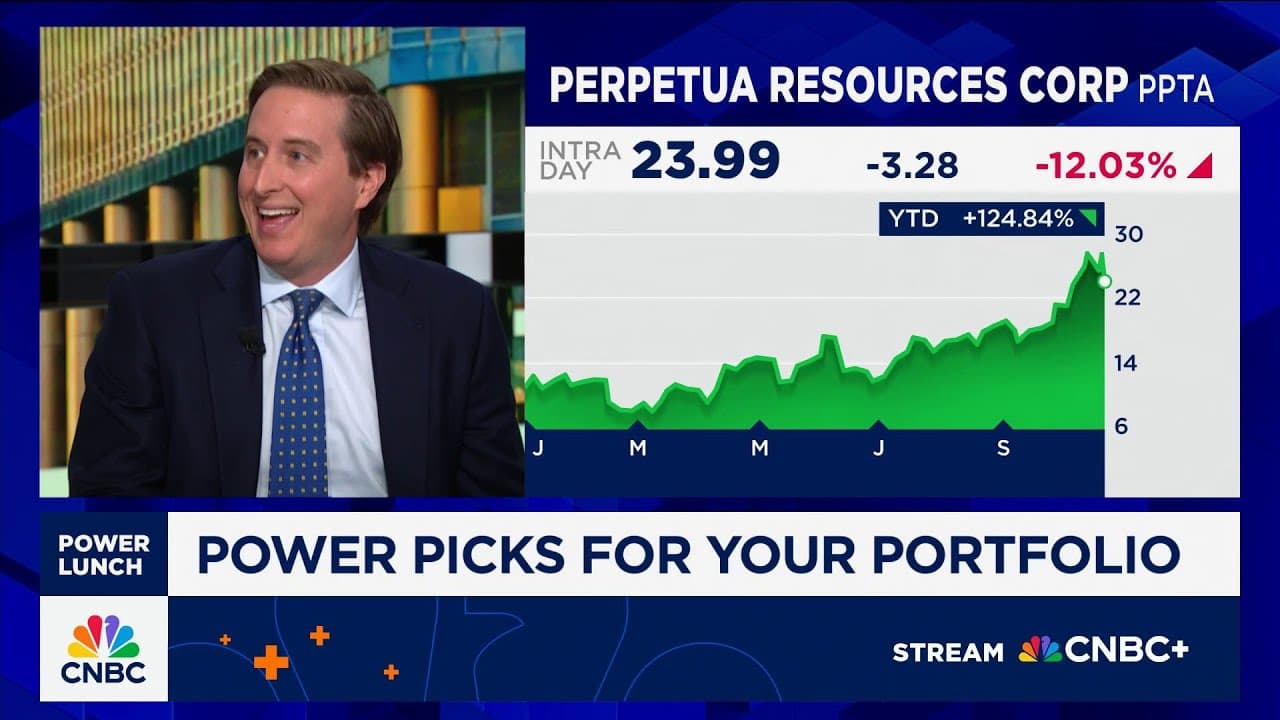
Tyler Rosenlicht, Cohen & Steers fund manager, joins 'Power Lunch' to discuss what are big opportunities for Rosenlicht, how the uranium buildout will happen and much more.