
加载中...
共找到 24,783 条相关资讯

The merger puts the billionaire entrepreneur's rocket and artificial-intelligence companies under one roof.


The Dow industrials gained 1.1%, boosted by a strong U.S. manufacturing report. Gold ended 1.9% lower, while silver is down 33% over the past two sessions.

Elon Musk plans to merge SpaceX with xAI, according to people familiar with the matter. The combined company would have a valuation of $1.25 trillion according to sources.

Elon Musk's SpaceX reportedly combining with xAI ahead of potential IPO
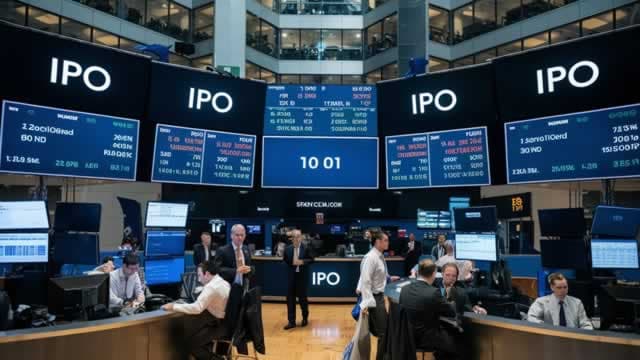
Elon Musk plans to merge SpaceX with xAI ahead of its IPO, with a combined valuation of $1.25 trillion, Bloomberg News reported on Monday, citing people familiar with the matter.

AI investing doesn't have to mean paying triple-digit multiples. These five value-oriented stocks offer exposure to the AI boom through power, infrastructure, and legacy industries.
Operator: Good day, ladies and gentlemen. Gigi: And welcome to the Fourth Quarter 2025 Hess Midstream Conference Call. My name is Gigi, and I will be your operator for today. At this time, all participants are in a listen-only mode. After the speakers' presentation, there will be a question and answer session. To ask a question during the session, you will need to press star 11 on your telephone. You will then hear an automated message advising your hand is raised. To withdraw your question, please press star 11 again. Please be advised that today's conference is being recorded for replay purposes. I would now like to turn the conference over to Jennifer Gordon, Vice President of Investor Relations. Please proceed. Jennifer Gordon: Thank you, Gigi. Good morning, everyone, and thank you for participating in our fourth quarter earnings conference call. Our earnings release was issued this morning and appears on our website www.hessmidstream.com. Today's conference call contains projections and other forward-looking statements within the meaning of the federal securities laws. These statements are subject to known and unknown risks and uncertainties that may cause actual results to differ from those expressed or implied in such statements. These risks include those set forth in the risk factors section of Hess Midstream's filings with the SEC. Also, on today's conference call, we may discuss certain GAAP financial measures. A reconciliation of the differences between these non-GAAP financial measures and the most directly comparable GAAP financial measures can be found in the earnings release. With me today are Jonathan Stein, Chief Executive Officer, and Mike Chadwick, Chief Financial Officer. I'll now turn the call over to Jonathan Stein. Jonathan Stein: Thanks, Jennifer. Welcome everyone to our fourth quarter 2025 earnings call. Today, I will review our 2025 performance, our 2026 and long-term guidance issued in December, and then I'll hand the call over to Mike to review our financial performance for the fourth quarter and guidance. In 2025, we continued our record of strong performance execution, completing our multiyear projects on time and on budget, and strategically growing our gas gathering and compression system. With the system now substantially built, our projected capital spending will be significantly lower. In 2026, we expect to spend approximately $150 million, a 40% reduction in capital spending relative to 2025. We expect our capital spend to decrease even further in 2027 and 2028 to less than $75 million per year. This lower capital highlights our ability to leverage our historical investments to drive significant free cash flow generation that supports our unique combination of shareholder return and balance sheet strength through a combination of targeted 5% distribution per Class A share growth through 2028, potential incremental share repurchases, and debt repayment. Now turning to Hess Midstream results. Fourth quarter volumes were generally flat year over year, but down relative to the third quarter due to severe weather through the month of December. Gas processing volumes averaged 444 million cubic feet per day. Crude terminaling volumes averaged 122,000 barrels of oil per day, and water gathering volumes averaged 124,000 barrels of water per day. For full year 2025, Hess Midstream's gas processing volumes averaged 445 million cubic feet per day. Crude terminaling volumes averaged 129,000 barrels of oil per day, and water gathering volumes averaged 131,000 barrels of water per day, resulting in full year adjusted EBITDA of $1.238 billion. Looking forward, for 2026, we expect lower volumes across our systems as severe winter weather has continued through January and into February, together with normal contingencies for the rest of the winter period. On a full-year basis, we are reiterating the volume guidance that we gave in December for the full year of 2026 and expect growth in volumes across our systems through the rest of the year consistent with historical seasonal volume expectations. With revenues that are approximately 95% protected by MVCs on a full-year basis, we anticipate net income and adjusted EBITDA to be higher through the rest of 2026 relative to our first quarter guidance. Looking beyond 2026, leveraging our historical investment in infrastructure and consistent with Chevron's optimized development program for the 5% annualized net income and adjusted EBITDA growth and approximately 10% annualized adjusted free cash flow growth through 2028 that is supported by gas volume growth, contracted annual inflation tariff rate adjustments, and lower operating and capital spend. In summary, with adjusted EBITDA growth and a moderating capital program, we expect significant adjusted free cash flow generation in 2026 of $850 to $900 million, reflecting 12% growth over 2025 at the midpoint, followed by annualized growth of approximately 10% through 2028, which we expect to use for incremental shareholder return and debt repayment above and beyond our 5% targeted distribution growth that can be delivered even at already set MVC levels. With that, I'll hand the call over to Mike to review our financial performance for the fourth quarter and guidance. Michael Chadwick: Thanks, Jonathan, and good morning, everyone. Today, I will summarize our financial highlights for 2025, provide details on our first quarter financial guidance and outlook through 2028, which we issued in December. For 2025, we delivered strong results with full-year net income of approximately $685 million and adjusted EBITDA of $1.238 billion. This adjusted EBITDA represents a growth of approximately 9% from 2024. For the fourth quarter, net income was $168 million, compared to approximately $176 million in the third quarter. Adjusted EBITDA for the fourth quarter was $309 million, compared with approximately $321 million in the third quarter. The decrease is primarily due to lower revenues caused by severe winter weather followed by a slow recovery through December, as well as lower interruptible third-party volumes and annual maintenance at LM4. Total revenues, excluding pass-through revenues, decreased by approximately $19 million, resulting in segment revenue changes as follows: Gathering revenues decreased by approximately $11 million, processing revenues decreased by approximately $6 million, and terminaling revenues decreased by approximately $2 million. Total cost and expenses, excluding depreciation and amortization, pass-through costs, and net of our proportional share of LM4 earnings, decreased by approximately $7 million, primarily from lower allocations under our omnibus and employee secondment agreements, lower seasonal maintenance activity, partially offset by higher processing fees, resulting in adjusted EBITDA for the fourth quarter of $309 million. Our gross adjusted EBITDA margin for the fourth quarter was maintained at approximately 83%, above our 75% target, highlighting our continued strong operating leverage. Fourth quarter capital expenditures were approximately $47 million, marking lower fourth quarter activity as well as the completion of our compression build-out. Net interest, excluding amortization of deferred finance costs, was approximately $54 million, resulting in adjusted free cash flow of approximately $208 million. We had a drawn balance of $338 million on our revolving credit facility at year-end. For 2026, we expect net income to be approximately $150 million to $160 million and adjusted EBITDA to be approximately $295 million to $305 million, including the impact of severe winter weather that continued through January and the potential for additional winter weather events through the quarter. We expect adjusted free cash flow in 2026 to increase relative to 2025 as capital expenditures in the first quarter are projected to be lower than the fourth quarter. Turning to our rates for 2026 and beyond, the majority of our systems that represent approximately 85% of our revenues are fixed fee with rates increasing each year based on an inflation escalator capped at 3%. For our terminaling systems, water gathering systems, and a gas gathering subsystem that represents approximately 15% of our revenues, we continue to reset our rates through our annual rate redetermination process through 2033. In general, tariff rates across most of our systems are higher in 2026 than 2025 rates. For the full year 2026, we continue to expect net income of between $650 million and $700 million and adjusted EBITDA of between $1.225 billion and $1.275 billion in 2026, approximately flat at the midpoint compared with 2025. As Jonathan mentioned, approximately 95% of our revenues are covered by minimum volume commitments in 2026. We continue to target a gross adjusted EBITDA margin of approximately 75% in 2026, with total expected capital expenditures of approximately $150 million. We expect to generate adjusted free cash flow of between $850 million and $900 million and excess adjusted free cash flow of approximately $210 million after fully funding our targeted 5% annual distribution growth, which we expect to use for incremental shareholder returns and debt repayment. Looking beyond 2026, we have visible drivers, including gas volume growth, that continue to make up 75% of our revenues, inflation escalators, and lower capital spend, that support the guidance we issued through 2028 that results in annualized adjusted free cash flow growth of approximately 10% through 2028 from 2026 levels, generating approximately a billion dollars of financial flexibility to continue return of capital to shareholders and pay down debt. This concludes my remarks. We'll be happy to answer any questions. I'll now turn the call over to the operator. Operator: Thank you. And wait for your name to be announced. To withdraw your question, please press 11 again. Our first question comes from the line of Doug Irwin from Citi. Douglas Irwin: Hey, good morning. Thanks for the question. I'm just trying to start maybe with the balance sheet. You've made a few mentions here of debt repayment, maybe taking more of a priority this year. Historically, I know you've pointed to about three times being the optimal level for Hess Midstream. Just curious, is that still the right way to think about it? Or are you maybe targeting a lower level today? And if so, could you maybe just provide some more commentary around maybe what drove that decision and then how that might impact capital allocation decisions here moving forward. Michael Chadwick: Can I take that one, Jonathan? So we plan to use a portion of our future free cash flow after distributions to pay down debt as the guidance in December indicated. And the conservative financial strategy we're following there is consistent with our volume profile and Chevron's target of 200,000 barrels of oil per day plateau production in the Bakken. So we'll still have a balanced strategy. So that includes the incremental return of capital beyond our 5% annual distribution growth and balance sheet strength. So in terms of our three times leverage, we will expect to naturally delever below the three times in the next few years. Our EBITDA will grow, we won't be increasing the absolute level of debt. So with some portion of our free cash flow after distributions being used for debt repayment, we expect to delever below this level of three. As we said in our December guidance release, we're also funding incremental shareholder returns for free cash flow after distributions, rather than leverage buybacks. And so it's just a bit more of a conservative approach that we're following that is in line with our profile and Chevron's target of 200,000 barrels of oil per day plateau. Having said that, we've got significant free cash flow that we see being generated that'll enable both the pay down of debt and further distributions back to shareholders. Don't know, Jonathan, if you want to add anything there. Jonathan Stein: Nope. That was great. Understood. Thanks for that. And then a follow-up maybe just on the third-party outlook. We've heard commentary from at least one big player in the Bakken talking about scaling back activity in the current crude environment. Just curious what you see is the impact to Hess Midstream there, if at all. And if you could maybe just provide a bit more commentary around what you're hearing from third-party customers in general? And then I guess tying on to that, I know you mentioned the 200,000 barrel oil equivalent day from Chevron, which they've kind of stood by. I guess, is there an environment where that outlook might be at risk in your view based on the discussions you've had with them? Sure. Michael Chadwick: Okay. So on the third party, really no change to our outlook there. So expecting 10% on average across oil and gas. Of course, you know, quarter to quarter, that could have, you know, some variability. You know, if you go back to the third quarter of last year, we had probably higher. We did have higher third parties as there was maintenance on northern border, and we're able to provide additional optionality for third parties to able to do additional routes, alternative routes to get to northern border. As well as optionally for other takeaway. So from time to time, it may feel a bit more. Time to time, a little bit less. But on average, we expect to continue to see 10% third party as part of our volumes and no change to that going forward. In terms of the 200,000, I mean, no change there. You just heard Chevron recently just Friday on their call, reiterating the 200,000 above a day target with continued optimization program. And I think it's important to highlight the guidance that we've given out in terms of the volume guidance and the EBITDA growth to 2028. As well as reduced capital spending with that supports our free cash flow growth over this period is also consistent, you know, with that plan. So no change there expected, and we're continuing to, you know, work with Chevron to work through the optimized and optimize our volumes as well. Understood. Thanks for the time. Operator: Thank you. One moment for our next question. Our next question comes from the line of Jeremy Tonet from JPMorgan Securities LLC. Elias Jossen: Hey. Good morning, everyone. This is Eli on for Jeremy. Wanted to get a sense of growth drivers further out in the forecast horizon. In that 2028 time frame, how much of the outlook is based on cost cutting and how does that contribute to the growth outlook? Jonathan Stein: Sure. Let me just start and say that, you know, as we look forward, right, as I just mentioned, the plan that we've given out, the guidance, which includes the EBITDA growth and net income growth as well as our free cash flow growth, is consistent with the plan that Chevron laid out. You know, that growth in terms of EBITDA is really driven by inflation escalators, a bit of growth in gas as well. And then the free cash flow growth is also increasing even more than that as a result of reduced capital as we go from our, you know, complete the infrastructure build-out and move to even a lower capital level going forward. So down to $150 million this year, 40% lower than $75 million in 2027-2028. So those are really the drivers of the growth. And I think, you know, I think it's important as we think about this long term and the business line going forward for Hess Midstream. We've gone through a period here of transition and gone through a period here of integration with Chevron. And while, you know, many things have changed as we've optimized our plan together with Chevron, I think it's also important to highlight take a moment just to highlight the unique combination of elements that's still a part of our plan. That includes significant free cash flow generation, leveraging the historical spend with significantly lower capital that I just talked about that driving that 10% free cash flow growth through 2028. We have distributions that have continued to target to go at 5% per share annually. Fully funded by free cash flow, and able to achieve that growth even at MVC level. And we have significant free cash flow distribution free cash flow after distribution that supports, as Mike said, both incremental shareholder returns and balance sheet strength. And all of this is consistent, as we said, with Chevron's development plan that targets 200,000 BOE per day with continuing opportunities for our optimization as well as 95% MVC revenue protection this year in 2026. And 90% MVC revenue protection 2027. So, you know, we've talked a lot about changes as a result of transition. But I think it's important to highlight that we continue to have the element of visibility and consistency, the shareholder returns, and balance sheet strength. That have been and continue to be the hallmark of Hess Midstream and really a differentiator in the strategy. So when we talk about the long term for Hess Midstream, while things have changed, it's really a lot more of the same unique combination that has always been our hallmark. Elias Jossen: Got it. That's great color. Thanks. And then maybe just to pick up on some of the remarks you made about CapEx just there. How low could we see CapEx actually be flexed? I think you've given some parameters around it, but just get a sense of, you know, how low that could get. Thanks. Michael Chadwick: Yeah. Sure. So in the first quarter, you know, we're expecting CapEx, as I said in my remarks, to be lower than the fourth quarter. And, you know, we've guided $150 million for 2026 and $25 million of that is for completing the compression and gathering pipeline build-out. Then we've got about another $125 million for the gathering systems and well connects and maintenance. Guided that in 2027 and 2028, we expect to be about $75 million, if not lower, and, you know, this is a trend that is following the reset that we said earlier about 2026. Following the rigs coming down from four to three from Chevron, and, you know, it's consistent with that plan. Jonathan, I don't know if you want to add any further color on that. Jonathan Stein: Yeah. The one thing I would just add is, you know, there's been a lot of discussion, obviously, we're as we've kind of gotten to the end here of our big build-out, you know, we really spent years building out our gathering and compression system. And just a couple of things to highlight. First is our ability now to go to this lower CapEx level really leveraging the historic investment. First is a function of the partnership that we have, the tight integration that we have with Chevron that historically with Hess and now with Chevron, that allows us it has allowed us to optimize our upstream and midstream investments so we don't overbuild and overinvest. And that's the result of that is one of the best EBITDA build multiples in the sector. The second thing I would say is that as Chevron talked about the development plan and optimizing the plan, that is also driving, of course, lower CapEx for us. And you know, one of the things just as an example, you know, as you heard Chevron talk about having increasing percentage of longer laterals. So if you think about that from our point of view, longer laterals, you know, not only make the wells more economic, so significantly increasing the breakeven, but also, in general, produce the same volume but with less wells reducing our well connect capital requirement. So also, a very positive effect there. So all that means that, you know, we can really continue to see this downtrend. This year, we have a little bit left to do in terms of pipeline. Build out at $150 million, still 40% less than last year. And then we're moving down to a much lower level at that less than $75 million on an ongoing basis as we really just have ongoing capital going forward to support the system and drive the significant free cash flow that comes out of this business model. Elias Jossen: Great. Thanks for all the color. I'll leave it there. Operator: Thank you. One moment for our next question. Our next question comes from the line of John Mackay from Goldman Sachs and Company. John Mackay: I think a lot of them have been answered. I want to just zoom in a little bit more on the weather piece. Is there any way you can kind of give us a snapshot of what you're seeing on the ground right now? Particularly, are you seeing, you know, some of the issues we've seen in past years with power down, etcetera? Or once the weather to improve a little bit or once the temperatures start to improve a little bit, should we start to see production coming back online? Maybe just frame it for us relative to maybe some prior years. Jonathan Stein: Sure. Yeah. I don't think this is yeah. You think back a few years ago where we had, you know, the significant power, you know, power lines down across the state, and, you know, that really went on for, you know, the first half of the year. We're really just seeing, you know, significantly extreme cold weather, you know, some snow, but really the cold, which has an impact on our system across the board. And so particularly on the gas side. So you know, that, I think, as we do start to see improving weather, certainly, that would be helpful, and that, you allows more activity to occur and also just to begin the recovery in terms of getting more production online and getting our making our system optimizing it back again. So we do still have in our, as we mentioned, contingencies, you know, in the I'd say the weather has continued certainly all through the month of January and a bit here into February, just getting started. You know, we have continued contingencies in our in our forecast. In our guidance, you know, for the rest of the winter. But, certainly, you know, as we come out of the winter, certainly, as we talked about, we expect to see increasing volumes seasonally as we get into the second and third quarter. I don't know, Mike, you want to just talk about the rest of the year? Michael Chadwick: Yeah. I think we, you know, as Jonathan said in his opening remarks that we're gonna see this the first half of the year's volumes lower than the second half. So there'll be a pickup in the second half of the year. One thing I'd highlight, though, is, obviously, we're at 95% coverage with our MVCs. So there's a floor. You know, production were to be lower, we've got 95% covered with MVCs, and that translates into 2027 as well at 90%, you know, before getting to 80% in 2028. So there's good protection for a many downside. Know, in terms of phasing, as Jonathan's described, you know, first quarter, we've been, you know, hit by the weather, and we'll be recovering from that. Second and third quarters are typically better months, and we'll get more production from that. And then the fourth quarter, we typically dial in some conservatism, because we start getting back into winter weather again and the OpEx again there as well. Will have an element of reduced and that's just phasing, seasonal phasing. John Mackay: That's great. Appreciate all the color. Super quick second one for me. Just following up on Doug's question. Apologies if I missed it. But do you guys have a kind of longer-term leverage target in mind now specifically? Or is it just a, hey. We expect to kind of, you know, put some more cash towards that over time and delever as EBITDA grows. Just trying to think if you have a new target. Yeah. Michael Chadwick: Yeah. I think what we're planning to do over the next three years with our free cash flow after distributions is just use that to both strengthen the balance sheet by delivering by paying down debt, and including that as of our fundamental, you know, incremental shareholder returns. So it's not a designed level that we want to get to. It's just gonna naturally occur that as EBITDA starts to build a backup, as we don't increase the absolute level of debt, and as we include some free cash flow towards paying down debt, our 3%, you know, our three times leverage is naturally gonna delever. But there's no specific target we're gonna get to. One of the key things that Jonathan's highlighted, obviously, is the free cash flow that we expect to generate over the next three years. And that's gonna be substantial in the context of being able to fund not only our growth of 5% on distributions within the MVCs, but also to pay down debt and also provide shareholder returns, you know, over the next few years supported by our strong MVC position. John Mackay: Alright. Got it. Thank you for the time. Appreciate it. Operator: Thank you. At this time, there are no further questions. This concludes today's conference call. Thank you for participating. You may now disconnect.

Operator: Good morning, and welcome to the Tyson Foods First Quarter 2026 Earnings Conference Call. All participants will be in listen-only mode. Should you need assistance, please signal a conference specialist by pressing the star key followed by zero. After today's presentation, there will be an opportunity to ask questions. To withdraw your question, please press star and then two. Note this event is being recorded. I would now like to turn the conference over to Jon Kathol, VP, Investor Relations. Please go ahead. Jon Kathol: Good morning, and welcome to Tyson Foods First Quarter Fiscal 2026 Earnings Conference Call. On today's call, Tyson's President and Chief Executive Officer, Donnie King, Chief Financial Officer, Curt Calaway, and Chief Operating Officer, Devin Cole, will provide prepared remarks. Following the prepared remarks, we will have a Q&A session with participants who will be joined by our Chief Growth Officer, Kristina Lambert. We have also provided a supplemental presentation, which may be referenced on today's call and is available on the Tyson Foods Investor Relations website and via the link in our webcast. During today's call, we will make forward-looking statements regarding our expectations for the future. These forward-looking statements made during this call are provided pursuant to the safe harbor provisions of the Private Securities Litigation Reform Act of 1995. Forward-looking statements include all comments reflecting our expectations, assumptions, or beliefs about future events or performance that do not relate solely to historical periods. These forward-looking statements are subject to risks, uncertainties, and assumptions which may cause actual results to differ materially from our current projections. Please refer to our forward-looking statement disclaimers on Slide two as well as our SEC filings for additional information concerning risk factors that could cause our actual results to differ materially from our projections. We assume no obligation to update any forward-looking statements. Today's segment results are presented on a segment operating income level and will be discussed on an adjusted basis. The primary difference between segment operating income and the method used in previous quarters is that we will no longer allocate corporate expenses and amortization down to the segment level. Donnie and Curt will share more thoughts on the change in their prepared remarks. We have recast previously reported quarterly results for the previous three fiscal years to reflect the new format. The segment change has no impact on consolidated historical U.S. GAAP financial results. The recast financial information is accessible through the events and presentation section of the company's investor relations website at ir.tyson.com. Please note that the references to earnings per share, segment operating income, operating income, and operating margin in our remarks are on an adjusted basis unless otherwise noted. For reconciliations of these non-GAAP measures to their corresponding GAAP measures, please refer to our earnings press release. Now I will turn the call over to Donnie. Donnie King: Thank you, Jon. Thanks to everyone joining us today. Before walking you through our first quarter results, I want to remind everyone of what we are building at Tyson Foods. A diversified, protein-centric company positioned to capture growing demand for high-quality protein. We are driving operational excellence, investing in our branded portfolio and innovation to capture market share, and deploying our capital strategically to strengthen our competitive position. Our Q1 results, with sales increasing to more than $14 billion, demonstrate our initiatives and our strategy are clearly working. We are driving operational excellence daily, and the team is energized for what's ahead. As Jon mentioned, we've made an important change to our segment reporting measure from adjusted operating income to segment operating income. This will allow you, the investor, to see the results in the same manner that I utilize to judge the effectiveness of our business decisions and accountability for the choices we make. This empowers our business leaders to pursue volume growth and enhance their decision-making based on a more direct view of the impacts of those decisions without corporate expenses and amortization, which are more fixed in nature. Of course, we will continue to focus on reducing this spend and maximizing efficiencies in our corporate functions. On the businesses, prepared foods took another step forward this quarter with sales increasing in volume, channel mix, and pass-through pricing. Segment operating income increased to $338 million. Importantly, our products are winning in the marketplace during a clearly dynamic consumer backdrop. Our prepared foods business is capturing more market share by volume and dollars, driven by increased brand investments and targeted MAP spending that is showing favorable returns. Our production facilities continue to make performance improvements through operational efficiencies. The chicken segment delivered another strong quarter with $459 million in segment operating income, a margin of 10.9% in a less favorable operating environment. These positive sales and earnings gains were fueled by more efficient marketing and promotional expenses. Results are becoming increasingly more sustainable and predictable with plenty of untapped potential in areas we can control within the business. Chicken is an affordable, high-quality protein, and our value-added offerings position us uniquely to serve both retail and food service customers. In the first quarter, we announced a strategic decision in our beef business to close our Lexington, Nebraska facility and scale back operations at our Amarillo, Texas plant to a single shift. These changes were implemented in January, and as a result, our first quarter results do not reflect the impact of these operational adjustments. We recognize the impact on people's lives, and we did not make them lightly. At the same time, we made this necessary choice to rightsize our beef operations with a smaller and more efficient footprint, higher capacity utilization, and stronger alignment with the long-term outlook for the U.S. cattle herd. These decisions position us to improve our overall beef capacity utilization and to compete more effectively in the beef business, both now and in the future. Continuing to absorb losses like we have been seeing for the past two years is simply unacceptable. Looking forward, we expect cattle supplies to remain tight throughout 2026 and 2027. During this period, chicken is likely to continue to benefit most from the changing consumer preferences both at retail and in food service, and we are obviously well-positioned to win. Devin Cole: Once again, our pork segment performed well, Jon Kathol: in a stable operating environment. We continue to increase yield and revenue by developing more value-added products. All parts of the pork value chain, from hog supply, pork production, through retail and food service customers, are in relative balance, allowing for more predictable and stable operating margins. Finally, our international segment continued its momentum and had another good quarter. Now let me share with you why we are very well positioned relative to what's occurring in the food industry. A recent development beneficial for Tyson Foods was the release of the new U.S. dietary guidelines. As you are aware, healthcare costs are rising, and it's important to have viable solutions to combat the challenge of obesity and inadequate nutrition. These updated guidelines and recommendations represent a historic validation of our core mission: providing high-quality essential protein to millions. By advocating for increased animal protein consumption as a leading pillar of a healthy lifestyle, the administration has underscored what we have always known: animal protein is a foundational building block of a nutritious diet. As a producer of one out of every five pounds of chicken, beef, and pork in the United States, Tyson Foods is uniquely positioned as the leader in this real protein space. And as the demand for protein continues to increase, Tyson Foods will be there to meet this demand. These policy recommendations underscore how public health priorities and consumer demand for high-quality protein are moving in the same direction. And even in a dynamic economic environment, protein remains essential in the grocery cart, with consumers continuing to favor chicken, beef, and pork. The updated guidelines also recommend limiting artificial flavors, petroleum-based dyes, and artificial preservatives. At Tyson Foods, we have been ahead of this curve and have already proactively removed petroleum-based synthetic dyes and other ingredients, including high fructose corn syrup, across our U.S. branded portfolio. By simplifying our labels and using the same ingredients you find in your pantry, we are providing consumers what they are looking for: protein. It's real food that tastes good and is good for you. And we are confident that this commitment to quality will continue to drive superior value for our customers and our shareholders. Let me now tell you about how we are winning in the market. According to Nielsen data, total category food and beverage retail volume declined 1.8%, with dollars up 0.9% over thirteen weeks ending in December. In contrast, our retail branded products, which include our national and regional brands, grew by 2.5% in volume and 3.6% in dollars, significantly outperforming the broader sector. This retail growth was broad-based, highlighted by strong volume performances across several national and regional brands and categories. A few examples include Tyson national and regional branded fresh chicken, up 10.7%, Hillshire Farm lunch meats increased by 10.4%, 12.5%, and 7.2%. In addition to the volume growth, all four grew dollars and share. We are also performing well in food service, with share gains and volume growth of 27 basis points. Our ongoing investments in innovation, wider distribution, and effective targeted marketing are driving growth and keeping us competitive, providing substantial opportunities for further progress. As more shoppers turn to the perimeter of the store, we are meeting their demand for fresh, high-quality options. Operator: This is why it matters. Jon Kathol: Demand for Tyson Foods products continues to grow, and we are well-positioned to capture this momentum. While some companies face challenges in generating demand, our share gains demonstrate both our strength and our expectation for further growth. An essential driver of our ongoing and future success. Our focus on protein-centric offerings combined with disciplined capital allocation enables us to accelerate expansion, optimize operations, and reinforce our supply chain and marketing capabilities. As a ninety-year-old American company, we provide durability, trust, and strategic continuity across cycles. These strengths allow us to deliver lasting value to our customers, consumers, team members, and shareholders. Operator: Looking ahead, Jon Kathol: the opportunities before us are more promising than ever, and I am very confident in our portfolio and in our strategy. With that, I'll turn it over to Devin to take you through the segments in more detail. Devin Cole: Thank you, Donnie, and good morning. In the first quarter, our team made tangible progress toward our strategic objectives. We remain committed to delivering best-in-class performance and holding ourselves accountable to our customers' and consumers' expectations. Now let's review our segment performance. Prepared Foods delivered a strong quarter with sales up 8.1% versus last year. Growth was driven by volume, channel mix, and pass-through pricing. Segment operating income was $338 million, up $16 million versus the prior year, reflecting continued progress on our multiyear plan to enhance profitability in this business. And we see more ahead. Our fill rates in prepared foods remain solid, but with room to improve, reflecting the improved S&OP process and unlocking efficiencies in our plants and distribution systems. Our retail businesses outpaced the category in volume, dollars, and units, leading to share growth in all three measures. This has enabled us to better serve our strategic customers with greater consistency and reliability. The progress achieved in the quarter was expected and has laid the groundwork for an exciting 2026. Growth in prepared foods is important to us as it grows our customers' business, expands the reach of our brands, and utilizes a sizable portion of our raw material availability. We see significant opportunities ahead to drive growth and improve profits. Our conviction in this multiyear opportunity to expand profitability in prepared foods remains strong. Our Chicken segment delivered a strong first quarter, in line with the prior year with a significantly more challenging operating backdrop, demonstrating the resilience of our business model and disciplined execution. Demand for chicken remains strong. Our diversified pricing strategies and product mix kept average selling prices steady, offsetting declines in commodity prices and disruptions from the temporary government shutdown. The efforts helped us overcome market volatility and achieved 3.6% year-over-year sales growth driven entirely by volume and strong consumer demand for chicken. This marks our fifth consecutive quarter of year-over-year volume and net sales gains, underscoring sustained demand for chicken and continued momentum of our strategic customer partnerships. While the retail channel saw strong growth across fresh and value-added products resulting in growth across nearly all retail sub-channels, we also saw strength in our foodservice business, led by solid results with QSR and distribution customers as consumers increasingly opt for value-oriented protein choices. Segment operating income for the chicken segment reached $459 million, driven by improvements in live performance along with strong volume expansion and continued operational excellence. These factors enabled the chicken segment to deliver consistent operating income, further validating our confidence in the long-term durability and resilience of our business model. In our beef segment, we remain focused on the factors within our control as we navigate a challenging and dynamic market environment. Beef sales increased, reflecting continued healthy consumer demand. As Donnie mentioned in his remarks, we announced changes to rightsize our beef business. These moves were completed after the close of our first quarter. Both moves are in response to the ongoing challenges of a tighter U.S. cattle supply, and we believe these moves align us to compete more effectively this year and over the long term, with a smaller production footprint and a higher capacity utilization. We expect to benefit in coming quarters from the effect of the actions taken. Segment operating income declined compared to the prior year, as higher cattle costs more than offset higher cutout values and continued high consumer demand. While navigating the headwinds, we remain committed to the elements we can control, like optimizing our operational footprint, as well as seeking out alternatives to improve our long-term results. In the pork segment, operating income margin increased 220 basis points to 6.7%, fueled by network optimization and operational efficiencies. Hog supplies were adequate during the quarter, and projections for an ample supply appear favorable for the upcoming year. The accessibility of pork raw material for our prepared food division is a key part of our end-to-end pork strategy. We have made substantial progress in utilizing raw materials like pork bellies to supply our branded bacon, and to supply lunch meat, and trimmings to supply sausage. We will continue to push for higher utilization as it will improve access, quality, and landing cost for our raw materials. Overall, I am encouraged by the incremental steps we have taken in the first quarter, and I am confident that we have room to grow and improve across the operational and aspects of our business in 2026 and beyond. We are focusing on our strategic customers and consumers while delivering value to our shareholders. With protein remaining a clear winner in the mind of consumers, the diversity of our portfolio enables us to make investments by partnering with our strategic customers to drive category expansion. With that, I will turn it over to Curt to walk through our financial results and outlook in more detail. Curt Calaway: Thanks, Devin. As mentioned earlier, our first quarter results reflect the change in financial metrics, as we are now referring to segment operating income, which excludes corporate expenses and amortization at the segment level. Operator: For comparative purposes, Curt Calaway: all historical results and comparisons presented have been updated to reflect this change. As Donnie mentioned, the reason for this important change is to report results in the same manner that our decision maker utilizes to assess business performance and allocate resources. We believe this provides investors with an increased level of transparency and it enables them to better compare our results to other food producers. For the first quarter, total company sales grew 6.2% to $14.3 billion compared to the prior year, led by beef with solid contributions from prepared foods, chicken, and pork, reflecting the healthy demand environment for protein. Operator: For comparative purposes, Curt Calaway: the sales increase was calculated excluding the effect of a $100 million legal contingency reserve that was recognized in the quarter. First quarter segment operating income was $811 million, down 12% compared to the prior year, driven primarily by the decline in our beef segment, partially offset by growth in our other businesses. Operator: Additionally, Curt Calaway: corporate expenses and amortization were lower by $20 million or 7.7% compared to the same period last year. Adjusted earnings per share for the quarter were $0.97, down 15% compared to last year, some of which was driven by a higher tax rate. Our multi-protein, multi-channel portfolio combined with our team's focus on operational execution in a dynamic macro environment performed well compared to the overall food industry during the quarter. Turning to our financial position, our approach to capital allocation remains disciplined, Operator: deliberate, Curt Calaway: and forward-looking. And we have a strong balance sheet. We are focused on maintaining financial strength, investing in the business, and returning cash to shareholders. Free cash flow is critical to us, and I am pleased with how cash trended in Q1. First quarter operating cash flow was $942 million and capital expenditures were $252 million, resulting in free cash flow of just under $700 million, well ahead of dividends for the quarter, which were $177 million. We ended the quarter with $4.5 billion in liquidity, and net leverage declined to 2.0 times, an improvement of a tenth of a turn since year-end. If you step back and look at our balance sheet and leverage over the last few years, we've made immense progress strengthening our foundation. In fact, we have reduced gross debt by $1.4 billion over just the last twelve months. With leverage continuing to decline and cash flows remaining strong, we continued share repurchases of $47 million during the quarter, and we returned $224 million to shareholders through a combination of dividends and repurchases. Our balance sheet remains healthy Operator: as we prioritize financial strength, Curt Calaway: our investment-grade credit rating, and cash management to drive long-term shareholder value. Let's take a moment to review our outlook for 2026. As a reminder, our accounting cycle results in a fifty-three-week year for fiscal 2026 as compared to a fifty-two-week year in 2025. The 2026 outlook is based on a comparative fifty-two-week year. We still anticipate full-year sales to be up 2% to 4% year-over-year. We expect the range for total company adjusted operating income to be between $2.1 to $2.3 billion. We anticipate interest expense of approximately $370 million and a tax rate of around 25%. We remain disciplined in managing cash, with CapEx expected to be $700 million to $1 billion and free cash flow in the range of $1.1 to $1.7 billion. The improved outlook in free cash flow is mostly associated with expected improvements in working capital compared to our prior outlook. Now to provide more color on our segment outlook. Based on the continuation of a tight cattle supply, we expect segment operating income in beef to be a loss of $500 to $250 million. The beef outlook does not include costs related to facility closures. We anticipate segment operating income for pork to be $250 to $300 million based on an adequate supply of hogs, continued productivity and operational improvements, and robust consumer demand for pork. We anticipate our segment operating income for chicken to be $1.65 billion to $1.9 billion. We believe chicken will be a preferred protein in the upcoming year. We also expect our operational execution and performance to continue to perform at a high level. In prepared foods, we expect segment operating income to be $1.25 billion to $1.35 billion. We expect a continuation of improved performance this year because of ongoing operational discipline and strategic investments in our categories. Our international segment performed well last year by managing controllable costs, maximizing efficiencies, and lowering conversion costs. Operator: We expect a continuation of these metrics in 2026. Curt Calaway: And segment operating income in international to be $150 to $200 million. Corporate expenses and amortization are anticipated to be $950 million to $975 million. These results align with the total company adjusted operating income range of $2.1 to $2.3 billion. Overall, I'm pleased with the first quarter's performance and confident that 2026 will be another strong year for our company. That covers our segment performance, financial highlights, and outlook for 2026. Now I will turn the call over to Donnie. Donnie King: Thanks, Curt. In the first quarter, our team successfully navigated a dynamic and challenging market landscape. These achievements are a direct result of our collective dedication, and we look forward to building on this momentum as we move further into 2026. I want to extend my deepest gratitude to every team member at Tyson Foods. Operator: It is your passion Donnie King: dedication, and unwavering commitment to our purpose that makes me most excited about our future. Together, we have a unique responsibility and privilege to feed the world like family by providing high-quality protein that not only tastes good but is nutritious, affordable, and convenient. Our purpose is about more than providing food. By providing protein, we have the ability to support good health. This shared purpose is what drives us forward and is the foundation of the future we are building together. With that, I'll turn things back over to Jon as we begin the Q&A session. Operator: We will now begin the question and answer session. To ask a question, you may press star then one on your touch-tone phone. If you are using a speakerphone, please pick up your handset before pressing the keys. To withdraw your question, please press star and then two. Please limit yourself to one question and one follow-up. If you have further questions, you may reenter the question queue. The first question comes from Ben Theurer with Barclays. Please go ahead. Ben Theurer: Yes. Good morning, and thank you very much for taking my question. Donnie, Devin, Curt, congrats on a good first quarter. Operator: First question I'd like to kick it off. Obviously, the change in some of that segment reporting versus adjusted reporting. Maybe if you could explain to us a little bit more the rationale behind that and, like, the management incentives on a per business level. And if there's any relationship from that into what the free cash flow change is, you've briefly mentioned working capital, so maybe there is something connected here. I would like to understand the rationale behind how to manage a business and what's ultimately then driving that free cash flow revision? That would be my question. Thank you very much. Donnie King: Thank you for the question, Ben, and good morning. Great question. And so let me start with the change was very intentional. It was on purpose. And let me back up a little bit and give you some of the rationale, that you know, for why I wanted it changed. And so let's start with if you go back a number of quarters ago, we talked about the fact that we were going to turn over every rock in this organization to be the best in class in terms of food companies. And we've been doing those things. There are a lot of proof points relative to that. One of the issues that we've had is, and particularly over the last couple of years as it relates to beef, is volume. So very simply, this. I needed the organization to grow this business, to grow volume in this business, grow it in our branded and value-added increase household penetration with consumers. And in order to do that, I kept bumping up against the fact that people would say things like, you know, this corporate overhead structure is, you know, I'm uncompetitive in the market, all these different things. And so here's the math very simply behind that. And why we did this. This is how we run the business. But before we make the first sale every week, before we turn on the first machine at Tyson Foods, every week, we're sitting with something on the order of a billion dollars in amortization and corporate expenses. Now corporate expenses make up about 80% of that, amortization about 20%. It is largely fixed in nature. And so, therefore, we start every week with about $20 million of fixed cost before we sell the first pound or produce the first pound. And so very simply, I wanted to move that barrier to our organization in terms of trying to sell and grow our business. And particularly in light of the fact that there is less beef production at the same time. We're employing, you know, an ROIC mentality. But it has energized our organization. And in fact, if you look at where we are at this point, we're down 8%, and we're just announcing it to you. But it gave me visibility that I needed. It gave those business leaders across the organization and function leaders to be able to see where, through an activity-based process, where we could manage our business better. And very simply, it was a matter of looking at things and saying, does the shareholder want to pay for this? Does a customer want to pay for this? Are they willing to pay for it? Is the consumer willing to pay for this? So all of those type things will add into this decision. Now just changing from AOI to segment operating income doesn't change anything. But what we did was expose what those corporate expenses are. And at the same time, we worked on some of those that are embedded in the cost structure and in businesses as well. But it was to simplify how we look at the business and be a catalyst for us growing the business. Let me see if you want to add anything to that too. Curt Calaway: Yeah. Thanks, Donnie. And, Ben, great question. I think think about the change today is more of the journey where we've been the last couple of years. We intentionally moved away from a return on sales percentage of a business a couple of years ago and really focused on dollar contribution of each of our businesses. And we did that in certainly how we talk, but also how we provide guidance to you. While not as apparent, but Donnie mentioned it, we've over the last couple of years also had a very renewed internal metric and focus on return on invested capital. In today's changes, as we're sharing with you and we've changed internally, this past quarter as well, is very intentional in setting us up to be very focused from a growth standpoint and a clarity standpoint. Hopefully, it gives you a little bit of intel. But I think the other part of your question was around improved free cash flow and perhaps whether that was included in or changed as we think about the relative segments. So let me maybe just back up a second and talk about guidance overall. And what changed and what didn't change. And let me just start with clarifying what did not change. So we did not change total company adjusted operating income, which was still $2.1 to $2.3 billion. Sales growth, still positive, up 2% to 4%. And CapEx stayed constant at $700 million to $1 billion. And then adjusted tax rate still at approximately 25%. None of those changed. We, as you pointed out, we did change free cash flow and actually improved it. Now a range of $1.1 to $1.7 billion. And you're right. The working capital performance is a driver of that. Better than we had previously included in our prior forecast for free cash flow. That also aided in reducing interest. Interest expense now on a net basis at $370 million. Partially from that improved free cash flow, partially from capital structure efficiencies that we put in place. But the other changes you highlighted certainly was a new type of guidance at the segment operating income level. Prepared foods $1.25 to $1.35 billion, still a range of $100 million. Chicken, $1.65 billion to $1.9 billion, still a range of about $250 million. International, $150 million to $200 million, still a range of $50 million. Pork, we did narrow the range to $250 to $300 million, really following a good Q1 performance, but also the seasonally usually a little bit better Q1 for us. And beef losses of $500 million to $250 million, so widen the range a little bit. Certainly, in light of a very dynamic beef environment, we widened that loss range a little bit. And then new corporate expenses and amortization a range of $950 to $975 million. But I just finished with Q1 was very much in line with our expectations. And from a total outlook, still a range of adjusted operating income at $2.1 to $2.3 billion. Operator: Okay. Perfect. And then a quick follow-up Ben Theurer: on prepared foods. You've flagged a very strong pricing increase over last year with essentially flattish volumes. But it seems the profit margin is still somewhat under pressure. Can you help us understand where you are in the journey of price increases of some of the food of the input cost inflation that you've been facing, particularly from beef that goes into prepared foods? So where how much more of price increases do you need to push through, and like what magnitude would that be to get a more stable profit margin? Operator: Versus last year? Donnie King: Sure. I'll take that one. And let me start with Ben. Our multiyear strategy is working. Our business is growing, which will create long-term value for the company. Our net sales were up about 8%. So let me touch on that here. The 8% increase was not pure price. The increase reflected a combination of channel mix and formula-based pass-through pricing. A large portion of the food service business is formula-priced. And as raw materials go up, finished goods pricing follows. And there's, of course, a lag with that. So the current state, as you think about commodities, and we talked about this last quarter, our commodity cost in this quarter is up $100 million. But I would tell you that pricing is catching up, which is you're seeing it in sales price. Beef and pork trim remains elevated, and other inputs are stabilizing. So it's predominantly a food service driving. But I would I have to point out this. In terms of growth in our prepared foods business, we grew market share. We grew volume, dollars, and unit share. And this is the fifth consecutive quarter of sequential improvement, but the pricing is not pure pricing. It's our pricing, particularly in food service, catching up with those increase in raw materials. Operator: Got it. Thank you very much. I'll pass it on. Thank you. And the next question comes from Leah Jordan with Goldman Sachs. Leah Jordan: Thank you. Good morning and great job on a nice quarter. I understand protein demand is really elevated right now, which is helpful for you. Operator: But what's really great to see is your branded portfolio across prepared and fresh continue to take share. Just what do you think you're doing differently to position your brands today? Why do you think they're resonating in the current environment, especially when the consumer backdrop has mixed? And maybe how much do you think innovation has been a driving factor as well? Donnie King: Sure, Leah. Good morning, and thank you for the question. Let me start out with the post line. Now thank you for recognizing that. But there's a number of things. Let's start with protein. Protein is a superstar in the story. The execution of the business is which yeah, you can think about it in terms of the traditional labor yield spend, those kind of things. But in terms of using tools in the market or that we have available to us, that we haven't had before you know, we see we see a number of things. For example, we're expanding our core distribution. We are with our customers, our strategic customers that we talk about across all segments, we're doing that with them. We're accelerating innovation and we continue to invest in map. And, so those are the levers, that we're using. So I would give you this statistic which I'm very proud of. It from an organizational perspective. Acknowledging that there's still plenty to do. Tyson Foods was the only food company in consumer staples growing volume and dollar share in the most recent report. The only other one was P&G, which is not in the food space. So I'm very proud of that. Our machine is working. But it's largely execution from one end of the supply chain to the other. And let me pass it on to Kristina Lambert and let her add a little more finer points to this. Kristina Lambert: Yeah. Thanks, Donnie. I think you started out earlier really well talking about our commitment to growing the volume within our businesses. And what you're seeing across our brands is that continued effort to increase household penetration, focusing on younger consumers meeting their needs in unique ways, whether it be renovation of our existing core items or innovating into new spaces to meet those unmet consumer needs. Donnie also talked about the expanded distribution. We've been able to gain increased distribution across our Tyson, Jimmy Dean, Hillshire Farm, Ballpark, all driven by that commitment with our strategic customers our intent to grow our business and their business at the same time. With the new dietary guidelines emphasizing protein, we're really excited about the opportunity for having three of the top 10 brands within the food segment for the U.S. So Tyson, Jimmy Dean, and Hillshire Farms. We are outpacing most of the channels in those strategic customers, again, in retail and food service, our portfolio allows us to meet continued needs as we go on this journey to provide food that tastes good. It's made with ingredients that consumers can find in their own pantry. It'll be nutritious, affordable, and convenient, and those are our commitments. Really excited about the opportunity for Tyson Foods. Thank you. That's very helpful. And then just switching over to beef, given the wider guidance range there, just more color on the trends you're seeing in that segment. Any puts and takes on the potential impact from your recent capacity closures as we think about the next few quarters? I think I heard in the prepared remarks that wasn't reflected fully in the updated guide. And just how are you thinking about capacity for the overall industry as we go forward? Devin Cole: Yeah. Good morning. This is Devin. You know, we continue to be in a very dynamic and volatile situation with the beef segment, as has been mentioned. In the quarter, you know, there are really four key drivers that affect the results in this business. We certainly have cattle costs, which we've talked a good bit about historically and continue to be a challenge. Just due to the general cattle availability. But, also, you know, we have cut out. We have the drop credit. In the manufacturing cost structure. There's really a balance for us between all of those factors, and in this quarter, we did experience, as I mentioned, the higher cattle cost. We also had additional freight impact as we worked to fill the production needs within the regional supply deficits that we saw. And certainly from quarter to quarter, we can and we'll have differences in basis derivatives that we use to risk manage the business. You know what? What I'm proud of this team, despite some very difficult circumstances, is that we are performing well with the metrics we can control. You know, we had heavier weights that did negatively affect cutout values due to body compositions. But they also, you know, help us with our volume. Overall, volume was slightly down. It was down 7.3% in the quarter despite the February waste. So there's pluses and minuses with those factors as well. But, really, all of these weighed into our decision to make changes to the production footprint. You know, we just recently completed these so that would not be anything that would be in the Q1 reporting. Relative to what we expect to see moving forward. You know, I think if you think about the future of this, it's important to point out that the data that we see indicates an ultimate smaller herd. As it does rebuild, which has been historically true for the last several cycles. And the strategic steps we've taken put us in the best possible position to maximize capacity utilization. And, you know, it allows us to increase our efficiencies, reduce our costs, and capture value from improved yields. And, really, you know, as in all of the businesses, as we've talked about, our objective is to be the most efficient and best-performing company. And so we're not only focused on the operational excellence, but continue to work with strategic customers and supply partners to make sure we're optimizing the mix and find innovative ways to add value and convenience for consumers. Curt Calaway: I think as well just one clarification in the question. As Devin had pointed out, right, the announcement of that was obviously in Q1. The activities didn't occur until our second quarter. The comments in the prepared remarks also referenced that our outlook would not include the cost associated with all that closure, obviously, because that is adjusted out as we did in Q1 as well. Leah Jordan: Thank you. That's very helpful. Operator: And the next question comes from Thomas Palmer with JPMorgan. Please go ahead. Thomas Palmer: Good morning. Thanks for the question. Operator: Donnie, I was curious your updated views of the chicken industry. Your tone in recent quarters I think, has been very constructive about supply growth being limited. Sean Cornett: Though in today's prepared remarks, you also referenced a weaker chicken environment in the quarter. Brady Stewart: And the annual outlook was reiterated. So maybe just an update on kind of how you're seeing the market environment? Thanks. Donnie King: Sure. And thanks for the question. Let me start with the begin with the end here, and just tell you that once again, we think that 2026 will be similar to what we saw in 2025. And so that's what we have modeled. But in terms of supply, from an industry perspective, you know, USDA projects a 1% growth in production. We think it's very manageable. You saw some recent excess increases and we think that's also manageable. But the other part of that equation, the demand side of that, demand continues to be strong, and our supply at Tyson Foods, we're in very good balance. I think the industry is in very good balance based on publicly available data. So we're very excited about that, but for Tyson Foods, you know, we think it's a constructive environment. But our confidence in last quarter, this quarter is based on the execution that we have in this business. For example, we did experience some commodity softness in the quarter. And in fact, we talked about a little bit earlier about in 2025, you saw some record recipe prices. I would expect, and we've seen that it's possible there will be some market normalization throughout '26. And there is. You saw mid-December prices move down. On some of the commodities, and they're back up more recently. I just call this typical seasonality. I'm not concerned about that. I think I would also point out, and we have in the past, that at Tyson Foods, we are not tied directly to commodity markets. And so that's also another point that you should be aware of. So we feel very good about it, and it's based on our execution. And every one of our, you know, from hatch, livability, customer relationships, but the secret sauce, if you will, around the Tyson Foods model is that we continue to grow volume. And continue to be aligned with strategic customers. And the execution with those customers in quality service consistency, those type of things is paying huge dividends and it's what we've been working on now for some time. You see the evidence of that in our volume being up 3.8%. And in fact, our volume in Q1 for poultry is an all-time record in terms of volume. But we saw it in places where we told you we wanted to see it. For example, our branded fresh business is up 9%. And our branded frozen is up 12.2%. So very nice job. The other part of that, and it gets back to your question, our net sales were up 3.6%. That's largely mix. But our actual pricing remained flat. Versus the prior year, and so I'll stop or take a pause right there and see if you have a follow-up to that. Thanks. That was really helpful. Sean Cornett: Color. I maybe just pivot a little bit on the now that we're seeing the corporate amortization for the first time, I guess, it guidance would imply it's down at least 4% year over year, I think. What's driving that decrease? Curt Calaway: Or your question is on amortization down year over year. Tom? The sorry. The corporate plus amortization line Sean Cornett: kind of the newly introduced line, I think guidance implies it's down at least 4% year over year. Curt Calaway: Yeah. Yeah. I think acknowledging that the first quarter right, we were down $20 million on a year-over-year basis. That really is driven by our focus from an overhead cost that we disclosed in October as well that the team member cost were down about $13 million. Versus the prior quarter. There will be a little bit of reduction as well in amortization on a year-over-year basis, but the largest contributor to that would just be team member-related cost. Sean Cornett: And Thomas Palmer: okay. I'll leave it at that. Thank you. Sean Cornett: Thank you. Operator: And the next question comes from Alexia Howard with Bernstein. Please go ahead. Alexia Howard: Good morning. Can I ask about Kristina Lambert: an update on HEPA retention and any signals that you're seeing out in the marketplace about how that's playing out? I think last quarter, you talked about how in certain Alexia Howard: regions, Kristina Lambert: we start to be seeing some heifer retention and the beginnings of the resolution of a beef cycle. Is that still the case? And are you seeing it expanding? Devin Cole: Yeah. Good morning. Yeah. The USDA did release their annual report on Friday, and, you know, I think, you know, a few points to note in there that you know, it is the smallest herd since 1951. But maybe more important to today's world that's it's 9% lower than it was in 2019. So, you know, cattle availability continues to be the issue for the industry. You know, however, I would say that we do continue to see some signs, early signs of a rebuild. Replacement heifers in that report did increase 1%. And there's some regionality in that, not a surprise similar to what we've been seeing. I think as we get through the winter months and spring, that will become more clear that that stays on course. But, also, I would say, you know, beef cow slaughter was down 7% in 2025, so that's well below the historical average. And heifers on feed also down 3.1% from the prior year. So, again, there are some bright spots in there as we begin to see these early signs of herd rebuild. But bear in mind too, as that happens, those cattle will become will be taken out of the supply chain, and we'll go through a period here. We will have less availability in the short term as we go back this herd. Yeah. I think this is the summary for all of those data points for us is that you know, cattle are gonna remain extremely tight for the foreseeable future. And we are in these early stages. I think, you know, coming out the other side, as I mentioned, this herd will be smaller than historical numbers post-cycle, which would be indicative of recent times whenever we've gone through rebuild cycles. They do come out with a lower overall number. Know, as a result, feedlots are having to hold cattle longer. Certainly, with stable grain inputs, they're maximizing their weight, which is just helpful from a volume standpoint. To a point. As I mentioned earlier, we do have some body composition issues as they become, you know, certainly really large. But, you know, I think in all of this, the point is demand remains very robust. USDA indicates that they're forecasting 2026 will be very similar to what consumption was in 2022. So no changes throughout all of this. But to me, really, what it does is emphasizes, you know, why we've made the decision to make the changes in our harvest footprint and really setting ourselves up for the future based on the data that we can see today. Alexia Howard: Thank you. And then as a follow-up, have you quantified how much the net savings are from the beef plant closure and the shift reduction Kristina Lambert: Just Alexia Howard: trying to figure out how that affects the profitability of that segment going forward. Devin Cole: Yeah. I think I'd just point you to the guidance that we have for the year, and we have baked into that everything that we are able to quantify today. It is early. We just recently completed this transition into our new footprint. And, you know, we do intend to not only, you know, increase our capacity utilization, but continue with all of the operational benchmarks and improvements that we see. And, ultimately, we intend to run a best-in-class operation. But I don't have any other specific numbers to give you. Alexia Howard: Thank you. I'll pass it on. Operator: And the next question comes from Pooran Sharma with Stephens. Good morning. And Sean Cornett: thanks for the question. Operator: Congrats on the results here. Sean Cornett: Just wanted to maybe start off with beef here. Operator: And just Brady Stewart: trying to get a little bit more Sean Cornett: color around guidance and cadence really Operator: I think midpoint of three seventy-five Brady Stewart: you know, Sean Cornett: signify some sort of kind of improvement from here. You've kinda spelled it out a little bit, saying you're gonna get some benefits from the facility closure. But I was wondering if you could help us kind of Operator: think about the margin aspect. I think Sean Cornett: beef packer margins are trending slightly worse right now than they were in April, and was just wondering if you guys are seeing the same thing Operator: And then in terms of the cadence, do you expect kinda just sequential improvements from here? Do you do you expect, like, a step-up improvement next quarter because of the facility cost? And then kind of normal seasonality? Or how should we think about cadence overall? This is Curt. I'll start, and Devin may have something to add here. I would certainly remind you, as you kind of highlighted there is always generally a little bit of seasonality in the beef business with our second quarter usually having a challenge is not not to make the least of which is would be Brady Stewart: weather related. Sean Cornett: But, you know, a range as we've widened it out $50 million at a loss of $500 to loss of $250. You know, I think acknowledging a Q2 our Q2 challenge and perhaps you know, what would seasonally be a little bit better in the back half of the year as you get into grilling season, but certainly animal availability is going to be a key determinant of that. And I'll let Evan add anything else he wants. Devin Cole: Yeah. No. I mean, I think that's really it. I mean, you can certainly see our results in Q1 and it's many of those issues that I mentioned previously were the drivers in that as we had regional disparity and had to move some cattle around. You know, Q2, as Curt mentioned, will always have its fair share of challenges. But, again, this is really why we've done what we've done to put ourselves not only in the back half of the year, but looking out beyond that. To be in the best possible position for success with the cattle that are available to us. So, you know, as you know, we don't guide quarterly, but, you know, certainly, you can put those building blocks together. Operator: Absolutely. I appreciate the color. Brady Stewart: And maybe just for the follow-up, wanted to ask about prepared foods. I think, you know, in the past, you've noted that there's Sean Cornett: a little bit more seasonality in the first half of the year, but we've had some challenges with input costs in the past few quarters. So I was just wondering if as we look out into this business, do you expect to see a more evening pace throughout the year Operator: or how should we think about seasonality in prepared foods? Brady Stewart: Yeah. Pooran. You're correct. Last year, we pointed to a more balanced front half, back half, and that was really driven by the building effect of our operational execution inside the walls of the plant that were really giving us some benefit. That kinda tilted the axis a bit, if you will. I think on balance, we said that that would probably start to revert back to a bit more normalized level. I think the only other data point you kind of alluded to it was we did make the comment a quarter ago that some of the run-up in raw material costs didn't fully get flushed through the P&L in Q4. We still carried some of that in inventory. That was the inventory we sold out are COGS you will, at the beginning part of the quarter. Which may, you know, alter it a little bit, a little closer to $50.50. But it's a mix of those. Right? I would say, generally, it's a little bit more front half loaded, but we did again carry some higher inventory into Q1. Operator: Into this Q1. Brady Stewart: Thank you. Operator: And the next question comes from Peter Galbo with Bank of America. Please go ahead. Peter Galbo: Hey, good morning, guys. Thanks for the question. Sean Cornett: Curt, maybe just a housekeeping go back to Ben Theurer's initial question. So understanding, right, no change at the consolidated sales or operating income line. And I think you talked about maybe some flex within pork and beef but the range is remaining relatively unchanged. So like, should we be viewing this as x the accounting changes were announced today, none of the segment dollar ranges really would have changed aside from maybe a little bit of tweaking at the top and bottom end? Just so that we're comparing kind of an apples to apples basis. Yeah. That's reasonable. I think, you know, as we said, $2.1 to $2.3 billion in total doesn't change. And hopefully, my clarity around free cash flow and the reasons why helped understand the additional components to that. But overall, right, our message is Q1 performed in line with in November. Expectation. And on the full year, we see the year we see it similar as we did. So I, you know, I think you're it's a reasonable push a reasonable thesis you have. And I should have added earlier, but hopefully, it's helpful if you haven't seen it yet. We did also file an 8-K this morning with the recast historicals for 2023, 2024, and 2025. By quarter, by segment. So you can see each of those changes, and it's available on our IR website as well. Hopefully, that gives you some really good clarity and ability to update the models as well. Donnie King: Yeah. Maybe I'll add one thing to that. Pete, and it's this. It's the obvious, but as we separated the corporate expense and amortization, we obviously intend to manage that more closely than we have in the past. So you should expect greater efficiency and greater leverage against that what we have termed a largely a fixed being fixed in nature. The other piece of that is you should see us growing volume across all of the businesses in all the right places. In order to fill capacity. So the outcome of this will be more volume, greater capacity utilization, which results in a better cost structure. Overall in terms of the controllable or plant cost or Brady Stewart: for example, Sean Cornett: Got it. Okay. No. Thank you guys for that. That's very clear. As a follow-up, if I could just just ask kind of on chicken, you know, a lot of that again, a lot of that accounting change I think, kind of footed out of out of that segment, both from a corporate and an amortization standpoint. But historically, there's been a fair amount of seasonality in the Chicken business, particularly into the second quarter. Just does anything change regarding that? Is it more accentuated now because there's other costs that have moved out? Or just any kind of nuance we should think about chicken as it relates to 2Q specifically? Thanks very much. Donnie King: Sure. Thank you for the question. And, you know, it's would tell you in across all businesses, I mean, we're off to a good start. In Q2 and very much in line with our guidance and our internal expectations. So I'll start with that. You'll see normal seasonality which I referenced earlier as being typical. I think you'll continue to see that. I don't know I can't tell you at this point what breast meat prices, for example, will do. What I can tell you is we are as I said earlier, we are not immune. But we're less influenced by commodity markets. And that's the know, essentially, the biggest part of that is because of our strategic customer relationships. And at the same time, it's the makeup of our portfolio particularly those things and in the Tyson brand. You know, that obviously gives us an advantage. It gives us more consistency. And, frankly, as a company across all businesses, you know, the highs and lows of markets, whether it be inputs, or finished goods in commodity market, looking for consistency and that provides a much more stable operating environment. Peter Galbo: Okay. Thanks so much, guys. Thank you. Operator: And the next question comes from Heather Jones with Heather Jones Research. Please go ahead. Heather Jones: Morning. Thanks for the question. Our first one is gonna be on chicken. And, y'all's outlook for the year roughly similar with fiscal 2025 and as we come into the year for the broader industry, we're seeing fresh pricing down fairly significantly versus last year. So just wondering if you could give us a sense of how much of your confidence in the full year is related to either thinking that supply and demand is gonna be more balanced for the full year than Brady Stewart: than Heather Jones: initial indications would indicate? Versus how much is Tyson Foods specific. Like, you've got this really amazing breed that's kicked in. You're operating at a better level than you have in many years. So it wondering if you could just help us parse out the factors that are driving your full year view. Donnie King: Well, I mean, I mentioned earlier, Heather, and thanks for the question, is you know, our confidence in our chicken business, not only for this quarter, but for the year and after is our execution. From one end of the supply chain to the other. So let's start with that. The other thing in terms of supply, we don't we do not anticipate any kind of supply runaway. We think the 1% increase is manageable, and I'd be so bold as to tell you, I think it will be necessary. In order to meet the chicken demand in '26 and beyond. So really important. Another factor here is USDA recently reported you know, Economic Research Service reported a document that says by 2030, 50% of animal protein consumption will come from chicken. And so there'll be some pluses and minuses across the broader sector, but chicken's a great place to be. There's never been a better time to be in protein. And so you know, we say the supply-demand fundamentals is good, and we like our execution and we like our strategic customers' alignment and relationships. And we like being and having the number one brand in chicken, Tyson. Heather Jones: Okay. Thank you for that. And then my follow-up was on beef. And so just for the quarter, just trying to do an apples-to-apples comparison. As far as how it's reported. Y'all's relative performance to some industry benchmarks that I've developed and monitor Brady Stewart: were Heather Jones: meaningfully weaker than they have been in recent quarters. Brady Stewart: And so Heather Jones: and I think one of the reasons that benchmarks were so much better is you just had a really strong downdraft in cattle prices for much of the quarter. And so I was wondering, would it be an issue if y'all forward bought more of your cattle or forward sold? Just trying to understand that just so have a, you know, how to set set for projections going forward in Q2 through Q4. Devin Cole: Yeah. Heather, sorry. I really can't I guess, comment on your benchmarks directly. I'm just not familiar with what you're talking about. But I can kinda reiterate the issues, you know, that drove the performance in the quarter. You know, Curt certainly had cattle cost. The freight impacts I've mentioned, you know, a couple of times as we really worked to make sure that we got cattle moved around to fill production needs, but also meet our customers' demand. And, you know, I think to your point that as far as I'd be willing to go is that we do have differences quarter to quarter. In basis and derivatives. You know, we're not speculators, and depending on circumstances, depending on commitments, depending on things that are going on in the external market, we, you know, we do use different metrics to risk manage the business. So, really, that's probably about as much as I can say to be helpful. Heather Jones: Okay. Thank you so much. Operator: The next question comes from Saumya Jain with UBS. Please go ahead. Saumya Jain: Hi. Good morning, and congrats on the quarter. With recent initiatives to reformulate products and remove certain additives, how do you balance these quality improvements with cost and consumer pricing sensitivity? And have you seen any measurable consumer response yet? Kristina Lambert: Hi. Thank you for the question. We're really proud of the product reformulations that we've been bringing into the market and frankly, we've been doing for many decades as the consumer evolves and what they want and expect for their products evolve. And as far as balancing with the costing, I mean, that's what we do every day to evaluate, can we make a better product and still having it be at an affordable and convenient offering for the consumer. So I wouldn't say that we have had any negative impact, and if anything, positive impact, we will continue to see as packaging gets updated. So some of these changes, we've reformulated ahead of some of the packaging evolutions, and that's something you can do if you're just in absence of some ingredients. So consumers should continue to see these products improve in the marketplace. And I think continue to see demand grow as consumers watch for opportunities to improve their nutrition and their diet. Great. Thank you. And you've highlighted a jump in retail branded volume sales, and we've seen peers of yours engage in M&A to grow certain brand sales. Is M&A something you guys would consider as well? Or could you provide more color on the capital allocation strategy going ahead? Curt Calaway: Yes, thanks. Our capital allocation priorities I think I said this morning in prepared remarks, are the same, very disciplined, deliberate, and forward-looking on maintaining our financial strength, investing in the business, and returning cash to shareholders. What we're looking for going forward is some certainly from a financial strength standpoint, we like where we're at. We have optionality and flexibility. We can continue to build on our strong balance sheet and improve our financial strength. We're looking for opportunities to invest in the businesses and we see organic growth opportunities to continue to meet our consumers' increasing desire for protein. We returned cash to shareholders about $224 million in Q1 through dividends and share repurchases. And we delivered nearly $900 million last year. You know, with respect to M&A, you know, we've demonstrated a very disciplined approach as we look at inorganic opportunities in the past. And we seek to balance, you know, growth consumer trends, and ultimately returns for our shareholders. Saumya Jain: Great. Thank you. Operator: And the next question comes from Michael Lavery with Piper Sandler. Please go ahead. Thank you. Good morning. I just wanted to Sean Cornett: unpack Operator: the top line maybe a little bit. You talked about how the corporate costs being separated helps to set up better volume incentives or visibility and Sean Cornett: also had a great strong one Q start to the year, but didn't do anything to change the guidance. Is the Operator: is the volume lift you expect Sean Cornett: more coming further down the road? Or is there a pricing offset with it? Or how do we think about just kind of where your head is on the top line? Donnie King: Sure. I think the best way for me to explain that is probably because you're looking at it in totality, I think. Is that remember, prepare, international, and pork. Are growing. We saw a reduction in volume as it relates to beef. And the quantum of beef is very large. So I think that is probably the math that is a bit confusing. But to be very clear, we're growing we're growing the other businesses particularly behind the brand. Not only at retail, but in food service as well. Those brands are healthy. And you know, we're in the protein business, and so the gains that we're seeing in volume and share is based on strong protein demand and disciplined execution. And it's there are a number of notable wins across the enterprise from Jimmy Dean Sausage, Hillshire Farm lunch meat was up 10.4%, bacon Ballpark Hotdog, Hillshire Farm Snacking was up 12.5%. I talked earlier about fresh and frozen chicken. Across retail and food service being up in it was up 9% branded and fresh 9% branded fresh and up 12.2% in frozen. So we continue to gain share there and grow the business. Operator: So Donnie King: hopefully, that answers your question. Operator: Yeah. That's helpful. And just to follow-up on the Brady Stewart: plant closure, I think the cost savings rationale and approach Operator: that is all very clear. But did you expect any impact on market dynamics Brady Stewart: from it? I realized, obviously, it wouldn't change consumer demand. Operator: And if you increase capacity utilization, Brady Stewart: with the same throughput, it wouldn't seem to impact supply realistically. But I know there can be regional or local components to the market that may be impacted. And I know it's just a couple weeks in, but is it progressing like you expected? And when what are you seeing there? Donnie King: I'll start with that one. Look. I think our message was clear, and we're positioning our footprint for the long term relative to what we see cattle availability at. I don't have any else any additional comments relative to how we expected the market to react. Operator: Okay. Thanks so much. And the next question comes from Andrew Strelzik with BMO. Please go ahead. Andrew Strelzik: Hey, good morning. Thanks for taking the questions. First one, back on the beef topic. Can you share with us what you're seeing in terms of screwworm in Mexico and maybe some of the signposts or milestones to watch for the border to potentially reopen there? Devin Cole: Yeah. Thanks for the question. I mean, other than what we see, you know, is publicly released relative to some of the incidents that continue to occur occur. You know, in Mexico, very close to the border. But, thankfully, at this point, not across the border. I don't really have anything else to add. I think, you know, just some of the cold temperatures that you've seen, unseasonably cold temperatures, you've seen in Texas certainly, you know, benefit you know, or maybe help help prevent some of the movement of that particular insect around. But, you know, it was something we'll watch as we get into the spring, but we don't really have anything that would give us any insight as to the wind. The government would open the board. Andrew Strelzik: Okay. And you know, if we go back over the last several years, Tyson Foods has obviously benefited from significant internal improvements, cost improvements. You've talked now about, you know, wanting to continue to work, some of the corporate costs lower. I guess across your business, when you look at where you are today, where are you versus where you want to be in terms of your operations broadly? And where do you still see meaningful opportunities to realize internal improvements? Thanks. Donnie King: Sure. Let me take that, and then anyone else can add to that. But very simply, it's across it's across every facet of every business and function. Including corporate. And you know, we're simply challenging challenging everything we're doing. We're obviously utilizing more technology today to help us be more efficient. And all that is paying off. We've talked early on about investing in those things. And, so we're seeing the benefit of a number of those things. There's a lot more to come. Relative to that. But we continue to assess everything about our business. Now that being said, I would tell you that we have a great business. That is running very, very well. We have the big challenge right now as it relates to beef and we're looking at that. And looking for solutions beyond what we can control. And but nevertheless, we are controlling what we can. But even with the as good as the business is running, there's still ample opportunity to improve capacity utilization to grow this business to be to be more targeted as it relates to math and promotional spend. And just everywhere we spend a dollar. Just being better at it and making sure that dollar is working for us. And this is the whole concept that I think Curt mentioned earlier. This ROIC mentality is what we're using. And so we have a good business. It hasn't been this good in a long time. But there's still a great deal that can be done that's within our control. I would not even come close to telling you we peaked in terms of performance. Andrew Strelzik: Great. Thank you very much. Thank you. This concludes our question and answer session. Operator: I would like to turn the conference back over to Donnie King for any closing remarks. Donnie King: Thank you for your time and continued interest in Tyson Foods. We look forward to sharing our progress with you next quarter. Operator: The conference has now concluded. Thank you for attending today's presentation. You may now disconnect.
Operator: Greetings. Welcome to Alliance Resource Partners Fourth Quarter 2025 Earnings Conference Call. At this time, all participants will be in listen-only mode. A question and answer session will follow the formal presentation. Please note this conference is being recorded. At this time, I'd like to turn the conference over to Cary Marshall, Senior Vice President and Chief Financial Officer. Thank you, Cary. You may now begin. Cary Marshall: Thank you, operator. Good morning, and welcome, everyone. Earlier today, Alliance Resource Partners released its fourth quarter 2025 financial and operating results, and we will now discuss those results as well as our perspective on current market conditions and outlook for 2026. Following our prepared remarks, we will open the call to answer your questions. Before beginning, a reminder that some of our remarks today may include forward-looking statements subject to a variety of risks, uncertainties, and assumptions contained in our filings from time to time with the Securities and Exchange Commission and are also reflected in this morning's press release. While these forward-looking statements are based on information currently available to us, if one or more of these risks or uncertainties materialize, or our underlying assumptions prove incorrect, actual results may vary materially from those we projected or expected. In providing these remarks, the partnership has no obligation to publicly update or revise any forward-looking statement, whether as a result of new information, future events, or otherwise, unless required by law to do so. Finally, we will also be discussing certain non-GAAP financial measures. Definitions and reconciliations of the differences between these non-GAAP financial measures and the most directly comparable GAAP financial measures are contained at the end of ARLP's press release, which has been posted on our website and furnished to the SEC on Form 8-Ks. With the required preliminaries out of the way, I will begin with a review of our fourth quarter 2025 results, discuss our 2026 guidance, then turn the call over to Joe Craft, our Chairman, President, and Chief Executive Officer, for his comments. For the 2025, which we refer to as the 2025 quarter, adjusted EBITDA was $191.1 million, up 54.1% from the 2024, which we refer to as the 2024 quarter, and up 2.8% compared to the 2025, which we refer to as the sequential quarter. Our net income attributable to ARLP in the 2025 quarter was $82.7 million, or 64¢ per unit, as compared to $16.3 million, or 12¢ per unit, in the 2024 quarter. This was the result of lower operating expenses, lower impairment charges, and higher investment income, including $20 million in investment income in the 2025 quarter, of which $17.5 million was related to our share of an increase in the fair value of a coal-fired power plant indirectly owned and operated by an equity method investee. This helped offset a $15.4 million decrease in the fair value of our digital assets. Total revenues were $535.5 million in the 2025 quarter, compared to $590.1 million in the 2024 quarter. This year-over-year decline was driven primarily by lower coal sales and transportation revenues, partially offset by record oil and gas royalty volume. Compared to the sequential quarter, total revenue decreased 6.3% due to lower coal sales volumes and prices. Average coal sales price per ton for the 2025 quarter was $57.57, a 4% decrease versus the 2024 quarter and a 2.1% decrease sequentially. As noted during prior calls, higher-priced legacy coal contracts entered into during the 2022 energy crisis continue to roll off and are being replaced at coal pricing levels assumed in our 2026 guidance ranges. Total coal production in the 2025 quarter was 8.2 million tons, compared to 6.9 million tons in the 2024 quarter. Wholesale volumes were 8.1 million tons, down from 8.4 and 8.7 million tons compared to the 2024 and sequential quarters. Segment adjusted EBITDA expense per ton sold for our coal operations was $40.24 per ton in the 2025 quarter, a decrease of 16.31.8% versus the 2024 and sequential quarters. In the Illinois Basin, coal sales volumes were 6.5 million tons in the 2025 quarter, down approximately 2% compared to both the 2024 and sequential quarters, primarily due to timing of committed deliveries. I would like to highlight the outstanding performance at our Hamilton Mining Complex, where we achieved record production volumes and saleable yield during the 2025 full year. Segment adjusted EBITDA expense per ton in the Illinois Basin decreased 14.4% compared to the 2024 quarter, due primarily to increased production at Hamilton resulting from fewer longwall move days and improved recoveries. Compared to the sequential quarter, Illinois Basin expense per ton decreased 3.8%. In our Appalachia region, coal sales volumes were 1.7 million tons in the 2025 quarter, down from 1.8 and 2.1 million tons in the 2024 and sequential quarters, respectively. This decrease was caused primarily by timing of committed sales at our Metiqui mine and Tunnel Ridge volumes that were impacted by December longwall jump necessitated by a block of support pole needed to be left beneath four gas pipelines. Segment adjusted EBITDA expense per ton decreased 17.5% versus the 2024 quarter, due primarily to increased production at our MC Mining and Metiqui operations and higher recoveries at Tunnel Ridge. Compared to the sequential quarter, segment adjusted EBITDA expense increased 9.7% primarily due to lower production and recoveries across the region. As I mentioned earlier at Metiki, a series of outages at a key customer's plant negatively impacted our shipments in the 2025 quarter. We have recently been informed that the plan expects additional outages during 2026, and they are not in a position to commit to purchase any additional tons from Metiki for the foreseeable future. Metiki depends on this customer purchasing a minimum of 1 million tons per year, and with no clear alternative customer to absorb production, issuing Warren Act notices became unavoidable. Metiqui expects to fulfill its existing contractual commitments, which are scheduled to conclude in March 2026, primarily from existing inventory. For the 2025 full year, segment adjusted EBITDA less capital expenditures at Metiqui was approximately $3.5 million. The anticipated impact of reduced sales volumes at Metiki is reflected in our 2026 guidance. Additionally, the partnership will evaluate any potential impairment related to this decision during the 2026. ARLP ended the 2025 quarter with 1.1 million tons of coal inventory, representing an increase of 0.4 and 0.1 million tons compared to the 2024 quarter and sequential quarter, respectively. In the 2025 quarter, Hamilton continued to produce record levels, accelerating the completion of District 3, which we felt was necessary due to deterioration in the active leader entries. This will result in an extended longwall move that started last week while the first longwall panel in District 4 awaits completion scheduled for May 2026. Our royalty segments delivered strong results during the 2025 quarter. Total revenue was $56.8 million, up 17.2% year over year due to higher coal royalty tons, higher revenue per ton sold, and record oil and gas BOE volumes, which helped offset lower benchmark oil prices. For the full year 2025, our oil and gas royalty segment achieved another record year of volumes on a BOE basis. In the 2025 quarter, BOE volumes increased 20.2% year over year and 10% sequentially, resulting in segment adjusted EBITDA of $30 million. As discussed last quarter, a high royalty interest multi-well development add in the Permian Delaware Basin was awaiting completion. Those wells were brought online during the 2025 quarter, and we are now benefiting from flush production from those recent completions. Additionally, acquisition activity picked up in the 2025 quarter, and we completed $14.4 million of oil and gas minerals acquisitions. Segment adjusted EBITDA for our Coal Royalty segment increased to $14.6 million in the 2025 quarter compared to $10.5 million in the 2024 quarter due to higher royalty tons sold primarily from Tunnel Ridge. Turning now to our strong balance sheet as well as our cash flows. As of 12/31/2025, our total on net leverage ratios improved to 0.66 and 0.56x debt to trailing twelve months adjusted EBITDA. Total liquidity was $518.5 million, which included $71.2 million of cash and cash equivalents on hand. Additionally, we held 592 Bitcoins valued at $51.8 million at year end. For the 2025 quarter, after $44.8 million in capital expenditures, Alliance generated free cash flow of $93.8 million. We reported distributable cash flow of $100.1 million, and based on our 60¢ per unit quarterly cash distribution, this represented us paying out 77.7% of the distributable cash flow and resulting in a distribution coverage ratio of 1.29 times. Looking now to our initial 2026 guidance detailed in this morning's release. There are a few notable areas that I would like to highlight. We anticipate ARLP's overall coal sales volumes for 2026 to increase, be in the range of 33.75 to 35.25 million tons. This guidance assumes the impact of reduced coal sales volumes at our Metiqui mine and still represents an increase in sales volumes of 0.75 to 2.25 million tons across the Illinois Basin and at Tunnel Ridge versus 2025. Demand fundamentals continue to strengthen, supported by higher natural gas prices and low growth from data centers and US manufacturing driving increased demand for our coal supply. Contracting activity has been robust, with over 93% of expected volumes in 2026 already committed and priced at the midpoint of our guidance. This is materially better than where we were twelve months ago. In total, we anticipate 2026 full year average realized coal pricing to be approximately 3% to 6% below fourth quarter 2025 levels. In the Illinois Basin, we anticipate 2026 sales pricing to be in the range of $50 to $52 per ton as compared to $52.09 in 2025 and $66 to $71 per ton for 2026 in Appalachia as compared to $81.99 per ton in 2025, which included a larger mix of higher-priced Metiqui tons. On the cost side, we expect full year segment EBITDA expense per ton to be in a range of $33 to $35 per ton in the Illinois Basin as compared to $34.71 per ton in 2025 and $49 to $53 per ton in Appalachia for 2026 as compared to $63.82 in 2025, which included a larger mix of higher-cost Metiqui tons. On a quarterly basis for 2026, it is reasonable to assume first quarter 2026 segment adjusted EBITDA expense per ton to be 6% to 10% higher than the 2025 quarter, as a result of the extended longwall outage in the Illinois Basin at our Hamilton mine. Across our mining portfolio, particularly at Riverview and Tunnel Ridge, we expect an improvement in segment adjusted EBITDA expense per ton in 2026 and the same for Hamilton in 2026, supporting our efforts to preserve operating margins, continued cost discipline, and operational execution. In our oil and gas royalty segment, we expect volumes of 1.5 to 1.6 million barrels of oil, 6.3 to 6.7 million CF of natural gas, and 825 to 875,000 barrels of natural gas liquid. Segment adjusted EBITDA expense is expected to be approximately 14% of oil and gas royalty revenues. We remain committed to investing in our oil and gas royalties business and will continue to pursue disciplined growth in this segment in 2026. Cary Marshall: Additionally, at the midpoint of our 2026 guidance, coal royalty tons sold are expected to be 6 million tons higher or 25% above 2025 level, reflecting higher volumes at our Hamilton and Tunnel Ridge mine. And finally, we're expecting 2026 capital expenditures to be $280 to $300 million, and for distribution coverage purposes, estimated maintenance capital per ton produced has been updated and is assumed to be $7.23 per ton produced in 2026 versus $7.28 per ton produced in 2025. And with that, I will turn the call over to Joe for comments on the market and his outlook for ARLP. Joseph Craft: Thank you, Cary, and good morning, everyone. Thank you for joining the call today. Alliance delivered solid performance during the fourth quarter and full year 2025, highlighted by resilient coal generation across our core markets, consistent operating performance from our Illinois Basin mines, and tightening fundamentals throughout US power markets. As Cary mentioned, we closed out the year with strong contracting activity. As we move into 2026, we have committed and priced more than 93% of our projected 2026 sales tons as reflected at the midpoint of our guidance range. Utilities are increasingly opting for longer-term agreements to lock in volume with reliable suppliers like Alliance as we enter a period of favorable supply-demand dynamics. Customers are prioritizing reliability, and we believe this reflects a growing recognition that future supply will not be as flexible or abundant as in price cycles. Before turning to the broader market, I do want to briefly discuss a few areas as I reflect on 2025. First, Illinois Basin delivered a stellar quarter and year, supported by robust customer demand and continued execution of our plan to enhance mine productivity and cost performance, solidifying our positioning as the premier mining operator in the basin. Hamilton set a new record for full-year clean tons in 2025. Segment adjusted EBITDA expense per ton in the region improved 14.4% quarter over quarter and 8.2% year over year, driven by meaningful cost reductions at both Hamilton and Warrior. In Appalachia, we endured a number of challenges in 2025, including recent events that led to last week's difficult decision to issue a warrant notice at Metiki. At the same time, the strategic importance of Tunnel Ridge in the region continues to grow, and I am confident in our team's ability to improve execution and drive continued improvement in 2026. While Tunnel Ridge represented approximately 73% of Appalachia sales tons in 2025, it generated over 98% of the region's cash flow in 2025, underscoring its materiality and long-term value. Finally, in our oil and gas royalty segment, as Cary mentioned earlier, we acquired $14.4 million of additional mineral interest during 2025. While lower oil pricing has sidelined many sellers and reduced the number of marketed acquisition opportunities, we remain committed to disciplined investment. Our focus is on proactively sourcing off-market bilateral opportunities and strengthening our targeted ground game efforts to expand our pipeline of attractive acquisition opportunities. Shifting to the macro. As we entered 2026, natural gas prices had softened in early January from the fourth quarter due to milder than normal weather. However, that softness proved short-lived. By mid-January, a nationwide Arctic blast delivered some of the coldest temperatures in years across the Midwest, Mid-Atlantic, and Northeast, followed immediately by a winter storm fern. These events pushed electricity demand to record winter levels as natural gas deliverability tightened and renewable output remained limited during the hours when generation was needed most. Wood Mackenzie reported that natural gas freeze-offs reached a single-day record high of 17 billion cubic feet on January 25, and regional hub pricing reached $100 for natural gas, proving once again that reliability goes hand in hand with affordability. By the way, our initial guidance we have referenced today did not factor in this Arctic blast, which weather experts are expecting will continue into mid-February if not longer. During the most stressed periods over the past couple of weeks, coal-fired generation once again served as the backbone of reliability. A January 25 article in the Wall Street Journal highlighted that coal supplied 40% of MISO's generation and 24% of PJM's generation during the winter event, playing a critical stabilizing role across the Midwest and Mid-Atlantic. These developments mirrored exactly what NERC highlighted in its 2025, 2026 winter reliability assessment, that resources appear adequate under normal conditions can quickly become insufficient during widespread extreme cold, especially when fuel deliverability constraints emerge. Load growth remains one of the significant long-term forces shaping US power markets. Across PJM, MISO, and SERC, operators continue to project the strongest multiyear demand growth in decades, driven by a rapidly expanding data center, AI computing loads, and industrial development. These fundamentals are showing up most clearly in PJM's auction capacity markets. In December 2025, the base residual auction for 2027, 2028 delivery years cleared at the FERC-approved cap across all areas, but PJM still fell approximately 6.5 gigawatts short of its reliability targets as the temporary price caps limited how much capacity the market could attract. This follows two consecutive auctions with similarly elevated outcomes, underscoring that PJM's accredited capacity challenge is structural. Since then, FERC has begun evaluating reforms intended to curb volatility, better balance affordability and reliability, and support the construction of new generation. Though the ultimate direction and timeline of these reforms remain uncertain, these market developments reinforce what we have consistently communicated: fuel-secure dispatchable generation remains indispensable, and coal's value to our nation's grid is increasingly being recognized by customers, energy markets, and regulators. From a policy and planning perspective, these conditions underscore why a balanced resource mix that includes coal remains essential as the grid navigates rapid change to ensure the United States can win the global AI race. I want to acknowledge the Trump administration's foresight in supporting policies to preserve coal units and recognize their contribution to grid reliability. From the first day President Trump was sworn into office one year ago, he understood the importance of preserving all existing base load generating units in order to protect our national security interest. Every day since, the Energy Dominance Council has worked tirelessly on this objective with particular focus on affordability, reliability, and preserving the existing coal fleet as well as providing a regulatory framework that allows the operating lives of these plants to be extended. Fortunately, their leadership is making a difference. According to America's power, utilities in 19 states have reversed or delayed more than 31,000 megawatts of coal retirements based on low growth or reliability concerns, reinforcing that policy is becoming increasingly aligned with real-world grid reliability needs. As we look to 2026 and beyond, we remain committed to a disciplined capital allocation framework by investing in high return across our core operations and royalty platforms, returning capital to unitholders, all while maintaining a strong balance sheet. We believe this balanced approach positions Alliance to capitalize on strategic growth opportunities while maintaining financial flexibility in a rapidly evolving energy landscape. I want to thank our employees for their outstanding performance throughout the year. We look forward to building on this momentum. That concludes our prepared comments, and I'll now ask the operator to open the call for questions. Operator: Thank you. We'll now be conducting a question and answer session. If you like to ask a question at this time, please press 1 on your telephone keypad, and a confirmation tone will indicate your line is in the question queue. You may press 2 if you'd like to remove your question from the queue. For participants who are using speaker equipment, it may be necessary to pick up your handset before pressing the star keys. One moment, please, while we poll for our first question. Thank you. Thank you. And the first question is from the line of Nathan Martin with Benchmark Company. Please proceed with your question. Nathan Martin: Morning. Thanks, operator. Good morning, Joe. Good morning, Cary. Joseph Craft: Morning, Nate. Morning. Nathan Martin: You know, as you guys said in your prepared remarks, more than 93% committed in price for '26 basically at the midpoint of guidance. With such a large chunk price, you know, what does it take to get you to the high or low end of your price per ton guidance? I guess, in other words, in what portion of your tons is still exposed to the market and could either go up or down, you know, depending on how things progress from here? Joseph Craft: Thanks. Yeah. So I think that most of our tons that are remaining to be sold are in the Illinois Basin. We do have a little bit at MC Mining, where we got about 200,000 tons to sell. But most is in the Illinois Basin, primarily Gibson South and Hamilton. We do believe that we're well positioned. I think that one thing that we have to factor in is that some of the tons that we have committed in those basins include optionality for our customers. So even though the price has increased this quarter, because of the Arctic air that we've seen and now the natural gas price is rising like they have, there should be some upside that allows for the Illinois Basin pricing to potentially end up towards the end, you know, at the high end of the range, if not exceeded a little bit. But that really depends on how our customers flex up. Contracts that we have just basically assumed in our contracted position that those are at their base levels and doesn't factor in their optionality. And I, you know, I don't know exactly precisely how that trends, but I do believe it's safe to assume that as we look at the markets right now that we would be at the high end of the range on Illinois Basin. And Appalachia, we just don't have that many tons to sell. Tunnel Ridge is basically route. MC, like I said, it's 200,000. And have seen an uptick in the export markets, which is positive for MC, but that hasn't materialized yet. We did book some tons just recently. We're anticipating that price may go a little higher. So we feel pretty good there, but we just don't have that many tons there to really influence what that price is gonna be for our price ranges for Appalachia. So I'd say they will probably come in at the midpoint level. Nathan Martin: And so that was very helpful. I appreciate that. Maybe a little bit bigger picture. If coal thermal coal demand specifically continued to be supported, utilities look, you know, more and more to contract for longer duration, as you mentioned, in your prepared remarks, what would it take for Alliance to increase production? I guess, you know, where are you guys kinda capped today? And what could you increase into with, you know, approximately how much investment? Joseph Craft: I think, right now, we do not plan to add any units. So the one area where we could add units is at Riverview. We could add a unit there. But we're not anticipating doing that. And I think that if there's any incremental demand that we could potentially just work a little bit more overtime on the weekends and things of that nature. But I think our primary growth is just being improved productivity. We're very focused on improving our productivity and specifically in Illinois Basin. We're encouraged by some of the investments we've made in our equipment. You know, we had the joint development agreement with Infinitum where we're converting some of our shuttle cars to the technology utilizing Infinitum motor. And that's proving to be a very attractive improvement in our productivity, and we're rolling that out with new, you know, our shuttle car rebuilds. So we do think that there could be an opportunity, things continue to progress on the trend line that they are, that we could show a little higher production in the Illinois Basin, our continuous miner operations. As we focus on productivity improvements, but we're not adding or planning to add any additional capital to increase with units and things of that nature. If a customer wants to come and lock up tons for a longer term, we would consider that. But at this moment, there's no plans to do so. Nathan Martin: Okay. Got it. Thank you for that. And then maybe one final more modeling question maybe for Cary. Equity method investments benefited from that $17.5 million in income from your previous investment at the Gavin coal-fired power plant. Cary, any thoughts on how to model that going forward? Is it just gonna be lumpy? And then maybe any updates on other potential investment opportunities like that that you guys see in the marketplace today? Thank you. Cary Marshall: Yeah. Sure. Sure, Nate. On that, I think when you look at that equity investment income, you know, I think, yeah, taking out the part associated with the increase in the fair value of the equity method investment, you know, is fair to do. I think as you look at it on a going forward basis, you know, we were at $17 million here. You know, I think a lower run rate on that, you know, more along the lines of, you know, $3 million or so per quarter is probably a fair number to take a look at here from a modeling perspective going forward, Nate. As far as looking at other opportunities, we are evaluating other opportunities to invest in existing coal-fired generation. So that is on our radar, and it would be great if we could find more opportunities that deliver the results that the Gavin plant has afforded us. It's been a very good investment. Nathan Martin: Okay. Great. I'll leave it on. Appreciate the time, Joe, and best of luck. Joseph Craft: Thank you, Nate. Operator: Our next question is from the line of Matthew Key with Tx Capital. Please proceed with your questions. Matthew Key: I wanted to talk, ask a little bit about expected sales cadence in 2026. Obviously, Metiqui expects to come offline in March 2026. And I think you mentioned that you'll have some catch-up sales and longwall moves as well. Just at a high level, how should we be thinking about cadence and quarterly sales as we go through this year? Cary Marshall: I think when you look at the quarterly sales, first quarter is gonna be the lowest level for us throughout the year. So first quarter will be, you know, on the low end. I would, you know, anticipate probably somewhere in the neighborhood of slight growth from where we were in the fourth quarter. You know, maybe 1% to 2% in terms of total sales growth for the quarter. You know, second quarter should be a little bit better. We do have the extended longwall move that I mentioned at Hamilton going on, you know, really throughout the first quarter. There is a longwall move scheduled for Tunnel Ridge in the second quarter, early on in the second quarter. So you should gradually get better in the second quarter. And then the last half of the year, we don't have any longwall moves. So those longwalls will be running full out at that particular point in time. So back half of the year, volumes will be the best volumes on a quarterly basis, you know, as we look quarterly throughout the year. Matthew Key: Got it. That's helpful color. And in regards to export sales for 2026, I see there's roughly 1.7 million tons committed. How do you expect export sales to compare to 2025 levels? And what type of net are you currently seeing in that market? Joseph Craft: Yeah. I think going forward, right now, the only exposure we would have to the export market will be the MC mining tons. I mentioned the 200,000 tons. So there's not much that we're looking at export. We're, as always, you know, we're primarily focused on our domestic customers, and we do believe with the demand they're going to have that they're going to need all of the production that we have that's available. We do have the ability at Gibson to ship into that export market. But currently, we see the domestic market as having higher netbacks. The only shipments we have are based on what we've had contracted that we're really targeting in 2026. Those were based on prices that we entered into a year ago. So the actual netbacks that we're looking at right now, I can't give you a number because we're not actively looking at that market other than at MC, where the netbacks have been around $83, I think, or $85 for the small tonnage that we did book this month. Matthew Key: Got it. That's helpful. Thank you for your time, and best of luck moving forward. Joseph Craft: Thank you, Matt. Operator: Our next question is from the line of Mark Bickman with Noble Capital Markets. Proceed with your questions. Mark Bickman: Good morning. You know, it's interesting this morning, the EIA had kind of a report out on the monthly wholesale electricity prices and just like, for example, in the Mid-Atlantic and the Midwest, regions that total generation increased 3% or 49 billion kilowatt hours. The natural gas declined while coal generation increased by 49 billion kilowatt hours. And so it looks like you saw pretty healthy increases in coal in the Midwest, the Mid-Atlantic, Central, and even in the Southeast to some extent. And I was just kinda curious, you know, is it still kind of a horse race between the spark spread and the dark spread, or have we reached a point where, you know, for utilities, the reliability, you know, the deliverability is more important? Joseph Craft: Well, during this winter storm, it was definitely the reliability. There were freeze-offs. There were a lot of, you know, utilities that were curtailing some of our customers, but the coal plants were running flat out. For numerous reasons that, you know, coal does have an advantage in winter storms, you know, because we have storage on-site, and I think that, you know, the freeze-off did play a role in that. I think as far as February, as I indicated earlier, you know, with the February pricing, we continue to believe that coal burns are gonna be strong in February. We are seeing March gas be very volatile. Gas prices have jumped 50¢ a day over the last week. So it's hard to predict exactly where that's gonna go. But there was significant draw over the last week of natural gas in the regions where we market. So we believe that both demand for data centers and the winter that we have, we're in good position relative to coal and gas demand for 2026, at least through the first half of the year. And then we'll focus on the next half when we start anticipating what the weather demands and the energy demand or the actual demand for electricity is in the second half of the year. But I think we're in very good shape from a coal perspective to see that the demand in 2026, and as we mentioned there, we do believe that supply is pretty limited. I mean, supply increase is limited, so that should bode well on supply-demand balance as far as pricing as we roll into the mid-year and start thinking about pricing for '27 going forward. Mark Bickman: Yeah. I would think so. I may be looking at this wrong, but I was just kinda curious, you know, the guidance on the total sales tons for coal versus the royalty tons sold. I mean, there was a bigger delta between the, say, the 2025 guidance and the 2026 guidance, you know, between those two segments. What was driving that? Cary Marshall: So when we're looking at '26, you were kind of, I think you were for '26 for royalty tons, you're 30 to 30.8. I think 25 guidance is 23.5 to 24.5. So that's a pretty big delta, whereas the total sales tons, you know, was 32.5 to 33.25 last year. Now it's 33.75 and 35.25. Joseph Craft: Yeah. I think, Mark, I think what the biggest delta is in there in terms of coal royalty tons and the increase that you're seeing is the movement over at Tunnel Ridge into the new district. Is leading to higher coal royalty volumes associated with that new district. So that new district does have, we do lease those, Tunnel Ridge does lease those from our coal royalty division there. And then additionally, we've got higher volumes projected coming from our Hamilton operation as well. And so those are the two primary differences that are leading to the increase in the guidance range. The largest of which is gonna be at Tunnel Ridge. Really, all of the Tunnel Ridge volumes now that we will be selling will flow into our coal royalties area. That was based on an acquisition we did a couple of years ago. Mark Bickman: Okay. No. That's very helpful. Thank you very much. Joseph Craft: Thank you, Mark. Operator: Thank you. The next question is from the line of Michael Matheson with Sidoti and Company. Please proceed with your questions. Michael Matheson: Good morning, you guys, and congratulations on all the visibility for coal over the past few weeks. Joseph Craft: Thank you. Michael Matheson: Coming to my questions, you referred briefly to 2027 pricing. With demand increasing the way it's been, are you seeing firmer pricing? And could you put any color behind that? Joseph Craft: Well, the tons that we contracted, you know, this year over this last quarter, I think we did contract 1.5 million tons in 2027. And that tonnage did price a little bit higher than the high end of our range. That we've got right in the right at the high end of the range for 2026. It was a little higher than what our fourth quarter sales prices were. Going in the out years, we had one contract that actually was a five-year contract. So we are seeing increases on a yearly basis. For that contract, we had two other contracts that were three years, you know, '26, '27, '28 time frame. So those prices mostly they were all in the Illinois Basin. And they were priced at the high end of our 2026 range. In '27, and then they got a little higher than that in '28 going forward. So that again, as I've mentioned in our guidance, we really didn't reflect what we saw with the Arctic weather and the higher gas prices. So if we were to contract today, those prices would be higher. Now how long that sustains itself is totally dependent on energy demand and, you know, what gas prices do going forward. Michael Matheson: Well, in trying to look at longer-term demand factors, inventory of coal held at power plants was significantly down in 2025. Big burn-off already here in Q1 2026. Do you see inventories at this level just kind of making where you were last year almost a trough in pricing and we should look at just higher pricing going forward for the new normal? Joseph Craft: I think so. I think that, again, the supply is limited. I don't think we're gonna see supply growth. We're actually seeing some mines that will deplete over the next three years. I don't believe that those companies are gonna recap to try to maintain that volume. So I do see supply pretty flat to trending down for the domestic Eastern markets. And I believe the demand's gonna go up. We've seen the extra capacity these coal units have available based off the coal burn we've seen in January. And as demand goes up for data centers and those data centers are completed, I expect that our energy demand for coal for data centers will, in fact, go up. So that should put us in a favorable supply-demand perspective. That would support higher pricing. Michael Matheson: Well, great. That's very helpful. So thank you and good luck in coming quarters. Joseph Craft: Thank you. Thank you. Operator: At this time, we've reached the end of our question and answer session. I hand the call back to Cary for closing comments. Cary Marshall: Thank you, operator. To everyone on the call, we appreciate your time this morning and also your continued support and interest in Alliance. Our next call to discuss our first quarter 2026 and operating results is currently expected to occur in April. We hope everyone will join us again at that time. This concludes our call for the day. Operator: Ladies and gentlemen, thank you for your participation. This does conclude today's teleconference. You may disconnect your lines at this time, and have a wonderful day.
Abdulkarim Abdulrazak: [Audio Gap] this restructure, we believe will be instrumental in Spenda's success. And without this restructure, just we don't think that the plan we have would have come to fruition. So it was very important that this happened and it has, and it's all showing now the hard work we've been putting in recently. And as you'll see shortly from Corrie and throughout this presentation, massive changes were made on an operational level as well. So you'll notice that Corrie has spearheaded this huge shift in Spenda's operations compared to how it was before, all within a few month period and all without negatively affecting the business. So I just wanted to kind of give a shout out there because I don't know if -- I talked to a lot of shareholders, and I myself as a shareholder for a long time prior to this. So I'm in the same boat as most of you or all of you really. And I just thought we really need to recognize the amount of work Corrie has put in and also hasn't taken additional salary compared to her previous as well, worth noting. So you'll notice operational changes have happened already on a huge scale. Board changes have happened on a huge scale recently as well. So everyone is now aligned. And now the business is almost complete to fully tackle the plans that we have. But as Corrie said, we weren't just waiting for this to happen. I've already got everything in order sales and marketing-wise. But I'll let Corrie continue, and we'll get into that a little later. Thanks, Corrie. Corrie Hassan: Thanks, Karim. Sorry, for some reason, there's a big delay, which I'll try to change the slide, not sure why. Abdulkarim Abdulrazak: Corrie, while you're doing that, I might just add a line in quickly. So just on the Board level as well, as Corrie mentioned, the Board is a lot more involved than before. So that may not be the norm for a lot of investors when they look at a Board, but we believe this is what was required. So myself, and as you can see here, James, which Corrie will introduce in a moment, but we will be pretty closely involved, each one of us adding value in our own way. And between us, we form this perfect combination of skills. So anyway, back to you, Corrie. Corrie Hassan: Thank you. Yes, Spenda has also welcomed James Matthews, you would have seen this morning, to the Board. So James is a tech, marketing and growth-focused business leader. He's got a huge history of success in scaling businesses. So we're actually really delighted that James has joined the Spenda team. His skill set is perfect for where we are right now, and I'm looking forward to working closely with him, particularly around bringing a real level of innovation around the marketing area. So in the last quarterly, I presented the new business strategy and how we were pivoting. I'll just do a quick recap on some of those changes. So there are 6 key focus areas. So simplifying the business. It was a fairly complex business, very difficult to understand or sort of get your arms around. So it needed simplification. We needed to really focus on the products that we commercialize quickly and only and have that narrow focus, which we've done. We needed a strong sales and marketing strategy, and we were resizing the business with the correct cost base and correct structure, stabilizing the product, ready to scale from February and then managing all of those changes without impacting revenue. That was the goal. So taking the staff from 90 at one point to 50, from 13 products to 3, ensuring that the business moved quickly to an execution-focused environment was really critical. So making sure everyone was aligned on the product vision so that we could execute on those deliveries quickly, laser focusing on that recurring revenue, having the right leadership team, so highly motivated, believing in the future and moving forward, which we have and then implementing a sensible cost base to support the business. I introduced our 3-pillar product strategy, so Spenda Retail. That product needed commercializing and scaling with existing capability. So we removed the road map, which was quite extensive and focused on stabilizing the core product offering and working with our cornerstone customer, Carpet Court, to establish a rollout plan across stores. We also needed to identify the next 2 or 3 cohorts because this product is not just about Carpet. It's actually been built so that it will suit a number of cohorts, and that's a big part of what Karim has been doing in the background. So I'm working really closely at the moment with the Carpet Court team, actually overseeing that piece myself. So we've got quite a tight process in terms of which stores we're targeting and how we roll those out. So that I can see it now starting to come to life, which is exciting, and you'll start to see those retail stores increasing month-on-month. Spenda Pay, that was rework. So it's really a 3-play strategy, I suppose, focused on the SME market. So it's a different type of customer. We're focusing in on their small- to medium-sized businesses, which really wasn't a specific focus before. So the 3 play is, one, a product where any business can use their credit card to pay supplies to endpoints. So that broadens our customer scope means that we can go for any customer in any industry. The app is also where our new lending product will be utilized. And again, that broadens the customer scope to any customer. And then thirdly (sic) [ secondly ], rolling in a SWIFT statement for Capricorn. So by rolling that functionality in, it means that those Capricorn members actually have a significant uplift in their feature set. And so they'll pay the same SaaS fee, but have additional features. So I believe that, that's the way to really scale that SWIFT statement customer base. And then third product, Spenda Ledger. So this product really has just been focused on APG as a customer since the Limepay acquisition. And that project now has successfully been completed and has moved into a Business-as-Usual scenario. So we needed to just enhance some of the dashboarding and reporting and get that ready to relaunch so that we can then start focusing on acquiring new marketplace customers in that product. We already have a number of marketplace customers there, not just Spenda Ledger. So it's really just making sure we've got the sales and marketing strategy to start to scale that product separately as well. So how did we do for the quarter? So for our Payments Volume, we saw continued growth. So it came in at $227 million compared to $204 million for the first quarter. We expect this trend to continue across the next financial year month-on-month. As we acquire new customers in all of our products, there's going to be a key element of Payments across all products as well. So any new product growth will also scale into our Payments increase volume. So the goal was to increase cash receipts with reoccurring revenue and not any sort of one-off lumpy receipts. So this ensures consistency and strength in the business, and it doesn't derail the business with large projects that do not really fit, I guess, with the Spenda road map. So quarter 2 was a healthy increase of 33% from quarter 1. Abdulkarim Abdulrazak: Sorry, Corrie, if I could jump in there for a second. It's also worth noting, guys, that the positive quarter numbers-wise and volume-wise happened at the same time as the huge cost-cutting exercise or exercises that Corrie underwent. So it's worth just keeping that at the back of your mind. Corrie Hassan: Thanks, Karim. The slides keep taking their time to click over, so sorry. Okay. So if I just do a quick dip into the targets that I set, we are ahead, which is really pleasing to see. These are just a flavor of the December targets we set. So revenue, $2.4 billion, we came in at $2.8 billion. Total payment flow was expected of $208 million, $227 million. SME funding, which is our new lending product. Because we're in the pilot phase, we knew kind of where that was going to sit because we haven't yet opened that up, which we are about to do. So we had anticipated growth of sort of 9%, and we've come in at 33%. So I was really happy with those results. And then moving through to quarterly operational update to give you a flavor of what we've been doing operationally. I'm just waiting for my slide to change. Sorry, everyone. Here we go. So keeping in mind, we didn't really have any sales team in place at all before. And really, we were focused -- it's just really our previous CEO who covered the sales side of things. We were really starting from scratch on that side. So we are moving very fast in that area at the moment. One of the key areas was obviously tight cost management. There was a large cost base in the business initially. So that was a very key focus. The first quarter, we saved $171,000 a month. And the last quarter, that increased to $320,000, and I want to continue to increase that quarter-on-quarter. We've revisited all the costs in the business. So obviously, staff was an immediate action that needed an overhaul, but everything else has been looked at, office rent, suppliers, subscriptions, audit fees, everything. So I'm used to running, I guess, a business keeping a very tight cost base, and that is something that I'm going to continue to do and will be a focus for me. We reduced our average burn by about 21%. So we also managed to continue to grow our revenue streams. And we just really want that, I guess, differential to shrink as quickly as possible. Taking a dive into products. We simplified the narrative for each product so articulating what we do and what each product does is actually easy. That sounds a very basic thing, but it was quite tricky, to be honest, before. When you've got 13 products, it's really hard to clearly articulate what you do and where you're heading. So we did that. We are really on track for this product. We've stabilized the tech, focused on strengthening the existing capability. And as I mentioned, I've been working really closely on the Carpet Court rollout, and I'm already seeing traction starting to come through there, which is great. And Spenda Ledger, again, we're on track to relaunch this product shortly. Again, it was focused just on APG, so we needed to do a little bit of work there, which we've done. So our revenue lines with APG will continue to grow. So yes, they are a cornerstone customer in that product. However, there will be many customers coming through here now. So APG, as they grow, we grow because our revenue is based on a clip of the transactions going through. We'll also increase lending income because APG as a lender, we will get a clip of the lending transactions as they go through. And we'll also be building extra features for APG as well. So there will be an ongoing monthly commitment in terms of monthly revenue. So a significant amount of time has been focused on the sales and marketing structure. So ensuring that we can get going as quickly as possible. And this is really Karim's area. Actually, I might pass to you, Karim, is that okay, just to give a little bit of an update as to what you've been working on? Abdulkarim Abdulrazak: Yes, sure. Thanks for that, Corrie. Yes. So just on the points that you can see there on the slide, I'll use them as a bit of a guide to kind of touch on each thing. So noting what Corrie mentioned before, we didn't have an existing sales team at Spenda. And that, I believe, was the case for quite a while. There was no designated sales team or person. So for me, that presents a pretty exciting opportunity if you want to look at it that way, where we have an existing base of, say, the $11 million revenue. As a shareholder, you could look at that and say, well, that was achieved largely with no sales team. I know what a lot of you might be thinking, and I get it, but you have to look at it as -- it's a positive thing because right now, with the sales team and with clarity on what we're actually selling, what could we achieve? Well, right now, if a salesperson come on board and had a clear idea of each of the 3 products that they're selling as opposed to before, even if we had a salesperson, what on earth are we actually selling? And how do you articulate that when you've got over a dozen products that some of them weren't exactly ready to be sold in reality. So as Corrie mentioned before, this is why you'll see things like Spenda Pay being relaunched again next month. A lot of you are wondering, wasn't that already there? Or is it just rebranded, but what have you actually changed? Well, that's a thing. It wasn't entirely fit to scale rapidly and to everyone, every Tom, Dick and Harry. So we want the products to be scalable across many different verticals, different markets and not custom built for just anyone. And it goes back to the project work that Corrie mentioned before, which take time and don't allow us to just scale to thousands of customers. It really just gets you the 1 or 2 big invoices for that quarter. So we'll still be doing those things, too, if it's available and easy to do, but it's not going to derail us from the plan. We don't want to do anything that's going to derail us. We need to stay on track, and this is the problem that we've had in the past, right? So sales function established. That's me at the moment now, which I'm doing. We are looking for a salesperson to come on board to assist us in -- assist me in particular, in selling. Now targeted customer management -- engagement, sorry. So we're essentially looking for businesses that we can sign up without having to do a 1-year build for or customization. We're looking for businesses that operate, for instance, a very similar vertical to Carpet Court that I've been looking into is window furnishings. They operate very similar, but it's not exactly the same, and they would be able to use our product pretty much out of the box. So that's been a vertical that I've been looking into the last few weeks. And we've done a few demos and people have been pretty positive about those demos where 90-plus percent of Spenda Retail, what Carpet Court is using essentially, would be fit for purpose for them. So that's pretty cool. And I believe that there are other verticals that we could target that way. So -- and that's already happening. It's not that it's going to happen. We've done the demos. People are positive and things are moving. So Spenda is in a position now where it's actually at the best position, I think. As I've been a shareholder for the last 6 years, I don't think it's been in a better position in that regard in terms of it's ready to kind of scale. Whereas before, no matter how much we might have heard that it was ready, it really wasn't. And that's what Corrie has been working so hard on, and we need to acknowledge. And I was one of those people. I jumped on board with a different mindset. And when I saw what Corrie was doing, I realized, okay, wait a minute, there's stuff we need to change, yes, but Corrie is doing what's needed and really what was needed a long time ago. So the sales narrative is now simplified, and that is largely due to Corrie's work, simplifying each of the 3 products and saying, okay, these are the ones that are ready. These are the ones they're strong technology. They have pretty cool features that a lot of businesses would love. And it makes it easier for a salesperson than like me to come on board and sell this product. So 50% of the work was already done from Corrie on that end. And now the rest is really crafting up the narrative. And this is where James Matthews, our new Board member that we've announced today, really comes and adds value here. So James has basically the entire life as a marketing expert, and that's exactly what we need right now. But obviously, having that person in-house, adding that value, which you normally have to pay lots of money for is very beneficial. I mean, he's got other strengths as well, but this is kind of what we need right now from him, so today after this webinar, and developing a story and a narrative for each product for us to put out there to make it easier to scale. So just on growth plans. So Spenda Pay launching next month, for example, don't misunderstand and think that it's the same product. It's not a brand new one, but it's not the same exactly as well. It is -- features have been added to enhance it to make it -- we want to make it that the 135 customers that are utilizing our Spenda Pay, you could say, the previous Spenda Pay version, we want it to be that we'd be able to accumulate those types of customers in a much shorter period of time. We don't want it to be that it takes so long to recruit people because the product is great to have, but not a need. We want the product to be a need and people to look at it and think, we don't need convincing, we want to use this product. And that's exactly what's going to hopefully happen in February for Spenda Pay. Corrie, did you want to take over here, Spenda Pay? Corrie Hassan: Yes. So as Karim mentioned, we've got a few different stages as we roll through this product, but converting existing SWIFT statement users onto their Spenda Pay is the very first step and getting them using the system. They'll be using AP to actually pay their suppliers and earn points, which is a big thing for them as well as being able to have the SWIFT statement capability. So I believe that, that really is going to bolster us forward quite quickly with the SME membership of Capricorn. And then as I mentioned, our lending piece is in here as well. So those customers that want to utilize lending will be using Spenda Pay. So those 2 combined will be the early uptakers of the product. And then we're going to scale it out more generally from there. So the sales and marketing play looks a little different for that product. It's probably more of a digital acquisition, but also a broker play, laying the foundations of those marketing materials -- those broker marketing materials as well for this last quarter has been key and then making sure that we're ready to scale quickly in February or probably the end of February, beginning of March as soon as the product is ready to go. So that's on track. It's -- yes, it's -- this was for me, I was worried that this may delay because there was quite a bit of work to do here, but we're on track. The team have really focused in on it, and they're smashing through the features, and it's coming together really nicely. So we're on target. And yes, we'll be ready to scale. So path to success, this is what I presented in quarter 1. I guess, just looking at 4 quarters, what those 4 quarters look like, and we're firmly on track. The next quarter is really heavily focused on sales and marketing because we'll have -- we fixed the product. We've got the right people in the right roles. Everything is stable. We're honing in on the 3 products that we need to commercialize. Everyone is accountable for their own area. They know what they're doing. Everyone is pulling in the same direction. Spenda Pay builds will be out at the end of Feb as planned. And yes, we're good to go. So I think the next couple of quarters really are about being consistent and just moving forward, consistently focusing on sales and marketing, onboarding new customers and scaling as quickly as we can. And that's where the whole business will be leaning in to do that. This is how we really build that shareholder value through the consistent execution of this strategy, which is delivering growth in repeatable and scalable income. So I'll just touch on this. Okay. So having, I guess, a credible AI plan has been a focus of our CTO and CPO. We already have some AI capability in our current product suite, but I really just wanted to make sure we've got a clear strategy on where we're heading so that we can stay ahead of the curve and keep innovating in the space. We've started to plan the rollout of a dual interface AI architecture. And we need to be able to, I guess, innovate in the space, but it needs to be in a very sensible and structured way because we are quite heavily regulated in the payment space. So we do need to be careful. So you can see our positioning statement there is, we do not let AI move money. We let AI help us decide how money should move. And that gives, I guess, sets a tone or gives you a flavor of how we see Spenda's evolution here. So you'll start to see a lot of this come to life throughout our products as the year rolls out. And that actually brings me to the end of the presentation. Abdulkarim Abdulrazak: Sorry, can I jump in for a second there on the AI front? Corrie Hassan: Yes, of course. Abdulkarim Abdulrazak: So just to reiterate once again because I found -- I myself as a shareholder was not as aware of this as I probably should have been or thought I was. So with AI and Spenda, I mean, our system already incorporates AI and a lot of the features actually work off the back of AI with the invoicing components and a lot of that, which is already available to be used and is being used now. So whilst we're looking to evolve and continue to stay up to date with the world and artificial intelligence, we do already have that. So we're not -- I wouldn't say we're behind or anything like that. So don't misunderstand and think that this is something we want to do later, and we're just going to be behind the world. We're aware, and yes, that's not the case. Corrie Hassan: No, we're evolving at the same pace as the world, I suppose. There's so much we can do around risk and managing payment and fraud and dispute risk in all of our products. So it will be exciting to see how that does come to life. Thanks, Karim. Unknown Executive: Thanks, Corrie. Okay. So it's now time for questions. As mentioned before, we had a great number of pre-submitted questions. So we're going to go through those questions first. And then if we have time, get to some of the questions that have come in via the chat function. So the first question was with $1.5 million cash at quarter end, $360,000 monthly burn and $2.5 million R&D refund expected in Q3, how should investors think about cash runway over the next 12 months? Corrie Hassan: I mean our focus is to get cash flow positive as soon as possible. That is my laser focus. So I'm just going to continue to take costs down, manage them really tightly and scale revenue as quickly as possible, and we're really confident in the plan. So... Unknown Executive: Okay. Next question. As higher-margin payments and lending products scale, how should investors think about margin expansion over the next few quarters? Corrie Hassan: So my main focus around revenue is to have a really healthy mix of SaaS, lending and payments together because those 3 really are the magic combination into having a really good GP and obviously increased profitability. So I think that will change and be very healthy as we scale all of our products as planned. Unknown Executive: SWIFT statement has around 135 paying customers. What are the main blockers to faster uptake inside Capricorn? Corrie Hassan: I don't think there'll be any main blockers once we roll out Spenda Pay. We have ramped up slower than expected. But when we did our sort of market research around that, it was the stores didn't really want to pay -- or the members, sorry, didn't want to pay that amount per month just for the reconciliation piece or they felt like Capricorn should have been paying that. So by adding these extra features, they're still paying the same. I think the big thing there is being able to pay Capricorn and getting Capricorn points, which is a real attractive feature to those members. So I think those -- I don't think there'll be any blockers. I think it's really about then how we scale as quickly as possible from there. I have no doubt that, that will start to take shape from March onwards. Unknown Executive: Great. How much of FY '26 growth is expected from existing customers' increasing usage versus new customer wins? Corrie Hassan: Both, I'd say. So we will continue to work closely with all our Cornerstone customers and grow with them. But our strategy ultimately is to have a really healthy spread of customers across all products. That's a healthy business in, I guess, any vertical, making sure you're not over reliant on any customer and that you have a really good spread of customers as well as a good spread of income mix. So yes, I think we'll be doing both. Unknown Executive: One investor has asked, I'm very confused by your recent quarterly. You have stated that you've simplified your products. How are they more simple? Have you just put them into different buckets and restricted the number of customers to one per bucket? Corrie Hassan: No. I don't think that's what's happened. Retail, we have simplified the offering. We've just really made that current feature set more robust and scalable and taken it straight to market. I guess Spenda Pay itself, it's a really -- really, it's a new product, and it's giving us a new customer base in the SME space, same with lending as well. So there's a large number of SMEs in Australia, and that product enables us to engage with that market and scale with that market as well as our larger customers. And then I guess, Spenda Ledger, we've just refocused on growing those marketplace customers there. We already have customers -- if I try to remember, the marketplace customers, we've got like travel businesses. We've got party stores. We've got retail cloth stores. We've got a large variety of different cohorts in there already. So we can -- yes, so there's a big scale up for each product with different cohorts and customers. Unknown Executive: APG Pay processed about $50 million in Q2 and a master services agreement is expected. How does revenue scale as volume grows? Corrie Hassan: So with APG Pay, we get a cut of the travel. And to be honest, they've got a really gun sales team. I've got no doubt that they're going to scale really quickly. So we'll just get, I guess, a higher percentage -- not a higher percentage, but a higher dollar value of income as they grow. So we'll grow with them. The lending, they are our lender. So again, we'll be getting a clip of the lending as we scale that lending out together. So we're working together as a partnership to get that product right to take it to market. And then thirdly, we'll continue to build out their road map as well, build in extra features. So there'll be some reoccurring income monthly as well. Unknown Executive: What milestones should investors watch to judge the success of the APG partnership? Corrie Hassan: Just growth, growth in the travel space, growth in the lending product. So we just -- as those 2 products grow, then our revenue grows with it. I think there's a lot of opportunity here, and I expect to see quite a lot of growth. The partnership that we have with APG is really unique, and we work really well together as 2 separate businesses as a team. So yes, I am foreseeing quite a bit of success there. Unknown Executive: So beyond APG and Capricorn, what verticals look most attractive for Spenda ledger? Corrie Hassan: Spenda Ledger has a number of verticals already in there. So it really does work in any vertical where there's a marketplace. Karim, maybe you could give a couple of examples of different industries you're working with for Spenda Ledger. Abdulkarim Abdulrazak: Yes. Yes, I'll jump in here as well because there is some work that's been happening over the last few weeks as well with Spenda Ledger and that has its own sort of verticals separate to Spenda Retail and what you think with Carpet Court, for example. So with Spenda Ledger, for example, I'm just going to give a couple of examples. Don't take me on this and remember it next quarter, but an example of a vertical we're looking into, and this is where the new Director, James Matthews, is going to be helping as well from his background in sports. So sports is an opportunity for us, which no one has really looked at before here. It's not really the type of industry that's always up-to-date with the times either. So James and I both have some sports backgrounds, but James was an executive in national sporting bodies. So hopefully, once he starts to communicate more with shareholders, you'll start to hear a lot of this. But ticketing, for example, right now, a lot of them would use the likes of Stripe. And I'm going to jump into this a little bit, Corrie, if you don't mind, just with Stripe because I see a couple of questions similar to this. So of course, we can't exactly just take over and dominate a business like that. So what we do is we be smart and focus on the areas where we have what you could call low-hanging fruit, meaning businesses that we don't have to put a huge amount of effort into to get on board. Now we are -- obviously, there's some stuff that I probably don't want to go into too much because we're a public business, and we still have competitors that we don't want to just [indiscernible] out everything that we want to do. But for shareholders to know, we have a few things that give us an edge on Stripe Connect, which, again, I haven't been here for years. So I'm not here just saying that just to make everyone happy. I only jumped on board 8 weeks ago, and I was angrier than all of you put together. So I'm telling you that there is a few things that we have an edge on. So without just kind of talking too much about it, there's an opportunity, ticketing, sport and any marketplace business similar to what Corrie has mentioned would be a suitable business for Spenda Ledger. And again, this is separate to Spenda Pay, separate to Spenda Retail. So it's almost like its own little business where you could just have a business, which is basically just a ledger product and you could do well. So the 3 products are actually plenty. It's not as little as you'd imagine. We had 13. Now we have 3. Geez, is that enough or whatever. It's actually quite a robust suite of products, and they do complement each other. And yes -- so the verticals in sport is something that we're looking into right now. Just to give you an example of the kind of the work that we're doing, education businesses is another one. So we talk to businesses similar to education businesses, for example, that sell courses online to universities or governments, et cetera, or training academies. So those types of businesses where you've got to go on their website and you pay for a course on their website, they'd have to have some sort of payment gateway there, which obviously they don't own and wouldn't have built themselves. It'd be either Stripe or similar or Spenda, Spenda Ledger, which we're hoping is going to be the case moving forward in Australia and New Zealand a lot. So yes, there are some verticals that we're looking into. And just remember, no one was doing this before. We had no sales team. So the proof will be once we actually accomplish it, and we're working on it now. Once a salesperson comes on board, we'd expect them to be sitting in front of these places. But in time, we'd like to continue to share more about progress with sales and verticals. And we'd love for shareholders to contribute and give us ideas. We're happy with all of that. But there is a pipeline, and we're not just kind of guessing and throwing the dart wherever. We're trying to be a bit more targeted. So we don't want things to take very, very long. We're mindful that we need to execute and the patience levels of most people has kind of run out for Spenda, and we're mindful of that. So we're trying to execute as fast as we can with, again, that word, low-hanging fruits, that phrase. So anyway, sorry, Rich, continue. Unknown Executive: Thanks, Karim. Okay. So you achieved about $3.85 million annualized cost savings. Are these structural savings? Corrie Hassan: Yes. Yes. So these are obviously staff reduction, rent. So both the Sydney and Perth office. For example, we were stuck in a 5-year lease with Perth. It took us a little time to negotiate out of that. So we'll be moving offices there next month. And then we're going to have a break from office space for a few months on either side, and then we will look at something smaller and more economical moving forward after that. Subscriptions, audit costs, platform costs, so Azure and Google, we're trying to look at have ways of reducing those costs because they are always big costs for a business like ours. And yes, we're [indiscernible] with a couple of partners. So yes, there's a lot of initiatives underway. Abdulkarim Abdulrazak: The R&D as well was a pretty big cost saving as well, our R&D agent. Corrie Hassan: Yes. Yes. So -- and actually, Karim has been pretty helpful there as he's got some really good contacts in some of those spaces. So it was really easy to then do a supply comparison quickly in terms of like-for-like costing. So yes, very quickly, we were able to focus on those areas and address some costs there. So yes, absolutely, they are very much so structural savings. Unknown Executive: Okay. So should investors expect reinvestment as sales and marketing activity increases? Corrie Hassan: So yes, the sales and margin structure has already been considered in the budget. But yes, of course, we're going to be focusing really heavily there. So that will be a key area of investment. I'd say probably not additional investment, more repurposed investment from ongoing cost savings. There's not going to be a massive outlay in that area. Unknown Executive: How do you balance product speed while keeping operating costs tight? Corrie Hassan: Honestly, we're finding we're actually moving faster than we ever have done as a business. So I guess just getting that right structure, the right level of communication, clear accountability for each person in the business, the right meetings to be had, making sure everyone is sort of communicating well. All of those things have come together quite quickly. And yes, everyone is moving in the right direction. So that hasn't been a challenge. In fact, it's been easier, I'd say. Unknown Executive: Now that you are permanent CEO after the stabilization phase, what 2 strategic decisions matter most for shareholder value over the next 18 months? Corrie Hassan: So managing capital debt and dilution, obviously, those are the real key focuses, and we need to balance those well with growing the business. So as a team, we're obviously managing all of those things together to try to get the best outcome for all shareholders. Unknown Executive: This may have been addressed at the start, but why did Mr. De Souza resign? Corrie Hassan: Really just a shift in direction. Yes. And like I said at the beginning, making sure we've got the right people in the right areas of sales and marketing expertise to take us forward into the next era. So Francis obviously recognized that, that wasn't his area of expertise so resigned to support that. Unknown Executive: And do you have any plans to add -- I think this question has largely been answered. I'll ask it anyway. So do you have any plans to add sales personnel that can grow the business? Corrie Hassan: Yes. So we're just currently looking for one salesperson. We haven't got a firm plan to take on a whole team or anything like that at this point in time. So we'll get one salesperson working alongside Karim for some time and see how that works and what we need to do from there. But we definitely need a focused salesperson alongside Karim for now. Unknown Executive: Instead of just focusing on franchises, what about younger influencer, social media side potential being made aware of a Spenda and what it can offer to them? Or are we just locked into a slow risk-averse small business model? Is Spenda too far under the radar? Corrie Hassan: Okay. Well, we are definitely not just focusing on those customers. We're spraying the net far and wide with our marketing plan and with our product suite. But I think with the addition of James, he's a real innovator in marketing. So he's definitely going to bring an edge to what we're going to be doing in the future. Whether that looks like, I don't know, social media influencers, possibly. But yes, putting together that plan and what that looks like with James is going to be the key to getting that working really well. Unknown Executive: Is Spenda still working with eBev and Lessn? Corrie Hassan: Yes. So Lessn is a Spenda Ledger customer still. So yes, we work -- still working with Lessn. eBev is a lending customer. So they were primarily just -- we're not doing anything else with eBev at the moment. It doesn't really fit with our new strategy, but they are still a customer of Spenda. Unknown Executive: Okay. So just moving on to some of the live questions that we got through. So what large projects did you do previously that didn't fit the business? Corrie Hassan: That didn't what sorry? Unknown Executive: That didn't fit the business. So was there any projects that you did previously that were done under previous management that weren't a fit for the products that you were developing? Corrie Hassan: Well, there were some large projects with Capricorn for previously and with a couple of other customers. They don't fit with the road map that we have now for our product suite that we have now. So -- and some of them were really big projects, which are good projects, bringing in a good amount of income. But when that happens, you do -- I guess, don't focus on your road map as a business. You kind of lose focus and just jump into a project. And some of them are quite big, so pretty much a big chunk of the business we're working on them. So rather than sort of label what all of those were, there were quite a few that maybe worked well for the business at the time, but didn't leave the product where it needed to be to stabilize the business in itself. Unknown Executive: Yes. So you've reduced staff from 90 to 50 and products from 13 to 3. Has there been any risks that have come with this reset? Corrie Hassan: Risk, I guess, not risk that wasn't there before. I think it just strengthens our position. The risk was being able to, suppose, maintain that recurring revenue or that revenue for the December quarter because really, there was so much change to manage that there was a risk that we wouldn't be able to deliver on those numbers. But that came good. So that was pleasing. I guess reducing staff numbers and obviously, you're dealing with a number of staff and morale -- managing that change and bringing people along on the journey, you worry that you may lose a few key staff members along the way, which we did a couple here and there, unfortunately. But I think we've navigated that risk well, and I think we're in a good position. Unknown Executive: So the December revenue and payment flow targets were beaten. What product drove most of this? Corrie Hassan: It's across product. There is a chunk in Spenda Ledger. So there's the marketing -- the marketplace revenue. And obviously, we're already working with Carpet Court across a couple of other products as well. So it's a combination of those. Unknown Executive: Okay. Ledger targets marketplaces, fintechs and large corporates, which segment is a priority? Corrie Hassan: Marketplaces now and then because there are some changes that we need to make to really take it to the fintech level. Not much, but we need to build that -- well, that -- sorry, that is already built into the road map. So marketplaces and then expand further into the fintech sector. Unknown Executive: And how important is white labeling in winning these deals? Abdulkarim Abdulrazak: Corrie, I can jump in here, if you like. Corrie Hassan: Yes. No, you go here. Abdulkarim Abdulrazak: Yes. So just on the white labeling, so it's not the white labeling on its own that becomes the enticing factor to win over a customer in Spenda Ledger. It's the combination of, as an example, being cheaper, offering surcharge capabilities or profit share capabilities and being able to compromise on the deal that we provide that customer rather than being a straight up, this is the deal sort of thing, and that's it. In addition to that, Australian Support Services, which you don't actually get with a lot of the others and white labeling combined with that, keeping in mind that we're fully white label. So it's not just a white label, but you still kind of have our branding on there. So businesses who care about that would obviously -- they would choose us for that. But it's part of a bit of a pack of enticing factors for people to jump on to Spenda Ledger. But our service is another aspect as well. And it's probably a conversation for another time, but people that have worked with competitors of ours in the Spenda Ledger place area will know that you're not treated like -- yes, you're not treated like their favorite customer because they're so big, but we have the opportunity to provide that sort of service. So we actually have a bit of a package of things to entice people to jump on board even if they are using another system. Unknown Executive: Okay. The next question is, are the APG fees lending income or payment income? And is there a minimum fee? Corrie Hassan: Minimum fee. So there's a percentage of travel income agreed contractually. There's not a minimum fee, but yes, it's a percentage of all transactions go. And I don't actually think there needs to be a minimum fee because I know they're going to grow from here. So I think we're pretty safe there. And the lending -- we're just finalizing what that -- actually, I forget we're ASX sometimes, sorry. There will be a cliff of the lending income, but we need to agree what that is. Unknown Executive: Yes. A few months ago, SWIFT statement was promoted regularly in Spark's magazine often in prominent placement. With revamp into Spenda Pay, do you plan to use Spark again as a key channel for Capricorn members? Or will the promotions shift to different acquisition channels and tactics? Corrie Hassan: We probably will, yes. And we will look at different acquisition channels as well. We'll do both simultaneously. So we need to grow the Capricorn membership usage, the lending component for SMEs and then general SMEs as well. There's 3 buckets. So the marketing activity will spread across those 3 buckets as to how best to reach those cohorts. Unknown Executive: And how is Capricorn supporting the rollout and development of Spenda Pay, both from product input and member adoption? Corrie Hassan: So we have a regular meeting with Capricorn around that. So they're supporting -- we're a preferred supplier for that product. So they'll be involved in helping to promote that moving forward, same as before. Unknown Executive: And we've just got time for a couple more questions before we end the session. So I appreciate everyone's time. Are you competing with the likes of pay.com? Abdulkarim Abdulrazak: I'll just jump in here, Corrie. So guys, pay.com.au is something that I've been looking at for a while. And even prior to joining the Board, I was wondering why we weren't competing with them actively because Spenda Pay and the capability that we will have next month, and we kind of already mostly have is, yes, a competitor of pay.com.au. But when you look at the scale and what they've been able to do with just a fraction of what we offer, again, it just presents an opportunity. So yes, that's correct. We are sort of competing with them, but not Spenda because it's one part of Spenda that competes with them. But we are looking to compete, yes. Unknown Executive: Can you give us an idea of what your ideal customer looks like in each of the 3 products? Corrie Hassan: So retail... Abdulkarim Abdulrazak: No, no, you go. We'll do this. We'll talk together. I'm sure. Corrie Hassan: Retail. Abdulkarim Abdulrazak: So for Spenda Retail, there's -- so anything that operates very similar to Carpet Court would be -- if I'm going to mention a name, for example, like, let's say, a Beaumont Tiles, very similar sort of method of operating from A to Z, getting a quote involves measuring, someone coming out on site, picking colors, picking designs. Our Spenda Retail product, the web version as well as the app that comes with it for contractors to view when they go and install, all of those sorts of things apply basically out of the box to, for example, Beaumont Tiles. Now at the same time, there are lots of other businesses, anything that's similar where you've got a phone call lead comes in and you've got to provide a quote with someone going out to measure and then the whole process down to reconciliation with 0 and installation, all of that happens through our system. And again, there's not -- for someone to achieve something like what we've got for Spenda Retail, so Carpet Court, for example, but a business like that would have to go and spend millions on their own to build their own system, which they would have to maintain forever. And I've been involved in businesses like that, and you've got hire an IT person or 2 full time to manage that for you and debug and add customization. So it does make sense for a business to just use us. There is a pretty easy pitch there. Again, we just need to do it. So an example for Spenda Retail would be that. Corrie, feel free to jump in whenever you like. I'll probably just do Spenda Ledger before you touch on Spenda Pay. So Spenda Ledger would be a marketplace, for example, like Airtasker or Carsales, these sorts of companies where online, you can make payments, they take payments, et cetera. We could be that product that they have in the back end facilitating those payments. So any marketplace business like that would work perfect or even, for example, I'm not sure if many of you guys have heard of certain food suppliers like -- the food suppliers where different cafes might jump on a website and have an account where they purchase from various different food suppliers and businesses, your bakeries, your coffee beans, your meats, all on one website where you go on and you purchase. That is a marketplace, and there's lots of payments going back and forth within that marketplace, and they're going to different cohorts. But that -- you could say the oracle, that middle -- that marketplace, our customer would be that one, say, that website, that place, that business that, say, the Carsales that we provide our technology to. And then we get the benefit of all those transactions that take place. Corrie Hassan: And yes, Spenda Pay, really, that's any vertical. So it's an SME-focused app for any customer in that space. So it would be anybody who's got suppliers to pay in Australia. So there will be a plan to take that overseas at some point in terms of making those payments overseas. We're looking at that now as part of our strategy moving forward. But we do have some capability for Hong Kong and Singapore at the moment around the payments space, but we'll be looking to expand that as part of our plan. But not right now because we've got quite a lot here that we need to commercialize on before we start to scale further from there. Unknown Executive: Okay. We've now run over time, so I appreciate everyone hanging on. And I know we'll be looking to do more of these and more engagement to both the market and shareholders going forward. But any closing comments, Corrie and Karim? Corrie Hassan: No, just that you'll see a lot more from us in terms of communication. Certainly, with James on board, he will help to sort of craft that communication with our investors and with our customers. So yes, trying to just make sure we keep in touch and keep you updated a bit better. That's certainly something that we're focused on doing. So thank you for your support, and thank you for joining today.
Abdulkarim Abdulrazak: [Audio Gap] this restructure, we believe will be instrumental in Spenda's success. And without this restructure, just we don't think that the plan we have would have come to fruition. So it was very important that this happened and it has, and it's all showing now the hard work we've been putting in recently. And as you'll see shortly from Corrie and throughout this presentation, massive changes were made on an operational level as well. So you'll notice that Corrie has spearheaded this huge shift in Spenda's operations compared to how it was before, all within a few month period and all without negatively affecting the business. So I just wanted to kind of give a shout out there because I don't know if -- I talked to a lot of shareholders, and I myself as a shareholder for a long time prior to this. So I'm in the same boat as most of you or all of you really. And I just thought we really need to recognize the amount of work Corrie has put in and also hasn't taken additional salary compared to her previous as well, worth noting. So you'll notice operational changes have happened already on a huge scale. Board changes have happened on a huge scale recently as well. So everyone is now aligned. And now the business is almost complete to fully tackle the plans that we have. But as Corrie said, we weren't just waiting for this to happen. I've already got everything in order sales and marketing-wise. But I'll let Corrie continue, and we'll get into that a little later. Thanks, Corrie. Corrie Hassan: Thanks, Karim. Sorry, for some reason, there's a big delay, which I'll try to change the slide, not sure why. Abdulkarim Abdulrazak: Corrie, while you're doing that, I might just add a line in quickly. So just on the Board level as well, as Corrie mentioned, the Board is a lot more involved than before. So that may not be the norm for a lot of investors when they look at a Board, but we believe this is what was required. So myself, and as you can see here, James, which Corrie will introduce in a moment, but we will be pretty closely involved, each one of us adding value in our own way. And between us, we form this perfect combination of skills. So anyway, back to you, Corrie. Corrie Hassan: Thank you. Yes, Spenda has also welcomed James Matthews, you would have seen this morning, to the Board. So James is a tech, marketing and growth-focused business leader. He's got a huge history of success in scaling businesses. So we're actually really delighted that James has joined the Spenda team. His skill set is perfect for where we are right now, and I'm looking forward to working closely with him, particularly around bringing a real level of innovation around the marketing area. So in the last quarterly, I presented the new business strategy and how we were pivoting. I'll just do a quick recap on some of those changes. So there are 6 key focus areas. So simplifying the business. It was a fairly complex business, very difficult to understand or sort of get your arms around. So it needed simplification. We needed to really focus on the products that we commercialize quickly and only and have that narrow focus, which we've done. We needed a strong sales and marketing strategy, and we were resizing the business with the correct cost base and correct structure, stabilizing the product, ready to scale from February and then managing all of those changes without impacting revenue. That was the goal. So taking the staff from 90 at one point to 50, from 13 products to 3, ensuring that the business moved quickly to an execution-focused environment was really critical. So making sure everyone was aligned on the product vision so that we could execute on those deliveries quickly, laser focusing on that recurring revenue, having the right leadership team, so highly motivated, believing in the future and moving forward, which we have and then implementing a sensible cost base to support the business. I introduced our 3-pillar product strategy, so Spenda Retail. That product needed commercializing and scaling with existing capability. So we removed the road map, which was quite extensive and focused on stabilizing the core product offering and working with our cornerstone customer, Carpet Court, to establish a rollout plan across stores. We also needed to identify the next 2 or 3 cohorts because this product is not just about Carpet. It's actually been built so that it will suit a number of cohorts, and that's a big part of what Karim has been doing in the background. So I'm working really closely at the moment with the Carpet Court team, actually overseeing that piece myself. So we've got quite a tight process in terms of which stores we're targeting and how we roll those out. So that I can see it now starting to come to life, which is exciting, and you'll start to see those retail stores increasing month-on-month. Spenda Pay, that was rework. So it's really a 3-play strategy, I suppose, focused on the SME market. So it's a different type of customer. We're focusing in on their small- to medium-sized businesses, which really wasn't a specific focus before. So the 3 play is, one, a product where any business can use their credit card to pay supplies to endpoints. So that broadens our customer scope means that we can go for any customer in any industry. The app is also where our new lending product will be utilized. And again, that broadens the customer scope to any customer. And then thirdly (sic) [ secondly ], rolling in a SWIFT statement for Capricorn. So by rolling that functionality in, it means that those Capricorn members actually have a significant uplift in their feature set. And so they'll pay the same SaaS fee, but have additional features. So I believe that, that's the way to really scale that SWIFT statement customer base. And then third product, Spenda Ledger. So this product really has just been focused on APG as a customer since the Limepay acquisition. And that project now has successfully been completed and has moved into a Business-as-Usual scenario. So we needed to just enhance some of the dashboarding and reporting and get that ready to relaunch so that we can then start focusing on acquiring new marketplace customers in that product. We already have a number of marketplace customers there, not just Spenda Ledger. So it's really just making sure we've got the sales and marketing strategy to start to scale that product separately as well. So how did we do for the quarter? So for our Payments Volume, we saw continued growth. So it came in at $227 million compared to $204 million for the first quarter. We expect this trend to continue across the next financial year month-on-month. As we acquire new customers in all of our products, there's going to be a key element of Payments across all products as well. So any new product growth will also scale into our Payments increase volume. So the goal was to increase cash receipts with reoccurring revenue and not any sort of one-off lumpy receipts. So this ensures consistency and strength in the business, and it doesn't derail the business with large projects that do not really fit, I guess, with the Spenda road map. So quarter 2 was a healthy increase of 33% from quarter 1. Abdulkarim Abdulrazak: Sorry, Corrie, if I could jump in there for a second. It's also worth noting, guys, that the positive quarter numbers-wise and volume-wise happened at the same time as the huge cost-cutting exercise or exercises that Corrie underwent. So it's worth just keeping that at the back of your mind. Corrie Hassan: Thanks, Karim. The slides keep taking their time to click over, so sorry. Okay. So if I just do a quick dip into the targets that I set, we are ahead, which is really pleasing to see. These are just a flavor of the December targets we set. So revenue, $2.4 billion, we came in at $2.8 billion. Total payment flow was expected of $208 million, $227 million. SME funding, which is our new lending product. Because we're in the pilot phase, we knew kind of where that was going to sit because we haven't yet opened that up, which we are about to do. So we had anticipated growth of sort of 9%, and we've come in at 33%. So I was really happy with those results. And then moving through to quarterly operational update to give you a flavor of what we've been doing operationally. I'm just waiting for my slide to change. Sorry, everyone. Here we go. So keeping in mind, we didn't really have any sales team in place at all before. And really, we were focused -- it's just really our previous CEO who covered the sales side of things. We were really starting from scratch on that side. So we are moving very fast in that area at the moment. One of the key areas was obviously tight cost management. There was a large cost base in the business initially. So that was a very key focus. The first quarter, we saved $171,000 a month. And the last quarter, that increased to $320,000, and I want to continue to increase that quarter-on-quarter. We've revisited all the costs in the business. So obviously, staff was an immediate action that needed an overhaul, but everything else has been looked at, office rent, suppliers, subscriptions, audit fees, everything. So I'm used to running, I guess, a business keeping a very tight cost base, and that is something that I'm going to continue to do and will be a focus for me. We reduced our average burn by about 21%. So we also managed to continue to grow our revenue streams. And we just really want that, I guess, differential to shrink as quickly as possible. Taking a dive into products. We simplified the narrative for each product so articulating what we do and what each product does is actually easy. That sounds a very basic thing, but it was quite tricky, to be honest, before. When you've got 13 products, it's really hard to clearly articulate what you do and where you're heading. So we did that. We are really on track for this product. We've stabilized the tech, focused on strengthening the existing capability. And as I mentioned, I've been working really closely on the Carpet Court rollout, and I'm already seeing traction starting to come through there, which is great. And Spenda Ledger, again, we're on track to relaunch this product shortly. Again, it was focused just on APG, so we needed to do a little bit of work there, which we've done. So our revenue lines with APG will continue to grow. So yes, they are a cornerstone customer in that product. However, there will be many customers coming through here now. So APG, as they grow, we grow because our revenue is based on a clip of the transactions going through. We'll also increase lending income because APG as a lender, we will get a clip of the lending transactions as they go through. And we'll also be building extra features for APG as well. So there will be an ongoing monthly commitment in terms of monthly revenue. So a significant amount of time has been focused on the sales and marketing structure. So ensuring that we can get going as quickly as possible. And this is really Karim's area. Actually, I might pass to you, Karim, is that okay, just to give a little bit of an update as to what you've been working on? Abdulkarim Abdulrazak: Yes, sure. Thanks for that, Corrie. Yes. So just on the points that you can see there on the slide, I'll use them as a bit of a guide to kind of touch on each thing. So noting what Corrie mentioned before, we didn't have an existing sales team at Spenda. And that, I believe, was the case for quite a while. There was no designated sales team or person. So for me, that presents a pretty exciting opportunity if you want to look at it that way, where we have an existing base of, say, the $11 million revenue. As a shareholder, you could look at that and say, well, that was achieved largely with no sales team. I know what a lot of you might be thinking, and I get it, but you have to look at it as -- it's a positive thing because right now, with the sales team and with clarity on what we're actually selling, what could we achieve? Well, right now, if a salesperson come on board and had a clear idea of each of the 3 products that they're selling as opposed to before, even if we had a salesperson, what on earth are we actually selling? And how do you articulate that when you've got over a dozen products that some of them weren't exactly ready to be sold in reality. So as Corrie mentioned before, this is why you'll see things like Spenda Pay being relaunched again next month. A lot of you are wondering, wasn't that already there? Or is it just rebranded, but what have you actually changed? Well, that's a thing. It wasn't entirely fit to scale rapidly and to everyone, every Tom, Dick and Harry. So we want the products to be scalable across many different verticals, different markets and not custom built for just anyone. And it goes back to the project work that Corrie mentioned before, which take time and don't allow us to just scale to thousands of customers. It really just gets you the 1 or 2 big invoices for that quarter. So we'll still be doing those things, too, if it's available and easy to do, but it's not going to derail us from the plan. We don't want to do anything that's going to derail us. We need to stay on track, and this is the problem that we've had in the past, right? So sales function established. That's me at the moment now, which I'm doing. We are looking for a salesperson to come on board to assist us in -- assist me in particular, in selling. Now targeted customer management -- engagement, sorry. So we're essentially looking for businesses that we can sign up without having to do a 1-year build for or customization. We're looking for businesses that operate, for instance, a very similar vertical to Carpet Court that I've been looking into is window furnishings. They operate very similar, but it's not exactly the same, and they would be able to use our product pretty much out of the box. So that's been a vertical that I've been looking into the last few weeks. And we've done a few demos and people have been pretty positive about those demos where 90-plus percent of Spenda Retail, what Carpet Court is using essentially, would be fit for purpose for them. So that's pretty cool. And I believe that there are other verticals that we could target that way. So -- and that's already happening. It's not that it's going to happen. We've done the demos. People are positive and things are moving. So Spenda is in a position now where it's actually at the best position, I think. As I've been a shareholder for the last 6 years, I don't think it's been in a better position in that regard in terms of it's ready to kind of scale. Whereas before, no matter how much we might have heard that it was ready, it really wasn't. And that's what Corrie has been working so hard on, and we need to acknowledge. And I was one of those people. I jumped on board with a different mindset. And when I saw what Corrie was doing, I realized, okay, wait a minute, there's stuff we need to change, yes, but Corrie is doing what's needed and really what was needed a long time ago. So the sales narrative is now simplified, and that is largely due to Corrie's work, simplifying each of the 3 products and saying, okay, these are the ones that are ready. These are the ones they're strong technology. They have pretty cool features that a lot of businesses would love. And it makes it easier for a salesperson than like me to come on board and sell this product. So 50% of the work was already done from Corrie on that end. And now the rest is really crafting up the narrative. And this is where James Matthews, our new Board member that we've announced today, really comes and adds value here. So James has basically the entire life as a marketing expert, and that's exactly what we need right now. But obviously, having that person in-house, adding that value, which you normally have to pay lots of money for is very beneficial. I mean, he's got other strengths as well, but this is kind of what we need right now from him, so today after this webinar, and developing a story and a narrative for each product for us to put out there to make it easier to scale. So just on growth plans. So Spenda Pay launching next month, for example, don't misunderstand and think that it's the same product. It's not a brand new one, but it's not the same exactly as well. It is -- features have been added to enhance it to make it -- we want to make it that the 135 customers that are utilizing our Spenda Pay, you could say, the previous Spenda Pay version, we want it to be that we'd be able to accumulate those types of customers in a much shorter period of time. We don't want it to be that it takes so long to recruit people because the product is great to have, but not a need. We want the product to be a need and people to look at it and think, we don't need convincing, we want to use this product. And that's exactly what's going to hopefully happen in February for Spenda Pay. Corrie, did you want to take over here, Spenda Pay? Corrie Hassan: Yes. So as Karim mentioned, we've got a few different stages as we roll through this product, but converting existing SWIFT statement users onto their Spenda Pay is the very first step and getting them using the system. They'll be using AP to actually pay their suppliers and earn points, which is a big thing for them as well as being able to have the SWIFT statement capability. So I believe that, that really is going to bolster us forward quite quickly with the SME membership of Capricorn. And then as I mentioned, our lending piece is in here as well. So those customers that want to utilize lending will be using Spenda Pay. So those 2 combined will be the early uptakers of the product. And then we're going to scale it out more generally from there. So the sales and marketing play looks a little different for that product. It's probably more of a digital acquisition, but also a broker play, laying the foundations of those marketing materials -- those broker marketing materials as well for this last quarter has been key and then making sure that we're ready to scale quickly in February or probably the end of February, beginning of March as soon as the product is ready to go. So that's on track. It's -- yes, it's -- this was for me, I was worried that this may delay because there was quite a bit of work to do here, but we're on track. The team have really focused in on it, and they're smashing through the features, and it's coming together really nicely. So we're on target. And yes, we'll be ready to scale. So path to success, this is what I presented in quarter 1. I guess, just looking at 4 quarters, what those 4 quarters look like, and we're firmly on track. The next quarter is really heavily focused on sales and marketing because we'll have -- we fixed the product. We've got the right people in the right roles. Everything is stable. We're honing in on the 3 products that we need to commercialize. Everyone is accountable for their own area. They know what they're doing. Everyone is pulling in the same direction. Spenda Pay builds will be out at the end of Feb as planned. And yes, we're good to go. So I think the next couple of quarters really are about being consistent and just moving forward, consistently focusing on sales and marketing, onboarding new customers and scaling as quickly as we can. And that's where the whole business will be leaning in to do that. This is how we really build that shareholder value through the consistent execution of this strategy, which is delivering growth in repeatable and scalable income. So I'll just touch on this. Okay. So having, I guess, a credible AI plan has been a focus of our CTO and CPO. We already have some AI capability in our current product suite, but I really just wanted to make sure we've got a clear strategy on where we're heading so that we can stay ahead of the curve and keep innovating in the space. We've started to plan the rollout of a dual interface AI architecture. And we need to be able to, I guess, innovate in the space, but it needs to be in a very sensible and structured way because we are quite heavily regulated in the payment space. So we do need to be careful. So you can see our positioning statement there is, we do not let AI move money. We let AI help us decide how money should move. And that gives, I guess, sets a tone or gives you a flavor of how we see Spenda's evolution here. So you'll start to see a lot of this come to life throughout our products as the year rolls out. And that actually brings me to the end of the presentation. Abdulkarim Abdulrazak: Sorry, can I jump in for a second there on the AI front? Corrie Hassan: Yes, of course. Abdulkarim Abdulrazak: So just to reiterate once again because I found -- I myself as a shareholder was not as aware of this as I probably should have been or thought I was. So with AI and Spenda, I mean, our system already incorporates AI and a lot of the features actually work off the back of AI with the invoicing components and a lot of that, which is already available to be used and is being used now. So whilst we're looking to evolve and continue to stay up to date with the world and artificial intelligence, we do already have that. So we're not -- I wouldn't say we're behind or anything like that. So don't misunderstand and think that this is something we want to do later, and we're just going to be behind the world. We're aware, and yes, that's not the case. Corrie Hassan: No, we're evolving at the same pace as the world, I suppose. There's so much we can do around risk and managing payment and fraud and dispute risk in all of our products. So it will be exciting to see how that does come to life. Thanks, Karim. Unknown Executive: Thanks, Corrie. Okay. So it's now time for questions. As mentioned before, we had a great number of pre-submitted questions. So we're going to go through those questions first. And then if we have time, get to some of the questions that have come in via the chat function. So the first question was with $1.5 million cash at quarter end, $360,000 monthly burn and $2.5 million R&D refund expected in Q3, how should investors think about cash runway over the next 12 months? Corrie Hassan: I mean our focus is to get cash flow positive as soon as possible. That is my laser focus. So I'm just going to continue to take costs down, manage them really tightly and scale revenue as quickly as possible, and we're really confident in the plan. So... Unknown Executive: Okay. Next question. As higher-margin payments and lending products scale, how should investors think about margin expansion over the next few quarters? Corrie Hassan: So my main focus around revenue is to have a really healthy mix of SaaS, lending and payments together because those 3 really are the magic combination into having a really good GP and obviously increased profitability. So I think that will change and be very healthy as we scale all of our products as planned. Unknown Executive: SWIFT statement has around 135 paying customers. What are the main blockers to faster uptake inside Capricorn? Corrie Hassan: I don't think there'll be any main blockers once we roll out Spenda Pay. We have ramped up slower than expected. But when we did our sort of market research around that, it was the stores didn't really want to pay -- or the members, sorry, didn't want to pay that amount per month just for the reconciliation piece or they felt like Capricorn should have been paying that. So by adding these extra features, they're still paying the same. I think the big thing there is being able to pay Capricorn and getting Capricorn points, which is a real attractive feature to those members. So I think those -- I don't think there'll be any blockers. I think it's really about then how we scale as quickly as possible from there. I have no doubt that, that will start to take shape from March onwards. Unknown Executive: Great. How much of FY '26 growth is expected from existing customers' increasing usage versus new customer wins? Corrie Hassan: Both, I'd say. So we will continue to work closely with all our Cornerstone customers and grow with them. But our strategy ultimately is to have a really healthy spread of customers across all products. That's a healthy business in, I guess, any vertical, making sure you're not over reliant on any customer and that you have a really good spread of customers as well as a good spread of income mix. So yes, I think we'll be doing both. Unknown Executive: One investor has asked, I'm very confused by your recent quarterly. You have stated that you've simplified your products. How are they more simple? Have you just put them into different buckets and restricted the number of customers to one per bucket? Corrie Hassan: No. I don't think that's what's happened. Retail, we have simplified the offering. We've just really made that current feature set more robust and scalable and taken it straight to market. I guess Spenda Pay itself, it's a really -- really, it's a new product, and it's giving us a new customer base in the SME space, same with lending as well. So there's a large number of SMEs in Australia, and that product enables us to engage with that market and scale with that market as well as our larger customers. And then I guess, Spenda Ledger, we've just refocused on growing those marketplace customers there. We already have customers -- if I try to remember, the marketplace customers, we've got like travel businesses. We've got party stores. We've got retail cloth stores. We've got a large variety of different cohorts in there already. So we can -- yes, so there's a big scale up for each product with different cohorts and customers. Unknown Executive: APG Pay processed about $50 million in Q2 and a master services agreement is expected. How does revenue scale as volume grows? Corrie Hassan: So with APG Pay, we get a cut of the travel. And to be honest, they've got a really gun sales team. I've got no doubt that they're going to scale really quickly. So we'll just get, I guess, a higher percentage -- not a higher percentage, but a higher dollar value of income as they grow. So we'll grow with them. The lending, they are our lender. So again, we'll be getting a clip of the lending as we scale that lending out together. So we're working together as a partnership to get that product right to take it to market. And then thirdly, we'll continue to build out their road map as well, build in extra features. So there'll be some reoccurring income monthly as well. Unknown Executive: What milestones should investors watch to judge the success of the APG partnership? Corrie Hassan: Just growth, growth in the travel space, growth in the lending product. So we just -- as those 2 products grow, then our revenue grows with it. I think there's a lot of opportunity here, and I expect to see quite a lot of growth. The partnership that we have with APG is really unique, and we work really well together as 2 separate businesses as a team. So yes, I am foreseeing quite a bit of success there. Unknown Executive: So beyond APG and Capricorn, what verticals look most attractive for Spenda ledger? Corrie Hassan: Spenda Ledger has a number of verticals already in there. So it really does work in any vertical where there's a marketplace. Karim, maybe you could give a couple of examples of different industries you're working with for Spenda Ledger. Abdulkarim Abdulrazak: Yes. Yes, I'll jump in here as well because there is some work that's been happening over the last few weeks as well with Spenda Ledger and that has its own sort of verticals separate to Spenda Retail and what you think with Carpet Court, for example. So with Spenda Ledger, for example, I'm just going to give a couple of examples. Don't take me on this and remember it next quarter, but an example of a vertical we're looking into, and this is where the new Director, James Matthews, is going to be helping as well from his background in sports. So sports is an opportunity for us, which no one has really looked at before here. It's not really the type of industry that's always up-to-date with the times either. So James and I both have some sports backgrounds, but James was an executive in national sporting bodies. So hopefully, once he starts to communicate more with shareholders, you'll start to hear a lot of this. But ticketing, for example, right now, a lot of them would use the likes of Stripe. And I'm going to jump into this a little bit, Corrie, if you don't mind, just with Stripe because I see a couple of questions similar to this. So of course, we can't exactly just take over and dominate a business like that. So what we do is we be smart and focus on the areas where we have what you could call low-hanging fruit, meaning businesses that we don't have to put a huge amount of effort into to get on board. Now we are -- obviously, there's some stuff that I probably don't want to go into too much because we're a public business, and we still have competitors that we don't want to just [indiscernible] out everything that we want to do. But for shareholders to know, we have a few things that give us an edge on Stripe Connect, which, again, I haven't been here for years. So I'm not here just saying that just to make everyone happy. I only jumped on board 8 weeks ago, and I was angrier than all of you put together. So I'm telling you that there is a few things that we have an edge on. So without just kind of talking too much about it, there's an opportunity, ticketing, sport and any marketplace business similar to what Corrie has mentioned would be a suitable business for Spenda Ledger. And again, this is separate to Spenda Pay, separate to Spenda Retail. So it's almost like its own little business where you could just have a business, which is basically just a ledger product and you could do well. So the 3 products are actually plenty. It's not as little as you'd imagine. We had 13. Now we have 3. Geez, is that enough or whatever. It's actually quite a robust suite of products, and they do complement each other. And yes -- so the verticals in sport is something that we're looking into right now. Just to give you an example of the kind of the work that we're doing, education businesses is another one. So we talk to businesses similar to education businesses, for example, that sell courses online to universities or governments, et cetera, or training academies. So those types of businesses where you've got to go on their website and you pay for a course on their website, they'd have to have some sort of payment gateway there, which obviously they don't own and wouldn't have built themselves. It'd be either Stripe or similar or Spenda, Spenda Ledger, which we're hoping is going to be the case moving forward in Australia and New Zealand a lot. So yes, there are some verticals that we're looking into. And just remember, no one was doing this before. We had no sales team. So the proof will be once we actually accomplish it, and we're working on it now. Once a salesperson comes on board, we'd expect them to be sitting in front of these places. But in time, we'd like to continue to share more about progress with sales and verticals. And we'd love for shareholders to contribute and give us ideas. We're happy with all of that. But there is a pipeline, and we're not just kind of guessing and throwing the dart wherever. We're trying to be a bit more targeted. So we don't want things to take very, very long. We're mindful that we need to execute and the patience levels of most people has kind of run out for Spenda, and we're mindful of that. So we're trying to execute as fast as we can with, again, that word, low-hanging fruits, that phrase. So anyway, sorry, Rich, continue. Unknown Executive: Thanks, Karim. Okay. So you achieved about $3.85 million annualized cost savings. Are these structural savings? Corrie Hassan: Yes. Yes. So these are obviously staff reduction, rent. So both the Sydney and Perth office. For example, we were stuck in a 5-year lease with Perth. It took us a little time to negotiate out of that. So we'll be moving offices there next month. And then we're going to have a break from office space for a few months on either side, and then we will look at something smaller and more economical moving forward after that. Subscriptions, audit costs, platform costs, so Azure and Google, we're trying to look at have ways of reducing those costs because they are always big costs for a business like ours. And yes, we're [indiscernible] with a couple of partners. So yes, there's a lot of initiatives underway. Abdulkarim Abdulrazak: The R&D as well was a pretty big cost saving as well, our R&D agent. Corrie Hassan: Yes. Yes. So -- and actually, Karim has been pretty helpful there as he's got some really good contacts in some of those spaces. So it was really easy to then do a supply comparison quickly in terms of like-for-like costing. So yes, very quickly, we were able to focus on those areas and address some costs there. So yes, absolutely, they are very much so structural savings. Unknown Executive: Okay. So should investors expect reinvestment as sales and marketing activity increases? Corrie Hassan: So yes, the sales and margin structure has already been considered in the budget. But yes, of course, we're going to be focusing really heavily there. So that will be a key area of investment. I'd say probably not additional investment, more repurposed investment from ongoing cost savings. There's not going to be a massive outlay in that area. Unknown Executive: How do you balance product speed while keeping operating costs tight? Corrie Hassan: Honestly, we're finding we're actually moving faster than we ever have done as a business. So I guess just getting that right structure, the right level of communication, clear accountability for each person in the business, the right meetings to be had, making sure everyone is sort of communicating well. All of those things have come together quite quickly. And yes, everyone is moving in the right direction. So that hasn't been a challenge. In fact, it's been easier, I'd say. Unknown Executive: Now that you are permanent CEO after the stabilization phase, what 2 strategic decisions matter most for shareholder value over the next 18 months? Corrie Hassan: So managing capital debt and dilution, obviously, those are the real key focuses, and we need to balance those well with growing the business. So as a team, we're obviously managing all of those things together to try to get the best outcome for all shareholders. Unknown Executive: This may have been addressed at the start, but why did Mr. De Souza resign? Corrie Hassan: Really just a shift in direction. Yes. And like I said at the beginning, making sure we've got the right people in the right areas of sales and marketing expertise to take us forward into the next era. So Francis obviously recognized that, that wasn't his area of expertise so resigned to support that. Unknown Executive: And do you have any plans to add -- I think this question has largely been answered. I'll ask it anyway. So do you have any plans to add sales personnel that can grow the business? Corrie Hassan: Yes. So we're just currently looking for one salesperson. We haven't got a firm plan to take on a whole team or anything like that at this point in time. So we'll get one salesperson working alongside Karim for some time and see how that works and what we need to do from there. But we definitely need a focused salesperson alongside Karim for now. Unknown Executive: Instead of just focusing on franchises, what about younger influencer, social media side potential being made aware of a Spenda and what it can offer to them? Or are we just locked into a slow risk-averse small business model? Is Spenda too far under the radar? Corrie Hassan: Okay. Well, we are definitely not just focusing on those customers. We're spraying the net far and wide with our marketing plan and with our product suite. But I think with the addition of James, he's a real innovator in marketing. So he's definitely going to bring an edge to what we're going to be doing in the future. Whether that looks like, I don't know, social media influencers, possibly. But yes, putting together that plan and what that looks like with James is going to be the key to getting that working really well. Unknown Executive: Is Spenda still working with eBev and Lessn? Corrie Hassan: Yes. So Lessn is a Spenda Ledger customer still. So yes, we work -- still working with Lessn. eBev is a lending customer. So they were primarily just -- we're not doing anything else with eBev at the moment. It doesn't really fit with our new strategy, but they are still a customer of Spenda. Unknown Executive: Okay. So just moving on to some of the live questions that we got through. So what large projects did you do previously that didn't fit the business? Corrie Hassan: That didn't what sorry? Unknown Executive: That didn't fit the business. So was there any projects that you did previously that were done under previous management that weren't a fit for the products that you were developing? Corrie Hassan: Well, there were some large projects with Capricorn for previously and with a couple of other customers. They don't fit with the road map that we have now for our product suite that we have now. So -- and some of them were really big projects, which are good projects, bringing in a good amount of income. But when that happens, you do -- I guess, don't focus on your road map as a business. You kind of lose focus and just jump into a project. And some of them are quite big, so pretty much a big chunk of the business we're working on them. So rather than sort of label what all of those were, there were quite a few that maybe worked well for the business at the time, but didn't leave the product where it needed to be to stabilize the business in itself. Unknown Executive: Yes. So you've reduced staff from 90 to 50 and products from 13 to 3. Has there been any risks that have come with this reset? Corrie Hassan: Risk, I guess, not risk that wasn't there before. I think it just strengthens our position. The risk was being able to, suppose, maintain that recurring revenue or that revenue for the December quarter because really, there was so much change to manage that there was a risk that we wouldn't be able to deliver on those numbers. But that came good. So that was pleasing. I guess reducing staff numbers and obviously, you're dealing with a number of staff and morale -- managing that change and bringing people along on the journey, you worry that you may lose a few key staff members along the way, which we did a couple here and there, unfortunately. But I think we've navigated that risk well, and I think we're in a good position. Unknown Executive: So the December revenue and payment flow targets were beaten. What product drove most of this? Corrie Hassan: It's across product. There is a chunk in Spenda Ledger. So there's the marketing -- the marketplace revenue. And obviously, we're already working with Carpet Court across a couple of other products as well. So it's a combination of those. Unknown Executive: Okay. Ledger targets marketplaces, fintechs and large corporates, which segment is a priority? Corrie Hassan: Marketplaces now and then because there are some changes that we need to make to really take it to the fintech level. Not much, but we need to build that -- well, that -- sorry, that is already built into the road map. So marketplaces and then expand further into the fintech sector. Unknown Executive: And how important is white labeling in winning these deals? Abdulkarim Abdulrazak: Corrie, I can jump in here, if you like. Corrie Hassan: Yes. No, you go here. Abdulkarim Abdulrazak: Yes. So just on the white labeling, so it's not the white labeling on its own that becomes the enticing factor to win over a customer in Spenda Ledger. It's the combination of, as an example, being cheaper, offering surcharge capabilities or profit share capabilities and being able to compromise on the deal that we provide that customer rather than being a straight up, this is the deal sort of thing, and that's it. In addition to that, Australian Support Services, which you don't actually get with a lot of the others and white labeling combined with that, keeping in mind that we're fully white label. So it's not just a white label, but you still kind of have our branding on there. So businesses who care about that would obviously -- they would choose us for that. But it's part of a bit of a pack of enticing factors for people to jump on to Spenda Ledger. But our service is another aspect as well. And it's probably a conversation for another time, but people that have worked with competitors of ours in the Spenda Ledger place area will know that you're not treated like -- yes, you're not treated like their favorite customer because they're so big, but we have the opportunity to provide that sort of service. So we actually have a bit of a package of things to entice people to jump on board even if they are using another system. Unknown Executive: Okay. The next question is, are the APG fees lending income or payment income? And is there a minimum fee? Corrie Hassan: Minimum fee. So there's a percentage of travel income agreed contractually. There's not a minimum fee, but yes, it's a percentage of all transactions go. And I don't actually think there needs to be a minimum fee because I know they're going to grow from here. So I think we're pretty safe there. And the lending -- we're just finalizing what that -- actually, I forget we're ASX sometimes, sorry. There will be a cliff of the lending income, but we need to agree what that is. Unknown Executive: Yes. A few months ago, SWIFT statement was promoted regularly in Spark's magazine often in prominent placement. With revamp into Spenda Pay, do you plan to use Spark again as a key channel for Capricorn members? Or will the promotions shift to different acquisition channels and tactics? Corrie Hassan: We probably will, yes. And we will look at different acquisition channels as well. We'll do both simultaneously. So we need to grow the Capricorn membership usage, the lending component for SMEs and then general SMEs as well. There's 3 buckets. So the marketing activity will spread across those 3 buckets as to how best to reach those cohorts. Unknown Executive: And how is Capricorn supporting the rollout and development of Spenda Pay, both from product input and member adoption? Corrie Hassan: So we have a regular meeting with Capricorn around that. So they're supporting -- we're a preferred supplier for that product. So they'll be involved in helping to promote that moving forward, same as before. Unknown Executive: And we've just got time for a couple more questions before we end the session. So I appreciate everyone's time. Are you competing with the likes of pay.com? Abdulkarim Abdulrazak: I'll just jump in here, Corrie. So guys, pay.com.au is something that I've been looking at for a while. And even prior to joining the Board, I was wondering why we weren't competing with them actively because Spenda Pay and the capability that we will have next month, and we kind of already mostly have is, yes, a competitor of pay.com.au. But when you look at the scale and what they've been able to do with just a fraction of what we offer, again, it just presents an opportunity. So yes, that's correct. We are sort of competing with them, but not Spenda because it's one part of Spenda that competes with them. But we are looking to compete, yes. Unknown Executive: Can you give us an idea of what your ideal customer looks like in each of the 3 products? Corrie Hassan: So retail... Abdulkarim Abdulrazak: No, no, you go. We'll do this. We'll talk together. I'm sure. Corrie Hassan: Retail. Abdulkarim Abdulrazak: So for Spenda Retail, there's -- so anything that operates very similar to Carpet Court would be -- if I'm going to mention a name, for example, like, let's say, a Beaumont Tiles, very similar sort of method of operating from A to Z, getting a quote involves measuring, someone coming out on site, picking colors, picking designs. Our Spenda Retail product, the web version as well as the app that comes with it for contractors to view when they go and install, all of those sorts of things apply basically out of the box to, for example, Beaumont Tiles. Now at the same time, there are lots of other businesses, anything that's similar where you've got a phone call lead comes in and you've got to provide a quote with someone going out to measure and then the whole process down to reconciliation with 0 and installation, all of that happens through our system. And again, there's not -- for someone to achieve something like what we've got for Spenda Retail, so Carpet Court, for example, but a business like that would have to go and spend millions on their own to build their own system, which they would have to maintain forever. And I've been involved in businesses like that, and you've got hire an IT person or 2 full time to manage that for you and debug and add customization. So it does make sense for a business to just use us. There is a pretty easy pitch there. Again, we just need to do it. So an example for Spenda Retail would be that. Corrie, feel free to jump in whenever you like. I'll probably just do Spenda Ledger before you touch on Spenda Pay. So Spenda Ledger would be a marketplace, for example, like Airtasker or Carsales, these sorts of companies where online, you can make payments, they take payments, et cetera. We could be that product that they have in the back end facilitating those payments. So any marketplace business like that would work perfect or even, for example, I'm not sure if many of you guys have heard of certain food suppliers like -- the food suppliers where different cafes might jump on a website and have an account where they purchase from various different food suppliers and businesses, your bakeries, your coffee beans, your meats, all on one website where you go on and you purchase. That is a marketplace, and there's lots of payments going back and forth within that marketplace, and they're going to different cohorts. But that -- you could say the oracle, that middle -- that marketplace, our customer would be that one, say, that website, that place, that business that, say, the Carsales that we provide our technology to. And then we get the benefit of all those transactions that take place. Corrie Hassan: And yes, Spenda Pay, really, that's any vertical. So it's an SME-focused app for any customer in that space. So it would be anybody who's got suppliers to pay in Australia. So there will be a plan to take that overseas at some point in terms of making those payments overseas. We're looking at that now as part of our strategy moving forward. But we do have some capability for Hong Kong and Singapore at the moment around the payments space, but we'll be looking to expand that as part of our plan. But not right now because we've got quite a lot here that we need to commercialize on before we start to scale further from there. Unknown Executive: Okay. We've now run over time, so I appreciate everyone hanging on. And I know we'll be looking to do more of these and more engagement to both the market and shareholders going forward. But any closing comments, Corrie and Karim? Corrie Hassan: No, just that you'll see a lot more from us in terms of communication. Certainly, with James on board, he will help to sort of craft that communication with our investors and with our customers. So yes, trying to just make sure we keep in touch and keep you updated a bit better. That's certainly something that we're focused on doing. So thank you for your support, and thank you for joining today.
Operator: Ladies and gentlemen, thank you for standing by. Welcome to Twist Bioscience Fiscal 2026 First Quarter Financial Results Conference Call. At this time, participants are in a listen-only mode. After the speakers' presentation, there will be a question and answer session. To ask a question during the session, you would need to press star 11 on your telephone. You will then hear an automated message advising your hand is raised. To withdraw your question, please press star 11 again. Please be advised that today's conference is being recorded. I would like now to turn the conference over to Angela Bitting, Senior Vice President of Corporate Affairs. Please go ahead. Angela Bitting: Thank you, operator. Good morning, everyone. I would like to thank you for joining us for Twist Bioscience's conference call to review our fiscal 2026 first quarter financial results and business progress. We issued our financial results press release before the market, and it is available at our website at www.twistbioscience.com. With me on the call today are Dr. Emily Leproust, CEO and co-founder of Twist Bioscience Corporation, Adam Laponis, CFO of Twist Bioscience Corporation, and Dr. Patrick Finn, President and COO of Twist Bioscience Corporation. Today, we will discuss our business progress, financial and operational performance, as well as growth opportunities. We will then open the call for questions. We ask that you limit your questions to only one and then requeue as a courtesy to others on the call. This call is being recorded. The audio portion will be archived in the investor section of our website and will be available for two weeks. During today's presentation, we will make forward-looking statements within the meaning of the U.S. Federal securities laws. Forward-looking statements generally relate to future events or future or operating performance. Our expectations and beliefs regarding these matters may not materialize, and actual results in financial periods are subject to risks and uncertainties that could cause actual results to differ materially from those projected. These risks include those set forth in the press release we issued earlier today as well as those more fully described in our filings with the Securities and Exchange Commission. The forward-looking statements in this presentation are based on the information available to us as of the date hereof, and we disclaim any obligation to update any forward-looking statements except as required by law. We'll also discuss adjusted EBITDA, a financial measure that does not conform with generally accepted accounting principles. Information may be calculated differently than similar non-GAAP data presented by other companies. When reported, a reconciliation between GAAP and non-GAAP financial measures will be included in our earnings documents, which can be found on the Investors section of our website. With that, I will now turn the call over to our CEO and Co-Founder, Emily Leproust. Emily Leproust: Thank you, Angela, and good morning, everyone. Q1 provided a strong start to fiscal 2026 and extended the pattern of consistent growth, marking our twelfth consecutive quarter of revenue growth. This performance builds directly on the operating momentum established in fiscal 2025 and reflects trends that remain intact as we move through the year. Notably, over the last three years, we have delivered a revenue CAGR of 24% and increased margin by 20 percentage points on relatively flat OpEx, materially outpacing growth across much of the life science tool industry. We believe the combination of sustained growth and meaningful operational progress clearly differentiates Twist Bioscience Corporation within our peer group. Going back to basics, at Twist Bioscience Corporation, our strategy is simple and very deliberate. We built a semiconductor-based DNA synthesis platform that gives us a technology advantage that translates into speed, scale, quality, and affordability for our customers. Everything we do builds on this differentiated and foundational platform. As we load more volume onto our chip, having more customers with more products improves our financial performance, strengthens our competitive position, and extends our addressable markets. This quarter's results reflect that our model is working as intended and we are building for the opportunities we see that leverage our advantage to accelerate growth. Over the last several years, we have transformed Twist Bioscience Corporation into what we describe as an NPI machine. We consistently launched new products that sit on top of the same manufacturing infrastructure, allowing us to expand into new applications and customer workflows without adding risk or complexity. As a result, our estimated serviceable market has expanded from approximately $2 billion in 2020 to roughly $7 billion today, driven by our current portfolio of products and services. Based on our market growth and customer adoption patterns, we continue to see a clear path to more than $12 billion of addressable markets by 2030, with additional growth opportunities as we launch new products. Importantly, this SAM expansion is occurring while serving some of the most sophisticated customers in life sciences across therapeutics, diagnostics, and applied markets. These customers choose Twist Bioscience Corporation because we future-proof their supply chains and innovation to enable them to move faster at scale with confidence. Javier will dive deeper into one of the opportunities in the DNA synthesis and protein solutions group to detail how we are playing to win in the AI-enabled discovery market as it forms and scales in real-time. For our energy applications group, we see a serviceable market of over $3 billion, with about 10% market share today. Looking at our serviceable markets within this group, we expect a blended CAGR for the industry of approximately 20% across oncology and rare disease diagnostics, microarray, biopharma R&D, and academic markets. Keep in mind, our revenue for NGS comes both through direct sales and also partners who sell our panel and reagents under their brand. Importantly, we expect our growth to outpace industry levels as we leverage our engine and commercial intensity to outperform our peers. We expect to drive growth in NGS applications by expanding volumes with existing density customers as their testing scales, particularly in oncology where recurring testing supports sustained demand. In addition, we expect to add new customers in the diagnostic space. Twist Bioscience Corporation will also pursue market share gains by converting legacy microarray workflows to sequencing-based solutions in agrigenomics and propagation genetics. In biopharma R&D and academic research, growth will be driven by increased adoption of Twist Bioscience Corporation's multiomics portfolio and by expanding product offerings to support new applications and workflows. The key to our ongoing success is that over the last decade, we have built deep, long-standing customer relationships that give us clear insight into unmet needs and emerging demand. We tailor customer insight with our proprietary platform to consistently deliver a strong product roadmap and a disciplined cadence of commercial launches. About a year ago, we recognized the early formation of a new category in AI-enabled therapeutics discovery, a market that was effectively nonexistent in 2024. At fiscal 2025, we had booked more than $25 million in orders, specifically tied to AI discovery. This exemplifies Twist Bioscience Corporation's ability to help define new categories by listening closely, adapting our roadmap ahead of market inflection points, and investing early to establish leadership. This was done with flat operating expenses through the fourth quarter of last year. Going forward, we see meaningful growth ahead as this category continues to develop. In the first quarter, we made targeted, deliberate investments to extend our advantages for all the opportunities we see across the business. Some of these investments are in the commercial team to amplify our success in the market. Others are in the infrastructure and operations to support the scale of the full portfolio. Importantly, we made these investments while remaining focused on our core financial priorities, including revenue growth, gross margin, and adjusted EBITDA breakeven. To be clear, we are committed to adjusted EBITDA breakeven in 2026. On top of this, we see an opportunity to increase our growth rate, and we have accelerated our operating expenses up by about $10 million per quarter without putting adjusted EBITDA breakeven at risk. As you know, investment in growth is like a turbo on an engine. There's a lag between pushing the gas pedal and the acceleration. On an ongoing basis, we expect approximately 75% to 80% of our incremental revenue growth across all product lines to drop to the gross margin line. We have worked hard to get to this point, and we'll continue to tune the machine. As a team, we are focused on three key performance metrics: revenue, gross margin, and adjusted EBITDA breakeven. We measure many other things within the company and the business, but ultimately, these three metrics drive our future growth. Our management team and every employee that we have are measured and incentivized on these three metrics. Overall, we are managing the business, keeping an eye on the gas, and the growth like ox. And we expect to become an even more formidable force in the coming years as we sustain growth through disciplined reinvestment of our profits. At this time, I'd like to turn the call over to Patrick Finn to further expand on our growth initiatives around AI-enabled discovery. Patrick Finn: Thank you, Emily. At Twist Bioscience Corporation, we're constantly engaged with our customers and key opinion leaders. Going back to December 2024, within a relatively narrow time window, we were in dialogue with several customers bringing forward new ideas for the use of our platform technology. Expanding beyond DNA synthesis and deeply into protein expression and antibody characterization for thousands of sequences. As you may remember from biology class, DNA encodes the sequence for protein, which can then be expressed in a cell. The proteins expressed within the cell can then be purified and run through specific assays to determine the protein's characteristics, including stability, developability, and more. Historically, we made DNA, but we've expanded to also expressing proteins from the DNA, opening up a $700 million market to Twist Bioscience Corporation. Because our semiconductor-based platform writes DNA sequences at scale, AI presents a fabulous use case that incorporates our unparalleled throughput, speed, quality, and cost advantages. All customers are engaged in a design-build-test-run cycle. The customer designs the sequences, we build the proteins, and then we conduct a series of assays to test the proteins. Once we deliver the products or data, the customer learns from the information and optimizes the cycle for the next iteration. These customers fall into three different buckets. First, we are currently working with large pharma companies who are building robust large language models and preparing training sets. We receive thousands of sequences to synthesize, but ultimately, this customer type does not want the DNA strands. They want Twist Bioscience Corporation to conduct protein expression and characterize the protein, delivering only a data file with the results of the assays. These customers have a wet lab but cannot handle the volume of sequences they want to test and may not be new to Twist Bioscience Corporation, with this being an expansion of our work with them. A second customer group includes large tech companies focused on creating or expanding their presence in life sciences. They do not have a wet lab and operate as a so-called dry lab company. This means they rely on Twist Bioscience Corporation to conduct all research experiments, and we deliver the data to them for evaluation and next steps. These customers are new to Twist Bioscience Corporation. A third customer group is well-funded biotech companies that need thousands of sequences and data, essentially pursuing similar paths to large pharma. Across all customers, the work is custom according to their requirements, but the work streams and margin profiles are similar across customer types, and we have the capacity to serve all. When we launch a new product or service, and the work in AI-enabled discovery is a series of both, we complete the work using the best tools, spending no expense to ensure the customer receives what they need. Once we know the product resonates with customers, we optimize processes, automate, and proceed through a series of improvements to rapidly bring the margin profile in line with the rest of the business, where 75% to 80% of incremental revenue drops to the gross margin line. We've done this time and time again with a repeatable process. In fact, we continued to strive in the first quarter with 74% of incremental revenue dropping through to gross margin. What began as exploratory work in early 2025, leveraging our platform to AI-enabled discovery market, is now transitioning into repeat production-level workflows with customers intrinsically focused on generating high-quality data at scale. As models mature, the constraint is no longer algorithm development, but the speed, quality, and economics of experimental data generation. That shift is driving demand toward platforms that can reliably deliver large volumes of data quickly and cost-effectively, and Twist Bioscience Corporation fits that need very well. Our platform is uniquely suited to this customer need, allowing customers to move from design to data in days, not months. We see this as a durable and expanding opportunity that aligns directly with Twist Bioscience Corporation's core strength of customization at scale, with an immediately serviceable market of $1.5 billion for customers of antibodies discovery services and $700 million for protein expression. With that, I'll turn it over to Adam Laponis to discuss the financials for the quarter. Adam Laponis: Thank you, Patrick. Revenue for the first quarter increased to $103.7 million, growth of 17% year over year and approximately 5% sequentially. Gross margin came in higher than expected at 52% for 2026, an increase of approximately four margin points over 2025, supported by increasing revenue and our continuous process improvement efforts. DNA synthesis and protein solutions revenue increased to $51.1 million, growth of 27% year over year, driven by strength from customers pursuing AI-enabled discovery, whether building models or testing molecules. NGS applications revenue for the first quarter grew to approximately $52.6 million. Excluding one large customer, NGS grew 18% year over year. For the quarter, revenue from our top 10 NGS applications customers accounted for approximately 36% of NGS revenue. Looking geographically, America's revenue increased to approximately $58.4 million for the first quarter, compared to $53.7 million for the same period of fiscal 2025, growth of 9% year over year. EMEA revenue rose to approximately $38.4 million in the first quarter, versus $28.3 million in the same period of fiscal 2025, growth of 36% year over year. APAC revenue increased to approximately $7 million in the first quarter compared to $6.7 million in the same period of fiscal 2025. Looking at revenue by industry, therapeutics revenue rose to approximately $37.2 million for 2026, compared to $26.8 million in the same period of fiscal 2025, an increase of 39%, reflecting the increased uptake of our products by large pharma and biotech customers in their efforts on therapeutics discovery, including AI-enabled discovery. Diagnostics revenue was approximately $35.3 million for the first quarter of 2026, substantially equivalent to $35.5 million in the same period of fiscal 2025. Excluding one customer, diagnostics was up 12% year on year. Adding to diagnostics, recall about 75% of our global supply partners' revenue is OEM partners selling Twist Bioscience Corporation products for NGS applications. Although we do not always know our OEM partners' end customers, we believe the vast majority of their revenue is focused on diagnostics. Industry and applied revenue were $6.1 million in 2026, compared to $5.5 million in the same period of fiscal 2025, an increase of 11%. Academic research and government revenue was approximately $12.2 million, relatively equivalent with $12.4 million in the same period of fiscal 2025. We saw fewer large-scale projects compared to the same period last year, but a large expansion in the number of customers purchasing from us based on our NPI and academic commercialization efforts. We see the academic market returning to growth in Q2 with increased confidence in NIH funding for 2026. Global supply partner revenue was $12.8 million in 2026 compared to $8.5 million in the same period of fiscal 2025, an increase of 50% driven by three factors: a significant new partner for NGS coming online, substantive growth in our diagnostics OEM partners, and growth for our distributors in APAC. Moving down the P&L, our gross margin for the first quarter increased to 52%, an improvement of approximately four margin points versus the same period of fiscal 2025, reflecting our strong revenue growth and customer base as well as continuous process improvements. Operating expenses, cost of revenues for the first quarter, were $86.9 million compared with $77.5 million in the same period of 2025. The increase in operating expenses was driven by investment in our commercial group to drive additional revenue growth as well as digital capabilities. Looking at our progress and our path to profitability, for 2026, adjusted EBITDA was a loss of approximately $13.4 million, an improvement of approximately $2.8 million versus 2025. This improvement demonstrates our ability to scale efficiently, even as we front-load strategic investments in commercial and digital capabilities. These investments are expected to remain stable or moderate slightly in the second half of the fiscal year. For 2026, net cash used in operating activities was $24.8 million. Capital expenditures in 2026 were $10 million. We ended the quarter with $197.9 million in cash, cash equivalents, and short-term investments. Turning to guidance, for fiscal 2026, we expect total revenue of $435 million to $440 million, growth of approximately 16% at the midpoint. We expect the revenue increase versus prior guidance to be generally balanced across DSPS and NGS. For 2026, we expect total revenue of $107 million to $108 million, growth of approximately 16% year over year at the midpoint. For NGS, we expect strong sequential growth in Q2 and growth in key accounts, with sequential growth throughout the year as previously discussed. We remain confident in our trajectory and continue to forecast reaching adjusted EBITDA breakeven for 2026. With that, I'll turn the call back to Emily. Emily Leproust: Thank you, Adam. As we step back and look across the business, what stands out is how consistently the pieces are coming together. At Twist Bioscience Corporation, our growth is being driven by a repeatable model. We're expanding our addressable markets with disciplined product innovation, putting more volume onto the same silicon-based platform, and converting that scale into improving financial performance. This is not dependent on a single product, customer, or market. It is the result of an NPI engine that continues to deliver, paired with operational execution that scales efficiently. We continue to introduce newer products across both DNA synthesis and protein solution NGS applications with different adoption dynamics with the same underlying outcome. More customers, more applications, and more volume flowing through the manufacturing infrastructure. This is what allows us to support growth while maintaining margin discipline and capital efficiency. Importantly, we have built this platform with significant capacity already in place. We have both continued demand without introducing meaningful execution risk. As revenue scales, the economics of the model become increasingly favorable, reinforcing our confidence in the path ahead. This is why we remain very confident reiterating our expectation to reach adjusted EBITDA breakeven in 2026. The drivers of that outcome are already visible in the business today. Consistent revenue growth, gross margin above 50%, disciplined investment in operating expenses to accelerate growth, and a scalable cost structure. More broadly, Twist Bioscience Corporation is increasingly positioned as an enabling infrastructure provider across the biological continuum from early discovery through diagnostics and into therapeutic development. Whether it is enabling AI-driven drug discovery, supporting precision diagnostics, or scaling production for applied markets, customers choose Twist Bioscience Corporation because our platform allows them to move faster, reduce risk, and operate at scale. To help investors engage more deeply with our strategy, platform, and long-term opportunities, we plan to host an investor day in May. At that time, we will provide a deeper look at our customers with our products, our product roadmap, market expansion opportunities, and financial frameworks as we continue to scale the business beyond adjusted EBITDA breakeven. We expect to provide more event details in the coming weeks. In closing, Twist Bioscience Corporation enters the remainder of fiscal 2026 with a differentiated platform, expanding markets, consistent execution, and a clear line of sight to profitability. We are focused on doing what we have consistently done: launching products, serving customers exceptionally well, and scaling the business with discipline. With that, we're happy to take your questions. Operator? Operator: Thank you. As a reminder to ask a question, please press star 11 on your telephone. To withdraw your question, please press star 11 again. We ask that you please limit to one question only. And if you have any additional questions, please return to the queue. Please stand by while we compile the Q&A roster. Our first question is going to come from Matthew Richard Larew with William Blair. Your line is open. Matthew Richard Larew: Hi, good morning, and thanks for taking my questions. I want to follow up on the demand you referenced in terms of AI drug discovery. You know, Emily, talked about this being a durable opportunity, but we think about customers trying to build out a foundation model and building training models. Is that demand something you think that's measured in months or years? Or is this a reference just a new part of the drug discovery ecosystem will be the first part? The second part of that was you called out over 50,000 genes manufactured for data characterization in the quarter. Curious what that number was in the prior period and kind of how the economics of delivering data versus delivering DNA work for Twist Bioscience Corporation? Emily Leproust: Thanks, Matt. Great question. Yeah. So we're very excited about what AI is doing for Twist Bioscience Corporation by, you know, pulling volume onto our chips and enabling us to ramp revenue and definitely, this quarter, 27% growth in DNA synthesis and protein is very much driven by AI. In terms of durability, so it's still early days but, what we are seeing is, a customer that had big orders, over the last year quarters are coming back, with other big orders. And so doesn't seem to be letting down. And, at the same time, we're adding more and more of the top 20 pharma to our platform as well as the magnificent seven as well as the start-ups that are very well funded, but where we don't have full penetration. So we see that there's a lot of growth coming. And then long term, what we think is that AI is going to become the first path. Right now, in the past, in vivo or in vitro was the question you had to ask yourself. I think AI would be the first path. It would be about probably the same cost of about $250,000 to discover an antibody. But the data will be delivered in two weeks instead of six weeks with in vivo and in vitro. And then in vivo and in vitro are still going to be important, but as a second path. As far as the 50,000 genes that we use internally for characterization, I want to call it quite a hockey stick, but it is backloaded into our Q4 and Q1. And it's the first quarter we felt we had to share the number because 271,000 genes in a quarter looks good, but actually, it's a small number compared to the actual number. Because we have more than 50,000 genes. So the trend looks good. In terms of cost, of price for the data, it kind of depends. But in general, it's $50 for a fragment, $100 for clonal genes, $200 plus for an antibody, can be $300 to $400 for the data depending on what kind of data customers want. So, definitely, as we upsell customers to data, we get a great benefit to the top line as well. Operator: Thank you. And our next question will come from Subhalaxmi T. Nambi with Guggenheim. Your line is open. Subhalaxmi T. Nambi: Hi, good morning. Thank you for taking my questions. You raised guidance by more than the fiscal 1Q 2026 beat. Could you speak to where the increased confidence specifically coming for both DNA synthesis and NGS? And as we move past the single customer that created the fiscal 4Q, fiscal 1Q air pocket, are there any other single customer dynamics that you're carefully monitoring in your outlook for the rest of this fiscal year? Thank you so much. Emily Leproust: Yeah. Thanks, Subbu. But I think you're correct. We raised guidance by more than double the beat at the midpoint. This comes from all across the board confidence. The one customer dynamic that we mentioned in NGS applications, where it passed. That customer is back. The orders are in. So we think we are set up really well in NGS. Not just that one customer, but overall. When that customer, now that that customer is back, we think there's a great setup as we look at more and more data coming from bespoke MRD enabled by Twist Bioscience Corporation at super high resolution, high sensitivity bespoke MRD. We think there's lots of need ourselves there. And then in DNA synthesis and protein solution, we have a great platform with DNA. Head to head, we win pilots and with great growth, but now that we've added protein and data on top of it, it's really meeting the moment. And we see those big customers coming back for more. So overall, the strategy that we've had, which was to add great products that all feed onto the semiconductor platform, is working. And so we'll feed the NPI engine. We'll do it again. We'll deploy commercial balance. We have a lot of headcounts open for salespeople when our competitors are laying off people and laying out salespeople. It's just we have essentially meaning in the field. And we don't expect to have other one customer dynamics in the future. Operator: Thank you. And our next question will come from Doug Schenkel with Wolfe Research. Your line is open. Doug Schenkel: Good morning, and thank you for taking my questions. My first is a follow-up on the over 50,000 genes manufactured for data characterization. I just want to make sure that I'm thinking about it right when I think of that as being, you know, almost synonymous in pharma volume. So that's one. And then, kind of the follow-up there is I just want to make sure we understand what's in guidance for the balance of the year. So that's one topic. Sort of related to that, the second is the 271,000 genes shipped in the quarter was quite robust. That grew over 30% year over year. Can you just talk about what you're seeing competitively? And I'll leave it there. Thank you. Emily Leproust: Harry, you want to take that one? Patrick Finn: Yeah. Thanks for the question, Doug. Yeah. I mean, the growth you're seeing is primarily driven by, you know, the pharma segment and the interest in AI. You know, I think we're pretty clear on those numbers, and that the scale of the platform is resonating incredibly well with that customer base. I think I said in my words that when we're being approached, the typical experimental size is a few thousand genes, a few thousand antibodies, and a few thousand characterizations run in parallel, and that's where the power of a platform with, you know, scale and speed and quality and economics is very, very enabling. So that's a good start. We're starting to understand the reordering pattern of the customers. So just to echo Emily's comment, it's early, but we can see what's coming next. It's good. Then from a competitive standpoint, we, you know, we have a healthy paranoia and obsession with what's going on out in the market. We're starting to see the early benchmarking studies when customers in the segment are going to, you know, other vendors, and the data really shows how strong Twist Bioscience Corporation is compared to our competitors. We're weeks faster than the competition stands today. And just in general, on the competitive landscape, you know, we've got our eyes on our competition. We know where they are. We know what they're working on. We know where they're laying off. We know where they're resizing, restructuring. We know them at a very, very intimate level in the hand-to-hand combat of selling. But really for us, we are just relentlessly focused on our own game and we're looking to really scale and accelerate into this opportunity. Operator: Thank you. And our next question will come from Catherine Schulte with Baird. Your line is open. Catherine Schulte: Hi, guys. This is Josh on for Catherine. Thank you for taking my question. Yeah. I was wondering if you could walk through gross margin expectations for 2Q, how that should progress through the rest of the year? And then I was also wondering, should we still bake in sequential improvement for the rest of fiscal 2026? Thanks. Emily Leproust: Thank you. Adam, do you want to take this one? Adam Laponis: Thank you, Josh, for the question. We really see Q1 in the 52% performance as proof that our manufacturing engine is working as intended. Our decision to hold the full-year guidance at above 52% reflects a really deliberate choice in accelerating our top-line growth rather than maximizing short-term margin expansion. We do see continued improvements throughout the year coming, in terms of the gross margin. But what we're doing now is we're both hiring the operators, adding the additional automation to ensure we can handle the higher capacity and throughput things like AI drug discovery that Patrick talked about in the call. We've also introduced several new characterizations around the clip clip and other new technologies. When we launch these products, we do it with, you know, manual processes, often cold plating them to make sure we meet the customer's needs fast. We're now automating those over time, and this investment temporarily moderates the margin expansion. That's really the right trade-off for long-term revenue growth. Most importantly, the core engine of our business hasn't changed. We continue to see 75% to 80% incremental revenue drop through the gross margin line over time. So maintaining our above 52% on gross margins is about giving ourselves the flexibility to aggressively fund the growth we see right in front of us. And we always say it, but we'd much rather build a multibillion-dollar business at a 50 plus percent gross margin than a $500 million business at 60. So thank you for the question. Operator: Thank you. And our next question is going to come from Vijay Kumar with Evercore. Your line is open. Vijay Kumar: Hey, guys. Thanks for taking the question. This is Mackenzie on for Vijay. You talked a little bit about the strategic investments you made in the quarter, and I was just wondering if you could talk a little bit more about these investments. Why now and where specifically were the investments made? And the second question is you disclosed that the AI-driven orders were $25 million in fiscal 2025. How much of this came in the fourth quarter? And what did you see for orders in the first quarter? Emily Leproust: Yeah. Thanks for the question. The $25 million of all the growth that we saw last year were backloaded. So some came in Q4, but some also came into Q1, meaning that the orders came in Q4, but they shipped in Q1. So definitely, some of the Q1 performance comes from that order growth that we've seen. And those customers are coming back. So there's definitely a high confidence that it's not a one-time thing. It's not a flash in the pan. It's coming back. In terms of the investment, we think of the investment in two ways. One, a more structural investment and the other are transient investments. So to give you a flavor, the structural investments are mostly in hiring of sales and commercial people. We've always had the strategy of hiring a little bit ahead knowing of what the business will need. It takes one or two quarters for a salesperson to ramp rapidly. And so we definitely want to do that, and we see a lot of good growth coming our way. So we want to make sure that we're able to capitalize on it and that we're not short on salespeople. So those are structural investments that are here to stay. And then there's some transient investments to help improve the business, mostly around our digital infrastructure. So to give you a flavor for what that is, just last week, actually, we launched our first e-commerce for NGS application business. In the past, we've always had a very, very strong e-commerce presence for the DNA synthesis and protein solution. And a very large fraction of our revenue for that product group comes from e-commerce. However, we did not have any e-commerce for NGS application. So literally 0% of our revenues. But we hired some contractors, and we made what we called a transient investment in our digital infrastructure, to launch a new channel for e-commerce, and we anticipate that that channel will be a catalyst and complementary to the salespeople we are hiring. And over time, we have the ability to taper off that investment in our digital infrastructure. Again, a contract of we decide when to turn them on and off. There's still more work to do on our e-commerce platform. So, it's not totally finished yet, but we're excited in the first phase of the launch. So, hopefully, that gives you a flavor for what we call the structural investment and the transient investment. But at the end of the day, Q4 adjusted EBITDA breakeven is a given for us now. So now it's all about growth. We have that very high confidence in growth, and how much growth can we exit in Q4. And hopefully, the guide reflects that confidence. Operator: Thank you. And our next question will come from Brendan Smith with TD Cowen. Your line is open. Brendan Smith: Great. Thanks for taking the questions. Maybe just another one on NGS from us. Emily, I think you referenced plans to sign additional partnerships within the diagnostic space moving forward. So I guess first from us, I mean, do you all have kind of a target number of deals you expect to confirm this year? And maybe more importantly, how material do you feel kind of new partnerships will be to the growth of NGS and maybe hitting your own internal revenue expectations over the, let's say, one to two years? Versus really just core execution and advancement of the existing partnerships you already have. Thanks. Emily Leproust: Yeah. Thank you. That's a really important question and something that we spend a lot of time on. And actually, Patrick is our head of opening those doors for new partners. And so we think about it kind of in two ways. The first is, FY 2026 growth in NGS is going to come from existing partners. Those deals are already signed. The pilots are done. The validation and verification, it's done. And so now it's just being there for them as the volume ramps for our current investors, current partners. Make sure that our supply chain is there for them. However, when we look at the growth we're going to need in 2027 and 2028, we do need new partners for that. And we have a very sustained effort. And actually, you may remember that at JPMorgan, we split where Adam and I took investor calls, and Patrick and our CTO took the customer's call. And so we have a dual track where we're working actively to get new partners on board for diagnostics. We don't have all of the volume, but the performance that we have is very, very, very strong. The supply chain excellence that we bring, we're able to future-proof the supply chain of our partners. And so we are working on bringing more onboard. It's going well. But we don't need them for 2026, but we're counting on them for sustained growth in 2027 and beyond. Operator: Thank you. And our next question comes from Mac Etok with Stephens. Your line is open. Mac Etok: Hey, good morning. Apologies if you already answered this question. My connection's a little spotty. Just looking at the performance in 1Q and the continuation of 52% gross margin guide, how are you thinking about the cadence for the rest of the year just given the level of investments that you're making in the business? Emily Leproust: Thank you. Adam, you want to cover that question? Adam Laponis: No. Thank you, Mac. And we did have a chance to address that question. It really reflects our confidence in the business and our ability to drive growth and the choice to invest into that. And so while we do see continued improvement in growth margin throughout the year, it'll be at a more moderated clip. As we continue to invest into the CapEx and the infrastructure and the people to accelerate the growth. And, you know, we are maintaining, giving ourselves that flexibility. Really would rather, you know, I said it before, build the multibillion-dollar business at a 50% plus gross margin. And a $500 million business at a 60% gross margin. So, we are excited. We are looking forward to moving forward, and there's no looking back. And as Emily and Patrick have also mentioned, within line of sight, we are absolutely committed and focused on making sure that in any scenario, we're at adjusted EBITDA breakeven by Q4 of this year. Operator: Thank you. I am showing no further questions at this time. I would now like to turn the call back over to Emily for closing remarks. Emily Leproust: Thank you for joining us today. Twist Bioscience Corporation's growth is built on a repeatable, scalable model. Our innovative technology, increased platform volume, operational rigor, and commercial prowess are translating to improving financial performance. This is not driven by one product, customer, or market, but by a durable NPI engine and execution that scales efficiently. We remain confident in our ability to drive sustained growth. Thank you. Operator: This concludes today's conference call. Thank you for participating and you may now disconnect.
Operator: Good morning, and welcome to the IDEXX Laboratories Fourth Quarter 2025 Earnings Conference Call. As a reminder, today's conference is being recorded. Participating in the call this morning are Jay Mazelsky, President and Chief Executive Officer, Andrew Emerson, Chief Financial Officer, and John Ravis, Vice President, Investor Relations. IDEXX would like to preface the discussion today with a caution regarding forward-looking statements. Listeners are reminded that our discussion during the call will include forward-looking statements that are subject to risks and uncertainties that could cause actual results to differ materially from those discussed today. Additional information regarding these risks and uncertainties is available under the forward-looking statements notice in our press release issued this morning as well as in our periodic filings with the Securities and Exchange Commission, which can be obtained from the SEC or by visiting the Investor Relations section of our website, idexx.com. During this call, we will be discussing certain financial measures not prepared in accordance with Generally Accepted Accounting Principles or GAAP. A reconciliation of these non-GAAP financial measures to the most directly comparable GAAP measures is provided in our earnings release, which may also be found by visiting the Investor Relations section of our website. In reviewing our fourth quarter 2025 results and 2026 financial outlook, please note all references to growth, organic growth, and comparable growth refer to growth compared to the equivalent prior year period unless otherwise noted. To allow broad participation in the Q&A, we ask that each participant limit their questions to one, with one follow-up as necessary. We appreciate you may have additional questions, so please feel free to get back into the queue. And if time permits, we'll take your additional questions. Today's prepared remarks will be posted to the Investor Relations section of our website after the earnings conference call concludes. I would now like to turn the call over to Andrew Emerson. Good morning, and welcome to our fourth quarter earnings call. Andrew Emerson: Today, I'm pleased to review our Q4 and full year 2025 financial results and the company's outlook for 2026. In terms of highlights for 2025, IDEXX delivered excellent financial performance in Q4, driven by double-digit top-line gains. Revenue increased 14% as reported and 12% organically, supported by 10% organic growth in CAG Diagnostics recurring revenues. We achieved record premium instrument placements in Q4, with strong gains across our major platforms, including over 1,900 IDEXX InVue DX placements, supporting a 69% organic year-over-year expansion of our CAG Diagnostic instrument revenues. Strong revenue growth delivered $3.08 in EPS, up 17% on a comparable basis while advancing planned investments in our commercial and innovation capabilities. IDEXX execution drove solid full-year revenue expansion, with benefits from organic revenue growth supporting strong financial performance aligned with our long-term potential. IDEXX achieved 10% overall organic revenue growth for the full year, driven by 8% organic growth in CAG Diagnostics recurring revenues. Our global premium instrument installed base expanded 12% year over year, including benefits from nearly 6,400 InVue DX instruments. Full-year operating margins reached 31.6%, an increase of 90 basis points on a comparable basis supported by solid revenue expansion and productivity gains. Full-year EPS of $13.08 per share was up 14% year over year on a comparable basis from strong operational performance. These results were achieved through successful advancement of our innovation-driven growth strategy, including new platform launches, creating a solid foundation to build upon as we enter 2026. We'll discuss our 2026 financial expectations later in my comments. Let's begin with a review of our 2025 results. Fourth-quarter organic revenue growth of 12% reflected solid gains across IDEXX's major business segments, including 13% organic growth in CAG, 10% organic growth in Water, and 4% organic gains in LPD. Worldwide CAG Diagnostics recurring revenue increased 10% organically in the fourth quarter, including solid benefits from volume growth and average global net price improvement of 4%. US CAG Diagnostics recurring revenues increased 9% organically in Q4, including approximately 4% net price improvement and approximately 5% volume growth. Volume benefited from sustained new business gains, aided by high customer retention levels and expanded utilization including benefits from IDEXX Innovations. In the fourth quarter, IDEXX achieved a revenue growth premium compared to US clinical visit growth levels of approximately 1,100 basis points. Pressure on clinical visits remains a headwind to the sector with US same-store clinical visit declines of approximately 1.7% in Q4 and 1.9% for the full year 2025. Wellness and discretionary visits remain more pressured than sick patient visits, with wellness visits down 3.6% in Q4 while early signs of an aging pet population and benefits from IDEXX Innovations contributed to diagnostic frequency and volume utilization gains per clinical visit. International organic CAG Diagnostics recurring revenue growth was 12% in Q4 with gains from net price realization and solid volume growth enabled by new business reflected in our double-digit year-over-year growth of our international premium instrument installed base. International regions have maintained strong growth throughout the year, highlighting the significant global opportunity and strong demand for diagnostic solutions. IDEXX VetLab consumable revenues increased 15% organically in the quarter, reflecting strong double-digit gains in The U.S. and international regions. Consumable gains benefited from a 12% increase in our global premium instrument installed base, reflecting solid advancement across our Catalyst premium hematology, CetiView, and InVueDx platforms. In the fourth quarter, we placed 6,567 premium instruments, up 42% from the prior year. Quarterly placement results included strong gains in NVDX and SETIVAEU while sustaining Catalyst placement levels worldwide. For the full year 2025, we achieved approximately 22,500 premium instrument placements with excellent quality, reflecting significantly expanded EVI metrics bolstered by new and competitive catalyst placements nearly 6,400 NVDx instruments. The successful launch of NVDX contributed over $75 million in instrument revenue for the full year, supporting approximately 200 basis points of overall company growth. Rapid Assay revenues declined 3% on an organic basis in Q4. Rapid assay results were constrained by pressure on U.S. wellness visits and continued transition of pancreatic lipase to our Catalyst slide which had an estimated 4% headwind to Q4 revenue growth. Global Reference Lab revenues expanded 9% organically in Q4. Reference lab results in the quarter were supported by solid volume growth across regions and net price improvement. Volume expansion included new customer growth along with continued traction of innovations like IDEXX CancerDx in North America reaching nearly 6,000 customers. CAG veterinary software services and diagnostics with results supported by 12% recurring revenues Imaging revenues increased 13% organically in Q4, with momentum from our vertical SaaS strategy including double-digit growth in our cloud-based PIMs recurring revenue. In other business segments, water revenues increased 10% organically in Q4, with double-digit international revenue growth and solid gains in The U.S. Livestock, poultry, and dairy revenues increased 4% organically in Q4, supported by solid gains in The Americas. Turning to the P&L, Q4 operating profits increased 21% as reported and 17% on a comparable basis from the prior year including gross margin gains and modest operational expense leverage. Gross profit increased 15% as and 13% on a comparable basis, achieving 60.3% in Q4. This is an improvement of 60 basis points comparably adjusting for approximately 10 basis points of negative foreign exchange impact. Gross margin gains were aided by strong consumable growth and benefits from higher reference lab gross margins, offsetting headwinds from business mix on strong instrument revenue levels. Operating expenses were up 11% as reported and 10% year over year on a comparable basis in the quarter, reflecting increases in R&D and commercial investments aligned with advancing our innovation roadmap including recently announced expansions of IMVUDx, and CancerDx platform capabilities, the completion of our global commercial expansions. For the full year 2025, operating margins were 31.6%, an increase of 90 basis points on a comparable basis net of approximately 180 basis point benefit related to lapping a now concluded litigation expense. On a full-year basis, there was immaterial margin impact from foreign exchange effects. Q4 EPS was $3.08 per share, up 17% year over year on a comparable basis. In Q4, EPS benefited from strong operational results and a lower effective tax rate, including 7¢ per share in tax benefit from share-based compensation. Foreign exchange provided a $0.09 per share tailwind to the quarter net of hedge effects. Full-year earnings per share was $13.08, an increase of 14% on a comparable basis. EPS results were driven by strong operational performance in the year and include a combined $0.64 benefit from an accrual adjustment during 2024-2025 related to a now concluded litigation, a 10¢ positive impact from currency changes, and 35¢ in tax benefits from share-based compensation activity. Foreign exchange had an 80 basis point full-year revenue growth benefit and increased operating profits by $10 million and EPS by $0.10 per share, net of $1 million in hedge losses. Full-year free cash flow was $1.1 billion for 2025 or 100% of net income, aligned with our third-quarter guidance and ahead of our long-term goals with capital spending of $125 million or approximately 3% of revenue. We allocated $1.2 billion to repurchase 2.4 million shares at an average cost per share of $500.06, supporting a 2.7% year-over-year reduction in diluted shares outstanding. Our balance sheet remains in a strong position and we ended 2025 with modestly lower leverage ratios of 0.5 times gross and 0.4 times net of cash. Turning to our full-year 2026 financial outlook, IDEXX is planning to deliver solid organic revenue growth and profit gains building on strong commercial execution and extensible new platforms. We're providing initial guidance for revenue of $4.632 billion to $4.72 billion, an increase of 7.6% to 9.6% on a reported basis, reflecting 7% to 9% organically. CAG Diagnostics recurring revenues are expected to grow 8% to 10% organically for the year, representing an increase of approximately 100 basis points at midpoint compared to our 2025 results. At current exchange rates, we expect foreign exchange to have an approximate 60 basis point benefit to full-year revenue growth largely in the first half of the year. At midpoint, our 2026 organic CAG recurring revenue growth outlook incorporates expectations for global net price realization of approximately 4%, reflecting a modestly lower net price realization than 2025. In The US, we anticipate net price improvement of approximately 3.5%, and have incorporated declines in U.S. same-store clinical visit growth of approximately 2%, similar to the full year 2025 given ongoing macro and sector constraints. Andrew Emerson: These targets incorporate continued solid global growth from IDEXX execution and innovation drivers including new customer gains and increases in testing utilization. The higher end of our CAG Diagnostic recurring revenue growth outlook captures the potential for improved sector and same-store growth trends, while the lower end of the range calibrates for further potential effects of macro and sector end pressures. We're planning for solid placement levels for full year 2026 across our premium instrument installed base categories, including 5,500 InVue DX instruments. We expect declines in CAG instrument revenues in 2026 as we lap the rapid expansion of IDEXX MUDX instrument placements and anticipate regional revenue mix dynamics. Our 2026 reported operating margin outlook for the full year is 32% to 32.5%. On a comparable basis, this reflects an outlook for 30 to 80 basis points of improvement year over year net of approximately 30 basis point benefit for foreign exchange and an approximately 20 basis point headwind from lapping a prior year now concluded litigation accrual adjustment in 2025. We're planning for solid gross margin gains on a comparable basis supported by growth in CAG Diagnostics recurring revenues, benefits from lab and operational productivity initiatives, and expansion of our high-margin cloud-based software business. We've captured impacts of tariffs under current laws in our outlook and we remain well-positioned to maintain supply continuity to our customers. Our 2026 EPS outlook is $14.29 to $14.80 per share. This reflects an increase of 10% to 14% on a comparable basis net of a 1% reported growth headwind from comparison to the prior year now concluded litigation accrual adjustment. Our EPS outlook includes $34 million of net interest expense at prevailing rates and a foreign exchange benefit of approximately 22¢ year over year at rates disclosed in our earnings release, net of established hedge positions. We're planning for a consistent year-to-year tax rate when excluding share-based compensation effects. In terms of sensitivities to changes in foreign exchange rates, we project a 1% change in the value of the US dollar would impact full-year reported revenue by approximately $16 million and operating income by approximately $5 million net of hedge effects. Our 2026 free cash flow outlook is for a net income to free cash flow conversion ratio of 85% to 95%, aligned with the long-term potential and reflects capital spending of $180 million or approximately 4% of revenues. The outlook incorporates capital deployment towards share repurchases to support a 1% to 2% year-over-year reduction in diluted shares outstanding while maintaining leverage ratios similar to the past couple of years. Regarding our Q1 outlook, we're planning for overall reported revenue growth of 11.5% to 13.5%, including approximately 2.5% growth benefit from foreign exchange at rates outlined in our press release. Organic revenue growth of 9% to 11% includes approximately 1% to 1.5% growth benefit from CAG instrument revenues supported by ongoing momentum in IVDX analyzer placements. As noted, growth from capital revenues is projected to become a headwind to overall growth over the balance of the year as we lap the launch of InVueDx. We expect Q1 CAG Diagnostic recurring revenue growth of 8.5% to 10.5%, which includes approximately 50 basis point benefit from equivalent days at midpoint and US clinical visit trends and pricing expectations aligned with the full-year guidance levels. Our Q1 reported operating margins are planned for 31.4% to 31.9%, reflecting solid expansion of comparable margins in the quarter aligned with our full-year expectations, net of approximately 90 basis point headwind from lapping a discrete litigation accrual adjustment in the prior year quarter and approximately 30 basis point benefit from year-over-year foreign exchange impacts. We're well-positioned entering 2026 with an expanded global field team and innovative platforms aimed at solving customer challenges. This concludes our guidance update, and I'll now turn the call over to Jay for his comments. Thank you, Andrew, and good morning. IDEXX delivered a very strong fourth quarter closing a year marked by exceptional execution across the organization and meaningful strategic progress towards our long-term potential. In many respects, 2025 was a defining year for our company. We successfully scaled multiple transformative innovations, expanded our commercial presence in key international regions, and continue to demonstrate the resilience and durability of the IDEXX business model pressured by broader economic uncertainty. Our performance reflects the strength of that model, one built on customer-centric innovation, high-quality, durable, recurring revenue, and solutions deeply embedded in the daily workflows of veterinary practices. This year, through significant innovations like InVueDx, CancerDx, VEL, and Catalyst Cortisol, our solutions provided valuable insights in the productivity lift sought by our customers. The human-animal bond continues to deepen and pet owners remain committed to providing a high standard of care, given amid what for many of them, may be challenging household economics. This commitment is especially evident in the aging pet population. Owners and veterinarians alike are prioritizing early detection, proactive screening, and longitudinal monitoring. Early signs of aging pets with solid visit growth for canines five-plus years old more weighted to non-well supported a second consecutive quarter of improving visits in this important segment. Additionally, in the fourth quarter, Jay Mazelsky: diagnostics frequency, the percentage of visits that include diagnostic testing expanded highlighting the structural demand for advanced diagnostics and the role it plays in driving the broader veterinary care envelope. Our commercial organization continues to be a core competitive advantage for IDEXX. In Q4, we completed the targeted expansion of our commercial footprint in geographies where we see significant long-term opportunity to increase diagnostics adoption and utilization. These new team members were fully onboarded and trained and are now active in their respective territories in Germany, The United Kingdom, and Australia. Alongside an expansion in The United States. By enhancing commercial capabilities in these markets, we meaningfully reduce the number of accounts assigned to each representative. This enables more frequent higher quality interactions with clinics and supports deeper integration of diagnostics into everyday care protocols. Our experience consistently shows that increased engagement leads to higher utilization, stronger customer satisfaction, and better medical outcomes. CAG Diagnostics recurring revenue growth in the quarter was driven by a combination of strong volume gains, adoption of new innovations, and continued success in premium instrument placements. Diagnostics frequency and utilization per visit remained important contributors, benefiting both patient care and clinic economics. Customer retention remains in the high nineties for our global CAG Diagnostics business. This level of loyalty underscores the value veterinarians place on the reliability, consistency, and clinical performance of IDEXX Solutions, and the strength of the partnerships our teams build over time. Our commercial team delivered an exceptionally productive year, achieving record instrument placements, and sustained double-digit economic value growth, including contributions from 6,200 Catalyst placements while delivering on our AVUDx agenda. We continue to see solid momentum in both competitive convergence and greenfield accounts. For the full year, we delivered double-digit growth at our premium instrument installed base, which now includes nearly 78,000 catalyst analyzers globally. Expanding the premium instrument installed base provides multiple future growth vectors for the business, including benefits from higher diagnostics, utilization, and new menu additions over time. We recently announced several new innovations including expanding the IDEXX CancerDx panel to include canine mast cell tumor detection with availability expected midyear 2026 in North America. This builds off a successful start to canine lymphoma commercialization, where we crossed an important milestone last quarter. Now more than half of lymphoma tests submitted are for screening versus as an aid in diagnosis. Building off the successful start in North America, we are on track for the next stage of expansion, a Q1 international rollout of IDEXX CancerDx. Getting back to mast cell tumors, they are among the most common cancers in dogs, yet they can be difficult to identify early. These lumps and bumps may go unnoticed, particularly in dogs with long coats, often resembling benign lesions even when detected. This creates uncertainty for clinicians and pet owners alike and underscores the need for tools that support earlier, more confident assessment. Building on the strong momentum of the CancerDx panel, mast cell tumor detection will be added at no additional cost, with no change to specimen requirements or workflow and sustained two to three-day turnaround in The United States. This expansion allows veterinarians to screen at-risk dogs for approximately a third of the most common cancer types during routine wellness visits and to evaluate symptomatic patients when mast cell tumors are suspected. Importantly, it integrates seamlessly into existing workflows, reducing friction while expanding clinical insight. We believe this enhancement further strengthens CancerDx as a foundational tool for early detection and informed decision-making. We have also seen exciting new developments with the first cancer DX marker for canine lymphoma. Evidence shows that we could detect lymphoma signals up to eight months prior to the clinical manifestation of the disease. This means crucial months of earlier detection and treatment potential. As patients undergo treatment, the lymphoma test has also been proven to be useful for repeated testing to monitor remission during shock chemotherapy, a common treatment for canine lymphoma. With this treatment monitoring use case, using reasonable assumptions, we see an addressable opportunity for canine lymphoma monitoring with 130,000 tests per year in North America alone. As is the case with the broader diagnostics category, the more we test, the more we learn. IDEXX InVue DX continues to be a transformational platform, redefining point-of-care cell cytology across several high-volume use cases. The rollout of InVue DX represents one of the most successful product launches in IDEXX history, and the fourth quarter reinforced that trajectory, bringing InVue DX placements for the year to nearly 6,400. This performance was driven by strong customer demand, operational readiness, and highly positive clinician feedback, exceeding our initial expectations. In December, we reached an important milestone with a controlled launch of fine needle aspirate or FNA on NVUDX. While the initial menu is for mast cell tumor detection, we view the FNIC capability as a platform of its own. As with all new platforms, this will be a controlled launch that builds over time ensuring that the testing performance and customer experience are exceptional within the real-world environment of a veterinary practice. FNA is a critical diagnostic technique used daily to evaluate masses and skin lesions. Historically, this process has been manual, time-intensive, and dependent on specialized expertise and external lab interpretation. By automating key steps and applying AI-powered analysis, InBioDX allows technicians to prepare a sample and receive results within minutes while the patient is still in the clinic, with the option of a one-click pathologist evaluation for additional expertise and review of FNA images and results. The initial FNA rollout focuses on mast cell tumor detection, one of the most clinically significant canine cancers. Together with CancerDx, these innovations will give clinicians confidence at every step from screening to diagnosis so they can act sooner and faster, growing cancer in or out with certainty. Our Catalyst platform continues to reflect IDEXX's technology for life strategy, delivering sustained value to disciplined menu expansions that enhance diagnostic confidence and efficiency at the point of care. In 2025, we built on this strategy with growing adoption of Catalyst pancreatic lipase and the launch of Catalyst Cortisol, both of which enable veterinarians to make faster, more informed decisions during the patient visit. Catalyst pancreatic lipase introduced in late 2024 saw broad uptake throughout 2025 as practices incorporated it into routine workflows to support timely pancreatitis assessment. The test provides rapid quantitative results for both dogs and cats, with reference lab quality helping veterinarians address clinically challenging conditions with greater confidence. Adoption across tens of thousands of practices supported diagnostic frequency gains and improved patient outcomes. We extended this momentum with the launch of Catalyst Cortisol in the third quarter, making the third Catalyst menu expansion in under a year. When including Catalyst QC, this test delivers real-time cortisol measurements to support endocrine diagnosis and ongoing disease management, allowing clinicians to move quickly from testing to action. Early adoption exceeded expectations and contributed to solid consumable growth in the second half. Together, these high-impact menu additions underscore platform benefits of our robust installed base and Technology for Life strategy. We're able to rapidly expand new specialty tests like these across a large global installed base of approximately 78,000 catalysts. For example, in North America, over 50% of Catalyst users adopted the pancreatic lipase test in the first twelve months. Our software ecosystem remains an important growth driver and a source of strategic differentiation. IDEXX software is deeply integrated across diagnostics, imaging, client communication, and practice operations, helping clinics fully realize the value of their diagnostic investments. In 2025, we saw strong performance across our practice information management systems, as well as continued momentum in pet owner engagement tools such as Velo. Our EasyVet and Neo platforms delivered double-digit installed base growth, with particular strength among multi-location practices and corporate customers. We closed the year with record quarterly bookings, reflecting contracted future ARR signaling strong momentum for IDEXX's software solutions. Clinics continue to choose our cloud data platforms for their modern interfaces, diagnostics interpretation, and ability to scale efficiently across locations with centralized workflows and data. Velo continues to expand, growing its users over 40% from last quarter, and nearly tripling last year. Clinics using Velo report improved communication with pet owners, increased visit frequency, and better compliance with diagnostics and treatment plans compared to practices relying on more basic engagement tools. We see VEL as a powerful complement to diagnostics, helping clinics translate clinical insight into action. We also made exciting progress in our diagnostic imaging business, where we launched in early January the most advanced radiography system in veterinary medicine, one that combines superb image quality at the lowest dose of radiation, an important consideration where seventy-five percent of technicians are women of childbearing age. Our solution enables a connected diagnostic imaging workflow for veterinary professionals, where AI-powered viewer automates key clinical measurements, and customers can now submit and review telemedicine cases directly through Webhacks. As we close out 2025, IDEXX remains firmly committed to creating long-term value for our customers, employees, and shareholders. Over the past year, we strengthened our commercial foundation, scaled impactful innovations, and reinforced our leadership in diagnostics and software. We enter 2026 with confidence in our strategy, our teams, and the opportunities ahead. The human-animal bond continues to deepen, and expectations for quality veterinary care continue to rise. IDEXX is uniquely positioned to support this evolution by delivering diagnostic and digital tools that enhance productivity, improve outcomes, and support sustainable practice growth. I want to close by thanking our 11,000 employees around the world. Your dedication to innovation, quality, and customer partnership is what enables IDEXX to deliver consistent performance year after year. We're excited about the year ahead and look forward to continuing to build on this momentum. With that, I'll open the line for Q&A. Thank you. Operator: A question, please say go. If you are using a speakerphone, please make sure your mute function is turned off to allow your signal to reach our equipment. A voice prompt on the phone line will indicate when your line is open. Please state your name and company before posing your question. Again, press star 1 to ask a question. And our first question is going to come from Chris Schultz. Please go ahead. Chris Schultz: Great. Thanks so much for the question. I just want to start on the vet visit side. We're obviously seeing a pretty wide divergence between wellness and non-wellness visits. Sounds like part of that from your perspective is the pandemic puppy starting to age here. But I was just interested to see how you're thinking about this evolving in 2026 as we think about wellness versus non-wellness visits in that negative two percent overall number. And maybe just related to that, on price, I know you're targeting a bit less price this year. What are you seeing at the vet practice level in terms of price increases? I guess, are you seeing any signs of some of these corporate practices starting to moderate price at all this year as well? I'm just trying to get some my hands around some of those dynamics. Thanks so much. Jay Mazelsky: Yeah. Good morning, Chris. Yeah. Just in terms of let me start with the vet visit profile first. We have seen some headwinds more on the wellness side. We think that's at this point, really macro probably in the lower end economic demographic households where there's obviously some financial pressures. Less so on the non-wellness side, obviously, and we have seen some green shoots now, two quarters in a row with those pets five years plus starting to grow. So we think that's positive. We think that likely reflects the pandemic adoption boom and these pets aging. And we'll likely continue going forward. In terms of 2026, we just kept that baseline of about 2% decline until, you know, I think until we have clear evidence that that's gonna improve with that that was a, you know, an appropriate path to take. From a vet inflation standpoint, you know, maybe on the vet services side or from the corporate perspective, we have seen some moderation. It's still running hotter than CPI. And I think that will come down over time. What we say is this, I think the corporate practices recognize that that may be an obstacle to getting care with some of their clients, and they're interested in being more aggressive and driving demand and patient traffic into their practices. So I think more to come as that develops. Andrew Emerson: Yeah. And Chris, I'd just add on the visit dynamic, you know, just in terms of both the non-well and the wellness visits. We continue to see a really nice quality of visits overall. The frequency and utilization continues to expand in both categories. And so even in those, you know, groups in terms of the wellness and discretionary types of visits, when they are coming into the clinic, you know, we're continuing to see really positive momentum for the use of diagnostics, which I think is a key part of our strategy overall. Jay Mazelsky: Yeah. Keep in mind that the non-wellness visits, you know, represent about sixty percent of the visits, but seventy to seventy-five percent of the diagnostics revenue. So this combination of what you know, Andrew put his finger on, which is they're using more diagnostics when they come in, so we call that frequency. But also it's more intensive. I think, an important factor to keep in mind just from a through a diagnostic lens. Thank you. Operator: And our next question is going to come from Erin Wright from Morgan Stanley. Erin Wright: So could you speak a little bit about the underlying drivers of the consumables growth? How should we be thinking about continuing mid-teens growth into 2026 or the cadence that we should be thinking about things here? What are the components of this? What will you lap? And then also, you know, I assume that InVue isn't necessarily directly contributing all that much in terms of meaningful consumables flow through as yet. So is there more to come on that front? What are you seeing in terms of that consumables flow through? And then if not, like, how do you think about when you enter into these contracts with placing an InVue, how is that translating into consumables growth across the entire portfolio? Thanks. Jay Mazelsky: Yes. Let me just maybe set this up from an innovation standpoint and then I'll hand it off to Andrew who can provide some additional specifics. The approach that we take with putting platforms out in the market and growing our installed base with this overlay of technology for life has proved very successful in terms of driving relevant consumables testing. So if you think about Catalyst, with these three tests, over the last year plus with SmartQC, pancreatic lipase, and cortisol. We now have almost 78,000 catalysts on a global basis. And keep in mind, the way we incent our sales organization is really on quality of premium instrument placement. Catalyst being obviously an important one. But really across the board. So they're looking to make sure that we seasoned customers who are gonna use them and who have higher utilization patterns. So in terms of driving the consumables growth, it really is a combination of being able to grow our installed base of premium instruments and increase utilization intensity through innovation. And for InVue, that's part of the story of course, with cell cytology, blood morphology, ear cytology, and now FNA for lumps and bumps. And so that's tracking to, you know, plan in terms of consumables use itself. You know, in combination, it's all these things that are driving the type of performance we've seen in 2025 and incorporated into 2026 guidance. Andrew Emerson: Yeah. Maybe just to add a couple of specific metrics there, you know, both for the full year and Q4. The install base actually expanded by about 12%, overall. So I think a really solid, economic, you know, view here of the expansion of the install base to Jay's point. That's supporting the consumable growth. You know, we also had a really exceptional new and competitive Catalyst placements in the fourth quarter. So we did over 1,350 new and competitive placements from a catalyst perspective on a global basis. We did over about 360 in North America. So yeah, really nice trajectory there. And, you know, we see rapid uptake of the new innovations that we deliver. You know, InVue, I think, you know, can sit can to be more the $3,500 to $5,500 per instrument. We're tracking well to that. That includes FNA, which will launch later this year as we previously announced, and, you know, we're excited by, you know, the expansion of that controlled rollout. Erin Wright: Okay. And then just quickly on Reference Lab, you mentioned new growth. Is that U.S. Market or is it international? Where are you seeing the tangible market share gains? And then is it innovation that's really changing the game in terms of you winning business in that inherently competitive category? Thanks. Jay Mazelsky: Yeah. We think we're doing really well on a global basis, and there have been a number of factors involved in seeing that reference lab growth. You know, first, we've invested heavily in the network, the reference lab network, so the customers get the type of service that they expect. You know, next day and in most cases, we've invested heavily in enabling infrastructure, whether it's lab information, systems and VetConnect plus localized outside The US. That's been important. Of course, the innovation story. Really across the board, whether you look at fecal antigen and, you know, our vector-borne disease. But cancer also has got a lot of attention both in terms of differentiation and having customers who don't use us as their primary reference lab send us samples. So in terms of competitive submissions, we're approximately 18% now. That represents, in many cases, a complete break for workflow. Veterinarians and customers really focusing and prioritizing on the patient, not who their primary reference lab provider is. They start with cancer as part of a panel and then, you know, we believe over time will give us more of their business. So I think it's all of those things in combination, which is, you know, created really strong differentiation in the reference lab business, and we're just seeing good growth as a result of that. Operator: And our next question is going to come from Mike Ryskin from Bank of America. Mike Ryskin: Great. For the question. I wanna ask sort of a big picture one on innovation. You guys had a really strong year for InVue placements in 2025. You know, beat all of your targets as you went through the year. I think you called out $75 million revenue contribution, in '25. Any way you could quantify what CancerDx was or what sort of total innovation contribution in '25 was? And what I'm getting at is, would be great to get a sense of how you think about InVue and CancerDx, what the dollar contribution for '26 would be. Just so we can look at the year-to-year comparison. Thanks. Jay Mazelsky: Yeah. Mike, let just I'm gonna keep this high level, and, you know, Andrew may provide some specifics. The way we think about innovation, this direct economic contribution is obviously, you know, InVue revenue and consumable usage and sales as a result of that. But there's also a tremendous leveraged impact indirect economic benefits when you place capital. And it's very often placed through an IDEXX 360 type program inspires usage of our broader portfolio and including reference labs and software and anything that is part of that program. So we've seen, I think, as a result of innovation and overlapping innovation, cancer being a great example with FNA and IDEXX CancerDx with mast cell that's coming in 2026. A leveraged impact, a multiplier impact across our entire portfolio. I think customers feel like it all works better together. It optimizes their workflow. They're able to really focus on what they want to focus on, which is the patient, of course. And we take care of everything else. Andrew Emerson: Yeah. I think Jay hit it well just in terms of a couple specifics. Yeah. We haven't broken out the CancerDx component of that. But I would say it's a direct revenue contribution, but it's modest. You know, I think the standalone test pricing is about $60. And when it's included in a broader diagnostic panel, which we're seeing an increasing percent of the test being done that way, it's about $15. So the direct contribution here isn't super large. But to Jay's point, I think it's really the opportunity, yeah, to continue to see broader adoption of our screening and core blood work. And over time, I think, you know, it'd be really compelling, you know, to see the direct contribution as well. You know, we believe that for CancerDx, you know, the, you know, opportunity to expand that panel or profile is about $1.1 billion over time. So yeah, it's a really meaningfully large category that, you know, we continue to advance, you know, through the innovation, including the launch of mast cell tumors, as Jay highlighted. Jay Mazelsky: Yeah, one way to think about the innovation impact. If you take a look at Catalyst One, and we began shipping that in late 2014, and you compare its economic value ten plus years later as a result of coming out with all the slides and the innovation we have. It's about two and a half times as impactful from an EV standpoint. And so that's always been our strategy, the testing, you know, drives differentiation, not just within that modality, but across the enterprise. And that the instruments that we have placed in the case of Catalyst nearly 78,000, they're just they're used more. And they're therefore, worth more to the company. Okay. Okay. Mike Ryskin: And then, if I could follow-up on price. You guys are talking about 4% total company next year, 3.5 in The U.S. It seems like you're bringing that down as you had previously said to be back within the LRP. I'm just curious what the conversations with vet clinics have been on pricing power the last couple of years. I know that in '21 and '22, it was sort of understood that with inflation, what it was, you know, everyone's gonna be taking a lot more price. Are you having more conversation with vets on that? Is there any pushback? Is there any dialogue with you on how to manage that? I know, you know, you have your long-term contract and relationships but just wondering if that's becoming a more common discussion point with your customers. Jay Mazelsky: Yeah. Thanks. You know, it hasn't been a big flashpoint with customers. They recognize that during the period of high inflation, they and their partners need to take a little bit more in price. The cost went up. They wanted to invest back in their practices, their staff, and I, you know, I think that's normal. If you take a look at over the last four plus years, we've remained pretty close to where the CPI is. A bit above, but not much above. I think what we've seen now is more volume-based recovery in our business. And so, you know, it's more balanced. We're getting back to, you know, I think a volume-driven top-line growth profile, which is healthy. Inflation has subsided. It's a little bit under 3%. So I think it just reflects getting back to more of a historical baseline of what we've seen in the business. Alright. Thank you. Operator: And our next question is going to come from Jon Block from Stifel. Jon Block: First one, pretty straightforward. Second one, not so much, but just on the first one, you know, Jay or Andrew, any thoughts or color on the 2026 international CAG Dx recurring revenue growth rate versus The U.S.? Just as we sit here and sort of contemplate the year to tie to the worldwide, I know you've got some of those commercial investments going on in international markets and arguably, of the innovation is more in an infancy stage. Relative to The U.S. So any color there would be great. And I'll just ask a follow-up. Jay Mazelsky: Yeah. So, you know, we think the international region offers and we've shared sort of the assumptions behind this profile. A bit of a higher growth profile than The U.S. over time. Part of that just comes back to where they are in terms of diagnostics usage, how often it's included, it's more of a sick patient testing market. We've made some very substantial investments over time, not just in that commercial piece as important as that is, we've shared that we invested in Germany and UK, Ireland, and Australia. But also the reference lab network, all the enabling infrastructure, which is important from a just a customer success standpoint. So we do think the international opportunity is a bit higher. From a CAG Diagnostics recurring growth rate. It obviously still requires sector development, but all the pieces are in place. And so what we've seen is that we've sustained double-digit growth now for multiple years. And I think that's just the result of the pieces that we've put in place and the focus that we have but also the inherent customer opportunity. Okay. Thanks for that. And then I maybe the more detailed one. Andrew, Jon Block: can you help me out with this if I've got these numbers correct? So the 1Q26 CAG Dx recurring revenue growth guidance of 9.5% at the midpoint is off of 4.5 comp. So the two-year stack for the first quarter is 14%. And that includes a 50 bps days tailwind, if I heard you correctly. The full year '26 guide for CAGDX recurring is nine at the midpoint off what you did in eight. So a 17% stack. So can you just talk to why the 1Q guidance is a decent discounted full year on the stack basis? Maybe tell us what you saw in the first month of the year, with some weather challenges that seem to be out there. Any color there would be helpful. Thanks, guys. Andrew Emerson: Yeah. Thanks, Jon. So I think just in terms of Q1, the performance that we had outlined, what I would highlight is really consistent with the full-year outlook overall. Certainly, are picking up some days benefit, which I think, you know, would be captured in that, 4.5% metric that you quoted. We had a bit of a days' headwind last year, and so we're picking that back up to some degree. So when you normalize for those, I think it's a relatively more consistent story. Certainly, I think, you know, from a clinical visit, you know, pressure, you know, it's an area that we wanna make sure that, you know, we continue to understand. In Q4, we saw about a 1.7% decline in overall clinical visits. So we're planning for about 2% for both Q1 and the full year. So it's a metric we'll continue to watch as well as, you know, some pricing dynamics as we get into '26. There's a bit of a headwind into the full-year math here. So I think the way we look at it is it's actually a relatively consistent story, and, you know, we're really focused on executing against the innovation that we have. But there's nothing I'd call out specific to, you know, January at this point. You know, we won't get into, you know, kind of a week-to-week or month-to-month, you know, metric here, but we feel good about, you know, the Q1 positioning overall. Jon Block: I'll follow-up more offline. Thanks, guys. Operator: And our next question is going to come from Daniel Clark from Leerink Partners. Daniel Clark: Great. Thank you so much. Just had a question on InVue placements. Where are we sort of in terms of placements into the larger corporate practices? And how are you thinking about placements into those groups in the 26 guide? Jay Mazelsky: Yeah. We're not placing InVue into corporate practices. As I've shared in the past. It tends to be a little bit longer sell-in cycle. They like to do the pilots, and then they wanna make sure that there's both clinical and economic benefits. So they approach it a little bit differently than independent practices, but we're now well into the sell-in and placement within the corporate groups. Daniel Clark: Gotcha. Thanks. And then just one on sort of divergence in wellness and non-wellness visits. When we think about the relative stability of non-wellness heading into 2026, if that does hold, like, would it be fair to kinda take the second half of '25 run rate for non-wellness and extrapolate that forward, or, like, how should we think about kind of that run rate into '26 in the context of the two percent overall visit decline guide that you gave? Thank you. Jay Mazelsky: Yeah. So the, you know, the two percent for '26 is the baseline, and that includes both well and non-well, you know, roughly within what we saw in '25. What I would say is the non-well is more resilient to the macro pressures. Obviously, you know, pets are getting sick. They need to come into the practice. So I think, you know, that they tend to be a bit more resilient. We also expect that the pandemic, you know, a dog and cat puppy and kitten boom will, you know, continue and those green shoots that we've seen will continue to modestly grow over time as these pets age and require more health care. So, you know, I think it's reflected at this point in the 2% decline guide for '26. And, you know, hopefully, as time progresses, that improves. Operator: And our next question is going to come from Brandon Vazquez from William Blair. Brandon Vazquez: Excuse me. Thanks for taking the question. Maybe you can start pivot us a little bit. We spent a lot of time talking about the good innovation on the hardware side. You can spend a couple of minutes talking about the software, especially some of the pet owner-facing ones like Velo. You know, I don't think we've gotten a good update on those. How are they contributing to results? And then more specifically, are they really helping you offset any of this weakness we're seeing in end markets? Are you any accounts with it or using things like Velo, are you seeing a better pull through of the portfolio? Jay Mazelsky: We are. You know, the software piece is a very, very important strategic business within the overall IDEXX business. It's a great business. In and of itself, software business. It's growing strongly. We see good profitability. There's a nice leverage impact in terms of diagnostics. We've grown our cloud-based PIMs placements at double digits. So we're a leader within cloud-based within the North American market, something that we think is very important. With that, from just an ARR standpoint, we see competitor engagement, application, Velo, is getting excellent traction. We shared some statistics both quarterly from a sequential basis and year on year. We know that those customers who use our software solutions use more of our diagnostics with specifically with reference to Velo we see fewer no-shows or clinical visits, more diagnostic usage, all the things that you would expect. So it is an important part important offset. Now it's still relatively small, compared to our total installed base of customers who used diagnostics. But we're very bullish on it. And we think it's an important element of really driving a solutions portfolio. Andrew Emerson: We saw solid double-digit growth in software on a recurring basis in the fourth quarter. And to Jay's point, yes, I think he had highlighted Velo expanded users by about 40%. So, we're seeing some nice traction there, and, you know, we're gonna continue to build off of that momentum. But there's strong demand, I think, from a customer perspective, you know, to continue to move to this vertical SaaS orientation that I think we're amplifying through the different offerings that we have. Brandon Vazquez: Okay. And as a follow-up here, you know, as we're a little early playing with the numbers still this morning, but it looks like to get to the 26 guidance, you don't really need to push your utilization metric too much. Even when you back out price next year to kind of be within the midpoint of that range. But I also hear you making comments about how FNA is in controlled launch, and you maybe haven't even really gotten into the corporate accounts in with InVue yet. Correct me if either of those are wrong, especially on the latter. But I guess the question being, one, is that correct? Like, is utilization largely consistent through '26? And then two, are some of these opportunities to maybe push utilization even higher? You get to see some of the benefits of innovation in the utilization bucket. Thank you. Andrew Emerson: Yeah. So, Brandon, just in terms of the '26 guide, you know, one thing that I would highlight is, you know, if you look at the midpoint from a comparability on the 8% in 2025. You know, where midpoint is about 9% for 2026. So about a 100 basis point improvement, you know, year to year. A lot of that is driven by volume. And certainly it comes with the expansion of our customer base but also just maintaining and growing strong utilization metrics overall led by some of the innovation benefits that we have. So I think you captured the controlled launch correctly, you know, from an FNA standpoint, you know, that'll be something that helps us in 2026. We've captured that in our outlook already. And as Jay just highlighted, you know, I think we are placing InVue into corporate accounts at this point. So, that's an area that, you know, we've been working towards and, you know, typically takes a little bit longer than, you know, independence. But we feel good that we have a nice momentum there. We're targeting about 5,500 InVue placements, for 2026 as well. So, you know, feel really good about the innovation and continuing to help our customers drive growth. You know, I think we're just being cautious, you know, relative to the macro environment and the sector trends that we've seen on areas like clinical visits that, you know, continue to be more muted. But overall, the business is performing quite well despite that. Operator: And our last question is going to come from Andrea Alfonso from UBS. Andrea Alfonso: Hi. Good morning, everyone. Thanks for taking my question. So I just was curious about the dynamics underpinning the gross margin mix in the quarter. It looks like pricing growth was pretty stable sequentially, although you did cite some pressure from mix. And I guess as we think about the 2026 margin expansion of 30 to 80 basis points organically, how do we think about your gross margin improvement stacking versus that 30 to 80 bps? I think you mentioned the moderation in pricing in The U.S. and obviously still calling out the mix impact. And then I guess the other part of that algorithm is how do we think about SG&A growth recognizing some of the ongoing commercial investments you're making. Thanks so much. Andrew Emerson: Yes. Thanks, Andrea. Just in terms of what we saw in Q4, we did have modest pressure just from strong instrument revenues in the quarter. Yes, I think we had highlighted that on the call. But we still delivered about 60 basis points comparably from a gross margin expansion standpoint. So quite solid on the improvement that we see on gross margins. And then for the quarter, we also saw about 120 basis points of operating margin improvement as well. So quite solid there as well. That included investments that we were making. Jay had highlighted we completed some of the expansions that we're expecting to be announced about midyear. So that was factored certainly into the overall SG&A growth as well as continued investment in areas like innovation, the strong R&D number as well. So that's how the quarter played out. I think that was largely in line with our expectations. You know, I think the implied midpoint was right around, you know, those same metrics. As we think about 2026, you know, our guidance for operating margin improvement is the thirty to 80 basis points that you'd highlighted on a comparable basis. That's largely gonna be gross margin led. Yeah. I think we continue to see benefits from a gross margin perspective there as we invest back into the business for the longer term. So we expect most of that would likely be gross margin led overall and we'll be we feel good about, you know, kinda where that positions us as we invest back into long term. Jay Mazelsky: Okay. Thank you for the questions. We'll now conclude our Q&A portion of this morning's call. It's been a pleasure to review another quarter and full year of strong IDEXX results. So thank you for your participation this morning. And we'll now conclude the call. Operator: And this concludes today's call. Thank you for your participation. You may now disconnect.
Operator: Ladies and gentlemen, thank you for joining us and welcome to the Q4 2025 Revvity Earnings Conference Call. After today's prepared remarks, we will host a question and answer session. If you would like to ask a question, please raise your hand. If you have dialed into today's call, please press 9 to raise your hand and 6 to unmute. I will now hand the conference over to Stephen Barr Willoughby, SVP, Investor Relations. Steve, please go ahead. Stephen Barr Willoughby: Thank you, operator. Good morning, everyone, and welcome to Revvity's fourth quarter 2025 Earnings Conference Call. On the call with me today are Prahlad Singh, our President and Chief Executive Officer, and Maxwell Krakowiak, our Senior Vice President and Chief Financial Officer. I would like to remind you of the Safe Harbor statements in our press release issued earlier this morning and those in our SEC filings. Statements or comments made on this call may be forward-looking statements which may include but may not be limited to financial projections or other statements of the company's plans, objectives, expectations, or intentions. The company's actual results may differ significantly from those projected or suggested due to a variety of factors which are discussed in detail in our SEC filings. Any forward-looking statements made today represent our views as of today. We disclaim any obligation to update these forward-looking statements in the future, even if our estimates change. So you should not rely on any of today's statements as representing our views as of any day after today. During this call, we will be referring to certain non-GAAP financial measures. A reconciliation of the measures we plan to use during this call to the most directly comparable GAAP measures is available as an attachment to our earnings press release. I'll now turn it over to our President and Chief Executive Officer, Prahlad Singh. Prahlad? Prahlad Singh: Thank you, Steve, and good morning, everyone. I'm glad you are able to join us to discuss our fourth quarter results and our initial outlook for 2026. Overall, 2025 proved to be a dynamic year filled with both new challenges and significant opportunities for both our company and our customers. I'm pleased to share that in spite of the evolving circumstances we faced, we closed the year on a high note. With our fourth quarter revenue, organic growth, and adjusted EPS all surpassing our expectations. This strong fourth quarter performance enabled us to exceed our adjusted EPS guidance for the entire year. It's especially impressive that even with factors such as changes in NIH funding, evolving tariffs, pharma policy uncertainty, the extended US government shutdown, foreign exchange movements, and shifts in DRG-related volumes affecting our diagnostics business in China, we were still able to deliver $5.06 in adjusted EPS, surpassing the initial guidance we provided a year ago. Additionally, our 3% organic growth for the year was also within our original guidance range we outlined last January despite all the unexpected challenges we encountered throughout the year. Our ability to achieve our initial organic growth guidance and exceed our EPS guidance in spite of these hurdles speaks to Revvity's resilience, our agility, and our overall ability to execute in those areas that are more fully within our control. We were able to accomplish all of this while still delivering strong outcomes for our customers, our employees, and our shareholders. In the fourth quarter, we saw positive momentum continue across our diagnostic businesses, with both reproductive health and immunodiagnostics performing better than anticipated. This strength led to our diagnostics segment organic growth being up 7% in the quarter overall. In our life sciences segment, we also continued to see trends gradually move in the right direction across our end markets as our organic growth was flat year over year with positive low single-digit growth from our pharma customers and a low single-digit year-over-year decline in sales from our academic and government customers, which included a modest headwind from the US government shutdown. Importantly, our sales of life sciences reagents and consumables were a bit better than we had expected and were flat year over year overall. We also saw continued improvements in demand for our life sciences instruments during the fourth quarter, as they were also roughly flat on a year-over-year basis. This performance for our instruments represented a strong double-digit sequential increase in total revenue as compared to the third quarter and marked a meaningful organic growth improvement compared to the most significant declines we've seen with these products fairly consistently over the past three years. Given the strong finish to 2025, and the progress we've made over the past few years, we chose to reinvest a portion of this operating up back into the company during the fourth quarter, with a particular focus on supporting our employees who have remained highly dedicated and productive throughout the year. This resulted in our adjusted operating margins in the quarter being 29.7%. When combined with some below-the-line favorability, this led to our adjusted earnings per share in the fourth quarter to be $1.70, which was $0.11 above the midpoint of our guidance and $0.06 above the high end. In addition to the meaningful progress we've made operationally in 2025, I'm very proud of what we've been able to opportunistically accomplish from a capital deployment perspective as well. In 2025 alone, we've repurchased over $800 million worth of our shares, reducing our share count by 8.5 million shares overall. This brings our repurchase activity since becoming Revvity in 2023 to over $1.5 billion, representing nearly 15 million repurchased shares or about 12% of our total share count at the time. This robust repurchase activity during a period of elevated end market uncertainty demonstrates not only a continued confidence in our transformation, and our medium and longer-term potential, but also our continued disciplined stewardship of shareholder capital. We will continue to be both opportunistic and disciplined as we evaluate all capital deployment opportunities going forward, both organically and inorganically. While we began to see some encouraging signs during the fourth quarter, and take note of a few different promising market tailwinds of late, such as stronger biopharma funding, M&A activity, and greater clarity on future NIH funding, we also want to remain cognizant in our initial outlook for 2026 that the signs of modest improvement we have seen to date have been only recent and we continue to operate in what is a fluid end market and policy environment. Consequently, while Max will provide more details in a bit, we are reiterating for our organic growth this year to be in the 2% to 3% range, as we are assuming recent end market trends continue over the course of the year. If these potentially favorable market conditions do result in customer demand recovering more than we currently anticipate in this outlook, we will look to appropriately update you on future quarterly earnings calls. I'm happy to report that in mid-January, we closed on our previously announced acquisition of the software company ACD. We are already in the process of integrating ACD into our signals business and initial steps are underway to integrate its core product offerings into our main signals one platform as well. We expect ACD to contribute a little over $20 million in total this year, which adds another roughly 75 basis points to our overall revenue growth for the year. So taking into account our 2% to 3% organic growth outlook, and the expected tailwinds from FX and the ACD acquisition, it brings our total expected revenue this year to be in a range of $2.96 to $2.99 billion. As we've highlighted in the past, we are making good progress with our various cost efficiency initiatives and remain on pace for them to be fully completed by the end of the second quarter. These programs include significant footprint consolidations, deeper commercial and operational integrations, and greater supply chain and logistical synergies. While their impact will increase as the year goes on, especially in the second half of the year, we continue to expect these initiatives to result in our adjusted operating margins this year being 28% overall. We expect this all to result in our 2026 adjusted earnings per share to be in the range of $5.35 to $5.45, representing high single-digit adjusted EPS growth for the year. So overall, we are positioned well as we enter 2026 and I'm optimistic that our end markets should begin to recover as we go through the year, which would provide even greater opportunities for us and our shareholders. Another item we are extremely excited about as we move into 2026 is our recent introduction and upcoming launch of our AI models as a service platform, Signals Synthetica. Our Signals software business is perfectly positioned to capitalize on the potential of AI, as it is the central repository and workflow engine for nearly all major pharma preclinical R&D activity across the globe and increasingly for many biotechs and small to mid-sized pharma companies as well. Preclinical scientists work within Signals One every day to create new data, analyze results, and seamlessly share it with colleagues. With the introduction of Synthetica, we are providing a platform where bench scientists will be able to seamlessly leverage industry-leading AI and ML models that are both publicly and privately available directly within their existing workflows. The insights gained by leveraging these AI models will be used by scientists to more quickly iterate and improve their drug candidates and development, both in the wet lab and virtually, enabling a lab-in-the-loop approach to drug development. We expect this repeating loop of faster and more frequent refinement and advancements of drugs in development will ultimately accelerate drug development timelines versus previous methods. As part of our Synthetica launch, we also announced our important collaboration with Lilly and its TUNE lab initiative. Lilly TuneLab's AI models are built on knowledge and insight from over a billion dollars of R&D investment by the company over the last decade. Lilly is not only making these models available to smaller biotechs, in exchange for them sharing data back into the platform, but they are also co-funding with us access to our Signals platform and providing Synthetica modeling credits to biotech users, exemplifying our shared commitment to driving and engagement of both platforms. Signals is embedded in nearly all major pharma companies around the world already, and now with Synthetica, and our collaboration with Lilly Tune Lab, we can uniquely deliver functional AI capabilities directly to scientists in a completely transformative way. So in closing, I'm excited that the power, differentiation, and momentum that we have built at Revvity over the last several years is increasingly garnering more and more appreciation amongst our customers, our investors, and even our competitors. Driven by leading innovation, coupled with strong and consistent operational and commercial execution, Revvity is on a strong path with a bright future, especially as key end markets likely continue to recover over the coming months and quarters. With that, I will now turn the call over to Max. Maxwell Krakowiak: Thanks, Prahlad, and good morning, everyone. As Prahlad highlighted, we navigated and overcame many obstacles during 2025, and were able to finish the year on a strong note in the fourth quarter as both our organic growth and adjusted earnings per share came in better than we expected. With this stronger finish, we were also able to take the opportunity to further reinvest back into our people with our expectations overall while keeping our adjusted operating margins consistent. I am proud of what we were able to accomplish last year, as we were able to achieve both our organic growth and adjusted EPS expectations that were either in line to above our guidance coming into the year despite significant headwinds versus our initial assumptions. From an innovation perspective, we introduced several very exciting new offerings and collaborations during the quarter, particularly in the areas of software and AI, and we remain opportunistically disciplined with our capital deployment by announcing the acquisition of the software firm ACD Labs, which closed a few weeks ago as well as by repurchasing another $108 million of our shares. As we continue to remain extremely confident in the medium and longer-term potential of Revvity, we use this opportunity to dramatically reduce our share count. I think this will bode extremely well for our shareholders once end markets more fully normalize and our overall financial performance moves back towards our long-range plan in the upcoming years. Our ability to opportunistically deploy capital like we have is a direct result of our strong free cash flow generation and conversion over the last several years since becoming Revvity combined with our strong balance sheet, both of which I expect to continue. As we look to the future, we will continue to take a balanced and disciplined approach to deploying capital with a focus on pursuing the highest potential return opportunities in front of us. As we have shown in the past, I expect this will continue to represent an appropriate and balanced mix of buybacks, M&A, and internal investments. While I will provide more specifics on our guidance for 2026 in a bit, as we look ahead to the future, I'm optimistic that our key end markets which have been under pressure are beginning to show some signs of potential initial recovery which would compare favorably to our current expectations that our end market demand trends continue to remain fairly similar to what they have been over the last three years. Now turning to the specifics of our fourth quarter performance. Overall, the company generated revenue of $772 million in the quarter, resulting in 4% organic growth. FX was an approximate 2% tailwind to growth and we again had no incremental contribution from acquisitions. For the full year, we generated $2.86 billion of revenue which was comprised of 3% organic growth, a 1% tailwind from FX, and no impact from M&A. As it relates to our P&L, we generated 29.7% adjusted operating margins in the quarter, which were down 60 basis points year over year but in line with our expectations. For the full year, our adjusted operating margins were 27.1% which were down 120 basis points year over year as margins were pressured from tariffs, FX, and lower volume leverage. This was partially offset by an increasing contribution from recently implemented cost containment initiatives. Looking below the line, our adjusted net interest and other expenses were $23 million in the quarter. This brought the full year adjusted net interest and other expense to $84 million. Our adjusted tax rate was 6.5% in the quarter, which benefited from the timing of discrete items which happened to primarily fall within the fourth quarter. This resulted in a full year adjusted tax rate of 14.5%. As we've previously mentioned, we continue to remain active with our share repurchase program as we averaged 113.2 million diluted shares in the quarter which was down over 2 million shares sequentially and resulted in our adjusted EPS in the fourth quarter being $1.70 which exceeded the high end of our expectations. For the full year, our adjusted EPS was $5.06, which is above the high end of our initial guidance at the beginning of the year, and represented 3% growth year over year. Moving beyond the P&L, we generated free cash flow of $162 million in the quarter, resulting in 84% conversion of our adjusted net income. This brought our full year free cash flow to $515 million equating to 87% conversion of our adjusted net income. Our balance sheet remains strong as we finish the year with a net debt to adjusted EBITDA leverage ratio of 2.7 times with 100% of our debt being fixed rate with a weighted average interest rate of 2.6% and weighted average maturity out another six years. As we evaluate capital deployment, we will continue to remain both flexible and disciplined in order to capitalize on the highest return opportunities, while ensuring we maintain our investment-grade credit rating. I will now provide some commentary on our fourth quarter and full year business trends, which are also highlighted in the quarterly slide presentation on our Investor Relations website. The 4% growth in organic revenue in the quarter was comprised of flat performance in our life sciences segment and 7% growth in diagnostics. Geographically, we had flat performance in both The Americas and APAC, and we grew double digits in Europe. For the full year, we achieved 3% organic growth with 4% growth in diagnostics and 2% growth in life sciences. The Americas grew low single digits, Europe grew high single digits, and APAC declined in the low single digits. From a segment perspective, our life sciences business generated revenue of $382 million in the quarter. This was up 2% on a reported basis and flat on an organic basis. For the full year, our life sciences business was up 2% organically. From a customer perspective, sales in the pharma biotech rose in the low single digits in both the quarter and for the year. While sales in the academic and government declined in the low single digits both in the quarter and for the year. Flat year over year organically in the quarter, our signal software business was driven by the timing of renewals and difficult year-ago comps when the business grew in the mid-thirties. For the full year, our signals business grew in the high teens organically. As it pertains to some of the software industry-specific metrics, our SaaS pipeline continues to grow with nearly 40% ARR growth as compared to last year, with SaaS now representing approximately 35% of the overall business. Signals again had double-digit APV growth, versus the prior year, and maintained a net retention rate of more than 110%. In our diagnostics segment, we generated $390 million of revenue in the quarter, which was up 10% on a reported basis and 7% on an organic basis. For the full year, our diagnostics segment grew 4% organically. From a business perspective, our immunodiagnostics business grew in the high single digits organically in the quarter, and in the mid-single digits for the full year. Strong performance outside of China was partially offset by double-digit declines for the business in China for the full year as we've continued to face DRG-related volume pressures which we expect will continue until we anniversary them around the end of the second quarter this year. Our reproductive health business grew mid-single digits organically in the quarter and for the full year. Newborn screening continued to perform well and grew in the mid-single digits in the quarter and in the high single digits for the full year. Our reproductive health business has continued to meaningfully outperform underlying birth rate trends through fantastic operational and commercial execution and an increasing contribution from our work with Genomics England. Now turning to our initial outlook for 2026. As we recently highlighted at a sell-side conference just a few weeks ago, while we may be starting to see some modest improvements in pharma and biotech customer sentiment, for the time being, we are expecting a continuation of the major end market trends that we've been experiencing over the last two to three years to continue as we move into 2026. Should demand trends sustainably improve more than this initial outlook, we would look to update you at an appropriate time. With this backdrop, we are reiterating our outlook for 2% to 3% total company organic growth in 2026. Using FX rates, as of December, we expect the impact from exchange rates to be an approximate 1% tailwind to our revenue given the weaker dollar. With us closing the ACD Labs software acquisition in mid-January, we expect this acquisition to add approximately 75 basis points to our overall company revenue growth this year. We expect this all to result in our 2026 total revenue to be in a range of $2.96 to $2.99 billion overall. As we've discussed at length over the past few quarters, given some of the unexpected headwinds we faced last year, such as tariffs, diagnostic volume pressures, and FX, we chose to implement and accelerate additional cost efficiency measures in the second half of the year which we anticipate will take until close to the end of the second quarter to be fully completed. We expect these initiatives to result in 28% adjusted operating margins this year up from the 27.1% we reported for 2025. As we've also highlighted in the past, if we are able to generate upside to our organic revenue growth this year, above our initial 2% to 3% expectation, we would anticipate some additional leverage and margin expansion above this initial outlook as well. We had another strong generation and conversion year in 2025, which I anticipate will continue going forward. As a reminder, we do have a low-cost €500 million bond that is maturing this July which we will look to retire. Because we will lose this currently favorable spread on our cash, versus this low-cost debt, and also have lower average cash balances as a result of our 2025 share repurchases, we anticipate our net interest expense and other to be $95 million this year up from $84 million in 2025. We clearly had some strong performance from our tax planning initiatives as we moved into 2025. While we could again see some benefit from our tax planning programs as we move throughout 2026, we are not going to assume any benefit from them in our initial outlook. Consequently, we are assuming an 18% adjusted tax rate in our initial 2026 guidance, up from the 14.5% we ultimately generated last year. While the timing and impact from discrete tax items can vary year to year, I am still very proud of the progress we've been making as it pertains to our overall tax structure over the last few years. Given our progress, our normal annual tax rate has now been lowered to approximately 18%, down from our previous 20% level just a year or two ago. Lastly, given our significant share repurchase activity throughout 2025, we expect our diluted average share count to be approximately 112 million in 2026. We expect all of this to result in our full year 2026 adjusted earnings per share to be in a range of $5.35 to $5.45. Here in the first quarter, we expect our organic growth to be in line with our full year 2% to 3% outlook and a sizable 3% tailwind from FX given the weaker dollar year over year. While movements in FX do not typically have a meaningful impact on our adjusted EPS, they can have an impact on both our revenue as well as our adjusted operating margins. Consequently, between FX, our first quarter this year having fourteen operating weeks, tariffs, and not all of our cost efficiency projects yet being fully complete, we expect our adjusted operating margins here in the first quarter to be approximately 23% before stepping up in the second quarter and then further stepping up in the back half of the year. Our margin expansion will improve as we go throughout 2026 as we will increasingly benefit from the cost programs currently underway, will anniversary tariff impacts, and will not have as large of a headwind from FX beyond Q1, assuming current rates continue. This all results in our first quarter adjusted earnings per share expected to represent approximately 19% of our full year earnings. Overall, we finished off 2025 on a strong note with momentum into 2026. We are well positioned to capitalize as end market trends recover while still also being appropriately prudent with our initial outlook for this year given continued market uncertainties and the dynamic environment we've experienced over the last three years. We have positioned the business well for the future given our dedication to innovation, and our ability to consistently deliver for our customers. When combined with our ongoing cost efficiency programs, and robust share repurchase activity, we are well situated to see outsized performance should end markets recover more than we are currently anticipating. With that, operator, we would now like to open up the call for questions. Operator: We will now begin the question and answer session. Please limit yourself to one question and one follow-up. If you would like to ask a question, please raise your hand now. If you have dialed in to today's call, please press 9 to raise your hand and 6 to unmute. Please stand by while we compile the Q&A roster. Dan Brennan: Your line is open. Please go ahead. Dan Brennan: Great. Thank you. Thanks for the questions. Congrats on the quarter. Prahlad and Max, maybe just on the 2% to 3% organic guide. I know you started talking about it back, I think, early September. And this was, you know, prior to the first MFN deal meeting struck by Pfizer. I think we've had 13 other signs since then. So there are definitely signs, you know, the biotech market's improving well. So just I know you've talked about it throughout this call about the arguable conservative nature to start here and you're leaving room for upside. But nonetheless, given you had that anchored back then and things haven't improved, I'm just wondering if you could provide more color on this two to 3% framework and kind of what the potential upside could be as the year unfolds. Maxwell Krakowiak: Yeah. Thanks, Dan. So I think as we think about our 2026 guidance, you know, to your point, it is consistent with the framework that we provided back in September. And, yes, there have been some positive signs in our end markets since September. You know, therefore, I think as we look at the guidance for 2026, we do believe that there are multiple paths to potential upside across both revenue and EPS. You look at things from a revenue organic growth perspective, some of those paths starting first in the life sciences side. So one, you know, we aren't really modeling any improvement in the preclinical markets across both pharma, biotech, and academic and government. I think we continue to see positive trends in pharma biotech, whether that's around the MFN deals and the certainty that brings our customers, the biotech funding environment, the M&A environment. There's definitely been some positive indicators over the past couple months. And, look, it's tough to believe that academic and government is going to be as challenged as it was last year. The second thing, you know, from a software perspective, we have, you know, the launch of some new products, at the '25, early '26. We are not embedding any material benefit from those software launches in 2026. But, obviously, there's a potential that those could accelerate quicker. I think when you look at things from a diagnostic side, you know, on the newborn screening side in particular, you know, we're assuming more LRP type performance for that business as opposed to the outperformance that it's driven over the past couple years. You know, there's nothing fundamentally changing there other than just a more prudent assumption to start off the year. And then secondly, from an immunodiagnostic side, you know, we are taking a little bit more, I say, of a conservative and prudent approach on some of the expectations for our China IDX business, which, you know, at the 2026 will be less than 5% of total company revenue. But we are taking a I would say a more prudent assumption there. So then, you know, from an EPS perspective, right, a couple potential opportunities for upside. One, as it relates from a margin perspective, I just talked about multiple paths from an organic growth upside. You know, if those were to come through, you know, we've previously mentioned that we would expect that to come with incremental margin expansion above the 28% baseline that's embedded in our guidance. And then secondly, from an EPS perspective, I'd say there's opportunity from upside from a below-the-line perspective. Obviously, we finished 2025 with a lot of momentum in terms of some of our tax planning initiatives. And as we've mentioned in the prepared remarks, you know, we're not really embedding any further upside or execution from a tax planning perspective or any benefits from any discrete items from the year, which we generally have a track record of being able to execute on. So I think that's how I think about it in terms of the upside, both from an organic growth perspective and also from an EPS perspective. Dan Brennan: Great. And then maybe just as a follow-up, just on the life science side, is it really just preclinical spending recovering that's gonna drive the strength in instruments and reagents? Are there any share potential there? And what can we be watching to get ahead of, like, when those businesses could start to turn up? Thank you. Maxwell Krakowiak: Yeah. Look. So I think from a preclinical perspective, you know, I think it one, a big part of that is just continued momentum in the end market. I talked about some of the positive signs we're seeing there, and so really just a continuation of the demand development off those positive indicators. You know, in terms of your comment on share, I would argue we've been taking share over the past couple years continuously in the preclinical market, particularly within the reagents business. And so I think that's something that we look to continue to execute upon. Operator: Your next question comes from the line of Daniel Anthony Arias with Stifel. Your line is open. Please go ahead. Dan, a reminder to kindly unmute yourself by pressing star 6. Daniel Anthony Arias: Okay. There we go. Sorry about that. Max, on software, to your point, you have a handful of new products that you're launching here. Can you just sort of refresh us on the timing of coming to market and then what your uptake trajectory might be? I mean, it doesn't sound like you have much baked in for this year. But what should we think about the curve looking like? And then how quickly do you think gets you back to the nine to, I believe, 11% range that you've laid out as an LRP for software? Prahlad Singh: Yeah. Let me take that, Dan. You know, as you saw in our results for last year, in our signals business, obviously, overall is doing extremely well. And as you pointed out with the upcoming launch of Biodesign, the introduction of Synthetica, and the launch later this year of Labgistics. Our signals business actually is in the mid of the most significant new product introduction phase in its history. You know, despite historically being focused primarily on small molecule workflows, you know, its revenue CAGR is lost solidly in the double digits and as you pointed out, above our LRP assumption of nine to 11%. So even before all these new product launches, you know, the advent of AI or how we might participate there, the business is already performing better than we expect from it over the coming years. Now let's say, as you pointed out to these new product launches, our new focus to also start gaining traction in other end markets, as material sciences. There is good potential for our growth rates in this business to accelerate even further. You know, despite having to grow off a larger base of revenue. So, no, obviously, while we are not gonna revise our LR assumption of a particular business on an earnings call, I would reiterate as I've said in the past, that we would be really disappointed if this business does not at least double in revenue over the next four to five years, which would imply something closer to a 15% organic growth rate. Daniel Anthony Arias: Okay. Helpful. And then maybe just on biopharma, Prahlad, you referenced biotech funding improvements as something that can help the recovery here. You're not alone. Several of your peers have done too. I'm just curious if you dig into the order book, are you finding that some of the early uptick signals that you're talking about are they coming from the companies that have successfully raised money? And so that makes you kind of feel okay about the thesis? Or, you know, is that a trend at all that you're seeing in the discovery space? I'm just trying to understand whether better biotech funding is actually something that we can count on for 2026. Prahlad Singh: Yeah. Dan, I would say it's a combination of both. Obviously, you know, we started seeing some modest improvement in the fourth quarter from these customers. You know, I think it's a lot more clarity and confidence in the policy and regulatory environment that we saw compared to the earlier part of '25, which is allowing more and more meaningful decisions. And on the behavior that we see with the uptick in biotech M&A, improvement in the funding. You know, I think all of these are contributing. So I wouldn't say that there is one lever, but definitely, there's just the confidence that you are seeing and consistency. But we've got to see this for a longer period of time before we, you know, make a call and it true durable uptake. But I'm optimistic that these customers are starting to move on the right path. Operator: Your next question comes from the line of Vijay Muniyappa Kumar with Evercore ISI. Your line is open. Please go ahead. Vijay Muniyappa Kumar: Hi, guys. Thank you for taking my question. First one maybe on the guidance 2% to 3%. How are you thinking about life science versus diagnostics relative to that two to three corporate? You know, your exit rate was 4%. Diagnostic, 7%, anything one-off in the 7% in the Q4. Maxwell Krakowiak: Yeah. Hey, Vijay. Look. So I think as you think about the framework of the two to 3% organic growth for 2026, right. I would say life sciences is embedded at sort of a low single digit as well as diagnostics. Breaking it down further within the life sciences business, we've got life sciences solutions at low single digits. And then software at mid-single digits. Know, within that life science solutions bucket, we anticipate low single-digit growth in our reagents business and flattish performance from our instrumentation. As we look at things from a diagnostic side, we've got again, low single-digit overall for DX. And then embedded underneath that, you have reproductive health, growing at mid-single digits. Immunodiagnostics growing at low single digits, given the headwinds from China. But outside of China, we still expect our immunodiagnostics business to grow in the high single digits for 2026. Vijay Muniyappa Kumar: That's helpful, Max. Maybe I'll pull out one for you on M&A environment. I'm curious how you're thinking about deal size. I know you mentioned, you know, returns metrics have to have to, you know, clear the hurdles. What is the potential for a merger of equals? Would that be on the table? Thank you. Prahlad Singh: Yeah. Vijay, you know, obviously, we continue to reevaluate redeploying cash into potential M&A targets. But it has to make a strong strategic addition to the company, you know, not just for size. And, you know, our focus is on software, and life sciences reagents primarily. And then as you pointed out, you know, with our multidisciplinary, we haven't seen yet any targets that are compelling enough either from a financial profile or an expected return perspective to move forward with. Operator: Your next question comes from the line of Josh Waldman with Cleveland Research. Your line is open. Please go ahead. Josh Waldman: Great. Thanks for taking my questions. Two for you. Prahlad, I wondered if you could provide more detail on what you saw within pharma biotech within the life science solutions business. I believe you mentioned no budget flush. Was the improvement in the quarter, you know, fairly evenly dispersed over the three months? And then were these more, like, longer-term projects that started to flip to orders, or did you see the actual, you know, new opportunities coming into the pipeline start to start to ratchet up? Prahlad Singh: Hey, Josh. You know, let me give you an overall color. Again, I think it's, you know, very similar to what I've, you know, said during Dan's question. I think overall, what we've seen is cautious optimism and consistency in terms of order trending. I wouldn't say that there was a budget flush. I think that's the way I would think of it. But what I would say is a lot more clarity and confidence in policy and regulatory environment enables our pharma biotech customers to plan appropriately and with more degree of confidence as we get into 2026. Maxwell Krakowiak: Yeah. And I would just say from a financials perspective in the fourth quarter, Josh, you know, when you look at the performance of life sciences solutions, it really kinda came in line with our expectation. You know, reagents were a little bit better than we had anticipated in the fourth quarter, coming in at approximately flattish versus a down low single-digit assumption heading into the fourth. And then from an instruments perspective, you know, although it was significantly improved from the trends that we saw over the past twelve quarters, it was a little bit lighter than what we had anticipated, but it also came in at around flattish for the quarter, which again was a significant improvement versus the trends we've seen over the past three years. Josh Waldman: Okay. And then on the diagnostics business, can you run through the areas that came in better than expected, either, you know, from a product angle within the subsegments or geographic? And then how durable do you think this is going into '26? Do you think diagnostics could also be a source of upside to the two to three, or is it more really the life science business on the back of pharma biotech that could produce the upside? Maxwell Krakowiak: Yeah. So I think as you look at the diagnostic performance in the fourth quarter, it did come in better than expectations. We had expected about positive mid-single-digit growth. It came in at a high single-digit growth. When you really look at the drivers of that, I would say, one, we did have continued strength globally in newborn screening, which was a tailwind to us versus our expectations. And then the second component was immunodiagnostics did a little bit better globally as well. Some of that, though, was around instrument-related timing. And so there was a little bit of additional tailwind from that. You think about how that then dovetails into 2026, you know, as I mentioned in the response, I think it was to Dan's initial question on where is upside, we definitely think we have some upside in the diagnostics business. You know, the first area I mentioned, we have a more prudent assumption around newborn screening, versus what we've seen over the past couple of years. Again, nothing's fundamentally changing there. Just a more prudent assumption, just start the year that's more in line with our LRP. Then the second dynamic is around immunodiagnostics. We've mentioned that we've taken up, again, a little bit more of a conservative assumption on immunodiagnostics in China. Just given some of the uncertainty there that's happened over the past couple years. But nothing is fundamentally changed. And should it have played out, you know, we could see some potential benefit there as well. So that's how I kinda think about the upside for diagnostics in '26. It's not just related to the life sciences business. Operator: Your next question comes from the line of Luke England Sergott with Barclays. Your line is open. Please go ahead. Luke England Sergott: Alright. Cool. Guys. Wanted to follow-up on that last China DX question on the IDX. I understand that you're taking a little bit more prudent outlook here. Does that have anything to do with kind of what peers are talking about from potential increasing of DRG or VBP plans over there to get into cancer or oncology testing? You know, I don't imagine you have a lot of exposure to those types of tests, but just what are you guys hearing over there from that perspective? And then how, you know, is that what's leading to that prudence? Maxwell Krakowiak: Excuse me. Yeah. Hey, Luke. Look. So as I think about China IDX, you know, again, I think the first thing I wanna call out is, again, this will represent less than 5% of total company revenue in 2026. So this continues to just become an overall smaller piece of the portfolio. You know, I would say from a market perspective, we've not seen anything fundamentally change in the past ninety days. You know, there has been, I think, some noise around potential theoretical new policies that could come in place, but, again, those are theoretical and no real details have really been released. And then as you mentioned, some of the policy changes related to oncology, etcetera, really don't impact our business. So I would say the punch line for us is nothing has really fundamentally changed. This is really just a matter of us taking a more, you know, prudent assumption, for what's gonna happen in China IDX for 2026. Luke England Sergott: Alright. Great. And then on the instruments piece, life science instruments, you guys are assuming that's flat for '26. Just give us a look at, like, what the backlog looks like or where the demand is, you know, just kind of mirroring, I guess, the last year, any type of pacing or pickup that you guys see throughout the year? Maxwell Krakowiak: No. I'd look. I would say from an interest perspective, nothing particular to call out. Again, most of our projects generally have, you know, four to five months lead time. Most of our instrumentation is customized. So we have generally good visibility from a funnel perspective. Again, we had talked about the funnel strength we were seeing heading into the fourth quarter. Again, that mostly largely played out as anticipated. It was still a really good performance for our instruments business in the fourth quarter. And so I would say as you think about the flattish assumption, again, this is assuming a similar CapEx environment that we just, you know, faced in 2025. And I think there's been some real indicators that, you know, things could be improving, but we need to see it over, you know, the course of a couple quarters before we start rolling that into the numbers. Operator: Your next question comes from the line of Andrew Cooper with Raymond James. Your line is open. Please go ahead. Andrew Cooper: Hey, everybody. Thanks for the questions. Maybe just to start with margins. Can you just give a little bit more of a breakdown of some of the moving parts for the year, especially the first quarter? I mean, we're used to some drop from 4Q to 1Q, but would you call normal versus the tariffs versus FX versus cost-saving program costs? You know, just help us some of those moving pieces would be great. Maxwell Krakowiak: Yeah. Absolutely. Hey, Andrew. So I think look. When you think about things from an operating margin perspective, you know, it is, to your point, normal for us to have Q1 be, I would say, several hundred basis points below our full year operating margin. Then normally, Q2, Q3 is kind of in line with full year, and the fourth quarter is, you know, several hundred basis points above our full year operating margin. You know, I think as you look at 2026, both the first quarter and the second quarter would be, I would say, lighter than normal, and there's for a couple reasons for that. First, as you look at the first quarter, you do have the impact of the extra week, which is an operating margin headwind for us. And then secondly, you know, as we mentioned in the prepared remarks, our cost are gonna continuously be executed throughout the first half of the year without being fully completed until the end of the second quarter. So you will get a little bit of a cost productivity benefit in the second half once those are 100% actioned. Andrew Cooper: Okay. Helpful. And then maybe just as follow-up. You know, high level launching products sometimes into what we'd all admit is a challenging kind of end market is always a little bit tricky. I mean, have you guys calibrated some of the software launch expectations and, you know, is it different given, I think, all the new launches are more SaaS oriented versus kind of on-prem upfront license fee? But, you know, how does this constrained capital environment impact the way you go to market with these newer products? Prahlad Singh: If at all? Yeah. Andrew, I mean, the way our software business is set up is, you know, you just essentially, you know, you have an installed base, and most of these product launches go into the signal suite. So it is more of an upsell opportunity that comes in, and then that rolls over. In some cases, when the contract come up for renewal, in some cases based on the customer's needs. That they might have an immediate need for it. So, you know, and as we've talked about earlier, right, most of what you know, our product launches with us around biodesign or logistics are based on custom demand and asks from the user group that the team puts in place. So there has been more of a pull for this than a push of a new NPIs. We expect them to start gaining traction earlier as we move from small molecules to larger molecules with biodesign. But generally, it takes a few quarters for them to start gaining traction. Operator: Your next question comes from the line of Daniel Louis Leonard with UBS. Your line is open. Please go ahead. Daniel Louis Leonard: Thank you very much. I've got another China diagnostic question. Fully appreciate that China immunodiagnostics is less than 5% of your revenue, but how confident are you that this returns to growth in the second half of the year? Maxwell Krakowiak: Yeah. Hey, Dan. Thanks for the question. You know, again, it's on China IDX. I would say that, you know, as we have taken a more prudent assumption, I would say we are no longer forecasting a return to low single-digit growth in the second half of the year. We expect it to now be, I would say, down slightly in the second half of the year. And, again, that just goes to what we're calling, you know, a more prudent and conservative assumption as we head into 2026. Nothing fundamentally changed throughout the underlying market conditions. Daniel Louis Leonard: Thank you for that clarification. And an unrelated follow-up, I could just, you know, use some help better understanding how you're framing the economic opportunity for that AI drug discovery offering and software. Thank you. Prahlad Singh: Yeah, Dan. I mean, look. The fact is that as, you know, we talked about at a health care conference earlier during the year, and we went through what Synthetica does. We really feel it's a very exciting area for us as a company. And then I think, you know, I would be bold enough to say for the industry as a whole. You know, Synthetica for me is not an AI. It's even more potentially important in the near term as it is in the longer term because what it does is it brings to action how drug discovery happens. You know, when you think of it today, you move from only being a wet lab to doing in silico modeling and being able to then link it back to what happens in the wet lab, bring it back onto the Synthetica plot. The signal suite provides a platform or a marketplace where all of this can happen in one place without you having to be a software expert. I think that's the value of Synthetica. It provides a federated model where you are able to curate put AI models on one platform that are validated and be able to use them and enable drug discovery to happen in an efficient form. I think in the longer term, the benefit of what you will see from that is not just on productivity and efficiency but also acceleration of drug discovery. So we really are, needless to say, very excited about Synthetica. And then in the first one, of, hopefully, a few is the partnership that we have announced with Lilly on that initiative. Operator: Your next question comes from the line of Brandon Couillard with Wells Fargo. Your line is open. Please go ahead. Brandon Couillard: Hey. Good morning. Thanks for taking the questions. Just one for me. Max, free cash flow conversions has improved over the last two years. I didn't hear you talk about a target for this year, but can you give us a little more color on the levers to improvement there and kind of where you're seeing free cash flow shake out for '26? Thanks. Maxwell Krakowiak: Hey, Brandon. Yeah. Look. I think from a free cash flow conversion standpoint, we've continued to execute, I would say, incredibly well over the couple years. I think if you look on average over the past couple years, it's been close to a 90% free cash flow conversion for us, which is obviously, again, a dramatic change from where we were. You know, if you go back, you know, a handful of years ago, we were hovering kind of around 70% conversion. I think there's really been a couple of drivers of that. You know? One, we continue to execute on some of the working capital initiatives that we have across the company. Two, you know, I would say it's a benefit of the portfolio we have now with the higher reoccurring mix of product. And then three, you know, we've really made sure that everyone across the company is incentivized and has targets from a cash flow perspective, which is really starting to pay a lot of dividends. You know, I think as you look at 2026 and the expectation, we do expect to have continued momentum. You know, our LRP kind of calls for 85% conversion or greater a given year, and I think that's the expectation we have for 2026 as well. Operator: Your next question comes from the line of Catherine Schulte with Baird. Your line is open. Please go ahead. Catherine Schulte: Hey, guys. Thanks for the question. Maybe just one from me as well. Can you just size how much benefit 1Q organic growth has from the extra week? And any other pacing commentary on how to think about organic growth for the rest of the year, you know, maybe what's implied in the guide for a 4Q exit rate? Maxwell Krakowiak: Yeah. Hey, Catherine. Look. So I'll actually answer the second part there first. You know, from an organic growth cadence over the course of the year, you know, we're calling for two to three here in the first quarter, which is in line with the full year. I would say we're expecting relatively consistent performance around that, you know, 2% to 3% for each quarter of the year. So I'd say relatively consistent there. And then I think as you look at the extra week, financials, just to talk through some of the different moving pieces across the entire P&L. You know, from an organic growth perspective, we expect it to be about a 100 bps tailwind to OG in the first quarter. You know, that's roughly 20 basis points for the full year. You know, the benefit from a revenue perspective, the majority of that tailwind is really from our life sciences reagents business as we pick up a couple extra selling days. Then there's a little bit of service and software, contract amortization. We are not expecting an impact across our DX or CapEx purchases from our customers. I think then when you look at it from a margin perspective, it is a headwind for us, as you do have an extra week of cost, which is predominantly labor-driven. Obviously, you have to pay your employees for that extra week. And so that ends up actually being a margin headwind for us, which is, again, leading to the lighter than normal Q1 margins. From an EPS perspective, you know, it's roughly about a $0.06 headwind that we're facing for the first quarter related to that extra week due to the margin, and then there's a little bit of extra net interest expense below the line as well. Operator: Your final question will come from the line of Tycho Peterson with Jefferies. Your line is open. Please go ahead. Tycho Peterson: Hey. Thanks. I wanted to touch on reagents. Appreciate all the color and, you know, 4Q a little bit better. But curious, last quarter, was noise on margins, discounting, promotional activity by some of your peers. Can you just talk a little bit about competitive dynamics on the reagent side? How you're thinking about pricing and margins there in consumables if top line does come back a bit? Prahlad Singh: Yeah. Hey, Tycho. I think as Max pointed out, you know, we feel very good about the way the business has been playing out. And I think we've taken some share. So we've not seen any margin dilution per se on the reagents business. And it continues to do well for us and bodes well for the way we are looking at how it is in 2026. So I wouldn't say that, you know, from our perspective, there was any noise either in terms of margins or share. I think we did well on both. Tycho Peterson: Okay. And then the second question and last one is just on instruments. Curious if we can get a little more color just on the various buckets, how you're thinking about, you know, liquid handling, in vivo, high content screening, obviously, some GLP benefit there. Maybe just talk about four buckets on the instrument side and what's baked in for each of those this year. Maxwell Krakowiak: Yeah. Hey, Tycho. Look. From an instruments perspective, we're not gonna guide by, you know, SOPs sub-product line. But I think as you think about the trends, right, particularly around high content screening, you know, high content screening for us, we had mentioned, was looking at a strong fourth quarter. It did end up being strong, I would say, double-digit growth in the fourth quarter as we continue to see momentum there, which, again, really is sold into the pharma biotech environment. So from that perspective, we expect, you know, the high content screening momentum to continue in 2026. And I would say, you know, the rest of the portfolio, again, expect it to be, I would say, relatively, you know, flattish as we've kinda come off the lower baselines here exiting 2025. Operator: There are no further questions at this time. I will now turn the call back to Steve for closing remarks. Stephen Barr Willoughby: Thank you, Nicole. Thanks, everyone. We look forward to catching up with you over the remainder of this week and hopefully see you in person in upcoming conferences the next month or so. Have a good day.
Lauren: Welcome to The Walt Disney Company First Quarter 2026 Financial Results Conference Call. My name is Lauren, I will be your moderator today. After today's presentation, there will be an opportunity to ask questions. Please note that today's event is being recorded. I would now like to turn the call over to Carlos A. Gomez, Executive Vice President, Treasurer, and Head of Investor Relations. Please go ahead. Carlos A. Gomez: Good morning. It's my pleasure to welcome everyone to The Walt Disney Company's First Quarter 2026 Earnings Call. Our press release, Form 10-Q, and management's posted prepared remarks were issued earlier this morning and are available on our website at www.disney.com/investors. Today's call is being webcast, and a replay and transcript will be made available on our website after the call. Before we begin, please take note of our cautionary statement regarding forward-looking statements on our IR website. Today's call may include forward-looking statements that we make pursuant to the Safe Harbor provisions of the Private Securities Litigation Reform Act of 1995. These forward-looking statements, including regarding the company's future business plans, prospects, and financial performance, are not historical in nature, are based on management's assumptions regarding the future, and are subject to risks and uncertainties. Including, among other factors, economic, geopolitical, operating, and industry conditions, competition, execution risks, the market for advertising, our future financial performance, and legal and regulatory developments. Refer to our Investor Relations website, the press release issued today, and the risks and uncertainties described in our Form 10-Ks, subsequent Form 10-Qs, and other filings with the SEC for more information regarding factors and risks that could cause results to differ from those in the forward-looking statements. A reconciliation of certain non-GAAP measures referred to on this call to the most comparable GAAP measures can be found on our Investor Relations website. Joining me this morning are Robert A. Iger, Disney's Chief Executive Officer, and Hugh F. Johnston, Senior Executive Vice President and Chief Financial Officer. Following introductory remarks from Bob, we will be happy to take your questions. So with that, I will now turn the call over to Bob. Robert A. Iger: Thank you, Carlos, and good morning, everyone. We are pleased with the start of our fiscal year and our achievements reflect the tremendous progress we've made. Beginning with our entertainment segment, our film studios generated more than $6.5 billion in global box office in calendar year 2025, making this our third biggest year ever and our ninth year as number one at the global box office over the past decade. Avatar: Fire and Ash became our latest release to cross the $1 billion threshold, joining Zootopia 2 and Lilo and Stitch to mark $3 billion titles in 2025. Zootopia 2 also became Hollywood's highest-grossing animated film ever, and one of the top 10 highest-grossing films of all time, earning more than $1.7 billion and firmly establishing itself as a popular new franchise. This builds on a rich legacy of both creative and box office for Disney. To date, 37 films have come from our studios, out of the 60 films that have hit this mark industry-wide. That's four times more than any other studio. Great storytelling generates value across our interconnected businesses with hits like Zootopia 2 lifting viewership of related titles on Disney Plus and fueling global interest in our parks and consumer products. The film also became the highest-grossing foreign film of all time in China, where the franchise is an important driver of attendance at Shanghai Disneyland with our Zootopia-themed land one of the most popular areas of the park. Looking ahead to our upcoming slate, we are excited about numerous titles coming to theaters this year, including The Devil Wears Prada 2, The Mandalorian and Grogu, Toy Story 5, the live-action Moana, and Avengers: Doomsday. Turning to streaming, our performance in the quarter reflects the strength of our content and continued technology improvements. We are seeing encouraging results from our investment in local content as we continue our focus on international growth. We're also rolling out product enhancements to elevate the user experience on Disney Plus. And we're layering in additional ways to engage audiences by developing new vertical and short-form experiences. Plans to introduce a curated slate of Sora-generated content on Disney Plus following our recently announced licensing agreement with OpenAI. We also took a major step forward with the launch of ESPN Limited, and while still early days, we're pleased with the adoption and engagement we've seen with the new app. ESPN is the industry leader in sports, offering fans the most compelling portfolio of live sports, studio shows, and original content with multiple ways to watch. And in Q1, ESPN delivered outstanding ratings across our portfolio of live sports. Highlights include ESPN's most-watched college football regular season since 2011, with ABC achieving its best college football season since 2006. Monday Night Football delivered its second-highest viewership in twenty years. And season to date, ESPN has delivered its third most-watched NBA regular season ever. Including the linear rights, we also just closed our transaction with the NFL to acquire NFL Network and other media assets, further bolstering ESPN's offering with an even richer content experience for football fans. Turning to our experiences segment, we had a solid start to the fiscal year with quarterly revenue exceeding $10 billion for the first time. We have expansion projects underway at every one of our theme parks, and next month, we're excited to welcome guests to the new world of Frozen at the completely reimagined Disney Adventure World at Disneyland Paris. This milestone marks the beginning of a bold new era for Disneyland Paris, nearly doubling the size of the second park. At Disney Cruise Line, we recently launched the Disney Destiny, which has received outstanding reviews from guests. We're also preparing for the launch of the Disney Adventure next month, which will be our first ship home-ported in Asia, bringing immersive Disney storytelling to more people globally than ever before. Overall, our results this quarter reflect our hard work and strategic investments across each of our priorities. And I'm incredibly proud of all that we've accomplished over the past three years to set Disney on the path of continued growth. And I'm inspired and energized by the opportunities ahead for this wonderful company. With that, we will be happy to take your questions. Carlos A. Gomez: Thanks, Bob. In order to get to as many questions as possible today. With that, operator, we're ready for the first question. Lauren: Thank you. Our first question comes from Robert S. Fishman from MoffettNathanson. Please go ahead. Robert S. Fishman: Hi, good morning. Bob, you've made some significant IP deals for Disney over the years. So I'm wondering as you watch from the sidelines, the value being ascribed to Warner Brothers and HBO, does that change or impact any of your strategies to better monetize or unlock the value of all Disney's premium IP? And then, Hugh, if I can squeeze in a quick one. The absence of subscriber disclosure, just wondering if you can help us better understand the drivers of SVOD's 13% subscription revenue growth. Any breakdown of US international or how you expect subscription and advertising revenue to trend over the rest of the year? Thank you. Robert A. Iger: Thanks, Robert. Look, if anything, the battle for control of Warner Brothers Discovery I think should emphasize or cause investors to appreciate the tremendous value of our assets, particularly our IP. It includes, obviously, all of our brands and our franchises. And, also, let's not forget ESPN. The other thing I'm reminded of is the deal we did for Fox in many ways was ahead of its time. We knew that we would need more volume in terms of IP, and we did that deal actually announced it in 2017, closed it in '19. And I also as I look at it, I think it was extremely well priced. Considering what's being offered for the Warner Brothers Discovery asset. We have a great hand as I, you know, look across for instance, what our experiences business is currently building. I think more than anything, it illustrates the value of that IP beyond the big screen. But you also have to look at what we've done on the big screen with $6 billion movies just in the last two years and $37 billion movies over time. Those throw off a tremendous amount of value and very long-term value. As if just as a, for instance, the lift Disney Plus that Zootopia 2 and Avatar: Fire and Ash have created is enormous in terms of first streams and in terms of hours engagement. And I've already talked about our parks, but, you know, we're opening Frozen Land in Paris in just a couple of months. We, obviously, have Star Wars present. The Zootopia land in Shanghai is enormous in terms of both its size and its value. The percentage of people that go to Shanghai Disneyland just to go to Zootopia land is very high. So I think we have a great hand. I don't really feel that we have a need to buy more IP. We're just gonna continue to create our own, and we've got an unbelievable bedrock of stories already told to grow from. Hugh F. Johnston: And then, Robert, on the subscription side, revenue growth was driven by a couple of factors. First, of course, was pricing, second, both North America and international growth, and third was bundling, the duo, the trio, and the max bundles all doing well and driving both engagement and revenue realization. Carlos A. Gomez: Thanks, Robert. Operator, next question, please. Lauren: The next question comes from Steven Lee Cahall from Wells Fargo. Please go ahead. Steven Lee Cahall: So Hugh, last quarter, there was a lot of focus on the domestic park trends. It looks like you saw some improvement there. Maybe even a bit of a snapback at attendance and per caps domestically. Could you give us any more color on how Walt Disney World did within there? I think you've spoken to some specific trends there more recently. And any commentary on the bookings pacing to the extent that you think that's a helpful indicator of where demand goes from here? And then just on the guidance, a couple of detailed questions there. No mention of fiscal '27 adjusted EPS growth in the earnings release. Should we assume that's something that's still double-digit or something that you're going to revisit? And same question on CapEx. Thank you. Hugh F. Johnston: Sure, Steve. Couple of notes on that. One, Walt Disney World had a very good quarter. Obviously benefited from the overlap of the hurricane. But in addition to that, saw strong attendance performance as well as strong pricing performance. As far as bookings for the full year, bookings are up 5% for the full year. Weighted more toward the back half. So certainly trending very positively in that regard. And then last, regarding '27 guidance, no update on that. You should assume that we're not changing any of that or we would have an update. So no change there. Carlos A. Gomez: Thanks, Steve. Operator, next question, please. Lauren: The next question comes from Jessica Reif Ehrlich from Bank of America. Please go ahead. Jessica Reif Ehrlich: So one for Bob and one operational. Bob, when you took over for, you know, you're coming towards the end. I should start with that. Towards the end of your reign as CEO. And when you took over from Michael Eisner, you quickly took many steps that had a huge impact on profit growth for years. Like, just two examples were moving Monday Night Football from ABC to ESPN, so you had a dual revenue stream for the first time. And then making peace with Steve Jobs, the obvious acquiring, you know, subsequently acquiring Pixar. So as you prepare to hand over the reins, do you see any areas your successor can really kind of jump start that would really drive the business for the long term? And then I guess just on an operational level, you mentioned that you just closed your deal with NFL. How do you see the relationship and the business evolving with the NFL, including the likely early renewal you guys may maybe a year later not sure. Robert A. Iger: Well, Jessica, first of all, thank you for noting some of the steps that I took when I became CEO. That's a long time ago. And I'm certainly proud of those as I am proud of a lot of the other things that we did thereafter. I think what is noteworthy is that when I came back three years ago, I had a tremendous amount that needed fixing. But anyone who runs a company also knows that it can't be about fixing. It has to be about preparing a company for its future and really putting in place taking steps to create opportunities for growth. So while I don't want to really either sound get too nostalgic or spend too much time on, you know, possible transition or the probable transition. I you know, the good news is that the company is in much better shape today than it was three years ago. Because we have done a lot of fixing. We've also put in place a number of opportunities including the investment across our experiences business to essentially expand in every location that we do business and on the high seas. I also believe that you know, in a world that changes as much as it does, that that in some form or another trying to preserve the status quo was a mistake, and I'm certain that my successor will not do that. So they'll be handed, I think, a good hand in terms of the strength of the company. A number of opportunities to grow, and, and also the exhortation that in a world that changes, you also have to continue to change and evolve as well. This your second question regarding the NFL, you know, we're really happy that we were able to close it. When we did. That enables us to get started sooner than we actually had anticipated. And so the upcoming NFL season, which will end in ESPN's first Super Bowl, is a huge opportunity for ESPN, not only in terms of its ability to manage the NFL network and Red Zone, but also with more NFL inventory. And we know how valuable that is. It's how valuable it will be, particularly for ESPN's streaming business. I'm not gonna comment at all about the future of ESPN's relationship with the NFL except to say that the NFL has an opt-out in the current agreement in 2030, and I think it's just premature to speculate what might happen at that point. Carlos A. Gomez: Thanks, Jessica. Operator, next question, please. Lauren: The next question comes from Thomas Yeh from Morgan Stanley. Please go ahead. Thomas Yeh: Thanks so much. Quick one on the streaming side. I wanted to ask about the progress on new bundle initiatives. I think you mentioned the pace of ESPN Unlimited sign-ups. Are you seeing the uptake coming through maybe less on the bundled side versus the authenticated? PTB side, and what's expected to drive that next leg of adoption? And then if you could give us an update on the plans around the Hulu integration, the key steps that you plan to take this year on that front, that'd be helpful. Thank you. Robert A. Iger: Well, Thomas, look, we've made huge progress turning the streaming business into a profitable business. Developing the technology tools to improve both the user experience and to improve results, and also developing programming across the globe. And I think it sets the business up to lean into accelerated growth you'll probably be hearing about more in the future. The things you have to look at in terms of the components of growth are one, continuing to deliver exceptional content. Particularly on the international front. Two, advancing the technology improvements that I just cited. Three, answering your question, delivering a unified app experience. And then the fourth would be introducing new features such as vertical videos, storage generated content, etcetera, which we've talked about. So far, the integrated experience that we've already offered with Disney Plus and Hulu has resulted in a reduction in churn, and that's the same is true for the bundle with ESPN, that the bundled subscribers churn out less. And we know that reducing churn is a critical component to improving the bottom line or to creating growth. And so we are hard at work on the technology front to create the one app experience even though consumers will always be able to buy Disney Plus or Hulu on its own. But by and large, we believe the farm great majority of consumers will buy both and it will be a fully integrated experience. I would guess that that would be coming sometime the end of the calendar year. Carlos A. Gomez: Thanks, Thomas. Operator, next question, please. Lauren: The next question comes from David Kunoff from JPMorgan. Please go ahead. David Kunoff: Thank you. With the OpenAI agreement, Bob, can you discuss how you plan to curate and deploy user-generated AI content across your platforms? Would this be entirely for vertical video? And then what would be your expectation for how a ramp in AI content might impact the downstream demand relationship for new programming or archive from your franchises? Thanks. Robert A. Iger: Well, good question. First of all, what the deal actually covers is a license agreement between ourselves and OpenAI to enable people to prompt Sora to create thirty-second videos of about 250 of our characters that do not include a human voice or face. And it's a that that is a that's a three-year agreement. Then we we are getting paid for. In addition, we will have the ability to use those videos, those sort of created videos in a curated form on Disney Plus. We have, for a while, wanted to include or add a feature on Disney Plus as ESPN did, by the way, in its new offering. That is both user-generated, but more importantly, short form. ESPN's a short form. Because we have obviously noticed the huge growth in short form and user-generated content on other platforms such as YouTube. So what this deal does is by giving us the ability to curate what has been basically created by Sora onto Disney Plus is it jump starts our ability to have short form video on Disney Plus. Additionally, it's our hope that we will use the Sora tools to enable subscribers of Disney Plus to create short form videos on our platform. Through Sora. And so it's all, I think, a positive step in terms of adding a feature that we believe will greatly enhance engagement. The second part of your question about its impact on other programming needs, is I don't really see that it will have any impact at all. You know, we view AI as having a number of obviously, possible advantages or opportunities for the company. One is as a tool to help the creative process. So creativity. Another is productivity, which is simply being more efficient. And the third, I'll call connectivity, which is creating basically a more intimate relationship with the consumer. Enabling the consumer and enabling us to with the consumer just to have a more engaged more effective relationship. Carlos A. Gomez: Thanks, David. Operator, next question, please. Lauren: The next question comes from Kannan Venkateshwar from Barclays. Please go ahead. Kannan Venkateshwar: So you maybe one for you in terms of drag of some of the streaming business. I mean, you've been investing in this business both in terms of unifying the interface and you know, as well as international content and so on. Would be good to understand how much of a drag this is and you know, to that extent, how much operating leverage could be extracted out of it as you go into next year and beyond? And then, Bob, from your perspective, you know, as you plan your transition, do you think the org structure is more or less in place in terms of leaders of different divisions and you know, how the company is operated on a day-to-day basis. Or is that something that's also part of the transition plan? To the extent you can share? Thank you. Robert A. Iger: Hugh, I'll take the first I'll take the second part and then I'll give it to you on the org structure. And one of the things that I did when I came back three years ago was to reorganize the company and the primary goal was to create more accountability on the streaming side. Our studio and our television organization basically spent the most money obviously, generating content. For streaming. And I felt strongly that those people that were investing the most needed to have much more skin in the game in terms of the impact of their spending on the bottom line. And so by putting streaming in the hands of Alan Bergman and Dana Walden, those that run our movie and TV business globally, there was a direct connection between their investments and ultimately, the bottom line of the streaming business. Three years ago, that business I think it lost about a billion five in the last quarter before I came back, and I think almost $4 billion last year. And you see the results this quarter and what we've managed to do in the last year where it's making more than a billion dollars and we're on a path to turning into a far better business. That reorganization worked. I can't I'm not gonna speak for my successor in terms of how the company will be organized, but I do believe strongly that it's very important that any organization that's created is created with an eye toward creating and maintaining accountability. Hugh F. Johnston: Dan, I'll jump in on the streaming question. You're right in that we were certainly investing in the business. At one point a few years ago, in fact, we were losing $1 billion a quarter. That number improved substantially. Bob laid out a goal for us. To return or to get streaming to profitability and then to get it to double-digit margins. Recall last year, we got it to a 5 margin, and we stated we have a goal this year and guidance this year to achieve a 10 margin. In terms of the quarter, we delivered 12% revenue growth and about a little over 50% earnings growth. So from that perspective, we are dropping a lot of operating leverage out of the business. And we would certainly expect to continue to drive operating leverage going forward even while we invest in international content and invest in technology. To make the product better. The balancing act, of course, is we want to continue to grow at a rapid rate while driving operating leverage. We talked last call about a goal of achieving double-digit revenue growth. And in fact, we did do that on the first quarter. And that's something we aspire to continue to do. Carlos A. Gomez: Thanks, Kannan. Operator, next question, please. Lauren: The next question comes from Michael C. Morris from Guggenheim. Please go ahead. Michael C. Morris: Thank you. Good morning. Wanted to ask first about the Entertainment segment and just maybe unpack the drivers a little bit of the second quarter guidance for comparable operating income and then, of course, the full year getting to double digits, certainly with the acceleration in the back half. Can you just talk about what's different in 2Q and then how that will change in the back half of the year for the guide? And then on the Sports segment, if I could, the 4% decline from fewer subscribers is clearly a meaningful improvement from the seven to 8% that you had in prior periods. Was that all driven by the launch of the ESPN streaming service or are you seeing any improvement in the bundle trend as well? Thank you. Hugh F. Johnston: Sure. Happy to talk about both of those. The big difference in terms of entertainment and in the quarters is really around the various product launches we have. On the network side, Q2, we have a couple of shows launching versus nothing to speak of last year. So from that standpoint, that's what's driving the change. In the back half of the year, we have a really strong theatrical slate between The Devil Wears Prada 2, The Mandalorian and Grogu, and Toy Story 5. And live-action Moana. So it's really that that's driving the big differences. And, of course, that slate is terrific both from an operating performance and in the current year, but also with that new IP sets us up well for both consumer products and for the parks downstream. Robert A. Iger: Hugh, let me just add that both Zootopia 2 and Avatar: Fire and Ash will also be on the streaming service at some point. Between now and the end of the year. And I referenced this earlier, but first streams on Disney Plus for the prior Zootopia and Avatar movies approached a million first streams. And second, the number of hours consumed of the first Zootopia movie and the first and second Avatar movies is in the hundreds of I think it's a couple of almost a couple of 100 million new hours consumed. And so when you look at putting those two films on Disney Plus between now and the end of the fiscal year, obviously, that's going to have significant value for the streaming service. Carlos A. Gomez: Thanks, Mike. Operator, next question, please. Lauren: The next question comes from John Christopher Hodulik from UBS. Please go ahead. John Christopher Hodulik: A couple of quick ones. First, a follow-up on the Sora commentary. Bob, when do you envision the user-generated content showing up on the Disney Plus platform? When can we expect to see that? And do you expect over time it to grow beyond the thirty-second videos, in the current agreement? Then a follow-up for Hugh. You know, the letter calls out lack of visibility on international visitation in the parks. I guess, the 5% increase in bookings. Just is that international visitation, is that incremental to what we've been seeing? And then any color you can give us on bookings for the adventure would be great too. Thanks. Robert A. Iger: John, we're not being specific about sort of timing. We're working through all the technical details of that. I imagine it'll be sometime in fiscal 2026. And for now, we're sticking to the thirty-second limit on videos created. Down the road, not sure, but we're not really focused on that at this point. Hugh F. Johnston: Right. And in terms of international visitation, international visitors do tend to stay in Disney hotels less, we do have a bit less visibility on that front. That said, we were able to read it from other indicators. And as a result of that, we pivoted our marketing and sales efforts, promotional as well as marketing efforts to a more domestic audience and were able to keep attendance rates high from that perspective. Carlos A. Gomez: Thanks, John. Operator, next question, please. Lauren: The next question comes from Peter Lawler Supino from Wolfe Research. Please go ahead. Peter Lawler Supino: Hi, good morning. On the subject of the entertainment segment disclosure, change, I wondered if you could help us understand how the new disclosure aligns better with how you think about that business' future and how you think about managing it, what allows you to do or communicate differently that that makes your life and ours better. Thank you. Hugh F. Johnston: Sure. Happy to talk about that. Look, the reality of it is we manage the entertainment business as a single entity. The notion of talking about linear networks separate from streaming, separate from theatrical I think really creates a lot of complexity. That's just not reflective of the reality. If you think about the networks versus streaming, really what that is is a product of consumers choosing to pivot from one form of distribution channel to another form of distribution channel. So for us to kind of get into a lot of depth in terms of what's happening there, I don't think it's terribly informative to investors. And it's not reflective of the way that we create or distribute content. We create content, and we basically put it across all of our distribution channels. So I think it's just a level of nuance that may have been relevant in the past. But just isn't relevant anymore, and that's why we made the change. Carlos A. Gomez: Thanks, Peter. Operator, we have time for one last question. Lauren: The final question today comes from Jason Bazinet from Citi. Please go ahead. Jason Bazinet: Had a question for Mr. Iger. When you first became CEO, I remember investors would lament your parks business as the worst business in the portfolio. And now I chat with investors, everyone says, oh, you know, the majority of Disney is really the parks business, you know, 60 odd percent of the EBIT. My question is, you've got sort of two vectors going on. You are in the early stages of the streaming pivot. You're showing good progress there. The other hand, even committed to invest a lot of capital in the experiences business. If you went out five years, seven years, ten years, pick your horizon. Do you think the EBIT mix will be more balanced at Disney going forward? Or do you think it will still be an experiences-driven company? In terms of the quantum of profits? Thanks. Robert A. Iger: Thanks, Jason. Look. If you go all the way back to 2005 when I became CEO, the return on invested capital in the then parks and resorts business was not impressive. And actually not acceptable. And we also had not that much building in progress, meaning there wasn't much expansion, but maybe for good reason because the return on invested capital was so low. As we added IP to our stable, including Pixar in '06 and Marvel in '09, and Lucasfilm Star Wars in '12 and then ultimately Twentieth Century Fox. We gained access to intellectual property that had real value in terms of parks and resorts and enabled us to lean into more capital spending because of the confidence level we had in improving returns on invested capital due to the popularity of that IP. And when you look at the footprint of the business today, it's never been more broad or more diverse. And the projects that we have underway are gonna make it even more so. Yeah. As I said, we're expanding in every place we operate. And additionally, having been in Abu Dhabi just two weeks ago, was reminded of how great the potential is to build in that part of the world. Not only is it strategically located, to reach a huge population that have never visited our parks, but we built in one of the most modern and technologically advanced ways. So you know, as I look ahead, I actually am very, very bullish on that business and its ability to grow because of everything that I just cited. In addition, though, because of what you said about the trajectory of our streaming business and what we know is in the pipeline in our movie business, I you know and also looking back just a few years, when our movie business was suffering from COVID and the streaming business was obviously in not an acceptable place, it's clear that the future of both of those businesses or let's call it our entertainment business is also bright and is going to grow. So we have a healthy competition now at our company in terms of which of those two businesses is going to essentially prevail as the number one deliver driver of profitability for the company. But I'm confident that both have that ability. Meaning, both have the ability to grow nicely into the future giving all the investments that we've made and the trajectory that we're on. Carlos A. Gomez: Thanks, Jason, and thanks to everyone for your questions today. We wish you all a good rest of the day. Take care. Lauren: This concludes today's call. Thank you for joining everyone. You may now disconnect your lines.
Kentaro Asakura: Ladies and gentlemen, thank you very much for your patience. Now we would like to start FY 2025 Third Quarter Financial Results Presentation. I am from Corporate Communications. My name is Asakura. I will be facilitating today's session. In this presentation, we are going to use Japanese and English. We have simultaneous interpretation service available. [Operator Instructions] We have uploaded Japanese and English presentation material in IR library on our corporate website. Whenever necessary, please feel free to download the material. Today's presenters are Mr. Ogawa, Senior Executive Officer, CFO; Mr. Abe, Head of R&D Division; and Mr. Ken Keller, Head of Global Oncology Business. Now Ogawa and Abe are going to take you through the financial results for the third quarter FY 2025, and then we are going to open the floor for the Q&A. Today's session will be recorded. I would like to ask for your cooperation. Now Ogawa-san, please. Koji Ogawa: This is Ogawa. Thank you for participating in Daiichi Sankyo's earnings briefing today despite your busy schedule. Now I will explain the consolidated financial results for the third quarter of fiscal year 2025 announced at 15:00 today based on the materials. Please look at Slide 3. The content I will discuss today is as follows. Fiscal year 2025 third quarter consolidated financial results, business update, research and development update. The research and development update will be explained by Abe, Head of R&D Unit. We will take your questions at the end. Please look at Slide 4. These are the highlights of the current earnings. Our flagship products, the anticancer agents, ENHERTU and DATROWAY continued to grow steadily and revenue increased significantly. The cost of sales ratio improved compared to the second quarter and core operating profit increased by 8.8% year-on-year. No additional major temporary expenses were incurred in the third quarter. There are no changes to the fiscal year 2025 consolidated earnings forecast from the October announcement. Please note that as reference information, the latest sales forecast for each product are listed in the supplementary earnings materials. Although there are some movements in individual products, there is no change in total revenue from the October announcement. Please look at Slide 5. This slide shows an overview of the fiscal year 2025 third quarter consolidated financial results. The revenue was JPY 1,533.5 billion, an increase of JPY 165.9 billion or 12.1% year-on-year. Cost of sales increased by JPY 13.8 billion year-on-year. SG&A expenses increased by JPY 93.7 billion, and R&D expenses increased by JPY 38.1 billion. As a result, core operating profit was JPY 249.2 billion, an increase of JPY 20.2 billion or 8.8% year-on-year. Operating profit, including temporary income and expenses, was JPY 233.8 billion, a decrease of JPY 14.5 billion or 5.9% year-on-year and profit attributable to owners of the company was JPY 217.4 billion, an increase of JPY 8.8 billion or 4.2% year-on-year. Regarding actual exchange rates, the dollar was JPY 148.75, yen appreciation of JPY 3.81 compared to the same period last year and the euro was JPY 171.84, yen depreciation of JPY 7.02 compared to the same period last year. Please look at Slide 6. From here, I will explain the factors for increases and decreases compared to the same period last year. Revenue increased by JPY 165.9 billion year-on-year, and I will explain the breakdown by business unit. First, for the Japan business unit and others. Sales of DATROWAY, Belsomra for the treatment of insomnia and Lixiana, direct oral anticoagulant and Tarlige, the pain treatment drug increased. On the other hand, sales of Inavir, influenza treatment drug decreased. And unrealized profit on inventory of Daiichi Sankyo Espha was recorded as realized profit in the previous period, resulting in a revenue increase of JPY 10.7 billion. The actual increase or decrease in the vaccine business, which is affected by seasonal demand after provision for returns was an increase of JPY 300 million. Next, I will explain the overseas business units. Here, the foreign exchange impact is excluded. Oncology business increased by JPY 113.3 billion due to growth in sales of ENHERTU and contribution of at DATROWAY sales. American region decreased by JPY 24.3 billion due to the impact of generic entry for the iron deficiency anemia treatment, Venofer, and the impact of price competition for Injectafer. EU Specialty business increased by JPY 13.6 billion due to growth in sales of Nilemdo/Nustendi for the treatment of hypercholesterolemia. ASCA business, responsible for Asia and Latin America increased by JPY 35 billion as ENHERTU grew mainly in China and Brazil. Contract upfront payments and development sales milestones related to partnerships with AstraZeneca and U.S. Merck in the third quarter resulted in an increase of JPY 20.9 billion. We received development milestone income from AstraZeneca associated with approval for first-line treatment of HER2-positive breast cancer in the U.S. for DESTINY-Breast09 and received a second upfront payment from U.S. Merck for R-DXd, which were recorded as sales revenue. The foreign exchange impact on revenue decrease was JPY 3.3 billion overall. Slide 7 shows the factors for increase and decrease in core operating profit. I will explain the JPY 20.2 billion increase by item. As explained earlier, revenue increased by JPY 165.9 billion, including a foreign exchange impact decrease of JPY 3.3 billion. Next, regarding the cost of sales and expenses. Excluding the foreign exchange impact, Cost of sales increased by JPY 12.4 billion due to increased revenue and the recording of inventory valuation losses for ENHERTU and others in the second quarter. SG&A expenses increased by JPY 100.3 billion, mainly due to an increase in profit sharing with AstraZeneca. R&D expenses increased by JPY 42.6 billion due to increased R&D investment associated with development progress of 5DXd ADCs. The expense decrease due to foreign exchange impact was JPY 9.7 billion in total and the actual increase in core operating profit, excluding the ForEx impact was JPY 13.8 billion. Next, on Slide 8, I will explain the profit attributable to owners of the company. As explained earlier, core operating profit increased by JPY 20.2 billion, including the impact of ForEx. Regarding the temporary revenue and expenses, again, as explained at the second quarter briefing in late October, same period last year included temporary income from the sale of shares in Daiichi Sankyo Espha. However, this year, we don't have such impact. Although there were incomes related to litigation with former shareholders of Ranbaxy, overall income decreased. Furthermore, there was a JPY 34.7 billion negative impact due to CMO compensation fee associated with the change in the launch timing of HER3-DXd as well as write-down of inventories of DATROWAY and HER3-DXd. Financial income and expenses contributed positively to earnings by JPY 9.5 billion, mainly due to improved FX gains and losses. Income taxes and so on decreased by JPY 13.9 billion, reflecting lower pretax income and the lower effective tax rate compared to the same period last year. As a result, profit attributable to owners of the company increased by JPY 8.8 billion year-on-year to JPY 217.4 billion. Next is business update. Please turn to Slide 10. This slide shows the sales performance of ENHERTU. Global product sales for the third quarter of FY 2025 increased by JPY 102.4 billion year-on-year to JPY 506.8 billion. New patient share remains #1 in all major countries and regions for existing indications such as breast cancer, gastric cancer and lung cancer. Regarding the new indications, we've started promotion for first-line treatment of HER2-positive breast cancer in the U.S. last December, driving growth in new patient share. In China, we've initiated promotion for hormone-positive HER2 low or ultra-low chemo-naive breast cancer patients in December, followed by promotion for second-line treatment of HER2-positive gastric cancer in January. The NCCN guideline has seen new additions and updates for multiple cancer types. First, ENHERTU has been newly added as a Category 1 recommendation for adjuvant therapy in HER2-positive breast cancer with high recurrence risk. For HER2-positive metastatic breast cancer, HER2 monotherapy was already recommended as first-line therapy based on data from the DESTINY-Breast03 trial, a second-line trial, which demonstrated extremely high efficacy. Additionally, based on data from the DESTINY-Breast09 trial, combination therapy with pertuzumab has been newly added with a category 2A recommendation. For HER2-positive uterine cancer, in addition to existing recommendations for endometrial cancer, ENHERTU has been newly listed with a Category 2A recommendation for endometrial carcinosarcoma. For HER2-positive esophageal and gastric cancers, the recommendation level has been elevated from Category 2A to category 1. ENHERTU is already listed in the NCCN guidelines for numerous cancer types and is recommended for use. We'll continue to generate data to pursue further new listings and category updates. Next, I will explain the sales status of DATROWAY. Please refer to Slide 11. Global product sales for the third quarter fiscal 2025 reached JPY 31.6 billion, representing 83.8% of the October forecast. In addition to steady market penetration for the breast cancer indication in Japan and in the U.S., the lung cancer indication rapidly gained market traction in the U.S., significantly increasing the number of new patients. Globally, prescriptions were issued to over 3,000 cumulative patients, approximately 1.5x more than the end of the previous quarter. Sales growth significantly exceeded expectations in both the U.S. and Japan with lung cancer indication, particularly driving sales in the U.S. Given these circumstances, we've updated our full year forecast to JPY 47 billion, up by JPY 9.2 billion from the October forecast. For both breast cancer and lung cancer, prescriptions have expanded beyond the projections. This is primarily due to much higher-than-expected unmet needs, especially in the third line and later, leading to prescriptions for more patients than expected. Additionally, awareness among health care professionals regarding AE management such as stomatitis and dry eye, an area where we have focused on since the launch has increased and experience is being accumulated. Furthermore, DATROWAY has seen new additions and updates in the NCCN guidelines. For triple-negative breast cancer, it's been newly added as a Category 2A recommendation for first-line treatment. For EGFR mutated NSCLC, recommended EGFR mutation coverage has been expanded from the existing category to existing, widening the opportunity for DATROWAY to make further contribution. We'll continue to pursue further market penetration in existing sales regions and expand into new countries and regions while advancing efforts to obtain new indications. We are committed to delivering ENHERTU and DATROWAY to as many patients as possible who need these medications. Slide 12 shows an update on Seagen U.S. patent dispute related to our ADC. Last December, the U.S. Court of Appeals for the Federal Circuit issued a ruling reversing the District Court's decision that ordered us to pay damages and royalties to Seagen, finding that Seagen's U.S. patent was invalid. The court issued a ruling affirming the U.S. Patent and Trademark Office decision that Seagen's U.S. patent is invalid, dismissing Seagen's appeal. We highly value this ruling by the court. Slide 13 is information about the briefing session. On April 8, Japan time, we will hold the sixth 5-year business plan briefing. Once details are finalized, we will inform you. From here, this is the R&D update. I will hand it over to Abe, Head of R&D. Yuki Abe: Thank you. This is Abe. I will talk about the R&D update. First, I will explain about 5DXd ADCs. Next slide, please. In December last year, ENHERTU in combination therapy with pertuzumab obtained approval for the first-line treatment of the patients with HER2-positive unresectable or metastatic breast cancer in the U.S. As you know, this indication based on the DB09 study was approved under breakthrough therapy designation, priority review and real-time oncology review program. Regulatory filings have also been accepted in Japan, China and Europe. And through Project Orbis, multiple regulatory authorities are proceeding with reviews. Next, please. I will talk about the final analysis results of the DESTINY-Breast03 study presented at the San Antonio Breast Cancer Symposium in December last year. This is a Phase III study that compared and verified the efficacy and safety of ENHERTU and T-DM1 for second-line treatment of HER2-positive breast cancer. As you can see in ENHERTU group, the median OS was 56.4 months and estimated 5-year survival rate was 48.1%, showing long-term significant efficacy compared to the T-DM1 group's median OS of 42.7 months and estimated 5-year survival rate of 36.9%. In addition, no new safety findings were observed through long-term follow-up. And the incidence rate of ILD adjudicated to be drug related in the ENHERTU group was 17.5% with no Grade 4 or 5 ILD observed. This indication has already been approved and launched in many countries and regions, including Japan, the U.S. and Europe. But these results reconfirmed ENHERTU's consistent sustained efficacy and long-term safety and substantiated its contribution to improving survival. Next, please. This slide summarizes updates toward expanding indications for ENHERTU. ENHERTU is making steady progress in expanding indications in various countries and regions centered around breast cancer. And in December last year, based on the results of DB05 for post neoadjuvant therapy for HER2-positive breast cancer with high recurrence risk, it received breakthrough therapy designation in the U.S. Also in December, based on the results of DB06, approval was obtained in China for the indication of chemotherapy naive hormone receptor positive and HER2 low or HER2 ultra low breast cancer. And this month, based on the results of DG04, approval was obtained in China for the indication of second and later line treatments for HER2-positive gastric cancer. Previously, in China, third-line treatment for HER2-positive gastric cancer had conditional approval. But with this approval, full approval has been obtained for second and later-line treatment. Next, please. This slide shows the progress of each ENHERTU study. Aiming to contribute to more HER2-expressing cancers, we started DESTINY-Lung06 in October last year, targeting first-line treatment of HER2 overexpressing non-squamous NSCLC. And in December last year, we started the randomized phase of DESTINY-Ovarian01 targeting first-line maintenance therapy for HER2-expressing ovarian cancer and DESTINY-Endometrial-02 evaluating adjuvant therapy for HER2-expressing endometrial cancer. Next slide, please. From here, this is the progress of DATROWAY. Data from the TROPION-Breast02 trial targeting TNBC not eligible for PD-1, PD-L1 inhibitor treatment was presented at ESMO in October last year. Based on this data, filings for approval were submitted in Europe and China and were accepted in December last year. Procedures toward filing are also progressing in other countries and regions. For TNBC, as shown in the table on the left, in addition to the TB02, 3 Phase III studies are ongoing in early stage and recurrent metastatic stage. Next, please. This slide introduces new Phase III trial. The TROPION-Lung17 trial compares DATROWAY monotherapy with docetaxel in patients with non-squamous NSCLC in second line or later setting. Building on insights from prior studies such as TROPION-Lung01, we target at patients with TROP-2 NMR biomarker positive. This trial aims to expand the treatment opportunity for DATROWAY monotherapy in NSCLC. Next slide. This slide introduces the latest status of the ongoing DATROWAY trials. The first is the TROPION-Lung07 trial, which targets first-line treatment for non-squamous NSCLC with PD-L1 expression below 50%. This trial had not previously applied the TROP-2 NMR biomarker, but following a protocol amendment, PFS and OS in the TROP-2 NMR-positive population were newly added as primary endpoint. The second is the TROPION-Lung12 study. This is an adjuvant therapy trial for Stage 1 NSCLC with ctDNA positive or high-risk pathological features evaluating combination therapy with rilvegostomig. Regarding this trial, due to complexity of study operation, we've decided to discontinue patient recruitment. No new safety concerns were identified, and there is no impact on other DATROWAY trials. Next slide, please. From here onward, I would like to talk about the progress of next wave. For EZHARMIA, we are preparing a Phase I trial combining darolutamide with EZHARMIA for metastasic CRPC. Regarding DS-9606, a modified PBD ADC targeting Claudin 6, we've decided to discontinue its in-house development following a strategic portfolio review. Meanwhile, DS-3610, a STING agonist ADC introduced at last year's Science and Technology Day commenced its first in-human trial in November last year. This slide shows that EZHARMIA received Prime Minister's award. EZHARMIA was approved in Japan 2022 for the treatment of relapsed/refractory adult T-cell leukemia lymphoma and in 2024 for relapsed or refractory peripheral T-cell lymphoma. Japan was the first in the world to obtain approval. This time, in combination of health care -- in recognition of health care contribution through establishing a new cancer therapy targeting EZH1/2 epigenetic regulation, we've received the Prime Minister's award at the 8th Japan Medical Research and Development Awards following Enhertu's award at the 6th ceremony. We are extremely pleased that the drug independently developed by Daiichi Sankyo is contributing to patients' treatment and that its achievement has been recognized by the society. Finally, news flow from now onward. Regarding upcoming regulatory decisions, we anticipate review results for DESTINY-Breast11 trial from the U.S. FDA in the first half of next fiscal year. As for the upcoming key data readouts, for the DESTINY-Lung04 trial of ENHERTU for the first-line therapy of HER2-mutated NSCLC, data is expected in the first half of next fiscal year. For the TROPION-Lung07 and Lung08 trials of DATROWAY for first line of NSCLC, data is expected in the second half of next fiscal year. Furthermore, AVANZAR trial data is now expected in the second half of calendar year 2026. Additionally, data from TROPION-Lung 15 trial, which targets EGFR mutated NSCLC after osimertinib is still expected in the next fiscal year as previously planned. Slide 29 and onwards are appendix. Please take a look at those slides later. That's all from myself. Operator: [Operator Instructions] The first question is from Yamaguchi-san, Citigroup. The sound is back now to the translation line. Sorry, we missed the question from Yamaguchi-san. Unknown Executive: Well, regarding 9606, we stated that our in-house development will be discontinued. As we proceeded in our development, we had the result. And regarding mPBD itself, its utility was confirmed. Hidemaru Yamaguchi: And then how should we do moving forward? Unknown Executive: We may have an option taking partnership with other companies who may be interested in out-licensing of this asset, but in-house development will be discontinued. Therefore, regarding mPBD technology, its usefulness has been confirmed. Therefore, the subsequent researches are ongoing. Therefore, changing the targets, the clinical programs will continue. That is our policy. Hidemaru Yamaguchi: So I'm sorry. But including the competition, for clothing -- regarding 9606, given the strategic value, you decided not to do it on your own. Is that right? Unknown Executive: In giant cell tumor, we had a positive result. So there is a room of making more development in that area. But given the portfolio perspective, we decided not to continue the in-house development in this field. I see. Hidemaru Yamaguchi: Another question is ENHERTU marketing. First, starting from December, promotion started. And I'm sure if it's already appearing quantitatively in the numbers, but what is your feeling in the market, DB09 marketing promotional activities, how effective the activities are producing the results? Unknown Executive: Thank you for your question. Regarding DB09 current status, Ken Keller is going to give you a comment, please. Joseph Kenneth Keller: Yes. Thank you very much for the question. So DESTINY-Breast09, which is the first-line HER2-positive metastatic breast cancer indication, it's been launched in the U.S. The team is now educating our oncology customers in the U.S. The data, as you know, is really outstanding. It's being received very, very well. I would expect the adoption to be very, very quick. At this point, the oncology community knows ENHERTU very well. They're comfortable with it. And with this data, I think they will embrace it very quickly. Hidemaru Yamaguchi: Do you have some sense of penetration rate as of today or it's too early to say? Joseph Kenneth Keller: It is too early to say what it is. We just launched it really just a little while ago. And so we'll be able to provide you with more information in about a quarter from now. Operator: Next question is from Daiwa Securities, Hashiguchi-san. Kazuaki Hashiguchi: This is Hashiguchi speaking. My first question is related to ENHERTU Japan, your sales situation. So this time, you have made a downward revision of your forecast slightly compared to the original forecast, what's going -- what is going differently? What is the background for you to take your forecast downward? Can you explain about the reason and the background for that? Unknown Executive: Yes, I would like to make one comment first, and then I would like to ask Ken Keller to make some additional comments. In Europe, we are seeing some adjustment. When we look at the quarter-on-quarter situation in Europe, there has been a change to the ERP system. As a result, we had to do some shipment in the second quarter, and that was affecting the quarterly sales. But I would like to ask Ken Keller to comment on the situation in Europe and sales from a full year sales perspective. Joseph Kenneth Keller: Thank you very much. When we look at ENHERTU in Europe, we're in a situation where all of the countries have launched the HER2-positive second-line metastatic breast cancer indication. And the market share, the penetration has already achieved a very, very high level. And so we see continued growth in that setting. But now as we look forward, we're going to see substantial growth in Europe as the different countries obtain access for the HER2-low indication. We've got the HER2-low indication in most countries in Europe, but now we're working through the typical reimbursement approval. As these occur, you'll see an acceleration of growth in Europe. Kazuaki Hashiguchi: For Japan, what's the situation in Japan? Unknown Executive: Yes. Let me respond to that question regarding Japan. Last year, in April, we had seen some impact. NHI drug price revision just before -- just before the start timing in April, we had seen some last minute on demand and that impact still lingered. Overall, ENHERTU future growth trajectory in Japan remains unchanged. Kazuaki Hashiguchi: Next, DATROWAY NSCLC Phase III trial progress, that's what I would like to understand. Avanzar study was changed from the first half to the second half in terms of the timing. And for TL07, your disclosure was always saying that FY 2026, but AstraZeneca is saying first half of the calendar year. And in your fiscal year, latter half, you've made a timing change to the latter half of your fiscal year. And what is the reason behind this timing change? Unknown Executive: Thank you very much, Mr. Hashiguchi. First, regarding AVANZAR, enrollment has been complete. And with the event -- with the incidence of event, we understand that there has been change made, and that's all we know. And for TL07, 08, we've disclosed second half of this fiscal year. So it's still being in line with our initial plan. Kazuaki Hashiguchi: Regarding 07, primary endpoint was added this time. And so when you get the overall primary endpoint data, I guess you are going to make a disclosure. Is that the case? Or if you collect -- can collect the data on already set endpoint, are you going to disclose those endpoints first or like all of them altogether? Unknown Executive: Thank you very much for your question. Regarding 07, NMR biomarker has been added to primary endpoint, as we have explained. And next year, second half, the PFS data is expected to be disclosed. So whenever we have event, we are going to make a disclosure. And as we have experienced at AVANZAR, when event becomes long or takes longer, then the timing of the disclosure may come later. But when that happens, we are going to communicate to you. This time it's protocol amendment, with regard to that, we've had a lot of sufficient discussion. And what's more important here is that is that we are going to get the positive study results. So we do our best, and we continue this study. Operator: Next question is Sakai-san from UBS. Fumiyoshi Sakai: This is Sakai, UBS. My first question is about the follow-up question of TL-07. There are 4 primary endpoints now. Is that right? And then what is the hierarchy of the statistical analysis? And how should we consider the alpha? And TL-08 and 10, don't you have to change their primary endpoints? Unknown Executive: Thank you for your questions. Whether or not in total, there are 4 endpoints in ITT and NMR positive population, PFS and OS will be evaluated as primary endpoints. And as a result, how we will be leading to the filing, we will consider risks and benefits, taking a look at the study results and make a strategy for filing. Therefore, at this point in time, which is going to be included or not, I may have to expect that anything is not yet definite. Therefore, I'd like to reserve my comment this time. But based upon data, we will proceed our filing. Fumiyoshi Sakai: What about 08 and 07. Unknown Executive: regarding TL-08, we are also having discussion. And we are currently considering to include NMR as of today. And if we decide and add to this change, then we will also let you know. Concerning TL10, we don't have any idea at the moment to make such an aggressive change. Fumiyoshi Sakai: Second question is the inventory write-down on the balance sheet. I think it was towards the end of the year, and it increased remarkably. What are the items contributed to that increase? And like the past case, don't we have to worry about any potential write-off of inventories? Unknown Executive: Thank you for your question. At this point in time, there is no potential impairment we anticipate. So that's one point. And for ENHERTU and DATROWAY, overall, they are accelerating the growth globally. And especially the stock takings are accumulating in the U.S. for the purpose of growth, and that is affecting most. Operator: Next question is from BofA Securities, Mamegano-san. Koichi Mamegano: I am Mamegano from BofA Securities. I would like to make one clarification on IDX. Phase III trial received a clinical hold, but I heard that this clinical study was reconvened -- recommenced. Is that the case? And for this, I think it was a trial to support the filing. And can you tell me like whether you've made -- you've submitted the filing already or not? Unknown Executive: Yes. Thank you very much for your question. And sorry that we've concerned you I-DXd, we've received a partial clinical hold, and it's been lifted already. However, I would like to explain the current situation. ED8-Lung-02 study shows ILD series serious, may have ILD serious cases and our R&D team came to realize that and we stopped the patient recruitment, and we made a report to the FDA. And then FDA has issued partial clinical hold and that's been already disclosed -- sorry, that's been already lifted. But in a meantime, ourselves and Merck decided to have a more strict risk management for ILD. So ILD high-risk patients are now excluded from the trial, and we have more strict inclusion criteria. Independent data monitoring data is looking at the safety and efficacy data more frequently. And on top of that, participating investigators and clinical site staff are receiving additional education and updated training amendment of protocol, ILD symptoms and ILD management are now more thoroughly implemented with those partial clinical hold has been lifted. Koichi Mamegano: And for ED801 study submission. What is the impact on the filing? Unknown Executive: There is no impact on such filing. So we are having a discussion with the regulatory authorities in different countries and regions. And we stick to the original time line. That's all. Koichi Mamegano: One more question. You're going to announce MTP, midterm business plan in April. And that's -- with regard to DATROWAY, I'm sure this is a growth driver for you. But now you have a AVANZA trial. And in the second half, you're going to have top line result. And in midterm business plan, DATROWAY's assumption. How should we expect DATROWAY's assumption to be laid out in the MTP? Unknown Executive: Thank you very much for your question. Well, we would like to make a detailed presentation on MTP when we make announcement. So I can't make a detailed comment at this point of time. But DATROWAY study result such as AVANZA study result and the others will make a big difference in coming 5 years business. So when we make announcement of MTP, we will explain about the assumptions and the scenario on which MTPs being formulated. We would like to offer you as much explanation as possible. Operator: Next question is from Ueda-San, Goldman Sachs Securities. Akinori Ueda: This is Ueda, Goldman Sachs. I have a question about clinical trials of DATROWAY. This time, TROPION-Lung07, which biomarkers were used. As a result, enrollment increased in terms of number of patients and the data affect to the data announcement timing? Or do you think that you still need to review all those? And also for 08 study, biomarker usage is now under review. And if you decide to use it, then should we anticipate that the timing of announcement will be changing. Unknown Executive: Thank you for your question. Regarding the timing, this time, the enrolled patients numbers have been increased and already we completed enrollment. Therefore, there is no delay anticipated. It's already complete. But as we experienced with AVANZAR, if any events happen and causing any delay, we will let you know. So for the enrollment of the patients compared to the original plan, we added on NMR, and we have already completed the enrollment. Did I answer to your question? Akinori Ueda: Yes. And it's the same situation for 08? Unknown Executive: Regarding 08, as of today, I'm sorry, I cannot comment in details, but a similar strategy is taken to move forward. Akinori Ueda: I understood. My second question is about ENHERTU indication expansion impact. First, in the first-line treatment, as you expand the indication more, I think the sales will be accelerated. And already in the U.S. DB09 positive results has been disclosed. And as a result, do you see already some positive impact in the clinical practice? Or can we expect more acceleration of the sales expansion? And DB05 and 11, those approvals are also expected. And number of patients seems to be big. But given the number of cycles of treatment, I may consider 09 contribution may be big or if actual the target population expands and if the clinical practices are conducted more efficiently, then there will be also a major contribution expected from 11's result. Which way do you consider? Unknown Executive: For this question, Ken Keller will answer to your question. Joseph Kenneth Keller: So if I heard the question correctly -- we're already seeing some spontaneous use in DESTINY-Breast09, from almost the moment when that data became public. So we are seeing people adopting it and using it already, even though commercially, we've launched this just a little while ago. As we project out to the early-stage breast cancer settings of DESTINY-Breast11 and 05, in these early settings, the goal is cure. And both of these studies provide standard of care changing new data. And I expect them and everything we're hearing from the community is that they will -- it will be embraced very, very quickly. Did that answer your question? Operator: Next question is from JPMorgan Securities, Mr. Wakao, please. Seiji Wakao: This is Wakao from JPMorgan. My first question is as follows. This time, you didn't have a temporary expense. But wasn't there any special factor? And then for the CMO compensation fee, I thought that there is something which is still under negotiation. What's the status right now? Unknown Executive: Temporary expense that we disclosed. And on top of that, is there anything else? The answer is no. And going forward, with regard to the CMO compensation fee, we did -- if we scrutinize the situation and when something comes up, we are going to disclose. But at this point of time, we don't -- we haven't identified any outstanding remaining compensation fee that we need to pay to CMO. Seiji Wakao: When are we going to see the conclusion of this? Unknown Executive: We are having an ongoing discussion with CMO and we cannot determine when is the expected timing of the conclusion of this negotiation. Seiji Wakao: TL-07 and 08, you are now adding NMR marker -- biomarker. And can you explain about the background why you've decided to do so? I understand that you are trying to improve the probability of success. But if you are confident in the result of Dato, I don't think it was necessary, but what's the reason behind? Unknown Executive: Thank you very much for your question. We've had a lot of internal discussion on that. And at one point of time, we thought that this biomarker is not necessary. But pembrolizumab and Dato-DXd, as we have experienced in breast cancer, these 2 are good match. And for lung cancer -- in lung cancer, patients are hetero as based on our experience. So NMR biomarker in lung cancer is very critical. That's one of the reasons. And although you haven't asked this, but TL-17 NMR biomarker study is going to take place. So in the area of lung cancer, with the existence of biomarker, we can offer better benefit to the patients. And in 07, 08, by using biomarker, we can enhance the probability of success. That's why we've decided to add biomarker in the protocol. Seiji Wakao: So I understand that you've discussed with FDA on this. And for NMR-positive population, if you meet endpoint, I would understand that you can successfully make submission and of course, depending on the data, but I think you can get the approval from FDA. Unknown Executive: Yes, we've consulted with FDA before we amended protocol. And it all depends on how good our clinical trial result is. MTP is to be announced in April. The other day, in the JPMorgan Healthcare Conference, CEO mentioned regarding the profit outlook into 5 years. So in 5 years from now, you have a sales milestone for ENHERTU, and you have cliff with Lixiana. So the profit somewhat may decline. However, if things go well, you can make some growth. Seiji Wakao: And I think that's the outline of the message of you. But can you explain about that once again? Unknown Executive: Well, with regard to the next MTP to be announced in April, I am very sorry, but we cannot offer you any detailed comment because we are having an ongoing discussion to formulate MTP. Lixiana, LOE, Injectafers being impacted by generic, you understand those things quite well. Those would be the downside factor, negative factors. So with 5 ADC growth, we are hoping to catch up or compensate those decline as much as possible. And that's all I can tell you for now, but we are still committed to improve profitability and that's the baseline for the next MTP. Operator: Next question is Muraoka-san, Morgan Stanley MUFG Securities. Shinichiro Muraoka: I'm Muraoka from Morgan Stanley. I have a follow-up question about Wakao-san's conference-related item. I'd like to understand the wording exactly. Did you say decline or a slight decline? And I think it depends on how much inclusion you assumed. And if you included Dato conservatively, is it a decline or slight decline? Could you share that part once again with us? Unknown Executive: In terms of wording, the word we used is slight decline. And overcoming the factors against the profit, we will be putting ourselves back on track for growth. And in that context, this wording was used. But how much -- I'm sorry, we cannot talk about it specifically. But at any rate, there would be some directions, negative direction putting us downside, but we would like to recover from that as much as possible and all those measures will be incorporated in our 5-year business plan. So if it is a slight decline, then I think naturally thinking you should be able to achieve a V-shaped recovery after that. Shinichiro Muraoka: Another question is smuggling point, are you going to make acquisition by the time of next 5-year business plan? And how many deals at what the scale? Unknown Executive: Well, excuse me, what you're asking about is to acquire external assets? Shinichiro Muraoka: Yes, yes. Unknown Executive: At this point in time, we don't have anything that we can talk about. But again, in our 5-year business plan, we look at our pipeline, especially in early-stage pipelines, if there are anything which we can expect working as a complementary, we would like to pursue toward the growth during the 5-year business plan and beyond, we'd like to explore externally any good candidates of assets. So that strategy is unchanged. And before the announcement of April, the announcement of the 5-year business plan, nothing is now moving at the moment in this regard. Shinichiro Muraoka: And just one more point. Well, actually, your stock price went down much, but it came back quite quickly. Did you conduct a buyback, share buyback? It is a sharp decline and recovery. So I think probably in the next week, you will disclose whether you conducted the share buyback or not. But could you comment regarding share buyback, as we have been talking about it. Unknown Executive: We will take into the stock price and others, and we make a comprehensive review and make a decision. And so far, on a monthly basis, we have the timely disclosure in the first operating day. And on that timing, we will continue disclosing the information. Operator: Next question is from Bernstein, Sogi-san. Miki Sogi: Regarding TL-07 and TL-08, I have question. NMR biomarker is now added in the primary endpoint. And I think this is a good news. Regarding this, I have 2 questions. Regarding 07, 08, it was a combination with KEYTRUDA and you use NMR and then this will increase the probability of success. And I think it will have a big commercial impact because you can combine with standard of care KEYTRUDA. 07, 08, for those 2 studies, I think you are done with the patient recruitment. And within 12 months, the result will be presented. So you have come to this end. Now you're making amendment. But you've got the kind of like consensus from the FDA. Does that mean that FDA understands the significance of NMR as a biomarker? Unknown Executive: Thank you very much. In terms of the marketability, I would like to ask Ken Keller to make some comment. And I would like to respond to your second part of your question, whether -- how FDA sees the significance of NMR. Well, this relates to the discussion of contents of FDA, so I can't make any comment. But by including biomarker, our intention is to improve the probability of success of this trial. That was the main intention, and please allow me to repeat that point once again. And depending on the result, study result, we will consult with FDA and figure out how we want to do with the filing. Joseph Kenneth Keller: And the question in terms of adding in and working with the standard of care, you are absolutely correct. KEYTRUDA is clearly the market leader, and we've got a number of first-line non-small cell lung cancer studies with KEYTRUDA. And also, to remind you, we've got the AVANZAR study with Imfinzi which is AstraZeneca's I/O drug. So we feel that whatever the preference is of that specific oncologist, we're adding DATROWAY in a way that is very convenient, and it should lead to very quick confidence in our drug adding to whatever they prefer. Miki Sogi: Next, regarding MTP, regarding health care conference hosted by JPMorgan. I know you're announcing MTP in April, so you can't talk much about it now, but slight decline, as you say, with regard to profit, It's not margin. Are you talking about absolute amount? Is that correct, not margin? And also when the profit declines, the driver behind is, I guess, the aggressive R&D cost assumption. So in your case, 5 ADC has many trials and you have partners. So with regard to the R&D cost, I would assume that with AstraZeneca, Merck, you've already, I guess, made alignment on the cost. And I don't think you alone cannot make adjustment or changes by yourself, correct? Unknown Executive: With regard to the future R&D spending, splitting R&D cost between us and the partner has been determined. So we stick to that. Which study is to be dealt by who. This is different in different trial. And when we've made agreement and then we just stick to the cost split structure we've predetermined with the partner. During the MTP period, how are we going to control R&D cost? I think that's what you wanted to understand. So to that end, we have trials where we work with partners, and we have development that we take care of all by ourselves. So in coming 5 years, what are going to be -- which projects are we going to prioritize. That project prioritization and the resource allocation needs to be well managed. Miki Sogi: Okay. I have a follow-up question. In next 3 years -- well, in next 3 years, not 5 years, am I correct to understand that you've already had a lot of discussion with your partners as to what kind of trials are going to take place for what product. Unknown Executive: Yes, depending on the product, we are in a different stage. And for each product, we have formulated joint team. So rest assured, we have sufficient discussion going on between us and our partner through the joint team. And we stick to the priority that we decide on. Operator: The last question is from Tony Ren from Macquarie. Tony Ren: So I want to go back to your Claudin 6 ADC, the decision to discontinue DS-9606. My question is about the construct of the modified PBD construct. You mentioned its clinical utility has by now been established. Can I confirm that the decision -- because I also noticed your peer company, Chugai also discontinued a Claudin 6 T cell engager in October. Can I confirm that it might be an issue with the target of Claudin 6. Can you also give us any sense about the toxicity of the modified PBD construct? So that's my first question. Unknown Executive: Thank you for your question. Regarding mPBD. In terms of technology, yes, we confirmed that technology utility, as I mentioned earlier. And the reason we selected Claudin 6, there are several reasons. Therefore, we expected in this asset, but there are things that turned out as it's expected or unexpected. And in terms of science contents, we'll be discussing it in some medical conferences. So allow me not to touch upon those. But in terms of utility in the giant cell tumors, if we can confirm the efficacy, then technology-wise, it should be very good. And for that point, we could confirm. And also side effect was manageable as well. Therefore, amongst the difficult challenging technology with PBD, we believe that our technology utility level is high. And talking about the Claudin 6 in, giant cell tumors, can't it be developed for this particular type of tumor. Well, I think it is possible. Therefore, any companies interested in this may consider development, including in-licensing. But what about the business viabilities or in terms of portfolio. Well, given our business portfolio overall, we decided to discontinue. That is the background reason. Did I answer to your question? Tony Ren: Yes. Yes, answered very well. I was mostly concerned about the toxicity. My second and the last question is about your CapEx plan. So Nikkei Asia reported that you guys were considering spending JPY 300, that is close to USD 2 billion on CapEx, right, in 4 different countries, Germany, Japan, U.S. and China. This obviously feels pretty big in relation to the JPY 800 billion in CapEx you guys already disclosed in the last 5-year plan. Can I confirm that this JPY 300 billion is in addition to above and beyond the JPY 800 billion already committed? Unknown Executive: Thank you for your question about our CapEx. Well, it is not a new additional investment. So what we announced is as we have been explaining so far within the range that we have been already talking about, this spending will be incurred. Therefore, there is nothing new, nothing additional to the CapEx that we have already announced. Tony Ren: Okay. So it is part of the JPY 800 billion already announced? Unknown Executive: Yes. Sorry. I'm not familiar with the articles detailed content. But yes, your understanding is correct. Operator: Thank you very much. So with that, we would like to conclude today's earnings call. Thank you for your participation today.
Operator: Please stand by. We are about to begin today, and welcome to the Aptiv Q4 2025 Earnings Call. Today's conference is being recorded. At this time, I would like to turn the conference to Betsy Frank, Vice President, Investor Relations. Please go ahead. Betsy Frank: Thank you, Jess. Good morning, and thank you for joining Aptiv's Fourth Quarter 2025 Earnings Conference Call. The press release and related tables, along with the slide presentation, can be found on the Investor Relations portion of our website at aptiv.com. Today's review of our financials excludes amortization, restructuring, and other special items, and we'll address the continuing operations of Aptiv. The reconciliations between GAAP and non-GAAP measures are included at the back of the slide presentation in the earnings press release. Unless otherwise stated, all references to growth rates are on an adjusted year-over-year basis. During today's call, we will be providing certain forward-looking statements that reflect Aptiv's current view of future financial performance and may be materially different for reasons that we cite in our Form 10-Ks and other SEC filings. We will begin today's call with a strategic update from Kevin Clark, Aptiv's Chair and Chief Executive Officer. Then Varun Laroyia, Aptiv's Chief Financial Officer, will cover our results and guidance in more detail. We'll then have brief remarks from Joe Liatine, Versagen's Chief Executive Officer, before Kevin and Varun take your questions. With that, I'd like to turn the call over to Kevin. Kevin Clark: Thanks, Betsy, and thanks, everyone, for joining us this morning. Starting on Slide three, we capped off 2025 with another solid quarter in which we seamlessly navigated ongoing changes in the macro environment. Our resilient operating model, which leverages our industry-leading engineering innovation, integrated global supply chain and manufacturing footprint, and best-in-class commercial capabilities, enables us to execute flawlessly in this dynamic environment. As we discussed at our recent Investor Day, we've been successfully leveraging our product portfolio and operating model to penetrate non-automotive markets, where the shared secular trends of automation, electrification, and digitalization are aligning customer needs for mission-critical applications across automotive, telecom, industrials, and other markets. Our momentum continued during the fourth quarter across all segments, as reflected by our partnership announcements with two robotics companies, Robust AI and Vecna Robotics, spanning sensing, compute, and software in intelligent systems. The launch of our modular connector series, developed jointly by our automotive and aerospace teams, and engineered components for multiple end-market applications, and a new business award for energy storage and management electrical distribution systems. Overall, we posted strong bookings in the quarter, validating customer confidence in our operating model across both geographic regions and end markets. During the quarter, we finalized the leadership team for our electrical distribution systems business, which remains on track to spin out as Versagen on April 1, under the leadership of Joe Liatine, who you'll hear from in a moment. We're confident that Versagen is well-positioned to deliver continued value to their customers and create value for their shareholders. Turning to our financial highlights, we reported record fourth quarter revenue of $5.2 billion, an increase of 3%, reflecting strength across multiple areas of our business. Adjusted operating income totaled $607 million as flow-through on volume growth and strong operating performance helped offset stronger than anticipated headwinds from FX and commodities. Combined with lower net interest expense and a lower share count, earnings per share totaled $1.86. Lastly, we generated $818 million of operating cash flow, more than half of which we deployed towards share repurchases and debt reduction. Varun will discuss each of these in more detail a bit later. I'd like to turn to slide four to touch on our achievements during 2025 and review the progress we made further strengthening our business model and increasing shareholder value. First, we continue to enhance our product portfolio with the launch of a number of new innovations across each of our segments, including interconnect product lines that leverage our expertise in both the automotive and aerospace markets, next-generation sensing and AI-powered software solutions that deliver market-leading performance at a competitive cost for applications across a broad range of end markets, and lastly, high-power distribution solutions for applications in energy storage. Second, we continue to gain new business with target automotive OEMs and further penetrate higher growth, higher margin non-automotive markets, as reflected by almost $4 billion of new business bookings with leading local China OEMs, new business awards with non-China Asian OEMs that totaled just under $4 billion, representing an increase of 20% over the prior year, and non-automotive new business bookings that reached more than $4 billion. Third, we continue to strengthen our operating model to further enhance our execution capabilities and enable profitable growth, including the continued enhancement of our supply chain digital twin, with 95% visibility down to at least Tier three levels, and 99% of our semiconductor supply chain down to Tier five level. The opening of a new engineering technical center in Chennai, India, to support our growing software and services business, and further optimization of our manufacturing footprint through the consolidation of seven facilities in North America, EMEA, and Asia Pacific. All of which enabled us to deliver record financial performance, including the impact of headwinds associated with tariffs, FX, and commodity prices, further complemented by disciplined capital allocation, which Varun will talk about in more detail shortly. Moving to slide five to review our new business bookings. As expected, customer awards were strong in the fourth quarter, leading to a record second half of the year bookings, bringing full-year new business awards to $27 billion, short of our target of $31 billion, a result of customer awards shifting to 2026 as we previewed in the last quarter. Customer awards were strong across each of our segments and were highlighted by awards in the China market totaling $5 billion, of which almost $4 billion was with the leading local China OEMs. Awards with Japanese and Korean OEMs that totaled $3 billion, representing a mid-single-digit increase over the prior year. And new business bookings in the rapidly growing India market, which increased significantly to over $800 million. We exited the year with a large and growing pipeline of commercial opportunities and expect 2026 bookings for total Aptiv, including Versagen, to increase to over $30 billion. Let's now review each segment in more detail. Moving to Slide six to review fourth quarter and full-year highlights for our Intelligent Systems segment. A couple of notable program and product launches in the quarter include numerous launches of local China OEMs across our product portfolio, including a Gen seven radar launch with a time to market of just four months, a smart camera launch also leveraging Wind River VX Works, and launches that leverage local China for China solutions for SoCs and software. The launch of an interior sensing system for a leading commercial vehicle OEM incorporating advanced biometric and attention monitoring software features, the launch of new ADAS software features on an existing system for a leading European OEM, and the introduction of next-generation radar solutions as well as the Wind River Cloud Platform for AI-ready private cloud applications. Moving to new business bookings, which were principally driven by strong demand for our active Gen six ADAS system award spanning multiple models and variants for a leading Indian commercial vehicle OEM that includes the full software stack and Gen eight radar solution. A next-generation high-performance compute solution spanning multiple platforms developed in partnership with a top global OEM. And a full-stack ADAS system for a large Korean OEM, incorporating Aptiv software and sensors reflecting the continued expansion of our technology partnership. In addition, we announced multiple new partnerships, featuring integration with our innovative sensing solutions such as Pulse, advanced compute, and Wind River Software Suite. With Vecton Robotics to co-develop next-generation autonomous mobile robots, or AMRs, enhancing safety, intelligence, and cost-effectiveness across warehouses and factories. And robust AI, to co-develop AI-powered cobots accelerating innovation in warehouse and industrial automation. We're encouraged by the momentum we have in the robotics sector and look forward to sharing further developments during 2026. Lastly, Wind River established a strategic partnership with a leading global cybersecurity provider to jointly pursue next-gen software tech stack opportunities in the automotive market. Moving to slide seven to review the fourth quarter and full-year highlights for our Engineered Components segment. Our product and program launches, as well as our new business awards, validate the strength of our product portfolio and operating capabilities across multiple end markets. Notable new product program launches during the quarter include the light-speed single-pair Ethernet technology for applications across increasingly connected and space-constrained end markets, such as industrial automation and next-gen mobility. A compact connector featuring high-speed data interfaces for seamless integration with sensors for Japanese OEMs' SUV models. A next-generation safety-critical rapid power reserve for a local Chinese OEM's all-electric SUV and a high-voltage connector launch for European OEM's global EV platform. New business bookings included a modular connector award for a major European OEM, enabling scalability across platforms, to support next-gen architectures, an award from a leading North American OEM on their top-selling truck and SUV platform, including high-speed interconnects, connectors, and terminals. And a ruggedized high-performance interconnect award for use in marine applications, validating the lightweight, flexible, and highly durable nature of our products. Turning to slide eight to review our Electrical Distribution Systems segment. New program launches reflected the strength of our new business awards over the past few years, including a launch for a high-volume SUV program for the leading North American-based global electric vehicle OEM. The launch of a BEV and extended range EV for a local China OEM that are planned for export markets. A launch for a major India OEM's premium SUV, and a complete low-voltage commercial vehicle launch for next-generation high-performance agricultural vehicles. Moving to new business awards, which span all major geographic regions and include an award with a leading China-based global electric vehicle OEM for production in Europe, serving as a key enabler of their regional manufacturing expansion. An award with a leading European-based global OEM on their new software-defined vehicle architecture, an award for low and high-voltage content across brands, models, and powertrains for a Korean OEM, and lastly, an award for a high-efficiency energy storage solution engineered for grid optimization. In summary, we executed well throughout 2025, finishing the year with strong momentum in the fourth quarter. Each of our three segments is enhancing their market positioning, deepening their customer engagement, and broadening their revenue mix. The penetration of new end markets and regions. The customer awards we've received validate our strategy and the investments we're making to capture the opportunity ahead. I'll now turn the call over to Varun to go through our financial results and our full-year and first-quarter guidance in more detail. Varun Laroyia: Thanks, Kevin, and good morning, everyone. Starting with our fourth-quarter financials on Slide nine. Aptiv delivered solid financial results in the fourth quarter, reflecting our continued execution focus on driving operational efficiencies and reducing costs across our business. Revenues totaled $5.2 billion, an increase of 5% on a reported basis and up 3% on an adjusted basis. Adjusted EBITDA and adjusted operating income margin rates were in line with our Q4 outlook and down only modestly on an absolute basis year over year. This was entirely driven by the impact of unfavorable foreign exchange and commodity, which amounted to a 160 basis point headwind to margin in the quarter. Excluding FX and commodities, our Q4 operating income margin would have been up 70 basis points versus the prior year, reflecting flow-through on volume and ongoing performance improvements. Earnings per share totaled $1.86, an increase of 6% from the prior year, reflecting the benefit of share repurchases and lower interest expense from capital deployment initiatives over the course of the year, partially offset by a higher tax rate. Operating cash flow totaled $818 million, a decrease versus the prior year owing to an increase in net working capital as we continued to invest in semiconductor inventory. As well as approximately $80 million in separation costs related to the upcoming spin-off of Versagen. Turning to the next slide and looking at fourth-quarter adjusted revenue growth on a regional basis. In North America, revenue grew 8% with double-digit growth in both Intelligent Systems and EDS. In Europe, revenue was down 1% in line with vehicle production in the region and relatively comparable across our segments. And in China, revenue was down 5% reflecting the continued impact of unfavorable mix. That being said, our performance versus the market in China improved further this quarter, a positive sign as the team works to further enhance our customer mix. End of note, approximately 80% of our China new business awards in 2025 were from the local OEMs. Moving on to our segment performance on Slide 11. Starting with Intelligent Systems, revenue of $1.4 billion increased 2% versus the prior year, predominantly driven by North America and the benefit of new program launches. Intelligent Systems operating income declined 17% reflecting three items. First, investments across both product and go-to-market capabilities as we continue to expand into non-auto markets. Second, the timing of engineering and commercial credits and commercial recoveries, and third, unfavorable FX. For Engineered Components, revenue of $1.6 billion increased 1% versus the prior year. Operating income increased 8% and margin expanded 60 basis points driven by flow-through on volume and continued performance improvements. This more than offset the impact of unfavorable FX and commodities, which were driven by higher copper, gold, and silver prices. And lastly, for our EDS business, revenue of $2.3 billion increased 5% principally driven by North America. EDS operating income declined 2% year over year, and margin contracted 90 basis points. This was driven by a significant headwind from FX and commodities as well as unfavorable labor economics, which are partially offset by performance improvements across manufacturing, material, and volume flow-through. Now let's turn to cash flow before we discuss guidance. Starting with Slide 12, we generated $818 million of operating cash flow in the fourth quarter. The decrease versus the prior year was primarily owing to unfavorable net working capital with investments to build semiconductor inventory. In some cases, this inventory build has been customer-required and has yielded dividends with our ability to mitigate supply chain issues that have emerged in the industry. In addition, as we get closer to the spin, we incurred approximately $80 million of separation costs in Q4, bringing the year-to-date total to approximately $180 million. Nevertheless, our full-year operating cash flow remained robust at well north of $2 billion, which led to an elevated year-end cash balance of $1.9 billion. Our capital allocation efforts in 2025 were twofold. First, retiring $1 billion in debt to reduce our leverage following the accelerated share repurchase program. And in Q4 specifically, we retired $150 million in debt through open market repurchases. And second, deploying $400 million towards share repurchases in the third and fourth quarters. This includes repurchasing 3.9 million shares in Q4, deploying approximately $300 million. As a reminder, since 2024, with the accelerated share repurchase program, we have deployed approximately $3.5 billion towards share repurchase, reducing our share count by 20%. And we remain committed to returning excess cash to our shareholders. Let's turn now to our 2026 financial outlook. Our full-year 2026 financial guidance includes a view on total Aptiv, which we believe is important for continuity and comparison, as well as views on each of NuAptiv and Versagen on a pro forma basis to provide visibility into our future state following the spin expected to be effective on April 1. Starting with NuAptiv, we forecast revenue in the range of $12.8 to $13.2 billion, up 4% at the midpoint, reflecting the benefit of new program launches, the abatement of certain headwinds that weighed on 2025 revenue growth, as well as improved end-market and product mix. EBITDA and EBITDA margin are expected to be $2.42 billion and 18.6% at the midpoint. This includes approximately $50 million in stranded costs for the full year and $35 million of engineering and go-to-market investments we are making across our businesses as we continue to grow our non-auto revenues. Excluding stranded costs, NuAptiv pro forma margin would be up 30 basis points year over year, reflecting the benefit of volume flow-through and performance improvements primarily in manufacturing and material. EBITDA margin will also reflect continued improvement in our business mix, specifically faster growth in software and services. Adjusted earnings per share is estimated to be in the range of $5.70 to $6.10, which assumes an effective tax rate of 18.5%. Please note that our NuAptiv EPS guidance does not incorporate the benefit of returning capital to shareholders through repurchases. However, it does incorporate the expectation that we will pay down approximately $1.9 billion in debt in 2026, funded principally from the Versagen spin dividend proceeds of approximately $1.6 billion, with the remainder funded with cash on hand. Subsequent to this, both NuAptiv and Versagen gross leverage is expected to be in the range of two to 2.5 times, in line with what we outlined at Investor Day. Free cash flow, measured as operating cash flow less capital expenditures, is estimated to be $750 million at the midpoint. This is net of approximately $250 million in separation costs associated with the EDS spin to be settled in 2026 and a further $200 million investment in semiconductor inventory build. As we mentioned at the beginning of last year, we have worked diligently to strengthen the resiliency of our supply chain and invested to build semiconductor inventory coverage to approximately twelve weeks. This has positioned us well given the heightened concerns over an industry-wide DRAM shortage. And we see minimal impact to us from a supply perspective in 2026. While we are confident of our ability to build inventory and work on long-term solutions with our customers and suppliers, we do expect to see higher input costs related to semiconductors, which we will pass on to our customers. Moving on to Versagen. We forecast revenue in the range of $9.1 to $9.4 billion, an increase of 2% at the midpoint versus a backdrop of vehicle production down 1% in 2026. We expect EBITDA and EBITDA margin of approximately $990 million and 10.7% at the midpoint. On a year-over-year basis, margin expansion is expected to be driven by flow-through on volume and manufacturing and material performance improvements, offsetting headwinds from labor economics, FX, and commodities. And lastly, free cash flow is expected to be $250 million at the midpoint, reflecting continued investments in footprint rotation and manufacturing automation that we discussed at Investor Day. Moving now to our first-quarter guidance and expected cadence through the course of 2026. As a reminder, given the expected effective spin date of April 1, our first-quarter results will be reported as total Aptiv. We expect first-quarter revenue for total Aptiv of $5.05 billion at the midpoint, reflecting adjusted growth of approximately 1%, with NuAptiv slightly above this range and EDS slightly below. Q1 revenue growth is below the full-year range, primarily owing to the cadence of expected global vehicle production in 2026. IHS forecasts vehicle production to be down 4% in Q1, which equates to down 2% on an Aptiv-weighted market basis. We expect adjusted EBITDA and EBITDA margin of $740 million and 14.7% at the midpoint. This includes a 120 basis point headwind associated with FX and commodities. And earnings per share of $1.65 at the midpoint, and this reflects an effective tax rate of 20.5%. For total Aptiv, the increase in the effective tax rate from 17.2% to 20.5% is attributable to the implementation of the Pillar two global minimum tax. Though the cash tax rate is expected to be lower than the ETR by approximately 300 basis points. Finally, as I close, I'd like to reiterate that with our resilient business model and relentless focus on optimizing performance, we remain confident in our ability to drive strong execution and financial results, as well as enhance shareholder value. And with that, I'd now like to hand the call to Joe Liatine for his thoughts on Versagen. Joe Liatine: Thanks, Varun. Great to speak with all of you again. Since we last spoke, we've continued to work diligently to ensure a smooth transition ahead of our first day of trading as an independent company on April 1. As Kevin shared, EDS had a very good year in 2025. We posted solid revenue growth and expanded our EBITDA margins through continued progress on our operational initiatives and drove another year of strong bookings, laying the foundation for future growth. We have momentum heading into 2026, and as an independent company with a strong financial profile, we're confident in our ability to deliver value for shareholders. And I look forward to meeting with many of you in the coming months. I'll now hand it back to Kevin and Varun to complete the call. Kevin Clark: Thanks, Joe. As I wrap up today's call, I want to provide additional context on 2025 and our outlook for 2026. Let me start by level setting on where we've been. During 2025, we continued to enhance the resiliency of our business model with the introduction of a broad range of market-relevant products and solutions, the continued increase in bookings with target customers across regions and end markets, and the ongoing enhancement of supply chain and manufacturing capabilities. During the year, we also illustrated our ability to execute in a dynamic environment. We navigated changes in geopolitical trends and global trade policies, as well as customer-specific challenges, and delivered earnings growth in the face of FX and commodity headwinds that were significantly larger than we had initially anticipated. As we look ahead to 2026, we expect the macro environment to continue to remain dynamic. But with the strength of our operating model, we're confident that we're well-positioned to execute our strategy. We're poised to capture commercial opportunities that are higher growth and higher margin across multiple end markets, and we'll continue to invest in our product portfolio and go-to-market capabilities to execute on these opportunities, while also continuing to further optimize our cost structure and eliminate the stranded costs associated with the spin. 2026 is a very exciting year for both Aptiv and for Versagen as we unlock value through the formation of two independent, optimally positioned public companies. Our team remains relentlessly focused on navigating the challenges and opportunities ahead while also serving our customers and delivering strong financial results to enhance shareholder value. Operator, let's now open the line for questions. Operator: Thank you. Signal by pressing star 1 on your telephone keypad. If you're using a phone, please make sure your mute function is turned off to allow your signal to reach our equipment. We request that you limit your questions to one initial with one follow-up so that we may take as many questions as possible. Again, press star 1 to ask a question. We'll pause for just a moment to allow everyone an opportunity to signal. Dan Levy: Hi, good morning. Thanks for taking the questions. I wanted to start first with a question on your memory exposure because I think that's top of mind for a lot of folks. You said that this wouldn't really be an issue into 2027. Maybe you could just give us a little more insight into what percentage of your COGS memory is of RemainCo, and when your contracts reset in 2027, what magnitude of impact this could be, and what is the line of sight to fully recovering all of those higher costs. Kevin Clark: So it's Kevin. Let me start with just sizing it. So to put it in perspective, memory, the purchase value is roughly $175 million as we sit here in 2026. And the majority of that is DRAM three and DRAM four. So those are the categories. Pricing or price increases for us in calendar 2026 are low double digits, and that's the result of the supply chain management strategy that we've been implementing over the last couple of years and included higher inventory levels as well as longer-term contracts with our semiconductor suppliers. As we head into 2027 or look at 2027, those negotiations actually had started months ago. So we're well ahead of kind of the current outlook for overall price increases. And we're confident that we'll be able to come in at a level consistent with 2026. We'll be higher, but a level that is certainly below the 100 to 120% price increases that you're hearing thrown around today. As it relates to whatever that price increase ends up being, we've been successful in the past, obviously, pushing through price increases or cost increases associated with various aspects or various inputs, semiconductors. I think this is an area we've already had conversations with all of our OEM customers. They understand the situation. And not that we won't have to have some difficult conversations, but we're highly confident we'll be able to push those cost increases through to our OEM customers. Dan Levy: Thank you. And just a reminder, you recovered 100% of your semi-inflation from the 2021 chip crisis? Kevin Clark: Yeah. A little less than 100%, but pretty close. Dan Levy: Great. Thank you. As a follow-up, I wanted to ask about the guide for new Aptiv into 2026. You're guiding to an adjusted growth of 4%. It is at the low end of the range of the 4% to 7% that you talked about at Investor Day. Maybe you could just give us a sense of what's a little lighter in '26 versus what accelerates into the out years? Varun Laroyia: Yeah. Hey, Dan. Good morning. It's Varun Laroyia. Listen. With regards to RemainCo guide, if you go back to Investor Day, the four to seven points growth that we had talked about through 2028, that remains intact. Right? It really starts with RemainCo still having about three-quarters of its business in the auto industry. And as you think about where expectations are for global vehicle production in 2026, and then in '27, '28, which it gets back to some level of growth. That's kind of the starting point number one. And then the second point I'd like to highlight is with regards to our non-auto revenues. Those are growing strongly. On a full-year basis, 2025 non-auto grew about eight points. And in the fourth quarter, other industrial revenue growth grew faster than our commercial vehicles revenue grew for NuAptiv. So that continues to grow and grow well. But again, it's about a quarter of the business. So in the outer years, with the investments we're making in both product but also in go-to-market, we expect that business to come through strongly. And finally, our Software and Services business continues to grow at mid-teens, which we are pleased with. Kevin Clark: If I could just augment what Varun just talked about, it really comes down to vehicle production and assumption. If you look at where we were and IHS was for the 2026 calendar year back in October, November, and then the average weighted market basis, our outlook was vehicle production up 1%. As we sit here today, our outlook and where IHS actually sits is actually, for, on a comparable basis for vehicle production to actually be down 1%. So it's that swing in global vehicle production and the weighting by market. Dan Levy: Great. Thank you. Operator: We will move next to Emmanuel Rosner with Wolfe Research. Emmanuel Rosner: Great. Thank you so much. Good morning. Continuing on this the outlook for the new Aptiv, I was wondering if you could just frame for us some of the puts and takes in the EBITDA outlook for 2026. Margins, basically, stable at midpoint, but obviously pretty decent organic growth. And then you have some puts and takes in terms of one-time costs, inflation, and some of the offsets. So if you could just give us a sense of what that walk looks like, landing you around stable margins. Varun Laroyia: Yeah. Emmanuel, it's Varun Laroyia. As we think about new Aptiv 26 versus 25, here are some kind of key elements, just to highlight for you. The first is just in terms of revenue growth. The volume that comes through associated with that and obviously the EBITDA. And that will kind of pick up just over a point. Okay? Commodities are expected to be a negative in 2026 for RemainCo. Again, it's a far smaller number associated with RemainCo versus Versagen. So about 50 bps is what we currently forecast with regards to EBITDA margin hit associated with that. We have our usual net price downs, so think about the one to one and a half points of what we typically have with net price downs. So that will be another negative associated with that. And then we've talked about investments to grow our non-auto side of the business. This includes go-to-market and also engineering. But again, and stranded cost as I mentioned also, which is about 40 basis points, about $50 million. Offsetting this are other performance items such as manufacturing, material, and also labor economics that we see. From a RemainCo perspective that will kind of help offset some of those pieces. So net-net, as you think about it, outside excluding stranded costs, we do expect on a pro forma basis, new Aptiv margins moving up on a year-over-year basis. Emmanuel Rosner: That's super helpful. And then as a follow-up, would you be able to provide a similar framework for Spinko? Varun Laroyia: Yes. Most certainly. Listen. From a Spinko perspective, overall, 26 versus 25 margins are up. And if you were to take them at a midpoint basis, on a pro forma basis, up about 40 basis points. Right? And it really starts with the volume associated with the growth that's anticipated. So obviously, Versagen, EDS, had a terrific 2025, finished the year strong, tremendous momentum in the business, great bookings coming through. And so from a growth perspective, roughly about the volume growth that comes through and the volume flow-through that comes through is a positive. On the flip side of it, as I mentioned, commodities are expected to be a negative, roughly about 50 basis points. Net price downs about 60 basis points and then finally, some stand-alone costs, which are roughly about $15 million that we talked about at Investor Day. And again, offsetting these elements are performance items such as manufacturing material, which will add back the better part of about 130 basis points of positive EBITDA, and that kind of are the key elements to think through from a bridge perspective twenty-five to twenty-six. Emmanuel Rosner: Great. Thank you. Operator: We'll go next to Itay Michaeli with TD Cowen. Itay Michaeli: Great. Thank you. Good morning, everybody. Just to follow-up on the last question. Curious how you're thinking about just the FX commodity impact on new Aptiv kind of beyond 2026? I think the targets for 2028 assume the minimal impact in the 200 bps of EBITDA margin expansion. Do you think that's kind of recoverable beyond this year? Or kind of how should we think about the kind of longer-term impact? Kevin Clark: Yeah. Definitely. I mean, we're still confident in our ability to expand margins at RemainCo by 200 basis points and, obviously, to do the same in Versagen. Versus your business, 2026, as it relates to RemainCo, there's the impact of stranded cost that Varun talked about. There's some incremental investment in engineering go-to-market capabilities that he walked through. Those are more 2026 related than they are 2027, 2028. Stranded costs obviously, will come out of the system in 2027 and be gone by 2028. There's a bit more that comes out in 2027 than in 2026. As we sit here today. So we remain very confident in our ability to expand margins by 200 basis points. Itay Michaeli: Terrific. Very helpful, Kevin. And then as a quick follow-up, hoping you can give us a little bit of a high-level view of how you see your revenue performing regionally this year. You've had very strong outperformance in North America. You mentioned China also improved sequentially. Hoping to get a little bit more color as to kind of how you see regional revenue progress this year. Varun Laroyia: Yeah. Itay, it's Varun Laroyia. Great question. And really what I'd point you towards is how we performed in 2025. You think about North America, certainly global vehicle production versus what our initial estimates were and where it finally ended up certainly provided a tailwind for North America. But I think importantly, as you think about our non-auto revenue growth, software and services, predominantly in North America. So from that perspective, I would probably share with you that North America will continue to lead the way. Then from a European perspective, based on where GDP is roughly flat to slightly down. And then from a China perspective, our overall mix continues to improve with the China local OEMs, number one. The second piece I kind of highlight about Asia Pac and China in particular is we will end up lapping a couple of programs in Intelligent Systems we had called out in the second quarter. Those will lap, and so we will expect to see a better second-half number come through from China. And finally, I'd say is, and Kevin referenced this in his prepared comments, the growth that we are seeing with Japanese OEMs, the Korean OEMs, and also in India, that again is strong coming through. And so as you think about 'twenty-six, North America, APAC, and then I'd say Europe will be flat to slightly down. Itay Michaeli: That's very helpful. Thanks so much. Operator: We will go next to Mark Delaney with Goldman Sachs. Mark Delaney: Good morning. Thanks very much for taking the question. You said that the S&P outlook for the production cadence this year is being consistent with your view that 1Q growth is slower than growth picks up beyond the first quarter. Can you speak more to what you're seeing with OEM schedules and how much visibility Aptiv has into that pickup starting in 2Q? Kevin Clark: Yes. It's Kevin. I'll start and Varun will provide you with more details. Obviously, as you look at the first quarter, at least four to six weeks out, we're on customer schedules. Now we have forecasts from most of our OEMs out for the full year. And as we sit here today, the schedules report a relatively weak year-over-year market in the first quarter. Right? So vehicle production being down, you know, roughly 4%. We're seeing weakness or we see weakness in China in line with what IHS is forecasting at this point in time. Beyond that, the forecast we receive from our customers, we see continued strengthening into Q3, Q4. Those are schedules that are locked in at this point in time, but as the order continues to evolve, we'll get increasing visibility and, you know, to the extent we're out communicating in the open market, we'll share updates to investors in terms of what we're seeing from a market outlook. But right now, we would say it very closely mirrors exactly what we're forecasting from a 2026 vehicle production standpoint. Mark Delaney: Thanks for that, Kevin. My other question is on the bookings, and you had spoken last quarter about the potential for some timing to shift into '26, which came through. But maybe just talk a bit more on the broader bookings environment in terms of the consistency of some of the programs that did shift. Anything in common that led to that? Is it more regionally driven or any commonality by powertrain type that may be behind some of that shifting? And when you look at your win rates, you know, to what extent is that tracking in line with your expectations and supportive of that longer-term growth that you laid out at the Investor Day? Kevin Clark: Yeah. Win rates continue to be strong. The shifting we saw in the fourth quarter related to programs in North America and Europe. We're well-positioned. We're confident that those are programs that will be awarded a matter of timing. I think when you're in markets like we've been over the last year or so with the dynamics of trade, with tariffs, with for some products, shortages, or tightness for some OEM customers if they're having specific unique supply chain issues. The focus of the procurement organization tends to shift to managing those situations versus awarding business. But, ultimately, if they don't want to impact SOPs, business needs to be awarded that engineering organizations can start working on those programs. Mark Delaney: Thank you. Operator: We'll go next to Joe Spak with UBS. Joe Spak: Hi, Joe. And, sir, your line is open. You may want to check your mute button. Joe Spak: Sorry about that. Good morning, everyone. Just going back to the '26 outlook, and Varun, I appreciate all the puts and takes. I just want to maybe dive in on a couple more things, specifically on the top line. Like, for Versagen, like, how much is copper helping the top line in that growth number? Maybe FX for each company as well? And then, you know, we also saw some big numbers put out by some automakers in terms of, you know, cash they're gonna give to suppliers for canceled programs or lower volumes. Is any of that baked into your outlook? And if not, is that something you are those conversations you're having and something you think you could expect to receive over the course of the year? Kevin Clark: So let me start with the last, and then Varun can walk you through your first few questions. Listen. As it relates to commercial recoveries, that's an active in your dialogue that quite frankly, is going out with customers all the time as it relates to various whether they're distinct or unique programs that are canceled or other items. As it relates to some of the larger decisions principally in North America as it relates to EV programs. Those are discussions that are underway now at this point in time. Certainly, the resolution of those is factored into our 2026 outlook. I wouldn't consider it wouldn't upside to our overall operating performance. They still need to be negotiated and finalized. I think some of the larger programs with some of the OEMs that we deal with especially in North America, I would say there's strong agreement that the situation needs to be resolved, and they need to support the supply base. So I don't think it's a matter of negotiating those recoveries. It tends to be how much. So, yes, they're in our outlook. At a level that we have high confidence in. But, Joe, there's you know, the nature of this business is there's an amount of that activity that goes on year in and year out, and it could be things like labor economics, program cancellation, program delays, commodity pricing, things like that that maybe there is a contractual mechanism to deal with that need to be dealt with separately. Varun Laroyia: And let me pick up the first part of your question, Joe. With regards to commodities, and essentially from our perspective, for Versagen, it's primarily copper. We expect copper as of now, we've budgeted that at $5.5 a pound. Versus a $4.51 number in actuals 2025 that leads to close to $200 million from a top-line revenue perspective. Though I do want to share with you and clarify, when we talk about a 2% growth at the midpoint for Versagen, that is adjusted growth. So that excludes the impact of any FX or commodities. Kevin Clark: Perfect. And the other thing, just from a mechanism standpoint, the way that works, Joe, is copper's index, so roughly 70% of our overall activity where we sell copper and principally in the EDS business, it's index. That price increase is passed on to the customer. Typically, sometimes it's six months, but more often than not, roughly on a three-month sort of delay. So that's how it effectively plays out from a reimbursement standpoint and pricing standpoint. Joe Spak: Okay. Maybe, just one more. I know this sort of changed over the years, but it's something that's come into more focus of late with is the peso. Because I know you used to hedge a lot of that, then I think you started to let more of it flow. Can you just remind us sort of what the current status of that is and maybe the sensitivity to the peso as well? Varun Laroyia: Yeah. This is so Joe, no, thanks for raising that. Again, listen, as we think about FX, with the weakening U.S. Dollar and our lack of an operational hedge primarily for our Versagen business, that's where the peso hurts. As that, if you're going to go back to a year ago when we gave guidance for 2025, the peso was just shy of 21 to the US dollar. I think we had flashed a 20.75. And if you see where it's currently tracking at sub 18, that certainly causes a ton of OI impact. Having said that, obviously, do have hedges in place. And then for 2026, in particular, we essentially hedged about 95% below 18. Okay? And so that's certainly less the impact up to a certain point. But clearly, in 2025, given the volatility from the start of the year to where it ended up, it certainly was a big driver of the impact that we certainly called out, and you know, were transparent in terms of what that was. Joe Spak: Okay. So much for the call. Operator: If you did have a question, it is star one. We will move next to Colin Langan with Wells Fargo. Colin Langan: Great. Thanks for taking my question. I think there was some concern heading into guidance about Versagen being, you know, down given, you know, EVs, particularly in North America, are expected to be down a lot. I mean, what are you assuming in terms of EV volume? And then so what is actually keeping that growth positive if EV is sort of an underlying headwind within there? Kevin Clark: Yeah. Our outlook for EV growth as a company is roughly 15% year on year. The majority of that growth is driven in China. And it's a mix of Bev and slightly faster growth rate in plug-in hybrids and hybrids. So very low growth here in North America, moderate growth in Europe, and then stronger growth in Asia Pacific, principally China. So I think we're roughly Colin, I think we're roughly five or six points from a growth rate assumption standpoint below where IHS sits today. Colin Langan: Okay. Great. And then Intelligent Systems margins were surprisingly weak in Q4. Particularly since normally a quarter where you get a lot of engineering recoveries. Any color on the weakness? And I guess more importantly, how should we think about margins into '26 as they kind of bounce back? Kevin Clark: Yeah. On a full-year basis, margins in Intelligent Systems were up 30 basis points if you exclude foreign exchange. So strong year-over-year growth. In the quarter, I think we had three impacts. Varun talked about foreign exchange. So we were impacted from a foreign exchange standpoint significantly. I think it's roughly 170 basis points that we show on our chart. Then there are two aspects from a timing standpoint. One, engineering credits actually were not as heavily weighted in the fourth quarter. I think in our Q3 earnings call, we made some commentary with respect to the timing of engineering credits. And then the second thing, just Varun mentioned, we've accelerated the investment in some engineering areas in and around technologies and solutions or bringing technologies and solutions into the robotics market. So we have incremental investment in the fourth quarter that will increase and that will continue into the first quarter of this year and, you know, through the balance of 2026. So those are the three drivers of the year-over-year margin degradation for the Intelligent Systems business. Colin Langan: And I guess FX and the into Q1, the engineering investment continue. So those would be incremental headwinds as we think about. Kevin Clark: Yeah. There's some headwind for FX and commodities, much lower based on where we sit today than what we had in the fourth quarter. And then the engineering investment will continue. Colin Langan: Got it. Alright. Thanks for taking my questions. Operator: We'll go next to James Picariello BNP Paribas. James Picariello: Hi, everybody. I just wanted to clarify first on the stranded costs that's embedded in the pro forma outlook because, yeah, adding the EBITDA midpoints of new Aptiv and EDS. Right? There's a like a $75 million difference. Does that account for both the RemainCo's $70 million in stranded costs? Well, based on the Analyst Day as well as the stand-up costs that EDS will have as a separate entity? Thanks. Varun Laroyia: Yeah. James, it's Varun Laroyia. Yes. You know, we called out about $70 million in stranded costs at Investor Day. What we obviously, we've made progress both from a headcount and non-headcount actions those have been layered in. Some of those actions have already begun. But $50 million impact in the first full year on a pro forma basis. For NuAptiv, that's the 50 small, I call it public company, setup costs for Versagen, roughly about $15 million. And then the other piece, as we called out, were some of the investments from a go-to-market perspective and product perspective that we're making in RemainCo across both intelligence systems and engineered components. Those are kind of the key elements to think about from that perspective. James Picariello: Perfect. That's very clear. And then my follow-up is on Wind River and its potential with respect to robotics and just how you foresee that, you know, the future end market demand, tied to AI and robotics, humanoid robotics. Does Wind River have, you know, have a TAM there and a place to play? Thanks. Kevin Clark: Yeah. So Wind River, I would say, is from a software standpoint, the tip of the spear. So they serve multiple markets, including the robotics market. Today with Linux solutions, with RTOS solutions, and other software products. So, it's a TAM that we estimate to be about $6 billion. When you look at the, you know, a comparable to our content per vehicle that we use for the automotive sector. It's roughly 4 to $5,000 of content. On a rollout when we look at sensor solutions, when we look at so that could be vision or camera as well as radar. When we look at the software tech stack. And then when we look at the interconnect and the cable or wire harness solutions. So we view it as a very attractive market. The partnerships that we've announced today, making meaningful progress with. We think during the first quarter we'll have more commercial relationships or partnerships that we'll be announcing that will show the traction that we have in place. And that's what quite frankly, gives us the confidence to increase the investment, targeted that specific market just given the opportunity. James Picariello: Thank you. Operator: And that was our final question. That will conclude today's question and answer session. I will now turn the call back to Mr. Kevin Clark for any additional or closing remarks. Kevin Clark: Thank you, everyone, for joining us today. We really appreciate your time and we look forward to speaking with you and meeting with you over the coming months. Have a nice day. Operator: Thank you. Ladies and gentlemen, that will conclude today's call. We thank you for your participation. You may disconnect at this time.
Kentaro Asakura: Ladies and gentlemen, thank you very much for your patience. Now we would like to start FY 2025 Third Quarter Financial Results Presentation. I am from Corporate Communications. My name is Asakura. I will be facilitating today's session. In this presentation, we are going to use Japanese and English. We have simultaneous interpretation service available. [Operator Instructions] We have uploaded Japanese and English presentation material in IR library on our corporate website. Whenever necessary, please feel free to download the material. Today's presenters are Mr. Ogawa, Senior Executive Officer, CFO; Mr. Abe, Head of R&D Division; and Mr. Ken Keller, Head of Global Oncology Business. Now Ogawa and Abe are going to take you through the financial results for the third quarter FY 2025, and then we are going to open the floor for the Q&A. Today's session will be recorded. I would like to ask for your cooperation. Now Ogawa-san, please. Koji Ogawa: This is Ogawa. Thank you for participating in Daiichi Sankyo's earnings briefing today despite your busy schedule. Now I will explain the consolidated financial results for the third quarter of fiscal year 2025 announced at 15:00 today based on the materials. Please look at Slide 3. The content I will discuss today is as follows. Fiscal year 2025 third quarter consolidated financial results, business update, research and development update. The research and development update will be explained by Abe, Head of R&D Unit. We will take your questions at the end. Please look at Slide 4. These are the highlights of the current earnings. Our flagship products, the anticancer agents, ENHERTU and DATROWAY continued to grow steadily and revenue increased significantly. The cost of sales ratio improved compared to the second quarter and core operating profit increased by 8.8% year-on-year. No additional major temporary expenses were incurred in the third quarter. There are no changes to the fiscal year 2025 consolidated earnings forecast from the October announcement. Please note that as reference information, the latest sales forecast for each product are listed in the supplementary earnings materials. Although there are some movements in individual products, there is no change in total revenue from the October announcement. Please look at Slide 5. This slide shows an overview of the fiscal year 2025 third quarter consolidated financial results. The revenue was JPY 1,533.5 billion, an increase of JPY 165.9 billion or 12.1% year-on-year. Cost of sales increased by JPY 13.8 billion year-on-year. SG&A expenses increased by JPY 93.7 billion, and R&D expenses increased by JPY 38.1 billion. As a result, core operating profit was JPY 249.2 billion, an increase of JPY 20.2 billion or 8.8% year-on-year. Operating profit, including temporary income and expenses, was JPY 233.8 billion, a decrease of JPY 14.5 billion or 5.9% year-on-year and profit attributable to owners of the company was JPY 217.4 billion, an increase of JPY 8.8 billion or 4.2% year-on-year. Regarding actual exchange rates, the dollar was JPY 148.75, yen appreciation of JPY 3.81 compared to the same period last year and the euro was JPY 171.84, yen depreciation of JPY 7.02 compared to the same period last year. Please look at Slide 6. From here, I will explain the factors for increases and decreases compared to the same period last year. Revenue increased by JPY 165.9 billion year-on-year, and I will explain the breakdown by business unit. First, for the Japan business unit and others. Sales of DATROWAY, Belsomra for the treatment of insomnia and Lixiana, direct oral anticoagulant and Tarlige, the pain treatment drug increased. On the other hand, sales of Inavir, influenza treatment drug decreased. And unrealized profit on inventory of Daiichi Sankyo Espha was recorded as realized profit in the previous period, resulting in a revenue increase of JPY 10.7 billion. The actual increase or decrease in the vaccine business, which is affected by seasonal demand after provision for returns was an increase of JPY 300 million. Next, I will explain the overseas business units. Here, the foreign exchange impact is excluded. Oncology business increased by JPY 113.3 billion due to growth in sales of ENHERTU and contribution of at DATROWAY sales. American region decreased by JPY 24.3 billion due to the impact of generic entry for the iron deficiency anemia treatment, Venofer, and the impact of price competition for Injectafer. EU Specialty business increased by JPY 13.6 billion due to growth in sales of Nilemdo/Nustendi for the treatment of hypercholesterolemia. ASCA business, responsible for Asia and Latin America increased by JPY 35 billion as ENHERTU grew mainly in China and Brazil. Contract upfront payments and development sales milestones related to partnerships with AstraZeneca and U.S. Merck in the third quarter resulted in an increase of JPY 20.9 billion. We received development milestone income from AstraZeneca associated with approval for first-line treatment of HER2-positive breast cancer in the U.S. for DESTINY-Breast09 and received a second upfront payment from U.S. Merck for R-DXd, which were recorded as sales revenue. The foreign exchange impact on revenue decrease was JPY 3.3 billion overall. Slide 7 shows the factors for increase and decrease in core operating profit. I will explain the JPY 20.2 billion increase by item. As explained earlier, revenue increased by JPY 165.9 billion, including a foreign exchange impact decrease of JPY 3.3 billion. Next, regarding the cost of sales and expenses. Excluding the foreign exchange impact, Cost of sales increased by JPY 12.4 billion due to increased revenue and the recording of inventory valuation losses for ENHERTU and others in the second quarter. SG&A expenses increased by JPY 100.3 billion, mainly due to an increase in profit sharing with AstraZeneca. R&D expenses increased by JPY 42.6 billion due to increased R&D investment associated with development progress of 5DXd ADCs. The expense decrease due to foreign exchange impact was JPY 9.7 billion in total and the actual increase in core operating profit, excluding the ForEx impact was JPY 13.8 billion. Next, on Slide 8, I will explain the profit attributable to owners of the company. As explained earlier, core operating profit increased by JPY 20.2 billion, including the impact of ForEx. Regarding the temporary revenue and expenses, again, as explained at the second quarter briefing in late October, same period last year included temporary income from the sale of shares in Daiichi Sankyo Espha. However, this year, we don't have such impact. Although there were incomes related to litigation with former shareholders of Ranbaxy, overall income decreased. Furthermore, there was a JPY 34.7 billion negative impact due to CMO compensation fee associated with the change in the launch timing of HER3-DXd as well as write-down of inventories of DATROWAY and HER3-DXd. Financial income and expenses contributed positively to earnings by JPY 9.5 billion, mainly due to improved FX gains and losses. Income taxes and so on decreased by JPY 13.9 billion, reflecting lower pretax income and the lower effective tax rate compared to the same period last year. As a result, profit attributable to owners of the company increased by JPY 8.8 billion year-on-year to JPY 217.4 billion. Next is business update. Please turn to Slide 10. This slide shows the sales performance of ENHERTU. Global product sales for the third quarter of FY 2025 increased by JPY 102.4 billion year-on-year to JPY 506.8 billion. New patient share remains #1 in all major countries and regions for existing indications such as breast cancer, gastric cancer and lung cancer. Regarding the new indications, we've started promotion for first-line treatment of HER2-positive breast cancer in the U.S. last December, driving growth in new patient share. In China, we've initiated promotion for hormone-positive HER2 low or ultra-low chemo-naive breast cancer patients in December, followed by promotion for second-line treatment of HER2-positive gastric cancer in January. The NCCN guideline has seen new additions and updates for multiple cancer types. First, ENHERTU has been newly added as a Category 1 recommendation for adjuvant therapy in HER2-positive breast cancer with high recurrence risk. For HER2-positive metastatic breast cancer, HER2 monotherapy was already recommended as first-line therapy based on data from the DESTINY-Breast03 trial, a second-line trial, which demonstrated extremely high efficacy. Additionally, based on data from the DESTINY-Breast09 trial, combination therapy with pertuzumab has been newly added with a category 2A recommendation. For HER2-positive uterine cancer, in addition to existing recommendations for endometrial cancer, ENHERTU has been newly listed with a Category 2A recommendation for endometrial carcinosarcoma. For HER2-positive esophageal and gastric cancers, the recommendation level has been elevated from Category 2A to category 1. ENHERTU is already listed in the NCCN guidelines for numerous cancer types and is recommended for use. We'll continue to generate data to pursue further new listings and category updates. Next, I will explain the sales status of DATROWAY. Please refer to Slide 11. Global product sales for the third quarter fiscal 2025 reached JPY 31.6 billion, representing 83.8% of the October forecast. In addition to steady market penetration for the breast cancer indication in Japan and in the U.S., the lung cancer indication rapidly gained market traction in the U.S., significantly increasing the number of new patients. Globally, prescriptions were issued to over 3,000 cumulative patients, approximately 1.5x more than the end of the previous quarter. Sales growth significantly exceeded expectations in both the U.S. and Japan with lung cancer indication, particularly driving sales in the U.S. Given these circumstances, we've updated our full year forecast to JPY 47 billion, up by JPY 9.2 billion from the October forecast. For both breast cancer and lung cancer, prescriptions have expanded beyond the projections. This is primarily due to much higher-than-expected unmet needs, especially in the third line and later, leading to prescriptions for more patients than expected. Additionally, awareness among health care professionals regarding AE management such as stomatitis and dry eye, an area where we have focused on since the launch has increased and experience is being accumulated. Furthermore, DATROWAY has seen new additions and updates in the NCCN guidelines. For triple-negative breast cancer, it's been newly added as a Category 2A recommendation for first-line treatment. For EGFR mutated NSCLC, recommended EGFR mutation coverage has been expanded from the existing category to existing, widening the opportunity for DATROWAY to make further contribution. We'll continue to pursue further market penetration in existing sales regions and expand into new countries and regions while advancing efforts to obtain new indications. We are committed to delivering ENHERTU and DATROWAY to as many patients as possible who need these medications. Slide 12 shows an update on Seagen U.S. patent dispute related to our ADC. Last December, the U.S. Court of Appeals for the Federal Circuit issued a ruling reversing the District Court's decision that ordered us to pay damages and royalties to Seagen, finding that Seagen's U.S. patent was invalid. The court issued a ruling affirming the U.S. Patent and Trademark Office decision that Seagen's U.S. patent is invalid, dismissing Seagen's appeal. We highly value this ruling by the court. Slide 13 is information about the briefing session. On April 8, Japan time, we will hold the sixth 5-year business plan briefing. Once details are finalized, we will inform you. From here, this is the R&D update. I will hand it over to Abe, Head of R&D. Yuki Abe: Thank you. This is Abe. I will talk about the R&D update. First, I will explain about 5DXd ADCs. Next slide, please. In December last year, ENHERTU in combination therapy with pertuzumab obtained approval for the first-line treatment of the patients with HER2-positive unresectable or metastatic breast cancer in the U.S. As you know, this indication based on the DB09 study was approved under breakthrough therapy designation, priority review and real-time oncology review program. Regulatory filings have also been accepted in Japan, China and Europe. And through Project Orbis, multiple regulatory authorities are proceeding with reviews. Next, please. I will talk about the final analysis results of the DESTINY-Breast03 study presented at the San Antonio Breast Cancer Symposium in December last year. This is a Phase III study that compared and verified the efficacy and safety of ENHERTU and T-DM1 for second-line treatment of HER2-positive breast cancer. As you can see in ENHERTU group, the median OS was 56.4 months and estimated 5-year survival rate was 48.1%, showing long-term significant efficacy compared to the T-DM1 group's median OS of 42.7 months and estimated 5-year survival rate of 36.9%. In addition, no new safety findings were observed through long-term follow-up. And the incidence rate of ILD adjudicated to be drug related in the ENHERTU group was 17.5% with no Grade 4 or 5 ILD observed. This indication has already been approved and launched in many countries and regions, including Japan, the U.S. and Europe. But these results reconfirmed ENHERTU's consistent sustained efficacy and long-term safety and substantiated its contribution to improving survival. Next, please. This slide summarizes updates toward expanding indications for ENHERTU. ENHERTU is making steady progress in expanding indications in various countries and regions centered around breast cancer. And in December last year, based on the results of DB05 for post neoadjuvant therapy for HER2-positive breast cancer with high recurrence risk, it received breakthrough therapy designation in the U.S. Also in December, based on the results of DB06, approval was obtained in China for the indication of chemotherapy naive hormone receptor positive and HER2 low or HER2 ultra low breast cancer. And this month, based on the results of DG04, approval was obtained in China for the indication of second and later line treatments for HER2-positive gastric cancer. Previously, in China, third-line treatment for HER2-positive gastric cancer had conditional approval. But with this approval, full approval has been obtained for second and later-line treatment. Next, please. This slide shows the progress of each ENHERTU study. Aiming to contribute to more HER2-expressing cancers, we started DESTINY-Lung06 in October last year, targeting first-line treatment of HER2 overexpressing non-squamous NSCLC. And in December last year, we started the randomized phase of DESTINY-Ovarian01 targeting first-line maintenance therapy for HER2-expressing ovarian cancer and DESTINY-Endometrial-02 evaluating adjuvant therapy for HER2-expressing endometrial cancer. Next slide, please. From here, this is the progress of DATROWAY. Data from the TROPION-Breast02 trial targeting TNBC not eligible for PD-1, PD-L1 inhibitor treatment was presented at ESMO in October last year. Based on this data, filings for approval were submitted in Europe and China and were accepted in December last year. Procedures toward filing are also progressing in other countries and regions. For TNBC, as shown in the table on the left, in addition to the TB02, 3 Phase III studies are ongoing in early stage and recurrent metastatic stage. Next, please. This slide introduces new Phase III trial. The TROPION-Lung17 trial compares DATROWAY monotherapy with docetaxel in patients with non-squamous NSCLC in second line or later setting. Building on insights from prior studies such as TROPION-Lung01, we target at patients with TROP-2 NMR biomarker positive. This trial aims to expand the treatment opportunity for DATROWAY monotherapy in NSCLC. Next slide. This slide introduces the latest status of the ongoing DATROWAY trials. The first is the TROPION-Lung07 trial, which targets first-line treatment for non-squamous NSCLC with PD-L1 expression below 50%. This trial had not previously applied the TROP-2 NMR biomarker, but following a protocol amendment, PFS and OS in the TROP-2 NMR-positive population were newly added as primary endpoint. The second is the TROPION-Lung12 study. This is an adjuvant therapy trial for Stage 1 NSCLC with ctDNA positive or high-risk pathological features evaluating combination therapy with rilvegostomig. Regarding this trial, due to complexity of study operation, we've decided to discontinue patient recruitment. No new safety concerns were identified, and there is no impact on other DATROWAY trials. Next slide, please. From here onward, I would like to talk about the progress of next wave. For EZHARMIA, we are preparing a Phase I trial combining darolutamide with EZHARMIA for metastasic CRPC. Regarding DS-9606, a modified PBD ADC targeting Claudin 6, we've decided to discontinue its in-house development following a strategic portfolio review. Meanwhile, DS-3610, a STING agonist ADC introduced at last year's Science and Technology Day commenced its first in-human trial in November last year. This slide shows that EZHARMIA received Prime Minister's award. EZHARMIA was approved in Japan 2022 for the treatment of relapsed/refractory adult T-cell leukemia lymphoma and in 2024 for relapsed or refractory peripheral T-cell lymphoma. Japan was the first in the world to obtain approval. This time, in combination of health care -- in recognition of health care contribution through establishing a new cancer therapy targeting EZH1/2 epigenetic regulation, we've received the Prime Minister's award at the 8th Japan Medical Research and Development Awards following Enhertu's award at the 6th ceremony. We are extremely pleased that the drug independently developed by Daiichi Sankyo is contributing to patients' treatment and that its achievement has been recognized by the society. Finally, news flow from now onward. Regarding upcoming regulatory decisions, we anticipate review results for DESTINY-Breast11 trial from the U.S. FDA in the first half of next fiscal year. As for the upcoming key data readouts, for the DESTINY-Lung04 trial of ENHERTU for the first-line therapy of HER2-mutated NSCLC, data is expected in the first half of next fiscal year. For the TROPION-Lung07 and Lung08 trials of DATROWAY for first line of NSCLC, data is expected in the second half of next fiscal year. Furthermore, AVANZAR trial data is now expected in the second half of calendar year 2026. Additionally, data from TROPION-Lung 15 trial, which targets EGFR mutated NSCLC after osimertinib is still expected in the next fiscal year as previously planned. Slide 29 and onwards are appendix. Please take a look at those slides later. That's all from myself. Operator: [Operator Instructions] The first question is from Yamaguchi-san, Citigroup. The sound is back now to the translation line. Sorry, we missed the question from Yamaguchi-san. Unknown Executive: Well, regarding 9606, we stated that our in-house development will be discontinued. As we proceeded in our development, we had the result. And regarding mPBD itself, its utility was confirmed. Hidemaru Yamaguchi: And then how should we do moving forward? Unknown Executive: We may have an option taking partnership with other companies who may be interested in out-licensing of this asset, but in-house development will be discontinued. Therefore, regarding mPBD technology, its usefulness has been confirmed. Therefore, the subsequent researches are ongoing. Therefore, changing the targets, the clinical programs will continue. That is our policy. Hidemaru Yamaguchi: So I'm sorry. But including the competition, for clothing -- regarding 9606, given the strategic value, you decided not to do it on your own. Is that right? Unknown Executive: In giant cell tumor, we had a positive result. So there is a room of making more development in that area. But given the portfolio perspective, we decided not to continue the in-house development in this field. I see. Hidemaru Yamaguchi: Another question is ENHERTU marketing. First, starting from December, promotion started. And I'm sure if it's already appearing quantitatively in the numbers, but what is your feeling in the market, DB09 marketing promotional activities, how effective the activities are producing the results? Unknown Executive: Thank you for your question. Regarding DB09 current status, Ken Keller is going to give you a comment, please. Joseph Kenneth Keller: Yes. Thank you very much for the question. So DESTINY-Breast09, which is the first-line HER2-positive metastatic breast cancer indication, it's been launched in the U.S. The team is now educating our oncology customers in the U.S. The data, as you know, is really outstanding. It's being received very, very well. I would expect the adoption to be very, very quick. At this point, the oncology community knows ENHERTU very well. They're comfortable with it. And with this data, I think they will embrace it very quickly. Hidemaru Yamaguchi: Do you have some sense of penetration rate as of today or it's too early to say? Joseph Kenneth Keller: It is too early to say what it is. We just launched it really just a little while ago. And so we'll be able to provide you with more information in about a quarter from now. Operator: Next question is from Daiwa Securities, Hashiguchi-san. Kazuaki Hashiguchi: This is Hashiguchi speaking. My first question is related to ENHERTU Japan, your sales situation. So this time, you have made a downward revision of your forecast slightly compared to the original forecast, what's going -- what is going differently? What is the background for you to take your forecast downward? Can you explain about the reason and the background for that? Unknown Executive: Yes, I would like to make one comment first, and then I would like to ask Ken Keller to make some additional comments. In Europe, we are seeing some adjustment. When we look at the quarter-on-quarter situation in Europe, there has been a change to the ERP system. As a result, we had to do some shipment in the second quarter, and that was affecting the quarterly sales. But I would like to ask Ken Keller to comment on the situation in Europe and sales from a full year sales perspective. Joseph Kenneth Keller: Thank you very much. When we look at ENHERTU in Europe, we're in a situation where all of the countries have launched the HER2-positive second-line metastatic breast cancer indication. And the market share, the penetration has already achieved a very, very high level. And so we see continued growth in that setting. But now as we look forward, we're going to see substantial growth in Europe as the different countries obtain access for the HER2-low indication. We've got the HER2-low indication in most countries in Europe, but now we're working through the typical reimbursement approval. As these occur, you'll see an acceleration of growth in Europe. Kazuaki Hashiguchi: For Japan, what's the situation in Japan? Unknown Executive: Yes. Let me respond to that question regarding Japan. Last year, in April, we had seen some impact. NHI drug price revision just before -- just before the start timing in April, we had seen some last minute on demand and that impact still lingered. Overall, ENHERTU future growth trajectory in Japan remains unchanged. Kazuaki Hashiguchi: Next, DATROWAY NSCLC Phase III trial progress, that's what I would like to understand. Avanzar study was changed from the first half to the second half in terms of the timing. And for TL07, your disclosure was always saying that FY 2026, but AstraZeneca is saying first half of the calendar year. And in your fiscal year, latter half, you've made a timing change to the latter half of your fiscal year. And what is the reason behind this timing change? Unknown Executive: Thank you very much, Mr. Hashiguchi. First, regarding AVANZAR, enrollment has been complete. And with the event -- with the incidence of event, we understand that there has been change made, and that's all we know. And for TL07, 08, we've disclosed second half of this fiscal year. So it's still being in line with our initial plan. Kazuaki Hashiguchi: Regarding 07, primary endpoint was added this time. And so when you get the overall primary endpoint data, I guess you are going to make a disclosure. Is that the case? Or if you collect -- can collect the data on already set endpoint, are you going to disclose those endpoints first or like all of them altogether? Unknown Executive: Thank you very much for your question. Regarding 07, NMR biomarker has been added to primary endpoint, as we have explained. And next year, second half, the PFS data is expected to be disclosed. So whenever we have event, we are going to make a disclosure. And as we have experienced at AVANZAR, when event becomes long or takes longer, then the timing of the disclosure may come later. But when that happens, we are going to communicate to you. This time it's protocol amendment, with regard to that, we've had a lot of sufficient discussion. And what's more important here is that is that we are going to get the positive study results. So we do our best, and we continue this study. Operator: Next question is Sakai-san from UBS. Fumiyoshi Sakai: This is Sakai, UBS. My first question is about the follow-up question of TL-07. There are 4 primary endpoints now. Is that right? And then what is the hierarchy of the statistical analysis? And how should we consider the alpha? And TL-08 and 10, don't you have to change their primary endpoints? Unknown Executive: Thank you for your questions. Whether or not in total, there are 4 endpoints in ITT and NMR positive population, PFS and OS will be evaluated as primary endpoints. And as a result, how we will be leading to the filing, we will consider risks and benefits, taking a look at the study results and make a strategy for filing. Therefore, at this point in time, which is going to be included or not, I may have to expect that anything is not yet definite. Therefore, I'd like to reserve my comment this time. But based upon data, we will proceed our filing. Fumiyoshi Sakai: What about 08 and 07. Unknown Executive: regarding TL-08, we are also having discussion. And we are currently considering to include NMR as of today. And if we decide and add to this change, then we will also let you know. Concerning TL10, we don't have any idea at the moment to make such an aggressive change. Fumiyoshi Sakai: Second question is the inventory write-down on the balance sheet. I think it was towards the end of the year, and it increased remarkably. What are the items contributed to that increase? And like the past case, don't we have to worry about any potential write-off of inventories? Unknown Executive: Thank you for your question. At this point in time, there is no potential impairment we anticipate. So that's one point. And for ENHERTU and DATROWAY, overall, they are accelerating the growth globally. And especially the stock takings are accumulating in the U.S. for the purpose of growth, and that is affecting most. Operator: Next question is from BofA Securities, Mamegano-san. Koichi Mamegano: I am Mamegano from BofA Securities. I would like to make one clarification on IDX. Phase III trial received a clinical hold, but I heard that this clinical study was reconvened -- recommenced. Is that the case? And for this, I think it was a trial to support the filing. And can you tell me like whether you've made -- you've submitted the filing already or not? Unknown Executive: Yes. Thank you very much for your question. And sorry that we've concerned you I-DXd, we've received a partial clinical hold, and it's been lifted already. However, I would like to explain the current situation. ED8-Lung-02 study shows ILD series serious, may have ILD serious cases and our R&D team came to realize that and we stopped the patient recruitment, and we made a report to the FDA. And then FDA has issued partial clinical hold and that's been already disclosed -- sorry, that's been already lifted. But in a meantime, ourselves and Merck decided to have a more strict risk management for ILD. So ILD high-risk patients are now excluded from the trial, and we have more strict inclusion criteria. Independent data monitoring data is looking at the safety and efficacy data more frequently. And on top of that, participating investigators and clinical site staff are receiving additional education and updated training amendment of protocol, ILD symptoms and ILD management are now more thoroughly implemented with those partial clinical hold has been lifted. Koichi Mamegano: And for ED801 study submission. What is the impact on the filing? Unknown Executive: There is no impact on such filing. So we are having a discussion with the regulatory authorities in different countries and regions. And we stick to the original time line. That's all. Koichi Mamegano: One more question. You're going to announce MTP, midterm business plan in April. And that's -- with regard to DATROWAY, I'm sure this is a growth driver for you. But now you have a AVANZA trial. And in the second half, you're going to have top line result. And in midterm business plan, DATROWAY's assumption. How should we expect DATROWAY's assumption to be laid out in the MTP? Unknown Executive: Thank you very much for your question. Well, we would like to make a detailed presentation on MTP when we make announcement. So I can't make a detailed comment at this point of time. But DATROWAY study result such as AVANZA study result and the others will make a big difference in coming 5 years business. So when we make announcement of MTP, we will explain about the assumptions and the scenario on which MTPs being formulated. We would like to offer you as much explanation as possible. Operator: Next question is from Ueda-San, Goldman Sachs Securities. Akinori Ueda: This is Ueda, Goldman Sachs. I have a question about clinical trials of DATROWAY. This time, TROPION-Lung07, which biomarkers were used. As a result, enrollment increased in terms of number of patients and the data affect to the data announcement timing? Or do you think that you still need to review all those? And also for 08 study, biomarker usage is now under review. And if you decide to use it, then should we anticipate that the timing of announcement will be changing. Unknown Executive: Thank you for your question. Regarding the timing, this time, the enrolled patients numbers have been increased and already we completed enrollment. Therefore, there is no delay anticipated. It's already complete. But as we experienced with AVANZAR, if any events happen and causing any delay, we will let you know. So for the enrollment of the patients compared to the original plan, we added on NMR, and we have already completed the enrollment. Did I answer to your question? Akinori Ueda: Yes. And it's the same situation for 08? Unknown Executive: Regarding 08, as of today, I'm sorry, I cannot comment in details, but a similar strategy is taken to move forward. Akinori Ueda: I understood. My second question is about ENHERTU indication expansion impact. First, in the first-line treatment, as you expand the indication more, I think the sales will be accelerated. And already in the U.S. DB09 positive results has been disclosed. And as a result, do you see already some positive impact in the clinical practice? Or can we expect more acceleration of the sales expansion? And DB05 and 11, those approvals are also expected. And number of patients seems to be big. But given the number of cycles of treatment, I may consider 09 contribution may be big or if actual the target population expands and if the clinical practices are conducted more efficiently, then there will be also a major contribution expected from 11's result. Which way do you consider? Unknown Executive: For this question, Ken Keller will answer to your question. Joseph Kenneth Keller: So if I heard the question correctly -- we're already seeing some spontaneous use in DESTINY-Breast09, from almost the moment when that data became public. So we are seeing people adopting it and using it already, even though commercially, we've launched this just a little while ago. As we project out to the early-stage breast cancer settings of DESTINY-Breast11 and 05, in these early settings, the goal is cure. And both of these studies provide standard of care changing new data. And I expect them and everything we're hearing from the community is that they will -- it will be embraced very, very quickly. Did that answer your question? Operator: Next question is from JPMorgan Securities, Mr. Wakao, please. Seiji Wakao: This is Wakao from JPMorgan. My first question is as follows. This time, you didn't have a temporary expense. But wasn't there any special factor? And then for the CMO compensation fee, I thought that there is something which is still under negotiation. What's the status right now? Unknown Executive: Temporary expense that we disclosed. And on top of that, is there anything else? The answer is no. And going forward, with regard to the CMO compensation fee, we did -- if we scrutinize the situation and when something comes up, we are going to disclose. But at this point of time, we don't -- we haven't identified any outstanding remaining compensation fee that we need to pay to CMO. Seiji Wakao: When are we going to see the conclusion of this? Unknown Executive: We are having an ongoing discussion with CMO and we cannot determine when is the expected timing of the conclusion of this negotiation. Seiji Wakao: TL-07 and 08, you are now adding NMR marker -- biomarker. And can you explain about the background why you've decided to do so? I understand that you are trying to improve the probability of success. But if you are confident in the result of Dato, I don't think it was necessary, but what's the reason behind? Unknown Executive: Thank you very much for your question. We've had a lot of internal discussion on that. And at one point of time, we thought that this biomarker is not necessary. But pembrolizumab and Dato-DXd, as we have experienced in breast cancer, these 2 are good match. And for lung cancer -- in lung cancer, patients are hetero as based on our experience. So NMR biomarker in lung cancer is very critical. That's one of the reasons. And although you haven't asked this, but TL-17 NMR biomarker study is going to take place. So in the area of lung cancer, with the existence of biomarker, we can offer better benefit to the patients. And in 07, 08, by using biomarker, we can enhance the probability of success. That's why we've decided to add biomarker in the protocol. Seiji Wakao: So I understand that you've discussed with FDA on this. And for NMR-positive population, if you meet endpoint, I would understand that you can successfully make submission and of course, depending on the data, but I think you can get the approval from FDA. Unknown Executive: Yes, we've consulted with FDA before we amended protocol. And it all depends on how good our clinical trial result is. MTP is to be announced in April. The other day, in the JPMorgan Healthcare Conference, CEO mentioned regarding the profit outlook into 5 years. So in 5 years from now, you have a sales milestone for ENHERTU, and you have cliff with Lixiana. So the profit somewhat may decline. However, if things go well, you can make some growth. Seiji Wakao: And I think that's the outline of the message of you. But can you explain about that once again? Unknown Executive: Well, with regard to the next MTP to be announced in April, I am very sorry, but we cannot offer you any detailed comment because we are having an ongoing discussion to formulate MTP. Lixiana, LOE, Injectafers being impacted by generic, you understand those things quite well. Those would be the downside factor, negative factors. So with 5 ADC growth, we are hoping to catch up or compensate those decline as much as possible. And that's all I can tell you for now, but we are still committed to improve profitability and that's the baseline for the next MTP. Operator: Next question is Muraoka-san, Morgan Stanley MUFG Securities. Shinichiro Muraoka: I'm Muraoka from Morgan Stanley. I have a follow-up question about Wakao-san's conference-related item. I'd like to understand the wording exactly. Did you say decline or a slight decline? And I think it depends on how much inclusion you assumed. And if you included Dato conservatively, is it a decline or slight decline? Could you share that part once again with us? Unknown Executive: In terms of wording, the word we used is slight decline. And overcoming the factors against the profit, we will be putting ourselves back on track for growth. And in that context, this wording was used. But how much -- I'm sorry, we cannot talk about it specifically. But at any rate, there would be some directions, negative direction putting us downside, but we would like to recover from that as much as possible and all those measures will be incorporated in our 5-year business plan. So if it is a slight decline, then I think naturally thinking you should be able to achieve a V-shaped recovery after that. Shinichiro Muraoka: Another question is smuggling point, are you going to make acquisition by the time of next 5-year business plan? And how many deals at what the scale? Unknown Executive: Well, excuse me, what you're asking about is to acquire external assets? Shinichiro Muraoka: Yes, yes. Unknown Executive: At this point in time, we don't have anything that we can talk about. But again, in our 5-year business plan, we look at our pipeline, especially in early-stage pipelines, if there are anything which we can expect working as a complementary, we would like to pursue toward the growth during the 5-year business plan and beyond, we'd like to explore externally any good candidates of assets. So that strategy is unchanged. And before the announcement of April, the announcement of the 5-year business plan, nothing is now moving at the moment in this regard. Shinichiro Muraoka: And just one more point. Well, actually, your stock price went down much, but it came back quite quickly. Did you conduct a buyback, share buyback? It is a sharp decline and recovery. So I think probably in the next week, you will disclose whether you conducted the share buyback or not. But could you comment regarding share buyback, as we have been talking about it. Unknown Executive: We will take into the stock price and others, and we make a comprehensive review and make a decision. And so far, on a monthly basis, we have the timely disclosure in the first operating day. And on that timing, we will continue disclosing the information. Operator: Next question is from Bernstein, Sogi-san. Miki Sogi: Regarding TL-07 and TL-08, I have question. NMR biomarker is now added in the primary endpoint. And I think this is a good news. Regarding this, I have 2 questions. Regarding 07, 08, it was a combination with KEYTRUDA and you use NMR and then this will increase the probability of success. And I think it will have a big commercial impact because you can combine with standard of care KEYTRUDA. 07, 08, for those 2 studies, I think you are done with the patient recruitment. And within 12 months, the result will be presented. So you have come to this end. Now you're making amendment. But you've got the kind of like consensus from the FDA. Does that mean that FDA understands the significance of NMR as a biomarker? Unknown Executive: Thank you very much. In terms of the marketability, I would like to ask Ken Keller to make some comment. And I would like to respond to your second part of your question, whether -- how FDA sees the significance of NMR. Well, this relates to the discussion of contents of FDA, so I can't make any comment. But by including biomarker, our intention is to improve the probability of success of this trial. That was the main intention, and please allow me to repeat that point once again. And depending on the result, study result, we will consult with FDA and figure out how we want to do with the filing. Joseph Kenneth Keller: And the question in terms of adding in and working with the standard of care, you are absolutely correct. KEYTRUDA is clearly the market leader, and we've got a number of first-line non-small cell lung cancer studies with KEYTRUDA. And also, to remind you, we've got the AVANZAR study with Imfinzi which is AstraZeneca's I/O drug. So we feel that whatever the preference is of that specific oncologist, we're adding DATROWAY in a way that is very convenient, and it should lead to very quick confidence in our drug adding to whatever they prefer. Miki Sogi: Next, regarding MTP, regarding health care conference hosted by JPMorgan. I know you're announcing MTP in April, so you can't talk much about it now, but slight decline, as you say, with regard to profit, It's not margin. Are you talking about absolute amount? Is that correct, not margin? And also when the profit declines, the driver behind is, I guess, the aggressive R&D cost assumption. So in your case, 5 ADC has many trials and you have partners. So with regard to the R&D cost, I would assume that with AstraZeneca, Merck, you've already, I guess, made alignment on the cost. And I don't think you alone cannot make adjustment or changes by yourself, correct? Unknown Executive: With regard to the future R&D spending, splitting R&D cost between us and the partner has been determined. So we stick to that. Which study is to be dealt by who. This is different in different trial. And when we've made agreement and then we just stick to the cost split structure we've predetermined with the partner. During the MTP period, how are we going to control R&D cost? I think that's what you wanted to understand. So to that end, we have trials where we work with partners, and we have development that we take care of all by ourselves. So in coming 5 years, what are going to be -- which projects are we going to prioritize. That project prioritization and the resource allocation needs to be well managed. Miki Sogi: Okay. I have a follow-up question. In next 3 years -- well, in next 3 years, not 5 years, am I correct to understand that you've already had a lot of discussion with your partners as to what kind of trials are going to take place for what product. Unknown Executive: Yes, depending on the product, we are in a different stage. And for each product, we have formulated joint team. So rest assured, we have sufficient discussion going on between us and our partner through the joint team. And we stick to the priority that we decide on. Operator: The last question is from Tony Ren from Macquarie. Tony Ren: So I want to go back to your Claudin 6 ADC, the decision to discontinue DS-9606. My question is about the construct of the modified PBD construct. You mentioned its clinical utility has by now been established. Can I confirm that the decision -- because I also noticed your peer company, Chugai also discontinued a Claudin 6 T cell engager in October. Can I confirm that it might be an issue with the target of Claudin 6. Can you also give us any sense about the toxicity of the modified PBD construct? So that's my first question. Unknown Executive: Thank you for your question. Regarding mPBD. In terms of technology, yes, we confirmed that technology utility, as I mentioned earlier. And the reason we selected Claudin 6, there are several reasons. Therefore, we expected in this asset, but there are things that turned out as it's expected or unexpected. And in terms of science contents, we'll be discussing it in some medical conferences. So allow me not to touch upon those. But in terms of utility in the giant cell tumors, if we can confirm the efficacy, then technology-wise, it should be very good. And for that point, we could confirm. And also side effect was manageable as well. Therefore, amongst the difficult challenging technology with PBD, we believe that our technology utility level is high. And talking about the Claudin 6 in, giant cell tumors, can't it be developed for this particular type of tumor. Well, I think it is possible. Therefore, any companies interested in this may consider development, including in-licensing. But what about the business viabilities or in terms of portfolio. Well, given our business portfolio overall, we decided to discontinue. That is the background reason. Did I answer to your question? Tony Ren: Yes. Yes, answered very well. I was mostly concerned about the toxicity. My second and the last question is about your CapEx plan. So Nikkei Asia reported that you guys were considering spending JPY 300, that is close to USD 2 billion on CapEx, right, in 4 different countries, Germany, Japan, U.S. and China. This obviously feels pretty big in relation to the JPY 800 billion in CapEx you guys already disclosed in the last 5-year plan. Can I confirm that this JPY 300 billion is in addition to above and beyond the JPY 800 billion already committed? Unknown Executive: Thank you for your question about our CapEx. Well, it is not a new additional investment. So what we announced is as we have been explaining so far within the range that we have been already talking about, this spending will be incurred. Therefore, there is nothing new, nothing additional to the CapEx that we have already announced. Tony Ren: Okay. So it is part of the JPY 800 billion already announced? Unknown Executive: Yes. Sorry. I'm not familiar with the articles detailed content. But yes, your understanding is correct. Operator: Thank you very much. So with that, we would like to conclude today's earnings call. Thank you for your participation today.
Operator: Good morning, ladies and gentlemen, and welcome to the conference call of Intesa Sanpaolo for the presentation of the 2025 Results and Business Plan, hosted today by Mr. Carlo Messina, Chief Executive Officer. My name is Sandra, and I will be your coordinator for today's conference. [Operator Instructions] I remind you that today's conference is being recorded. At this time, I would like to hand the call over to Mr. Carlo Messina, CEO. Sir, you may begin. Carlo Messina: Good morning, ladies and gentlemen, and welcome to today's conference call on our full year results and our new business plan. This is Carlo Messina, Chief Executive Officer; and I'm here with Luca Bocca, CFO; Marco Delfrate and Andrea Tamagnini, Investor Relations Officers. Before starting our presentation, let me recap the main elements of our strategy. Over the last two business plan, we have delivered on our commitments, exceeding our targets. We have created a unique business model strongly focused on commissions with high efficiency and a low risk profile. This strategy was enabled by strong investments in technology and in our people. Our investments in technology are a key enabler of growth, risk management and of the scalability and resilience of our operating model. They continue to translate into benefits over time, both in cost control and in the way we run the group. The new business plan will build on what already works, scaling our strengths. It is an ambitious plan, but with zero execution risk. I will now briefly review our full year results, which are a key enabling factor for the new plan before presenting our 4-year strategy and targets. Please turn to Slide 2. In 2025, we delivered record net income at EUR 9.3 billion. best-in-class cost income ratio, lowest ever NPL inflows, stock and ratios with bad loans reset to near 0, strong growth in capital and high increasing and sustainable value creation. Slide 3, we delivered on our commitment while paving the way for the new business plan. Revenue grew despite a significant drop in Euribor, costs were down, cost of risk was low and net income was the highest ever despite significant Q4 managerial actions to favor derisking and strengthen the balance sheet. Slide 4, we over delivered on all our targets set in the previous business plan, while investing more than planned. Shareholder distribution was 50% more than the business plan target. Slide 5. We leveraged Q4 profitability to allocate EUR 1 billion of gross income to strengthen future profitability. We are the most resilient bank in Europe, fully equipped to succeed in any scenario. Slide #6. In this slide, you have a brief summary of our excellent performance. In a nutshell, we had the best year ever for revenues and operating margin with record high commissions and insurance income. We reduced costs and net income was up 8%. Slide 7. We delivered a strong growth in return on equity, earnings per share, dividend per share and tangible book value per share. For 2025, we will pay a cash dividend up 10% on a yearly basis, and we will launch a EUR 2.3 billion buyback in July. Slide 8 for a look at capital. The common equity Tier 1 ratio grew to 13.9%, 13.2% after the buyback to be launched in July. We were able to increase the common equity Tier 1 ratio while distributing EUR 8.8 billion to shareholders. Please turn to the next slide to see the further strengthening of our 0 NPL bank status. We strongly reduced the NPL stock in Q4. We now have just EUR 0.8 billion in bad loans. This is a key element for maintaining a low cost of risk in the coming years. Slide 10, our NPL stock ratios are among the best in Europe, like in Nordic Bank. Slide #11, revenues were up year-on-year despite a strong decline in market interest rates. Thanks to our well-diversified business model. Slide 12. Net interest income was resilient despite a strong drop in Euribor. In Q4, we decided not to push strongly our loan growth and we are accelerating in the first quarter to compensate the EUR 570 million impact on common equity Tier 1 ratio from the Italian Budget Law. Still, loans in any case were up EUR 4 billion in the quarter. Slide 13. We had a record year for commissions and insurance income, and Q4 was the best quarter ever for commissions. Slide 14. Costs are down year-on-year. In Q4, in light of our strong profitability, we accelerated investments, training in preparation for the new business plan and advertising campaigns for the Winter Olympics. Our digital transformation is enabling significant efficiency gains, and we have high flexibility to further reduce costs in the coming years. Slide 15. Our cost of risk was 26 basis points when adjusting for additional provisions to favor derisking and strengthen the balance sheet. The Italian economy is very resilient, and we see no signs of asset quality deterioration. Slide 16. Our excellent and sustainable performance allow us to benefit all our stakeholders and strongly support the fight against poverty and inequalities. Slide 17, our resilient profitability, well-diversified business model, low cost income ratio, cutting-edge technology and best-in-class risk profile place us in a unique position to keep succeeding in the coming years in any scenario. Slide 18, Intesa Sanpaolo is also far better equipped than its European peers, and we are the most resilient European bank. Slide 19. In this slide, you can appreciate the unique business model of Intesa Sanpaolo. Now we can turn to Slide 20, '26 outlook -- to see the 2026 outlook. So Slide 20. For 2026, we expect a net income of about EUR 10 billion, driven by increased revenues, mainly thanks to commissions and insurance income growth, stable costs, low cost of risk driven by our 0 NPL bank status and the tax rate increase due to the Italian Budget Law, coupled with an increase in costs concerning the banking and insurance industry. We are also raising our cash payout ratio to 75% with an additional 20% buyback for a total payout of 95%. Now let me briefly summarize our key messages for the full year results. The level of profitability we have delivered is driven by structural factors, not by temporary effects. In Q4, we took significant managerial actions to further strengthen the sustainability of our results, fully consistent with our approach that balances short term and long term. The combination of profitability, capital strength and low risk we have is not common in the banking sector. From this position of strength, we are entering the next phase of our strategy with strong confidence. In the following slides, you have the full details of our full year and Q4 results, but now let me turn to our new business plan. Over the years, we have significantly strengthened the group. So this plan is about taking the strength further with zero execution risk. The plan is based on businesses we already run, investments we have already made, an execution model that is already proven. We are unique in Europe, resilient and ready to succeed in any scenario. Our Wealth Management, Protection & Advisory model is fully integrated and operates efficiently with product factories and distribution networks working together under full strategic control. It has delivered results over many years, and we will take this model to the next level. The plan includes a very detailed road map to grow our advisory network in Italy and abroad. We will scale up the Global Advisers network in the Banca dei Territori division, and this network will become the third largest in Italy, with Fideuram remaining #1. On top of that, we will set up a Fideuram-style network in the International Banks Divisions. The plan unlock synergies across divisions, not only in Italy but also abroad. We will export all the elements of our successful business model to our international banks. We will leverage isytech, our product experience and fully owned product factories to fully unlock the bank's growth potential. The International Banks will contribute a lot more to net income growth than in the past. The synergies included in the plan have been developed together with the other group divisions through a dedicated steering committee zero-ing execution risk. Another perfect example of our ability to extract synergy outside of Italy is the launch of Isywealth Europe. We see the opportunity to be a challenger in France, Germany and Spain, where we are already present with international branches. We will extend our successful business model, leveraging our strong tech investments, the extension of isytech, our Wealth Management leadership and our existing international branches presence. We will combine our digital capabilities with the development of a sizable network of Wealth Management advisers. This is an opportunity for the group in the midterm, and this is why we assumed 0 revenues in the business plan despite including investments. We will be able to structurally reduce cost and technology remains a major enabler, supporting efficiency, risk management and scalability. We are the first leading bank fully adopting a cloud-based core banking system. As you will see, our business plan includes substantial growth in terms of new clients, new customer financial assets and new lending. On this point, let me highlight that our total new lending in Italy will be by far bigger than Italy's recovery plan and, as usual, will follow high-quality origination standards. We are the most resilient bank in Europe as confirmed by the EBA stress test and the 0 NPL bank status that we will maintain. Against this backdrop, the new business plan is built around three clear pillars: cost reduction, conservative revenue growth and low cost of risk. Let's now turn to Slide 3. This is very important for me. So let me start with our people, our most important assets. And I want to thank them for their hard work and full commitment to the success of Intesa Sanpaolo. Our people will always be our main asset and the key enabler of future success, and we will continue to invest in their talents. On top of that, we have a strong long-standing and cohesive management team. Slide #4. Intesa Sanpaolo is a proven delivery machine, and this slide shows the excellent results of the past business plan. Net income and return on equity more than doubled. Cost income improved strongly. Customer financial assets grew significantly. NPL stock and ratios reached historical lows, and we returned almost EUR 50 billion to shareholders, mainly cash. Slide #5. As you can see in this slide, net income has grown 20 years -- 12 years in a row. Slide #6. The three pillars of our strategy are: one, cost reduction, benefiting from tech investments already deployed; two, conservative revenues growth, thanks to group synergies and additional people to strengthen our Wealth Management protection and advisory leadership; three, low cost of risk driven by our 0 NPL bank status with bad loans already reset to near 0. Our people are now fully committed to delivering the new business plan, a plan they were essential in developing. Slide #7. Let's now go through the business plan numbers. By the end of the plan, we will deliver a net income above EUR 11.5 billion, a sustainable return on equity above 20% and the cost-income ratio at 37%. We will maintain our rock-solid capital position and our leading role in social impact with a new EUR 1 billion contribution. Slide #8. Our priority remains high in sustainable value creation and distribution with strong growth in earnings per share and dividend per share and a total capital return of EUR 50 billion, close to 50% of our market cap. We will distribute in each year of the business plan a cash dividend equal to 75% of our net income, and we will add a 20% buyback. Any additional distribution will be evaluated year-by-year starting from 2027. Slide #9. As usual, our business plan is built on a solid set of industrial initiatives that I will outline later. Slide #10. This plan leverages our strengths with no execution risk. We can leverage a proven track record in cost reduction and our cloud-based digital platform is now being extended to the whole group, while generational change is already underway. We can boost our revenues through the unique combination of fully owned product factories, growing advisory networks and a cohesive management team to extract the group growth potential. We can count on a very low NPL stock, high-quality loan origination and a strong track record in managing emerging risks. Slide 11. To sum up, we are committed to a strong increase in profitability and efficiency with a return on equity above 20%, a result that very few banks in Europe can deliver. Slide 12. We have significant client and loan growth potential. We will expand our customer base by 2.5 million clients, mainly leveraging Isybank and the international banks. We will provide more than EUR 370 billion in medium/long-term lending to households and businesses. In Italy, the amount of new lending is higher than the European Union financial support to fund the national recovery and resilience plan for the country. Slide 13. We will also increase customer financial assets by EUR 200 billion, of which EUR 100 billion in assets under management, also thanks to 3,700 additional people to further strengthen our Wealth Management Advisory Network. Slide 14, our common equity Tier 1 ratio will remain comfortably above the target level of 12.5%, even after EUR 50 billion of capital return, thanks to strong internal capital generation. Slide 15, we will also maintain an excellent liquidity profile despite a light funding plan confirming once again the zero execution risk of the business plan. Slide 16, I want to highlight that the business plan targets are based on conservative rate assumption. Italian GDP growth will be supported by Italy's strong fundamental and our international markets will show an even higher increase. Slide 17. The Italian economy remains resilient and recent upgrades of Italy's rating confirm the country's strength. Slide 18. In this slide, you can see the main P&L figures we are targeting for 2029. And in the next two slides, you will find the main balance sheet figures with a positive contribution from all business units. Now we can go to Slide 21. Thanks to the new plan, we will further strengthen our unique business model. Slide 22, our new business plan will generate benefits for all stakeholders, and we will contribute EUR 500 billion to the real economy over the next 4 years. We can now move to the next section for the industrial initiatives of the business plan. Slide 25. Let's now go through the first pillar of the business plan, cost reduction, which includes five main initiatives, such as the extension of isytech and the acceleration of generational change. Slide 26. As a result of these initiatives, cost will decrease by EUR 200 million in absolute terms, thanks to EUR 1.6 billion in cost savings while keeping investing in technology and growth. To my knowledge, we are the only large bank in Europe with a business plan delivering cost reduction, and we are further stead to have further cost reduction. Then we can go to Slide 27 to see more in details, the first initiative, the extension of isytech. Isytech is our cloud-native digital platform, and it has already been deployed with success to the Italian Retail segment, and this is a key enabler for expansion into a new international markets. Slide 28. This is very important. Isytech will be rolled out across the entire group over the course of the business plan. And by 2029, 100% of application will be in the cloud. But what I want to point out is the '26, '27 in which we will extend to all the Wealth Management activity of the group, so affluent, exclusive, private, and this is -- will be very important also for the international expansion of Wealth Management of the group that we will see in Isywealth Europe. Slide 29, we will deliver a significant increase in productivity through artificial intelligence. This evolution will transform our service model, enhanced operational efficiency and strengthen oversight of risk and control. Slide 30, we will expand also our digital branch capabilities to increase productivity and commercial activation, leveraging artificial intelligence. Slide 31. Our bank is undergoing a generational transition and a significant portion of our workforce is approaching retirement. And by 2029, we will have more than 12,000 exits at no social cost, while hiring more than 6,000 young people in Italy, largely global advisers with skills aligned to evolving business needs. This will enable EUR 570 million in cost savings at run rate. Slide 32, we will also leverage our in-sourcing machine, enabling EUR 200 million savings in external costs. Slide 33. In this slide, you can see our continuous focus on proactive cost management, driving structural administrative cost reduction. Slide 34, we enter into revenues. We have a strong internal growth potential, also leveraging group synergies. The business plan envisages a wide set of revenue growth initiatives across all business lines in Italy and abroad. Slide 35. Our ambition for the top line mainly comes from growth in Wealth Management, Protection & Advisory without relying on interest rate increases. Commissions will be the main source of revenue growth, thanks to initiatives that strengthened both our product factories and distribution networks. But do not forget the growth in net interest income, because in 2026, we will have the first round -- the final round of Euribor reduction. And then in 2027, '28 and '29, we will have a significant acceleration also in the growth of net interest income coming from growth in loan book in deposits and in hedging facilities. So also net interest income will be a key driver of increase of our revenue base with an acceleration starting from 2027, significant acceleration. We can go to Slide 36, starting from the first initiative. This will strengthen our distinctive advisory network, focusing on the Exclusive Client segment. We started serving these clients with a dedicated service model in the last business plan. In this business plan, we will unlock the full potential by serving them with over 2,300 new global advisers, bringing more than EUR 300 million in additional revenues. And you can see also that this acceleration in growth will leave us with further significant space of growth, just looking at the quartile in which we have not generated significant revenues. So the potential is really enormous in the Exclusive Client segment. Slide 37. The Banca dei Territori Global Advisers Network will become the market's third financial advisory network with our Fideuram network remaining in the first place. In addition, we will set up a new Fideuram style advisory network in our International Bank divisions. Slide 38, Private Banking. We will continue to strengthen our Private Banking leadership by enhancing our commercial proposition, reinforcing our life cycle and longevity offering and scaling up our international prices increasing by 500 units the number of financial advisers. And remember, just in 2025, we increased by 500 person the network of Fideuram. So it is really something conservative in my view. Slide -- we can move to Slide #42 to look at the leadership that we have in product factories. We will continue to strengthen our fully owned product factories in Asset Management through the enhancement of our service model and product offering coupled with international expansion. In Life Insurance by developing dedicated solution to address specific customer needs. And in Property & Casualty insurance by extending our proposition to our private banking, SMEs and corporate clients. Now let's turn to Slide 45. Very important for our Property & Casualty Insurance business. As you can see in this slide, we have huge potential to grow Property & Casualty revenues, increasing penetration of our products across our client base, including private banking, in which today we have zero penetration. So, we think to have further significant potential of growth in this business unit. Slide 46. Moving into Corporate and Institutional clients. In the new plan, we target a 5.4% increase per year in IMI Corporate Investment Banking net income. We will grow across various dimensions, scaling up our international business while strengthening our propositions in high-growth value chains, global markets, transaction banking and private markets. We can go to Slide 47, and we will look that we will also scale up IMI Corporate Investment Banking, International Business, launching a new dedicated service model to support Italian Corporates and SMEs in core and emerging markets while strengthening institutional client coverage in core geographies. We can go to Slide 51. Moving into transactional banking, which is very important. And in 51, you can see the SMEs initiatives. In this slide, you can see that we will introduce two different service models to best serve SMEs, thanks to our distinctive product offering and top-notch digital platform. This is another example of synergies across divisions. Slide 53, consumer finance. We are also planning to grow in the consumer finance space where we can improve our market share with a particular focus on personal loans and salary-backed loan solution. Slide 54, Isybank. With more than 1 million clients already on board, a complete product offering, Isybank is beating the FX. In Slide 55, you can see that in the new business plan, Isybank will further consolidate its leading position among Italian digital banks, acquiring 1 million additional new clients. Slide 56, international banks. Looking outside of Italy, we will grow across our international banks, leveraging our successful business model in Italy and unlocking full synergies with other group divisions, a lot more than in the past, also thanks to the extension of isytech. We created a dedicated steering committee with the division sets, the CFO and Chief Transformation and Organization Officer and the Chief Technology Officer to accelerate synergies. This will lead to a 50% significant increase in profitability. Slide 57. Our international banks are expected to deliver strong net income growth driven by the evolution of the business model with enhanced advisory capabilities. The setup of the Fideuram style network to accelerate growth in Wealth Management and Protection, a strong focus on digital, including the isytech adoption and the launch of a new digital payment and lending solution. Slide 59. By 2029, we will have a Fideuram style advisory network in the International Banks division with 1,200 people to fuel growth. Slide 61. This is a very important project for the future of Intesa Sanpaolo. So last but not least, we see the opportunity to extend our successful business model to the main European countries where we are already present such as France, Germany and Spain in which we have branches. We can leverage our leadership in Wealth Management, the EUR 10 billion tech investments already deployed, the extension of isytech in 2027 to Wealth Management areas and the existing presence in these countries. We can combine our digital capabilities with the development of a sizable network of Wealth Management advisers, and we will build on our product factories to develop solution tailored to the new markets while at the same time, leveraging partnership with global champions as we are already doing with BlackRock in Belgium and Luxembourg. This is an opportunity for the group in the midterm, and this is why we assumed zero revenues in this business plan. Despite this, we included EUR 200 million of investments. Slide 62. We have a two-phase road map for Isywealth Europe. In the first phase that I will directly overseas, we will launch the project, extending our international branch, license to serve retail and private client and setting up the new business model. So we will transform our branches that today only corporate devoted into branches that can operate on retail and private. In the second phase, following the extension of isytech to Affluent and Private Client segment. So at the end, we will have Isybank in our branches, just to make it easy. We will have a state-of-the-art IT system, cloud-based that will allow us to make Wealth Management also in this country. We will scale up the business by extending the footprint into other major cities, launching a new digital and holistic product offering and expanding the network of financial advisory and private bankers through hiring or acquisition. At the same time, our product sector in the insurance company has created product in health and house that will be available starting from 2027 also abroad of Italy and especially in Germany, France and Spain. Slide #63. We can enter into the pillar of cost of risk. Slide 64. We are a zero NPL bank. And during the plan, we will keep NPL inflows low, thanks to high quality origination and optimized credit portfolio management. This will drive a structurally low cost of risk without using overlays. Slide 65. As mentioned earlier, in Q4, we reset bad loans to near zero. In the next two slides, you can see more details about our active credit portfolio optimization and forward-looking credit decisions. Slide #68. In addition to our credit risk strategy, we will continue to maintain a strong focus on all other risks, strengthening the internal control framework, risk management and anti-financial crime. We will also improve the management of emerging risks in the new economic and geopolitical environment. Slide 69, we are the most resilient bank in Europe, also demonstrated by the EBA stress test. Slide 71. We will invest heavily in the development of our people. We will scale up capability building and we will push connecting with -- connectivity within the group. As you can see in Slide 72, we will also further promote our group culture and enhance welfare at group level. Slide 73. We will continue to be the #1 bank in the world for social impact with an additional EUR 1 billion contribution to support people in need, fight poverty and reduce inequalities. We will also support clients in the sustainable transition by allocating 30% of total medium-long term new lending to sustainable financing. We confirm our commitments to decarbonization and will continue our commitment to preserving and promoting our cultural heritage, while fostering innovation. In the next slides, you can see more details about our initiatives. We can go to Slide 79 for final remarks before we take your questions. 79. To sum up, our strategy for the next 4 years is based on three key pillars, all enabled by our people, structural cost reduction, conservative revenue growth and low cost of risk. Slide 80, this plan, free from execution risk, translates into a net income above EUR 11.5 billion, giving us a sustainable return on equity above 20% and strong growth in earnings per share and dividend per share, all of this while leveraging our strong growth potential, distributing EUR 50 billion of capital to shareholders and maintaining a rock solid capital base and a very low risk profile. Slide 81, as mentioned earlier, our new business plan will generate benefits with an almost EUR 500 billion contribution to our stakeholders. So today, we covered a lot of ground this morning, and it was important to go into details so that you can see exactly why we are unique and how we will execute this strategy. So this is a plan based on a bottom-up approach, and I think that we will overdeliver the plan. At the core of this strategy is value creation and distribution, guided by a strong sense of purpose. Year-after-year, we have demonstrated our ability to deliver our targets even in a challenging environment. So thank you for your patience. And now let's move to your questions. Operator: [Operator Instructions] We will now take the first question from the line of Antonio Reale from Bank of America. Antonio Reale: It's Antonio from Bank of America. I have two questions, please. The first one, if I may. It's on the vision you have for Intesa Sanpaolo. I think, I mean, you and the country are at a strategic turn, at least in my view. And if I look at your business on one hand, you're clearly -- Italy is a national champion and that's I think an undisputed statement, you generate a steady stream of income, and you have a return that is well in excess of the market growth rate. You can continue to defend that market position within Italy and continue to distribute almost all of your earnings in the form of cash, which is what you've been doing. Or you can have the ambition to add scale and export some of your products internationally, thinking about insurance, asset management. And I'm hearing you talk a little bit about both, some international expansion as well as at the same time, increasing dividends slightly. Interested to hear, sort of, your views here, especially in the context of the changes that are taking place in Italy. There were more headlines also over the weekend. So your views will be very, very helpful here. And my second question is on the NII bridge between '25 and '29. If you could just walk us through the moving parts? And maybe give us a sense of what your NII could look like also this year and next? And particularly related to that, when you think loan growth will be resuming in Italy? Carlo Messina: Thank you, Antonio. So, starting from the second question, then I will elaborate more on the first that was more strategic. On the first -- on the second question, our expectation on net interest income is that we will increase in 2026 in comparison to 2025. We still have roughly 20 basis points of reduction in terms of Euribor. So we will have a reduction in terms of contribution of markdown. But at the same time, the acceleration in the loan book, as I mentioned, we decided to decrease the strong acceleration that we are seeing in the loan book in the last quarter, because we want to be sure to be in a position to face the EUR 60 million of taxation coming from the new budget law. But at the same time, we have a lot of origination that is already in place for 2026. At the same time, the hedging facility will give us a strong contribution during 2026. So, we expect a growth in terms of net interest income in 2026 in comparison to 2025. Having said that, starting from 2027, we will have a flat Euribor in our assumption. Then in the forward, there could be also an increase in terms of Euribor, but we had a conservative approach, not considering a further benefit coming from increase in Euribor. And at the timing, we will have all the game that will be based on items relating on hedging facilities that will continue to bring positive on the net interest income, but also we will have the full impact of the growth in terms of loan and also deposits. Because at the timing, both these two areas will have a positive. That's the reason why in the growth of our total financial assets, you will not see only growth in terms of assets under management, that is, for sure, a priority, but also the increase in deposits will bring us strong contribution to revenues through increase in net interest income. So, my expectation is that we can have really a clear trend of strong acceleration, probably much higher that we have considered in our plan. So, I'm pretty positive on the evolution of net interest income and also of our ability to increase the loan book, both in Italy, in which in the assumption that we have in the plan, we have been, in my opinion, conservative. And in the international expansion in International Bank division and also in all the trend of growth that we have in the IMI Corporate Investment Banking divisions, they are operating in a very good way outside of Italy. And in my expectation, we can have further growth in terms of loan book. Then you see that we decided to change our attitude toward the consumer finance, so allowing increase not only in mortgages with individuals, but also in consumer finance. So my expectation is that also, net interest income will give positive surprise during the next business plan. Coming on the point of Italy and outside of Italy. So the possibility of defending our positioning and changing our view for the international. So in Italy, we are a clear leader, and any kind of combination that can happen also reading on the newspaper will not change our leadership. We have a strong leadership based on strong relation with our client base with our 100% product factories. So we will remain, by definition, the leader, and we will attack all the other players through the acquisition of private bankers and financial advisers in the market, and the hiring of global advisers will allow us to increase also the penetration in the exclusive segments in our country. So I'm not worried at all for the dynamics in the competitive landscape in the country. They will take a number of years to have some potential competitors for Intesa Sanpaolo, also, if we have the combination within other players not realized until today. But my view is that now it's a timing in which we have to accelerate also outside of Italy. Our International Bank divisions today, I want to consider them as Intesa Sanpaolo. Because until the previous plan, there was something like not part of the Intesa Sanpaolo Group, but like an entity separated by the group. Now there is the full integration. They will work with the same approach in terms of Digital Wealth Management & Protection approach. And if you see the dynamic of commissions in 2025, you have the clear evidence that also these divisions will bring us a very positive trend in terms of fee and commissions, and the acceleration will be based on our Wealth Management & Protection models, so reinforcing the advisory, but also recruiting a Fideuram equivalent financial advisers team. And so this -- for a significant number, you see that we are talking about more than 1,000 people. So, we are now changing the approach, and this portion of the group is part of clearly Intesa Sanpaolo. So we're not -- we will not have more Italy and outside of Italy. We will have Intesa Sanpaolo in all the countries in which we operate. Understanding this approach, we are now considering that in the Eurozone, you do not need to make acquisition of banks, especially if you enter into fighting in the country in which you make the acquisition, but it is much better to leverage on branches that you have, especially if you are able to create, moving from corporate into private banking and retail activity, if you created a specific technological system upgrading and cloud-based like isytech. In 2027, we will have isytech and Isybank, because isytech is a system of Isybank, but also the system of Intesa Sanpaolo. And if you have a branch outside of Italy, like in Germany, in France and Spain, you have, by definition, Isybank Wealth Management in the country through the branch. And this will allow us to have a clear state-of-the-art company that can operate in Wealth Management. What we need is to increase, obviously, the financial advisory team. So, we will recruit a significant number of people in this sector. This is a clear project like we made in the past in our delivery machine. So, we started in saying, we will be a leader in Wealth Management. We will reduce to zero the non-performing loans. We will have the system based on cloud through investments like no other in Europe. Now we want to create a new way of entering into market like a challenger bank, but with the strong ability and the strength of an incumbent in a country in which Wealth Management is, by definition, a point of strength, and we have product factories. We are working with our insurance company in order to be ready to have products for health and house like in Italy, in which in some years, we are today with Unipol, the leader into -- in this market. And at the same time, through this isytech evolution for 2027, we will have ready for the branches outside of Italy, a best-in-class technological unit that could be considered a branch or an Isybank Wealth Management in the country. And with agreement with best-in-class players, and we hope to have further agreement with players like BlackRock and the other big player in the market. We can create something that could be very important for the medium-term value of the organization. So, we are moving into a strategic usage of technology in the Eurozone. And our target is today to work to create a project that can allow us to have strong presence in Germany, France and Spain in Wealth Management, Protection & Advisory activity. And I think that this will be a clear priority for the new business plan. So, technology and the ability to have a Wealth Management & Protection, in my opinion, will lead us in a clear diversification approach, not paying goodwill to other players through acquisition in the markets outside of Italy. Operator: We will now take the next question from the line of Ignacio Ulargui from BNP Paribas. Ignacio Ulargui: I have two questions, if I may. The first one is coming back a bit to the target growth of deposits that you were mentioning before, Carlo, on the Italian side. I mean, how do you see the growth of deposits and the speed of conversion of the deposits into asset under management that we have discussed in previous calls? And the second one, looking to the cost. If I just look to the inflation that you are targeting. You're targeting like around 2.5% inflation. Should that be the level of savings that we are getting, not -- I mean, shouldn't be inflation a bit higher in the context that we are telling in Europe and with the expansion that you are targeting in terms of growth in financial advisers? Carlo Messina: So in terms of cost, the inflation of 2% is what we have considered, looking at the most important forecast, but all the dynamics of cost is based on actions. So, we considered the inflection as the trigger point in order to have the inertial trend of cost base, but we don't have any kind of impact coming from this in all directions, especially all actions related to acquisition of people within the business plan. Just the cost, on the cost side, what I can tell you is that we have been really conservative. We have a lot of contingency plan, because all the migration to the cloud and the possibility to close the mainframe will allow us to have a further cost reduction and a portion of this, so EUR 200 million, we decided to devote to the Isywealth Europe project. But we still remain with the potential of further reduction. We will check during the plan, because we will have the clear evidence only when we'll have the migration of the most important part of the segment that is the one related with the Wealth Management in 2027. But my expectation is that we can exceed our expectation in terms of cost reduction and also when we will have the second phase on the corporate activity in 2028 to 2029, we will create further room for reduction in these 2 years and also in the medium term. Looking at deposits, what I can tell you is that the majority of the growth in assets under management was derived by conversion of assets under administration. So we consider in this -- with this plan, deposit strategic like assets under management, just to make it easy. Then obviously, asset under management has a clear priority for us in terms of business model. But when we talk about Wealth Management Protection & Advisory for us, in Wealth Management, we consider also the deposit base, because at this level of Euribor, deposit can have a profitability equivalent to the asset under management product. So for us, what it is very important is to have clients with us to maintain the strong relations that we have with our client base and also the acquisition of new volumes coming from existing clients that have deposits or assets under management with other players or the acquisition of private bankers or financial advisers that can bring us further volumes, but not only in terms of asset under management, but also in terms of deposits. So deposits remain a clear strategic priority in the plan that we have considered a growth that is more in line with the GDP growth, with a nominal GDP growth. But in my expectation, probably we can also have an acceleration in terms of deposit growth. Operator: We will now take the next question from the line of Delphine Lee from JPMorgan. Delphine Lee: Thanks for the comprehensive business plan presentation. I just have two questions. So first of all, just wanted to come back on net interest income following up on previous questions. So if you look at your assumption of, sort of, NII growth, it looks pretty much in line with the loan growth assumption. So it seems to imply the replicating income contribution have some benefit in '26, but quite limited post -- well, from '27 onwards? Just checking if this is correct. Second question is on distribution. So you mentioned you are going to reevaluate additional payout on top of the 95% from '27. So, I assume this is from fiscal year '27. I'm just wondering why you could not do that maybe already for fiscal year '26 or a little bit earlier? Carlo Messina: So, let me start from net interest income, and then I will elaborate on distribution. Because on distribution, I have to make a clear reference in 2027 to our projects of expansion in terms of Isywealth Europe. So in terms of net interest income, in 2026, we will have a clear strong contribution by the [ XME ] facilities, that we will have a strong contribution also from financial securities portfolio. So if you want to make a clear indication of the drivers for 2026, and we will have a strong contribution coming from the loan growth. So in terms of volumes. Deposits, will remain point, the full amount of deposits. So the combination of volume and markdown will be the negative driver of the net interest income coming in 2026 in comparison with 2025, because the first 6 months of 2025 were very positive. And so in comparison, in this area, we will have a negative. But the combination of these effects will bring us to have a growth in terms of net interest income. And then we will have a clear acceleration, because we remain with strong contribution from hedging facility from security portfolio and the timing, loan book will accelerate and will bring a positive trend, but also the growth in terms of deposits will not have more -- the negative coming from the markdown trend, and this will allow us in terms of comparative dynamics in 2027, in comparison with 2026 will allow us to have a strong acceleration. I have to tell you that in the plan, we decided to put a number that is conservative in comparison with what we have in our final figures for the plan, because we want to remain with what we have called, no execution risk in the plan. But the reality is that the net interest income implied in what we have as a potential looking at the growth of the loan book deposits and the hedging facility is much higher than we have considered in the plan. Delphine Lee: Understood. And on the distribution? Carlo Messina: Sorry, on the distribution, so the additional payout will be considered year-by-year starting from 2027 because in 2027, we will have completed the migration on the Wealth Management portion of the isytech system. At the timing, we will have the possibility. In the meantime, we will start during 2026 in selecting financial advisers networks in the different countries in the Central Eastern Europe for the project of international banks and in Germany, France and Spain, but I want to start with Germany as a country, which we can make this analysis. And the timing, we will have a clear view on possibility of making acquisition of network of financial adviser or insurance agents, and we will see what will be the real trend in terms of potential acquisition of this player. For the timing, we will have also a clear understanding of what today is a project because, as I told, we have no revenues embedded in this project. And in my view, it is the clear most important strategic project of the business plan. But if we have a clear potential of increasing significantly revenues for the group, creating ROE that could be much higher than the capital that we can distribute, we will use this for the growth in this sector. So this is the real point of 2027. We will see, we have a lot of room in capital, because also in capital position, we have been conservative in the trend of estimates of our common equity Tier 1 ratio, we will see what can happen. But please do not forget that 2027 linked with technology. So with the technology improvement of isytech will be a very important year for the group, because we will have the possibility to set all the optionality in terms of Wealth Management growth through hiring or acquisition of financial adviser networks that will bring us at the scale of the European level in terms of Wealth Management. Today, we are already in terms of dimension. In the first slide -- in the second slide of the plan in which we demonstrate in the final figures related to what we realized in the plan starting from EUR 900 billion of Wealth Management, financial customer, financial assets, and now we are at EUR 1.5 trillion. We made an incredible job in this, being today one of the leader in Wealth Management in Europe, but we are mainly concentrated in Italy. What we want is to move into a different approach based mainly on organic growth, so leveraging on technology as a strategic tool and on our ability to be a leader in Wealth Management. But we cannot exclude also to make acquisition of network of financial advisers during the period of the business plan. So 2027 will allow us to better understand this point. Operator: We will now take the next question from the line of Sofie Peterzens from Goldman Sachs. Sofie Caroline Peterzens: Here is Sofie from Goldman Sachs. Just my first question would be on the fee income guidance that you give a 3.8% CAGR. In 2025, you had 6% fee growth and kind of, if you look at the volumes that you're looking to grow AUM, it's over 4%. So, why not be more ambitious on the fee income guidance, especially your push for P&C and also Wealth Management. So maybe if you could just talk about the upside risk, the fee guidance? And then my second question would be around kind of the having a zero NPL strategy. What's the rationale for this? Wouldn't it make sense to take a little bit more risk, do a little bit more higher risk lending? Where do you want to kind of aim for zero NPLs? Isn't it better to kind of increase the risk appetite a little bit more, especially given that we have had a lot of deleveraging in Italy over the past decade? Carlo Messina: So, I will start from the second question. Because I used to be the CFO of this organization, and then the CEO during a very difficult period in which you had in Italy and in Europe, different phases of negative cycle, the COVID period. So the approach on the most important risk that the bank can have because you are today, all the analysts and investors are bullish on economy, on the trend of loan book, asking for increasing loan because this increased loans, this increased net interest income. And believe me, I'm used to manage crisis and difficult situation. And I can tell you that you never know what can happen in the future. And it is much better to be really on the safe side if you want to be a clear sustainable and medium-term value proposition for your shareholders. So that's the reason why I think that it is always much better to stay in a very conservative risk approach that's moving into a bullish approach that can be transformed in 1- or 2-year time is something that could be really dangerous. Having said that, the strategy of zero NPL is also made by the fact that apart from other players that are continuing to reduce the coverage of the non-performing loans, in reality, non-performing loans need to be covered. So you cannot avoid to make provisions during the different periods of the year. And so having a zero level of non-performing loans can allow you to have only provisions coming from the new inflows. So that's fundamental if you want to maintain a sustainable cost of risk apart from marketing activities. So if you want to be a real medium, long-term sustainable bank, not -- they can stay here for the next 12 months or 24 months, but you want to stay here forever, it is very important to be in the very safe side of the market. And this is the reason why we decided to move into a significant derisking, being today the best bank in Europe also looking at this level. Then obviously, we will accelerate in our loan book activity, but marginally, this will allow in case of negative to maintain a level of non-performing loans that was the level of the pre-derisking. So, I think that -- we had enough room to continue this strategy. Also, our risk appetite is moving into a more significant appetite also for something that we decided in the past not to do, so consumer finance, more lending at international level. So, we are moving into a different approach, but starting with an hedging that is the zero level of the non-performing loans. And remember that we decided not to use overlays and to maintain during the period of the plan, the amount of the overlay. So, we remain very conservative in terms of hedging in case of negative, but open to accelerate in terms of attitude of risk appetite, especially reinforcing the original to share activity that we are doing today in the Corporate Investment division and will be extended also in the Banca dei Territori divisions. So, looking at the second question, so on fee guidance, we decided to be also very conservative in terms of fee and commissions. So if you look also the amount of growth in terms of assets under management, it's equivalent to the EUR 100 billion of what we have already selected in the past as area of amount that can be converted. In reality, the amount is much higher in comparison to the first point, because we have a significant portion of the asset under administration that today is capital positive, capital gain positive. And this will allow us, if it is the case, to make a further conversion into asset under management product. For the time being, looking at our business plan, we do not need to make further acceleration. And we have also considered a very conservative approach also in terms of pricing. So, we decided to reduce also the unit pricing for the asset under management product, and this will allow us to be in a very conservative side of the plan. And it is also related with the fact that we have considered also in the title, with no execution risk. Operator: We will now take the next question from the line of Andrea Filtri from Mediobanca. Andrea Filtri: The first is on capital. Why has the minimum CET1 ratio increased by 50 basis points to 12.5%? And the second, 2029 should see the launch of the digital euro. What assumptions have you made on the impact of digital euro revenues and costs? Carlo Messina: On digital euro, we do not see a significant amount of contingency to be placed in the plan. So we think that at the end, this will be something that will have an important role in terms of strategic geopolitical position, but ECB will move in order not to create any kind of stress for the banking sector. Looking at capital, just because we decided to move into a dividend policy that has changed because from a substantial point of view, we have used in the past the ability to consider each year with the Board of Directors, the possibility to pay a share buyback. And now having a dividend policy in which it is clear that we will pay cash dividend and share buyback, we decided to move into a different approach also in terms of common equity to be sure also in relation with the Board of Directors and the supervisor that the minimum level can be increased, but the dividend policy at the same time could be really significant. And with a strong correlation, with our very low risk profile and also our very sustainable cash flow generation because today, we are probably the bank that has the clear sustainability of cash flow for the future. So that's the reason why. Operator: We will now take the next question from the line of Britta Schmidt from Autonomous Research. Britta Schmidt: I have a question on costs. Maybe you can give us a little bit more of a breakdown of the EUR 1.6 billion savings, the EUR 570 million in personnel, how much of that is incremental to the existing program? I think you also talked about some external savings but maybe you can give us a bit more of a breakdown. And then coming back to capital, there is a comment that also the 20% share buyback could be dependent on M&A. Am I interpreting this correctly? And maybe you can just give us a clarification as to what tax rate and increase in levies you've assumed both for 2026 and 2029? Carlo Messina: So on cost, we consider to have a reduction in the IT cost, in the real estate cost and in the administrative expenses, in marketing for the current activity in the country but an increase in marketing outside of Italy. And consultancy expenses will be reduced during the period of the plan due to the fact that a majority of the mainframe cost will be reduced during the plan. So the concentration is based on this area. At the same time, the reduction of people already realized, so something that we have already embedded in figures for 2026. And further, people that can leave the organization. These people are people that have already asked to leave the organization, the timing of the previous exit, we were not in a position to allow them to exit the bank. Now we are ready to consider also their will to be part of a story of retiring. And so that's something that we consider absolutely achievable. So personnel cost and administrative expenses mainly concentrated in IT, real estate and consultancy, these are the area in which you can have the most important reduction. Looking at capital, so distribution of capital. From a substantial point each year, when we decided to make the share buyback, we made a clear process that is the normal process in any organization in which you consider before proposing to your Board of Directors to make a share buyback that you have not better allocation for your capital. So that is the rule of the game in each Board of Directors. In all these years in which we presented the plan of share buyback, for each year for the authorization of the Board of Director, we presented also the potential optionality that we can have because we -- it is true that we do not M&A, but we are not in a position not to look and make analysis, and making analysis of M&A, there was no possibility, and this was something part of the decision that have a better allocation of capital. So moving from a substantial dividend policy into a formal dividend policy in which we have not only the cash dividend, but also the share buyback, having a formal process, you need to make the formal statement that you make all the analysis and in the end, you will decide that there will be no better allocation of capital to shareholders. So it's a normal phrase that you have in all the process related to the share buyback in all the organization. And especially when you have a price to book that is significant like all the other European banks today, but there is nothing strange in this approach. It is the usual one in a well-managed organization. The other part of levies, there is an increase related to Banca Progetto in comparison with 2025 that is in the range of EUR 30 million net income, and this will create conditions to have a spike in 2026. Operator: We will now take the next question from the line of Andrea Lisi from Equita. Andrea Lisi: The first one is trying to figure out the room of conservative divestment you adopted during the plan. In particular on capital, if do you assume any new SRT over the plan period or room from further optimizing the risk-weighted assets and capital? And related to P&L, I saw that you have indicated pretax profit of EUR 18 billion. You already indicated that you took some margins of prudence on NII fee and cost, but also below the pay tax line to arrive to EUR 11.5 billion. Can you tell us what you have assumed in order of other provision charges, levies and the tax rate as well, so to figure out if you were prudent there as well? The other question is on Isywealth, we've adopted one of the most interesting projects in the plan. So can -- just a clarification if the EUR 200 million you said that should be made as an addition of cost or that investment you made? And if your reality plan or have an idea of already starting to generate some revenues and contribution to NII before the end of the planned period? Carlo Messina: So the EUR 200 million are already included in the cost base of the plan. So that's the reason why I think that we have a really significant room in our cost base. These are already embedded in the cost base, because it is a project that I want to realize, and I will do all my best to realize this project that I consider really the strategic move for a group like us that wants to be sustainable for the future and doesn't want to make -- to put the shareholders in the condition, not to understand what could be your attitude towards the future, making a different allocation of capital. This is the clear trend of the bank. We want to allocate capital on this. We have already cost on this base. We will try to do our best as in the past to set a delivery machine to deliver on this point. We have technology, we have branches. It is the euro area, and there could be a clear interest. All the country in euros to have players like us that can invest in the country, hire people. I think that we can have also a positive welcome in these countries, especially because we will have a friendly approach and not a no-style approach. And so I think that this could be a very positive project for the future. We will work with clear key players in the country in order to be sure to have a friendly approach in all these countries. At the same time, looking at the P&L we had, as I told, different area of conservative approach, both on revenue and on cost side. But also on tax rate, we have considered a tax rate close to 32%. So we remain, in my opinion, in a very conservative side. And then we can have also extraordinary items that can compensate positive, that can be allocated also for further future growth. So today, the plan is all on the ordinary activity with also some degree of conservative approach also in the tax rate area. On risk-weighted assets, we will continue the optimization. We have further room. In the plan, it's already indicated that we have 30 basis points of benefit, but the benefit could be much higher in the next years. Operator: We will now take the next question from the line of Andrew Coombs from Citi. Andrew Coombs: Firstly, on net interest income. You've used a similar set of assumptions to what you used back in 2022. And by that, I mean you're assuming flat 1 month Euribor. If I go back to the 2022 plan, you did include a line where you talked about EUR 1 billion of incremental NII for every 50 basis points of rate hikes. So perhaps you could just touch upon what you think your NII sensitivity today is if you end up actually seeing the forward curve play out as opposed to flat Euribor? And then second question is coming back to M&A. I mean you've touched upon it specifically in the Wealth space. You've talked about plans to expand in Central and Eastern Europe and Spain and France and Germany. But when you're thinking about M&A, how do you weigh up the prospect of just hiring teams of relationship managers and hire agents that is actually acquiring a wealth business? What are the dynamics and the thought process that goes behind that? Carlo Messina: So, in terms of sensitivity, today, we have that for a spike of 50 basis points. We can have a move of EUR 300 million of increase in terms of net interest income. That's more or less what we can consider in terms of dynamic of net interest income. Looking at M&A, so we -- so our attitude, it is not that we are against M&A by definition. We are against the possibility of not creating value for shareholders. So for a bank like us, entering into -- and we do not like to make acquisition of minority stake just for the sake of increasing the total amount of net income through consolidation. So I think that the industrial part of the story of a bank is based on industrial actions, not on the hedge fund activity and investments. So my point is that if I'm in a position to increase in a sustainable way through the leveraging of technological improvement and through our ability to make Wealth Management, our ability to have product factories, our ability to hire Wealth Management, Financial Advisers, and we are able to do in Italy, we are able to do in Central Eastern Europe. And I think due to the reputation of the bank, we will be able also to do in countries different from Italy in which we have branches that are operating. And do not forget that in Germany, in France and in Spain, our Corporate Investment Banking division is a player. So the total amount of loans that we grant in the area is really significant. So, we are not a marginal player in the country. And we think that this can allow us to be considered a player like all the other if we are able, especially if there could be some people that can leave organization in Germany, in France and Spain, we can be ready to hire these people, creating a network of people. Then if it is not possible through the hiring of people, we are ready also to consider acquisition of financial advisers network. But my attitude is that if I can avoid to pay goodwill to other shareholders. So if it is possible to do something without paying a premium to other shareholders is the best for my shareholders. So my priority is not to make happy the shareholders of other players, it's to make happy my shareholders. So if I have the strength within my organization and if I have the ability, the people, the team and the reputation, I will do all the best to do this without making acquisition. Then if it is needed, because it is strategic for us to have this growth in terms of technological usage, strategic usage of technology, and because we made billions and billions of investments in order to create something that is state-of-the-art, we are ready to use also outside of Italy and using outside of Italy, if I'm ready to make acquisition of financial adviser would be the best solution. Otherwise, I will make acquisition of network of financial advisers. Today, we have nothing on the table because it is a project. So we have to make the screening to work in this country. That's the reason why we will take until the end of the migration on cloud, on the new technology of isytech, but we have enough time to be in a position to create a project that can work. In terms of revenues, we decided to put zero. Because it is really part of the conservative story of the plan in which we have the cost, but we have not the revenues. So I know that all the market today is really concentrated on the short term. So the amount of share buyback, the amount of dividends, the implication of all these M&A bubble that especially we have in Italy. But we couldn't care less of this situation. We work for the medium, long term. And this is the job of a CEO like me, and the job of 100,000 people working in Intesa Sanpaolo. That's all. Operator: We will now take the next question from the line of Noemi Peruch from Morgan Stanley. Noemi Peruch: I have two. One is a follow-up on fees. During the plan, most of the BTP Valore taken up post the rate hikes will expire. How do you consider this trend in your plan? Or could this allow for more upside risk to the plan targets? And my second question is on the strategy of isytech and Isywealth. What would be the differentiated proposition of Intesa to clients, especially in developed Europe? Carlo Messina: Sorry, I didn't understand your first question. Sorry, because the line was not very good, and I didn't understand your first question. So if you can repeat, please. Noemi Peruch: Sure. So during the plan, Most of the BTP Valore taken up post rate hikes will expire. How did you consider this trend in your plan? And could this allow for more upside risk to your targets? Carlo Messina: Okay. So this is a very important question. So that's a good point because we have a really significant amount of these assets under administration that are in the hands of our clients. There is not only the expiring portion, but there is also a capital gain embedded position of these that are an amount that can exceed the EUR 50 billion in our assets under administration. So it is really a significant portion. Our expectation in the plan, we have not considered the total conversion of these BTP Valore into products of assets under management. There is also a portion, let's say, 50% of this can be considered as a potential conversion, but it is not only in assets under management, but it is also a life insurance product, because it is more -- it is probably something similar to BTP for clients that can be risk adverse. And so that's the reason why we have also something that can increase in life insurance. But the point of the BTP Valore is a very important point in combination with a significant number, more than EUR 30 billion, EUR 40 billion of certificates that will expire during the period of the plan. So that's the reason why our approach today is really conservative in this point, because we have billion and billion of assets under administration that we expire during the period of the plan, or it is already today capital gain positive. On isytech, we are today, if you look at the comparison between Isybank and all the other digital players in the market, we are, by definition, best practice in all the different sectors of the mass market. We want to create the same approach in terms of usage of this platform like a digital bank but within a bank like Intesa Sanpaolo. And so we will facilitate the operation of all the Wealth Management clients with an acceleration of timing, the possibility to choose a product with an easy approach. And we have already within the group, a company that is Fideuram Direct that is doing this job in Belgium and Switzerland, with an agreement with BlackRock. So it's something that already is a very important player with us in this area. But we think that isytech is a clear evolution also, what we can do in terms of proposal for clients in Fideuram Direct, isytech would be really the best-in-class system for the management of Wealth Management. Then we can add also the proposal of Aladdin in terms of proposal to our clients. So we think that we can set a number of proposals to international clients that could be best practice also outside of Italy. Operator: We will now take the next question from the line of Hugo Cruz from KBW. Hugo Moniz Marques Da Cruz: Just three questions. One, on the NII, the hedging facility contribution, if you could give a little bit more color, is it going to be a linear improvement year-on-year? What is the front book yield you're assuming in the plan for the rollover of the hedging facility? Second question on operating costs. What will be the shape in the plan? Are the savings more backloaded or not? And third, how do you avoid the risk of cannibalization between Banca dei Territori Advisory Network and Fideuram? You're getting -- you're becoming so big. How do you do prevent that risk? Carlo Messina: So starting from the last question. So cannibalization of the segment are completely different because the two areas are with a specific indication of what would be the clients in each division. So I do not see any kind of cannibalization. There could be clear usage of best practice within the organization and the reinforcement of global advisers within the Banca dei Territori. So I think that at the end, we will have Banca dei Territori with global adviser and relationship managers. Private Banking division with financial advisers and private bankers, but with specific clients for each division. And all these will be used also as best practice in the international bank division. And hopefully, in my expectation, through Isywealth also outside of Italy in countries in which we have branches. Looking at operating cost, we made, in managerial actions, we can call, in 2025 in the range of EUR 50 million that will be something that made an anticipation of cost in 2025 that we, in any case, could have been placed in 2026. So this is the amount of cost that being front-loaded in 2025. Then it is clear that looking at the evolution of isytech and the possibility to make write-offs of procedures related to mainframe, we will have the possibility to make further write-off, creating condition to have a reduction of costs during the next years. In terms of aging facility, we have a contribution in 2026. That would be an increase of EUR 500 million, between EUR 450 million, EUR 500 million, then moving into EUR 300 million per year during the next years. Operator: We will now take the next question from the line of Ignacio Cerezo from UBS. Ignacio Cerezo Olmos: I've got three short ones, hopefully. First one is on the fees. So the 4% blended fee breakdown, if you can give us a bit of color on the disaggregation of that number between commercial banking fees and market fees? The second one is within the market fees, if you're allowing for a decline of the placement component? Or do you think that is a sustainable part of the fee number? And the third one is, if you can share with us what kind of market performance are you assuming to back the 4% AUM growth per annum revenue? Carlo Messina: The performance is really limited, so 1%. So we have been really conservative also in terms of market performance in terms of volumes. Then in terms of performance fee, there is an amount that is below EUR 100 million per year, so it's very limited. In terms of component of fees, commercial fees, we move between 2% and 3% during the period of the plan. So again, in my expectation, this include also the corporate investment banking fees that will accelerate, in my opinion, in a significant way. In terms of the other component related to Wealth Management, we will have a trend of gross inflows that would be in the range of EUR 150 billion per year. So that's more or less the amount of increase that we will have in commission deriving from volumes. And in terms of net inflows could be between EUR 50 billion and EUR 20 billion depending by the years. What we will have through this significant action that we made in Banca dei Territori is a significant increase of 360 degrees Valore Insieme that could be an accelerator of commissions within the -- all the group. But again, then we decided to make a reduction in terms of pricing. So bringing to something that both in terms of volume and pricing, in my view, is conservative. Operator: We will now take the next question from the line of Giovanni Razzoli from Deutsche Bank. Giovanni Razzoli: I have just one question, which is about the operating leverage that you have on your EUR 200 million investment to scale up your international presence. I was wondering how much of operating leverage you do have on these initiatives. So if the success of this initiative were to exceed your expectations, shall we expect progressive acceleration of those investments and costs going forward? Or can you leverage on your tech spin to exploit the acceleration of revenues with no major increase in the cost? Carlo Messina: So, we will accelerate these figures. So that's for sure. But in any case, our expectation is to use the reserves that we have in the cost base, so maintaining the total amount of cost more or less in line. Then we will see depending on what could be the real acceleration. But theoretically, we have enough room to accelerate this process to increasing the amount of cost devoted without changing the total amount of costs that we have considered for 2029. Operator: We will now take the next question from Fabrizio Bernardi from Intermonte. Fabrizio Bernardi: [Foreign Language] I am Fabrizio with Intermonte. I heard you talking about Fideuram Wealth Management, asset management many times. So my question is not on the state cost-income ratio or tax ratio. My question is that if you believe that we should change our mind about how to value Intesa Sanpaolo. So from a commercial bank to a player that is well involved in asset management, so technically with higher multiples? Carlo Messina: So I think that the first point is that we consider -- so then obviously, investors and analysts can make their own evaluation. But if you want my personal view on my organization is that today, we are a technological company. So that's my first point. So, we are ready to be really a clear technological player in the market using technology, so using the strategy embedded, the potential strategy that technology can give you, we can do something that other players cannot do. So moving into different countries, to branches, euro area. So with, I think, a very positive approach from the local government and player to increase the presence, to make investments, to be a clear player in the market. Then obviously, this will be made in sectors in which we are a leader in which we consider that we have the winning business model that is Wealth Management Protection & Advisory. So asset under management will be a strategic part of this job, but also Property & Casualties business, because we think that through a proposal in health and houses, we can also increase our penetration outside of Italy starting from 2027. Fabrizio Bernardi: If I can follow up regarding something else, like the, let's say, the link between Monte di Paschi and Banca Generali. Is this a key point for you or no? I mean, is this a clear competitor that can create some problems or not? Carlo Messina: So we do not see any kind of problem coming from the combination of Monte Paschi di Siena in their ability to have an approach with Banca Generali or the full group Generali. I think that our dimension in Italy is relevant for us. And also I think that there is today an overestimation of the potential of dimension of Generali in Italy, Generali is not only in Italy. In Italy, the dimension of Generali is comparable with the one of BPM in terms of presence. So, in terms of the -- as soon as we talk about Generali -- it enters into a rebound, okay? So, I was telling that Generali is a clear best practice player in terms of insurance business. But in terms of asset under management in Italy, I think the dimension is not different from the one of BPM. And so the possibility with Monte Paschi di Siena, they can accelerate the placement of the insurance product. But again, do not forget that the #1 player in Italy also in terms of life reserve, life insurance reserve is Intesa Sanpaolo, not Generali. And in terms of new premium Generali is the one, the first in terms of life premium, and Intesa Sanpaolo is a second one. So, I have to tell you that from this linkage between Monte Paschi and Generali, I don't see any kind of threats. I hope that there could be a clear, more relaxed approach between the different players involved in the saga, in the past of these M&A sector for 2025. But then as I told in the other answer, we are pretty happy to be part of a completely different story. We are on a different planet and our expansion will be outside of Italy. Thank you. Operator: I would now like to turn the conference back to Mr. Carlo Messina for closing remarks. Carlo Messina: I want just to stress the point of the correlation between technology and Wealth Management. I think that probably, I will use the next month in order to explain better the combination that we see between the strong investments that we made in technology and the potential of growth that we have in terms of Wealth Management & Protection. My strategic view for the market is that branches and acquisition of branches or acquisition of bank with branches will lose a lot of value for the future in the next 5 years' time. And what is really the winning business model is to work in terms of Wealth Management & Protection, using people within the organization, creating the sense of being proud of being part of an organization of success, but using technology in favor of people within the organization. Having said that, technology will allow us to increase our presence also outside of Italy and the strong capital base that we have, the strong synergies that we will create in terms of cost base will allow us to have significant amount of money that we can invest in expansion in other countries in Europe leveraging on our strengths. So that's what I see for the future of the bank, and I think that we are a unique case in Europe. And also the fact that we decided to reduce in a significant way the non-performing loans is based on the clear view that a bank that can be a leader in terms of Wealth Management and Technology cannot have a significant amount of non-performing loans. So zero non-performing loan is also a precondition to be a clear leader in a market in which we want to enter, starting from the point that we are a zero bad loan bank. And please compare us with all the players that you have in your country because all the players will have non-performing loans much higher than Intesa Sanpaolo. And so starting point is, we have an approach that is less risky than the other player. And we are a Wealth Management leader, Technological leader, and we want to play a game also outside of Italy, but not paying goodwill to other shareholders. So thank you very much. Operator: This concludes today's conference call. Thank you for participating. You may now disconnect.
Operator: Ladies and gentlemen, welcome to the Julius Bär 2025 Full Year Results Presentation for media and analysts. I am Sandra, the Chorus Call operator. [Operator Instructions] The conference is being recorded. The presentation will be followed by a Q&A session. [Operator Instructions] The conference must not be recorded for publication or broadcast. At this time, it is my pleasure to hand over to Alexander van Leeuwen, Head of Investor Relations. Please go ahead, sir. Alexander van Leeuwen: Good morning, everyone. Welcome to the Julius Bär Full Year Results Call. I am Alex van Leeuwen, Head of Investor Relations. We are joined today by our CEO, Stefan Bollinger and CFO, Evie Kostakis. Today, in addition to the financial results presented by Evie, Stefan will also provide an update on the execution of our strategy as promised back in June. Before starting, I would like to flag the important information provided on Slide 2 of the presentation. It's now my pleasure to hand over to Stefan for his introductory remarks. Stefan Bollinger: Thank you, Alex, and good morning, everyone. Thank you for dialing in for this full year results call and update on our strategy execution. Let me start by giving you my take on our 2025 results. Overall, 2025 was a good year with a strong underlying financial performance. It was also an important transition year for us as we redefined our strategy and started our transformation journey. And with all our efforts so far, I'm pleased that we are back to solid foundations with a positive execution momentum to deliver our midterm targets. First, a few comments on business performance. We're happy to report record high assets under management of more than CHF 520 billion, underpinned by solid net new money of CHF 14.4 billion, and that despite our ongoing derisking efforts. This further solidifies our position as the largest independent wealth manager internationally. On an underlying basis, operating income was up 6%, while costs were up only 1%, resulting in a 17% increase in pretax profit. Our underlying cost income ratio improved by a full 3 percentage points to 67.6%. This resulted in positive operating leverage for the first time since 2021. We also further bolstered our capital position with a CET1 capital ratio of 17.4%. Second, in 2025, we decisively addressed legacy issues and strengthened our foundations. We completed the credit review, upgraded our governance and renewed our leadership team. We also significantly simplified the organization, enhanced accountabilities and promoted disciplined entrepreneurship. And third, we successfully launched our new strategy and created great momentum in executing it. We empowered the organization front to back to fully focus on profitable growth, and we continue to improve operational efficiencies and advance on our technology priorities. We achieved what we planned for the year, and we are ready for the transformation ahead. I'll give you more color on the key milestones and the way forward a little later. And now I'd like to hand over to Evie for more details on the financials. Evie Kostakis: Thank you, Stefan, and good morning, everyone. As usual, before discussing the results, I'll start on Page 6 with an overview of some of the key market developments in 2025 that provide the backdrop and context to our results. In Swiss franc terms, despite the tariff shock in April, stock and bond markets were up by mid-single-digit percentages with the Swiss market outperforming global indices. And in terms of FX moves, I would highlight that the dollar weakened by 13% versus Swiss franc. We saw further rate cuts across the board with the Swiss National Bank reducing rates in the first half by another 50 basis points to 0 and the European Central Bank reducing the main refi rate by a further 100 basis points. The U.S. Fed kept its rates steadfastly unchanged in the first half, before reducing in three 25 basis point steps in the second half. The third set of graphs on the bottom left of the page shows that the shape of the key yield curves continued to normalize for European and Swiss rates throughout the year and the 1- to 5-year belly of the U.S. yield curve started to flatten again in the second half. Finally, stock market volatility saw a massive spike in early April after Liberation Day in the United States, but then swiftly normalized down to lower levels again during most of the rest of the year. Moving on to Slide 7, which shows assets under management up 5% to CHF 521 billion after having been down 3% in the first half as the positive effects of the CHF 14.4 billion haul in net new money and the CHF 57 billion uplift in markets were partly offset by the steep weakening of the dollar to the tune of CHF 38 billion as well as the sale and deconsolidation of our onshore Brazilian business in H1. Monthly average AUM, important for the margin calculations, grew by 7% year-on-year to CHF 499 billion, and total client assets, including assets under custody, were up 4% to CHF 614 billion. Proceeding to net new money on Slide 8. Against the backdrop of continued derisking of the client book, the net new money reached CHF 14.4 billion by year-end or just shy of 3% annualized, essentially in line with our guidance at the start of the year. In terms of regional contributions from key markets based on client domicile, I would highlight Asia, especially our key markets, Hong Kong, India, Singapore and Thailand, Western Europe with a strong contribution from the U.K. and Ireland, Germany and Iberia, and the Middle East, particularly the UAE. After releveraging came to a halt in the first half, there was an initial amount of releveraging in H2, adding 0.6 percentage points to the net new money pace in H2 and 0.3% for the full year. This marks the first year of client leverage coming back in earnest after 2021 and is consistent with the normalization of the shape of the yield curves we saw in the market backdrop slide. So now let's go to revenues on Slide 9. As a reminder, as of 2025, adjusted operating income now excludes M&A-related impacts, the same way we adjust on the expense side. On that adjusted basis, operating income was unchanged year-on-year at CHF 3.861 billion. However, as the comprehensive credit review led to a significant increase in loan loss allowances in 2025, excluding the resulting net credit losses from operating income would result in a more meaningful overview of the underlying revenue development. As a reminder, we announced a CHF 130 million increase in gross loan loss allowances in May, a further CHF 149 million in November for a total of CHF 279 million which after taking into account net recoveries at the end of the year was reduced to net credit losses for the year of CHF 213 million. If we strip out those CHF 213 million negative revenues in 2025, then the underlying operating income showed a year-on-year increase of 6% to almost CHF 4.073 billion. Looking at the revenue composition and starting from the largest contributor to our revenue base, we see that net commission and fee income was up 5% year-on-year to CHF 2.314 billion, largely driven by the year-on-year increase in average AUM. Moving beyond commission and fee income, we saw a CHF 252 million decline in net interest income being more than compensated for by CHF 326 million increase in net income from financial instruments or trading income. NII was strongly impacted by the year-on-year decrease in interest rates by a mix shift to lower interest rate Swiss franc-denominated loans and slightly smaller treasury bond portfolio, a weaker U.S. dollar and to a lesser extent, the further shrinking of the private debt portfolio, which is now virtually completely wound down. As a result, while deposit expense fell substantially by 22%, on the asset side, interest income on the loan portfolio decreased by 29% and interest income from the treasury portfolio fell by 11%, resulting in NII of CHF 125 million. Against that, net income from financial instruments at fair value through profit and loss improved by 25% to CHF 1.608 billion, essentially all on the back of a 51% rise in treasury swap income or quasi NII as we like to refer to it. This was the result of a 28% year-on-year increase in average swap volumes to CHF 27 billion as well as higher average spreads. While income related to structured products and FX trading initially grew in the first 4 months of 2025, especially during the market volatility spike following the liberation Day announcement in early April, it then normalized to lower levels in the remainder of the year. On Slide 10, we regrouped the IFRS revenue lines in an alternative way with the aim to better reflect the three key business drivers, i.e., recurring income, interest-driven income and activity-driven income. For the definitions on how we derive this alternative split from the IFRS view, please refer to the appendix, and I note that the treasury swap income figures we use are based on management accounts. What this alternative view shows clearly is how the CHF 252 million year-on-year decline in NII has indeed been more than compensated by CHF 358 million higher treasury swap income. In other words, what we call interest-driven income, which is the sum of accounting NII and treasury swap income, actually increased year-on-year by CHF 106 million or 10% to almost CHF 1.2 billion. Recurring income grew by 5% to over CHF 1.8 billion, while activity-driven income was unchanged at just over CHF 1 billion. On Slide 11, we show the same, but in gross margin terms. The slight 1 basis point decrease in underlying gross margin to 82 basis points is essentially the result of a small, almost 1 basis point increase in the interest-driven gross margin to 24 basis points. This was more than offset by a small, slightly more than 1 basis point decrease in the activity-driven gross margin to 21 basis points. The recurring gross margin remained at 37 basis points on a rounded basis. The exit gross margin in the last 2 months was 77 basis points, of which just over 37 basis points from recurring, slightly over 24 basis points from interest-driven income and around 15 basis points from activity-driven income, as client activity slowed down towards the end of the year from the more elevated levels seen in September and October. By the way, in the appendix, you can find an overview of the half year gross margin development, including on the basis of the IFRS revenue split. Now let's move on to operating expenses on Slide 12. While, as I showed earlier, underlying revenues were up 6% year-on-year, costs were up only 1% to CHF 2.808 billion, mainly driven by somewhat higher personnel expenses being largely offset by a decline in general expenses, partly as a result of internalizations of 184 formerly external staff. Costs include CHF 40 million cost-to-achieve related to this year's cost saving program, of which CHF 31 million in personnel restructuring costs compared to CHF 24 million included a year ago. Personnel costs increased by 4% to CHF 1.848 billion, in part due to a rise in incentive and performance-related costs, a small increase in pension fund-related expenses and the slightly higher severance payments. General expenses came down by 7% to CHF 714 million, while legal provisions and losses increased by CHF 12 million to CHF 56 million. Excluding provisions and losses, general expenses decreased by 9% to CHF 658 million, mainly on the back of stringent vendor management, leading to a reduction in consulting and legal fees and lower spend on external staff. Depreciation and amortization went up by 4% to CHF 246 million, following the rise in capitalized IT-related investments in recent years. As a result, the expense margin improved by 4 basis points year-on-year to 55 basis points and the underlying cost-to-income ratio by 3 percentage points to 68%. In other words, a satisfactory return to driving operating leverage in the business. As usual, we also show the approximate split of expenses by currency, and it is encouraging to see that despite the significant year-on-year strengthening of the Swiss franc, the share of Swiss franc denominated cost has actually come down year-over-year. The share is now 55%, whereas a year ago, it was 56%. The sensitivity to changes in the key FX rates is largely unchanged to what we showed last June. A 10% weakening of the dollar with ceteris paribus and not including any potential mitigating actions, impact our cost-to-income ratio by approximately 2 percentage points. On Slide 13, we provide some statistics on our now completed 2025 cost-saving program. As you may recall, last February, we announced we would extend the pre-existing program and aim to save another CHF 110 million gross in 2025. In the end, we overachieved on this by CHF 20 million and delivered CHF 130 million of gross cost savings on a run rate basis by the end of 2025, of which CHF 60 million were already reflected in the full year results. Furthermore, initially, we had budgeted around CHF 65 million of cost to achieve, whereas ultimately, we were able to limit that number down to CHF 40 million. And as a reminder, the main measures applied were the simplification of the organizational structure, the optimization of the front operating model as well as a significant reduction of non-personnel spend. And finally, just to reconfirm that in the strategy update, we also announced further structural efficiency improvements also for CHF 130 million with a phased implementation by 2028 and against estimated cost-to-achieve of around CHF 65 million. The incremental P&L benefit of these further measures will be back-end loaded as the cost-to-achieve will mostly be booked in '26 and '27 and the improvements realized mostly in '28. Slide 14 summarizes the profit development. IFRS net profit was impacted by the nonrecurring release of tax provisions in 2024, the increase in loan loss allowances following the completion of the credit review in '25 and the mostly noncash impact from the sale of Julius Bär Brazil earlier in 2025. But on an underlying basis, i.e., excluding M&A-related items and the net credit losses, it is pleasing to see meaningfully positive operating jaws with operating income up 6% and expenses up 1%, resulting in 17% year-on-year increase in underlying pretax profit to CHF 1.27 billion, and the underlying pretax margin improving by 2 basis points to 25 basis points. As the tax rate normalized from 2.9 percentage points in 2024 to 17.2%, underlying net profit was just CHF 1 million higher at CHF 1.05 billion. Due to a very significant buildup in capital, as we will see a few slides later, return on CET1 on this basis was 28% compared to 32% a year ago. Our forward tax guidance for the new strategic cycle is unchanged at between 18% and 20% and takes into account the currently expected impact of the implementation of the OECD minimum tax rate in different jurisdictions. On to the balance sheet on the next slide. Our balance sheet remains highly liquid with a loan-to-deposit ratio of 62% and one of the highest liquidity coverage ratios in Europe at 261%. As a large portion of the balance sheet are denominated in dollars, the year-to-date weakening of the dollar against the Swiss franc had a meaningful impact on how those balance sheet items developed in Swiss franc terms. For example, the loan book increased by 1% or CHF 0.5 billion to CHF 42.1 billion. But on an FX-neutral basis, the increase in loans was 5% or plus CHF 2.3 billion. And deposits declined by 3%, minus CHF 1.9 billion to CHF 66.8 billion. But on an FX-neutral basis, deposits actually increased by 3% or plus CHF 2 billion. Turning to the capital development on Slide 16. The Basel III final standard was fully implemented in Switzerland as of the 2025 financial year. And with this full implementation, the Swiss framework went significantly further than the ones currently applicable in, for example, the Eurozone, the United Kingdom and the United States. In the graph on this slide, we show for end of 2024, the CET1 capital ratio pro forma for Basel III final at 14.2%. And then the development from there to the 17.4% print at the end of 2025. CET1 capital grew by 10% to CHF 3.9 billion as the combined benefits of net profit generation and the continued OCI pull-to-par effect more than offset the impact of the dividend accrual. At the same time, risk-weighted assets decreased by 10% to CHF 22.7 billion, mainly on lower operational risk positions as the 2015 U.S. case dropped out of the calculation as well as lower credit risk positions, partly due to a decrease in the treasury portfolio and partly as a result of a further wind-down of the private debt loan book, which typically carries a risk weighting of 100%. So as a result, the CET1 capital ratio improved on a like-for-like basis by around 320 basis points to 17.4%, almost fully restoring capital levels to pre-Basel III final levels in the space of just 12 months. The risk density was 21% at the end of 2025. However, our risk density guidance for the new cycle is unchanged from the 22% to 24% range we gave in the June strategy update. In line with our dividend policy, where the dividend is the higher 50% of adjusted net profit or last year's dividend per share, the proposed dividend is unchanged at CHF 2.6 per share. And as we also discussed extensively last year, any additional capital distribution in the form of future buybacks remain subject to regulatory approvals from our home regulator, FINMA. We continue to have an active and constructive dialogue with them, but it is ultimately the regulators' time line. Finally, on Slide 17, a quick review of the development in the Tier 1 leverage ratio. As a result of the CET1 capital development and the net impact of the CHF 350 million AT1 call in June, and the $400 million A Tier 1 issuance in February, Tier 1 capital increased by 4% to CHF 5.5 billion. The leverage exposure increased by 3% to CHF 111 billion, basically in line with balance sheet growth. As a result, the Tier 1 leverage ratio was essentially unchanged at 4.9%, comfortably above the regulatory floor of 3%. With that, it is my pleasure to hand the microphone back to Stefan for an update on the strategy execution. Stefan Bollinger: Thank you, Evie. Let me start with a few comments on our financial results in the context of our 2026, '28 midterm targets. First, on net new money. Overall, there was positive momentum last year across all our regions and client segments. We aim to gradually improve the pace to 4% to 5% per annum by 2028. Second, on cost income ratio. We have made excellent progress last year with an improvement of over 300 basis points to 67.6%. We're starting our new strategic cycle with front-loaded investments for backloaded returns and remain committed to achieving a cost income ratio of below 67% by 2028. And third, on capital. We significantly improved our CET1 ratio to 17.4%. And given the capital generative nature of our business model, we reiterate our midterm target of a return on CET1 of above 30% with a 14% underpin. Overall, last year's results are a testament to the resilience of our franchise, the trust of our clients and the commitment of our people. This sets us well on course to achieve our midterm targets. Let's now look at 2025 in the context of our overall transformation journey. It was a crucial transition year for us. The focus was twofold. On one hand, to address pressure points and strengthen our foundations, and on the other hand, to define and start executing our new strategy. As I said in my introduction, we delivered on both of those objectives. To give you a few highlights. First, on strengthening foundations, we made significant progress in derisking. As part of that, we defined a new group risk appetite framework. We also upgraded our risk organization and carved out separate compliance function. And last but not least, we completed our credit book review, which allows us to turn the page and fully focus on our business. We enhanced our leadership structure with a smaller executive Board and the newly introduced global wealth management committee, including key leadership appointments. We also reinforced accountability and ownership across the bank by enhancing the first and second line of defense, introducing a new front operating model and the new compensation framework. Now on to strategy execution. We sharpened our high net worth and ultra high net worth client proposition, and we are launching a comprehensive growth agenda. More to come in a minute. On the cost and efficiency front, we implemented our cost program and overachieved the target set for 2025. And on technology, we launched the IT infrastructure renewal project in Switzerland and delivered on time our new global finance platform. Now looking ahead, let's talk about our new strategic cycle. This is what I believe matters most. It comes down to a few simple transformational imperatives. First, on profitable growth. It's about reviving our organic growth engine to our full potential. Second, on cost, the imperative is to instill everyday cost consciousness in everything we do. Third, on risk and compliance. It comes down to disciplined entrepreneurship fully in line with our core wealth management lane. On the technology front, it's about scaling and harmonizing our infrastructure to deliver the best digital experiences. And finally, it is critical to drive our culture transformation and promote performance and ownership. Over the last few months, we've been talking a lot about cost and risk. Today, I want to talk about growth. We have a comprehensive agenda which cover all the relevant dimensions: productivity, client propositions, product access and geographic footprint. And everyone has a role to play, regions, products and group functions. With everything we did last year, we have set the stage to execute on it. There are three main components driving that execution as we enter our new strategic cycle. First, it's about front productivity and growth mindset. We continue to operationalize our new front operating model, including processes and incentives. Under the umbrella of ease of doing business, we are streamlining processes supported by digital tools for relationship managers. A good example is the rollout of our new wealth navigator. And on the talent front, we're doubling down on internal mobility and career development programs. We are scaling up our associate relationship manager program and completed our first ever summer internship program. Second, on regional and product priorities, starting with our home market, Switzerland, we see significant further potential. It comes down to leveraging all the great capabilities and expertise we have on the ground and developing new client solutions tailored to local needs. Since the beginning of the year, we have strong leadership in place with Marc Blunier and Alain Kruger. On Region Asia, our second home market. This year marks the 20th anniversary of our local presence. We have a very strong position there and continue to grow, especially with ultra high net worth clients through our hubs in Singapore and Hong Kong. We are well positioned to also capture opportunities arising from a changing geopolitical landscape by leveraging our global scale, independence and Swiss heritage. An example is our Lat Am business, which delivered positive net new money for the first time in several years. And with the arrival of Antonio Murga to lead LatAm, we're looking forward to further grow this franchise. And now on products. Our new Global Products & Solutions unit as well as our independent CIO office are now fully operational and already creating tangible impact. We see strong traction on structured products with a significant increase in volumes. We're also expanding alternative investments and high-end advisory and discretionary mandates. Third, to deliver on our growth agenda, we need the regions, products and group functions to come together. To do so, we are launching a 3-year dedicated revenue and growth program to support execution and ensure focus on organic growth. We can't talk about growth without talking about clients. What we see is renewed energy, strong momentum and continuous engagement with our clients. It is clear when the regions, products and functions come together, we unlock the power of our franchise. I've seen this firsthand having personally met with more than 1,000 clients since I joined. In summary, our transformation is about striking the right balance across growth, cost and risk. On cost, we will further optimize our front-to-back operating model and simplify our processes and IT landscape. We'll also continue embedding cost consciousness and ownership in the day-to-day business. I'm convinced that our designated Chief Operating Officer, Jean Nabaa, with his track record in driving operational excellence will bring additional momentum to our efforts. On risk. We are just about to complete the rollout of our bank-wide culture and conduct awareness program. And our designated Chief Compliance Officer, Victoria McLean, will focus on operationalizing our new compliance function. Before we go into Q&A, let me reiterate my key takeaways. We have delivered a strong underlying performance, a testament to the strength of our franchise and overall transformation momentum. 2025 was a crucial transition year for us. We addressed legacy issues, strengthened our foundations and mobilized the organization around the execution of our strategy. We have a clear growth agenda focused on reviving our organic growth engine. We have a plan, we have momentum, and we are on track to achieving our midterm targets. With that, let's transition to Q&A. Operator: [Operator Instructions] Our first question comes from Amit Ranjan from JPMorgan. Amit Ranjan: The first one is on the dedicated 3-year revenue and growth program that you talked about, what are some of the key metrics that you are looking here to measure progress? And if you could also talk about the phasing of this? Is it mostly a 2028 measurement? Or there are some guideposts in between? And in that context, if you could please also talk about your net new money expectations for 2026 and adviser hiring expectations after the decline that we have seen in 2025? Evie Kostakis: Amit, thanks for the questions. Let me start with the second batch of questions on net new money and RM hiring. So first, on net new money. Last year, despite derisking and the year of, I would call it, transition, we were able to bring in CHF 14.4 billion of net new money or 2.9% on an annualized basis, pretty close to what we thought we would do and what we said we would do at the beginning of the year at 3%. When I look at 2026, we aim to do a bit better than that, but please do not forget that our midterm targets stipulate that we will gradually improve to the level of more than 4% by 2028. And then on the RM hiring front, last year, we hired 120 RMs on a gross basis. We intentionally shifted some of the hiring into early 2026 to align with both bonus cycles and onboarding readiness. You're right in that we did have a decrease in the net number of RMs. That's due to the sale of Brazil, the intensification of low performer management and natural attrition, so the net number ended up lower. However, we are planning to hire more than 150 RMs this year. And hiring momentum has picked up. In January, we saw 16 new RMs join with another 8 hires already signed. And as I said, we have the ambition to hire 150 plus this year, focused on our key strategic markets and always subject to strict quality criteria. I think we're quite confident in our ability to attract top talent. We've shown it again and again. We have a strong employer brand. We're dedicated to RM enablement, and I think people appreciate the performance-driven culture. Operator: The next question comes from Benjamin Caven-Roberts from Goldman Sachs. Benjamin Caven-Roberts: Just actually one for me, please, on the cost income. If you could talk a little about how you expect the cost income to develop into 2026. You mentioned the fact that there is the CHF 130 million of savings targeted with cost-to-achieve mostly front-loaded and savings largely back-end loaded. But I just wanted to check how should we think about progress on cost and efficiency there. Evie Kostakis: Good question, Ben, thank you, and good morning for the question. In the second -- I think we didn't answer Amit's second question. So Stefan, over to you. Stefan Bollinger: Yes. Amit, the revenue and growth program specifically addresses the organic growth dimension and provides a structural central framework for systematic sales management, pricing and product adoption, think discretion mandates, high-end advisory mandate, structured products, alternatives funds lending and so forth. If you think about how this is then going to play out, an obvious example is our existing seasoned RMs and giving them the tools to deliver growth. This will be a combination with the things I mentioned around products, but also ease of doing business is an important component of that. Evie Kostakis: And then going back to your question, what I would say is that based on an 80 basis point gross margin as an input factor and assuming the other key input factors provided at the strategy update in June, including reasonably normal market performance, AUM and no big change to the initial input factor of a dollar exchange rate at spot rate, we would from today's perspective expect to land at levels slightly higher than 2025 underlying, on track towards our target of less than 67% by 2028. The non-steerable cost growth as shown in the cost-to-income ratio walk for the '26 to '28 cycle on the strategy update is more front loaded. You might recall that was around 6 percentage points. The benefits of the further efficiency improvement program will be more back ended in 2028, plus the cost-to-achieve needed to realize those improvements will be booked mostly in '26 and '27 and then fall away in '28. And therefore, the resulting net benefits will normally only start to come through in '27 and more fully, I would say, in '28. So in short, in the near term, overall, a slight upward pressure on the cost-to-income ratio and then a clear drop towards 67% or lower in 2028. And as a reminder, again, this is based on an input factor of 80 basis points gross margin and a USD 0.80 exchange rate against the Swiss franc, and we're already about 4% weaker than that right now. Operator: The next question comes from Anke Reingen from RBC. Anke Reingen: Just one, please. Just on the buyback. Basically, your commentary says it's for FINMA to decide on the share buyback. Sorry to be wanting to be precise on the words, but does that basically mean you requested for the buyback and you're just waiting for FINMA to confirm? And then secondly, on client releveraging, so you saw a bit more pickup in releveraging here. Do you think that's something that's going to continue into the start of the year, obviously, a function of markets? Or is it like not something we can extrapolate? Stefan Bollinger: Thanks, Anke. On the share buyback question, you may recall that in November, we talked about some conditions still to have to be in place, and we pointed out things like the Chief Compliance Officer only arriving at the end of this month. So we're not yet in a position to ask for a share buyback. Evie Kostakis: And on the second question, Anke, we were pleased to see releveraging come back in earnest to the tune of CHF 1.7 billion in 2025. This was -- we saw some releveraging, particularly in the low-yielding Swiss franc, including from clients in emerging markets and Asia, but also on the euro side as well, less on the dollar where rates remain still quite high. We don't know now with the appointment of the new Governor for the Federal Reserve, whether rates will come down faster on the U.S. dollar than we have expected. But if we continue to see yield curves normalize, and if we continue to see relatively benign market action, then I don't see any reason why we shouldn't see a continuation of releveraging. But just as a reminder, in terms of our midterm planning, we have factored in stable loan penetration at current levels of around 8%. Operator: The next question comes from Hubert Lam from Bank of America. Hubert Lam: I've got three questions. Firstly, on RMs, I saw that you gave us a guidance on the gross RM hires. But can you talk about RM attrition? Are you seeing more turnover there? Are there -- has there been any unwanted departures and you should expect more to come this year as -- once bonuses are paid and new incentive schemes are put in place? Second question is, can you give us also an update on the timing of the Swiss IT project, the time line, implementation and the cost around that? And lastly, I have a question around flows and derisking. Evie, I know you gave guidance for this year around flows, but does that imply also some further client derisking? Or is that process largely over last year? Evie Kostakis: Hubert, thanks for the questions. Let me start with the RMs. I mean we did have a net decrease in RMs, as I mentioned in Amit -- to Amit's question earlier on. That was, to some extent, a result of the intensification of local management that was part of the cost program. We also had some regular attrition as we do on a yearly basis. We had the sale of Brazil as well, where 28 RMs left the platform. So I would say that last year was indeed a year of decline in RMs. But in our planning, we are factoring in a slight increase of RMs year-on-year from '26 to '28 going forward, including hiring about 150-plus RMs every year. On the IT project, time line, implementation and costs, as Stefan mentioned, we've embarked on this journey to replace our core infrastructure in Switzerland. We hope to do this in a time-boxed approach, so in the next 3 years, recognizing that there's always risks to delays and all the costs associated with that core infrastructure renewal are embedded in our cost-to-income ratio targets for 2028. And then I think your other question was on derisking. I mean, client risk management, as we have said in the past, is an ongoing exercise in wealth management, particularly as the geopolitical landscape evolves. So there will always be some client risk management that we do. And indeed, in the last couple of years, we've done more than you would do on a usual basis. As I said, we aim to do better than last year in terms of net new money this year and to gradually improve our net new money growth potential to 4% to 5% by 2028. Operator: The next question comes from Benjamin Goy from Deutsche Bank. Benjamin Goy: Two questions please from my side. So first on Asia, trends look actually very positive. So maybe you can comment a bit specifically on this important region for you. And then secondly, your cost/income ratio, as you mentioned, made significant progress in '25, and it was also better than expected. Clearly, there were some headwinds like currency. Nevertheless, just trying to understand where did you overperform versus initial expectations. Evie Kostakis: I'll take the cost/income ratio question. So I think we had said at the November IMS that we expected to land the year at less than 69% on an underlying basis. We ended up doing a little bit better than that. We ended at 67.6%. There was a pickup though in costs. So I think November to December, the cost-to-income ratio was around 75%. There are some seasonal costs that came in. They were just a little bit less than what we expected. So I would say that it's mostly a cost-driven beat compared to that initial guidance. Then Stefan, do you want to take the Asia question? Stefan Bollinger: Sure. Look, in Asia, we had a strong year, and I think there's a very positive momentum. As you know, there was a flurry of IPO activity, particularly in Hong Kong with over 100 IPOs last year. And in these IPOs, there's always a lockup period until clients actually get the liquidity, which will happen in the coming months and years, and this will bode extremely well for our business. And I feel we're very good, well positioned to capture those opportunities. Benjamin Goy: And do you see trading activity from clients improving as well? Evie Kostakis: I think -- I guess your question is what we've seen so far in January, right, with all the turmoil we've seen in the precious metals market. Benjamin Goy: Yes. Evie Kostakis: Well, indeed, we have seen a notable pickup in activity in January, as you would expect, given the turmoil in the markets. Operator: The next question is from Jeremy Sigee from BNP Paribas. Jeremy Sigee: These are both follow-ups actually. So the first one links to your last comment about transaction income. I just wanted to check, you mentioned the 80 bps sort of gross margin guideline or plan assumption. Are you still happy with that versus the exit rate that you mentioned, which was lower? Is 80 bps still a reasonable expectation? And then second clarification, again, on the adviser numbers, you said that on a net basis, you're expecting slight increases in RMs year-on-year in '26 onwards versus quite meaningful gross hires. So by implication, you're assuming quite chunky attrition or performance management of advisers. I just wanted to check that's the right understanding. Evie Kostakis: Jeremy, thanks for the question. Let me start with the second one. In 2025, we didn't indeed have higher overall attrition than we usually have on a year-on-year basis, and that was a result of all the factors that I discussed before. Of course, every year, we hire on a gross basis, but we also have some natural attrition. And that natural attrition is in the single digits percentage-wise on a normal basis. Then on the 80 basis points input factor, what I can say is that our recurring margin at 37 basis points is, I think, a pretty good starting point. It's going to be -- of course, we want to get that up, but it's going to be a slow grind towards 2028. Then assuming on interest-driven income, assuming stable balance sheet structure and stable AUM, we think 24 basis points is a reasonable assumption for interest-driven income. And then the hardest one to forecast always is activity-driven income. It was 15 basis points in November and December. For the half year, it was 19 basis points. For the full year, it was 21 basis points. In January, we've seen a strong start to the year. So I think that's kind of the piece that's the hardest one to forecast. Operator: The next question comes from Mate Nemes from UBS. Mate Nemes: I have two questions, please. The first one would be on net inflows. So it looks like in November, December, we've seen some acceleration from the July, October period. And given the derisking of client base, given the performance management in the RM side, you seem to be off set up actually for some acceleration in net new money in '26. I was just wondering, based on recent trends, where do you expect net new money to drive mainly the group numbers, where do you expect really good momentum in influence? That's the first question. The second question would be just a follow-up on the Sphere Swiss Core booking platform replacement and modernization. Could you give us a sense what part of the overall spending will be flowing through the P&L and what could be capitalized? Evie Kostakis: Thanks for the question. Let me start with the second one. Typically, we capitalize around 70% of our change the bank and expense the remainder. On net inflows, indeed, we did see an acceleration in November and December in that 2-month period, we annualized net new money at 3.2%. As I've said, I think, quite often in the past, the net new money is a very volatile time series. So you should not extrapolate any 2-month, 4-month or 1-month number. We do plan to do better than what we did in 2025 and 2026 and reiterate that we target a 4% to 5% increase by 2028. Operator: The next question comes from Stefan Stalmann from Autonomous. Stefan-Michael Stalmann: I have two, please. The first one on your new compensation framework. Could you maybe outline in general terms what has changed compared to the previous one? And maybe also if you had applied hypothetically this new compensation framework in 2025, would that resulted in higher or lower compensation expenses? And the second question on a regulatory topic. There's obviously quite a lot of debate in Switzerland, among others on the treatment of software assets in CET1 capital. And it now looks as if maybe the government is going to a potential outcome where there's partial deduction as opposed to full deduction on CET1. Would you expect that to actually have a benefit for you going forward? Stefan Bollinger: Thank you, Stefan. I would say on the compensation framework, the main purpose was twofold. First, to create accountability and ownership of the first line of defense and then make sure that they do the right thing from a risk point of view. Think about how we think about compensation for clients with higher reputational risk, more credit intensity and other things. And on the other hand, the revision of the compensation framework was done to incentivize our RMs to deliver organic growth. As you say, we are now going through this compensation cycle. And of course, time will tell what the results will be, but the early indications are very positive. Evie Kostakis: Stefan also from my side. I guess you're referring to the proposed amendment of the 2 big to fail regime. But let me remind you that's mainly directed to SIPs. As we aren't one, we do not expect any substantial impact on our regulatory capital and liquidity. We already treat software as an intangible asset. And consequently, we deducted from CET1 capital, as you know. Regarding DTAs, there's no tax loss carryforwards that we have remaining on the books as of today, which we -- which were previously deducted from capital. I would say our CET1 is, therefore, already of high quality. Operator: The next question comes from Nicholas Herman from Citi. Nicholas Herman: I have 3 questions left, please. Just firstly, on your targets, you said that you are firmly on track to achieve the 2028 or medium-term targets. Just curious, is that a reference to the much higher revenue power of the business on the back of higher AUM and strong markets last year? Or is it also a reference to the fact that you are ahead of your transformation process? Secondly, on risk density, other than deleveraging and maybe perhaps some increased investment into the treasury portfolio, are there any other factors expected to drive the risk density higher from here from 21% to the guidance of 22% to 24%? And then finally, on your swap volumes, I think you said CHF 27 billion, just curious how you expect that to trend from here, please? Evie Kostakis: Nick, thanks a lot for the questions. Let me start with the swap volume. So it was around CHF 27 billion in 2025, up from roughly around CHF 21 billion in 2024. That's primarily driven by our excess funding position primarily in dollar deposits. Sometimes there's some seasonality in that if we issue, for example, term deposit notes from our markets business. So I think you can sort of model how we think about that based on the 24 basis points interest-driven income guidance we've given and the interest rate sensitivity we show in the appendix of the presentation. On risk density, we do stick to our guidance of 22% to 24%. It's on the credit side of things, again, we're assuming stable lending penetration. So loan growth pretty much tracking AUM growth. Operational RWAs, we've had the big U.S. case drop out of the operational loss database at the end of 2025 and we don't see any other large cases dropping out before 2029. And then, of course, you have the markets RWA, which is more seasonally driven. So I think we stick to 22% to 24%. Yes, I would say that it's more likely to be closer to 22% than to 24%, particularly if you take into account the fact that we're also managing down the CHF 0.7 billion portfolio that we announced in IMS, which carries a higher risk density. Stefan Bollinger: And Nick, to your comment that we are firmly on track in terms of the midterm targets. What I was referring to is that when we announced our strategy last year in June, we still had a lot of wood to chop. We had to complete the credit review. We had to hire a new Chief Compliance Officer, implement a new risk appetite framework, new compensation framework and so forth. What I meant is that having made all these changes and entering our 2026, '28 strategic cycle, we feel very confident that we have made the changes necessary to have the right conditions to reach those targets. Operator: [Operator Instructions] The next question comes from Giulia Aurora Miotto from Morgan Stanley. Giulia Miotto: I have two. The first one, going back to the core banking system change in Switzerland. And when is the bulk of this project happening? So is it in '26 or '27? I'm referring to basically the migration of clients. When do you expect that to start? And then secondly, on the FINMA discussion, any color that you can share with us in terms of what FINMA is waiting for essentially? What are the next deliverables? And is there any time line? Would it be realistic to expect the second half of this year to see the end of this enforcement action? Evie Kostakis: On the second question, there's no migration of clients happening in '26 or '27, probably '28 if everything is on track. Stefan Bollinger: And on FINMA, look, we are just waiting for the enforcement proceeding to be completed and this thing can take time. I would say that our interaction with FINMA and all our other regulators is very active, proactive, transparent, and we feel we're making good progress. We will take a little bit more time. Operator: The next question comes from Nicolas Payen from Kepler Cheuvreux. Nicolas Payen: I have two questions, please. The first one would be on the credit recovery that we saw in H2. Just wondering if it's final or we should -- we could expect something more going forward? And then a follow-up on the net inflows contribution. Could we have the split between seasoned RM and newly hired RM, please? Evie Kostakis: Sorry, your second question was how many seasoned RMs versus RMs business case? Well... Nicolas Payen: Split regarding net inflows contribution between seasoned RMs and newly hired RMs, please? Evie Kostakis: Super. Thank you. So roughly about 70% of the net new money call came from RMs and business case with 30% coming from the seasoned RMs and RMs on business case represent roughly 31% of the population of RMs, which is the highest proportion of RMs on business case we've had in 6 years. So I think that bodes well at least for that portion of net new money generation in the coming quarters. And then on your question on credit recoveries, yes, the bulk of the credit recovery was from the 2023 largest private debt case. However, there were a few others. I would say that the vast majority of the 2023 case is already in the books. Operator: The last question comes from Tom Hallett from KBW. Thomas Hallett: Can you just remind us what your exposure to China is in terms of AUM and revenue, please? And then secondly, I'm just trying to reconcile the kind of strong performance in costs with your relatively downbeat assessment of the cost-income ratio. I was wondering if you could kind of bucket the moving parts in costs into kind of the underlying inflation rate, the cost saves and the investment rates and those related to compsn? Evie Kostakis: Tom, thanks a lot for the questions. Let me start with China first. So it's Chinese domicile clients are roughly more than 1/4 of our total AUM base. So you can make your assumptions on gross margin and work out revenues. This is something we don't disclose, obviously. The second point on cost-to-income ratio, you characterized as downbeat. I would not characterize it as downbeat. I would characterize it as realistic. So we said that some of the investments, the non-steerable investments that we talked about in the June strategy update will be front-loaded. And that was roughly 6% in cost-to-income ratio terms across the '26 to '28 cycle. Then we have non-steerable investments that will power the growth in terms of the revenue and growth program that were around 3.5 percentage points, leading to an uptick of 6 percentage points in terms of additional revenue and cost-to-income ratio terms for '26 to '28. What we said is that some of these non-steerable investments will be front-loaded in '26. And therefore, that's why we're giving realistic guidance on where we'll land on the cost-to-income ratio in '26. Stefan Bollinger: Just to clarify, our Asian assets are over a quarter, not just China. Operator: Ladies and gentlemen, that was the last question. I would now like to turn the conference back over to the management for any closing remarks. Stefan Bollinger: Thank you all very much for your engagement and your questions. Julius Bar is now stronger, simpler and fully focused on the future. We'll be back with our next update at the IMS in May. The IR team is available offline in case of further questions. Thank you all and have a great day. Operator: Ladies and gentlemen, the conference is now over. Thank you for choosing Chorus Call, and thank you for participating in the conference. You may now disconnect your lines. Goodbye.