
加载中...
共找到 24,950 条相关资讯

More inflation data coming as signs suggest soft landing, shipping giant to buy U.S.-listed ZIM in $4.2 billion deal, and more news to start your day.


The most oversold stocks in the energy sector presents an opportunity to buy into undervalued companies.
The style box analysis confirms the relative outperformance of value versus growth across the market caps. The question is how long does it last, and just how much “alpha” can value generate versus growth, given its long period of underperformance.

Kevin Warsh, nominated to lead the Federal Reserve, may want a smaller central bank balance sheet, but he's unlikely to get it absent major tinkering with the financial system, and even then, it might not be possible.
On Wednesday, prominent Wall Street executives and investors will convene to discuss the “future of finance and technology” alongside federal officials and U.S. lawmakers at President Donald Trump's private Mar-a-Lago club in Palm Beach, Florida.
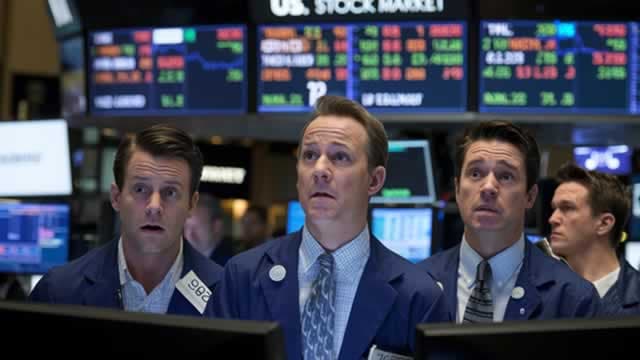
UBS global head of equities thinks the question of how to turn capex into profits is becoming more challenging for AI developers to answer as funding commitments boom and funding gets more difficult.

Anxiety around both AI spending and competition lingered in the U.S., while Lunar New Year celebrations closed markets in China and thinned trading elsewhere.

European equities futures point south as Wall Street is set to return to trading following the President's Day holiday. A.I. concerns remain with the Nasdaq stuck deep in the red.

U.S. Treasury yields inched lower on Tuesday as investors looked ahead to more delayed data releases during the holiday-shortened trading week.

Gold and silver prices drop

The CNN Money Fear and Greed index showed further decline in the overall market sentiment, while the index remained in the “Fear” zone on Friday.

AI is now disrupting software itself, shifting market focus from growth vs. value to resilience vs.

As luxury companies like LVMH and Gucci-owner Kering struggle to recover from a two-year slowdown, they are navigating increasingly sharp share price swings stoked by hedge fund bets and investor nerves over AI-rattled markets.

China stocks outlook turns bullish as SSE and Hang Seng target breakouts, driven by AI gains, export strength, and PBOC easing bets despite housing risks.

U.S. stock futures were little changed late Monday, following another brutal week for tech stocks.
Ignacio Artola: Hello, and good morning, everyone. Welcome to Fagron's Full Year 2025 Results Webcast. I'm joined today by our CEO, Rafael Padilla; and our CFO, Karin de Jong. We will open the floor for questions at the end of the session. And with that, I will hand over to Rafael. Rafael Padilla: Thanks, Ignacio, and good morning all. We are very pleased to report another outstanding set of results with full year revenues reaching EUR 952 million. This translates into a 9.1% organic revenue growth at constant exchange rates, driven by all regions and segments. Profitability increased 10.9% to EUR 193 million, which represents a margin of 20.3%, 30 basis points higher than in 2024. Main contributors were our operational excellence initiatives and a positive sales mix. As you already know, during the year, we also accelerated our M&A efforts and announced 12 transactions across our regions and segments, always maintaining a disciplined approach. Additionally, we have proposed a dividend of EUR 0.40 per share, reflecting a 14.3% increase compared to last year. Looking ahead, in 2026, assuming no major changes in current market conditions, we expect mid- to high single-digit organic sales growth at CER and a slight improvement in profitability year-on-year. Going on to the regions. In EMEA, we had a solid performance. Brands and Essentials benefited from underlying demand, improved availability and our diversified footprint, while compounding services was supported by demand in both sterile and non-sterile compounding as well as new customer wins. In LATAM, we benefited from strong execution in Brazil. Innovation and targeted commercial actions supported growth. We have also received clearance from the Competition Authority, CADE for the acquisition of Vepakum. Finally, in North America Pacific, we continue to see strong underlying demand. Brands and Essentials improved on the back of operational improvements and availability, while Compounding Services continued to benefit from demand trends in both health and wellness and hospital outsourcing. Also, very happy to share that our expansion projects in Wichita and Las Vegas are progressing as planned. Turning to M&A. Our strategy remains consistent. We acquired businesses we know well, often partners where we can strengthen local positions, enter new markets or expand product capabilities. During 2025 and year-to-date, we announced 12 acquisitions across all regions and segments as well as completing 2 further deals we had announced previously in '24. As you would have noted, most of the deals we announced in '25 have already been completed with Injeplast, Amber and Vepakum pending completion. We all remain disciplined and have a clear integration playbook to capitalize synergies in an 18 to 24 month period, being the key levers, procurement, portfolio breadth, operational and commercial synergies. And with that, Karin, for the financial review. Karin de Jong: Thank you, Rafa. Good morning, everyone. And let me walk you through our full year 2025 results and share more details about our 2026 outlook. In 2025, revenue increased 9.2% on a reported basis to EUR 952.2 million. In organic terms at constant exchange rates, the group grew 9.1%. Gross margin increased by 30 basis points to 62.6%, supported by sales mix and procurement and manufacturing savings. Operating expenses increased to support volume growth. At group level, our profitability expanded 30 basis points year-on-year to 20.3%, demonstrating our improved operational capabilities and synergies from acquisitions. Moving on to the next slide. The bridge shows our revenue development for the full year. EMEA delivered 4.2% organic growth at CER, supported by broad-based demand and contributions across segments. Latin America delivered 14.1% organic growth at CER, driven mainly by strong performance in Brazil. North America Pacific delivered 10.8% organic growth at CER, supported by compounding services and continued progress in Essentials. M&A contributed to reported growth, while FX was a headwind. On the right side in the table, you can see the nonrecurring items. They were limited at EUR 0.3 million, mainly acquisition-related costs, partly offset by an earn-out release. Depreciation and amortization increased, mainly reflecting purchase price allocations from acquisitions. And the financial result was a cost of EUR 28.6 million higher than last year. This was mainly driven by an increase in currency differences of EUR 1 million due to volatility of the U.S. dollar throughout the year. The remaining is spread of the different categories such as interest on leasing and other financial costs. The effective tax rate was stable at 22.2% versus 22.3% last year. And as a result, net profit increased to EUR 91.5 million and earnings per share increased to EUR 1.25, a 13.6% increase on the prior year. Moving to EMEA. So revenue increased to EUR 355.1 million with 4.2% organic growth at CER, supported by underlying demand and the contribution from acquisitions. REBITDA increased to EUR 77.9 million and the margin improved to 21.9%. The margin improvement reflects operational excellent benefits and sales mix. And as highlighted by Rafa, we also strengthened the region through acquisitions. Turning to LATAM. Revenue increased to EUR 183 million with 14.1% organic growth at CER, partly offset by FX. Performance was supported by strong underlying demand and new product launches, particularly in brands. Brands revenues this year represent 38.1% of LATAM's total revenue, an increase of 360 basis points. REBITDA increased to EUR 33.6 million with a margin slightly higher at 18.3%. The margin in the second half of 2025 was 19.2%, reflecting the seasonality effect in this region. We also made progress on M&A execution, firstly, with the completion of Purifarma, and we also received CADE clearance for Vepakum and expect that to complete soon. Injeplast is still to be completed. Moving to North America Pacific. Revenue increased to EUR 414.1 million with 10.8% organic growth at CER. Brands and Essential performance remained strong and was mainly supported by improvements in product availability and supply chain. Compounding Services remains strong despite the absence of GLP-1 shortages during the second half of the year. The higher operating expense is mainly related to the need to accommodate the growing volumes coming from high market demand, while REBITDA margin expanded by 20 basis points to 19.7% as we continue to improve our operational excellence activities. We also expanded the business through the acquisitions of CareFirst and UCP and also including entry into Australia through Bella Corp. Looking at our cash flow now. A high level of cash conversion remains as one of the main strength of our business model. Operating working capital increased by 10 basis points to 12.1% as a percentage of annualized revenue. Operating cash flow increased by 41.3% to EUR 155.3 million. Normalized CapEx adjusted for one-offs ended at 3.1% of revenue, in line with our guidance. And lastly, free cash flow conversion reached 65.3%, reflecting continued discipline on CapEx and working capital. Our net debt evolution for the year shows a modest increase to EUR 283.3 million, reflecting acquisition and investments during the year. Despite this, leverage improved with net debt to EBITDA at 1.2x, and we remain well below our internal threshold of 2.8x. This keeps sufficient headroom to pursue opportunities while maintaining a prudent balance sheet. Finally, our outlook. For 2026, assuming no significant changes in market conditions, we expect a mid- to high single-digit organic growth at CER. We also expect a slight year-on-year increase in profitability with the second half expected to be stronger than the first half. CapEx is expected to remain at around 3.5% of revenue, excluding one-off projects, and our midterm guidance remains unchanged. And with that, I will hand back to Rafa for the conclusion. Rafael Padilla: Thanks, Karin. 2025 shows again the resilience of our business model consisting of predictable growth, strong cash generation and continued progress on quality and operational excellence. We also accelerated M&A in a disciplined way and are now heavily focused on integration and value creation. This performance builds on a long-term track record with EPS growing at around 9% CAGR since 2017. We remain confident in the underlying drivers of our end markets and in our ability to deliver the midterm targets. With that, let us open the line for questions. Operator: [Operator Instructions] The first question comes from Michael Heider from Berenberg Bank. Michael Heider: Congrats on the strong execution. I have 4 questions, please. First of all, your growth accelerated in the fourth quarter in North America, so in the U.S. market, despite a stronger headwind from the GLP-1 revenues. Can you give us a little bit more light on what were the main drivers here, please? Rafael Padilla: Yes, sure. Michael, thanks for confirming the results. We're also very happy. Regarding the U.S. growth, you see that has been across all the segments. Of course, we're starting with Anazao where we have the headwind. The core business also grew. So that shows the resilience of the business, of course, and the trend we have spoken also in your last conference of the prevention and lifestyle products. B&E was also -- we also saw good results ahead of our own expectations as well. We have been improving our operations and supply chain. As you also know, we also discussed this one. And then regarding FSS or the hospital outsourcing, we also explained during our Q3 trading update call that at that time, we're adding the EUR 25 million extra capacity that door-to-door, right? Therefore, in Q3, we had the lesser growth at FSS, hospital outsourcing. And with the visibility we have, we would see a strong Q4. Thanks a lot for the question, Michael. Michael Heider: And then secondly, on the capacity expansions, can you elaborate what -- where the focus is in 2026? And how much CapEx can we expect on that? Rafael Padilla: Yes, sure. That's a very important question for this year and also for 2027 because here, we have announced -- last year, we announced the expansion across the street. That's the new capacity that we're getting will be online during 2027. What we explained in Q3 was an extra capacity added wall to wall, so upgrading the current facility to support growth. And for 2026, as we also have explained many times, there is this new opportunity for us as the B2A where a 503B can compound for a 503A, that would be the same as we have here in the Netherlands with the [indiscernible], where a compounding center can compound for other compounders. And of course, as we can understand, the sterile products are the most important because of the difficulty made and all the quality requirements needed and investments. Of course, therefore, we see a good opportunity for us, of course, at the B facility in Vegas, but also at the B facility in Wichita because now we started bringing the portfolios together, having R&D cost, quality control cost, streamlining also the operational part on our [ 503s ]. Karin de Jong: Yes. And maybe to add on that on the financials for the expansion project. So we had 3 projects, the Las Vegas expansion, the Wichita expansion and the Netherlands. In total, roughly EUR 73 million expansion CapEx. In 2025, the amount spent was limited to a couple of million. And then for 2026, we expect to spend approximately 75% of that amount and the rest in 2027. The timing, however, is depending on ordering and billing. So it could deviate a bit. However, it does not indicate any delay in timing. So we remain on track to complete the investment in 2027, which was in line with the original plan. Michael Heider: All right. Then on the -- on your tax rate, it was stable in '25 versus '24. Now looking at your acquisitions, do you think there will be an impact going forward? So maybe with more exposure to the Brazilian market that we have to expect a slightly higher tax rate going forward? Karin de Jong: Yes. So we were around 22% this year and last year. We are funding part of the Brazilian acquisitions in the U.S. to mitigate a bit this risk. So we expect a slight step up, but not a major one going forward. Michael Heider: Okay. And then last one, just generally, I mean, you had a fantastic run on acquisitions with 12 acquisitions announced. Do you see any limits to that on your capacity to integrate so many acquisitions? Karin de Jong: Yes. Indeed, we did a number of deals in 2025. They were all spread across the different continents. So we have a global coordinator. So we have an M&A lead, and we have the regional teams that are responsible for the integration, and they are supported by the global back office and roles such as finance, tax, treasury, IT. The plan -- so the integration plan is already prepared during the acquisition process and discussed with the area leaders and executive leadership team to accelerate the integration as of day 1. So important levers, as Rafa mentioned, for the synergies are the procurement and the product breadth, and we have an experienced team to execute on this. So we are very confident that we are well prepared to integrate the acquisitions. Operator: The next question comes from Stijn Demeester. Stijn Demeester: Ignacio congrats on the results from my end. I have 3. In your outlook, you guide for a slight profitability improvement. I think we are all banking on somewhat lower margins because of the dilution of Purifarma. Does it mean that you see cost synergies in Brazil more positive versus earlier? Or has it to do with an offset from higher-margin acquisitions such as Vepakum and maybe a bit of light here. Then the second question, given the strong underlying growth in the U.S. Compounding segment, will there be a point in the next quarters where you will be pushing against the limits of your capacity in Wichita before the new capacity provides additional headroom in 2027? And then, related to the previous question, it was indeed a very busy year for your M&A team. Could you imagine that at one point, there is a change in your capital allocation policy, whereby you would, for example, for a buyback over M&A considering your sufficient free cash flow and your underlying valuation at this point? These are my questions. Karin de Jong: Yes. Thank you, Stijn. Maybe to start with the guidance on profitability. So yes, in profitability, we indeed saw a nice step-up in 2025 with 30 basis points, which was driven by operational excellence, the operational benefits and innovation. While acquisitions are expected to have a modest dilutive impact in 2026, as synergies are realized, we anticipate a slight improvement in profitability versus 2025. We also expect a stronger second half compared to the first half, reflecting the phasing out of the GLP-1 headwinds, as you all know, and the integration of newly acquired businesses. And maybe to break it down per region, LATAM. LATAM will have a small dilutive impact due to the acquisition of Purifarma. This will be partly offset by Fagron. So from H2 onwards, we expect synergies to start contributing to margin improvement at Purifarma. If we look at North America, North America will be slightly impacted by the UCP acquisition, though the overall effect on the margin development is expected to be limited, and North America will continue to benefit from operational leverage and operational excellence initiatives. And therefore, we expect a margin improvement in 2026. And EMEA, I said, delivered a very strong performance in 2025, and we anticipate to be broadly in line with that or slightly improve compared to 2025 in 2026. So that's basically on your first question. Rafael Padilla: Sure. On the second one, as well. You are totally right. And this is also what we explained during the Capital Markets Day last year that Wichita is coming to its max capacity. Therefore, we are at least EUR 25 million extra capacity for '26 and the first semester of '27. And then during 2027, we will see the new capacity going online. As we said, we are totally on track for timing and also on budget. So that's good to remark. And of course, we have the Boston facility. And this one is giving us the possibility to capture the underlying trend that we see in the hospital outsourcing. And that, as you know very well, is because of the high-quality standards that are being asked in the industry and also the B2A opportunity that we see now, that's when I repeat myself of the first question, when a 503B can compound for [ 503A ] mainly on sterile products. Karin de Jong: Last question on the capital allocation. So our capital allocation is focused on growth. organic growth and inorganic growth. And indeed, we had a very good year on M&A in 2025. We have a solid pipeline to continue that M&A strategy. We see opportunities in the different regions, in the different markets, and we want to be able to act on those. So for now, our capital allocation strategy will not change, and we are focused on that growth. We did have a small dividend and a small dividend increase also, and that's reflecting of the strong performance we had on our cash flow and our earnings. Operator: The next question comes from Thibault Leneeuw from KBC Securities. Thibault Leneeuw: The results. First question is with respect to EMEA and the compounding services. You reported 1.9% organic growth at CER. You talked about volume growth in sterile and non-sterile business. So does that mean that there was some pricing pressure? That's the first question. Rafael Padilla: Yes. Thanks, Thibault. And what we have explained, if you recall years ago that -- how normally -- and it's, of course, that situation, the Netherlands is accounting for more than 90% of this performance. So how does it work? There is a product portfolio in compounding. We have the product portfolio, the biggest one in the whole industry after so many years, of course. And some of the bigger compounds are getting registered, so then we cannot sell. This we explained, if you remember in 2021 at that year. And then this means also that we introduced new compounds, and we also registered some of them. So it's a dynamic portfolio. So all in all, you see that the almost 2% demand comes from this dynamic portfolio, some products coming in, some products coming out. And also, as we explained, I believe it was last year also, there was one question regarding this topic is that prices in this market are somehow flattish. So therefore, you see that all the growth that you see from compounding services in this region comes from volume. Thibault Leneeuw: Very clear. And maybe as a small follow-up, maybe it has been explained in the past, but would be gentle to remind me is for North America, the Compounding Services there, when you look at the growth outlook, has there some price increases been included in the long-term outlook of like the low to mid-double-digit revenue growth? Is there some price increases included in that? Or do you basically assume stable prices in that outlook? Karin de Jong: Yes. So we -- historically, where growth in the U.S. and maybe in Compounding Services is driven by volume. So we are capturing market share, and that was historically the case. Currently, we see that it's more volume than price, but price is a very small part of that growth level, and that's also embedded in our growth numbers going forward. Operator: The next question comes from Usama Tariq from ABN AMRO ODDO BHF. Usama Tariq: Congratulations on the strong results. I have just 2 questions initially. The first being, could you clarify on the cash outflow expected, especially with regards to M&A in 2026. So you've already indicated the CapEx. Does that include it, but that's I think that is only with regards to the expansion CapEx. So any pointer on the amount of cash you expect with regards to M&A next year? And secondly, do you see any impact with regards to the Trump health care plan? I do understand that Fagron is outside the insurance policy-based mechanism, so 80%, 90% cash settled. Do you still see some positive or negative impact in the short to medium term because of policy changes? Karin de Jong: Starting with your first question, indeed, the answer that I gave on the previous question was related to the expansion CapEx. So if we now break it down with regards to the acquisition, so at the end of 2025, there's EUR 14 million at the balance sheet to be paid. And on top of that, as you know, we announced a number of deals in 2026, which also resulted in a cash out. And the cash out in 2026 is around EUR 80 million for those 3 acquisitions. So there are 3 additional acquisitions pending closing. That's for Vepakum, Amber and Injeplast, and that's roughly around EUR 70 million. So if we combine those amounts, then it's the EUR 150 million and the EUR 14 million that was still open. So that's EUR 164 million that has to be paid. And if we annualize the EBITDA of the acquisitions and look at pro forma net debt to EBITDA, including those, we would still be between the 2 to 2.5x net debt to EBITDA. So within our sweet spot and below our internal max of 2.8x. So we have sufficient room there, but also on the liquidity side, as you know, we have a new facility at the end of 2025, the U.S. notes for USD 125 million. So on the liquidity side, we're also good to continue our M&A strategy. Rafael Padilla: And for the second one, Usama, you are totally right. So there is no action on the policy because our business is out of pocket. So totally right. Operator: The next question comes from Frank Claassen from Degroof Petercam. Ignacio Artola: Okay. We'll try to add Frank. Let's continue with the Q&A. Operator: The next question comes from Eric Wilmer from Kempen Research. Eric Wilmer: I wanted to press a bit on the profitability guide, which indeed screens a bit confident perhaps. I believe your largest 2 acquisitions last year, which should add 5% of sales had a margin profile below the group, which you will now need to implement. And I hear what you say with regards to the H1 profitability commentary this year. But at the same time, I always had the impression that your Dutch compounding business is margin accretive which I believe saw a bit of a tougher Q4. So are you actually anticipating a change regarding the latter? And do you also see further room with regards to further operational efficiencies? Maybe some color on the latter as well to help understand the qualitative margin bridge from '25 to '26. Karin de Jong: Maybe indeed to start. So the acquisitions overall have a modest dilutive impact. We added the Brazilian Vepakum because we have CADE approval, so competition clearance for that acquisition. So that's added. That acquisition is above group average EBITDA levels. So that compensates partly for the dilutive impact for Purifarma. And then overall, the acquisitions, some are below, others are above. So in general, if you sum it all up, it's below group average. However, we do anticipate synergies coming in as of H2 on the back of the plans that we're having. So that's one on the acquisitions. If we look organically, we do expect to see benefits from the strategy that we initiated on operational excellence initiatives. So we already see that translated into procurement savings, so better gross margins. We see operational leverage coming through, especially in the U.S. where we continue our growth path. So on the back of that, we also expect the business, excluding acquisitions to make good progress in 2026. Ignacio Artola: Well, let's end the session. Thank you very much for your participation today. I will remain at your disposal should you have any further questions. Thank you very much, and goodbye. Rafael Padilla: Thank you. Karin de Jong: Thank you. Rafael Padilla: Bye-bye.

Andrew Harding: Good morning, and welcome to the first half 2026 results. We are in Brisbane today. Therefore, I acknowledge the traditional custodians of this land, the Turrbal and Jagera people, and pay my respects to the elders past, present and future for they hold the memories, the traditions, the culture and hopes of Aboriginal Australia. We must always remember that under the ballast, sleepers, rail systems and office buildings where Aurizon does business was and always will be traditional Aboriginal land. I'm joined on the call by Gareth Long, Acting CFO and Group Executive Strategy, and the rest of the management team. This morning, we announced the appointment of Ian Wells as CFO and Group Executive Strategy commencing in April. Ian is an experienced global finance leader across the resources and infrastructure sectors, most recently at FMG, including 5 years as Group CFO. His expertise will be instrumental as we continue to optimize our portfolio, allocate capital with discipline and invest in long-term growth. I look forward to welcoming Ian to Aurizon in April. Gareth Long, who has been Acting CFO and Group Executive Strategy, will transition to the role of Group Executive Enterprise Services, leading functions, including asset management, procurement, technology, people and safety. Turning to safety. Our focus at Aurizon is protecting our employees, customers and the communities in which we operate. It was pleasing to see a step down in the actual and potential serious injury and fatality frequency rate when compared to the second half last year. However, the total recordable injury frequency rate deteriorated slightly, driven by lower severity injuries. Efforts have been stepped up in response to this movement with safety intervention activities enacted where required. Level crossings continue to be a safety issue for the rail industry. Just last week, the Australian Transport Safety Bureau published their investigation into a collision between a passenger train and a truck near Alice Springs. Despite advanced road warnings, a stop sign and the sounding of the trains horn, the truck continued at the level crossing, resulting in a collision with the truck driver sustaining serious injuries. We have updated our community engagement program, reframing the importance of waiting at a level crossing as an active responsibility for the people that matter most. The billboards have been rolled out at target locations and will also be used across social media. Collectively, we must step up efforts and investment to improve safety at level crossings. This includes the rail and road industries, all levels of government enforcement and road safety agencies and the general community. Turning to the results. Today, we present a strong set of results and more importantly, represents the continued execution of strategy. That is, disciplined Coal and Network business units, specifically noting increased reliability in the Central Queensland's coal network, bulk and containerized freight growth, including lower cancellation of services and strong shareholder returns driven by capital efficiency. Underlying EBITDA increased by 9%, supported by solid contributions from Network, Bulk and Coal. Revenue growth was driven by regulatory revenue and higher volumes, while disciplined cost control, including the successful execution of last year's $60 million cost-out program further strengthened our position. This performance has flowed through to underlying NPAT, free cash flow and importantly, to earnings per share, up 20% with the impact of the buyback program being seen. Reflecting the stability and resilience of the business, and with the expectation of lower capital growth, we increased the dividend payout ratio to 90%. Further increasing shareholder returns, today, we announced an extension of the buyback program by $100 million. This follows the completion of around 85% of the original $150 million buyback announced in August. Turning to the business units. Although, volumes were flat, network earnings increased by 4%, driven by higher regulatory revenue. Importantly, a customer-supported submission on a new 10-year undertaking was lodged to the regulator in December. The agreement brings certainty to all network stakeholders, and from an Aurizon perspective, increases revenue across the undertaking period. Coal earnings benefited from a 1% volume uplift, improved yield and disciplined cost management, delivering a 6% reduction in unit costs. Two coal contracts have been extended to FY 2028 and FY 2034, respectively, pushing out the contract book as shown in the appendix. You may recall that we will have available capacity in the Hunter Valley, once the contract comes to a close in June. As noted at August results, we have 3 options regarding the deployment of this capacity. They are pursuing tender opportunities, maintaining spot fleet capacity and/or reappointing the assets to Bulk. Each of these options remain available at this time. Bulk earnings increased to a record first half result of $117 million, up 39% on the prior period. The uplift was driven by higher volumes and the nonrecurrence of prior year impacts, particularly the provision for doubtful debts. Volume growth was supported by increased base metals haulage, including BHP Copper South Australia, new iron ore customers and additional grain haulage due to lower cancellations in the context of a record harvest in Western Australia. Earnings for the other segment, including containerized freight, declined by $11 million, entirely due to the prior period, including legal settlement proceeds of $18 million. National interstate TEU volumes increased by almost 30%, with capacity utilization of 69% across the half. While near the 70% breakeven utilization as published at establishment of containerized freight, EBITDA breakeven has not yet been achieved due to additional costs due to increased freight frequencies and third-party network outages, most notably the Cross River Rail disruptions in Southeast Queensland and the mix of freight carried. To mitigate rail disruptions in Southeast Queensland, we entered a 3-year agreement with SCT Logistics in November to haul Aurizon freight into and out of Brisbane from their southern side terminal. This resolves local access challenges, improves customer frequency options and freeze a rising capacity for redeployment. In Western Australia, the Kewdale Terminal is expected to become operational in the first half of FY 2027, improving efficiency and performance for our East West services. We continue working with NYK on supporting the import and distribution of motor vehicles through land bridging. These discussions are now at CEO level, and I was in Tokyo in January to progress. I look forward to updating the market in due course. Late last year, we submitted a draft 10-year undertaking to the Queensland Competition Authority to apply from July 2027 to 2037, known as UT5+. The proposal was developed through months of constructive negotiation with the submission supported by customers. Importantly, it was lodged some 18 months prior to the current undertaking expiring, which is an amazing feat. Those with a longer corporate memory will recall how different this outcome is compared to the submission of the original UT5 undertaking. In addition to providing all users and Aurizon Network with long-term certainty, the agreement brings customer benefits such as a new throughput-linked incentive payment, 5-year rolling access agreements, a network-led continuous improvement group, retention of collaborative maintenance processes and customer oversight of major procurement contracts. For Aurizon, UT5+ delivers an average annual revenue uplift of $45 million flowing entirely to EBIT. The uplift is driven by updated WACC parameters, the introduction of a throughput payment and changes to depreciation that bring forward cash flows. The initial WACC will be set between January and April 2027 based on prevailing market parameters. The undertaking is subject to QCA's usual process, and we expect to see progress through this calendar year. Beyond securing long-term earnings certainty for network, it has been a year of delivery, driving value for shareholders. Following the June announcement and October commencement, we now provide integrated logistics, rail, road and port for BHP's South Australia copper operations. This represents 1.3 million tonnes per annum and total revenue of $1.5 billion in revenue over 10 years. This is the largest known road-to-rail conversion in Australia, and was made possible by our strategic investments in One Rail, Flinders Logistics and The Gillman terminal. South Australia is a growing copper province and presents a great opportunity for Aurizon. Moving to the cost side. We delivered the previously announced $60 million in annualized cost savings, exceeding the original $50 million target. These savings can be seen in today's results with flat operating costs despite a 4% increase in revenue and against a high inflation environment. Having the right assets in the right regions is key for Aurizon's continued success. We've had a long presence in the Yilgarn region of Western Australia, hauling iron ore for export at Esperance. Although, impacted by the decision by Mineral Resources to cease operations at the end of 2024, the very same fleet of locomotives and provisioning sheds are back in use in the haulage of iron ore for 2 new customers in that region. The historical iron ore volume hauled by MRL has now been fully replaced by our other customers. Finally, to capital management. We have completed $425 million of on-market buyback in the past 18 months at an average price of $3.36, including $125 million so far this financial year. The cancellation of 126 million shares has increased earnings per share by 7.4%. Today, we further increased shareholder returns with a step-up in the dividend payout ratio and a $100 million extension of the buyback. These achievements reflect my priorities, delivering growth, maintaining a competitive cost base and executing disciplined capital management. Finally, I want to address the Network ownership structure review. The review has now concluded with a decision to retain Aurizon's existing integrated model in Central Queensland. The group's portfolio composition is reviewed regularly, including an assessment of the integrated above and below rail model in Central Queensland. The outcome of the review was last published externally in 2019 and found that the benefits of integration of above and below rail outweighed the benefits of separation at that time. I commissioned a new comprehensive review last year, considering the same assessment criteria as previous review with a particular focus on shareholder value. The review assessed a broad range of whole of business and minority structure options for Network, including monetization and demerger scenarios, noting that a transaction would be pursued if it delivered shareholder value. An investment bank was appointed to assist in running a comprehensive market sounding process for potential alternatives. Each alternative was evaluated across numerous valuation benchmarks and discussions were held with more than a dozen institutional investors. Retail brokers were also consulted to investigate investor appetite and valuation metrics. The review and recommendations were independently assessed by Flagstaff. The review confirmed Aurizon's view that the Central Queensland Coal Network is a highly attractive and unique set of assets, connecting the globally significant premium coking coal basin to export markets, supported by regulatory settings, network value under Aurizon's integrated model is derived from several factors: stable earnings and cash flows via supportive regulatory frameworks, including revenue and inflation protection, accelerated depreciation, primarily returning invested capital across a rolling 20-year period, supporting our strong investment-grade credit rating and has underpinned $6 billion of shareholder returns over the past decade. We also see value in the operational alignment of the integrated model. The operational overperformance of network, which is monitored using a suite of interrelated measures benefits throughput for all above rail operators. This is calculated to benefit Aurizon by up to $75 million per annum. A stand-alone entity may not achieve this level of alignment with above rail operators. In addition to lost synergies, there is also the creation of dis-synergies depending on the structure of the change in ownership. In a demerger, this is calculated at $30 million to $40 million per annum, primarily consisting of the duplication of corporate functions. Beyond any transaction costs such as tax considerations, the loss of $100 million per annum is significant and therefore, was incorporated when assessing value to shareholders. This is particularly the case for ownership structures where the value outcome is not certain. We received numerous expressions of interest from well-credentialed investors, which validated the quality of Network. However, the proposed valuations did not meet the threshold required to create meaningful shareholder value compared to the tangible benefits being captured by Aurizon under the integrated model, while introducing significant additional uncertainties, complexities and risk. Therefore, we have determined that retaining 100% of Network remains the option that best delivers long-term value for Aurizon shareholders at the present time. The review is now concluded. Turning back to the results and to Gareth. Gareth Long: Thank you, Andrew. Today, we present a strong set of results with Coal, Bulk and Network business units each contributing to the uplift in earnings. Step-up in shareholder returns has been delivered with an increase in the dividend payout ratio to 90% and a $100 million buyback extension. Turning to the table. Revenue increased by 4%, driven by Network regulatory revenue and stronger volumes from both Coal and Bulk. Coal also benefited from stronger yield, which I'll return to shortly. Despite an uplift in revenue and a higher inflationary environment, total operating costs were flat against the prior corresponding half. This was largely driven by the $60 million cost-out program undertaken last year. Net finance costs were broadly in line with the second half last year, but 10% higher when compared to the first half due to the hybrid issuance undertaken in May 2025. Underlying free cash flow of $335 million, was 41% higher than the prior corresponding period. A higher cash tax rate was recorded for the half at 32%, largely driven by timing differences, including take-or-pay. We expect these timing differences to unwind in the second half, which will see our cash tax rate fall to below 30% at year-end. A dividend of $0.125 per share has been declared, 90% franked, representing a higher payout ratio of 90% of underlying net profit after tax. This is in addition to the $100 million extension of the current buyback, taking the total FY '26 buyback to up to $250 million. This follows the completion of the $300 million buyback last year, demonstrating our strong cash flow generation and disciplined capital management. Statutory EBITDA is $3 million lower than the underlying result due to the impact of the following. There was a $4 million over-recovery in network track access revenue. As previously announced, this is the first year of recognizing the regulatory allowable revenue in underlying earnings regardless of volumes. Although, deducted from underlying earnings, a positive timing adjustment of $4 million is captured in the statutory earnings. This was offset by 2 significant items. $1 million of transformation costs, which represents the remaining redundancy cost from the cost-out program undertaken last year, and $6 million for technology upgrade costs. Aurizon has commenced an upgrade of its enterprise resource planning system. This is a migration from a legacy system, and we expect total implementation costs to be in the range of $90 million to $100 million, to be spent over the FY '26 to FY '28 financial years. This will be treated as a significant item. FY '26 costs are expected to be approximately $25 million, including $6 million in the first half. The variance from these timing differences and significant items at the statutory NPAT line is a negative $2 million. Moving now to Network. Network EBITDA increased $21 million or 4% to $516 million. This was driven by higher access revenue. Volumes were flat compared to the prior corresponding period at 109.8 million tonnes. In the bridge on the right, you can see access revenue was $26 million higher, driven by an uplift in allowable revenue due to high return on and of capital and due to an increase in the maintenance allowance. Note, these figures are net of energy costs, which are passed through to Network customers. Operating costs increased by $2 million due to higher maintenance costs. As I noted earlier, an over-recovery of $4 million in track access revenue was collected in the first half of FY '26, with an equivalent timing adjustment reduction recognized in the underlying result. This year is the first of 2 transition years with unpaid -- with the updated approach to underlying revenue recognition for Network. That is we recognize the full maximum allowable revenue, or MAR, including the prior year's revenue cap. Next year, FY '27 will be the last transition year and includes $50 million of rev cap from an under-recovery from FY '25. From FY '28, the MAR will be booked less any revenue cap, given it will already have been recognized in the respective year. As usual, in the appendix, we include a full MAR table, including the revenue cap adjustment I just spoke of, in addition to the impact of the long foreshadowed end of GAPE from FY '28. The table also includes preliminary values for UT5+ from FY '28. Moving to Coal. Coal volume increased 1% to 101 million tonnes with revenue increasing by 3%. We also saw a reduction of 4% in operating costs, which resulted in an uplift in earnings of 13%. In the EBITDA waterfall chart on the right, you can see the benefits of the additional tonnes hauled, equating to $9 million net of the cost of hauling the additional volume. Inside the dotted area, we show the yield increase of $10 million. You may recall in August last year, we provided full year guidance for Coal, including the expectation of lower yield. That is the benefits of price indexation were expected to be negated by an unfavorable customer mix on a rate per tonne basis. As can be seen in the chart, the customer mix impact on yield was limited, resulting in the overall positive yield. Operating costs decreased by $15 million, supported by the rollout of TrainGuard in addition to benefiting from favorable maintenance scheduling. We do expect second half earnings to be lower. This is due to the anticipated customer mix having a negative impact on yield and higher operating costs driven by both projected haulage and the reversal of the favorable maintenance scheduling mentioned earlier. Moving now on to Bulk. Bulk earnings increased to $117 million, an uplift of 39%. The result was driven by an increase in volume and the nonrecurrence of prior year impacts, primarily the provision for doubtful debts booked during the period. Bulk revenue was up 6% at $595 million, driven by base metals, grain and new iron ore customers, nonrecurrence of the July '24 derailment in WA, partly offset by lower iron ore volumes in South Australia and the Northern Territory. Operating costs were flat at $478 million. However, when excluding fuel and access costs, which are largely a pass-through, operating costs were up $21 million. This mainly reflects additional costs associated with volume growth. Excluding doubtful debt provisions, operating costs increased by 3%. Looking ahead, Bulk earnings in the second half are expected to be broadly in line with the first half. Potential upside from the ramp-up of contracts that commenced in the first half, including BHP Copper and the new iron ore haulage is expected to be largely offset by weather impacts and third-party track closures experienced in January, as well as further third-party track closures in Queensland anticipated later in the year. Higher operating costs driven by both -- sorry, while Containerized Freight doesn't have a dedicated slide in today's presentation as it is not reported as a separate business unit, it's worth calling out the continued momentum we saw during the half. Volumes increased by 23% with the second half last year. However, despite this volume growth, higher operating costs were incurred primarily to mitigate the impacts of the Cross River Rail project in Southeast Queensland. With the previously announced SCT contracted solution in place, we expect a stronger second half. Now moving to gearing and funding. As shown in the chart, the work undertaken during the half has further lengthened, smoothed and diversified the funding profile. Aurizon's credit profile continues to remain attractive to bank and debt investors with the Network's recent refinancing and upsizing of its institutional loan facilities being just under 2x oversubscribed, despite a reduction of the existing margins. As a result of this refinancing, Aurizon's Bank Group has expanded by 3 lenders to 26 banks across its facilities. Also within the chart, you will note an upcoming maturity in FY '26 being our $778 million Network euro medium-term note, which will be repaid using available committed undrawn banking facilities. Note, we have a total of $1.35 billion of undrawn facilities in Network. Further detail on our funding activities can be found in the debt slide in the appendix of this presentation as well as in the Appendix 4D. Looking at some of the other metrics on the page, I note the group gearing was 55.5% compared to 56.2% in FY '25. The funding strategy remains unchanged. That is to ensure we access multiple pools of capital and lengthen the debt maturity profile to align with Aurizon's long-duration assets. Importantly, we maintain a commitment to strong investment-grade ratings with Aurizon operations and Aurizon Network's credit ratings, both at BBB+, Baa1. This commitment is supported by group net debt to EBITDA, which now stands at 3.1x. Moving to capital allocation. Strong free cash flow generation and lower capital expenditure have underpinned higher shareholder returns through dividends and buybacks during the half. As shown in the chart on the left, total half year CapEx was $327 million, down 5% on the prior period. Non-growth CapEx was 247 million, representing a 17% reduction and reflects lower bulk transformation spend as terminals such as Gillman came online and the timing of asset renewal expenditure within Network compared to the prior period. As a reminder, around 70% of total nongrowth capital is invested in the Network business, which directly feeds into the regulatory -- regulated asset base. As reflected in the chart, total growth CapEx for the half was $80 million, $36 million higher than previous half, largely due to the capital requirements for Bulk for the new BHP contract and containerized freight for the Kewdale Freight Terminal in Perth. As Andrew will discuss shortly, growth CapEx guidance is unchanged, while nongrowth, including transformation CapEx guidance has been reduced to $580 million to $600 million, which is broadly in line with last year and largely reflects timing differences. Long-term expectations for non-growth CapEx remain around $550 million to $600 million per year, although this is constantly reviewed in conjunction with our long-term volume outlook. Turning to the right-hand side of the slide. The proportion of forecast capital allocated to shareholders in FY '26 is expected to be broadly in line with last year and consistent with levels seen between FY '16 and FY '21. Dividends have benefited from the increase in the payout ratio to 90% of underlying NPAT. In line with our capital management framework, we are able to maintain our strong investment-grade credit ratings and deliver capital back to shareholders, while at the same time, focusing on earnings growth. In closing, it is encouraging to see revenue growth across our Coal, Bulk and Network business units with all 3 contributing to the uplift in first half earnings. Looking ahead, Aurizon's strong cash flow generation underpinned by regulatory revenue, contracted revenue and CapEx profile positions the company to enhance shareholder returns, while continuing to invest prudently in the long-term sustainability of the business. Thank you. I'll now hand back to Andrew. Andrew Harding: Thanks, Gareth. Turning to the outlook. Group underlying EBITDA has been maintained at $1.68 billion to $1.75 billion. Due to the uplift in the payout ratio, we have increased the expectations for full year dividends to $0.22 to $0.23 per share, up from $0.19 to $0.20 per share. Non-growth CapEx is now expected to be $580 million to $600 million, including $30 million of transformation capital. This was previously $610 million to $660 million, including transformation capital. Growth CapEx has been maintained at $100 million to $150 million. Network earnings are expected to be higher than FY 2025, with an increase in the regulatory revenue, partly offset by increased direct costs. Coal earnings are expected to be higher than FY 2025, driven by volumes and flat unit costs, partly offset by lower yield due to customer corridor mix. Although, a positive yield impact in the first half, the full year yield is expected to be lower when compared with FY 2025. Bulk earnings are expected to be higher than FY 2025, driven by the nonrecurrence of provisions and increased grain volumes. Other EBITDA is expected to be higher than FY 2025, with improved Containerized Freight contributing -- contribution offsetting the nonrecurrence of the settlement of legal matters in FY 2025. No significant disruptions to supply chains and customers such as major derailments to extreme prolonged wet weather. Finally, this slide summarized progress against the strategic aims that we set at our most recent Investor Day. The strength of our Network and Coal businesses can be seen in today's results and the submission of UT5+ provides commercial and operational certainty through to mid-2037. Today's Bulk reset is a record first half, having the right assets in the right regions sets the business unit up for growth, including the commencement of the BHP Copper contract in South Australia, the largest known road to rail conversion in Australia. Containerized Freight volume continues to grow and with Network stability after the SCT agreement, filling capacity to drive earnings is the priority. Land bridging is progressing, and I look forward to updating the market in due course. Today, I presented a strong set of results that demonstrates the continued execution of our strategy, disciplined coal and network business units, specifically noticing increased reliability in the Central Queensland Coal Network, Bulk and Containerized Freight growth, including lower cancellation of services and strong shareholder returns driven by capital efficiency. I'm excited about the opportunity ahead of us and most importantly, continuing to deliver against our strategy. Thank you, and I will hand over to the operator for questionnaires. Operator: [Operator Instructions] Your first question today comes from Anthony Moulder from Jefferies. Anthony Moulder: If I can start on Coal, the contract loss in the Hunter Valley that's for FY '27 previously, I think you've said that there are contracts coming up for renewal through the Hunter that could be -- you could win to effectively replace a large proportion of that volume. I appreciate cascading some of the equipment to Bulk was also an option. But can you just give us an update as to how you're thinking about contract wins in the Hunter Valley for that replacement volume, please? Andrew Harding: Yes, sure, Anthony. I might get Ed to talk about that because he's obviously very focused on it. Ed McKeiver: Thank you, Andrew. Thank you, Anthony. Yes, very focused on it. I can't talk about specific customers or contracts as you'd understand. What I can say is, we're in discussions with several Hunter Valley customers regarding our available capacity. We're also progressing FY '27 ramp-up nominations from other customers in the Hunter Valley. So we're still in the planning processes. As Andrew mentioned, we're actively pursuing some tender opportunities at the moment and also weighing the option of whether we keep spot capacity installed to chase volumes that our customers can't deliver or surge with our existing customers. Beyond those options, we've got -- we've always got the potential to redeploy assets, people to Bulk, which we've got a track record for doing so back and forth. And so all I can say at this point in time is that these 3 options remain open to us and as we work to finalize the fleet allocation for '27. Anthony Moulder: Still a work in progress effectively. But I guess likelihood is that you keep that installed capacity on the expectation that you will either convert that to spot tonnes or win volumes over the next couple of years. It sounds like nothing imminent from a contract perspective. Andrew Harding: Anthony, I think you've monitored this long enough to appreciate that when you actually announce a contract win or a contract loss, it wasn't the result of a bunch of work that was done the day before you made the announcement. There's usually a good period of time leading up to such changes and such announcements. So we're in that process. There's opportunities which have to be carefully outlined as -- for obvious reasons, as Ed has done. And I think your comment of work in progress, it's still a work in progress, and we remain quietly confident of where we can get to. I can't really talk about it much more. Anthony Moulder: Very good. If I can move on to the sustainability of the lower maintenance CapEx, it sounds like some of that's more a timing issue. Is that how we should think about the maintenance CapEx spend? And then obviously, if you can comment more on the further projects that will require that sort of $100 million to $150 million of growth CapEx going forward. It seems like you're coming to the end of that investment phase for growth CapEx. Is that a fair expectation for beyond '26, I guess? Andrew Harding: So I'll deal with the CapEx component, but I might just get Ed to talk a little bit about the maintenance changes. Ed McKeiver: Was that in relation to the coal? Andrew Harding: I'm sorry, I assume it was coal you're asking about, Anthony, did I miss -- you talking in general? Anthony Moulder: Yes, group. Andrew Harding: Group. I'll get Gareth to talk about group. Gareth Long: Anthony, yes. So in terms of that reduction in sustaining CapEx. So at the bottom end reduction of around $30 million. It's predominantly driven by changes to scope, how we're thinking about better execution of some of that work and some of it is timing-related. Remembering around 70% of that sustaining capital sits within the Network business. So there are plenty of projects and pieces of work still to be done. And indeed, in Ed's business around some of our traction engines. So as we said in the script, long-term sustaining CapEx still in that $550 million to $600 million. Anthony Moulder: I just had one final question that was around the Containerized Freight. It looks like it continues obviously to get tougher. I appreciate that a lot of that difference in this year or this half's result is as a consequence of the Cross City Rail -- Cross River Rail. But confidence in that business, obviously, not only getting to breakeven, but to a point in which you are returning a return on the invested capital in that Containerized Freight business above WACC? Andrew Harding: Yes. Look, I'll get George to talk about that now that he's had more than 6 months' experience operating that part of the business. He can talk about it in some detail. George Lippiatt: Thanks, Andrew. Anthony. Yes, there were 3 things that impacted Containerized Freight in the first half, Anthony. The first was Cross River Rail closures that effectively meant we had extra cost in the business because we were paying for SCT to perform that hook and pull and we were holding on to train crew on the East Coast. We now have certainty with SCT arrangement for 3 years. So we are not holding that same level of installed cost. The second one was track closures, which were high, in particular, in September that impacted the Containerized Freight business. And then as Andrew said, a lower yield, particularly with us doing more East Coast services with SCT. And we also saw TGE's volumes increase. That's probably the encouraging part about the first 6 months is the first 6 months of FY '26, we did see volumes improve by 29%. Actually, TGE's volumes were up 16% and then non-TGE volumes up fourfold from the prior corresponding period. So that's the positive. In terms of FY '27 and the catalysts that get us to breakeven, the first one is having that certainty around how we mitigate Cross River Rail closures. Cross River Rail meant that we couldn't get our services into Brisbane 25% of the year. So you can imagine that was a significant impost when you're selling a service that's based on reliability to your customers. The second one is Kewdale coming online. Everyone sees the capital that we're spending on that, but that will be a step change for ourselves and our customers in terms of efficiency. We go from operating out of Forrestfield, where we have 3 300-meter tracks to a terminal that will have 2 1,800-meter tracks, improved freight availability for customers, better efficiency in terms of shunting for us. Those will be 2 step changes in FY '27, and then we'll look to build from there. Operator: Your next question comes from Matt Ryan from Barrenjoey. Matthew Ryan: I just had a question about the increased dividend payout ratio. I'm assuming the Board doesn't want to move that ratio around too much unless it has to. So just trying to get some color on, I guess, the sustainability of that number into the second half and beyond. And I think a little bit earlier, you mentioned that one of the drivers was lower capital costs moving forward. So maybe if you could just talk a little bit more about that and whether that just relates to growth projects that may or may not happen. Andrew Harding: Yes, Matt. So look, I mean I can reflect the Board's interest and desire not to change payout ratios on a regular basis. I can absolutely speak for myself that the pain associated, and rightly so with lowering a payout ratio is very notable. There's a little bit occasionally joy with increasing a payout ratio, but the pain is it's asymmetric, I suppose. So it's something indelibly printed on my mind. So when you -- when we do look forward, and indeed, I can speak personally here as well is that when you are looking forward, you're looking forward to ratios that have a low risk of actually having to be changed down over time. So you're looking at all the things that could impact the business, and then actually you're being cautious as well when you're picking that because of the asymmetric experience when you actually take it down. And I understand that because that's money flowing to investors. So hopefully, that gives you some sense of the approach that we do take to the adjustment to the payout ratio. And indeed, to the second part of your question around the lower CapEx, you've followed the business for enough years now. When we talked about some of the CapEx that we were indeed in spending in advance and that did not have contractual backing sort of like intimately, we -- which included such -- we include such things as the billing of the Kewdale Terminal in Western Australia and as George said that's coming to completion in the not-too-distant future. So you're seeing those things finishing. And then you're seeing although more growth capital being spent on things that have got a contractual backing like the BHP Copper South Australia arrangement, which is a 10-year deal, but it does include the building of the Pimba terminal. And so there's CapEx that's associated with the construction of that. It includes some other equipment that we assemble for taking containers on and off the trains and such forth. So you can expect us not -- I think there's still growth -- plenty of growth opportunities available, contract backed opportunities. So you can expect us to spend capital associated with that. going forward. Does that help add the color that you're after? Matthew Ryan: Yes, for sure. And just maybe one follow-up to do with that. So there obviously seems to be a lot of inflation in things like train kits and presumably a lot of the other things that you have to spend on. So just thinking about this guidance that Gareth, just -- or color, I should say, around the $550 million to $600 million being the long-term target. What are the things that you guys are doing in order to offset those inflationary pressures through your CapEx line at the moment? Gareth Long: Yes. So look, there's -- there's -- I'd say, a bunch of different issues. So I mean, if you think -- if you go and think actually non-financially and thinking operationally, we do spend after every one of our CapEx -- any CapEx expenditure of note. We go back through and we look at what we could have learned from how we conducted that, both at an operational construction level, and we take learnings forward. You've seen one of the responses that we're doing, for example, that we go through the business is looking at multiyear arrangements where that allows us to actually generate more buying -- more certainty for a supplier group and they bid tighter for that sort of potential work. And that's in areas like in the Network where you're seeing CapEx expenditure, which has got -- which is the same type of expenditure, but it's executed over multiple years and those sort of things. So putting pressure on scope performance and actually the contractual bidding side of it and then looking at the actual execution that we do. We've changed the way we do maintenance of the rolling stock fleet from a large-scale taking out locomotives and they go out for a year, and we do a massive overhaul, and we do that every -- more or less frequently than a decade. But when you're doing -- when you have a large fleet, you're doing quite a few in every year. And we've progressed over recent times and still in the progression, actually, there's still one way to finalize this, where you're going to component level change out. So we're actually reducing the impact of those larger scale programs. And indeed, the component level change out, we can fit more of that into the operational duty cycle at the depots. So we're actually seeing benefits and improvements at that level. But to your point, there are pressures, and there are pressures in things that are actually difficult to control, like the increase in IT equipment brought about by the rapid build-out in AI hardware, I suppose. And so that leads to escalation in prices, which are actually quite large. So you see those sort of things on the negative side of the ledger, but we are doing a lot on the positive side of the ledger as well. Operator: Your next question comes from Jakob Cakarnis from Jarden Australia. Jakob Cakarnis: I just wanted to focus on the other segment just quickly, please. I know that, you've said that you anticipate it would get better in the second half. But maybe, George, could you just break down for me year-on-year relative to the first half of '25, how much of what looks to be about $11 million delta at the EBITDA line is from those disruptions versus the yield? I appreciate that you've stepped out that there's 3 sources of that change. But could you just give me a sense of how much was one-off versus the pricing contribution, please? Andrew Harding: George, I'll -- do your best to satisfy question. George Lippiatt: Sure. Jakob, I mean, the first thing I'd say about the other segment is you've got to remember that there was $18 million as a benefit that we booked in underlying earnings in the prior corresponding period to do with the legal settlement. So the first thing you've got to do is back that out of the prior corresponding period. Then you get to an understanding, hopefully, that you can see the CF business was broadly flat versus the PCP in terms of EBITDA contribution. It was though still a negative contribution. In terms of the one-offs, both the costs on the East Coast and the track disruptions, they were probably 2/3s of the impact we saw from what we expected. The other was the yield. So certainly, the bigger contributor was the track disruptions, and the extra costs that we were carrying in the first half. Jakob Cakarnis: Okay. That's helpful. And then just one for Ed, if I could, please. There's a big re-contracting period by the looks of Slide 26 in FY '28. Could you just let us know if there's any one particular customer that's sitting in there? And I guess, more generally, some commentary, please, on competition in CQCN and just what you're seeing there from other competitors in the space and maybe how you're seeing their capacity settings, please? Andrew Harding: And indeed, just we don't like talking too much about competitors. George Lippiatt: Certainly. Andrew Harding: Going to the first part of that question. George Lippiatt: Yes, certainly. As Andrew has alluded to, re-contracting activity is commercially sensitive and always confidential. So I can't comment on individual customers or contracts. What I can say is very alert to managing the contract pipeline. And we are currently engaged in multiple tenders. It's been a very busy few months. And I can also say, we've not lost any contracts this financial year. So I'm confident about our ability to manage the pipeline. And there are -- and we're still processing really the nominations going forward. In relation to the question more generally about competition, I mean, the Coal market remains resilient. We compete aggressively, as I've said before, to retain business, protect earnings. It's difficult to predict what rates will do. We've not seen a material change in competition or structural capacity. So we're continuing to play to our strengths, which is a focus on performance and listening to our customers around their preferred risk positions. Jakob Cakarnis: Sorry if I tripped on something there, guys, but I didn't ask for a specific comment on a customer. I was just asking on that Slide 26 for FY '28, is there a particular exposure that's in there that would be an outsized part of that contracting volume expiring? Yes, I'm just keen, if there's one particular customer sitting there at size, please. George Lippiatt: There are multiple customers within there, Jakob. So I really don't want to go into any more information on the public call. Operator: Your next question comes from Andre Fromyhr from UBS. Andre Fromyhr: Just staying in the Coal business, I want to talk a bit about the momentum into second half. I know in the guidance commentary, you pointed to sort of the positive yield effects reversing and then unit costs ending the year flat. So my interpretation of that is we're going to get quite a different margin experience first half versus second half. So how should we think about which of those is more representative of normal conditions? Or should we be sort of looking through the full year to think about what's normal as we look beyond FY '26? Andrew Harding: Ed, do you want to take that? Ed McKeiver: Yes, certainly. I'll probably start by saying we're really pleased. I'm really pleased with the strong delivery for customers and shareholders in the first half, especially the Hunter Valley Blackwater and West Moreton Systems, where we experienced demand stronger than planned. The way you should be thinking about it, earnings were strong. We had higher -- this is a volume business. We had higher volumes, higher yield than anticipated and lower unit costs, so higher NTKs and lower costs. And you'll remember at the August -- at the full year results, I guided to or committed to keeping costs flat in nominal terms for FY '26 compared to FY '25. And so the first half cost favorability was a positive surprise. And on the back -- it came on the back of 3 things: the TrainGuard benefits flowing through, the Coal's contribution and share of the aforementioned enterprise cost-out program and also some maintenance sequencing, which was driven by really the timing and for example, lower wheel exchanges in the first half, which we expect to flow into the second half. When you think about the second half, I'd just reiterate, we had -- the yield benefit that we saw in the first half, we had expected that the yield to be negative in the first half. It was accretive. You never know until the half runs exactly what customers are going to rail what volumes under what contract. So that was favorable. That said, we do expect that to unwind in the second half and the second half yield to be negative and for the -- thinking through the full year to be more reflective of our August guidance comments. So I'd reiterate we expect cost to be flat in nominal terms across the year. I'm still committed to that, noting there's some second half headwinds, some changes in customer mix and the expenditure on maintenance that we didn't see in the first half. Andre Fromyhr: Okay. And there's another part of the outlook commentary that just as always, suggests that the guidance is based on no significant disruptions, including from extreme wet weather. What have we seen so far in the wet season? I understand that there's still plenty of time to go. But are we tracking sort of above or below that sort of normal weather experience? Andrew Harding: So you had a cyclone, Koji hit Queensland. It was a big cyclone in the scale of cyclones. They're all different in the amount of water that falls and where the water falls and those sort of things, but it was a reasonable experience and obviously impacting people's lives. But from a business point of view, it wasn't one that you'd go. That was an easy one that hit. If I just stick to commentary about Queensland to give you an idea, we did see, and I made comment -- raised the comment, we did see resiliency in the network improve. We have been spending money on improving the resiliency in the network. You've probably heard me talk about simple to imagine or articulate issues like better drainage to get the water to move faster and indeed not pull near the track, which causes formation failures over time, which leads to speed restrictions and/or higher maintenance and those sort of things. So we've actually seen after working at that for a number of years now, we've actually seen it through one cyclone and been positively impressed by what the work led to. I do go back to my opening statement is I'm not going to -- I'm not trying to take nature on and say that we can resist all cyclones, but it's likely based on the data and the experience that the network is more resilient than it has been. We will continue to spend that money with customer support. And indeed, they are supporting it because the benefits are tangible. So that's the network business at a very high level. If you go to the Bulk business, the Mount Isa, Townsville line was out for the month of January. And so that's not -- it's been out for longer and it's been out for shorter, but there's definitely not evidence of an improvement in resiliency that we're seeing in the CQCN. So that's a drag on George's business. It's been -- it's a regular drag on the business through the wet season. If I was to stand back and look at how volumes impact on -- are impacted by wet weather, it's our experience through that -- through the wet weather to this point in time or the wet part of the year through to this point in time, despite fairly normal heavy weather, the business has performed better. But once you get into the individual componentry, it gets more complicated, Andre. Hopefully, that helps a bit. Andre Fromyhr: Sure. I just got one more question relating to the enterprise resource planning system investment. This is like $90 million to $100 million, pretty decent sized investment over 3 years. Just curious, are we expecting any productivity gains or, I don't know, revenue opportunities off the back of this investment? And is there a reason that it's not like a capital project? Andrew Harding: I'll get Gareth to talk about the reason for it not being in the capital project, but I volunteered myself to run the project as Chair of the activity, because I do take it seriously. And I don't need to tell you or anyone listening that these projects have some chance of going awry, if you look at the number that work compared to the number that don't work or at least meet budget time and cost and deliverables. So it's one that's got a lot of focus. One -- the reason I go through all that palaver at the beginning of introducing the answer is that, we've actually chosen an approach to the ERP, which replacement or upgrade, which is more akin to minimizing risk. That's the emphasis. So we're not changing at all. We're only changing a few of the, I'm going to say, component modules to it, for example, payroll procurement and the base financial underpinning of the system. There's many more things we could have changed in the pursuit of what you said, increased productivity and the like. But I would rather break this into 2 components, which is to get the first part done, which keeps the business operating with the lowest risk to failing time failing on costs. There is obviously, because you're moving into a cloud-based system, which has built an AI functionality, there will be an upgrade -- well, this is an entire industry hoping there will be an upgrade because of AI functionality. There will be an upgrade in productivity and the like. We aren't counting on it. And I indeed only working at getting it through is the lowest risk that I can. After we do that, and we put those changes behind us, we will move through other parts of the functionality and -- but we'll do it on the basis of the large -- a fair chunk of change management having been done, people familiar with the system, and then we'll add further components as we go over a longer time scale. Hopefully, that gives you an idea of what I'm trying to do. Sorry, Gareth, you needed to answer some questions. Gareth Long: Andre, that's the reason why it's expensed as opposed to capitalized is because it's Software as a Service. Operator: Your next question comes from Justin Barratt from CLSA. Justin Barratt: I just wanted to ask about that sort of first half, second half split in terms of the yield. I was just wondering if you could go into that a little bit more detail, please. But equally, in addition to that, I guess this is the second year in a row now where there's been, I guess, a bit of a disconnect between yields in the first half and the second half with the first half being quite strong and the second half being a little bit weaker. I just wanted to see, is there anything structural there that we should be aware of that's driving that change? And I guess, therefore, sort of expect that kind of differential to continue into FY '27 and beyond? Andrew Harding: Yes. So look, I might do it rather than getting into all the detail with Ed, which probably won't help anyway. The thing with yield is it reflects the fact that we have contracts with customers that have different fixed component charges versus variable tonnage movement charges. And depending on who rails, well, the difference occurs between the planning and actual for us, depending on which customer says they're going to rail, what volume in what period and whether they do or not. So in a sense, when you're seeing a repetition of some sort of biased outcome, it's the customer saying what they're going to rail and then maybe not delivering exactly as they would. There's also customers really do in the last couple of months of the year, you can see a general race in the financial -- towards the end of the financial year to get as much tonnes as they can when they take stock of where they got to after the wet season starts to wind down. That's part of the drivers for the variability. It is very hard for us to take the customers' nominations and ignore them, not very hard. It's -- we can't ignore their nominations. So we take them as for what they say they're going to do, and we budget accordingly. Justin Barratt: Yes. Fantastic. And then look, I mean, I know you got this question a little bit back in August, but we've seen the benefits of the cost-out program that you sort of ran, I guess, throughout FY '25 in this half. I just wanted to, I guess, double check in again and just sort of say, look, again, is there, I guess, more opportunity for cost out going forward? Andrew Harding: Yes. Well, let's get Gareth to talk. He's moving into a new role, which will have a reasonable focus on improvement. So Gareth, do you want to talk about some? Gareth Long: Sure. So yes, I mean, we're pleased that we've seen the delivery of that $60 million continuing to flow through '26, Justin. In terms of further programs, we haven't got any program in execution at the moment, but it won't surprise you to hear that we continue to focus not just on the cost, but also the productivity and the utilization of our assets, facilities and how we do our business. So that will continue to be an enduring feature of how Aurizon conducts its business. Operator: Your next question comes from Cameron McDonald from E&P. Cameron McDonald: Just want to get some detail around the provision reduction and the write-back. You've said you've had some recoveries in bulk. Can we get some detail around that, please? Andrew Harding: Gareth, can you provide some detail, please? Gareth Long: Cameron, so yes, you'll note within the accounts, you'll have seen a half-on-half improvement in impairment for doubtful debts to the amount of $7 million. That is, yes, a good approximation for sums that we've managed to recover. Cameron McDonald: Okay. So -- and that -- is there any expectation that you'll recover any more -- like what's the outlook for some of those increased provisions from last year? Gareth Long: Yes. So listen, I mean, we continue to work and pursue all legal and commercial avenues, Cameron. I wouldn't expect there to be a material addition to that recovery. But as I say, we continue to work with all parties. Cameron McDonald: Okay. Andrew, can I just sort of ask a more strategic question. If I look at the annual report from last year, the LTI for non-coal EBITDA growth is now 283% to 326% growth. That's up from $131 million to $157 million minimum maximum the year before. That seems like an extraordinary growth rate, but also just trying to get a sense of how achievable you actually think that is given not only the current delivery to date. But secondly, the reduction in sort of what has been non-growth CapEx -- or sorry, growth CapEx that -- so can you achieve that without putting more capital in? Andrew Harding: Great question. And I'm going to get George to talk about the deliverability of the future. The thing -- the point that I would make is that from a strategic point of view, we've been assembling assets and business activity that allows us to get into new contracts that we were unable to get into before and access a broader profit pool. So an example of that, which I've used a lot, but I'll use it again, is the BHP Copper South Australia contract, where we assembled 3 businesses, which is not the sole purpose of buying the One Rail business by any means, but we had the One Rail business. We bought the Flinders Logistics business to get the terminal access. And you put those together so that you actually can then provide the full service offering, which we knew the customer was chasing. So there's numerous opportunities that expand out of that particular -- in that particular area and that particular assemblage of businesses. And then you can -- we're doing similar things I should say, with the nature of bulk is, it is similar in that there's rail activity and there's port activity, but they're all different as well. We're doing similar style of things across the country. So what I might do is get -- just hand to George, so you can -- and the only other point I'd make is we recently only achieved putting in that -- for that particular case, we only just managed to put those assets together to enable that activity to take place, which is, to your point, some of the reason around the delay in delivery. George? George Lippiatt: Sure. Thanks, Andrew. Cameron, I'll start with containerized freight because it's a similar theme. You have to spend capital in advance of then getting the benefits from it. When we said we were going to stand up containerized freight, we said it would be about $425 million of capital. Now what we've spent to date, including the most recent half is about $300 million to $320 million of capital. A lot of the balance is that Kewdale terminal that we touched on before. That will unlock efficiency. But that's containerized freight. We don't have a lot more capital to spend. Now it is about getting the trains full, targeting the right service frequency and getting the right yield and cost base around that business. When it comes to bulk, I think I said in August, the most important customer we have is our existing customer base. So what do I mean by that? As Andrew said, we've got a great footprint. We've got 5 port terminals. We've got 2,500 kilometers of track infrastructure, got over 200 locomotives that we can draw on across the business. And so when I look at growing the Bulk business, there are 4 levers that I look at. The first is the customers that railed in the first half that haven't yet had a full year of railings. AG River, Yilgarn and BHP Copper. We started in the first half of FY '26, but you're yet to see a full year of railings for them. The second driver is cancellations and waste in the supply chain. We've reduced cancellations by 2% compared to the prior corresponding period, but they're still too high. And when you've got a business that doesn't have high take-or-pay, when you don't run a train, you're still maintaining it, you still got the crew, but you're not getting the revenue. So that is a big value lever for us. The third value lever is our existing customers and them growing. BHP Copper want to grow their copper output, that will see commensurate growth in their inputs as well, which we move for them. CBH over in WA have a 30 million tonnes by 2030 strategy. So those 2 customers, just those 2 want to grow significantly. And then you have to look at growth, Cameron, which will come from new projects coming online. So then you are talking about the Arafura's in the Central Corridor. You're talking about the Ammaroo's, the Verdant's, those will come with capital. But my point is the first 3 levers that I mentioned are fairly capital light because we've already got the assets in place. The fourth lever where we see new projects is where there would be more capital. But that, as Andrew said, will be contract backed. Cameron McDonald: And then just finally, any sort of commentary around what's happening around Phosphate Hill and Glencore around Mount Isa? George Lippiatt: Well, I won't specifically comment on those particular customers. We don't do that, and that wouldn't be appropriate. We do watch -- we are involved, and we do watch it carefully. Operator: Your next question comes from Tom Peyton from RBC Capital Markets. Your next question is from Rob Koh from Morgan Stanley. Robert Koh: Congratulations on the result. May I just ask a couple of questions about the network review, which you've given us the decision on now. Just wondering, if you could share if there was anything material you learned in terms of potential tax consequences or financing synergies? Andrew Harding: I learn enough that I'm not going to answer those questions on a public call, Rob. We're definitely not going to answer those questions on a public call, sorry. Robert Koh: That's okay. respect. Okay. My next question is on Coal, maybe for Ed. But just wondering if you could give us any color on how EBAs are going. From memory, I think you have some Queensland train crew and maintenance EBAs up this year. Ed McKeiver: Yes. Thank you for the question, Rob. You're correct. We are currently negotiating both enterprise agreements actually in New South Wales and Queensland. And the New South Wales one expired in November and the Queensland one expires in March. It's going well overall. We've been at the bargaining table in New South Wales for over 6 months and for a couple of months in relation to the Queensland agreement. This is the fourth time in the last 16 years that I've overseen the renewal of these agreements. I'm confident that, we're going to resolve negotiations in due course. And of course, we're keeping our customers well informed and remain committed to meeting their needs. There's -- the tone of these negotiations is always different. And I characterize these ones as constructive. We are engaged with our employees and their representatives. And as always, we're trying to strike the balance between claims that are commercially sustainable with productivity improvements necessary to preserve the viability and performance of the business over time. Robert Koh: Good. Sounds good and wish you well with it. Maybe a final question. I note you've got an incoming new CFO and group exec strategy with a bit of FMG experience. And I understand that FMG is taking delivery of some battery electric trains. Just wondering if you could give us any update on your own future fleet and I think you're going to be trialing some battery electric trains later this year, if that's right? Andrew Harding: I was wondering where you were going with that. We're not getting. Rob, I thought you got to we get in mining, and I was going to have to leap on the denial of that. No. So battery -- we have 2 battery electric activities going on in the very near term. A battery electric loco, which to remind people, is a project where we're taking a diesel electric loco out of the field. In the normal course of business, we've been taking them out to do maintenance activity to them. We're taking this one out instead of replacing it with a diesel engine, we're replacing it essentially with a battery electric engine. It is far battery electric drive. It is far more complicated than what I just said and engineers would be horrified with the simplicity of it. But that work has been progressing for some time. We will see that battery electric loco operating in Western Australia, actually, I think we've said publicly now in the next financial year, I think, is the time frame for that. The second bit of battery electric work we're doing -- and sorry, the reason we're trialing that as an approach is it's damn expensive to buy brand-new electric locomotives when your diesel ones are perfectly good. So that's very hard economics to leap over if it's possible. So we're looking at how we can actually manage the transition of a diesel fleet over a very long time, and that's a lead project in that activity. The second one we're doing is the battery electric tender. And that is a -- if you -- the way to imagine it would be the first wagon behind the lead locomotives is actually instead of being a wagon that carries a product like ore or grain or something, it's a wagon that's actually full of batteries. And it can act as either an extender to a battery electric loco or it indeed converts a diesel locomotive into a hybrid system. So -- and that is being done with -- built in Queensland, and that will be about a year before it's in operation and operating for one of our customers is pretty excited to give it a trial. So those things -- those 2 activities, variations on the current -- trying to -- I'm not say repurpose, but move the current fleet in an economic way from high fossil fuel load to a lower fossil fuel load in the future. And both of those are underway, and we'll start to see outcomes like in the next 12 to 24 months. They'll be operating in real mining environments or real haulage for mine, sorry, environments. They'll be doing real tasks and it will be pretty interesting to see how they perform and delighted to have the customer support we've got to actually execute against it. Operator: Your next question comes from Tom Peyton from RBC Capital Markets. Tom Peyton: Andrew and not to Ian, congratulations on the appointment. A number of questions already today, so I'll keep it short. Firstly, on the time line and pacing of the $100 million buyback, if you can offer some color around that. And secondly, increased grain volumes for bulks. Just wondering if you can speak to the sort of regional splits around that at all. Andrew Harding: George. Do you want to do the grain first and then I'll do the buyback after? George Lippiatt: Sure. Yes. Thanks, Andrew. Thanks for the question, Tom. If you look at our grain exposure, where Western Australia, South Australia, which is good because they tend to be fairly stable grain markets if you look historically. Western Australia, we haul for CBH. They've just closed a harvest at 24 million tonnes, which congratulations to them and their growers. That's a record. Most of that grain, we will haul in the second half of FY '26. And the reason for that is that the harvest really occurs from, call it, October through to January. So a lot of that grain is still in front of us. We're busy moving it in WA. About 50% to 55% of the total harvest tends to go on rail in WA, the balance on road. In terms of our other exposure, that's South Australia, where South Australia has just closed a harvest of about 8 million tonnes. So closer to an average harvest compared to a weaker one the year before. The majority of grain tends to go on road in South Australia. We do the balance for Bunge, used to be Viterra, and similar to WA, the majority of that grain that we will move for Bunge will go via the second half of FY 2026 rather than the first half. Gareth Long: And then to buyback and timing and a little bit more color on that. I'd just point to our history, pretty proud of the fact when we say we're going to do a buyback, we actually do the buyback -- and I want to keep that tradition running zfor obvious reasons. We do -- I did announce this $100 million as an extension to the current buyback, and we have yet to finish the current buyback. I believe it's about $25 million remaining on the current buyback. So given that, that's a buyback that was complete -- that's to be completed by the end of the financial year, we'll be pushing pretty hard on that buyback to get it done in that period of time. It's not all obviously about the execution within the time, you've also got to pay attention to how you're executing it and make sure you stick within the rules and not trying to be as predictable as you could be in your approach. So hopefully, that gives you some color as to what we're trying to execute with that extension. Operator: Your next question comes from Ian Myles from Macquarie. Ian Myles: I'll try and be brief. If we go back to the dividend, can you maybe just give a bit color? You made the comment that your long-term CapEx spend for maintenance is not really changing. Your guidance for FY '25, '26 hasn't changed at the EBITDA level, but you have actually lifted the dividend. I'm just trying to understand what's changing there to then lift that payout ratio because as you say, you don't want to take it back down again. Andrew Harding: Yes. The confidence -- again, remember, Ian, what I said when I was talking about -- I answered the question earlier on changing the payout ratio. One of the things you want to look at when you're looking at lifting it is if that's an easy experience, lowering it is the opposite by times 10. So very cautious to make sure that we can do what we can do for the longer term. Obviously, it's never -- there's always things that could change in the future could change your mind, but you really want to go into it with a view that it's something that you don't want to lower unnecessarily. So we've had -- we've got a lot more information. We're 6 months further on than the last time we talked. We've seen some improvements in the business. We've introduced a new operational contract with BHP. We've managed to make some changes, improvements to the containerized freight business. We're seeing an underlying improvement in other customers and indeed the main customer for containerized freight. So when you -- and there's many other things. So when you add all that together, it actually says that we can progress with a higher payout ratio with increased sort of reliability, so to speak. Ian Myles: Okay. And on the -- just on the Bulk side, your statement at FY '25 had a view that iron ore was a detractor from potentially the growth. You sort of removed that part in your commentary. And I was just intrigued, have you replaced -- is that suggesting that you've actually replaced the earnings side of it or just the volumes? Andrew Harding: Do you want to talk about that, George? George Lippiatt: I'll talk about it as best I can, Ian, without touching on individual customers and earnings contributions. Ian Myles: You can talk in totality. George Lippiatt: Yes. No, I will try. If you look at what happened when Cliffs shut down, that mine got restarted by MinRes, MinRes shutdown, which was going to be a drag certainly on the first half of '26. We've now fully replaced that volume. If you look at Yilgarn Iron, and you look at Gold Valley's volumes at full run rate, that replaces the MinRes volume. We didn't have certainty on the Yilgarn volume when we made that statement. So that's one thing that's changed for the positive. And also in the central corridor, we've had lower iron ore volumes from One Steel, but we have had AG River startup near Tennant Creek and start railing at the back end of the first half of '26. So yes, some declines, but also we've seen replacement. And it just reinforces what Andrew said that, if you have the right assets in terms of locomotives and hopper wagons for iron ore as well as that track infrastructure in the central corridor, you can provide an avenue for iron ore mines to come back online quickly. Ian Myles: Okay. And when you -- on the Coal side, you've obviously got the Hunter Valley volumes potentially moving. When do you start thinking about changing maintenance schedules around that equipment if you can't recontract or the timing of re-contracting is different to the day you lose the other contract? Andrew Harding: Ed, do you want to take that one? Ed McKeiver: Yes, suress. Well, the way I'm thinking about it is, first of all, we are sold out for FY '26. So we're not changing the maintenance schedules ahead of finalizing this year. We're doing the planning processes now, Ian, around our customer nominations for FY '27, tender outcomes, cost base assumptions is normal this time of the year. And so we know on a consist basis what periodosity we need to maintain them at, what capital we have to provide for. And so we're pretty adept at turning that off and on as we need to. Operator: Your next question comes from Scott Ryall from Rimor Equity Research. Scott Ryall: One question following up on Rob's question and your answer on the use of batteries in trains, Andrew. Most of your mining customers are struggling with this transition themselves and a lot of them have talked about lower carbon liquid fuels. Do you -- what are you doing in that sense? What's the latest in terms of what you're willing to look at? I know there's not much supply, but in terms of looking at the options. Andrew Harding: Yes. Look, we're involved in pretty much all the discussions that occur around the drop in fuels. The same issue exists when you're doing the work for the battery technology is none of it's cheap. And the drop in fuels are expensive. And to your point, can you get them? And if there is volume, it's probably going to, at least as far as I can tell at the moment, more than likely be biased to the aviation industry in the -- from in the early part of the take-up. So we are doing work. We've done -- we understand the engineering. The new equipment we have can easily run the drop-in fuels and without any changes. So we're in a position where we could make use of the idea or the opportunity if it comes along. It's a very big price difference when you're just comparing it to straight diesel. And you've got to have a customer base that's motivated or willing to pay for it. Scott Ryall: Yes. Understood. All right. My second question is just on the updated network undertaking. Congratulations. Your big legacy, I think, in terms of Aurizon move towards these long-term contracts with your customers. In terms of the comments, so I'm just trying to contextualize in terms of the comments that were made around CapEx going forward and the discussion pack that you put out just prior to Christmas when you announced it, which showed a flat RAB going forward or flat to ever so slightly down in nominal terms. Do you think there is a world in which over the course of the next 10 years that you would see any sharper declines in the RAB than what is forecast there? Andrew Harding: So look, I'd be reasonably confident that you won't -- that you'll see flat, slightly down and very unlikely that you'll see sharper declines. Part of the thing that people don't think about is you're managing -- moving -- you're always trying to manage for the operational efficiency of the train sets on the network. And so you're dealing with managing against congestion, you're managing against the mining the locus of intensity of mining in particular areas moving to different corridors and in different parts of different corridors because you're talking over the long term. So it's more than, likely that you'll see flat than anything else as a result of those changes that occur over time to the network as you're continually trying to keep it optimized because people don't want slower train trips even into the future as much as they don't want them now. Operator: Your next question comes from Nathan Lead from Morgans. Nathan Lead: Just one question on Coal and just a couple on capital management, if you don't mind. So just on Coal, just the guidance there that Edward was talking about, the cost being flat. Just confirm that's on a dollars per NTK basis? Or is it absolute dollars? Ed McKeiver: No, it's on a dollars per NTK basis. Nathan Lead: Yes. Okay. Just wanted to confirm that. Second, just on -- just a couple in terms of capital management. So Andrew, very much heard your comments there about wanting to sustain that higher payout ratio. What's your thinking in terms of the sustainability of the franking rate going forward? Andrew Harding: It was always going to be you, Nathan, that was going to ask me that question. So thank you for not disappointing me. So look, from a -- and I'll get Gareth to come in if there's anything that needs to be added to it. Look, if you looked at when we had 100% payout ratio, we had a franking at around 70%. We look -- again, we've looked forward, and we don't want to make strong representations about the actual franking itself. But setting a 90% payout ratio, you're thinking about not lowering it in the future. Franking credit, again, depends on a number of moving pieces, particularly in a business like Aurizons, which has got large infrastructure and you've got those accelerated fixed assets versus your tax cash rate. So it's not something you'd see moving readily, and it's something that we're happy about, but I'm not going to sit here and actually make too many bold statements about the future. I'll leave the bold statement to Gareth in his last minutes as the CFO. Gareth Long: Yes. Thank you, Andrew. Nathan, so as Andrew said, we don't generally give franking credit guidance. However, what I would say is second half, I would expect to maintain that 90% franking. And as you know, the nature of our business being heavy infrastructure, generally speaking, our cash tax rate will be less than 30%. So you can infer from that what that would mean for a franking position. So yes, hopefully, that answers your question, Nathan. Nathan Lead: Excellent. And just another one on capital management. I hear what you're saying, Andrew, about saying you're going to do a buyback and actually completing it. But the share price is up a lot if we look back sort of I suppose, to middle of last year. Where in your mind does a buyback become uneconomic? Andrew Harding: I know you know I'm not going to answer that question, Nathan. What I can tell you is when we look at extending the buyback and we look at a tradition that I want to maintain of keep buying -- completing buybacks, I did -- I was working on being able to achieve both of those. Operator: There are no further questions at this time. That does conclude our conference for today. Thank you for participating. You may now disconnect.
Operator: Good day, and welcome to the Bendigo and Adelaide Bank 2026 Half Year Results Briefing. [Operator Instructions]. I would now like to hand the conference over to Sam Miller, General Manager, Investor Relations. Please go ahead. Samantha Miller: Thanks, Rocco. Good morning, everyone, and thanks for joining us for Bendigo and Adelaide Bank's 2026 Half Year Results Briefing. Let me begin today by acknowledging the traditional owners of the lands on which we meet today, the Gadigal People of the Eora Nation. I pay my respects to their elders, past, present and emerging. And I also extend my respects to the Aboriginal and Torres Strait Islander people who are present on the call today. Moving towards the agenda. There's been a minor change to our presentation today, and we will broadcast audio and slides only. Our CFO, Andrew Morgan, has tested positive to COVID, and our CEO, Richard Fennell, will present the first half 2026 results with Richard and I handling the Q&A. I'll now hand over to Richard. Richard Fennell: Thanks, Sam, and good morning, everyone, and appreciate you taking the time to join us today. Our half year result reflects a period of intensive strategic execution, disciplined margin management and a significant reduction in operating costs in the second quarter of the half. We've taken a patient approach to deliver against our strategic priorities, which is strengthening our business. These actions are delivering momentum that is building and is expected to deliver stronger balance sheet growth in the second half. Our customer numbers continue to grow strongly and are expected to reach 3 million in Q4. This growth is supported by our Bendigo Bank and Up Net Promoter Scores that are respectively, 25 and 42 points above the industry average. During the half, we saw the benefits of our deliberate strategy to focus on growing our share of lower-cost deposits, which grew by 3.6% to now represent 53.8% of our total customer deposits. Our investment in digital capability is a key driver of this outcome with digital deposit sales accounting for 41.4% of total deposit sales, an increase of 7.4% for the half. On the lending side, we are regaining momentum in residential mortgages with strong application flow in December and positive growth for the month of January. The more balanced approach to residential loan growth follows the decision to exit our legacy mortgage partner business, allowing us to deploy our capital into higher returning channels. This decision has led to higher discharges in that channel, which has been offset by 6% growth in our digital channel. Meanwhile, application momentum in our higher returning channels is building, placing the bank in a stronger position over the long term. Our second quarter expenses were 6.4% lower than the first quarter, reflecting higher seasonal cost drivers in the first quarter, such as the annual salary adjustment process. A highlight for the half was our digital bank Up, achieving its first month of profitability in September, more than 6 months ahead of schedule. This is a significant milestone and tangible evidence that our investments in digital are creating value and continue to contribute positively to the group's competitive position. As we announced back in November, we are acquiring RACQ Bank's loan and deposit books. This is a valuable opportunity for us to grow our business in Queensland and welcome a new group of customers to the fold. Finally, towards the end of last year, we identified and self-reported the shortcomings in our management of AML/CTF risk. We continue to engage proactively with regulators and are developing a comprehensive action plan to address the issues identified. We are committed to strengthening our processes and meeting our regulatory obligations, and I'll have more to say on this matter later in the presentation. Returning to execution. The first half was a period of intense focus and significant process on the delivery of initiatives aligned with our strategic pillars and enablers, which we shared 6 months ago. I covered some of these strategic achievements at our investor update in December, so I'll only briefly recap them here. In just 3 months, our digital and technology engineering teams rebuilt and delivered our in-app digital onboarding capability, which is delivering significantly increased new customer flow through this channel. We finalized the full rollout of the Bendigo lending platform with it now being available across all of our retail branches. And we migrated 180,000 Adelaide Bank customer accounts onto our core banking system, delivering on our long-held objective of 1 core banking system and 2 main customer-facing brands. One aspect I didn't speak to at length at our investor update last December was our new 5-year partnership with Google. This partnership will provide enhanced cloud capability, access to enterprise-wide AI tools and industry-leading cybersecurity defenses. Over 2,200 of our people are already utilizing the Gemini AI tools with early adoption showing significant productivity benefits. Examples such as generative AI for hardship detection, improving timeliness of engagement, accuracy and productivity are supporting improved customer outcomes. These initiatives I've highlighted are tangible examples of the early progress we are making to deliver on our 2030 strategy. I'm excited by the benefits we're starting to see flow, which I'll walk through shortly in our progress update. But first, I'd like to turn to our financial performance. For the half, cash earnings of $256.4 million were up 2.8% on the prior half, driven by a 3.7% uplift in total income. Notably, this is the first half in the bank's history that we have delivered more than $1 billion in income. Income benefited from a 4 basis point improvement in margin as we focused on delivering a more favorable mix of lower cost deposits following a moderation in lending growth. Operating expenses increased by 4.2%, reflecting expected increases in software costs and amortization charges, additional workdays during the half and higher remediation expenses. Our investment spend declined by 19% for the half as major technology projects such as the rollout of the lending platform came to an end. And finally, in credit expenses, we saw a $2.4 million write-back for the half as collective provisions reduced, reflecting lower overall loan balances, together with the repayment of some larger impaired loans. The overall credit portfolio has remained resilient, and we remain focused on helping customers that face difficult choices due to cost of living and other pressures. Turning now to our divisional performance. Our Consumer division delivered strong earnings growth of 5.9% for the half, with net interest income increasing by 4.9%. This performance was largely driven by an 8 basis point improvement in margin, supported by the previously mentioned strong growth in lower cost deposits. Residential lending declined by 2.6% for the half. As noted, this reflects our strategic decision to exit less profitable legacy partners in our third-party originated channel, which contracted by 7.4% over the half. However, our digital lending channel grew 6%. This deliberate shift in focus towards more profitable channels is expected to continue to lift the returns for our Consumer division over the longer term. Our Business and Agri division's cash earnings decreased by 1% with higher net interest income largely offset by higher expenses. Higher NII benefited from higher average interest-earning assets and additional workdays, while expenses were impacted by the ongoing investment in our business lending platform. While overall loan growth was largely flat for the half, we have a strong pipeline of business coming into the second half with momentum building across our broker channel, agri business and equipment finance. At the FY '25 full year result, I shared 3 areas of focus for the next 2 years that will be critical to progressing towards our ROE target. As I said then, at each half and full year result, I will update you on the progress we're making across each area of focus. And to recap, these areas are optimizing our deposit franchise, enhancing productivity and delivering sustainable growth. Let me step you through the progress we've made this half. We've previously highlighted that we'll be taking a deposit-first approach to growth, targeting lower-cost deposits as the primary source of funding for our lending activity. To enable this deposit-led approach, we've strengthened our digital deposit franchise through the refresh of our in-app digital account opening capability for Bendigo's new-to-bank customers, and we've enhanced app functionality to deliver improved digital experiences for all our customers. We're now seeing weekly volumes of 400 to 500 new customers joining us through this digital onboarding functionality. Our frontline teams are proactively engaging with our existing Bendigo customers who don't currently have a Bendigo transaction account. And we've also continued to upskill the sales capabilities of both our frontline and virtual banking teams. These initiatives have already delivered benefits with lower cost deposit growth of 3.6%, particularly in the EasySaver and increased digital deposit sales of 7.4% for the half. Up's Grow & Flow product drove an additional $190 million of lower cost deposits over the half, and we expect this momentum to continue as highlighted at the investor update, and we are targeting digital deposit sales of 45% by the end of the financial year. Following the announcement of our productivity program in August, the outcome of the first phase is evident in the half year results. Investment spend has reduced, supported by a 48% reduction in contractor numbers over the half. Our full-time equivalent employee numbers have reduced by 5% on the prior corresponding period and 4% over the half. This is a result of several support function and technology division restructures. But let me highlight a couple of the outcomes this half. Through our focus on operational excellence within our operations teams, we've successfully realized a $9.6 million benefit this half. And we're elevating our AI and automation program in partnership with Google, which continues to empower our people to self-drive productivity and process improvements. Our entire workforce has access to the Google AI suite, and we're seeing organic people-led innovation outcomes. Our productivity program has now entered its second phase, which comprises 2 key initiatives. The first initiative is a new information technology partnership for which we are now in advanced negotiations and the second focus on business processing where planning activity continues. Together, these initiatives will enhance our technology and operational capabilities, drive innovation and support our guidance of keeping business as usual costs no higher than inflation through the cycle. We'll provide further updates to the market through the course of this half year. Our third area of focus is maintaining a disciplined approach to capital allocation to drive long-term sustainable growth that exceeds our cost of capital. This discipline is reflected in our NIM to credit risk-weighted asset ratio, which despite slightly moderating this half, remains well above the level of 2 years ago. Our recent decision to exit less profitable legacy mortgage partners is another example of this discipline in action. By prioritizing growth in our higher-returning channels, we're actively managing our portfolio to improve returns. We expect decisions like this will continue to support our NIM to credit risk-weighted asset metric over the longer term. In Business and Agri, we saw the usual agri seasonality with high loan repayments driven by strong yields for our grain growers, particularly in WA and New South Wales. This seasonality is expected to reverse as funding is redrawn down in the second half. In addition, growth in the business portfolio remains robust, particularly across portfolio funding and business lending with a strong pipeline heading into the second half. Finally, I'd like to take a moment to provide an update on our approach to addressing the deficiencies in AML/CTF risk management at the bank. We recently appointed a new highly experienced Chief Compliance Officer and Head of Financial Crime Risk, Steve Blackburn, to lead our response. We've now received detailed recommendations, actions and a road map from Deloitte, which we're using to guide our remediation and uplift program with a focus on enhancing our enterprise-wide AML/CTF risk management, including transaction monitoring. Our current expectation of the total cost over a period of up to 3 years will be $70 million to $90 million, of which we expect an initial cost of $15 million will be incurred in the second half of financial year '26. These expenses will be contained within our existing 2026 investment slate. In parallel, Deloitte are also completing an additional root cause analysis across our broader nonfinancial risk management. I'll now move to the financial results in more detail. This result reflects improved momentum across a number of metrics following our first quarter trading update. We've slowed the decline in residential lending and expect to return to growth into the second half. We've also seen an improved funding mix with stability in transaction accounts and continued strong growth in savings accounts. This has enabled us to deliver a lift in net interest margin in the second quarter despite the lower cash rate. We've also carefully managed pricing decisions to stimulate growth in key target segments. And we've tightened our management of business as usual costs in the second quarter with quarterly costs reducing over 6% on the first quarter. Our operating performance was 2.8% higher than the prior half, mostly due to strength in income and cash earnings of $256.4 million are 2.8% higher than the prior half. Our balance sheet is in a strong position going into the second half, reflected in strong capital, funding and liquidity. On this slide, we show you the usual reconciliation of cash to statutory earnings. You can see that the Adelaide core consolidation was in line with the higher end of the flagged range and most of the restructuring costs booked in the first half was in relation to the productivity initiatives, which I mentioned earlier. Growth in house prices in Sydney and Melbourne boosted Homesafe unrealized income. And going into the second half, we expect a very small amount of residual costs associated with the Adelaide Bank core consolidation. We also expect to incur further restructuring costs in relation to the next phase of our productivity program and also preparation work for the completion of the RACQ transaction. Turning now to total income for the half. Income of $1.01 billion was up 3.7% on the prior half. Net interest income increased 3.2%, reflecting a slight contraction in average interest-earning assets and an improved margin. This was further bolstered by stronger other income, which was up almost 7%. Other income, excluding Homesafe was up 6%, reflecting improved wealth and cards income. Homesafe income was up 8%, reflecting 5% growth in completed contracts on the prior half and a stronger average profit per completion. In respect of key considerations, as previously flagged, income from the Homesafe portfolio will reduce over time, subject to the rate and profit on contract completions. This half saw the number of open contracts reduced by around 3%, which is a rate consistent with the last 2 halves, whilst the average life of contracts completed through the half was around 8 years. Turning now to net interest margin. Compared to the prior half, our NIM was up 4 basis points to 192 basis points. Asset pricing negatively impacted 3 basis points, which was due to a combination of front book pricing pressure in residential lending and ongoing retention pricing pressure in business and agri. Deposit and funding pricing improved 3 basis points, mostly reflecting the benefit of term deposit repricing and mix provided a 4 basis point benefit, reflecting a combination of improved funding mix and improved asset mix. Income from our replicating portfolios was flat as expected as was revenue share. Our exit NIM was slightly higher than the second quarter average. Looking forward, key considerations for the second half of '26. We think it likely that a further cash rate increase will happen later this financial year. And we expect a small amount of NIM pressure as lending volumes improve into the second half following some selective repricing during the second quarter. We also continue to see customers rolling off fixed rates and mostly favoring variable rate mortgages. First half maturities were around $2 billion, and we expect around $1 billion of further maturities into the second half of '26. And higher swap rates could see replicating portfolio contribution turn from flat to slightly positive. The unknown factor as always, is the degree of price competition on both sides of the balance sheet. Turning now to residential lending. Settlement volumes in aggregate were down 15% on the prior half, particularly in third-party channels. Discharges were also elevated, mostly due to the closing down of one of our partner channels. We continue to prioritize the deployment of capital into channels where both the economics are compelling and growth opportunities exist, being self-serve digital mortgages and broker intermediated mortgages through our new lending platform. This half, almost 50% of new settlements came through our physical network, 1/3 through broker intermediated channels and 17% through direct digital channels, including Up. We do see further growth opportunity in our physical network following the completion of the rollout of the new lending platform, which was completed in November 2025. The positive trends in our mortgage book continue. First, around 40% of new loans are below 60% LVR and almost 90% of new loans are below 80% LVR. Second, the average credit risk weight on new mortgages has continued to improve. And third, critically, the ratio of NIM to credit risk-weighted assets on new business as a proxy for risk-adjusted returns is up strongly on 12 months ago. Momentum in the book is improving. Applications per day steadily improved over the second quarter, and we saw the strongest volume of applications per day in December and expect these loans to settle during the third quarter. Discharges have also slowed progressively over the second quarter. So with this momentum in mind, we are targeting growth around system towards the end of the second half of FY '26. Our deposit gathering franchise remains an ongoing strength and is improving. Across both our proprietary network and community bank partners, we delivered growth of just under 2% on the prior half, and we continue to see good momentum in digital deposits. In our Up business, digital deposits increased 24% over the half, whilst Bendigo digital deposits grew 13% over the same period. Whilst deposit growth over the half looks modest at 1.1%, deposit mix has continued to improve. We continue to see strong growth in EasySaver accounts, which were up 7% on the prior half and overall savings accounts up 5%. Following a dip in the first quarter, transaction account balances had a strong second quarter, finishing marginally higher than the prior half. And partly as a result of tax receipts, we saw offset accounts rise 5% over the half. Through careful management of our funding requirements, we also managed to reduce term deposit balances, which were down 4% on the prior half. The overall picture on deposits is that lower cost deposits increased to almost 54% of total deposits, up from 52.4% just 6 months ago. And critically, our household deposit-to-loan ratio remains strong at 77%, which is 9 percentage points higher than the industry average. Turning now to operating expenses. Total costs increased 4% for the half as previously flagged, second quarter costs came in 6% lower than the first quarter. Business as usual costs, excluding the increase in remediation costs, grew 5% over the half. Inflation software license fees, amortization and 3 additional workdays impacted our BAU costs, contributing 6.1% to overall cost growth. Spot FTE were 4% lower than the prior half, reflecting a number of restructuring activities through the half. In respect of second half costs, we are targeting to manage total BAU costs to no higher than the first half. And longer term, we reiterate our cost guidance, which is to keep BAU cost growth contained to no higher than inflation through the cycle. I want to spend now a few minutes on our investment spend, including its composition and how we think about investment spend for the second half of the year in the context of the recently disclosed AML/CTF issues. As a reminder, coming into this financial year, we had said we expected cash investment spend to be roughly the same as last year or around $230 million, plus noncash spend of $30 million at the upper end of the Adelaide core migration. So in total, around $260 million. Around half of the $230 million cash spend was expected to be expensed. For the first half, we spent just under $89 million on cash investment spend with 65% of that expensed. In addition, we spent $35 million on noncash investment spend, mostly on the completion of the Adelaide Bank core migration. Our early-stage estimate for the AML/CTF uplift program is that it will cost approximately $70 million to $90 million and will run over the next 3 years. The remainder of this year will be about mobilization and early-stage activity, costing an estimated $15 million in the second half, and then the work will ramp up into the next financial year. We intend to cover the cost of the AML/CTF program inside our previously flagged FY '26 cash investment spend and expect expensed investment spend in the second half to be slightly higher than the first half. Moving to credit quality and credit expenses. Our key credit metrics remain sound, and we continue to carefully watch trends in the industry and within our book. Through the half, we booked a net write-back of $2 million, mostly reflecting reduced collective provision on the lower residential lending portfolio. Gross impaired loans have remained stable at 15 basis points of gross loans and arrears across the book remain low, but are increasing. 90-day arrears in residential lending have increased in the low single-digit basis points in the last 6 months to 85 basis points. In agri business, arrears have been stable over the half and the dollar value of arrears has reduced. The technical issue that we described at full year around expired facilities has not yet been fully resolved, though we do expect third quarter arrears to return to more normal levels. Whilst asset quality remains sound and arrears are at relatively low levels, we do expect bad debts to trend upwards over time. Our funding and liquidity metrics remain strong and well diversified. Our average liquidity coverage ratio for the second quarter was strong at 135%. The proportion of customer deposits to total funding improved on the prior half to just under 80% and our coverage of household deposits to loans at 77% is well above the industry average. Through the half, we retired some wholesale debt, bringing the proportion of our funding needs met by wholesale down to 21%. And our Community Bank partnerships importantly provide us with a net $15 billion of funding, which provides further diversification and a relatively cheaper funding source than wholesale funding. And finally, turning now to capital and dividends. Our CET1 ratio increased 37 basis points to 11.37% over the half, and this reflected lower capital consumption through reduced lending. Our capital remains well above the Board target of above 10%. On a pro forma basis, our 1 January capital position reduced by 18 basis points, reflecting the inclusion of the $50 million regulatory capital overlay. Directors have determined to pay an interim dividend of $0.30 per share, which will be fully franked. This represents a 67% payout ratio for the half and on a cents per share basis is flat on the prior comparative period. As a prudent measure, this half, we will be underwriting around 70% of our dividend, which will, in effect, mean we retained 31 basis points or approximately $121 million -- sorry, $120 million of our CET1, CET1 following the payment of the interim dividend, further strengthening our capital position. So in summary, we are in a strong capital position going into the second half. I'll now open it up for questions. Operator: [Operator Instructions]. Samantha Miller: Thank you. I'd like to go to our first question. We have Annabel Ross from Barrenjoey. Annabel Ross: I just had one on expenses, specifically BAU costs. So turning to Slide 20, when you talk about you're targeting to limit business as usual expenses to no higher than inflation through the cycle, I'm wondering, do you mean 2.5%, which is the RBA target or 4%, which is the current inflation rate? And then just a second part on BAU costs as well. So they were down -- in the first quarter, they were $299 million and then in the second quarter down to $280 million. And should we extrapolate from that second quarter number when forecasting and going forward? Richard Fennell: Thanks, Annabel. In relation to inflation, the reality is that we face the inflationary environment that exists in the economy. So we obviously recognize the RBA is targeting 2% to 3%. But when we're sitting more in the 3% to 4% range, that's the inflationary environment we're operating in. And that's the basis upon which right now, we're focusing on trying to keep our BAU costs no higher than that inflationary environment. Clearly, over time, if the RBA is successful in getting that down within its range, then our target will likewise reduce to that 2% to 3% range rather than where inflation sits at the moment at 3% to 4%. In relation to looking forward to the second half of '26, the guidance we are giving on costs is to keep our second half BAU costs no higher than the first half BAU costs. So rather than looking at quarter-by-quarter, if you look at the cost numbers for the first half, that's the target we've set ourselves to not exceed in the second half. Samantha Miller: Our next question comes from Kelsey Bentley from JPMorgan. Kelsey Bentley: Just looking at the NIM walk on Slide 17. Could you please describe what drove the 3 basis point headwind of lending pressure just given the fact that there was negative credit growth in the period? And then just as a follow-up per your guidance point, how much should we expect margin to come under pressure as growth builds as you said, it has already begun? Richard Fennell: Yes. Thanks, Kelsey. Look, a couple of factors on the lending pricing pressure. The reality of the fixed rate lending that is expiring is a lot of that was written at a time during the COVID period when funding costs were at all-time lows. And so the margin on those loans as they then roll into variable rate loans often has a slight headwind. We're also seeing on the business and agri side of it, there is intense competition. So the competition to retain and write new business is continuing to have a slight impact on margin through that channel. So overall, the B&A side was about 2 basis points of the 3 basis point contraction. So they're probably the 2 key factors there. Looking forward, the pressure in the second half, look, it's going to be an interesting one to see how that plays out. We're comfortable with where our pricing sits right now on the lending side of it. But the reality, if we do see continued growth in application flow leading to stronger growth in the second half and if we're able to get up to that expected level of around system growth by the end of the half, we will need to fund that growth. And the reality is moving from little or no growth to stronger growth, we may need to look at utilizing some other funding sources such as wholesale or term deposits, which are slightly more expensive. So that's really what we're pointing to with some potential impact with some slight margin pressure from that higher growth. The reality is there are going to be a lot of moving parts as there always are with NIM, with the higher cash rate. That obviously has generally some positive impacts. And also with the higher swap rates as well, we expect to see some slight positivity from the replicating portfolio versus what we saw in the first half when that was no positive impact. Samantha Miller: Thanks, Kelsey. Our next question comes from Sally Hong from Morgan Stanley. Sally Hong: So on margins, what benefit do you expect to get from higher rates? Like what's the sensitivity for every 25 basis point increase in the cash rate on your unhedged deposits? Richard Fennell: Yes. Sally, generally, it's around 2 basis points, maybe 1.5 to 2 basis point range for every 25 basis point move. The interesting aspect, though, as always, with interest rate moves in either direction is what the price setters in the market. And obviously, with us sitting here at a couple of percent market share, we don't have that luxury of being a price setter or what they choose to do on both sides of the balance sheet as far as passing all of that through or not. So yes, I think a decent rule of thumb that we have traditionally used is around that 2 basis point level. But as I said, the competitive dynamics will always be interesting to watch as the cash rate moves up or down. Sally Hong: Just a second question. So you had a 3 basis point benefit from term deposits. Would you see that as a one-off benefit? Or do you expect to get further benefits in second half '26? And do you think the deposit mix benefit of 2 basis points can continue if the loan growth improves? Richard Fennell: Yes. Look, the term deposit, we have a really strong deposit franchise, as I know you understand. And over the last half, with less demand on funding, we haven't needed to price our term deposits as sharply as some competitors have done. The reality is, as we move to stronger lending, I don't think we'll have that luxury again, and we'll probably need to make sure that we are priced more closely to where our competitors are. So I don't expect that TD benefit to play out again. From a deposit mix perspective, I'd love to sit here and say yes, we will continue to see stronger growth in our savings accounts and lower cost deposits in generally. That's the reason we've invested to improve our digital deposit gathering capability, but it's very hard to make that sort of commitment with a forward view, again, given the competitive dynamics and also with the expectation that we'll be growing the balance sheet in the second half. So look, I'd be -- I'd love to say, yes, that's what's going to play out in the second half, and I'll be delighted in 6 months if we can report that. But I don't have a strong level of confidence that we'll see a similar benefit in the second half. Samantha Miller: Thanks, Sally. Our next question is from Andrew Lyons from Jefferies. Andrew Lyons: Richard, just a question that somewhat relates to what's been asked already around margin, but maybe from a higher level. If you look at your divisional revenue performance on PCP, your Consumer division saw strong revenue growth in the face of a shrinking loan book, while your Business and Agri division saw strongly negative revenue growth, I think, minus 5% or 6% in the face of what was pretty strong loan book growth on the PCP. Now while I accept you can't shrink to greatness that infinitum, from a high level, what does it say about the state of the business when the cost of loan growth seems to be such significant revenue margin pressure. And I think it's particularly relevant given you are looking to accelerate growth into the second half. Richard Fennell: Yes. Look, it's an interesting conundrum, isn't it, Andrew? What we need to do is try and get this balance right. One of the reasons we -- I guess, or that influenced the lower growth in the residential side or the consumer side of things, well, there's 2 factors there. One of those was what I spoke about earlier with exiting one of the third-party channels, which has seen accelerated runoff in the back book there. But the other factor is we really did want to wait until we had the functionality in place from a digital perspective to see stronger growth in our lower cost deposits before we felt comfortable to, I guess, move back to a more competitive position and hopefully drive stronger growth going forward. And the reason we did it that way is so we can hopefully keep that balance in check between in the consumer business, the lending side and deposit growth so that we don't face the margin crunch that we saw on the back of the finalization of the government support on the back of COVID when margins got crunched pretty badly. On the B&A side of things, when rates fell, our low rate-sensitive savings accounts really did get a -- took a hit in that space. B&A, the deposit business in B&A is heavily skewed towards those transaction accounts, those lower rate accounts. And so they are more sensitive to moves in interest rate. And look, I would be hopeful then we'll see some improvement from a margin perspective with higher interest rates and not quite sure how high they will go. Also, I'm not sure -- I'm trying to think back, I've been in this business nearly 20 years now with this bank. I'm not sure I've seen such competitive pressure in the business and agri space during that time. And the reality is that's a challenge. We want to retain our book. We'd like to grow our book. We've got a good offering, but the reality is we've got to be priced competitively in that space. We'll be doing our best to maintain a solid NIM in that book going forward. It is a NIM that has a reasonable premium over the consumer business. We don't want to give it all away, but it's the ongoing challenge we face, and it's a challenge for the industry as a whole. Andrew Lyons: Yes. Great. And Rich, just that comment on business and agri being as competitive as ever. Is that a comment on both sides of the balance sheet? Or is it particularly in that space biased to one element? Richard Fennell: Look, it -- they tend to be related because if you do a good job of bringing a B&A customer onto the books, hopefully, you get both sides of their balance sheet. But the reality is the competition actually is manifesting as much as anything in the competition for business and agri lenders and business and agri business managers. And so look, we've seen these things happen from time to time again. I do suspect that will ease at some point. But right now, it seems to be a flavor of the month. One of the other aspects that I think will help us although it's still probably a little way away. Once we finish the build-out of our consumer digital onboarding capability, we swung that team now across to start looking at building digital onboarding capability for our business and agri customers. That's a more complex build because, as you can imagine, onboarding the complexity of a business customer versus an individual, there is -- it is by its nature, more challenging to do that in a digital environment. But that's some work we've kicked off, and we think that will help us continue to grow the deposit side of that business once we've got that in place. I'm not going to be able to give you an exact date. It won't be this half, but I would hope that to be up and running during FY '27. Andrew Lyons: And then just a second question just on expenses. Your overall expense -- sorry, investment spend guidance is broadly unchanged from what you said in August. But since then, you've had 2 additional things that you've got to effectively include within that envelope being the AML and then the RACQ acquisition, which does somewhat imply that you are sacrificing, I guess, investment spend to grow the business in inverted commerce. So like are you really in a position to allow this to happen in an environment where your major bank peers are ticking up investment spend and reshaping it more towards growth? And you've obviously got what's going on just in the broader revolution in relation to AI. Just keen to sort of understand the decision to hold investment spend in the face of additional costs. Yes. Richard Fennell: Yes. Look, it's -- one of the real positives that we've been able to deliver over the last 6 months is actually a significant increase in productivity in the technology development space. And a really great example of that is one we've probably banged on about a bit, which is the build of the consumer digital onboarding capability in just 3 months for about $0.5 million, we expected that to take a lot longer and cost a lot more. We are in the process of materially changing our technology development operating model. That was one of the first areas operating under a new operating model. So we're seeing greater efficiency and productivity coming through that space, which has actually freed up space in our investment slate for us to then reallocate funding to AML/CTF and also RACQ. Now the other aspect that actually has allowed us, as we've been generating this productivity, that has allowed us to free up contingency that historically we haven't necessarily been able to free up because we've had to use it on major projects. So again, I'd like to say this is a foresight of what we'll continue to see with a significant improvement in productivity, and that includes the use of AI tools in the development of new functionality and coding and the likes, which is actually having a positive impact in our tech productivity space. So that's -- we don't think reallocating funds to these areas are going to impact our growth agenda. We think we've got it enough to allocated to those aspects that will drive growth, such as the digital onboarding for B&A. But the reality is you're always making tough choices when it comes to the investment slate because there is always an excess of demand over the amount that we're prepared to allocate. Samantha Miller: Thanks, Andrew. Our next call is from Tom Strong from Citi. Thomas Strong: A couple of questions. Just going back to the TD pricing. I mean you have lagged your peers considerably over the last few months and sits below them. I mean, is there a point of catch-up regardless in terms of getting back into flow? Or is it more just contingent on the sort of growth dynamics between your digital deposits and low-cost deposits versus getting back to system? Richard Fennell: Yes. You're right, Tom. We have deliberately lagged some of the pricing there. We did make a move in our 12-month TD I think it was late December or January, I'm trying to remember exactly when we did make a change, but that has put us -- we found with that 12-month one, which has become positive again as the curve has moved higher, we had to move back to a more competitive position there. And look, we will continue to monitor the different terms across the TD profile to make sure that we've got certainly 1 or 2 competitive rates out there, generally one in the shorter terms, sort of sub-6 months and generally one more around that longer term of around a year. And I think from memory, we did make some other tweaks just going back in the last week or so as well just to make sure we've got competitive positioning there. Obviously, that also reflects the cash rate change that happened a week or so ago and locking in a higher curve where everyone is adjusting their TD rates to reflect that. Thomas Strong: Great. And just a second question on capital. You mentioned the strength of capital, which is popping up further. You did get a considerable benefit in this quarter from the cash flow hedge and some of the reserve movements. Can you just touch on the sustainability and what's driving that? Richard Fennell: Yes. Look, that's -- this is one that I'll probably normally throw to Andrew to give me all of the detail on this. But the cash flow hedge reserves, I mean, they are -- the movements there do depend on when those hedges have been set and obviously, movements in rates. I don't expect you're going to see an additional tailwind in the second half. But look, maybe to give you a fulsome answer on that, we might pick that up in our one-on-one discussion later today because if you'd ask me 6 or 7 years ago when I was sitting in Andrew's seat, I would have been all over it, but I must admit it's not one that I've necessarily focused a lot of attention on that specific point. Samantha Miller: Thanks, Tom. Our next question is from John Storey from UBS. John Storey: I just want to go back to your deposit franchise, right? And one of the things that definitely sticks out to me, obviously, you've got a fantastic offering there. And obviously, you've got a great client value proposition as reflected by a very high NPS score. 27% of the deposit base, if you're going to have a look at it, is effectively at a cost of 0% to 1%. I'm just thinking kind of more structurally, as your client base becomes more digital, how price sensitive would this client base be? And how sticky are those deposits within that context? Richard Fennell: Sorry, that -- was that -- you just got a little bit muffled there. Was that in relation to the Bendigo business or the Up business or both you're talking about? John Storey: No, that's in relation to both, Richard. Yes, absolutely. Richard Fennell: I got it, yes. Look, the -- on the Bendigo side of things, it is interesting. Most of our customers who do most of their banking with us will have a transaction account and the savings account, and they will actively move funds between the 2. As I mentioned earlier on the call, one of the important elements of our business banking franchise is actually a pretty significant transaction account balance where you generally see a higher float being held in the transaction accounts. So just because they're moving to a digital channel, what we're seeing interestingly from the -- I'm trying to remember how many thousand customers we've already onboarded through the new digital capability from -- through Bendigo Bank. We're seeing them then bring -- open a transaction account as their first account and then open additional accounts, often a savings account. And so there is a mix then of funds sitting in those 0 or very low interest rate accounts and then also putting money into savings accounts. And in some cases, in fact, actually then going on and taking out lending with us. On the upside, the move to the new Grow & Flow product has actually been really positively received by their customer base with significant increase in funds going there. Now from memory, the flow rate is around 1.5% or thereabouts and the grow rate is above 4%. So again, it's a reasonable mix. There are some specific requirements such as no withdrawals from your Grow account to get that higher interest rate. But again, what we're finding with the customers, and I was talking to my son about this over the weekend about how to manage his cash flow so we can maximize the amount in his Grow account versus his Flow account, which pays 1.5% is to -- they end up having funds in both. So I'm not sitting here overly worried that we're going to see a significant reduction in those lower cost deposits on the back of the digital channels. Samantha Miller: And I think, Richard, the aspects you talked about at Investor Day with the emotional drivers and the strong NPS, this seems to be coming to fruition. Richard Fennell: Absolutely. No, we've been really encouraged by the early customer flow we're seeing through that new digital channel. I mentioned 400 to 500 a week. We're hopeful that we can get that up above 100 a day in the near future with some targeted promotion and marketing. And it's been really pleasing to see the customers voting well, I was going to say with their feet, but really with their fingers in taking up those digital accounts. John Storey: Great. Maybe just quickly on my second question, just around lending growth and obviously, your ambitions to try and accelerate that in the second half of the financial year. Maybe you could just comment around the ability of Bendigo to lean on some of its proprietary channels to try and drive growth. And it looks like as you've kind of mix -- as the mix has changed more towards proprietary, obviously, your new business volumes have come off pretty substantially. And just thinking about it from a volume margin trade-off, if you can drive lending growth through proprietary, obviously, you'd be able to hold margin a little bit better. But if you're reliant more on third-party channels to try and accelerate growth, particularly in the second half of the year, arguably, there would be more of a margin impact. Just how do you think about those dynamics there? Richard Fennell: Yes. Thanks, John. I'm really quite positive about what we can do in our proprietary channels this half. We didn't actually move our largest geography by customer, Victoria onto the new platform until I think it was late November or even early December last year. Now getting on to that new platform drastically reduces the amount of time a lender needs to work on actually delivering a home loan and processing for a customer that home loan. It literally takes it from many hours down to minutes. And on the back of that, we're looking for an increased flow through our lenders out in the retail network. The other element historically, we've seen a disappointing percentage of applications to settlement. And roughly through our retail channel, we were seeing only about 60% of applications settling. And a large reason for that was the amount of time it was taking us to get to unconditional approval, in many cases, many weeks. Now unconditional approval or conditional approval is within minutes. unconditional approval tends to be dependent on the customer getting any additional information back to us. But at the moment through the retail channel, that's down to about 7 days on average from, as I said, weeks. And on the back of that, we have the early signs of the loans going through the lending platform through retail are seeing a higher proportion of applications settling. And so that's a significant productivity and also growth improvement opportunity for us. Samantha Miller: Thanks, John. Our next question is from Matt Dunger from Bank of America. Matthew Dunger: Richard, if I could ask you around the residential lending flows on Slide 36. I understand that the value of third-party flows is more than halved versus the first half of '25. And you've talked to the net interest income to credit risk-weighted asset improvement. Just wondering how you can maintain this? How much of this do you expect to unwind in the second half as you return to growth? And what sort of cost of capital targets are you going to set? Will you be able to maintain the improvements that you've got through from pricing discipline? Richard Fennell: Yes. We are certainly hoping that we can hold out our margin and therefore, the returns we're generating through our residential lending book in the second half. The reality of that drop-off in third party, I expect that on a percentage basis, it not to rebound all the way because I do expect we'll probably continue to see some elevated runoff in some of those third-party channels that we've closed. But I do also expect that we may well see some additional new business flow as we have moved some of our price points in some of the higher returning points across the competitive market into a position where we are price competitive. Look, it's going to be -- that's the real challenge in front of us to hold that return in new business through our margin. The one thing, though, that does help us is the significant productivity benefits we are now getting through that new lending platform. So the cost of manufacture of a lot of those loans is a lot lower than where it was a couple of years ago before we had that platform. So the price points we've got there are above our cost of capital across those different products. The challenge, though, as I mentioned earlier, is as we get that higher growth is to not give that margin back through funding. And that's the art and science of this business. As I said, we've now got more capability from a customer deposit perspective in that digital space. Up is making a positive contribution, a net positive contribution with its deposits as well. We're going to be working damn hard this half to not give back margin as we start to see growth come through. Matthew Dunger: That's very helpful. And if I could just follow up on the cost side, and thank you for quantifying the $70 million to $90 million of AML and CTF costs. Just wondering if you could talk to the scope and composition of this spend. Why is this the right number? And does this Deloitte program have scoped out the work? Does that draw a line in the sand? Richard Fennell: Look, the way we've come up with that number is through working with Deloitte, who have the experience of working with a number of other banks have gone through similar processes. And one of the few positives out of this experience is that we're not the first bank to experience this. And so we can leverage the experience of others. They have identified from the review they undertook, which we obviously identified to the market late last calendar year, they have then done work to map out the actions they believe we need to take over the next few years. And they've also given an estimate of the cost to do that. We've worked our way through that. We've also assessed each of those actions against what we believe our capability is to deliver on those and then done a bottom-up analysis of the potential contingency around the different actions we need to take. And so that's where we end up with a range whether you've got it with or without contingency. As far as drawing a line in the sand, look, we would -- we are very hopeful that this time frame and this investment will get us to a position of addressing the shortcomings that we've identified. Steve Blackburn, who I mentioned, who's just joined us, comes with the experience of working or doing the same role with one of the major banks when they went through this process and also another large listed organization, not in the banking sector who went through a similar challenge. He's only been with us a couple of weeks now. He's now working his way through a review of that estimate. Early days, he's only been with us a couple of weeks now. He thinks it looks reasonable, but there's still more work for him to do and his team to really forensically assess whether that's the right plan and the right cost. But we thought it was really important, given we've got this initial estimate to get it out there. It may change. But if it does change, we'll certainly keep the investment community abridged of that. I'm very hopeful that we're allowing sufficient funds and sufficient time to fix the issues we've identified. Samantha Miller: Thanks, Matt. Our next question comes from Ed Henning from CLSA. Ed Henning: Just following on from the question from Matt there. On the $70 million to $90 million, does that include there's still analysis going underway of the root cause? Is there potentially any add-on from that and change of scope? Richard Fennell: Yes. This is specific to the AML/CTF, Ed. Yes, as we've identified, we're doing an additional piece of work to see if there's any read-through from the shortcomings. We've identified on AML/CTF to our broader nonfinancial risk management within the organization. That will report back to us late this half. And we will see what comes of that. If that requires further activity to be undertaken to improve our nonfinancial risk management, then we'll address that. We've already been doing work for some time to uplift our capabilities in that space. So if anything, that would probably see a continuation of that work, which is already work that is included within our existing slate. So we'll just have to wait and see what comes and what findings come from that work and then if there's additional activity that needs to be undertaken. I would hope that, that would again be something that we could manage through a mixture of BAU costs and slate -- existing slate. Ed Henning: Okay. And just further, just to confirm, I think you said during the presentation that you'll expense 65% again in the second half of your investment spend. Was that right? Richard Fennell: I'm just trying to get exactly the words so I can -- we were certainly guiding to above... Ed Henning: Greater. Richard Fennell: Yes, above more than half. For the first half, 65% was expensed. In the second half, we're expecting the expense ratio to be more than half. I wish we could forecast with exactly that level of precision, but -- so we're being a little bit more general in saying we expect more than half to be expensed, but we'll have to wait for a few things to play out, but it was 65% in the first half. Ed Henning: Okay. That's fine. And then as you know now with the AML program and you're talking about investment spend of around $230 million for this year or broadly a bit under that. Is that what you expect going forward, including the AML spend as well? Richard Fennell: I'd love to sit here and be able to confidently say we'll be reducing that into FY '27. That's something we'll know further have a better feel for later this half. We highlighted that we're in advanced negotiations in relation to a new partnership in the technology space. That's going to be an important factor in our ability to continue to drive efficiency in our ongoing development. So I'm hopeful, but I'm not going to be able to sit here today and give you guidance on that one. Ed Henning: All right. And just one final one, just another clarification. You've talked today about getting back to system on the mortgage side. You got a benefit during the half on the asset mix side. Do you think that reverses or it just becomes more of a neutral going forward? How should we think about the margin on the asset mix side, please? Richard Fennell: Yes. I think asset mix will probably be more neutral in the second half, I'd expect. The benefit -- there was some benefit from the runoff in the lending book versus growth in average interest-earning assets on the business and agri side of things. If those 2 are running more in line, then the mix shouldn't see a significant movement one way or the other. Clearly, there are some tailwinds, though from a margin perspective coming into the second half. As I mentioned, the replicating portfolio should have a slightly positive impact and the rate leverage with higher rates. So -- and not that I want to make a big deal of it, but our exit NIM at the end of the year was slightly higher than the average. So again, it gives us some positivity around margin in the second half as we move into what we expect to be a slightly higher growth. Well, certainly a higher growth on the resi lending side of things. Samantha Miller: Thanks, Ed. Our next question is from Carlos Cacho from Macquarie. Carlos Cacho: I was just curious on the capital side and your decision to do the effectively small $120 million raising. When you announced the RACQ acquisition, it was fully funded by cash reserves. With a 31 basis point raising, it's now largely funded by new capital. I guess curious that you can talk us through what changed since December. I mean, obviously, the APRA overlay is added, but the potential for that was probably known at the time. Is there something else that you're concerned about? What shifted there? Richard Fennell: Yes. Look, thanks, Carlos. When we announced the AML/CTF issue in concert with the RACQ piece, we weren't aware of the $50 million overlay from the regulator. Now in hindsight, should we have expected that? I don't know, but we weren't aware of it. So that is one element that has changed. I think also, as we are looking forward with some growth levers available to us, I think the Board has decided, let's make sure we're in a strong capital position, knowing that we've got that RACQ drag of pretty much the same amount that we're underwriting here so that we know that we have plenty of capital available for whatever comes up in future periods. So it really is making sure that we maintain our very strong capital position, both pre and post the RACQ acquisition completing. Carlos Cacho: Great. And then just on the deposit side of things, you have spoken to the strong growth you've seen in lower-cost deposits. But we've seen incredibly strong system growth over the last 3 to 6 months. And so your growth, if we compare it to that, has probably been a bit on the softer side. I understand you're shrinking in TDs, but still it's been half system overall in the housing book. How much capacity do you think you have to get back towards system growth in deposits? Because it would seem that without that, the risk is that the mortgage book growth you're hoping to achieve potentially becomes a negative for returns and margins. Richard Fennell: Yes. Look, I think we will continue to hopefully see strong growth through these digital channels I've spoken about. We only went live with the digital onboarding, I think it was in October. In fact, I do recall, it was October 2 was a birthday present to me. So that's only been in place for a quarter, and the volumes are increasing through that channel. Having said that, we do know that we will need to see some growth in term deposits. And I guess our flagship deposit product of EasySaver continues to grow above system. And that continues to be a really attractive product for our customer base. And so we'd hope to see that continue. But look, your question is a fair one. As we start to grow the lending side of things, we need to make sure that we maintain our deposit-led approach to lending and not let that lending get to a position where the funding of that is going to have a material negative impact on margin. Samantha Miller: Thanks, Carlos. Our next question is from Brendan Sproules from Goldman Sachs. Brendan Sproules: Richard, congratulations on doing the whole presentation by yourself, the process of answering questions. Look, I've got a question on Slide 40 around the composition of your business lending mix. I mean, 18 months ago, Bendigo came to the market with a new strategy around business lending. But what we've seen since then is growth really in equipment finance, and we haven't really seen the growth in those 4 target areas of micro SME, property and agri that you outlined. In terms of the equipment finance, you have had one of your competitors say that they're exiting that market, citing very low returns on equity. Can you maybe talk about the returns on equity in that part of the business? And then secondly, around when we should start seeing some growth in those 4 target areas that you outlined 18 months ago? Richard Fennell: Yes. So look, equipment finance is an interesting one. We actually see really strong returns there, but we are not generally offering -- our book is not dominated by distribution through third parties. And so we often see it as actually a great first product for a relationship with a business customer that allows us to then build out from there. So it's a really important part of our offering. And certainly, the direct returns for equipment finance have been strong. On the -- and that actually goes not just for business, but agri as well. On the agri side, we've actually seen growth customer numbers through the agri business. And prior to the seasonal runoff that we saw with the paybacks in November, December, the book was actually in a really strong position. And if you look where it is versus a year ago, it's slightly higher than where it was at December '24. I would be really hopeful that we'll continue to see good growth there as we continue to build out the mix of agri subindustries that we're seeing growth come from and being a little bit less reliant on the cropping and livestock side of things. So I'm really positive on the agri business. As I said earlier, it is damn competitive though. But one thing I do know about agri is it is a really important relationship business. People remember you if you stick by your customers through the good times and bad. And unfortunately, there have been some challenging times in South Australia and Western Victoria and then throw on some floods in Queensland, we have got a good reputation amongst that customer base. So hopefully, we can continue to grow that. SME is one that is -- this is one where I think it's going to be really important for us to build that digital deposit capability. A lot of SMEs we're seeing now in the market are looking to use digital channels in how they look to interact with their bank. Less and less of them are cash reliant. And so that's where we see a real importance to build that digital capability to allow us to grow, again, what is often the first product for an SME customer being a deposit product and then potentially moving into the lending side of it. So look, there's a number of factors there. We are seeing some growth on the business lending side. As I said, I'm pretty comfortable that the agri side is in a good place. We need to enhance our digital offering. We did consumer first, now focused on business and agri. And I think that will hopefully then in the next 12 months, we'll see continued growth in business and agri. And certainly, the team -- I caught up with them not just a few weeks ago. They're pretty excited about the half year ahead. Samantha Miller: Thanks, Brendan. Our next question comes from Brian Johnson from MST. Brian Johnson: Thanks, Richard, and well done on a great result. Richard, a few questions. The first one is if we have a look at the slide on the AML program, I think I asked this question last time, but I'm just wondering, can you explain to us exactly what happened in very simple language? And the other one is, could you talk about us -- talk to us about the prospect of a fine? And then I have a few other questions. Richard Fennell: Okay. In very simple terms, Brian, we identified some suspected money laundering occurring through one of our branches. And we identified that early last calendar year. We reported that to the appropriate authorities, both the regulatory authorities and law enforcement. We worked with those authorities over a period of time until action was taken. I've got to be careful how much I'd speak to here because these legal matters are not an area of great expertise for me. But once that action had been taken, we then pretty much immediately assigned a third-party, Deloitte, to come in and review the root cause of the issue that we had identified. They undertook a review of several months to look at the underlying -- or the issues that we'd identify and the underlying root cause. They identified deficiencies in our AML/CTF risk management, the way we were doing that, that had allowed this to occur. And -- that's as soon as we got that report and the report was finalized, we self-identified that and self-reported that to the market. On the back of that, and as you can imagine, through that whole process, we were in regular contact with the regulators to keep them informed of the process we're undertaking to make sure that was an appropriate process. On the back of that, just before Christmas, the Prudential regulator imposed the $50 million capital overlay and asked us to undertake a broader nonfinancial risk management review, which is underway. And AUSTRAC initiated an enforcement investigation. So if you like, there are 3 streams of work going on at the moment. The AML remediation, the $70 million to $90 million that we've kicked off, there is the nonfinancial risk management review that we're undertaking for the Prudential regulator. And we are working with AUSTRAC to provide them with all the information they need to complete their enforcement investigation. What comes out of that enforcement investigation, I really don't know, and I don't even know the time frame. Brian Johnson: So Richard, that this was facilitated by Bendigo staff. Richard Fennell: This was not -- look, I'm not -- actually, I'm not going to go there, Brian. There was clearly a breach of AML/CTF activity going on, and it went through one of our branches. And that's, I think, all I can say. If and when law enforcement activities are completed, then I'll be happy to make public anything that is made public through that. But I just -- I've really got to be careful what I do and don't say. Brian Johnson: Now Richard, the other one is just on the net interest margin slide. Very cautionary outlook. But then if you have a look at the considerations, we're talking about cash rates rising, but you're talking about some margin pressure. You're talking about returning to growth perhaps in the fourth quarter. You're telling us that the exit rate is actually higher than the December rate, which was higher than basically the September quarter. That kind of sounds to me as though you're telling me in the next quarter, the NIM is up and then it falls quite dramatically in the quarter thereafter. And then when we have a look out in the year after, are we talking about this 3 basis point decline on the asset side that we see coming through each quarter going into '27? Richard Fennell: Yes. Look, you're right, there are some tailwinds, but it is really hard to be that precise to -- I mean, if I could precisely forecast our NIM in the fourth quarter to the basis point, I'd probably be in a different job or retired. But look, the -- yes, there are some tailwinds for this quarter, absolutely. The challenge we're leaning into is to not see significant margin degradation as we return to growth. Now you can all form your own judgments as to our ability to deliver on that. I hope in 6 months, I'll be sitting here hopefully alongside Andrew, so I only have to do half the presentation and talking about maintaining our NIM in parallel of seeing some stronger growth come through. Brian Johnson: Richard, the final one for me, just the slide on capital and dividends. If we have a look at the pro forma capital ratio, 11.19%, but then we've got to take out RACQ out of that. And so we've got the operational risk overlay. We've got the dividend comes out, and then we've also got basically RACQ comes in. What is interesting is that you guys keep on talking to a greater than 10% core equity Tier 1, whereas your direct peer, Bank of Queensland actually talks to greater than 10.25%. I see where that figures in the ROE. Can we just get a feeling a little bit more precision on that greater than 10%? Does it actually mean greater than 10.25% like your peer? Or if it is, in fact, just greater than 10%, why is your capital requirement lower than your immediate peer? Richard Fennell: That last question is one I'm not -- I can't answer. But our Board limit is 10%, and our Board requires us to keep our common equity Tier 1 ratio above 10%. Now clearly, any time you pay a dividend, then that has a negative impact. So we need to run a significant buffer above that 10% running into dividend period assuming we're not going to be underwriting a DRP every time. But 10% is our Board limit, and we're required to keep it above that from a risk appetite perspective. I can't comment on our Northern neighbors. Brian Johnson: So Richard, just on the 11.19%, when you think about all the bits and pieces, can we be relatively confident this has got any APRA or any AUSTRAC fine that may be incorporated that you could fund it basically without resorting to another capital raise? Richard Fennell: As I said to your earlier question, I have no idea what potential penalty, if any, will apply. And we'll cross that bridge when we get to it. We -- post RACQ and dividend, I think our adjusted common equity Tier 1 ends up around 10.70% or something ex-div. That clearly provides about $270 million of capital buffer above that 10% limit. I'd love to think that's all going to be available to drive value-creating growth. But we'll continue to make sure that we're in a conservative capital position, and we think that's the right way to run this bank balance sheet first. Brian Johnson: Fantastic. And congratulations again, Richard, great operational performance during the period. Richard Fennell: Thanks for that, Brian. I appreciate it. Samantha Miller: Thanks, Brian. Our next call is from Christian Mazza from Jarden. Christian Mazza: Two questions, if I may. Firstly, as discussed, we've seen FTEs fall over the recent halves as a result of your productivity initiatives. What -- where exactly are these employee reductions coming from? And if we include contractors, are FTEs still down? Richard Fennell: Yes. Thanks, Christian. The FTEs have come -- let me -- I guess I'll talk through a number of factors over the half. Early in the half, we did a number of reviews of our support functions. And so across a number of support functions, there were headcount reductions, employee reductions. Then in the -- following that work and following the relatively recent appointment of a new Chief Technology Officer or Chief Information Officer, there were significant reviews undertaken into our technology organization that has seen reductions in both employee numbers and very significant reduction in contractor numbers during the second quarter of the half. That's been probably the biggest impact in the half. Contractors have not been replacing employees that have been reduced. In fact, the contractor reduction has been more significant than the employee reductions. Those contractors have generally been contractors that have been employed on the investment spend. And again, as I spoke about earlier, one of the real positives we've been seeing lately as we've changed our technology development operating model is greater efficiency in that space, and that has allowed us to reduce the resources needed to be applied in our investment slate. Where we've gone first is to reduce the contractors in that space because they are generally more expensive than our employees. And to be frank, I'd rather retain our employees who have made a commitment to our organization if we can. Christian Mazza: Yes. Perfect. That makes sense. And then secondly, reflecting on your Google partnership, it's clear that recent norm has been to migrate data systems to the cloud. However, if AI reaches its potential, is there a risk we have to U-turn and bring back core elements of data infrastructure back to on-premise just to protect that data? Richard Fennell: Yes. Look, again, I'm probably edging into an area outside of my limited areas of strength, but on this one. But everything that we know is at this point in time is that the level of security that is available through leading cloud providers such as Google and the way those cloud services are established, managed and protected certainly doesn't nothing in our forward view sees us needing to bring significant workloads back on-premise to on-premise data centers. And so that's not currently in our plans. Again, I haven't done a lot of broader research in this space. So again, probably not an area of strength for me, Christian. Samantha Miller: Thanks, Christian. We have our final question from Richard Wiles from Morgan Stanley. Richard Wiles: Your answers to the questions from Carlos and Brian on capital raised some extra questions about how the Board is thinking about capital management. APRA has imposed an overlay on every bank that has had an AML issue in the past 10 years. So I don't know why you expected in October that, that wouldn't be the case when you announced the RACQ acquisition. Even if we put that aside, the pro forma is 11.2%. You yourself just said that after taking account of the acquisition and the DRP underwriting, it will be 10.7%. That's a buffer of $250 million, $270 million. It does raise the question as to whether that 10% target is appropriate. That seems like a very large buffer. It also raises the question as to whether you have confidence in your capital generation. On Slide 24, we see that you've got a 16 basis point RWA benefit from the runoff in the loan portfolio. You also got benefits from deferred tax assets and then other factors such as the movement in reserves. Without that, you wouldn't have generated any capital, even taking into account the runoff of the loan portfolio. So do you have confidence that if you get the loans growing again, if the portfolio grows on the back of an improvement in mortgages, that your capital generation will be positive? And do you have confidence in that 10% capital target that the Board has currently outlined? Richard Fennell: I'll go to the last bit first. I've got no indication that there is any intention to change that 10% target from the Board. Now we obviously have management targets also that provide an additional layer above that. So although that's the Board target, we then have a management target that builds in some buffer above that, that we operate towards. And the reality is that we feel that it is more appropriate right now to take a more conservative position with our management target as we're moving into a period of time where we expect to grow the balance sheet. Now there are other actions we are taking, and I talked about earlier in the presentation, the second phase of our productivity initiative to look to drive higher returns. And if we can, therefore, keep a relatively stable margin as we grow through those partnerships, generate greater productivity. So more of the revenue we write falls to the bottom line, then over time, we'll hopefully move to a position where we're generating more capital organically. That's not going to happen overnight, I get it. But in an environment like this with a lot of moving parts, I certainly was very comfortable and as a Board member, supportive of moving to a more conservative capital position. Richard Wiles: So Richard, can you tell us what that management buffer is? There's a Board target, then there's a management buffer. In practice, that means that the management target is your capital constraint. Can you tell us what that buffer is? Richard Fennell: Look, we don't disclose that. Richard Wiles: Is it 50 basis points? Richard Fennell: As I said, we don't disclose that, Richard. That is a dynamic target. So it does change from time to time, but it's not something we'll be disclosing publicly. Samantha Miller: Richard, that was our final question. I might hand back to Richard Fennell to do some closing comments. Richard Fennell: Thanks, Sam, and looking forward to a couple of minutes of not talking in a moment. But in wrapping up, hopefully, over the half, you've seen that we've demonstrated our strong execution capabilities as we've really delivered some significant progress on our refreshed strategy. Our customer numbers are growing, supported by the customer advocacy scores across both our key brands and also improved digital capabilities. We've increased the share of low-cost deposits. We're regaining momentum in our lending businesses and our productivity program is going to drive sustainable long-term benefits. So I want to thank all of our people who work so hard to deliver great outcomes for our customers and value for our shareholders. Thanks, everyone, for joining us this morning, and look forward to talking to many of you over the next day or so. Operator: Thank you.
Julia Chao: Ladies and gentlemen, good afternoon. This is Julia Chao from AUO's IR department. On behalf of the company, I would like to welcome you to participate in our 2025 Fourth Quarter Financial Results Conference. I have four executives joining us: Paul Peng, our Chairman and Group CEO; Frank Ko, our President and Group COO; James Chen, our Senior VP of Display Strategy Business Group; and David Chang, our CFO. The format of today's meeting is this. First of all, our CFO will go over our 2025 fourth quarter financial results and provide you with the outlook for Q1 2026. Then our Chairman and President will share with you our business updates and our outlook. Then we will proceed to questions and answers. We have collected questions from analysts previously. We will address these questions in the first part of the Q&A session. After that, if you still have more questions, we will open the floor for you to post more questions. So that is the agenda for today. Now before I turn over to David, I would like to remind you that all forward-looking statements contain risks and uncertainties. Please also spend some time to read the safe harbor notice on Slide #2. David, please. Po-Yi Chang: Ladies and gentlemen, good afternoon. I would like to go over our financial highlights for the fourth quarter and also provide you with an outlook for Q1 of 2026. First, let's look at the income statement. Our Q4 revenue reached TWD 70.1 billion, which was roughly flat compared to the previous quarter. Thanks to the depreciation of the NTD against the dollar, we saw about a 3% positive impact. For display, due to the traditional off-season, shipment volume dropped, but our revenue only slipped by about 4%, which was less than the usual dip in Q4. As for Mobility Solutions, strong demand in Mainland China's automotive market and better product mix pushed the revenue up by about 9%. For our Vertical Solutions, since some industrial and commercial display customers pull in orders earlier this year, they experienced inventory adjustments in Q4. So our revenue dipped slightly by 2%. Again, it was less than the usual Q4 drop. Overall, all three business pillars performed in line with our expectations for the quarter. Moving on to our gross profit expenses. Q4 gross margin rose to 10.7%, up by 1.1% from last quarter besides the favorable exchange rate. Better product mix in display and a higher share from Mobility Solutions helped boost our margins. Both Q-on-Q and Y-o-Y wise, AUO's gross margin kept improving showing our transformation strategy is starting to pay off. Q4 OpEx ratio went up to 13.4%, up by 1.2% Q-o-Q. This is mainly because Q4 is the peak season for securing automotive orders. So we spent more on upfront project costs, plus with better overall profitability in 2025, we increased employee compensation, which pushed up expenses. The expense ratio was 13.4%, which was slightly higher than expected. We will keep tight control going forward. Our short-term goal is to bring down to 11% to 12% and midterm target is 10%. Q4's OP margin was negative 2.7%, about the same as last quarter with an OP loss of TWD 1.9 billion. Non-op income was about TWD 4.8 billion, mainly from the disposal of our Hsinchu plant, which we've completed the ownership transfer. So after related costs, we recognized a net profit of TWD 4.7 billion. Our net profit was TWD 2.88 billion, and EPS was TWD 0.38. For the entire year of 2025, EPS was TWD 0.9. Now let's look at the full year results. 2025 revenue was TWD 281.4 billion, roughly flat from last year, but the revenue structure changed. The combined share from higher-margin Mobility and Vertical Solutions rose from 38% in 2024 to 43% in 2025. Meanwhile, display share dropped from 56% to 52% during the same period. This optimization in our business mix drove up our gross margin. In 2025, net profit attributable to owner of the company was about TWD 6.8 billion with EPS at TWD 0.9. Now let's look at the balance sheet. Q4's cash and cash equivalent was TWD 55.6 billion, about the same as last quarter, which is a healthy level. I'll explain the cash flow in more detail on the next page. Short- and long-term loans dropped to TWD 109.1 billion, and the gearing ratio fell 6.5 percentage points to 32.6%. With our transformation strategy, capital investment is coming down and shifting to asset-light investments. More stable operating and free cash flow in addition to funds from selling the Hsinchu Plant will help us reduce debt and interest expenses, further optimizing our financial structure. Inventory at the end of Q4 was TWD 36.2 billion with inventory turnover at 52 days, both at the same as last quarter, still at a reasonable and healthy level. For cash flow, Q4 operating activities brought in about TWD 2.9 billion. Depreciation and amortization for the quarter was TWD 7.6 billion. Investment activities brought in about TWD 3.3 billion, including TWD 3.8 billion in CapEx and TWD 6.8 billion from selling the Xsinchu L3C Plant. Financing activities saw a cash outflow of TWD 9.2 billion, mainly using the asset sale proceeds to pay down TWD 8.7 billion in loans, optimizing our financial structure and lower interest expenses. This slide shows the revenue breakdown for our three main business pillars. Display was hit by the off-season and weaker demand for consumer products. So its share dropped by 2 percentage points from last quarter to 50%. Mobility Solutions benefited from Mainland China's automotive market peak and better product mix. So its share grew by 2 percentage points to 29%. Vertical Solutions stayed at 17%, basically flattish from last quarter. Now I'd like to share our outlook for Q1 2026. For Mobility Solutions, due to fewer working days and seasonal factors, we expect revenue to drop by a high single-digit percentage points compared to Q4. For Vertical Solutions, based on our current business situation, we expect revenue to be flat or slightly down from Q4. Lastly, for display, Q1 is usually the off-season, while some customers are starting to stock up for upcoming sports events. Fewer working days and memory shortages mean that we expect display revenue to drop compared to Q4. This concludes my presentation. Thank you. Julia Chao: Thank you, David. Next, our Chairman will have a business update and share with you our business outlook and strategy. Shuang Peng: Ladies and gentlemen, good afternoon. It is such a happy occasion that we get to meet with you face-to-face. Q4, as our CFO said, our revenue was a bit better than expected. There were a few reasons for this, including stronger customer demand and favorable NTD, our Q4 revenue was about the same as Q3, and we posted OP loss. However, thanks to non-op income from disposal of a facility, our net profit for Q4 was TWD 2.88 billion. Let me sum up 2025. With issues like tariffs, NTD appreciation and capital market competition in Mainland China, it was a year with a hot start, but a cool finish. Originally, we expected steady growth each quarter, but the second half didn't go as planned. So our total revenue for 2025 was TWD 281.4 billion, up by 0.4% from 2024. Thanks to structural changes, our gross margin improved by 2.9 percentage points, showing better profitability during our transformation. As a result, in 2025, we successfully turned losses into profits. Our overall financial structure remains solid. In Q4, inventory was TWD 36.2 billion with 52 days of inventory turnover, and our gearing ratio dropped to 32.6%, much lower than last quarter. So we are in a healthy position. For 2026, we are cautiously optimistic about the market. However, there are still lots of uncertainties. including memory shortages and price hikes, ongoing tariff discussions and geopolitical tensions. These are things that we need to watch out for. But we still believe our revenue stands a chance to gradually increase this year. Starting from July last year, we've been telling everyone that our company will be operating based on three main pillars. The first in the middle is display, which has been our biggest investment and asset for almost 30 years. Going forward, we hope display will generate profits and cash flow to support the growth of our mobility and vertical solution businesses. The second pillar is vertical solutions, mainly led by ADP, focusing on smart retail, smart health care, smart education and enterprise solutions. In addition to our commercial and industrial displays. Today, our ADP President, Tina Wu, is here. Tina, please say hi to everyone. Tina took the helm at ADP last year. We are expecting solid growth for ADP ahead. The third pillar is Mobility Solutions. With BHTC joining us, we've moved up to not just Tier 1, but also made big progress in smart pockets, which will be a major focus for us going forward. We believe AMSC and Vertical solutions together will be key growth engines for AUO going forward. We will show you that the revenue and gross margin for each of these three pillars separately going forward. Starting from this year, each pillar will be measured on its own performance. The idea is for each business to focus on its own strengths and advantages, but also create synergy as a group. So we are hoping to maximize our overall results. We will use these financial numbers to keep ourselves accountable and share them with all the investors at the same time. As David just shared with you, for the past three years, we have seen that there are three pillars involved in terms of revenue. Our goal is that by 2030, Mobility and Vertical Solutions together to make up 70% of our revenue. These two pillars have shown steady growth and stable margins, unlike the more drastic ups and downs of the display business. So we are hoping to focus more on improving profitability of our entire company. Last year, our gross margin rose by 2.9%. That's real progress and shows that our efforts are paying off. Next, I want to talk to you about micro LED. Most of the products you see on site today are micro LED displays. For example, the screens here are projections, but if they were switched to micro LED, you wouldn't have any visibility issues. The brightness and color of micro LED displays are excellent, and the images are super clear. Please check out our products on site later if you have time. Before I begin, I would like to introduce the products that our executives are holding, these watches are made of our company's micro LED displays. Even from a distance, you can still see that they are very -- they really demonstrate clarity. Micro LED offers excellent visual effects, including brightness, color and wide viewing angles, which is why it's chosen for premium wearable devices. The commercialization of the smartwatch proves that AUO's micro LED technology is already in progress, not just a concept, not just in exploratory stage. Since 2018, we've showcased micro LED applications in wearables, large TVs, automotive displays and transparent screens, among others. Moreover, AUO has started volume production in all of these areas. Why are we so confident? Our confidence comes from years of technical accumulation. We can produce not only standard shapes, but also free form, flexible and even stretchable displays, which are all in mass production. There are three key factors. First, we master critical processes and technologies. Second, we support various scenarios and sizes. Thirdly, and most importantly, we have built a complete ecosystem. Therefore, we have advanced from the first generation to Gen 4.5 facilities. This progress brings greater generation power and significantly reduced costs. As a result, it has enabled wider applications. Micro LED also plays an important role in AI systems. Speaking of AI, AUO has four main arrows or strategies, which I will explain in detail. First of all, we have products and smart services in place. For example, smart cockpits, ADP smart displays, AET, intelligent manufacturing and circular economy carbon management. These make up part of our AI portfolio and services. AET and Smart Manufacturing, which operates under the name of ADT in Mainland China. It has become an expert in circular economy and carbon management and AET was selected as an ESCO partner by the Ministry of Economic Affairs. In Mainland China, its revenue has doubled in recent years. It has also gained strategic investment from strategic investors for the first time last year. This shows that investors have recognized the value of our smart manufacturing services. The second strategy or arrow is our cloud AI and infrastructure. The third strategy focuses on Edge AI, specifically human AI interaction and physical AI, which are closely linked to our product applications and smart services. The first arrow is our smart products and services. The second arrow is Edge AI and then Cloud AI infrastructure as well as Physical AI. Each pillar has its own application scope. Next, I will explain how we apply AI beyond products and services, including three more technical areas. First, micro LED for CPO and optical communication, especially in AI data centers, where energy efficiency is crucial and computing capabilities are also vital with energy efficiency taking an important -- increasingly important crucial role. Optical transmission is replacing copper and our micro LED CPO will be vital for short distance transmission in AI server racks. In AI data centers, if we cannot reduce power usage, energy demands of data centers will become extremely high. So the shift from copper to optics means that our micro LED CPO technology will play a very important role. And our micro LED CPO features high bandwidth and low power consumption. As data center architectures undergo systematic transformation, this technology allows us to control power and heat dissipation more effectively. Micro LED CPO plays a crucial role in enabling sustainable development in the environment. The opportunity is the shift from copper to optical transmission. The system consists of optical communication modules positioned alongside the AI chip, including transmitters, receivers and ASICs. For AUO, we have invested in Ennostar, a company specializing in micro LED and its subsidiary, Tyntek, which focuses on photonics for the receiving end. AUO is capable of integrating the entire optical communication modules system. In the future, these optical communication modules will inevitably transition to glass-based production, an area where we have a cumulative 30 years of expertise. Combined with our advanced mass transfer capabilities for micro LED, we are confident in our ability to lead in this field. In fact, we have already produced demo samples and are currently discussing commercialization with our customers. The second difficult area is low earth orbit satellite, LEOs. Without connectivity, intelligence cannot be achieved in mobile applications. Satellite signals are essential for smart mobility, and we provide the receiving terminals. Given that our satellite antennas are thin, lightweight and transparent, they are ideal for mobile platforms for mobility vehicles. This time, at CES, we showcased a satellite antenna integrated into the sunroof of a vehicle. The antenna combines glass RDL and RFIC into a single unit. Despite this integration, the antenna remains extremely thin, lightweight and transparent, allowing for excellent signal penetration. As a result, it ensures reliable signal reception even while the vehicle is in motion. More importantly, it is thin and transparent. It's designed -- this kind of design means that low power consumption and no need for extra cooling is possible. The final strategy is the AR glasses. We focus on waveguide technology, not on computing power. As we have accumulated rich experience in waveguide technology, it is crucial for the last mile of AI visual output. We also play a key role in AI glasses, enabling lightweight and comfortable AI eyewear for long-term use. Our technology combined with the light engine makes extended wear possible without adding too much weight. So in summary, AUO's four AI strategies include three product areas and service. We believe that AUO plays a crucial role in these areas, having invested years in R&D and actively discussing various levels of implementation with our customers. Many of the showcased items on site are already in projects or entering volume production such as micro LED for smart watches and micro LED applications outside of vehicles. So we take this opportunity to explain face-to-face to you our progress and plans. For a more hands-on experience, please visit our live demo area. For example, the micro LED tree here combines various micro LED possibilities at CES. For example, people ask if it could be purchased immediately because these applications are mature and ready for the market. So this concludes my report. Hoping that this has given you a better understanding of AUO's past, present and future. If you have any questions, we can discuss later. As we are going to enter into the spring festival in just a few days, I hope to take this opportunity to also wish you a happy and prosperous Year of the Horse. Next, I would like to turn over to Frank to provide you with more details on our three business pillars. Fu-Jen Ko: Thank you, Paul. Dear investors, partners and journalists, good afternoon. As Paul just explained, he talked about AUO's overall business strategy and our focus in the AI ecosystem. Now I will walk you through the status of our three main pillars as well as our short, mid- and long-term outlook and growth targets. Now let me first spend a bit of time on our display business outlook and strategy. Our core business, as you know, is LCD panels. Besides TVs and IT products for leading global clients, we're also providing more high-quality panels. And as Paul mentioned, advanced display technologies. These support our two new pillars, Mobility Solutions and Vertical Solutions, which are at the heart of our shift towards solution-based displays. On this slide, you can see our focused product directions. However, to start off, let me talk about the industry from a supply and demand perspective. This year, from the supply side, we think the panel industry will keep producing rationally based on demand through 2025 and 2026. So supply should stay pretty stable. On the demand side, 2026 TV demand is being driven by sports events. In Q1, we've already seen brands ramping up their orders, which has pushed up prices a bit. This year, we've also seen a memory material shortage, which could push brands to plan and promote bigger TV sets. Therefore, average TV sizes are likely to keep growing. For IT products, there is a new wave of replacement after the pandemic, plus Windows 10 reaching end of life, which will drive replacement demand. But the industry is a bit worried about rising memory and other component prices as well as material shortage of memories, which could impact IT demand. In this situation, we are staying focused on using our core technologies and key capacity to meet customer demand as the market changes. For high-end products like the mini LED, et cetera, we've always been very strong. Now the industry is focusing more on energy-saving displays. We're actually the first in the world to use LTPS for 1 Hertz panels, which is a big deal for AI PCs, AI notebooks, which need more efficient components. This is a major advantage for AUO. We're also adding value with system integration in our display business like privacy protection and touch integration. These are well established with our clients. We've been increasing the share of our products with our clients, boosting our overall value. That's the direction for our core display business. As for the growth engine micro LED for the display segment, Paul has already explained it very well, so I won't go into details. But I would like to add that micro LED isn't just a growth driver for consumer displays. It's also moving into mobility and verticals, powering smart cockpits in vehicles and new immersive AI applications in vertical markets. So under this trend of micro LED plus AI, AUO is in a great position. To sum up, Q1 is usually a slower season for panels. Even though clients are stocking up for sports events, few working days and supply chain challenges remain that our display revenue will likely drop from last quarter. For the entire year, we will keep focusing on profitability and stable cash flow. Now let me update you on Mobility Solutions. The biggest thing from last quarter to this quarter is AMSC. You will start hearing more about our new company, AMSC, AUO Mobility Solutions Corp. It was set up on January 1st. It combines BHTC and AUO's Mobility's business into one company. The main goal is to deepen post-merger integration and synergy while focusing on the future of our mobility business. AMSC made its debut at CES this January, showing the world our positioning and product focuses. Our growth focus is built on three core strengths: Display HMI, automotive computing and smart vehicle connectivity, making AMSC a future partner for automakers and automotive OEMs in smart cockpit solutions. The slide shows what we presented at CES. On the left is a smart dashboard, combining CID, cluster and passenger information display into a seamless interface. This shows our real integration capabilities after the acquisition of BHTC. At the same time, we showcased our domain controller, zonal control, which enables AI services like real-time diagnosis and smart air conditioning, one of BHTC's strength. In the middle of the slide, here, it displays a transparent micro LED with automotive AI computing to power an immersive interactive car window. We also demonstrated features like voice, gesture, street view tagging and AI interaction, demonstrating all kinds of future mobility services. With AI in the air, we are creating the best possible user experience. Just imagine as self-driving becomes common and robotaxi services grow, what will people do in the cars? Besides moving from point A to point B, there will be more in-car services. That's where our mobility service displays comes in. We are offering the best solution for these scenarios. On the top right, as Paul mentioned, to make sure that we can provide global services, we need seamless worldwide communication for mobility providers. That means we have to connect from the cloud to the car. Therefore, we showcased a glass substrate-based satellite antenna developed with a partner from design, manufacturing to integration with the sunroof, the demonstration showed carmakers that we have a complete setup. Of course, at CES, besides showing of AMSC's offerings, we also brought micro LED applications into all kinds of different fields. At the bottom of the slide, on the left, there is a 42-inch AI interactive translation system. So you can see those transparent displays next to the tree. We demonstrated AI applications alongside micro LED technology at CES. Basically, we took the smart interactive window idea from the slide and put it into retail and business settings for AI interaction. For example, at customs or hotels, when you need to communicate in different languages, if someone doesn't speak English, you can use this AI real-time translation technology. At CES, we showed this by letting customers from different automotive OEMs, how they could order in their own language, and they found it super useful. On the lower right, we showcased a 64-inch transparent micro LED display. It can be set up at a stadium, transparent stadium window. So spectators could interact and see information about players and the game in real time. They could even place bets or buy snacks right there. These are all examples of how micro LED and AI can be used in new smart retail and service scenarios. The hands-on experience at CES garnered us a lot of accolades from the visitors. People were saying that we were the must-see booth. We couldn't bring everything back to show you here, but we did bring the brightest one. This micro LED tree, it is very gorgeous, isn't it? If you have any new ideas, let's brainstorm together, micro LED is ready, including all the AI solutions that people need. Now back to AMSC's outlook and strategy. Let me break down the numbers. In 2025, AMSC's total revenue is up by 17% from 2024. That's actually higher than the high single-digit growth we predicted in July. The main reason is the benefits from our BHTC acquisition. We are integrating faster with BHTC and seeing more results. We've also landed more big orders for display HMI from major clients in Europe and the U.S. In addition to these markets, we are also doing pretty well in Mainland China and emerging markets in 2025. Looking ahead to 2026, the global automotive market should be about the same as last year, about 90 million vehicles. At the same time, the number and size of displays in each car will keep growing. But honestly, the growth is starting to level off. Therefore, AMSC has to be ready to keep creating more value and push for double-digit CAGR growth. This slide shows AMSC's core business. AUO used to be a Tier 2 panel supplier. But after two years of integration, our core business is now what you see here, Display HMI, which means cockpit HMI with all kinds of display technologies like LCD, micro LED and mini LED and more integration of mechanical parts allow us to offer high-quality custom design and manufacturing for international automotive OEMs, which is a big reason for why we acquired BHTC in the first place. The results speak for themselves. By combining the strengths of both companies, AMSC team landed several major deals last year. These deals were what AUO couldn't have won alone, especially in North America, we've done really well. That's why we talked about expanding production in Mexico last quarter. It's all because of these new orders. Speaking of our core business Display HMI, I would like to explain how AMSC is getting ready to keep adding value to our offerings. Our goal for AMSC is to combine innovative display technology from LCD to micro LED and keep pushing forward. By integrating our SI capabilities and system capabilities plus computing and wireless connectivity, we're always making our products better. Of course, the market is giving us strong impetus too. At this year's CES, you can already see how the trend of so-called Physical AI is becoming a big deal, especially in V2X. In the past, people talked about software-defined vehicles. But today, it's all about AI-defined cars. So AMSC is basically offering a hardware solution for AI-defined vehicles. With this kind of product value increases, we can expect the value of AMSC's products to jump from just the value of a regular panel to a smart cockpit solution worth more than 10x as much. Now how does this strategy show up in our revenue? Let me give you a reference point. If you look at the AMSC's revenue in 2025, more than 40% is already from display HMI. Thanks to the new orders we've been getting over the past few years, the proportion of new orders is even higher, especially from the Display HMI segment. So we are seeing this value increase and the share will keep growing. Also, the smart cockpit solution, we've been working on for years is shipping this year. The unit we show at the event here is going to be adopted by a commercial automotive OEM in Taiwan in Q2 and more partners will join in the second half of the year. Our strategy is to use this commercial technology platform to get certified, prove our solution works and then expand overseas. At the same time, we will work on entering the much bigger passenger car market at the same time. Talking about the short term. In Q1 this year, because of fewer working days and seasonal effects, revenue from Mobility Solutions will drop compared to last quarter by a high single-digit percentage points. However, looking ahead to 2026, since we've been getting new orders every year, way above the year's revenue, we estimate that Mobility Solutions will still achieve a low teens annual growth rate in U.S. dollars. Next, I would like to explain our outlook and strategy for Vertical Solutions. In 2025, our Vertical Solutions revenue grew by 9% compared to the previous year, which is lower than the high teens growth we anticipated back in July. The main reason is that the energy business was affected by policy and demand was really weak in the second half of the year. So the annual revenue dropped by more than 40%. However, if we exclude the impact from the Energy segment, the Vertical Solution BG's revenue actually increased by 21% compared to 2024, mainly thanks to the growth in smart retail and the inclusion in AD Link's revenue starting from Q3 last year. So our core business focuses on display-centric solutions led by ADP, while solar and smart manufacturing are grouped under green solutions, including AET and ADT technology service in Mainland China. Over the past few years, we've integrated new ventures and acquisitions. ADP has been transforming into an international solution provider, focusing on vertical fields like retail, health care, education and enterprise services. Let's look at the past quarter. Last December, our health care team of ADP joined the Taiwan Healthcare ESMO Expo. The slide here shows on the top left, ADP leveraged 3D display technology combined with partners to launch a 3D microscopic surgery imaging solution, which works with surgical robots like da Vinci. On the right, we teamed up with AD Link and a medical startup to create a navigation-guided ultrasound system. It leverages ADP's core imaging and visual strength plus Edge AI computing technology from AD Link to help doctors enlighten their workload during surgery. The solution has garnered a lot of attention at the expo. Down below, you can see our most popular product at the event. It is an AI-powered diagnostic solution for traditional Chinese medicine, including pulse diagnosis as well as tongue recognition. They basically digitize the classic diagnostic methods of traditional Chinese medicine. The system is already being used in leading medical institutions, including China Medical University, Taipei City Hospital and Maran TCM clinics worldwide. ADP has now become a key driver of smart TCM in Taiwan. Looking ahead, our Vertical Solution BG is leaning into ESG opportunities and implementing Edge AI for future growth opportunities. For energy saving solutions, AUO has partnered with E Ink. We are showcasing the aecoPost product here on site. And we're also displaying our own cholesteric LCD HiRaso, which are perfect for outdoor wide temperature e-paper displays. It makes ADP a provider of energy-saving display solutions for all environments from outdoors to indoors. This year, our cholesteric LCD displays HiRaso and ESLs as well as price tags are being used by McDonald's in New Taipei City for improving energy efficiency and sustainability. As for AI empowerment, ADP's investment -- AUO's investment in AD Link is a key focus for the future. We are already collaborating with AD Link in entertainment and health care, and this will be a major growth driver from 2026. Looking at Q1, Vertical Solutions revenue should stay flat or dip slightly. For the entire year of 2026, smart vertical, including AD Link and Green Solutions will grow. And the overall Vertical Solutions revenue in U.S. dollars could reach 20% annual growth. Lastly, to sum up, looking ahead at 2026, the display industry will see a healthier supply and demand balance. We are focused on improving profitability and cash flow. For AMSC, we will keep pushing for new business growth and gaining new project awards. This year's revenue in U.S. dollars is anticipated to grow by low teens. Our goal for the next few years is to maintain double-digit annual compound growth. For Vertical Solutions, the target is over 20% annual growth in USD terms this year and to keep up double-digit CAGR in the coming years. Of course, there are lots of uncertainties this year. So our team will closely monitor developments and opportunities. This year marks AUO's 30th anniversary. The management team is committed to steady operations and building a sustainable, profitable business structure for AUO's future growth. We hope that this framework and greater group synergy will help AUO open new tracks for competitiveness and lay out the next growth engine for the next 30 years. Thank you. Julia Chao: Thank you, Paul and Frank, for your sharing. Now we will address the questions that we collected from analysts before the meeting. The first question is financial related. Could you provide an update on 2026 depreciation and CapEx? Will there be a significant decrease in CapEx and depreciation in the coming years? David, would you please? Po-Yi Chang: Okay. I'll take this one. For AUO, the depreciation in 2025 was TWD 29.8 billion, about the same as what we estimated last time. We expect that depreciation and amortization in 2026 to be around TWD 28 billion. As for CapEx, it was TWD 18.2 billion in 2025. And currently, we estimate 2026 CapEx will not exceed TWD 20 billion. Moving forward, the company will focus our CapEx resources on Mobility, Vertical Solutions and micro LED development for panels. As we mentioned last time, our CapEx strategy is shifting from heavy capital investment to a more asset-light approach. So in the mid- to long term, both CapEx and depreciation should gradually decrease year-by-year. Thank you. Julia Chao: Thank you, David. The next question is about display market updates and outlook. What are the TV monitor notebook end market demand in Q4? And what is our view for Q1? Moreover, will memory price increases and shortages affect end market demand? James, would you please? Chien-Pin Chen: Good afternoon. In Q4, which was the peak promotion season, TV set sell-through was in line with anticipation. In terms of quantity, there was a slight decline of about 2% to 3%. Thanks to strong sales of large size like 85-inch and above TVs in North America, sales grew by around 32%. In Mainland China, although the government trading schemes effect weakened a little bit and the numbers dropped slightly. The average TV size purchase has increased to over 68-inch and even 85- or 100-inch models are selling really well. Therefore, overall, TV shipment area in Q4 was up slightly by single digit and inventory levels were pretty healthy. In the first quarter, we are seeing two big sports events coming up, the Milan Winter Olympics and the World Cup in the U.S., Canada and Mexico around June and July. Because of that, customers are already stocking up early. So Q1 supply is a bit tight. That's also pushing TV panel prices higher. With these events, we expect that TV sales to pick up in the first half of the year. For TVC outlook for the first half of this year looks pretty positive. Now on the IT side, Q4 last year performed better than expected. The pause in device upgrades of Windows 10 triggered a wave of replacements. And we also saw some memory shortages in Q4. So customers pulling orders and stocked up early. Overall, notebook shipments in Q4 grew about 8% Y-o-Y. Looking at Q1, memory shortages and price hikes are still an issue. Even CPUs are starting to get tight. The main challenge this quarter is whether customers can get all the parts they needed -- they need, and if production schedules can go smoothly as they plan. As customers are already reacting to the rising memory and CPU prices, laptop prices are being adjusted at the end market with 10% to 30% increase in end prices currently. We are keeping a close eye on whether this will impact demand going forward. Since the price rise is pretty significant, we will keep working closely with our customers to manage supply and demand. Hopefully, even with tight memory supply in Q1 and Q2, we can still deliver good results. Thank you. Julia Chao: Thank you, James. We will now open the floor to take questions. [Operator Instructions] Unknown Analyst: I am Dana from UBS. I have two questions. First, regarding AI. You mentioned that some products are already in mass production and some services are being offered. How do you see the overall AI revenue contribution or growth target going forward? Secondly, there's a lot of discussion about advanced packaging. What is the company's view on the future trends for fan-out PLP, RDL or glass core substrate? And what role does AUO see yourselves playing in the industry? Unknown Executive: Thanks, Dana, for the questions. Actually, besides just selling display panels, most of our other products already have AI applications built in different -- just to different degrees. So if you look at Vertical Solutions and Mobility Solutions, those definitely include AI. However, if it's just a stand-alone panel, then no, because that's not a system. Another key reason that our gross margin has improved is not just our product mix and transformation, but also our leadership in AI applications at our facilities. Since 2015, we've been driving smart manufacturing. And over the years, we've seen significant reductions in labor, utilities and other indirect costs. This has helped us stay competitive in large-scale manufacturing. At the same time, we have also spun off this expertise into two services companies, both of which are growing nicely. One is AET, which is focused on circular economy and water management and is quite established in Taiwan. The other is ADT technology service in Mainland China, which turns our hardware expertise into selling know-how in Mainland China. As I shared with you earlier, we've been attracting international strategic investors who see our growth potential and are willing to invest. So while I cannot give you an exact AI revenue number, basically, except for standalone panel sales, you will see AI in almost all of our hardware and services. As for glass core, Frank, about the Fan-out PLP process and the potential and development path of using glass substrates for advanced packaging, including RDL and TGV glass core VIH formation for AUO also, we've previously shared that AUO has been building up a broad set of technical capabilities and preparations in this area. We've conducted fundamental studies on technologies such as RDL and glass core structures. We've also been working closely with advanced packaging companies, customers and partners in optical communication-related fields. These collaborations include joint development efforts, technical exchanges and even co-defining the next wave of products and future directions. So our thinking is that these processes require heterogeneous integration, especially in optical communications, like Paul just mentioned with CPO. This is where it really comes together. When AUO started developing micro LED processes, we built up integrated manufacturing. Because of our micro LED strategy, our core strength in optoelectronics have grown, which is crucial for the next wave of CPO technology. Our main idea isn't just to do the process. We want to create system-level modular products. For example, CPO is more of a module product, not just RDL for packaging. Therefore, things like glass antennas or CPOs are about using RDL and glass core processes to make meaningful products, especially for new solutions needed in AI and LEO satellites. Julia Chao: Are there any other questions from the audience? Okay. We'll address Derek's questions first and go to Brett later. Hong Ji Yang: Everyone Derek from Morgan Stanley. I have two questions. First, about our mid- to long-term margin trends. Since display business still has some ups and downs, but the swings are smaller than in the past decade. The other two business segments are more stable and their share is increasing. For example, by 2030, when your pure panel business is down to 30% as a share of your revenue, what do you think the company's overall gross margin will look like? Second, regarding AI applications, if we narrow it down to the three products of the four arrows -- of the four strategies that Paul mentioned earlier, micro LED, CPO, LEO satellite antennas and AR glasses waveguides, what's their current revenue contribution, and what do you expect in 5 years from now? Unknown Executive: Thanks, Derek, for the questions. On that chart I showed earlier, Vertical Solutions plus Mobility Solutions are anticipated to make up over 70% by 2030. For Display, direct sales to external customers will be about 30%. But we also expect another 10% to 20% of our revenue to come from internal customers. This means that display will help drive growth in the other two segments. So if you add them all up, Display could account for around 40% to 50% of our total revenue. However, as our external sales drop, we will focus more on profitability rather than volume since we won't be chasing big volumes anymore. Instead, we will work on growing the other two segments. Of course, we hope profit growth will accelerate. As for the 2030 gross margin, it's very hard to give a long-term number now. But looking at our transformation over the past few years, our margin improvement is speeding up. Last year, our net profit was in the positive range, though some of that was from non-op income. In the future, we aim for positive profits from our operations, and we hope our past capital investments to generate strong cash flow. When it comes to free cash flow, we also want to give back to our long-term shareholders. This will create a positive cycle for the company's operations. That's why we are focusing more on profitability instead of revenue growth. Revenue may not grow super fast, but profit growth should look -- should pick up speed. As for the other three AI-related products, CPO is still in the development stage. Currently, the industry expects CPO for optical communications to mature in 2 or 3 years. So it is not contributing to our revenue yet, but we are already involved in industry alliances and leveraging our group strength to play a key role in the future. And we are also creating synergies across the organization. For the transparent antenna, this is the first time that we showcased it, and it's already impressed a lot of automotive OEMs. They think it's the right solution, so commercialization should speed up. We have been developing satellite antennas for a long time. Therefore, we have the process and mass production capabilities. As for waveguide application in AR glasses, we've already been working on nanoimprint technology for a while, and it's pretty mature. We're working with customers on different projects. And within the next 2 to 3 years, these should start contributing to revenue. The key is what we are -- is that we are well positioned in AI and future growth areas. And we should be able to keep up with the trends and bring in more new businesses. And these new revenues should come with stable or even strong margins. So this should be able to boost our margins. Julia Chao: Brad from BoA, please. Brad Lin: I have two questions. First, about this year's outlook. We've seen TV demand is better than expected lately, especially with all the sports events driving restocking. Paul mentioned earlier that you expect TV growth this year. But does that already factor in the possibility that TV demand might soften in the second half? In addition, besides the memory price hikes possibly affecting demand, gold prices have been very volatile and mature foundry prices are also rising. If driver ICs face similar issues, should you stay optimistic about the second half margin because of mix improvement or be more cautiously optimistic? That is my first question. Sorry, that was a bit long. Can I go on? Okay. My second question is about CPO with micro LED. We know that CPO is a big trend, but most current solutions use indium phosphide or gallium arsenide lasers. How does your micro LED solution compares to laser-based ones? And how is your engagement and validation with optical communications and AI system companies since they need to get involved early. That's all from me. Unknown Executive: Thank you, Brad, for the questions. Frank already covered the full year outlook in his remarks. So all the factors have already been factored in, including TV price adjustments. For IT, we are being very cautious about memory shortages, which could dent demand, and rising memory prices will also take a toll on the industry. It's not just about memory, PC boards and metals are also getting more expensive, which will push up costs and eventually push up end prices. We are watching closely to see if this will impact end demand, and we're being very cautious. Overall, we still expect growth each quarter. In addition to display, our mobility and vertical solutions are both expected to see double-digit revenue growth this year, as Frank stated in his remarks. So we are confident about sequential growth. But we are tracking all these external factors weekly and adjusting as needed because rising material costs will squeeze profits. And if we can't absorb them, we will have to pass them on. As for micro LED versus laser, micro LED is more for short distances like rack-to-rack or server-to-server connections and lasers are used for longer transmission. The applications are different. However, right now, VCSELs are more mature. But for massive data transmission, server-to-server and rack-to-rack and where power consumption is extremely huge. That's why everyone is pushing for optical communications to move into this space. Even though the distance isn't as long, it's enough for data centers. That's why there is so much focus on optical communications and micro LED playing a key role. Plus with FAU, fiber assembly units, you can boost bandwidth and lower power consumption for data center links under tens of meters. Unknown Analyst: Becky from Yuanta Securities. Thank your for taking my question about Mobility Solutions. The management had a pretty positive outlook. Could you share more details about important new projects this year and next and their contributions? Secondly, for verticals like retail, education, enterprise, health care, et cetera, which end market is growing fastest? Fu-Jen Ko: Thank you for your questions. For the first question, the most representative Mobility Solution projects last year and this. As we mentioned, every year in the past few years, the new projects that we secured, projects that will contribute to AMSC's future revenue to our three years down the road have always been much larger than the same year's revenue. This is a key reason that we can keep forecasting double-digit growth. Last year's big highlight was getting a manufacturing base in North America or more specifically Mexico post the BHTC acquisition. While we are working on the integration of the two companies, we are integrating AUO Display expertise with BHTC's mechanical control technology, allowing us to partner with automobile OEMs to submit strong proposals. There's a big trend here. Two years ago, everybody talked about digitalizing the cockpit, removing all the knobs and buttons and going for full touch. That boosted our panel value, and we benefited. However, safety concerns remained. Leading governments to require physical controls again. Therefore, combining physical controls with displays is now a very important core capability of AMSC, and it's driving momentum in our proposals to automotive OEMs, especially with our North America and Mexico operations. Thanks to USMCA tariffs, our North American orders last year were multiple times more than the previous year. That is a product trend plus a tariff-driven result. As for verticals like health care, retail, enterprise and smart manufacturing, which one is growing fastest? I can provide you a reference point based on industry data. Smart retail is leading the pack with annual growth rates over 20%. ADP has invested actively in this area, not just with industrial panels for kiosks and post systems, but also with ESG solutions. Products like aecoPost, EcoTech and Edge AI solutions are key to tapping into smart retail's 20% plus annual growth. These are also crucial for AI adoption, as Paul mentioned earlier. The second fastest-growing vertical is digital transformation in smart manufacturing, which is what our two new companies, AET and ADT focused on. Globally, companies need to balance their digital and AI adoption with ESG considerations. Our solutions aren't just in Mainland China or Taiwan. Actually, we've seen great results in Southeast Asia, too. For example, ADP and AET helped Taiwanese partners with digital ESG transformation in Vietnam. So this is the two growth drivers that I would like to share with you. Julia Chao: Thank you, Frank. In the interest of time, our investor conference concludes here. However, ours SOPs, including transparent micro LED smart cockpit, cholesteric LCD HiRaso and the aecoPost e-paper signage at the entrance will stay on site for a while. Feel free to check them out and our staff will be there to explain to you. If you have any other questions, please feel free to contact us after the event. Thank you all for your participation. We'll see you online next quarter. Thank you.
Yuko Okimoto: [Interpreted] Good afternoon, everyone. This is Okimoto from IR PR department. Thank you very much for joining PeptiDream's Financial Results briefing for the fiscal year ending December 2025. We are very sorry that the starting was delayed. Now we will begin the meeting. Today's attendees are President and CEO, Patrick Reid; Director and the CFO, Kiyofumi Kaneshiro; Chief Medical Officer and President of PDRadiopharma, Masato Murakami; and Chief Scientific Officer, Christian Cunningham. Please note that simultaneous interpretation is provided for today's briefing by selecting your language at the bottom of the screen, you can listen to the audio in your chosen language, including the interpreted audio for either the Japanese or English lines. If you do not select a language, you will hear the original. Please also note that simultaneous interpretation is not available for access via telephone lines. Today's briefing will begin with Patrick Reid presenting FY '25 summary, key topics and future outlook, followed by Mr. Kaneshiro discussing FY '25 consolidated financial results and FY '26 forecast. This will be followed by a Q&A session. Presentation materials are available on our company website. Before beginning the presentation, we would like to make a disclaimer. The explanations provided may include forward-looking statements based on current expectations. All such statements involve risks and uncertainties. Please be aware that actual results may differ from these projections. We will now begin the presentation. Patrick Crawford Reid: Good afternoon, everyone, and good evening or good morning to those overseas that are in attendance today. Today, I'm going to provide an overview of where we are as a company, how we performed in fiscal year 2025, provide some guidance on what fiscal year 2026 and beyond will look like for PeptiDream. After this, Kiyo will provide an overview of our financial results for the 2025 fiscal year, along with guidance for the fiscal year 2026 before we move on to take questions from those in attendance. PeptiDream was founded with the dream of creating a revolutionary peptide library generation and hit finding platform that could enable us to unlock the exceptional promise and power of macrocyclic peptides to create the next generation of life-changing therapeutics for patients in need worldwide. What was only a dream 20 years ago has now become a reality. PeptiDream started as a university spin-out focused on creating our revolutionary PDPS platform and getting some of the world's largest pharmaceutical companies excited about the power of macrocyclic peptides. We spent the next 10 years focused on our discovery and development partnerships, narrowing our own focus to our 5 core therapeutic areas across RI and non-RI, creating our own internal wholly owned discovery pipeline and acquiring the exceptional Radiopharmaceutical business now known as PDRadiopharma to further accelerate all of these efforts. Today, PeptiDream on the back of an exceptional 2025 embarks on a new chapter in our history, with our first wholly owned CAXI program moving into a U.S. Phase I study in the coming weeks. This event marks the start of our evolution from a global discovery company into a truly global discovery and development company and represents the next phase toward our goal of ultimately becoming a global pharmaceutical company. Over the coming years, investors should expect to see us continue to focus on our discovery partnerships as we see the fruits of those efforts produce clinical compounds and clinical candidates that move into clinical development. In parallel to these efforts across our 5 core therapeutic areas, we will continue to grow a robust preclinical pipeline, both in-house and partnered, while in parallel moving some of the highest value programs into clinical development to both unlock further value and operational flexibility with the ultimate goal of creating exceptional value for shareholders and delivering life-changing therapeutics and diagnostics to patients. Our focus has been and will continue to be on creating a pipeline of high-value preclinical and clinical programs, both in partnerships and as in-house wholly owned programs across our 5 core therapeutic areas. The 5 core therapeutic areas represent initially in the RI side of our business, RI-PDCs. We have the goal to continue to position PDRadiopharma as the leading Radiopharmaceutical company in Japan by supplying a robust set of exciting programs for PDRadiopharma to bring to patients in need in Japan. PeptiDream also has a validated platform and track record of discovering best-in-class and first-in-class macrocyclic peptide ligands for use as targeted RI conjugates across the broad spectrum of targets and tumor types. And this is highlighted, as I'll highlight, by our Glypican-3 program and our FAP program moving into the clinic in 2025. Our second core area of focus is around oral and injectable peptide therapeutics. We have a long collaboration history in the field of injectable peptide and oral peptide therapeutics, and we've been leveraging this extensive experience and expertise to in parallel, develop a robust internal pipeline of programs. The third core area is around oligo PDCs. PeptiDream has been researching utilizing macrocyclic peptides as targeted delivery vectors for CNS delivery back since 2017 and also ex-liver oligo delivery since 2021 across a wide range of partnerships. We have extensive experience in conjugating various partners, oligo therapeutic payloads to our peptides and showing robust delivery, and I'll touch on that today. Our fourth area -- core area of focus is around cytotoxic PDCs. From our RI business, we have a growing track record of discovering and developing tumor-targeting macrocytic peptides, utilizing RI payloads for cell killing. In this area, we extend beyond RI to also cytotoxic payloads and other small molecule payloads capable of killing cells, similar to ADCs. In most of this business, the cytotoxic payloads are provided by the partner, but we have an extensive growing pipeline in this area. And lastly, is around our area of multifunctional peptide conjugates. PeptiDream has been combining our macrocytic peptide discovery capabilities with our next-generation proprietary linker architectures to allow us to create an entire new spectrum of multi-specific biologics that are capable of doing some exceptional things as both therapeutics and potentially as next-generation diagnostics. We made exceptional progress across these efforts in 2025. We had 6 programs enter clinical development in total last year, allowing us to close 2025 with a total of 13 programs in clinical development. This is an exceptional year for us, almost doubling the number of clinical programs that we have for this company. In addition to that, beyond just the 6 programs that moved into clinical development, we saw 13 programs stage advance across the entirety of our development pipeline and portfolio in 2025. We saw our ALXN2420, our GhR antagonist program partnered with Alexion and AstraZeneca moving into a global Phase II. We also saw a number of new programs in our cadherin-3 program and our IL-17 oral program also being announced. So 2025 represented a significant and exciting new phase driven by the creation of significant pipeline value, both with preclinical programs and the successful movement of clinical programs for us. More specifically, on Slide 9, we highlight some of the late-stage development pipeline that is progressing forward at PDRadiopharma. We're on target to bring these 3 late-stage exciting programs to the market between 2027 and 2029. We've announced previously on the right, the LinqMed collaboration for the Copper-64-ATSM. This continues to progress in an exciting Phase III study in malignant brain tumor patients, on path for the submission of an NDA in 2027. The 2 PSMA programs partnered with Curium, our diagnostic copper-64-PSMA-I&T entered first patients last year and is on path to progress forward for NDA submission in 2027 for the diagnostic of prostate cancer. Fast followed by the 177-lutetium-PSMA I&T therapeutic program, which has now kicked off its registrational bridging study, utilizing the data from Curium's global Phase III and are now on path toward potential submission in 2029. So these are 3 late-stage exciting programs that should contribute significantly to growing revenue at PDRadiopharma. In addition to those assets, in 2025, we saw our in-house or partnered discovery assets also moving forward into the clinic. With RayzeBio, our diagnostic and therapeutic pair of gallium-68 Glypican 3 and actinium-225 Glypican 3 as a therapeutic, moving into a Phase I, Phase B study for the treatment of hepatocellular carcinoma, liver cancer, excitingly. That was also followed by the lutetium-177 therapeutic and diagnostic gallium-68 FAP program, partnering with Novartis, that Novartis took into a Phase I study against 4 different types of cancers of solid tumors. We're looking forward to the future Phase I results to arise from those programs. In addition to excitement around the late-stage assets and our partnered programs that have been discovered at PeptiDream, as I mentioned, we're also developing a robust internally wholly owned pipeline, centered around initially our internal CAXI program. At the end of 2025, we had filed INDs for both the diagnostic Copper-64 CAXI program and the therapeutic actinium-225 program, both of which were accepted. And now we are on path to initiate a Phase I study of both of these programs here in 2026. As a second program that we had announced 2 years ago, 18.2 for gastric cancer and pancreatic cancer with a diagnostic Copper-64 agent in partnership with the actinium-225 therapeutic, we are on now path in 2026 to initiate a Phase 0 study to get an initial early look at human feasibility data in patients. In addition, we are rapidly planning a Phase I study that hopefully, we will have more news on soon, looking forward possibly to start the initiation of the Phase I in the second half of 2026. The third program, which we had announced at our R&D Day, December of 2025 was targeting cadherin-3 for potential use in head and neck squamous cell carcinoma and triple-negative breast and a few other types of solid tumors are possible. We think this is an exciting program. We currently have moved this into IND-enabling studies, and we are also now rapidly investing in the possibility of conducting a Phase I human validation study as soon as possible for this program. We look forward, of course, over the course of 2026 to update on the progress of all 3 of these exceptional programs here at PeptiDream. From the previous 3 slides, you can see we're developing a compelling targeted Radiopharmaceutical pipeline, both of exciting therapeutics and next-generation diagnostics. And we couldn't do any of this without PDRadiopharma. PDRadiopharma is Japan's leader in radiopharmaceuticals. It has a 50-year history from 1968. It is -- represents the clinical and commercial arm for PeptiDream in Japan. It has a fully integrated R&D, manufacturing and commercialized operations and a nationwide distribution and sales network. And the 450-plus people at PDRadiopharma represent a trusted partner for global companies to access the Japan market. The ongoing transformation of PDRadiopharma, that was initiated when we acquired the company in 2022, continues today under the exceptional leadership of Murakami Masato. We are very much focused on strengthening our teams across the entirety of the organization, focused on our people. We are focused on driving capacity, as we had mentioned previously, and I will touch on in a later slide, expanding our manufacturing capability and capacity and related infrastructure is a key to the growth of this business. And lastly, diversifying the product portfolio, not just across SPECT and PET and targeted therapeutics, but also from a partnering perspective, from retaining rights to the Japan rights to certain PeptiDream collaboration programs such as Glypican 3 and also PeptiDream's own wholly owned compelling programs to take forward. We believe PDRadiopharma is well positioned to see exceptional revenue growth in the many years to come, and we look forward to seeing these unfold. Beyond our Radiopharmaceutical business, the other 5 core areas of focus are, of course, spread across our non-Radiopharmaceutical business. Second core area of focus that I'll mention today, of course, is around our oral injectable peptide therapeutics. PeptiDream has numerous collaboration programs in the field of injectable and oral peptide therapeutics, and we have been leveraging this extensive experience and expertise gained over the past 10 years. At the close of 2025, PeptiDream currently has 5 programs in clinical development, but we have a robust pipeline of preclinical collaboration programs complemented by a growing number of high-value in-house programs that are setting up us for future success and future growth. In 2025, we saw significant progress across these efforts. Highlighted in part by the ALXN2420 program. As I mentioned, this moving into Phase II -- a global Phase II study is a big step forward in seeing our pipeline in our discovered macrocyclic peptide programs progressing toward the market. In addition to that, we had 2 other programs, one partnered with Asahi Kasei Pharma and one partnered with Johnson & Johnson that also reached development candidate nomination in 2025. Both of those programs, which have certain information yet to be disclosed, are progressing toward the next steps of the Phase I initiation. Dramatically -- we look forward to seeing these programs advance in that respect. Complementing our clinical pipeline, of course, has been our in-house preclinical discovery efforts, highlighted in part by our oral myostatin inhibitor program, which we have reached development candidate nomination of, and we continue to progress with IND-enabling efforts as we continue partnering activities around this program. As everyone is aware, we did not find the right partner or have yet to consummate a deal for this program, but we've had a number of exciting discussions and look forward to those continuing here in 2026 to find the ideal partner for this exciting program. At the end of 2025, we also announced our oral IL-17 dual A/F inhibitor program. This exciting program has now progressed to development candidate nomination and will be progressing into IND-enabling studies while we consider partnering activities. There's exceptional interest around this program. We continue to field such interest, and we will continue to listen and consider best partnering possibilities for this program, while we continue to drive this toward clinical development. In addition to both the oral myostatin inhibitor program and the oral IL-17 A/F inhibitor program, we have a number of other exciting preclinical oral peptide therapeutic programs ongoing, that we look forward to taking forward toward development candidate nomination in 2026. And once we do, we will, of course, make that news publicly available. From our third core area of focus is our peptide oligo conjugate efforts. We have a strong roster of peptide-oligonucleotide conjugate discovery collaboration partners from Alnylam to Takeda to Shionogi and so forth. Extensive experience in conjugating partner therapeutic oligo payloads to our peptide delivery vectors has gone exceptionally well. We're going after not only targeting CNS, but also the ex-liver organs of skeletal muscle, cardiac muscle, kidney and adipocytes. As a highlight of 2025 in December, we announced a pivotal breakthrough in our collaboration with Alnylam, demonstrating extrahepatic tissue-specific delivery of a peptide-oligo conjugate in large animals. This breakthrough paves the path for us to see multiple programs, both nominated as development candidates, and we expect to see these programs progress into the clinical development in the years to come. This represents an exceptional and transformative time for our peptide-oligo conjugate efforts. Our fourth area -- core area of focus is around peptide-cytotoxic conjugates. As I had mentioned, we have a track record of discovery and development of tumor targeting macrocyclic peptides capable of delivering both RI and cell-killing payloads, yielding similar potencies to comparable ADCs. Such exceptional efforts have gone and continued extremely well in 2025, and we are now progressing toward the nomination here in '26, potentially of the first development candidates to take forward into clinical development. This fourth area, for us, we believe is going to continue to grow in the future and yield many development candidates in clinical programs in the years to come. Lastly is around our multifunctional peptide conjugate programs, largely focused around next-generation immune engagers. We have been combining PeptiDream's macrocyclic peptide discovery capabilities with our next-generation proprietary linker architectures to create an entire new spectrum of multi-specific biologics that demonstrate all of the best qualities and best properties of their more complex protein brothers, but with the simplicity of the ease of chemistry of peptide-based therapeutics. In 2025, we had successful in vivo proof of concept of our first in-house immune engagers, which is supporting expansive -- expansion of our efforts and expansion of the programs. And at the same time, we are both considering strategic partnering of these programs and a variety of different collaboration opportunities in the MPC space. Everyone should look forward to more news to come around this area for us in 2026. As we look to our guidance of 2026 and around our clinical pipeline, I am very excited to announce that we expect to see anywhere from 6 to 12 programs enter clinical development in 2026. While we haven't broken down whether these are RI or non-RI at the moment, we expect to see these programs as they advance into clinical development, allow us to close the 2026 year with anywhere from 19 to 25 clinical programs. These 6 programs in this ratio that may not -- that may enter the clinic in 2026. If they don't, they will be on Q4 and then they will progress in the clinic in 2027. So we see very good line of sight to these 12 programs advancing and we're extremely excited about both 2026 and also 2027 and seeing our clinical pipeline, continue the trend we saw in 2025 and expand further. These amazing efforts underlie our transformation into a discovery development company. To enable this next phase of growth, the next 10 years of this company, we felt it's extremely important to create a new organizational structure and management system to enable this to occur. As announced in part last year, we have now created both an executive leadership team and also a research leadership team and a development leadership team to coordinate our research-related functions and our development-related functions and for the ELT to oversee the entire strategy of the company and all aspects thereof. To support this organizational change, we also feel it's extremely important to increase the management team. PeptiDream has relied on a very skilled but lean management team until now. To recognize the future of this company, we believe it's important to expand that team further. This is in part why we are introducing an EVP, SVP and VP system. We expect going forward to add additional EVPs, SVPs and VPs in the future. This, as is depicted on Slide 20, is not going to happen tomorrow. This is over the next 5, 10 years of our company to build out this management structure so that we can take on the future of developing a robust clinical pipeline and also advancing the many, many preclinical programs we have here at PeptiDream. To support this further, of course, is our continued investment in growing the company from a capital perspective. As we have touched on in the past, what is shown here on Slide 21, is our efforts to build and expand PeptiDream's current headquarters and R&D center at the Tonomachi site. We believe that this program is moving very well through the design phases. We had hoped that this would start construction in late '26, but that has now moved into early 2027. We're very excited about the capabilities that this new building will bring to us going forward. In addition to that, on the right side is the Kazusa manufacturing site, a further extension of PDR's current manufacturing capabilities by adding exceptional new lines to support our next-generation programs and products, both across partners and in-house, supporting lutetium-177, actinium-225 and Copper-64-related programs. This is on track to initiate construction in late 2026 and become operational sometime in 2028. So we very much look forward to providing additional news on these -- both of these exciting capital projects as they advance here in 2026. And with that, I would like to pass this over to Kiyo Kaneshiro to continue the financial presentation. Kiyofumi Kaneshiro: [Interpreted] This is Kaneshiro speaking. In the interest of time, I'd like to highlight some of the key points to give you an overview of the consolidated performance of FY 2025 as well as the full year forecast for FY 2026. Please turn to Page 23. And this is the consolidated results for the FY 2025. For the Drug and Discovery Development (sic) [ Drug Discovery and Development ] business, oral myostatin inhibitor out-licensing was not able to conclude a deal during FY 2025 and versus the initial forecast that it was -- the business was significantly below the forecast. However, on the Radiopharmaceutical side, it is now growing into the growth stage, the PET business. And it drove this entire Radiopharmaceutical business for -- therefore, after the merger in 2022, for the 4 consecutive years, we were able to maintain the profitability and also for the clinical pipeline, which made a significant progress. So it is growing steadily. Please turn to Page 24. This is the difference from the initial forecast. Let's start with in-house programs, which is the oral myostatin inhibitor. Regarding the out-licensing, we are to maximize the value, and we are exploring a more optimum partner. That is essential. Under this strategy, we wanted to prioritize choosing the best partner. Therefore, we -- the conclusion of the deal wasn't achieved in 2025. We, however, continue the negotiation towards 2026. And we initially planned to reach an R&D milestone for the existing programs as well as new partnership agreement. Part of them were delayed and postponed to 2026. Following page describes the consolidated balance sheet for FY 2025. As you can see, in the last few years, financial soundness has been our objective, and we are making steady progress. Equity ratio is improving steadily. In addition, net cash positive was maintained. So towards FY '26 and onwards, for future growth, we'd like to continue our active investment. However, financial soundness is also very important for us. And this is -- we have a very sound finance, and therefore, equity finance is not scheduled. Please turn to 26, Page 26. This is the consolidated cash flow. As you can see in the bar chart on the right-hand side, as of the end of December 2025, the cash amounting to JPY 28.6 billion, and the operating cash flow and the investment cash flow as well as financial cash flow. As of last year, the net debt, apart from that, the income tax payment as well as the repayment of the borrowing are the main contributor here. And regarding the PeptiDream and PDR pharma, R&D as well as manufacturing-related equipments and also future CapEx are the major consumption or factors plunging the cash. Please move on to Page 27. This shows the full year forecast for 2026. In revenue, JPY 32 billion plus outsourcing upfront payment. That is our announcement. We would like to make sure that we won't repeat the same incident which took place last year. Therefore, large-scale products -- projects are taken separately, and we are planting seeds for multiple programs and accumulating to stabilize our revenue. And we'd like to maximize our asset value. Those are the basic assumptions. And based on that, we'd like to actually achieve both of these in order to actually create an upside potential strategically. Please move on to Page 28. This shows our new growth drivers as well as the midterm and long-term management goals. As I mentioned earlier and Reid-san mentioned earlier, we'd like to become a global discovery leader, focusing on 5 core therapeutic areas, whereby we'd like to accumulate our asset values. That is the most paramount growth driver that is going to be. And also, needless to say, first, the platform is going to generate a stable cash flow. Second, under these core areas, we'd like to accumulate a strategic asset value. And number three, we'd like to utilize the strength of our infrastructure so that we can solidify the competitive edge. There are many companies which may have one of them. However, but combining, it's unparalleled that it's only PeptiDream that has all 3. Therefore, we will be able to serve as a growth model that can leverage this proprietary strength. And this is my key message here. And lastly, I'd like to introduce our sustainability-related initiatives. As you can see in the diagram or slide, we'd like to ultimately pursue ESG-related initiatives, and we have been accumulating results. As a result, on the right-hand side, each rating agency rate us quite highly, and it is rising and improving. This is the propensity we'd like to maintain. And within the industry, we have reached a high level considering the industry average. We have been closely working with the old stakeholders. And once again, we'd like to express our gratitude for those of you who have supported us throughout this. That concludes my presentation. Now we'd like to entertain questions from the floor and participants. Yuko Okimoto: [Interpreted] Thank you very much. Now, we'd like to entertain questions from those in attendance. [Operator Instructions] Now we'd like to open the floor. Yamaguchi-san, would you like to start your question. Hidemaru Yamaguchi: [Interpreted] Citigroup, Yamaguchi is my name. For this year, you explained the forecast for 2026, and -- but you expect the lump sum payment -- upfront payment of JPY 14 billion. And then for the close to the JPY 30 billion that you were expecting, but didn't receive last year that is to be added on that. Is that a correct understanding? Kiyofumi Kaneshiro: [Interpreted] Thank you for your question. First, yes, your understanding is correct. Hidemaru Yamaguchi: [Interpreted] I see. And then for all the myostatin, I believe that it will be difficult for you to make a comment. But for the past 1 year, you made efforts to maximize the value, but didn't achieve that. But this year, you didn't include this in your forecast. So it seems that you can just out-license at any time. But what is the reason of the delay? And then about the expected timing of the license out this year, if you can discuss? Patrick Crawford Reid: Thank you for the question. So you're asking in regards to whether or not we will be able to partner the myostatin program this year. And what is the current status of those efforts? As you mentioned, we started this in 2025. We continue to discuss with a number of different companies. What is a key difference for the myostatin program compared to any of our other programs is that will be combined with someone else's oral weight loss drug. As we've mentioned previously, that makes picking the right partner extremely important. With the exception of Lilly and maybe Novo, the rest of the large pharma companies are still very much working on their oral weight loss directions. And therefore, without having a strong sense of where they intend to take or say, exceptional maybe Phase II or early Phase III data, it's hard to expect them to want to combine an oral muscle preservation piece to those studies. So we think the value of this program is exceptional. One of the challenges then is that we were probably a little too early, right? The other muscle preservation agents that are in development are being developed for SMA or just early stages in combination in obesity, but being developed as injectables. There is no current oral muscle preservation agent in clinical development. So our goal, of course, is to partner this in 2026. I would really like us to be able to find the right partner. But I don't think we have -- we know exactly when that will happen or we can't comment on this time exactly who that will be with or when that will happen or what the deal economics will look like. In part, that's very similar for IL-17 program or our CAIX program. There's exceptional interest in these programs for us. But I think it would be difficult for us to disclose what we expect for upfront fees or what type of deal structures would be the best for those programs. Yes. Hidemaru Yamaguchi: [Interpreted] Just one thing to clarify that you talk about -- you wanted to combine with the oral to oral rather than oral to injectable, right? Patrick Crawford Reid: That's correct. From the large pharmaceutical big pharma perspective, that would be their development goal. They don't -- they -- or at least the discussions that we have to date, none of them have been around combining with their injectable. So it has been an oral-oral. Yes, that's correct. Yuko Okimoto: [Interpreted] Next question from Wada-san, please. Hiroshi Wada: [Interpreted] SMBC, Wada speaking. Am I clear? Yuko Okimoto: [Interpreted] Yes, we hear you clearly. Hiroshi Wada: [Interpreted] I'd like to actually confirm several things about the business forecast. On Page 27, that is regarding the discovery business amounting JPY 15 billion, what is included here? And what is the assumption? For R&D progress in 2026, 6 or 12 programs are anticipated, which are making -- will make a stage advance to the clinical stage. So are they included? So -- at least 6 programs, which will enter the clinical stage. Is it the assumption for the R&D piece here, which is included in the full year forecast scheduled for JPY 15 billion? Kiyofumi Kaneshiro: [Interpreted] Thank you very much for the question. So out of -- in terms of the breakdown of JPY 15 billion, I understand that you are actually asking the breakdown. So the revenue is comprised by milestone payment as well as R&D funding. And amounting to [ JPY 500 million ], they come. And outside that, JPY 1 billion will come from new deal or existing programs expansion. So that is the breakdown. Hiroshi Wada: [Interpreted] I'd like to ask you one more thing regarding costs. Last year, the entire cost, including the COGS as well as SG&A amounting to JPY 23.5 billion. And this year, it was expanded, right, if I understand it correctly. But the significant surge will come from R&D costs. Is that -- am I right in thinking that? So cost-wise, what is the main driver? Or what is the major factor contributing to the significant increase in cost for 2026? Kiyofumi Kaneshiro: [Interpreted] Thank you very much for the question. So basically, you had the right understanding. Regarding R&D expenses last year in FY 2025, which amounted to JPY 5 billion. But this year, in 2026, FY is going to increase to JPY 6.4 billion. So it's an increase of about JPY 1.4 billion year-on-year. Yuko Okimoto: [Interpreted] Mr. Hashiguchi, please. Kazuaki Hashiguchi: [Interpreted] This is Hashiguchi from Daiwa. Regarding the forecast, the assumption, what Kaneshiro-san just mentioned, the remaining [ JPY 10 billion ], the new deal and also myostatin, IL-17 that is included in the plus alpha, what are the differences between those? Regarding the new deal -- so you have a good probability, including the actual value. And so those in the plus alpha like myostatin, am I correct to assume that it's possible that you will not out-license that in 2026? Kiyofumi Kaneshiro: [Interpreted] Thank you for your question. The first -- regarding the first point, yes, your understanding is correct. So the JPY 15 billion, there are quite certain probable ones that includes those proper ones. And so our activities of this year will not actually lead to the actual revenue this year, but there will be some delay. The activities in the past may lead to the activity -- the actual revenue of this year. And also, we have a rather high certainty or the probability of receiving that amount from the activities of the last year or 2 years ago. And regarding the upfront payment, your question is what is different. And so one thing is that we have some potentially large project. So the impact on our revenue or the profit is quite large. And of course, it depends on our partner. And so it's not only the timing that is important for us, but it's important for us to maximize the value of our asset. And so the partner as well as the future development should be optimal. So including everything, we want to maximize the value of the asset. So it's possible maybe we may be able to conclude the deal within 2026, but it may be possible that our optimal solution may be to postpone it to 2026. Thus, we are separating this JPY 15 billion in the lump sum payment. Kazuaki Hashiguchi: [Interpreted] So myostatin, IL-17, these ones, you have 4 projects here. So you will continue the clinical development in-house like myostatin and IL-17, your option is to continue the development through the registration. Is that possible? Kiyofumi Kaneshiro: [Interpreted] Thank you for your question. And our answer is yes, especially like the CAIX and Claudin, we do have the capability to work end-to-end. But for the myostatin and IL-17, for the actual manufacturing, we will need a partner and that's our assumption. And so within that framework, we would like to consider what is the optimal time point to transfer or change the hands. Yuko Okimoto: [Interpreted] We'd like to take next question from Ueda-san. Akinori Ueda: [Interpreted] This is Goldman Sachs, Ueda speaking. I'd like to raise questions pertaining to your full year forecast. Currently, your basic revenue-generating ability and also what is the future outlook for mid- to long term? What is your perception here? Previously, in 2024 performance and 2024 initial forecast that about JPY 50 billion that was achievable, that was achieved. And you were to actually reach the JPY 100 billion mark in mid- to long term. That was your long-term view. However, this year, profit-wise, you are to reach JPY 5 billion level as a basic assumption, is that true? And also, if you are to reach JPY 100 billion level, do you have a concrete picture to reach that far? What is your perception right now? Kiyofumi Kaneshiro: [Interpreted] Thank you very much for the question. On Page 28, you are asking questions. Regarding the revenue mid- to long-term goal of achieving JPY 100 billion, we are on track of reaching this JPY 100 billion level in revenue in the long term. Of course, there will be some fluctuations and ups and downs down the road. However, broadly speaking, for us to attain this JPY 100 billion, the biggest driver here, which is described on [ Slide 28 ] are the core therapeutic areas. We are to maximize the values and accumulate values in these 5 core areas. That is most important. And to be more specific, in the first half of our presentation, in 2025, it was an exceptional year for us. It was the best in the past. And also in 2026, we'd like to surpass the 2025 results in order to maximize value in these 5 core areas, and that is our -- on our horizon. So in terms of mid- to long-term goals, we are making a steady progress and everything is on track. And to raise your -- to address your numbers -- second question, which is the profit level, profitability, JPY 32 billion plus upfront as a result of out-licensing. And if the upfront payment is on top, that will be added on top of the profitability. So there is a significant potential of upside in terms of profitability and the bottom line. Akinori Ueda: [Interpreted] And I'd like to raise the second question. Regarding the management structure, what was the background that prompted you to change the management structure? And what was the purpose of the change in management structure? In terms of the growth that -- well, in anticipation of the growth in the size of your business. But in the last few years, in terms of revenue, the top line hasn't grown that much in the last few years. So what prompted you to actually decide in this management change? What are the factors behind this change? And also this time, in terms of the management organization, the Executive Vice President ought to be introduced and what the benefits or what is the advantages of deploying this executive... Patrick Crawford Reid: Of course, our plans to revise management moving to the EVP, SVP and VP system. And of course, what type of individuals or what type of capabilities are we looking to expand and have covered. I think at this stage, as we want to grow into a global pharmaceutical company, we could use, I think, certain talented executives around overall operations and operational management, decision-making at PeptiDream. We are looking for individuals to focus or with strategic or expertise around strategic planning. We have many, many programs, of course, so which programs should be a priority and which programs maybe should be less of a priority. And also certain executives with portfolio management background and skill sets. Moving from a company that is just discovering drugs and passing those on to partners to develop them into a company that is going to take forward our own or certain of our own assets requires a very different operational skill set than we currently have. So I'm very much looking over the next couple of years to see us expand kind of our talent around those core areas around operations, around strategy and around the portfolio management, as we look to continue this trend of taking more of our high-value preclinical programs into clinical development to at least gain human POC before kind of out-licensing them. So I think this is a natural evolution for a company like PeptiDream I don't think this is surprising. And this is, as almost all U.S. biotech companies do, is the best path forward to maximize value for shareholders, which is, of course, the core focus of everything we're doing here at PeptiDream. And it's also the best way to see these programs drive forward toward patients in need. So with those 2 focuses in mind, those are the type of individuals we look to bring in for the next 10 years of growth here at PeptiDream. Yuko Okimoto: [Interpreted] Next question, Kawamura-san. Ryuta Kawamura: [Interpreted] Kawamura from SBI. I have two questions. First, some overlap of the previous question is that this year's forecast and your target last year was quite high. And so you said that it's a mind setting that needs to work. You have plan B, but you needed to do the downward revise. And so JPY 15 billion is the important point. And so you have a quite strong commitment. And for the management, it's really a must or do you rather consider the maximization of the pipeline value more important than achieving this number, particular number? Kiyofumi Kaneshiro: [Interpreted] Thank you for your question. This is about the '26 forecast and the positioning of the JPY 15 billion. And as you mentioned, it's rather conservative. Yes, this is a very rather conservative expectation, and so probability is quite high. And -- but not only that, naturally, of course, we want to have additional one. We want to maximize the pipeline values and/or the assets. And so we will positively work on the further upside. And so we wanted to separate these 2 gears. And so we will target a high level, but with quite a high probability projects and also some projects that where we have to think about the different options. They are separate. Ryuta Kawamura: [Interpreted] And the second question is regarding the myostatin. So I want you to do some expectation control. And so this obesity area is quite a hot area and the expectation is very high. And the player is -- there are 2 leading companies for the oral and other companies are working on the different mechanism of actions such as long-acting. And so with this trend, you want to combine the oral on the oral combination. Do you have a lot of inquiries or on the potential deal partner companies? And so can we have a very high expectation? Or could you discuss as much as possible? Patrick Crawford Reid: Yes, Kawamura-san. I understand you're asking about, of course, our myostatin program and what is the likelihood of a deal soon, what is the size of a potential deal soon and with who. I think it's hard for us to give concrete guidance at this stage. As you mentioned, I think we have the only orally bioavailable muscle preservation agent against a very exciting pathway, the myostatin pathway, that has already shown clinical success in humans with the injectables. So that places us in a very, very strong position. As you mentioned, besides the 2 top players in the space, the rest of the companies are navigating their strategies. And I think as you well know, their strategies changed quite quickly sometimes, right? We saw some large acquisitions by Pfizer and Roche over the last couple of years. There's a number of deals coming up, of course, licensing deals coming out of China still. So it is a very fluid market space still today. Because of that, I think that's what is -- makes it difficult to give you guidance exactly when a deal will happen. But as I mentioned, I think we have an extremely valuable program. I think we will find an exceptional deal for this program. What I don't know or what we don't know is the exact timing of that yet. But we do believe it's in the future. I think just lessons learned is to not put it as a part of guidance. That's a very good lesson learned from 2025 for us. And I would echo to your earlier question, I would echo kind of Kaneshiro-san's guidance, which is, yes, we're returning to more of a conservative guidance for the company. The goal over the next 3 or 4 years is to continue to grow our clinical programs and clinical pipeline. That's how we reach the goal of the -- I don't know what it is, [ thousand-billion ] yen kind of goal that we have. We get there on the strength of the clinical pipeline. And so that's going to be our focus in -- for these next couple of years. We will, of course, intend to return to the black this year. We -- and the JPY 150 million or the [Foreign Language] gets us, of course, back into the black so that we can continue to take the proceeds or the profits from that and reinvest into the clinical pipeline. I think that is what we've been doing in the last couple of years, and that will continue to be the goal over the next 2 or 3. And we will manage our clinical programs as best we can. It was previously asked also, do we think R&D spending is going to go up every year. And yes, we budgeted for almost a -- I guess, [Foreign Language] an increase in our R&D costs for this fiscal year. That could potentially increase every year by around [Foreign Language] depending on whether we take 1 program in there into the clinic or whether we take 2 programs into the clinic. And we believe part of that is going to be guided by the revenue that we can continue to bring in. So as long as we can continue to maintain good revenue streams, good cash flow, instead operating in the black, we continue to use those proceeds to invest into taking more of our exciting preclinical programs into the clinic. And I think long term, that's how we best generate value for shareholders over the next 10 years. Yuko Okimoto: [Interpreted] Next, we take questions from Yamakita-san. Miyabi Yamakita: This is Yamakita speaking from Jefferies Securities. I'd like to ask you a cost-related questions. Regarding the number of headcounts, which was reported in the summary of the financial results, a slight increase to 810 from 761. Why at this timing did you increase the number of headcounts? And is it inflating your R&D, most of the R&D cost increase? Kiyofumi Kaneshiro: [Interpreted] Thank you very much for the question. So for the entire group, you are asking the entire headcount, PeptiDream as well as PDRadiopharma, both increased our headcount. And nearly 50 personnel was added new for this year. And mostly, the growth came from PDRadiopharma because listed products -- or excuse me, launched products are nearing the clinical late stage, and we are to make full preparation for the manufacturing and sales. So we are making preparations for the market launch. And then starting from 2026, we'd like to make necessary preparations. And in 2027 and onwards, on a gradual basis, the approval or the application will be filed, and we are to make a solid preparation that is reflected in the increase of the headcount in the PDRadiopharma. Miyabi Yamakita: [Interpreted] Thank you very much for the detailed explanation. Second question relates to a quick confirmation. Last year, during the first half, in your presentation, you had a deal pipeline or the timing of your potential deals. In 2026, first half, the partnerships awards to be concluded for about 2 to 3 programs. There was a time line describing -- the chart describing a time line, but is it a thing of the past? Regarding the timing of each expected pipeline or deal? Kiyofumi Kaneshiro: [Interpreted] Thank you very much for the question. The answer is yes and no. So 6 months ago, we showed you a diagram describing the time line, and there are some ongoing items. So for those, you had the right understanding as we announced previously. And on top of that, towards the year-end as well as the beginning of this year, there are new deals that are making -- that are underway. So in terms of the revenue and the forecast of those KPIs and numerical targets, and regarding the timing and the order as well as the price -- unit price and how much time line is expected. We are actually talking with our counterparts. So at the best possible way, we'd like to actually attain our numerical targets for the revenue and both the top line and the bottom line. That is our mindset. Yuko Okimoto: [Interpreted] Next is Matsubara-san, please. Matsubara: [Interpreted] This is Matsubara from Nomura. Just one question from me. Again, it's about the myostatin inhibitor. Last year, the end of last year for the [ P1 ] study, so siRNA data was obtained that reduces the body weight while maintaining the muscle and the deal -- was your deal affected by that? Or because you have the combination of the -- so probably [ it ] wouldn't affect that... Patrick Crawford Reid: With regards to recent disclosure around an siRNA to knock down myostatin or other players in the myostatin Activin signaling pathway as potential new therapeutics for muscle preservation. As you are probably well aware, manipulating the myostatin pathway is useful in a number of potential therapeutic diseases beyond just muscle preservation. It also has a key role in many of the muscular dystrophies such as DMD. As you know, there's a couple of inhibitors for myostatin that are about to be approved for SMA and again, a number of other muscular-related disorders to which inhibiting this pathway could be very effective -- clearly very effective since you have some myostatin inhibitors about to be approved for SMA and other disorders. So I think that's largely the science behind various companies moving to an siRNA-based approach to go after myostatin, of course, inhibitors. Whether this will affect our oral myostatin program, I would say, at current, no. And I think just looking at siRNA in general, I might point to one very obvious comparison, which is in the high cholesterolemia space of PCSK9. So PCSK9, of course, there is an approved siRNA drug for high cholesterolemia targeting PCSK9. But as you know, Merck is -- or may know, Merck is about to seek approval for an oral macrocyclic peptide inhibitor of PCSK9, which shows significant value to our patients different than the siRNA. So the siRNA, while can be wonderful in some cases, multiple injections over long periods of time renders them less effective. You have certain injection site issues. You can have other kind of compelling reasons why someone is not able to take an siRNA drug that actually exists for those type of therapeutics. So that's a specific example where there's an approved siRNA therapeutic against PCSK9, but now also an oral macrocyclic inhibitor, PCSK9, that will be approved, and there's actually a small molecule inhibitor PCSK9 underway, too. So I think it's a very interesting space, but we don't see siRNA, at least at this stage, causing any type of, say, loss of value for this program for us. Kiyofumi Kaneshiro: [Interpreted] Let me add a few things here. For the myostatin, we received several questions. And I'd like to add one thing. From last year, we made various presentation and the clinical -- regarding the research and clinical. But as a market is getting warmer. I think you can understand it that way the myostatin including siRNA, there are many different approaches, and it's getting a lot of attention in the industry, and there are many players. And when the data are becoming available, then we are -- we can expect the competitive advantage of a compound as it becomes clear and clearer. And also various companies have different clinical plans. And so our compound, the positioning of clinical -- the positioning is getting clearer. And so the market is getting warmer and warmer right now. That's what we understand. On the other hand, the market potential for this compound is quite large. And so in our asset, the net present value is very large for this. And so we want to maximize the net present value for this compound. And so we are looking at the timing. And also, we are taking a little -- more time from last year to this year. And so with that, we want to really maximize the high net present value. Yuko Okimoto: [Interpreted] We will take questions from Mizuho Securities. Yuriko Ishida: [Interpreted] This is Ishida speaking. Regarding the full year forecast, I'd like to confirm one thing. Regarding the upfront plus alpha additional CAIX and Claudin are listed on your slide. Previously, under RI, maximization of value, you mentioned P1 data or partnership after the P1 data has become available. But regarding the [ PI ] domain, the partnership out-licensing or in-house, the decision, what is the threshold? Is it changing whether you are to out-license or conduct an in-house development? Kiyofumi Kaneshiro: [Interpreted] Thank you very much for the question. Regarding Page 27, myostatin, IL-17, CAIX, Claudin, all of these at this point in time have inquiries in this -- so in that sense, without being selective, they can be out-licensed by tomorrow, but that is not the case. Of course, we need to ascertain when the data will become available so that we can maximize the value. In that sense, CAIX, IL-17 and Claudin, we'd like to wait until Phase I results come out. That will be the maximize sweet spot for us to initiate the out-licensing. We are actually advancing in the clinical development phase. And of course, multiple companies are interested in these products. So finally, when we reach the final decision, our ultimate goal is not to actually reach the out-license agreement. We are to commercialize so that we can keep winning in the market once these products are launched in the market. So at the best earliest timing, out-licensing at an early timing is necessary. So in that sense, for this year as well as next year, we'd like to maximize value. And that is our policy in terms of making the right decision. Yuko Okimoto: [Interpreted] Now we'd like to entertain one more question from [ Yamada-san ]. Unknown Analyst: [Interpreted] [ Yamada from Nikkei Biotech ]. In 2026 for the clinical, the pipeline, the compounds are getting into clinical in 2026. And you mentioned that between 5 to 12 projects will go into the clinical phase. And for those -- excuse me, it's 6. And for those 6, could you discuss which area, which of these... Patrick Crawford Reid: Thank you, [ Yamada-san ] for the question. The 6 to 12, I think we'll just comment that it's a good -- it's roughly a 50-50 mix between RI and non-RI. Again, at this stage, we're not sure exactly of the 6 that will enter the clinic. Those already, at least the 6 that we know will enter the clinic for sure in 2026 are also a mixture of both RI and non-RI programs. So last year, we had 6 programs moving into the clinic, and those were all RI related. So this year will be more of a balanced mix between our RI and non-RI programs. And of course, as far as the -- I guess you're asking if any of those are also either peptide-oligo or peptide cytotox or maybe an MPC. None of those are MPCs, we can say at this stage. But we think that could be a representative of an oligo peptide and potentially a cytotox peptide. But Again, I think it's just a better -- it's a better mix than it was in 2025 of both RI and non-RI. And we are expecting over the next 12 to 24 months to see potential clinical programs across all of our core therapeutic spaces. Yuko Okimoto: [Interpreted] This come to conclude the session. Now we'd like to adjourn this financial results briefing for FY 2025. Additional questions, please contact IR department. Thank you very much for taking the time out of the busy schedule to attend our briefing. Thank you. The meeting is adjourned. [Portions of this transcript that are marked [Interpreted] were spoken by an interpreter present on the live call.]